Overview
Data interpretation is a critical skill tested extensively throughout the GMAT Quantitative Reasoning section, appearing in both Problem Solving and Data Sufficiency questions. This competency requires candidates to extract meaningful information from various visual and tabular representations of data, including tables, charts, graphs, and complex multi-part displays. Unlike pure computational problems, GMAT data interpretation questions assess your ability to quickly identify relevant information, recognize patterns and relationships, perform accurate calculations under time pressure, and draw logical conclusions from presented data sets.
Mastering data interpretation is essential for GMAT success because these questions typically appear in sets (Integrated Reasoning section) and as standalone problems throughout the Quantitative section. The GMAT frequently embeds data interpretation within real-world business contexts—financial reports, market research, demographic studies, and operational metrics—making this skill directly applicable to graduate business education. Questions range from straightforward data extraction to complex multi-step problems requiring synthesis of information from multiple sources, ratio analysis, percentage calculations, and trend identification.
Within the broader Quantitative Reasoning framework, data interpretation serves as an integrative skill that combines arithmetic operations, algebraic reasoning, ratio and proportion analysis, and statistical concepts. It bridges pure mathematical computation with analytical reasoning, requiring test-takers to demonstrate both technical proficiency and strategic thinking. Strong data interpretation skills enhance performance across multiple GMAT question types and directly support success in the Integrated Reasoning section, where complex data sets and multi-source reasoning problems are standard.
Learning Objectives
- [ ] Identify data interpretation questions and recognize the various formats in which data is presented on the GMAT
- [ ] Explain the principles and methodologies underlying effective data interpretation strategies
- [ ] Apply data interpretation skills to solve GMAT questions efficiently and accurately
- [ ] Analyze complex data sets containing multiple variables and extract relevant information for specific questions
- [ ] Evaluate the relationships between different data points and identify trends, patterns, and anomalies
- [ ] Synthesize information from multiple data sources to answer multi-part questions within time constraints
Prerequisites
- Basic arithmetic operations: Essential for performing calculations with extracted data, including addition, subtraction, multiplication, and division with whole numbers, decimals, and fractions
- Percentage calculations: Required for analyzing growth rates, proportional relationships, and comparative data commonly presented in GMAT charts and tables
- Ratio and proportion concepts: Necessary for understanding relative relationships between data points and scaling information appropriately
- Algebraic manipulation: Needed for setting up equations based on data relationships and solving for unknown values
- Basic statistical measures: Understanding of mean, median, mode, and range helps interpret summary statistics often embedded in data presentations
Why This Topic Matters
Data interpretation represents one of the most practical and directly applicable skills tested on the GMAT. In real business environments, managers and analysts constantly work with financial statements, market research reports, operational dashboards, and performance metrics—all requiring the same analytical skills assessed through GMAT data interpretation questions. The ability to quickly extract insights from complex data presentations, identify relevant information while filtering out distractors, and perform accurate calculations under pressure directly translates to success in business school case studies and professional decision-making contexts.
On the GMAT specifically, data interpretation questions appear with high frequency across multiple sections. Approximately 20-25% of Quantitative Reasoning questions involve some element of data interpretation, whether through explicit charts and tables or embedded data within word problems. The Integrated Reasoning section dedicates an entire question type—Graphics Interpretation—exclusively to data interpretation skills, and Multi-Source Reasoning questions frequently incorporate tabular and graphical data. These questions typically carry medium to high difficulty ratings and serve as effective discriminators between average and high-scoring candidates.
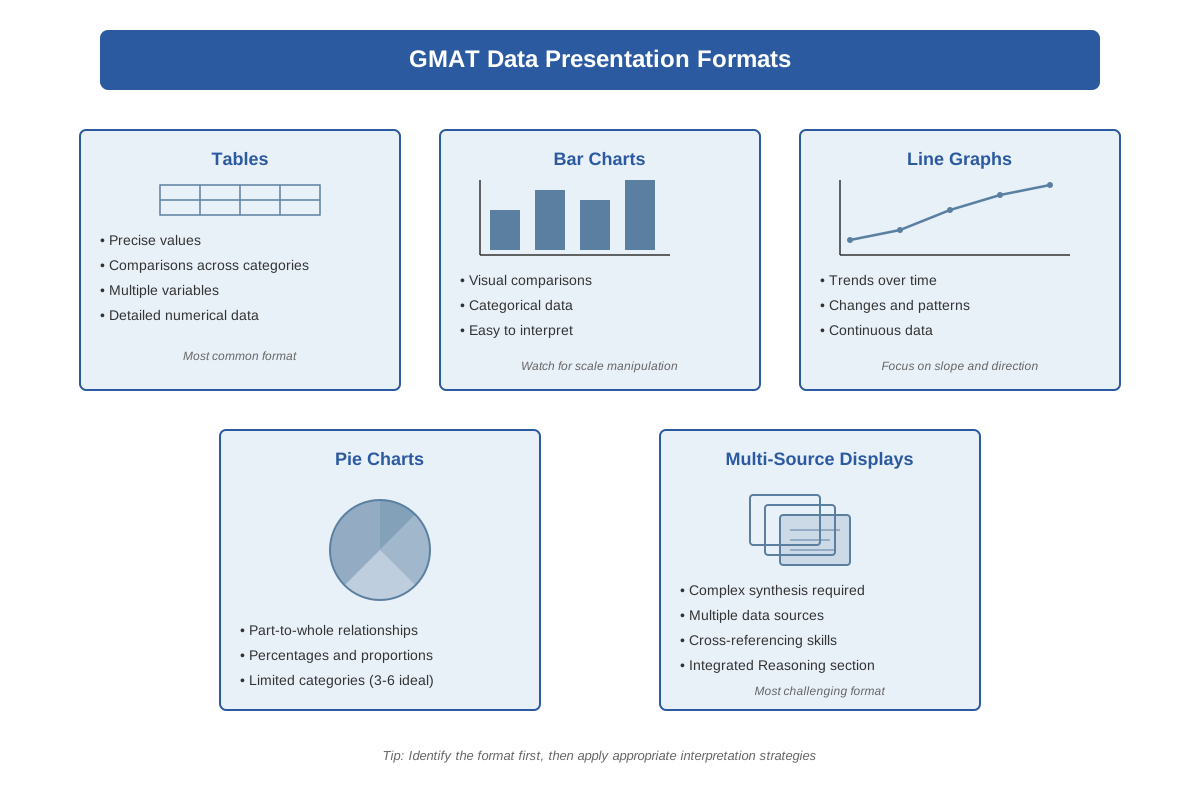
Common GMAT data interpretation formats include: bar charts (comparing categories across one or more variables), line graphs (showing trends over time), pie charts (displaying proportional relationships), two-way tables (cross-tabulating two categorical variables), scatter plots (illustrating correlations between continuous variables), and complex multi-panel displays combining several data representations. Questions may ask for direct data extraction, calculation of derived values (percentages, ratios, averages), comparison of multiple data points, identification of maximum or minimum values, or projection of trends. The GMAT deliberately designs these questions to test both computational accuracy and strategic data navigation, rewarding candidates who can quickly identify the most efficient solution path.
Core Concepts
Types of Data Representations
The GMAT presents data through several standard formats, each with characteristic features and common question patterns. Tables organize data in rows and columns, allowing for precise value lookup and cross-referencing of multiple variables. Two-way tables (also called contingency tables or cross-tabulations) display relationships between two categorical variables, with row and column totals often providing crucial information for calculations. When approaching tables, identify the row and column headers first, note any totals or subtotals, and check units of measurement.
Bar charts use rectangular bars to compare quantities across categories, with bar height or length representing the measured value. Vertical bar charts typically show categories on the x-axis and values on the y-axis, while horizontal bar charts reverse this orientation. Grouped bar charts display multiple data series side-by-side for each category, enabling direct comparison. Stacked bar charts show component parts that sum to a total, useful for analyzing both individual components and aggregate values. When reading bar charts, always check the scale on the value axis—GMAT questions frequently use non-zero baselines or irregular intervals to test careful reading.
Line graphs connect data points with lines to show trends over time or across a continuous variable. Multiple lines on the same graph enable comparison of different data series. The slope of line segments indicates the rate of change between points—steeper slopes represent faster change. GMAT questions often ask about periods of increase or decrease, maximum or minimum values, or the magnitude of change between specific points. Pay attention to whether the y-axis starts at zero, as this affects visual perception of relative differences.
Pie charts divide a circle into sectors representing proportional parts of a whole, with each sector's angle proportional to its percentage of the total. The entire circle always represents 100% of the measured quantity. GMAT pie chart questions frequently require calculating actual values from percentages (or vice versa), comparing sector sizes, or combining information from multiple pie charts. Remember that sector angles are proportional to percentages: a 90-degree sector represents 25% (90/360), a 180-degree sector represents 50%, etc.
Data Extraction Strategies
Efficient data interpretation begins with strategic reading of the data presentation before examining the question. Invest 10-15 seconds scanning the title, axis labels, legend, units of measurement, and overall structure. This orientation prevents misreading and helps identify where specific information is located. Note any footnotes or clarifying text, as these often contain crucial information about data definitions or calculation methods.
When extracting specific values, use a systematic approach: locate the relevant category or time period, trace to the appropriate data series if multiple are present, and read the value carefully from the scale. For bar charts and line graphs, if a data point falls between gridlines, estimate the value proportionally. GMAT questions are designed so that reasonable estimation yields sufficient precision for answer choice discrimination.
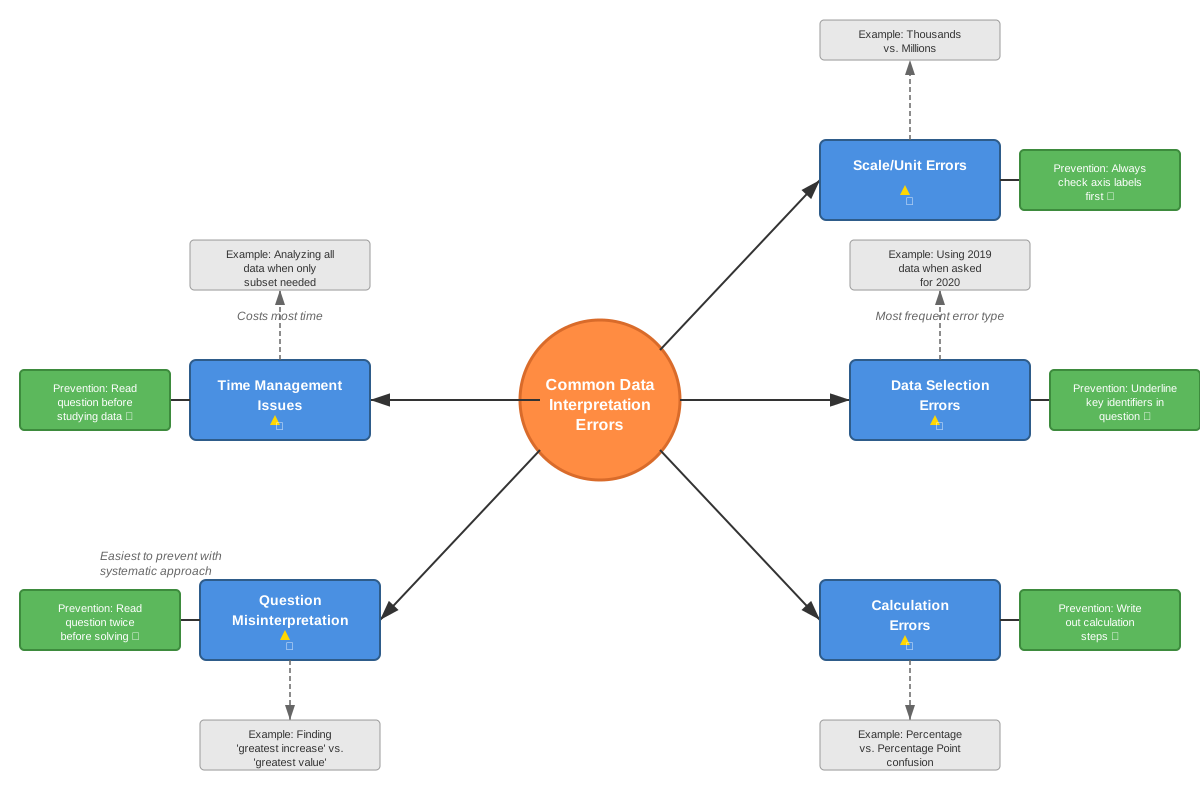
For questions requiring calculations with multiple data points, extract and write down all necessary values before beginning computations. This reduces errors from misreading and allows verification if time permits. When dealing with percentages, always identify the base (the "whole" that represents 100%) before calculating. A common GMAT trap involves shifting bases—for example, calculating a percentage increase based on the wrong reference year.
Calculation Techniques
Many GMAT data interpretation questions require performing calculations with extracted data. Percentage calculations appear most frequently, including finding percentages of totals, calculating percentage change, and working with percentage points (the arithmetic difference between two percentages). The percentage change formula is:
Percentage Change = [(New Value - Old Value) / Old Value] × 100%Note that percentage change is always calculated relative to the original (old) value. A common error is using the new value as the denominator.
Ratio and proportion problems require setting up equivalent fractions or using the relationship that if two quantities are in ratio a:b, they can be expressed as ax and bx for some multiplier x. When data is presented in ratios, use the total to find the multiplier. For example, if quantities are in ratio 3:5 and the total is 240, then 3x + 5x = 240, so x = 30, giving actual values of 90 and 150.
Average (arithmetic mean) calculations frequently appear in data interpretation contexts. Remember that:
Average = Sum of Values / Number of ValuesConversely, if you know the average and number of values, you can find the sum: Sum = Average × Number of Values. This reverse calculation is particularly useful when combining information from multiple data sources.
Multi-Step Problem Solving
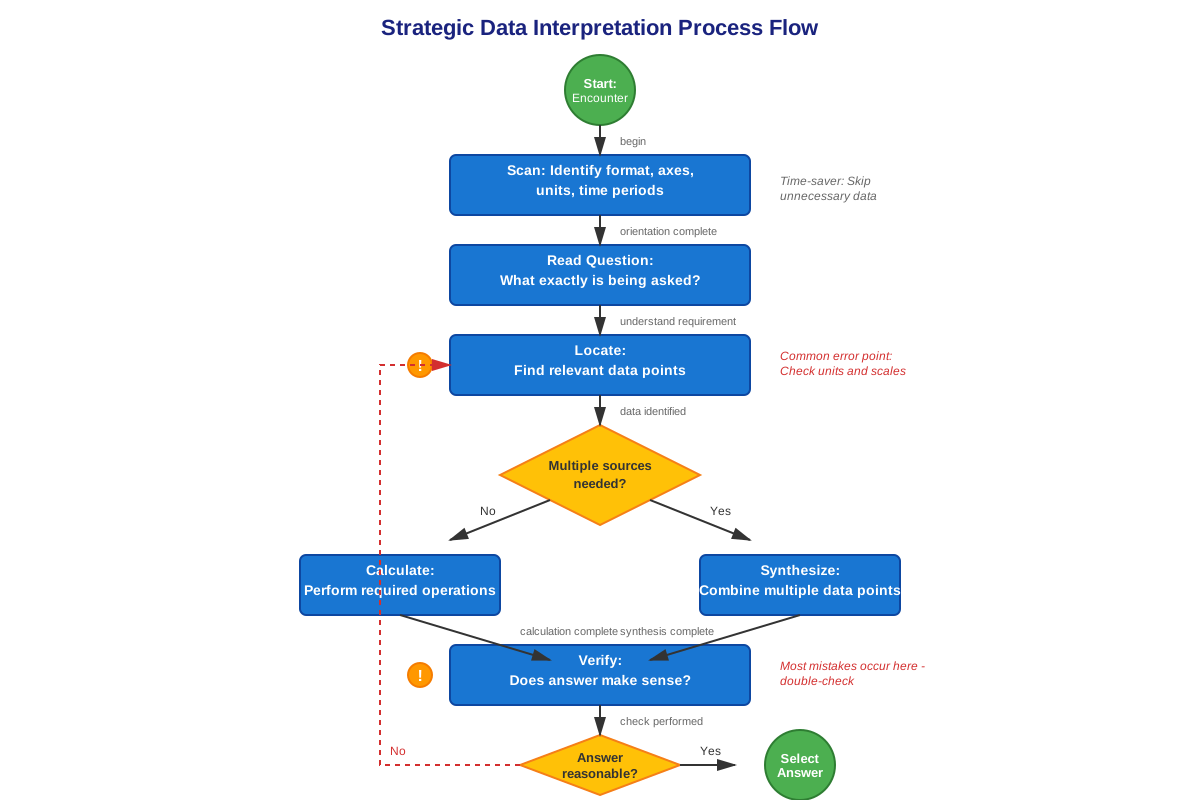
Complex GMAT data interpretation questions require multiple steps, often combining data extraction with sequential calculations. Approach these systematically: (1) identify exactly what the question asks for, (2) determine what intermediate values you need to calculate, (3) extract the necessary raw data, (4) perform calculations in logical sequence, and (5) verify that your final answer addresses the original question.
For questions asking about relationships between variables, look for patterns such as direct proportionality (as one increases, the other increases proportionally), inverse relationships (as one increases, the other decreases), or threshold effects (relationships that change at certain values). The GMAT often tests whether you can identify which variables are related and the nature of that relationship.
When questions involve comparing multiple data points, consider using benchmark values or reference points to simplify comparisons. For example, when comparing percentages across categories, identify the largest and smallest first to establish bounds, then evaluate intermediate values as needed. This strategy often allows elimination of incorrect answer choices without calculating exact values for every option.
Common Data Interpretation Scenarios
Growth and decline analysis questions ask about changes over time, often requiring calculation of absolute change (new value minus old value) or relative change (percentage change). Be alert to questions asking about the "greatest increase" or "fastest growth rate"—these may require different calculations. The greatest absolute increase might occur in a different period than the greatest percentage increase.
Comparison questions require evaluating relationships between different categories, time periods, or data series. These often involve ratio calculations or percentage comparisons. When comparing percentages from different bases, remember that a larger percentage of a smaller base might represent a smaller absolute quantity than a smaller percentage of a larger base.
Projection and estimation questions ask you to extend trends or estimate values not explicitly shown. Use proportional reasoning and linear interpolation for values between shown data points. For projections beyond the data range, the GMAT typically expects simple linear extrapolation unless the question specifies a different relationship.
Concept Relationships
Data interpretation serves as an integrative skill that draws upon and connects multiple foundational quantitative concepts. At the most basic level, arithmetic operations provide the computational foundation for all data interpretation work—extracting values from charts and performing calculations requires fluency with addition, subtraction, multiplication, and division across different number types.
Percentage concepts connect directly to data interpretation through the frequent need to calculate proportional relationships, growth rates, and comparative metrics. Nearly every pie chart question and many bar chart comparisons require percentage calculations. This connection flows bidirectionally: strong percentage skills enhance data interpretation performance, while practicing data interpretation problems reinforces percentage calculation fluency.
The relationship map for data interpretation concepts follows this progression:
Data Recognition → Strategic Reading → Value Extraction → Calculation → Interpretation → Answer Selection
Within this framework, Data Recognition involves identifying the type of data presentation (table, bar chart, line graph, pie chart) and understanding its structural elements. This leads to Strategic Reading, where you orient yourself to titles, labels, scales, and units before examining specific values. Value Extraction requires locating and accurately reading specific data points needed for the question. Calculation applies arithmetic, algebraic, or statistical operations to extracted values. Interpretation involves understanding what calculated results mean in context and how they address the question. Finally, Answer Selection requires matching your interpretation to the provided choices, often involving estimation or elimination strategies.
Data interpretation also connects forward to more advanced GMAT topics. Strong data interpretation skills directly support success with Integrated Reasoning questions, particularly Graphics Interpretation and Multi-Source Reasoning problems. The analytical thinking developed through data interpretation practice enhances performance on complex word problems that embed data within narrative contexts. Additionally, the pattern recognition and relationship identification skills honed through data interpretation work support logical reasoning and critical thinking across all GMAT sections.
Quick check — test yourself on Data interpretation so far.
Try Flashcards →High-Yield Facts
⭐ Bar chart scales frequently do not start at zero—always check the y-axis minimum value before comparing bar heights visually, as non-zero baselines exaggerate apparent differences.
⭐ Percentage change and percentage point change are different—if a value increases from 20% to 30%, that's a 10 percentage point increase but a 50% relative increase (10/20 × 100%).
⭐ In pie charts, sector angles are proportional to percentages—a 90-degree sector represents exactly 25% of the total (90/360 = 0.25).
⭐ When comparing percentages from different bases, the larger percentage does not necessarily represent the larger absolute quantity—always consider the base values when making comparisons.
⭐ Tables with row and column totals enable checking calculations—if you calculate a subtotal, verify it against provided totals to catch arithmetic errors.
- Line graph slopes indicate rates of change—steeper slopes (positive or negative) represent faster change, while horizontal segments indicate no change.
- Stacked bar charts show both component values and totals—the top of the highest segment represents the sum of all components.
- When multiple data series appear on one graph, the legend identifies which line or bar represents which series—always reference the legend before extracting values.
- Percentage calculations require identifying the correct base—"what percent of X is Y" means Y/X × 100%, where X is the base.
- Estimation is often sufficient for answer choice discrimination—GMAT answer choices are typically spaced far enough apart that precise calculation is unnecessary.
- Questions asking for "approximately" or "closest to" explicitly permit estimation—use rounding and benchmark values to simplify calculations.
- Multi-part data displays may require synthesizing information from multiple sources—read all provided data before attempting to answer questions.
- Units of measurement matter—mixing thousands with millions or confusing percentages with absolute values leads to order-of-magnitude errors.
Common Misconceptions
Misconception: Visual comparison of bar heights or line positions provides sufficient accuracy for answering questions.
Correction: While visual comparison helps with quick estimation, GMAT questions often require reading exact values from scales. Non-zero baselines, compressed scales, and closely-spaced answer choices mean that visual approximation alone frequently leads to errors. Always reference the numerical scale when extracting values.
Misconception: The largest sector in a pie chart always represents the largest absolute quantity across different pie charts.
Correction: Pie charts show proportions, not absolute quantities. A 40% sector from a total of 1,000 (representing 400 units) is smaller than a 30% sector from a total of 2,000 (representing 600 units). Always calculate absolute values when comparing across different pie charts with different totals.
Misconception: Percentage increase and percentage decrease are symmetric operations.
Correction: A 50% increase followed by a 50% decrease does not return to the original value. If a quantity increases from 100 to 150 (50% increase), then decreases by 50%, it falls to 75 (50% of 150 is 75), not back to 100. Percentage changes compound based on the current value, not the original value.
Misconception: When a line graph shows two lines crossing, the values are equal at the intersection point.
Correction: While this is often true, it's only accurate if both lines use the same scale. Some GMAT graphs use dual y-axes with different scales for different data series. Always check whether multiple data series share a scale or have separate scales before concluding that intersection points represent equal values.
Misconception: Data interpretation questions always require using all provided data.
Correction: GMAT data displays often include more information than necessary to answer specific questions. Part of the skill being tested is identifying which data is relevant to the question at hand and efficiently ignoring extraneous information. Reading the question carefully before extracting data prevents wasted time and reduces calculation errors.
Misconception: Averages can be averaged to find overall averages.
Correction: You cannot simply average two averages to find the combined average unless the groups have equal size. If Group A (10 people) has an average of 80 and Group B (20 people) has an average of 70, the combined average is not 75. Instead, calculate: (10×80 + 20×70)/(10+20) = 2200/30 ≈ 73.3. Always use weighted averages when combining groups of different sizes.
Worked Examples
Example 1: Multi-Step Bar Chart Analysis
Question: The bar chart below shows quarterly revenue (in millions of dollars) for Company X across four quarters. Q1: $2.4M, Q2: $3.0M, Q3: $2.7M, Q4: $3.6M. What was the percentage increase in revenue from Q1 to Q4?
Solution:
Step 1: Identify what the question asks for—percentage increase from Q1 to Q4.
Step 2: Extract the relevant values:
- Q1 revenue: $2.4M (starting value)
- Q4 revenue: $3.6M (ending value)
Step 3: Apply the percentage change formula:
Percentage Change = [(New Value - Old Value) / Old Value] × 100%
Percentage Change = [(3.6 - 2.4) / 2.4] × 100%
Percentage Change = [1.2 / 2.4] × 100%
Percentage Change = 0.5 × 100% = 50%
Step 4: Verify the calculation makes sense—the revenue increased by $1.2M from a base of $2.4M, which is exactly half the original value, confirming a 50% increase.
Answer: The revenue increased by 50% from Q1 to Q4.
Connection to Learning Objectives: This example demonstrates applying data interpretation to extract values from a bar chart and performing percentage change calculations, directly addressing the "Apply data interpretation to GMAT questions" objective.
Example 2: Complex Table with Multiple Variables
Question: The table below shows the number of employees in three departments (Sales, Marketing, Operations) across two years. In 2022: Sales had 45 employees, Marketing had 30, Operations had 75. In 2023: Sales had 54 employees, Marketing had 27, Operations had 84. Which department experienced the greatest percentage increase in employees from 2022 to 2023?
Solution:
Step 1: Recognize that this requires calculating percentage change for each department and comparing results.
Step 2: Calculate percentage change for Sales:
Sales % Change = [(54 - 45) / 45] × 100% = [9 / 45] × 100% = 0.20 × 100% = 20%Step 3: Calculate percentage change for Marketing:
Marketing % Change = [(27 - 30) / 30] × 100% = [-3 / 30] × 100% = -0.10 × 100% = -10%Marketing actually decreased, so it cannot have the greatest increase.
Step 4: Calculate percentage change for Operations:
Operations % Change = [(84 - 75) / 75] × 100% = [9 / 75] × 100% = 0.12 × 100% = 12%Step 5: Compare the positive percentage changes:
- Sales: 20%
- Operations: 12%
Answer: Sales experienced the greatest percentage increase at 20%.
Connection to Learning Objectives: This example demonstrates analyzing complex data sets with multiple variables, evaluating relationships between data points, and synthesizing information to answer comparison questions—addressing multiple learning objectives simultaneously.
Exam Strategy
When approaching GMAT data interpretation questions, begin by reading the question stem before examining the data display in detail. This "question-first" approach focuses your attention on relevant information and prevents wasting time analyzing data you won't need. Identify exactly what the question asks for—a specific value, a comparison, a percentage, a trend—and note any keywords that indicate the required operation.
Trigger words and phrases signal specific approaches:
- "Approximately" or "closest to" → estimation is acceptable and often faster than exact calculation
- "Greatest increase" → compare absolute changes (new minus old)
- "Fastest growth" or "highest growth rate" → compare percentage changes
- "What percent of X is Y" → calculate (Y/X) × 100%
- "X is what percent greater than Y" → calculate [(X-Y)/Y] × 100%
- "How many times greater" → calculate X/Y (a ratio, not a percentage)
For process-of-elimination strategies, use estimation to quickly eliminate unreasonable answer choices before performing exact calculations. If a question asks for a percentage and you can quickly determine the answer must be between 20% and 30%, eliminate choices outside this range immediately. When answer choices are widely spaced (e.g., 15%, 25%, 35%, 45%), rough estimation often suffices to identify the correct answer without precise calculation.
Time allocation for data interpretation questions should follow this pattern: spend 10-15 seconds orienting to the data display, 15-20 seconds reading and analyzing the question, 30-45 seconds extracting data and calculating, and 10-15 seconds verifying your answer matches what the question asked. If a question requires more than 90 seconds, consider whether you're overcomplicating the approach—GMAT data interpretation questions are designed to be solvable within 2 minutes when using efficient strategies.
For multi-part data displays (common in Integrated Reasoning), read all questions associated with the display before beginning calculations. Sometimes information needed for one question is calculated as an intermediate step for another question, allowing you to work more efficiently. Additionally, if one question asks for a total that appears in the data, you can use that total to verify calculations for other questions.
When checking your work, verify that your answer is reasonable in magnitude and makes sense in context. If a question asks about company revenue in millions and your calculation yields 0.003, you've likely made a unit conversion error. If a percentage change calculation yields 500% when the data shows modest growth, recheck your formula—you may have inverted the fraction.
Memory Techniques
SCALE mnemonic for approaching any data interpretation question:
- Scan the data display (titles, labels, units, structure)
- Clarify what the question asks
- Access relevant data points
- Logically calculate required values
- Evaluate answer reasonableness
"PINT" for percentage calculations:
- Part divided by
- Is (equals)
- Number (the base/whole)
- Times 100%
This reminds you that "Part/Whole × 100% = Percentage"
Visualization strategy for percentage change: Picture a number line with the old value on the left and new value on the right. The distance between them (new minus old) is the change. The question is: "What fraction of the old value is this change?" This visual reinforces that the old value is always the denominator in percentage change calculations.
"BARS" for bar chart analysis:
- Baseline (check if y-axis starts at zero)
- Axis labels (identify what each axis represents)
- Range (note minimum and maximum values)
- Scale (check intervals and units)
Acronym "PIE" for pie chart essentials:
- Proportions (sectors represent parts of whole)
- Identify the total (what does 100% represent?)
- Each sector angle = percentage × 3.6° (since 360° = 100%)
Summary
Data interpretation is a high-yield GMAT skill that integrates arithmetic, algebraic, and analytical reasoning to extract meaningful insights from visual and tabular data presentations. Success requires systematic approaches to reading charts, tables, and graphs; accurate extraction of relevant values; efficient calculation techniques; and strategic time management. The GMAT tests data interpretation through various formats including bar charts, line graphs, pie charts, tables, and complex multi-source displays, with questions ranging from straightforward value extraction to multi-step problems requiring synthesis of information from multiple sources. Mastery demands understanding the structural elements of each data format, recognizing common question patterns, applying appropriate calculation methods (particularly percentage change, ratios, and averages), and avoiding common pitfalls such as confusing percentage change with percentage point change or comparing percentages without considering their bases. Efficient test-takers read questions before analyzing data displays, use estimation to eliminate answer choices quickly, and verify that calculated answers are reasonable in magnitude and context. The skills developed through data interpretation practice directly support success across multiple GMAT sections and provide practical analytical capabilities essential for business school and professional contexts.
Key Takeaways
- Always check axis scales, units, and baselines before extracting values from charts—non-zero baselines and irregular scales are common GMAT traps
- Read the question before deeply analyzing the data display to focus on relevant information and avoid wasting time
- Percentage change always uses the original (old) value as the denominator: [(New - Old) / Old] × 100%
- When comparing percentages from different bases, calculate absolute values before drawing conclusions about relative magnitudes
- Estimation is often sufficient for answer choice discrimination—use rounding and benchmark values to work efficiently
- Pie chart sectors represent proportions of a whole; always identify what the total represents before calculating absolute values
- Multi-step problems require systematic approaches: identify the final goal, determine intermediate calculations needed, extract data, calculate sequentially, and verify the answer addresses the original question
Related Topics
Integrated Reasoning - Graphics Interpretation: Builds directly on data interpretation skills by presenting interactive graphs and requiring selection of correct statements from dropdown menus. Mastering basic data interpretation is essential preparation for this question type.
Integrated Reasoning - Multi-Source Reasoning: Combines data interpretation with information synthesis from multiple tabs or sources, including text, tables, and charts. Strong data interpretation skills enable efficient navigation of these complex question sets.
Ratio and Proportion: Provides the mathematical foundation for many data interpretation calculations, particularly when working with scaled data or comparing relative quantities across categories.
Percentage Applications: Extends basic percentage calculations to real-world contexts frequently encountered in data interpretation questions, including growth rates, market share analysis, and financial metrics.
Statistics and Data Analysis: Deepens understanding of measures of central tendency (mean, median, mode) and dispersion (range, standard deviation) that often appear in data interpretation contexts, particularly in Integrated Reasoning questions.
Practice CTA
Now that you've mastered the core concepts of data interpretation, it's time to reinforce your learning through active practice. Attempt the practice questions associated with this topic to apply these strategies to realistic GMAT problems. Focus on implementing the systematic approaches outlined in this guide—read questions first, extract data strategically, estimate when appropriate, and verify your answers. Use the flashcards to drill high-yield facts and formulas until they become automatic. Remember that data interpretation skills improve significantly with deliberate practice, and each question you work through builds pattern recognition that accelerates your performance on test day. Your investment in mastering this high-frequency topic will pay dividends across multiple GMAT sections!
Sign up free to keep reading
Create a free AnvayaPrep account to finish this GMAT guide on Data interpretation — plus flashcards and practice questions.