Overview
Business passages represent one of the most frequently tested passage types in the GMAT Reading Comprehension section. These passages explore topics such as corporate strategy, management practices, economic theory, marketing approaches, organizational behavior, and industry analysis. Unlike passages that require specialized scientific or technical knowledge, GMAT business passages draw from the world of commerce, finance, and organizational dynamics—domains that MBA candidates will encounter throughout their graduate studies and professional careers.
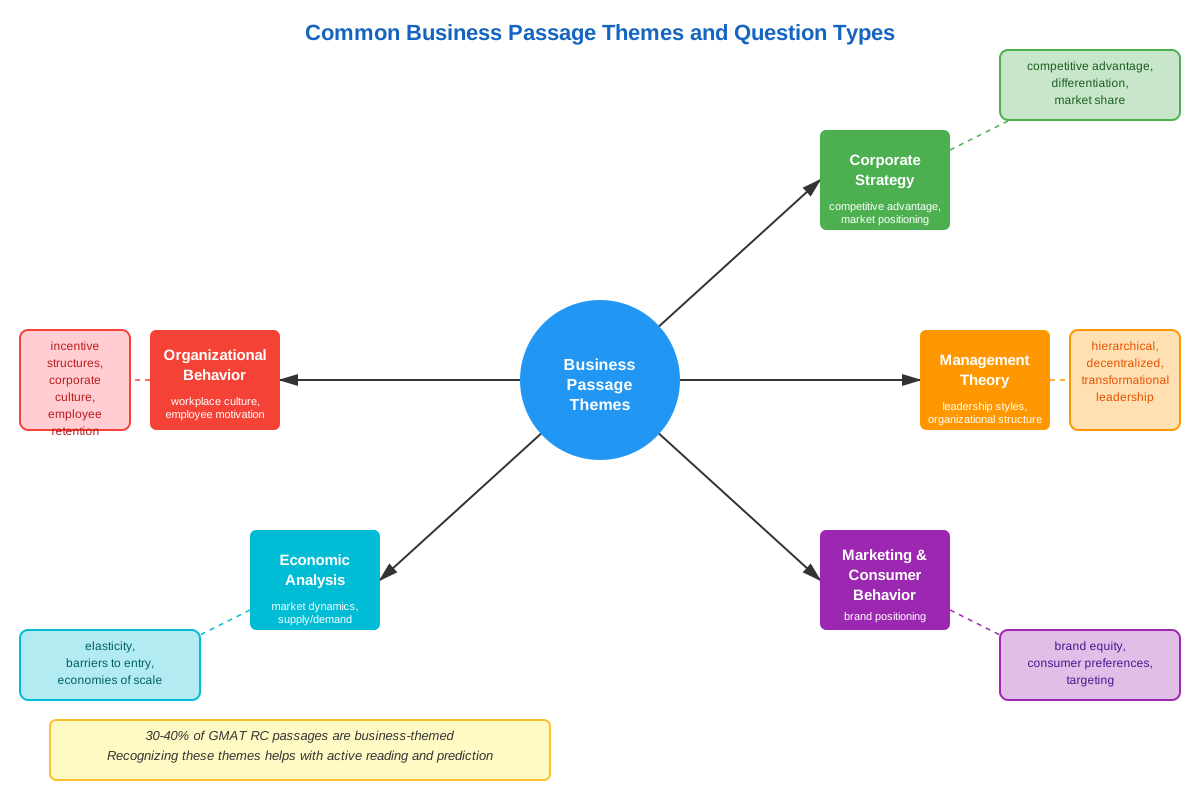
Understanding how to efficiently navigate business passages is essential for GMAT success because they typically appear in 30-40% of Reading Comprehension questions on the exam. These passages test not only reading comprehension skills but also the ability to analyze arguments, evaluate evidence, understand cause-and-effect relationships in business contexts, and synthesize information about market dynamics, competitive advantages, and organizational challenges. Business passages often present multiple perspectives on a business problem, describe the evolution of management theories, or analyze the factors contributing to corporate success or failure.
Within the broader Verbal Reasoning framework, business passages serve as a bridge between pure analytical reasoning and real-world application. They require students to employ critical reading skills—identifying main ideas, understanding passage structure, recognizing author's tone and purpose—while simultaneously engaging with content that demands business acumen and logical thinking. Mastering business passages strengthens overall Reading Comprehension performance and provides valuable preparation for the types of case studies and business analyses that form the core of MBA coursework.
Learning Objectives
- [ ] Identify business passages by recognizing characteristic topics, vocabulary, and structural patterns
- [ ] Explain the common themes, organizational structures, and argumentative approaches found in business passages
- [ ] Apply business passage comprehension strategies to GMAT questions, including specific question types
- [ ] Analyze the relationship between business concepts presented in passages and the questions that test them
- [ ] Evaluate competing business theories or strategies presented within a single passage
- [ ] Synthesize information from multiple paragraphs to answer inference and application questions
- [ ] Distinguish between factual statements and opinions or recommendations in business contexts
Prerequisites
- Basic reading comprehension skills: The ability to identify main ideas, supporting details, and passage structure forms the foundation for tackling any GMAT Reading Comprehension passage.
- Familiarity with GMAT question types: Understanding the difference between specific detail questions, inference questions, main idea questions, and application questions enables strategic reading.
- General vocabulary proficiency: Business passages use sophisticated vocabulary, and students should have strong general vocabulary skills to minimize comprehension barriers.
- Logical reasoning fundamentals: The ability to identify assumptions, evaluate evidence, and recognize logical relationships supports deeper passage analysis.
Why This Topic Matters
Business passages hold particular significance for GMAT test-takers because they directly align with the skills and knowledge domains relevant to graduate business education. The GMAT is designed to predict success in MBA programs, and business passages assess whether candidates can quickly comprehend, analyze, and apply business concepts—exactly what they'll do in case discussions, strategy courses, and organizational behavior seminars.
From an exam statistics perspective, business passages appear with high frequency on the GMAT. Approximately 30-40% of Reading Comprehension passages fall into the business category, making them the most common or second-most common passage type alongside social science passages. Each passage typically generates 3-4 questions, meaning that mastering business passages can directly impact 9-12 questions on the Verbal section—a substantial portion of the overall score.
Business passages commonly appear in several recognizable forms: analyses of corporate strategy and competitive advantage, discussions of management theories and organizational structures, examinations of marketing approaches and consumer behavior, explorations of economic principles as they apply to business decisions, investigations of industry trends and market dynamics, and evaluations of business ethics and corporate social responsibility. The passages may present a single perspective with supporting evidence, contrast two competing theories or approaches, trace the historical evolution of a business concept, or analyze the causes and effects of a particular business phenomenon. Understanding these common patterns enables more efficient reading and more accurate prediction of question types.
Core Concepts
Characteristics of Business Passages
Business passages on the GMAT share several distinguishing features that help test-takers quickly identify them. The subject matter centers on commercial, organizational, or economic topics rather than scientific, historical, or purely social phenomena. Common topics include corporate strategy, competitive dynamics, organizational behavior, management theory, marketing and consumer behavior, economic principles applied to business contexts, industry analysis, and business innovation.
The vocabulary in business passages includes terms like "market share," "competitive advantage," "organizational structure," "economies of scale," "differentiation strategy," "stakeholders," "profit margins," "market segmentation," "supply chain," and "corporate culture." While GMAT business passages don't require specialized business knowledge to answer questions correctly, familiarity with common business terminology improves reading efficiency and comprehension speed.
The tone of business passages tends to be analytical and objective, though some passages present arguments advocating for particular management approaches or business strategies. Authors may describe research findings, compare competing theories, analyze case studies, or evaluate the effectiveness of business practices. Unlike some scientific passages that focus purely on mechanisms and processes, business passages often incorporate human decision-making, organizational dynamics, and strategic choices.
Common Structural Patterns
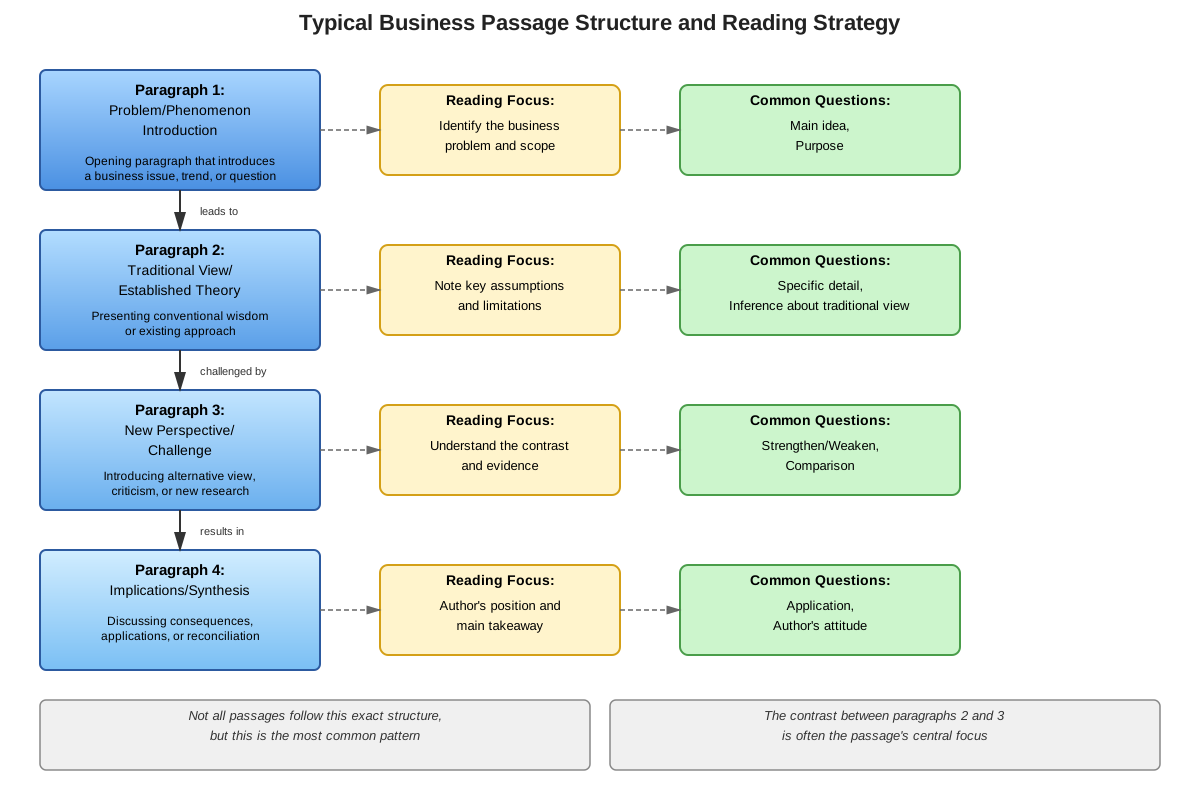
Business passages typically follow predictable organizational structures that, once recognized, facilitate faster comprehension and more accurate question answering.
Problem-Solution Structure: The passage introduces a business challenge or problem (declining market share, organizational inefficiency, competitive threat) and then describes one or more solutions, strategies, or responses. Questions often test understanding of the problem's causes, the proposed solutions' mechanisms, or the potential effectiveness of different approaches.
Theory-Application Structure: The passage presents a management theory, economic principle, or business framework in the first paragraph(s), then illustrates how it applies to specific companies, industries, or situations. Questions frequently ask about the theory's implications, its limitations, or how it would apply to new scenarios.
Comparison-Contrast Structure: The passage examines two or more competing business strategies, management approaches, or theoretical perspectives. The author may remain neutral, presenting both sides objectively, or may favor one approach over another. Questions test the ability to distinguish between the approaches and understand their respective advantages and disadvantages.
Chronological-Evolution Structure: The passage traces how a business concept, management practice, or industry has changed over time. This structure often appears in passages about the evolution of management theory or the transformation of industries due to technological or market changes.
Key Business Concepts Tested
While the GMAT doesn't require prior business knowledge, certain business concepts appear frequently enough that understanding them enhances comprehension efficiency:
| Business Concept | Definition | Common Question Focus |
|---|---|---|
| Competitive Advantage | Factors that allow a company to produce goods or services better or more cheaply than rivals | What creates or sustains advantage; why advantages erode |
| Economies of Scale | Cost advantages from increased production volume | When they apply; their limitations; relationship to market structure |
| Market Segmentation | Dividing markets into distinct customer groups | How companies use it; its effectiveness; potential drawbacks |
| Organizational Structure | How a company arranges authority, communication, and workflow | Impact on efficiency, innovation, or employee behavior |
| Differentiation vs. Cost Leadership | Two primary competitive strategies: offering unique value vs. lowest cost | When each is appropriate; risks of each approach |
| Stakeholder Theory | Businesses should consider all affected parties, not just shareholders | Contrasts with shareholder primacy; implementation challenges |
Question Types and Business Passages
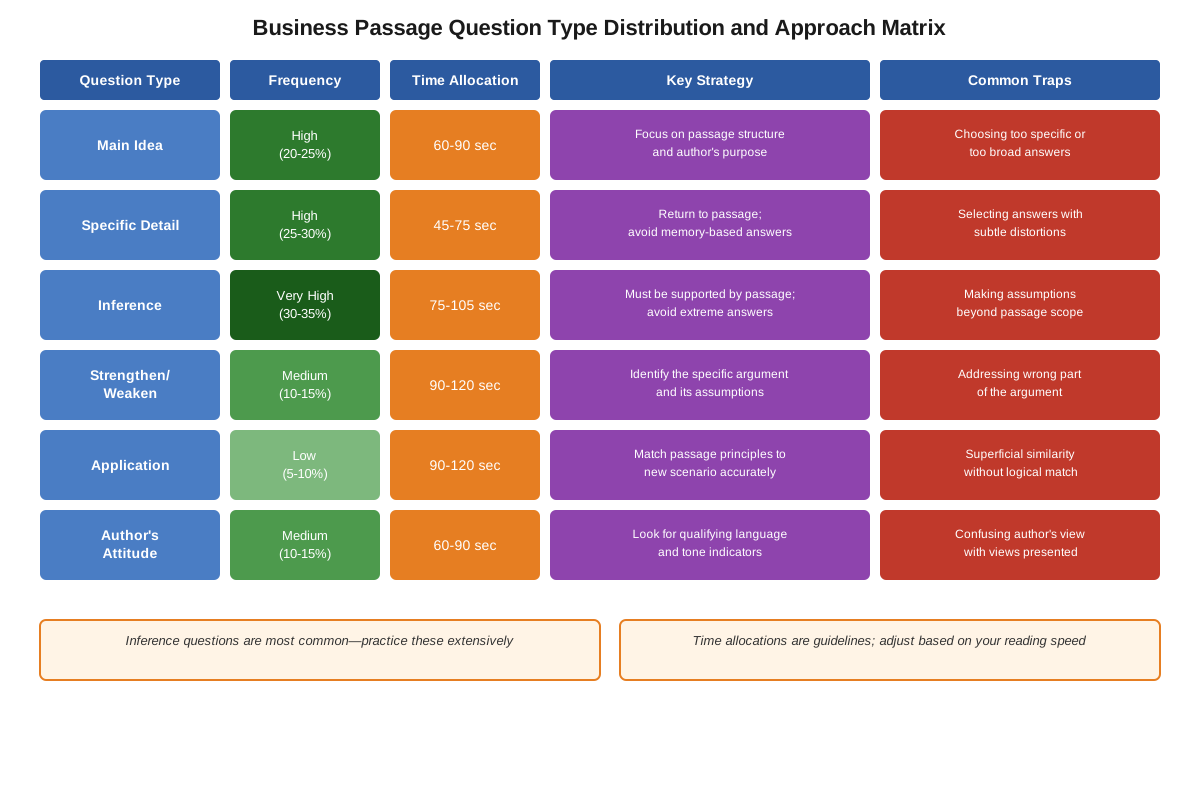
Business passages generate all standard GMAT Reading Comprehension question types, but certain types appear with particular frequency:
Inference Questions ask what can be logically concluded from the passage without being explicitly stated. In business passages, these often involve inferring the likely outcomes of business strategies, the reasons behind management decisions, or the implications of market trends.
Application Questions present new scenarios and ask how concepts from the passage would apply. For example, a passage about differentiation strategy might be followed by a question asking which new company would most benefit from this approach.
Strengthen/Weaken Questions ask which additional information would support or undermine an argument or claim in the passage. Business passages frequently include claims about strategy effectiveness or causal relationships that these questions test.
Purpose Questions ask why the author included specific information or what role a paragraph plays in the overall passage. Understanding business passage structure helps predict these answers.
Reading Strategy for Business Passages
Effective business passage reading involves a strategic approach that balances speed with comprehension:
- Identify the passage type in the first 2-3 sentences by recognizing business vocabulary and subject matter
- Map the structure by noting whether the passage follows problem-solution, comparison-contrast, theory-application, or chronological patterns
- Identify the main idea of each paragraph, focusing on the author's primary point rather than every supporting detail
- Note contrasts and transitions using words like "however," "although," "in contrast," "traditionally," and "recently" that signal important shifts
- Recognize the author's attitude toward different theories, strategies, or approaches presented
- Mark key terms and concepts mentally or with light notation to facilitate quick reference when answering questions
Concept Relationships
The concepts within business passages interconnect in systematic ways. Passage identification (recognizing business topics and vocabulary) → enables → structural recognition (identifying whether the passage follows problem-solution, comparison-contrast, or other patterns) → which facilitates → strategic reading (knowing where to focus attention and what information to retain) → leading to → efficient question answering (quickly locating relevant information and making accurate inferences).
Business passages also connect to broader Reading Comprehension skills. The general reading strategies learned for all passage types (identifying main ideas, understanding structure, recognizing tone) → apply specifically to → business passage navigation → while → business-specific knowledge (understanding common business concepts and terminology) → enhances → reading efficiency and comprehension depth.
Within the Verbal Reasoning section, business passages relate to Critical Reasoning questions, as both test the ability to analyze arguments, evaluate evidence, and understand cause-and-effect relationships. The analytical skills developed through business passage practice—distinguishing between facts and opinions, identifying assumptions, evaluating the strength of evidence—transfer directly to Critical Reasoning performance.
High-Yield Facts
⭐ Business passages appear in approximately 30-40% of GMAT Reading Comprehension questions, making them the most or second-most common passage type.
⭐ Common business passage topics include corporate strategy, management theory, organizational behavior, marketing, and industry analysis.
⭐ Business passages typically follow predictable structures: problem-solution, theory-application, comparison-contrast, or chronological-evolution.
⭐ The GMAT never requires specialized business knowledge to answer questions correctly; all necessary information appears in the passage.
⭐ Inference and application questions appear with particularly high frequency in business passages.
- Business passages often present multiple perspectives on a business problem or contrast competing theories.
- The author's tone in business passages ranges from neutral/descriptive to analytical/evaluative, but rarely becomes strongly opinionated.
- Key transition words like "however," "although," "traditionally," and "recently" signal important contrasts or shifts in business passages.
- Questions about business passages frequently test understanding of cause-and-effect relationships between business decisions and outcomes.
- Business vocabulary (market share, competitive advantage, economies of scale, differentiation) appears consistently but doesn't require prior knowledge to understand from context.
Quick check — test yourself on Business passages so far.
Try Flashcards →Common Misconceptions
Misconception: Business passages require prior knowledge of business concepts or MBA-level understanding. → Correction: The GMAT is designed to be fair to test-takers from all backgrounds. Every business passage contains all the information needed to answer its questions correctly. While business familiarity may speed up reading, it's never necessary for accuracy.
Misconception: Business passages are easier than science passages because the topics are more familiar. → Correction: Business passages can be equally complex, featuring sophisticated arguments, multiple perspectives, and subtle distinctions between similar concepts. The familiarity of business topics can actually create overconfidence, leading test-takers to rely on outside knowledge rather than the passage text.
Misconception: The author always supports the business strategies or theories described in the passage. → Correction: Authors may present theories or strategies neutrally, describe them critically, or contrast multiple approaches without endorsing any. Identifying the author's actual attitude requires careful attention to qualifying language and tone.
Misconception: Detailed examples and case studies in business passages are the most important content. → Correction: Examples illustrate broader principles, but questions more frequently test understanding of the main concepts, theories, or arguments. Spending excessive time on example details at the expense of grasping the main idea reduces efficiency.
Misconception: Business passage questions can be answered using general business knowledge or common sense. → Correction: GMAT questions are carefully crafted to require specific reference to passage content. Answer choices that seem reasonable based on general knowledge but aren't supported by the passage are incorrect. Always ground answers in textual evidence.
Worked Examples
Example 1: Theory-Application Business Passage
Passage Excerpt:
"The resource-based view of competitive advantage holds that firms achieve superior performance by developing valuable, rare, inimitable, and non-substitutable resources. Unlike the traditional industry-structure approach, which emphasizes external market positioning, the resource-based view focuses on internal capabilities as the primary source of competitive advantage. Companies like Apple have demonstrated this principle by cultivating design expertise and brand loyalty that competitors find difficult to replicate, even when operating in the same industry with access to similar technologies and suppliers."
Question: The passage suggests that the resource-based view differs from the industry-structure approach primarily in its:
A) Assessment of whether competitive advantage can be sustained over time
B) Focus on internal capabilities rather than market positioning
C) Evaluation of the role of technology in creating competitive advantage
D) Analysis of how companies in the same industry can achieve different outcomes
E) Emphasis on the importance of rare and valuable resources
Worked Solution:
Step 1: Identify the question type. This is a specific detail question asking about the primary difference between two approaches.
Step 2: Locate the relevant information. The second sentence explicitly states: "Unlike the traditional industry-structure approach, which emphasizes external market positioning, the resource-based view focuses on internal capabilities."
Step 3: Evaluate each answer choice against the passage:
- (A) Not mentioned—the passage doesn't discuss sustainability of advantage
- (B) Directly matches the passage's explicit contrast
- (C) Technology is mentioned only in the example, not as a point of contrast
- (D) While implied, this isn't stated as the primary difference
- (E) This describes the resource-based view but doesn't contrast it with the other approach
Step 4: Select the answer that most directly addresses the question. Choice (B) precisely captures the stated difference.
Connection to Learning Objectives: This example demonstrates how to identify business passages (theory-application structure), explain the concepts presented (two competing frameworks for understanding competitive advantage), and apply comprehension to answer specific detail questions by locating explicit contrasts.
Example 2: Problem-Solution Business Passage with Inference Question
Passage Excerpt:
"Traditional hierarchical organizational structures, with their multiple management layers and centralized decision-making, served manufacturing-era companies well when efficiency and standardization were paramount. However, as markets became more dynamic and innovation more critical to competitive success, these rigid structures began to impede rather than facilitate performance. Many technology companies have responded by adopting flatter organizational structures with fewer management layers, distributed decision-making authority, and cross-functional teams. While these structures promote faster adaptation and innovation, they also present challenges: unclear accountability, coordination difficulties, and potential for inconsistent decision-making across the organization."
Question: The passage most strongly suggests which of the following about organizational structure?
A) Flat organizational structures are superior to hierarchical structures in all industries
B) The optimal organizational structure depends on the competitive environment and strategic priorities
C) Technology companies have successfully eliminated the challenges associated with hierarchical structures
D) Manufacturing companies should maintain hierarchical structures regardless of market changes
E) Cross-functional teams always improve organizational performance
Worked Solution:
Step 1: Recognize this as an inference question ("most strongly suggests") requiring a conclusion supported by but not explicitly stated in the passage.
Step 2: Identify the passage's main argument: hierarchical structures worked well in one context (manufacturing era, efficiency focus) but became problematic in another context (dynamic markets, innovation focus), leading to adoption of flat structures that have their own trade-offs.
Step 3: Evaluate each choice:
- (A) Too extreme—the passage indicates flat structures have challenges and were appropriate for specific contexts
- (B) Supported by the passage's logic: different structures suit different contexts (manufacturing vs. technology, efficiency vs. innovation)
- (C) Contradicted—the passage explicitly states flat structures "present challenges"
- (D) Too extreme and not supported—the passage doesn't recommend maintaining any structure "regardless" of changes
- (E) Too extreme—the passage mentions cross-functional teams as a feature but doesn't claim they "always" improve performance
Step 4: Select the answer that represents a logical inference without overstating the passage's claims. Choice (B) captures the passage's implicit message about context-dependent effectiveness.
Connection to Learning Objectives: This example shows how to explain business passage concepts (organizational structure evolution), apply inference skills to business contexts, and distinguish between supported inferences and extreme or unsupported claims.
Exam Strategy
Initial Approach: When beginning a Reading Comprehension passage, quickly scan the first sentence and any topic sentences to determine whether it's a business passage. Look for business vocabulary (strategy, market, organizational, competitive, management) and business-oriented topics. Once identified as a business passage, activate your understanding of common business passage structures to guide your reading.
Trigger Words and Phrases: Pay special attention to words that signal important relationships and contrasts:
- Contrast indicators: "however," "although," "in contrast," "unlike," "traditionally," "recently"
- Causation indicators: "because," "therefore," "as a result," "consequently," "leads to"
- Theory/concept introduction: "the view that," "the principle of," "the approach of," "the theory holds"
- Evaluation language: "effective," "successful," "problematic," "challenge," "advantage," "limitation"
Structure-Based Reading Strategy:
- In problem-solution passages, focus on clearly understanding the problem's causes and the proposed solution's mechanism
- In comparison-contrast passages, create a mental table of how the two approaches differ on key dimensions
- In theory-application passages, ensure you understand the theory's core principle before reading the application examples
- In chronological passages, note what changed and why at each stage
Question Approach Process:
- Read the question stem carefully to identify the question type (specific detail, inference, main idea, application, strengthen/weaken, purpose)
- Return to the passage with the question in mind, locating the relevant paragraph or section
- Predict an answer before looking at choices when possible, especially for main idea and specific detail questions
- Eliminate clearly wrong answers first, looking for extreme language, unsupported claims, or contradictions
- Choose the best remaining answer that is fully supported by passage text
Time Allocation: Spend approximately 3-3.5 minutes reading a business passage and 1-1.5 minutes per question. Business passages often contain more familiar vocabulary than science passages, potentially allowing slightly faster reading, but don't sacrifice comprehension for speed. The time saved by efficient reading should be invested in careful question analysis.
Process of Elimination Tips:
- Eliminate answers with extreme language ("always," "never," "only," "all") unless the passage itself uses such language
- Eliminate answers that introduce new concepts not mentioned or implied in the passage
- Eliminate answers that contradict passage information, even if they seem reasonable based on general knowledge
- Eliminate answers that are too narrow for main idea questions or too broad for specific detail questions
- Be suspicious of answers that rely on outside business knowledge rather than passage content
Memory Techniques
BICS Acronym for Business Passage Structures:
- Business problem-solution
- Industry/theory comparison
- Chronological evolution
- Strategy application
VRIN Mnemonic for Resource-Based View (frequently appears in passages):
Resources that create competitive advantage are:
- Valuable
- Rare
- Inimitable (hard to imitate)
- Non-substitutable
The "Three Cs" of Business Passage Reading:
- Contrasts: Note all "however," "although," "unlike" statements
- Causes: Identify cause-effect relationships between business decisions and outcomes
- Concepts: Understand the core business theory or principle being discussed
Visualization Strategy: When reading about organizational structures, management approaches, or competitive strategies, create a simple mental image or diagram. For hierarchical vs. flat structures, visualize a pyramid vs. a pancake. For differentiation vs. cost leadership, picture a luxury brand vs. a discount retailer. These visual anchors improve retention and recall.
The "Author's Attitude" Quick Check: After reading each paragraph, ask: "Is the author describing, advocating, or criticizing?" This habit prevents misreading the author's purpose and improves accuracy on tone and purpose questions.
Summary
Business passages constitute a critical component of GMAT Reading Comprehension, appearing in approximately 30-40% of passages and testing the analytical skills essential for MBA success. These passages explore corporate strategy, management theory, organizational behavior, marketing, and economic principles as applied to business contexts. While they don't require prior business knowledge, they do demand careful attention to passage structure, author's purpose, and the relationships between business concepts. The most common structural patterns—problem-solution, theory-application, comparison-contrast, and chronological-evolution—provide frameworks for efficient reading and accurate prediction of question types. Success with business passages requires identifying key contrasts and transitions, understanding cause-effect relationships between business decisions and outcomes, distinguishing between facts and opinions, and grounding all answers in specific textual evidence rather than general business knowledge. By recognizing business passage characteristics, applying strategic reading techniques, and practicing with authentic GMAT-style questions, test-takers can master this high-frequency passage type and significantly improve their Verbal Reasoning scores.
Key Takeaways
- Business passages appear in 30-40% of GMAT Reading Comprehension questions, making them essential to master for test success
- All business passages follow predictable structures (problem-solution, theory-application, comparison-contrast, chronological) that guide strategic reading
- The GMAT never requires prior business knowledge; all necessary information appears in the passage itself
- Focus on understanding main concepts, key contrasts, and cause-effect relationships rather than memorizing every detail
- Pay special attention to transition words ("however," "although," "traditionally") that signal important shifts in business passages
- Ground all answers in specific passage evidence, avoiding the temptation to rely on general business knowledge or common sense
- Inference and application questions appear with high frequency in business passages and require careful logical reasoning from passage content
Related Topics
Social Science Passages: These passages share structural similarities with business passages but focus on psychology, sociology, anthropology, and political science. Mastering business passages builds skills directly transferable to social science passage comprehension.
Critical Reasoning: The argument analysis skills developed through business passage practice—identifying assumptions, evaluating evidence, understanding cause-effect relationships—apply directly to Critical Reasoning questions, particularly those with business contexts.
Science Passages: While covering different content, science passages require similar structural reading strategies. Understanding how to navigate business passage structures prepares students for the parallel structures in science passages.
Humanities Passages: These passages about art, literature, history, and philosophy complete the four main passage types. Success with business passages demonstrates mastery of analytical reading that extends to humanities content.
Advanced Reading Comprehension Strategies: After mastering business passages, students can explore advanced techniques like comparative reading, complex inference chains, and sophisticated author's purpose analysis.
Practice CTA
Now that you've mastered the core concepts of business passages, it's time to apply your knowledge! Attempt the practice questions designed specifically for this topic to reinforce your understanding and build confidence. The flashcards will help you internalize key concepts and vocabulary for rapid recall during the exam. Remember: business passages are highly predictable once you understand their patterns, and consistent practice transforms these patterns into automatic recognition. Each practice question you complete strengthens your ability to efficiently navigate business content and accurately answer questions under time pressure. Your investment in mastering business passages will pay dividends across multiple questions on test day—start practicing now to maximize your GMAT Verbal score!
Sign up free to keep reading
Create a free AnvayaPrep account to finish this GMAT guide on Business passages — plus flashcards and practice questions.