Overview
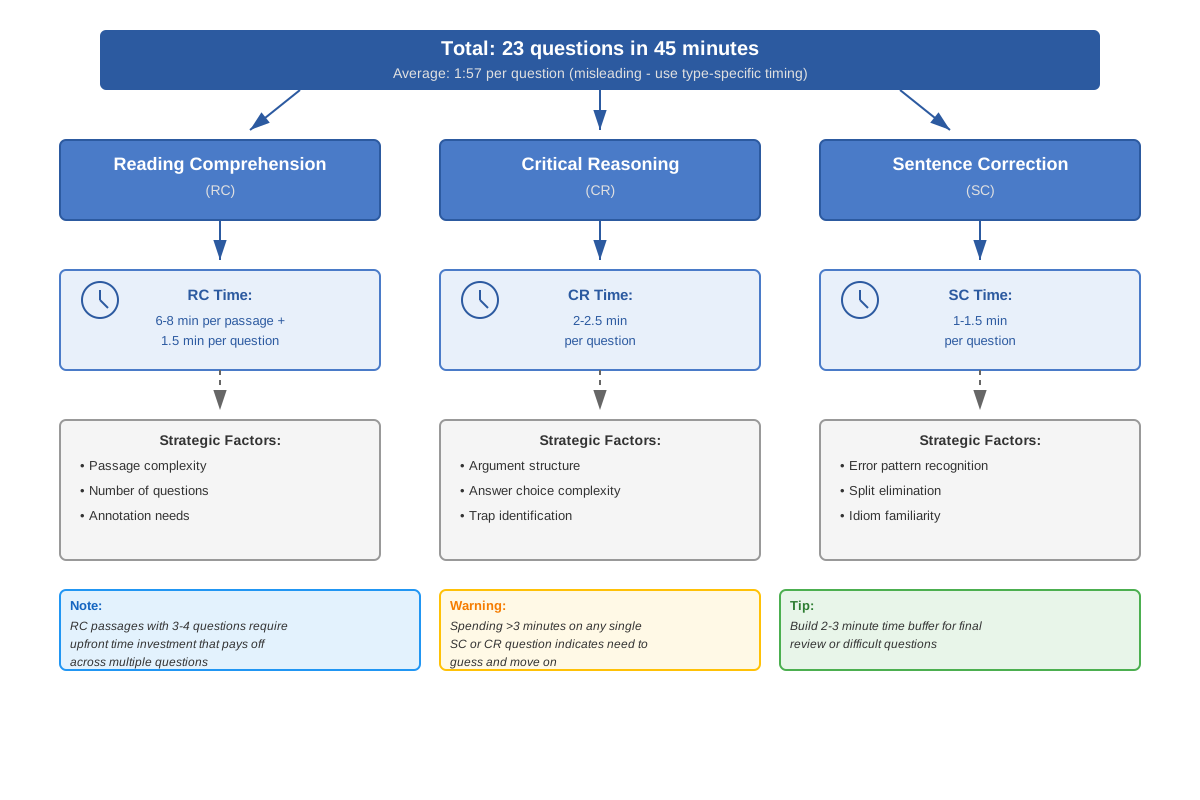
Time management is one of the most critical yet often overlooked skills for achieving a competitive score on the GMAT Verbal Reasoning section. While many test-takers focus exclusively on content mastery—learning grammar rules, logical reasoning patterns, and reading comprehension strategies—they frequently underestimate how profoundly time pressure affects performance. The GMAT is designed not only to test knowledge but also to assess how efficiently candidates can apply that knowledge under strict time constraints. In the Verbal Reasoning section, students face 23 questions in 45 minutes, translating to an average of approximately 1 minute and 57 seconds per question. However, this average masks significant variation: Reading Comprehension passages with multiple questions require different time allocation strategies than standalone Critical Reasoning or Sentence Correction items.
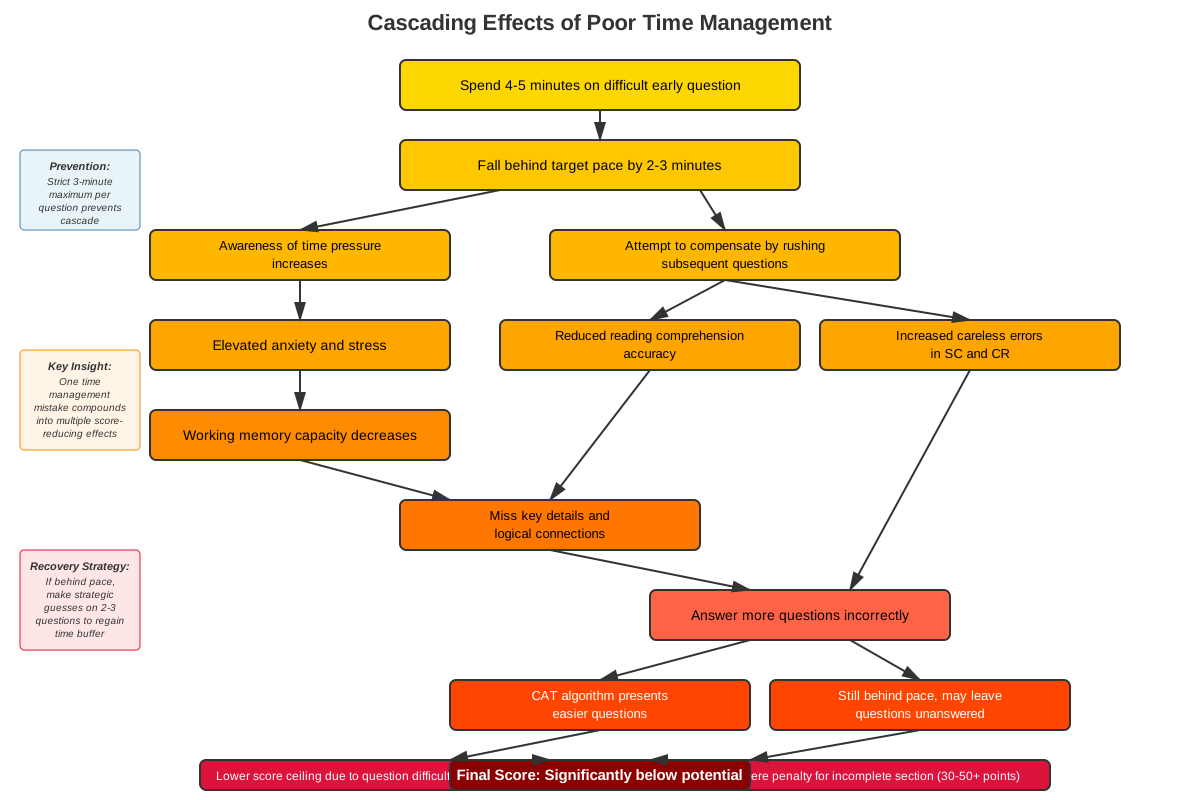
Effective GMAT time management directly impacts score outcomes because the exam employs computer-adaptive testing (CAT) algorithms that penalize incomplete sections severely. Leaving questions unanswered at the end of a section can reduce scores by 30-50 points or more, making pacing as important as accuracy. Furthermore, poor time management creates a cascading effect: rushing through later questions increases error rates, while spending too long on early questions creates panic that impairs cognitive function. The relationship between time management and other Verbal Reasoning skills is symbiotic—strong foundational skills in Reading Comprehension, Critical Reasoning, and Sentence Correction enable faster, more confident decision-making, while disciplined pacing ensures that knowledge can be applied systematically across all questions.
Within the broader context of GMAT preparation, time management serves as the operational framework that allows content knowledge to translate into actual points. It connects to Reading Comprehension through strategic passage navigation, to Critical Reasoning through efficient argument analysis, and to Sentence Correction through rapid pattern recognition. Mastering time management transforms test-taking from a reactive, anxiety-driven experience into a controlled, strategic performance where every second is allocated purposefully.
Learning Objectives
- [ ] Identify time management challenges specific to GMAT Verbal Reasoning
- [ ] Explain time management principles and their application to different question types
- [ ] Apply time management strategies to GMAT questions under timed conditions
- [ ] Develop personalized pacing benchmarks based on individual strengths and weaknesses
- [ ] Implement decision protocols for when to skip, guess, or invest additional time in questions
- [ ] Analyze time allocation patterns to identify and correct inefficiencies
- [ ] Execute strategic guessing techniques that maximize probability of correct answers when time is limited
Prerequisites
- Basic familiarity with GMAT Verbal section structure: Understanding the three question types (Reading Comprehension, Critical Reasoning, Sentence Correction) and their distribution is essential for allocating time appropriately across the section.
- Foundational content knowledge in Verbal Reasoning: Time management strategies build upon existing skills; students must have baseline competency in analyzing arguments, identifying grammatical errors, and comprehending complex passages.
- Experience with timed practice: Students should have attempted at least several timed practice questions to understand how time pressure affects their performance and decision-making.
- Self-awareness of personal pacing tendencies: Recognizing whether one naturally works too quickly (sacrificing accuracy) or too slowly (risking incomplete sections) enables targeted improvement.
Why This Topic Matters
Time management represents the difference between demonstrating knowledge and achieving a competitive score. Research on GMAT performance consistently shows that students who master pacing strategies score 50-100 points higher than equally knowledgeable peers who struggle with time allocation. The exam's computer-adaptive format means that early questions have disproportionate impact on the difficulty level of subsequent questions, making efficient use of time in the first third of the section particularly crucial.
On the GMAT Verbal section, approximately 35-40% of test-takers report not finishing all questions, and these candidates experience significant score penalties. The exam algorithm interprets unanswered questions as incorrect responses and applies additional penalties for incomplete sections. Conversely, students who finish with 2-3 minutes remaining can review flagged questions or ensure they've submitted all responses, providing a critical safety margin.
Time management challenges manifest differently across question types. Reading Comprehension passages typically require 6-8 minutes total (2-3 minutes for initial reading, 1-1.5 minutes per question), while Critical Reasoning questions average 2 minutes each, and Sentence Correction items should take 60-75 seconds. However, these averages obscure the reality that some questions—particularly complex inference questions or lengthy Sentence Correction items—legitimately require more time. Effective time management means recognizing when to invest additional seconds and when to make an educated guess and move forward.
The practical significance extends beyond test day: time management skills developed for the GMAT transfer directly to business school case analyses, consulting interviews, and professional environments where synthesizing information quickly under pressure determines success.
Core Concepts
The Time Budget Framework
The foundation of effective time management begins with understanding the total time budget and creating a strategic allocation plan. The GMAT Verbal section provides 45 minutes for 23 questions, but treating this as a uniform 1:57 per question leads to suboptimal performance. Instead, successful test-takers implement a differentiated time budget that allocates resources based on question type and point value.
A recommended framework divides the section into three segments:
| Segment | Questions | Time Allocation | Purpose |
|---|---|---|---|
| Opening | Questions 1-8 | 16-18 minutes | Establish strong performance for CAT algorithm |
| Middle | Questions 9-17 | 18-20 minutes | Maintain steady pace through varied question types |
| Closing | Questions 18-23 | 8-10 minutes | Complete section with buffer for review |
This framework accounts for the computer-adaptive algorithm's sensitivity to early performance while ensuring adequate time remains for later questions. The opening segment receives slightly more time per question (2:00-2:15 average) because these responses significantly influence subsequent question difficulty and overall scoring potential.
Question-Type Specific Pacing
Different Verbal question types require distinct time management approaches:
Reading Comprehension Pacing: Passages appear with 3-4 associated questions, requiring a two-phase approach. The initial reading phase should consume 2-3 minutes depending on passage length (short passages: 2 minutes; long passages: 3 minutes). This investment enables faster question response, with each question taking 1-1.5 minutes. Total time per passage set: 6-9 minutes. The critical principle is that thorough initial reading accelerates question answering and improves accuracy, making the upfront time investment worthwhile.
Critical Reasoning Pacing: These questions should average 1:45-2:00 minutes each. The time breaks down as: 30-45 seconds reading and understanding the argument, 30-45 seconds identifying the question type and forming a prediction, and 30-45 seconds evaluating answer choices. Questions requiring assumption identification or argument strengthening/weakening typically need the full 2 minutes, while main conclusion questions may take only 1:30.
Sentence Correction Pacing: These items should be the fastest, averaging 60-75 seconds each. Efficient test-takers spend 15-20 seconds reading the original sentence and identifying potential errors, 10-15 seconds scanning answer choices for patterns, and 30-40 seconds evaluating remaining options. The key is recognizing error types quickly through pattern recognition rather than analyzing each answer choice independently.
The Checkpoint System
Effective GMAT time management requires real-time monitoring through strategic checkpoints. Rather than constantly checking the clock (which increases anxiety and wastes time), implement predetermined checkpoints:
- Checkpoint 1 (Question 8): Should be reached at approximately 15-16 minutes remaining (29-30 minutes elapsed)
- Checkpoint 2 (Question 15): Should be reached at approximately 8-9 minutes remaining (36-37 minutes elapsed)
- Checkpoint 3 (Question 20): Should be reached at approximately 3-4 minutes remaining (41-42 minutes elapsed)
At each checkpoint, assess pacing status:
- On pace: Continue current strategy
- 1-2 minutes ahead: Maintain quality; don't rush remaining questions
- 1-2 minutes behind: Identify one question in next segment to answer more quickly
- 3+ minutes behind: Implement catch-up protocol (detailed in Exam Strategy section)
The Decision Hierarchy
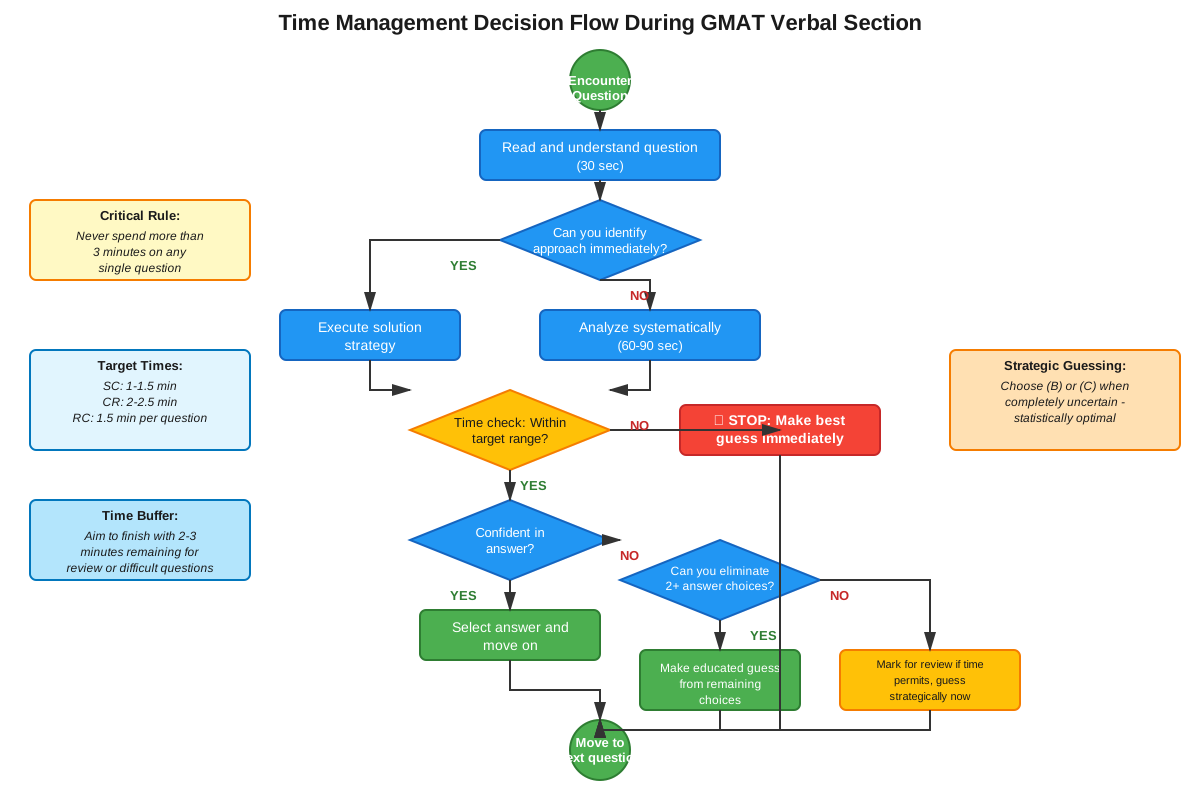
Time management requires rapid decision-making about resource allocation. Implement this hierarchy when encountering each question:
- Immediate Recognition (0-15 seconds): Can this question be answered quickly based on pattern recognition or obvious errors/logic? If yes, solve immediately.
- Standard Approach (15-90 seconds): Does this question require systematic analysis but falls within normal difficulty? Apply standard problem-solving methodology.
- Complex Investment (90-150 seconds): Is this question challenging but solvable with additional time? Invest up to 2.5 minutes if within time budget.
- Strategic Skip (150+ seconds): Has this question consumed excessive time without clear path to solution? Make educated guess and move forward.
This hierarchy prevents the common trap of perseverating on single questions while neglecting others. The GMAT rewards completing all questions with reasonable accuracy more than achieving perfection on a subset while leaving others unanswered.
The Guessing Protocol
Strategic guessing is not admitting defeat—it's an essential time management tool. When time pressure necessitates guessing, implement these protocols:
For Reading Comprehension: Eliminate answers containing extreme language ("always," "never," "only") or information not mentioned in the passage. Select the most moderate, passage-supported remaining option.
For Critical Reasoning: Identify the question type and eliminate answers that don't address the specific task. For strengthening questions, eliminate answers that weaken or are irrelevant. For assumption questions, eliminate answers that aren't necessary for the conclusion.
For Sentence Correction: Eliminate answers with obvious grammatical errors first (subject-verb disagreement, pronoun errors). Among remaining options, select the most concise choice that maintains the original meaning.
Time Anxiety Management
Psychological factors significantly impact time management effectiveness. Time anxiety—the stress response triggered by awareness of limited time—impairs working memory and decision-making. Combat this through:
- Controlled breathing: When noticing time pressure, take one deep breath (4 seconds in, 4 seconds out) to reset the nervous system
- Positive self-talk: Replace "I'm running out of time" with "I'm making strategic decisions about time allocation"
- Checkpoint focus: Concentrate on reaching the next checkpoint rather than completing the entire section
- Practice desensitization: Regular timed practice under realistic conditions reduces anxiety response over time
Concept Relationships
Time management serves as the integrating framework that connects all Verbal Reasoning skills into effective test performance. The relationship flows as follows:
Content Knowledge → Pattern Recognition → Decision Speed → Time Efficiency
Strong foundational skills in Reading Comprehension, Critical Reasoning, and Sentence Correction enable faster pattern recognition, which accelerates decision-making, which improves time efficiency. Conversely, effective time management creates the conditions for applying content knowledge—rushing prevents accessing stored knowledge, while strategic pacing allows systematic application of learned techniques.
Within time management itself, concepts connect hierarchically:
Time Budget Framework (foundational structure) → Question-Type Specific Pacing (tactical implementation) → Checkpoint System (monitoring mechanism) → Decision Hierarchy (real-time resource allocation) → Guessing Protocol (safety mechanism)
Each level depends on the previous: checkpoints are meaningless without a budget framework, decision hierarchies require checkpoint data, and guessing protocols activate when decision hierarchies indicate resource constraints.
Time management also connects forward to test-day execution and score outcomes. The relationship is: Preparation Pacing Practice → Internalized Time Awareness → Automatic Pacing Adjustments → Completed Section → Maximized Score
High-Yield Facts
⭐ The GMAT Verbal section contains 23 questions to be completed in 45 minutes, averaging 1:57 per question, but optimal pacing varies significantly by question type.
⭐ Leaving questions unanswered results in severe score penalties, often reducing scores by 30-50+ points; completing all questions with 80% accuracy outperforms completing 80% of questions with 95% accuracy.
⭐ Reading Comprehension passages should receive 2-3 minutes for initial reading, with 1-1.5 minutes per associated question, totaling 6-9 minutes per passage set.
⭐ The first 8 questions disproportionately influence the computer-adaptive algorithm; allocating slightly more time to this segment (2:00-2:15 per question) optimizes overall scoring.
⭐ Strategic checkpoints at questions 8, 15, and 20 enable real-time pacing adjustments without constant clock-watching that increases anxiety.
- Sentence Correction questions should be answered most quickly, averaging 60-75 seconds each through rapid pattern recognition.
- Critical Reasoning questions require 1:45-2:00 minutes on average, with assumption and strengthen/weaken questions typically needing the full allocation.
- Spending more than 2:30 on any single question creates time deficits that are difficult to recover; implementing the decision hierarchy prevents this trap.
- Time anxiety impairs working memory and decision-making; controlled breathing and checkpoint-focused thinking mitigate these effects.
- Educated guessing using elimination strategies yields approximately 40-50% accuracy on GMAT questions, significantly better than random guessing (20%) and essential for completing sections.
- Practicing under timed conditions with checkpoint monitoring builds automatic pacing awareness that reduces cognitive load on test day.
- The final 3-4 minutes should serve as a buffer for completing remaining questions and verifying all responses are submitted, not for extensive review.
Quick check — test yourself on Time management so far.
Try Flashcards →Common Misconceptions
Misconception: All questions should receive equal time since they're weighted equally in scoring.
Correction: While questions have equal weight, the computer-adaptive algorithm makes early questions more influential in determining subsequent difficulty levels. Additionally, different question types have inherently different optimal time allocations based on their complexity and structure.
Misconception: Spending extra time on difficult questions demonstrates thoroughness and increases accuracy.
Correction: Beyond 2:30 minutes, additional time investment yields diminishing returns while creating time pressure on remaining questions. The GMAT rewards completing all questions with reasonable accuracy more than achieving perfection on a subset.
Misconception: Checking the clock frequently helps maintain good pacing.
Correction: Constant clock-checking increases anxiety, wastes time, and disrupts focus. The checkpoint system (monitoring time at questions 8, 15, and 20) provides adequate pacing feedback without these negative effects.
Misconception: Reading Comprehension passages should be skimmed quickly to save time for questions.
Correction: Thorough initial reading (2-3 minutes) enables faster, more accurate question answering. Skimming forces repeated re-reading during questions, ultimately consuming more total time and reducing accuracy.
Misconception: Guessing should be avoided because it lowers scores.
Correction: Strategic guessing using elimination techniques is essential for time management. Educated guesses yield 40-50% accuracy, and completing all questions (even with some guesses) significantly outperforms leaving questions unanswered.
Misconception: Fast test-takers have an inherent advantage that cannot be learned.
Correction: Efficient pacing results from pattern recognition developed through practice, not innate speed. Systematic practice with timed conditions and checkpoint monitoring builds automatic pacing skills in all students.
Misconception: Time management strategies are only necessary for students who work slowly.
Correction: Even naturally fast test-takers benefit from strategic time allocation to avoid careless errors from rushing and to ensure they're investing appropriate time in high-value questions.
Worked Examples
Example 1: Implementing the Checkpoint System
Scenario: A student is taking a GMAT Verbal section and has just completed question 8. The timer shows 29 minutes remaining (16 minutes elapsed).
Analysis:
- Identify checkpoint status: Question 8 is Checkpoint 1, which should be reached at 29-30 minutes remaining.
- Assess pacing: With 29 minutes remaining, the student is exactly on pace.
- Calculate remaining allocation: 29 minutes for 15 remaining questions = 1:56 average per question.
- Decision: Continue current pacing strategy without adjustments.
Alternative Scenario: The timer shows 26 minutes remaining (19 minutes elapsed).
Analysis:
- Identify checkpoint status: The student is 3-4 minutes behind pace.
- Implement catch-up protocol:
- Identify question types in next segment (questions 9-15)
- Plan to answer 2-3 Sentence Correction questions in 60 seconds each (rather than 75 seconds)
- If a Reading Comprehension passage appears, limit initial reading to 2 minutes (rather than 2.5-3 minutes)
- Avoid panic: Three minutes can be recovered across 7 questions without sacrificing significant accuracy.
- Next checkpoint goal: Reach question 15 at 8-9 minutes remaining (currently projected for 6-7 minutes remaining if no adjustments made).
Connection to Learning Objectives: This example demonstrates applying time management principles through real-time pacing assessment and strategic adjustment, directly addressing the objective of implementing decision protocols based on time constraints.
Example 2: Question-Level Decision Hierarchy
Scenario: A student encounters a Critical Reasoning question asking which answer choice most strengthens the argument. After reading the argument (45 seconds) and forming a prediction (30 seconds), the student has spent 1:15 and is evaluating answer choices.
Analysis:
- Time invested so far: 1:15 (within normal range for CR questions)
- Remaining time budget: 30-45 seconds to evaluate choices and select answer
- Evaluation process:
- Eliminate choice (A): weakens rather than strengthens (10 seconds)
- Eliminate choice (B): irrelevant to argument's logic (10 seconds)
- Consider choice (C): seems to strengthen by providing supporting evidence (15 seconds)
- Consider choice (D): also strengthens but addresses a different assumption (15 seconds)
- Eliminate choice (E): out of scope (5 seconds)
- Decision point at 1:55: Two viable options remain (C and D)
- Apply decision hierarchy:
- This is a "Standard Approach" question (not immediate recognition, not excessively complex)
- Invest additional 20-30 seconds to distinguish between C and D
- Identify that the argument's conclusion depends on the assumption addressed by choice (D)
- Select (D) at 2:15 total time
- Outcome: Question completed within optimal time range (1:45-2:00 target, 2:15 actual is acceptable)
Alternative Scenario: At 2:00 minutes, the student still cannot distinguish between choices C and D.
Analysis:
- Recognize transition point: Question has moved from "Standard Approach" to "Complex Investment" category
- Assess time budget: If on pace at checkpoint, can invest up to 2:30 total
- Make strategic decision:
- Invest final 30 seconds re-reading conclusion to identify which assumption is more critical
- If still uncertain at 2:30, make educated guess between C and D (50% probability)
- Flag question if time permits for potential review
- Avoid trap: Do not spend 3+ minutes; this creates cascading time pressure
Connection to Learning Objectives: This example illustrates applying the decision hierarchy to allocate time strategically, demonstrating when to invest additional time versus when to guess and move forward—directly addressing the objective of implementing decision protocols.
Exam Strategy
Pre-Test Preparation
Effective time management begins before test day. During preparation:
- Establish baseline pacing: Complete 3-5 full-length practice Verbal sections under timed conditions to identify natural pacing tendencies
- Calculate personal benchmarks: Determine average time spent on each question type and compare to optimal targets
- Identify time sinks: Recognize which question types or topics consistently consume excessive time
- Practice checkpoint monitoring: Train to check time only at questions 8, 15, and 20, building automatic awareness
- Simulate test conditions: Practice with the same interface, time limits, and environmental conditions as the actual exam
Trigger Words for Time Decisions
Certain question characteristics signal time allocation needs:
Invest additional time when you see:
- "EXCEPT" or "LEAST" in question stems (require evaluating all choices)
- Multiple conditional statements in Critical Reasoning arguments
- Questions asking about author's attitude or primary purpose (require holistic passage understanding)
- Sentence Correction with significant structural differences between choices
Move quickly when you see:
- Specific detail questions with clear line references
- Sentence Correction with obvious grammatical errors in multiple choices
- Critical Reasoning questions asking for main conclusion (often stated explicitly)
- Vocabulary-based questions where you either know the word or don't
Process of Elimination for Time Efficiency
When time pressure necessitates rapid elimination:
- First pass (15-20 seconds): Eliminate obviously incorrect answers based on clear errors or logical flaws
- Second pass (20-30 seconds): Among remaining choices, eliminate those with subtle issues (extreme language, scope problems, logical gaps)
- Final selection (10-15 seconds): Choose the best remaining option without excessive deliberation
This three-pass approach prevents the time trap of comparing all five choices equally, which can consume 90+ seconds on a single question.
Time Allocation by Section Position
Adjust strategy based on section position:
Questions 1-8 (Opening): Invest slightly more time (2:00-2:15 average) to establish strong performance for the adaptive algorithm. Avoid careless errors from rushing.
Questions 9-17 (Middle): Maintain steady pace (1:50-2:00 average). This segment typically contains the most varied question types; use checkpoint at question 15 to assess and adjust.
Questions 18-23 (Closing): Ensure completion (1:30-1:45 average if on pace). If behind schedule, implement strategic guessing on 1-2 questions to guarantee finishing. The final 2-3 questions can be answered more quickly if necessary without severe score impact.
Recovery Protocols
When falling behind pace:
1-2 minutes behind: Identify 2-3 upcoming questions to answer 15-20 seconds faster (typically Sentence Correction or specific detail Reading Comprehension questions)
3-4 minutes behind: Implement aggressive catch-up:
- Limit next Reading Comprehension passage to 2 minutes initial reading
- Answer next 2 Sentence Correction questions in 60 seconds each
- If encountering difficult Critical Reasoning question, make educated guess after 1:30 rather than investing full 2:00
5+ minutes behind: Emergency protocol:
- Identify 2 questions in remaining set to answer via strategic guessing (30-45 seconds each)
- Focus remaining time on questions matching personal strengths
- Ensure all questions are answered before time expires
Memory Techniques
The "8-15-20" Checkpoint Mnemonic
Remember checkpoint questions using the pattern: "8-15-20" (sounds like "ate fifteen twenty" or "eight-fifteen-twenty")
- 8: First checkpoint after approximately 8 questions
- 15: Second checkpoint at question 15 (middle of section)
- 20: Final checkpoint at question 20 (3 questions remaining)
The "2-3-1" Reading Comprehension Rule
"2-3-1" represents optimal time allocation for Reading Comprehension:
- 2: Minutes for short passage initial reading
- 3: Minutes for long passage initial reading
- 1: Minute (plus 0-30 seconds) per question
The "DISC" Decision Framework
Determine difficulty immediately (0-15 seconds)
Invest appropriately based on category (Standard vs. Complex)
Stop at 2:30 maximum per question
Choose strategically if uncertain (educated guess using elimination)
The "PACE" Anxiety Management Acronym
When feeling time pressure:
Pause for one controlled breath
Acknowledge current checkpoint status
Continue with strategic focus
Eliminate anxiety-driven rushing
Visualization: The Time Budget Pie
Visualize the 45-minute section as a pie divided into three equal slices (15 minutes each):
- Slice 1 (Questions 1-8): Slightly larger pieces (more time per question)
- Slice 2 (Questions 9-17): Standard-sized pieces (average time per question)
- Slice 3 (Questions 18-23): Smaller pieces with a small reserve wedge (buffer time)
This mental image reinforces that time is a finite resource requiring strategic allocation rather than uniform distribution.
Summary
Time management represents the operational framework that transforms content knowledge into GMAT Verbal Reasoning performance. The section's 45-minute, 23-question structure demands strategic allocation rather than uniform pacing, with Reading Comprehension passages requiring 6-9 minutes total, Critical Reasoning questions averaging 1:45-2:00, and Sentence Correction items taking 60-75 seconds. The checkpoint system—monitoring time at questions 8, 15, and 20—enables real-time pacing adjustments without anxiety-inducing constant clock-watching. Effective time management requires implementing a decision hierarchy that categorizes questions as immediate recognition, standard approach, complex investment, or strategic skip, preventing the common trap of perseverating on single questions while neglecting others. The computer-adaptive algorithm's sensitivity to early performance justifies investing slightly more time in the opening segment, while the severe penalties for incomplete sections make finishing all questions paramount. Strategic guessing using elimination techniques is not a failure but an essential tool that yields 40-50% accuracy when time constraints prevent thorough analysis. Ultimately, time management success depends on deliberate practice under realistic conditions, building automatic pacing awareness that reduces cognitive load and enables systematic application of Verbal Reasoning skills across all questions.
Key Takeaways
- The GMAT Verbal section requires differentiated time allocation: Reading Comprehension (6-9 minutes per passage set), Critical Reasoning (1:45-2:00 per question), and Sentence Correction (60-75 seconds per question)
- Implement the checkpoint system at questions 8, 15, and 20 to monitor pacing and make strategic adjustments without constant clock-watching that increases anxiety
- The decision hierarchy prevents time traps: recognize question difficulty within 15 seconds, invest appropriately based on category, stop at 2:30 maximum, and make educated guesses when necessary
- Completing all 23 questions with 80% accuracy significantly outperforms completing 80% of questions with 95% accuracy due to severe penalties for unanswered items
- Early questions (1-8) disproportionately influence the computer-adaptive algorithm; allocating slightly more time to this segment optimizes overall scoring potential
- Strategic guessing using elimination techniques yields 40-50% accuracy and is essential for time management, not a sign of failure
- Time management skills develop through deliberate practice under realistic conditions, building automatic pacing awareness that transfers to test-day performance
Related Topics
Reading Comprehension Strategies: Mastering efficient passage reading techniques and question-type specific approaches directly improves time management by reducing the minutes required per passage set. Strong Reading Comprehension skills enable the 2-3 minute initial reading that forms the foundation of effective RC time allocation.
Critical Reasoning Question Types: Deep familiarity with the 10-12 standard CR question types (assumption, strengthen, weaken, evaluate, etc.) accelerates pattern recognition, reducing average question time from 2:00+ minutes to the optimal 1:45-2:00 range.
Sentence Correction Error Patterns: Automatic recognition of the 8-10 most common grammatical error types enables the rapid 60-75 second SC pacing that creates time buffers for more complex questions.
Test Anxiety Management: Psychological strategies for managing stress and maintaining focus under pressure complement time management techniques, preventing anxiety-driven rushing or freezing that disrupts strategic pacing.
Computer-Adaptive Testing Algorithms: Understanding how the GMAT's adaptive algorithm responds to performance patterns informs strategic time allocation decisions, particularly the rationale for investing more time in early questions.
Practice CTA
Now that you understand the principles and strategies of GMAT time management, the next critical step is deliberate practice under realistic conditions. Attempt the practice questions associated with this topic, implementing the checkpoint system and decision hierarchy with each question. Use flashcards to reinforce the "8-15-20" checkpoint pattern, the "2-3-1" Reading Comprehension rule, and the "DISC" decision framework until they become automatic. Remember: time management skills develop through repetition and reflection. After each practice session, analyze your pacing patterns—identify which question types consumed excessive time and which you answered efficiently. This metacognitive awareness transforms time management from an abstract concept into an internalized skill that will serve you not only on test day but throughout your business school career and professional life. You have the knowledge; now build the automaticity through focused practice.
Sign up free to keep reading
Create a free AnvayaPrep account to finish this GMAT guide on Time management — plus flashcards and practice questions.