Overview
Distribution grouping is a fundamental pattern within Analytical Reasoning Legacy (Logic Games) that appears with remarkable frequency on the LSAT. Unlike selection games where the primary question is "who's in and who's out," or sequencing games where order matters most, distribution grouping focuses on dividing a set of elements among multiple groups, teams, or categories. The central challenge involves determining which elements can or must be placed into which groups while respecting numerical constraints and conditional rules.
This topic represents one of the most common game types students encounter in the grouping games legacy category. Distribution grouping questions require test-takers to track multiple variables simultaneously: the identity of group members, the size of each group, and the relationships between elements across different groups. Mastery of this pattern is non-negotiable for achieving a competitive LSAT score, as these games typically appear once or twice per exam and account for 5-7 questions each time they surface.
Within the broader landscape of Analytical Reasoning, distribution grouping serves as a bridge between pure selection games and more complex hybrid scenarios. The skills developed here—creating effective diagrams, tracking numerical distributions, and applying conditional rules across multiple categories—transfer directly to advanced game types. Understanding distribution patterns also strengthens logical reasoning abilities that extend beyond games into the Logical Reasoning sections, particularly in questions involving categorical relationships and conditional logic.
Learning Objectives
- [ ] Identify how Distribution grouping appears in LSAT questions
- [ ] Explain the reasoning pattern behind Distribution grouping
- [ ] Apply Distribution grouping to solve LSAT-style problems accurately
- [ ] Construct effective visual diagrams for distribution scenarios with fixed and unfixed group sizes
- [ ] Recognize and differentiate between balanced and unbalanced distribution patterns
- [ ] Execute efficient deduction strategies specific to distribution constraints
- [ ] Identify numerical implications and their cascading effects on group composition
Prerequisites
- Basic conditional logic and contrapositive formation: Distribution games heavily rely on "if-then" rules that govern which elements can or cannot be grouped together
- Set theory fundamentals: Understanding how elements relate to groups, including concepts of membership and exclusion, forms the foundation for tracking distributions
- Diagramming conventions for logic games: Familiarity with standard notation systems enables efficient setup and reduces cognitive load during timed conditions
- Rule representation techniques: The ability to translate verbal constraints into symbolic notation is essential for managing complex distribution scenarios
Why This Topic Matters
Distribution grouping represents approximately 15-20% of all Analytical Reasoning games on modern LSAT administrations. These games appear in various contexts: assigning employees to projects, distributing students among classes, allocating resources to departments, or organizing participants into teams. The LSAT tests distribution grouping because it mirrors real-world analytical tasks that lawyers regularly perform—allocating cases among attorneys, organizing evidence into categories, or structuring arguments across multiple supporting points.
From an exam strategy perspective, distribution games offer significant scoring opportunities. Unlike some game types that feature deliberately obscure setups, distribution scenarios follow predictable structural patterns. Students who master the core frameworks can often complete these games more quickly than average, banking time for more challenging sections. Additionally, distribution games typically yield to systematic diagramming approaches, meaning that invested preparation time translates directly into point gains.
Common manifestations include: assigning exactly 6 volunteers to 3 committees with specific size requirements; distributing 8 artifacts among 4 museum wings where some wings receive more items than others; or placing 7 speakers into morning, afternoon, and evening sessions with numerical constraints. The LSAT frequently combines distribution with conditional rules (e.g., "If Martinez is on the finance committee, then Rodriguez cannot be on the same committee") and numerical restrictions (e.g., "Each team has at least two members, and no team has more than four").
Core Concepts
The Distribution Framework
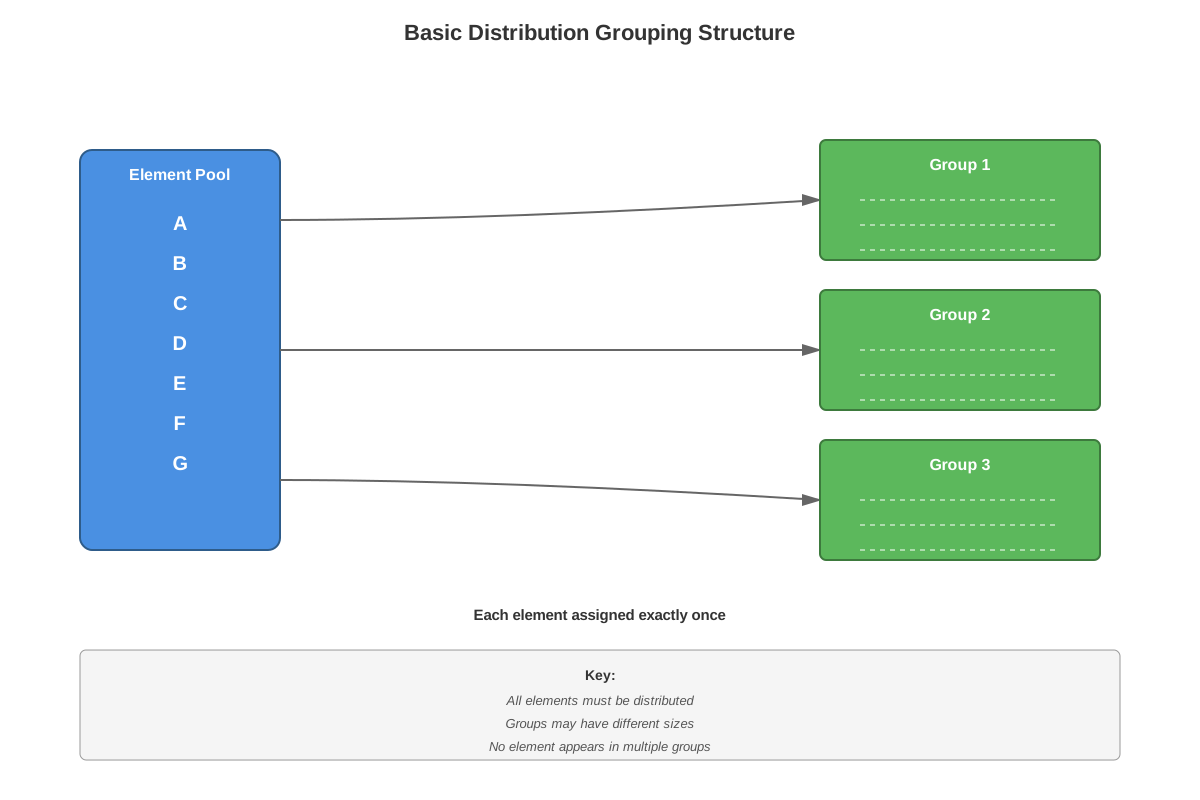
LSAT distribution grouping involves systematically dividing a fixed set of elements among a specified number of groups according to explicit rules and constraints. The fundamental structure includes three components: the element set (the items being distributed), the group structure (the categories or containers receiving elements), and the distribution rules (constraints governing placement).
Every distribution game begins with identifying whether the distribution is fixed or unfixed. Fixed distributions specify exact group sizes (e.g., "Three students attend each of two workshops, and four students attend the third workshop"). Unfixed distributions provide ranges or minimum/maximum constraints (e.g., "Each committee has at least one member, and no committee has more than three members"). This distinction fundamentally shapes the solving approach and determines which deductions become available.
Numerical Distribution Patterns
The mathematical constraints in distribution games create predictable patterns that expert test-takers recognize immediately. When distributing N elements among M groups, the distribution pattern can be represented as a numerical sequence. For example, distributing 7 elements among 3 groups might yield patterns like 3-2-2, 4-2-1, or 5-1-1.
| Total Elements | Number of Groups | Possible Distributions | Notes |
|---|---|---|---|
| 6 | 3 | 4-1-1, 3-2-1, 2-2-2 | Assuming each group gets at least one |
| 7 | 3 | 5-1-1, 4-2-1, 3-3-1, 3-2-2 | Most common LSAT setup |
| 8 | 4 | 5-1-1-1, 4-2-1-1, 3-3-1-1, 3-2-2-1, 2-2-2-2 | Balanced vs. unbalanced matters |
Recognizing these patterns enables rapid setup and immediate deductions. When the game states "seven elements distributed among three groups, with each group receiving at least one element," experienced test-takers immediately enumerate the four possible distributions and consider which rules might eliminate certain patterns.
Rule Types in Distribution Games
Distribution games employ several characteristic rule categories:
- Assignment rules: Direct placement statements (e.g., "Garcia is on the marketing team")
- Conditional placement rules: If-then statements about group membership (e.g., "If Thompson is in Group A, then Williams is in Group B")
- Exclusion rules: Elements that cannot share groups (e.g., "Martinez and Chen cannot be on the same committee")
- Inclusion rules: Elements that must share groups (e.g., "Patel and Quinn are always assigned together")
- Numerical constraints: Size restrictions on groups (e.g., "The research team has exactly three members")
- Relative size rules: Comparative constraints (e.g., "Group 1 has more members than Group 2")
Diagramming Strategies
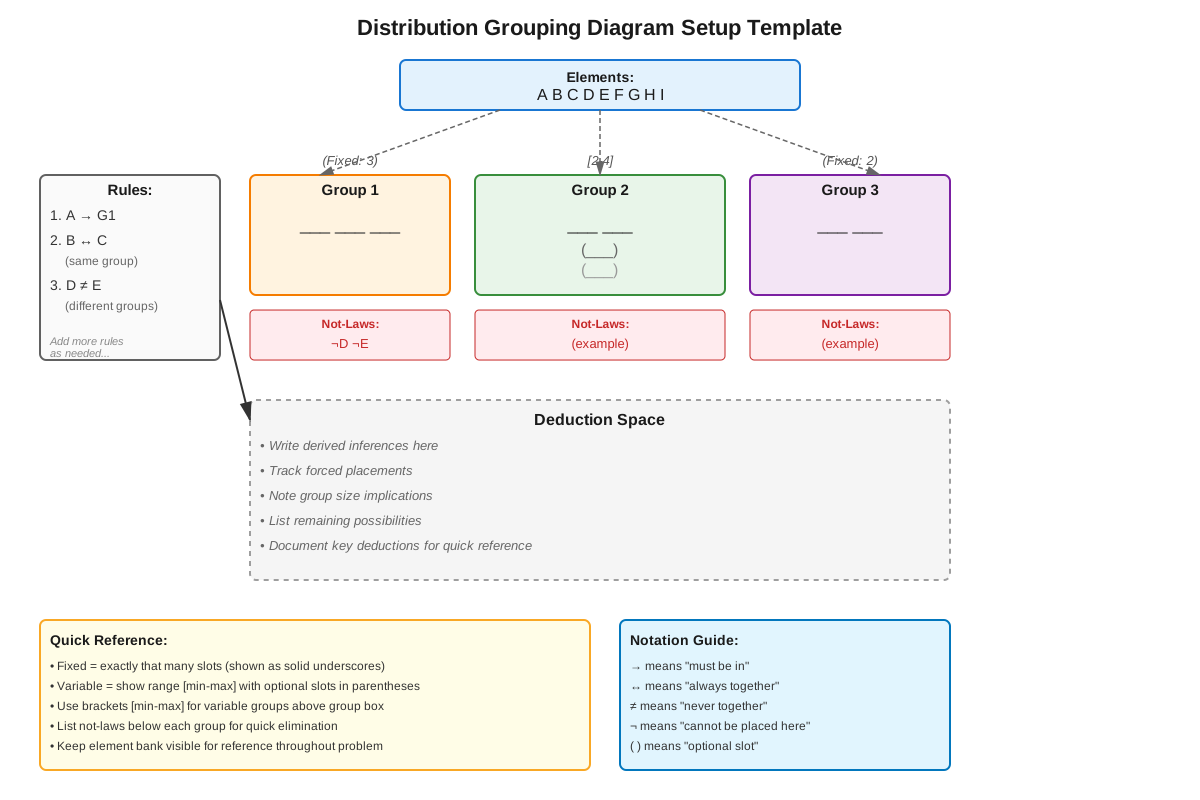
Effective diagramming transforms abstract distribution scenarios into visual representations that support rapid reasoning. The standard approach uses horizontal or vertical slots representing groups, with spaces beneath or beside each group for elements.
For a game distributing 7 people (A, B, C, D, E, F, G) among 3 teams with a 3-2-2 distribution:
Team 1: ___ ___ ___
Team 2: ___ ___
Team 3: ___ ___
Advanced diagramming includes notation for conditional rules. If the rule states "If A is on Team 1, then B is on Team 3," this appears as:
A₁ → B₃
B₃̄ → A₁̄
The contrapositive (second line) proves equally important, as distribution games frequently test understanding of logical equivalence.
Key Deduction Types
Distribution games reward systematic deduction-making. The most powerful deductions include:
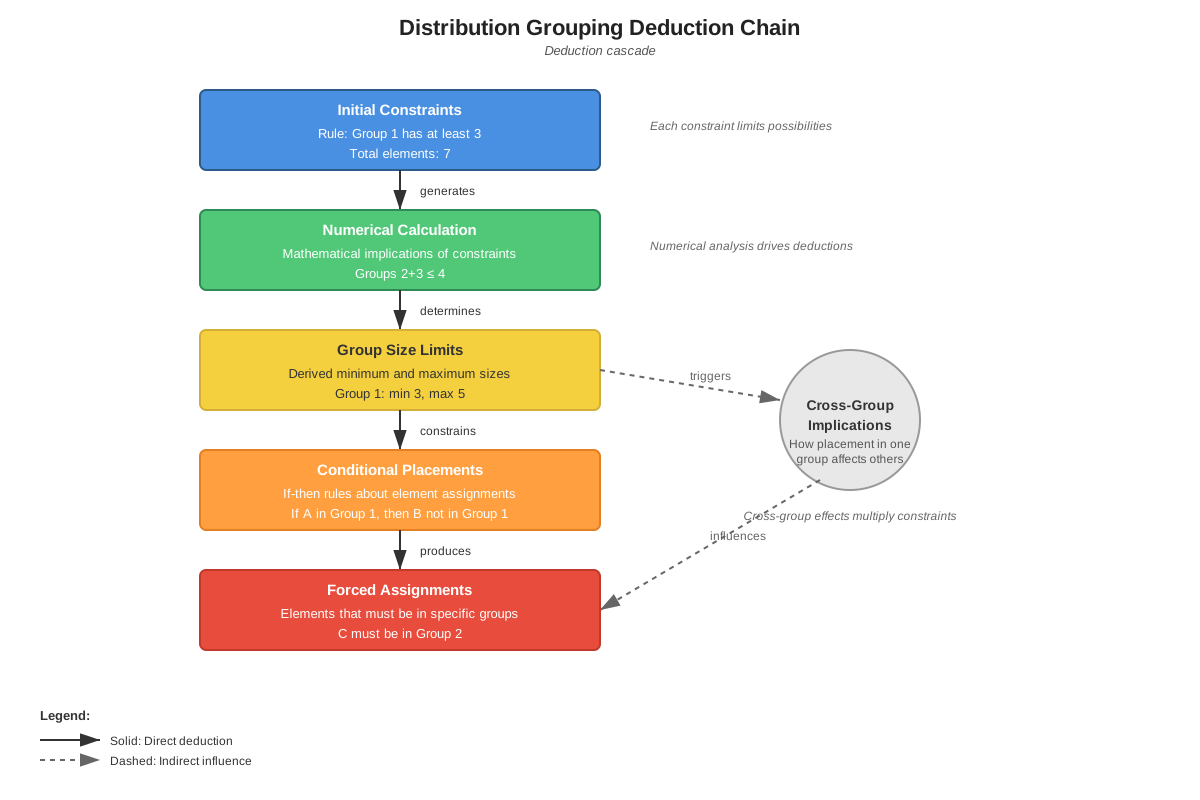
Numerical deductions: When rules force certain group sizes, other groups' sizes become determined. If 7 elements distribute among 3 groups as 3-2-2, and rules place 3 specific elements in Group 1, the remaining 4 elements must split 2-2 between Groups 2 and 3.
Forced placements: When an element cannot fit in multiple groups due to exclusion rules, it must occupy the remaining available group. If element X cannot be with elements in Groups 1 or 2, X must be in Group 3.
Block deductions: When rules require elements to stay together, they function as a single unit for distribution purposes, reducing complexity.
Anti-block deductions: When rules prohibit elements from sharing groups, and group sizes are small, cascading restrictions emerge. If A and B cannot be together, B and C cannot be together, and only three groups exist with limited spaces, significant restrictions follow.
Balanced vs. Unbalanced Distributions
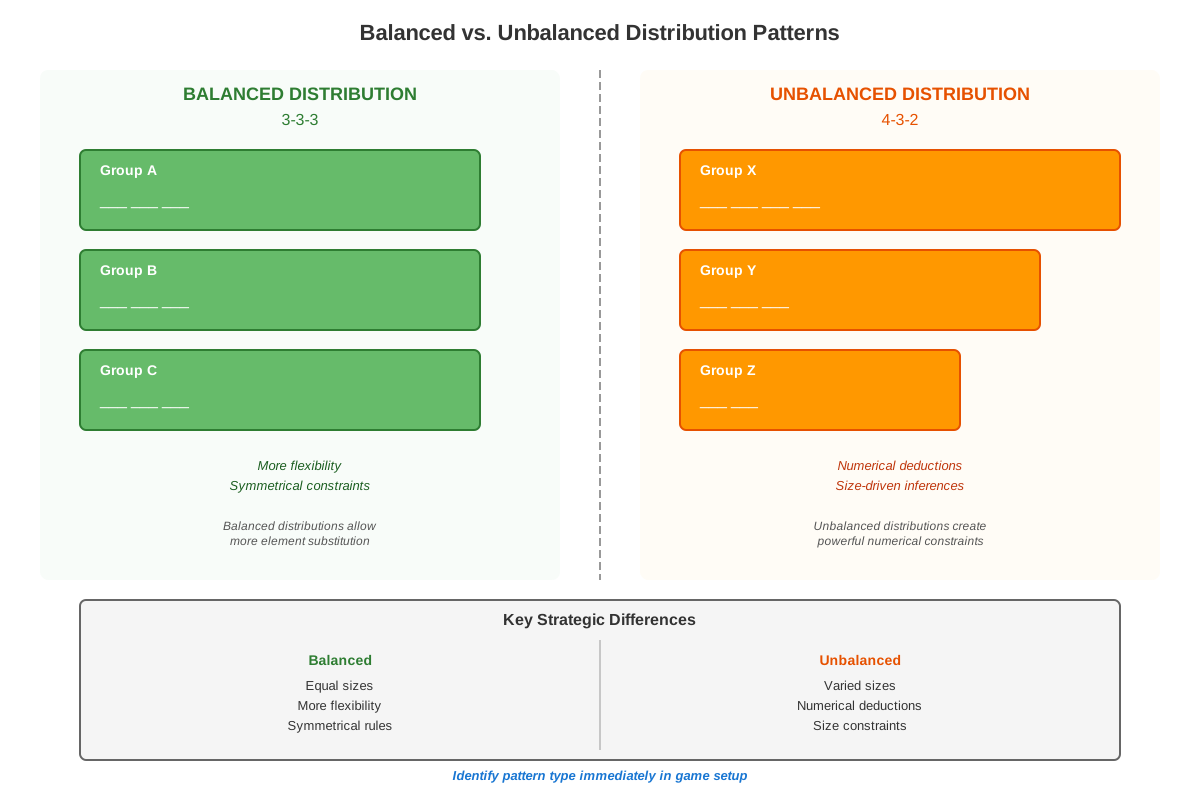
Distribution patterns fall along a spectrum from perfectly balanced (equal group sizes) to highly unbalanced (one large group, several small groups). This distinction affects solving strategies:
Balanced distributions (e.g., 2-2-2 or 3-3-3) create symmetry that can complicate deductions, as no group has inherent distinguishing features. However, they also mean that rules affecting one group often have parallel implications for others.
Unbalanced distributions (e.g., 5-1-1 or 4-2-1) create natural focal points. The largest group becomes a primary consideration, and elements that cannot coexist often must separate into the smaller groups, creating forced placements.
Concept Relationships
The concepts within distribution grouping form an interconnected system where understanding one element enhances comprehension of others. The distribution framework serves as the foundation, establishing the basic structure upon which all other concepts build. From this foundation, numerical distribution patterns emerge as the mathematical skeleton that constrains possible arrangements.
Rule types interact with numerical patterns to create the specific constraints of each game. For instance, exclusion rules become more powerful in unbalanced distributions where fewer placement options exist. This interaction flows into diagramming strategies, which must adapt to represent both numerical constraints and rule relationships simultaneously.
The relationship map follows this progression:
Distribution Framework → Numerical Patterns → Rule Types → Diagramming Strategies → Deduction Types → Balanced/Unbalanced Analysis
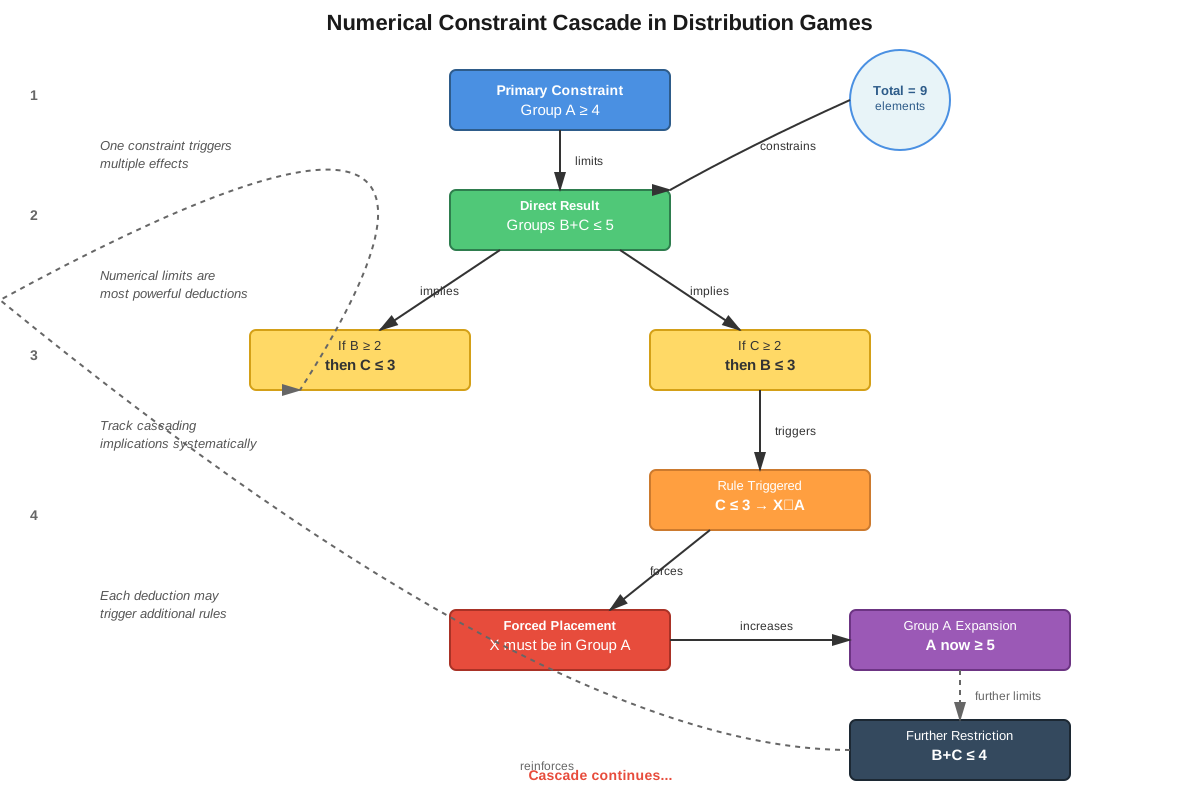
Each deduction type depends on recognizing numerical implications and rule interactions. Forced placements emerge when numerical constraints combine with exclusion rules. Block deductions require identifying inclusion rules within the broader distribution framework. The balanced versus unbalanced distinction affects which deduction types prove most fruitful—unbalanced distributions favor forced placement deductions, while balanced distributions often require more sophisticated conditional reasoning.
These concepts connect to prerequisite knowledge through conditional logic (which underlies rule representation) and set theory (which informs understanding of group membership). They extend forward to hybrid games that combine distribution with sequencing or selection elements, where the same analytical frameworks apply but with added complexity layers.
High-Yield Facts
⭐ Distribution games always involve dividing a complete set of elements among multiple groups—no elements remain unassigned
⭐ Fixed distributions (exact group sizes specified) enable more immediate deductions than unfixed distributions
⭐ The contrapositive of conditional placement rules is equally important as the original rule and often more useful
⭐ In unbalanced distributions, the largest group becomes the primary focus for initial deductions
⭐ When two elements cannot be together and group options are limited, forced placements frequently result
- Numerical constraints often create cascading effects where determining one group's composition automatically determines another's
- Exclusion rules become exponentially more powerful as the number of available groups decreases
- Elements that must be together (blocks) reduce the effective number of elements being distributed
- Distribution games frequently combine with selection elements where some potential elements remain unused
- The most efficient solving approach involves making all possible deductions before attempting questions
- "At least" and "at most" language in numerical constraints creates ranges that require testing multiple scenarios
- Distribution games with many conditional rules often reward creating multiple scenario diagrams
Common Misconceptions
Misconception: Distribution games and selection games are essentially the same because both involve grouping elements.
Correction: Distribution games require placing ALL elements into groups with no leftovers, while selection games involve choosing some elements and rejecting others. This fundamental difference affects setup, deductions, and solving strategies. Distribution focuses on "which group?" while selection focuses on "in or out?"
Misconception: When a distribution pattern is unfixed, no meaningful deductions can be made until questions provide additional information.
Correction: Unfixed distributions still constrain possibilities significantly. By enumerating all possible numerical distributions and testing which patterns the rules permit, test-takers often discover that only one or two distributions actually work, enabling substantial upfront deductions.
Misconception: Conditional rules in distribution games only matter when the sufficient condition is triggered.
Correction: The contrapositive provides equally valuable information. If "A in Group 1 → B in Group 2," then "B not in Group 2 → A not in Group 1." Many questions specifically test contrapositive understanding, and failing to recognize these implications leads to incorrect answers.
Misconception: The order in which elements are placed within a group matters in distribution games.
Correction: Unless explicitly stated otherwise, distribution games care only about group membership, not internal ordering within groups. Elements A, B, and C in Group 1 is identical to C, A, and B in Group 1. Confusing distribution with sequencing wastes time and creates unnecessary complexity.
Misconception: When an element could go in multiple groups, it's best to wait for question-specific information before making any placement decisions.
Correction: Even when an element has multiple possible placements, exploring the implications of each possibility often reveals that one option creates contradictions or violates rules. Testing possibilities systematically during setup saves time across all questions and prevents repeated work.
Misconception: Balanced distributions (equal group sizes) are easier than unbalanced distributions because of their symmetry.
Correction: Balanced distributions often prove more challenging because the symmetry provides fewer natural deduction opportunities. Unbalanced distributions create forced placements more readily, as the size differential between groups combines with rules to limit options.
Quick check — test yourself on Distribution grouping so far.
Try Flashcards →Worked Examples
Example 1: Fixed Distribution with Conditional Rules
Setup: Seven employees—F, G, H, J, K, L, and M—are assigned to exactly three projects: Project 1, Project 2, and Project 3. Each employee is assigned to exactly one project. The following conditions apply:
- Project 1 has exactly three employees
- Project 2 has exactly two employees
- Project 3 has exactly two employees
- F and G cannot be assigned to the same project
- If H is assigned to Project 1, then K is assigned to Project 2
- L and M are assigned to the same project
Question: If G is assigned to Project 1, which of the following must be true?
Solution Process:
Step 1: Establish the distribution framework. We have a fixed 3-2-2 distribution across three projects.
Step 2: Diagram the initial setup:
P1: ___ ___ ___  (3 employees)
P2: ___ ___      (2 employees)
P3: ___ ___      (2 employees)
Step 3: Apply the given condition. G is in Project 1:
P1: G ___ ___
P2: ___ ___
P3: ___ ___
Step 4: Apply the exclusion rule. Since F and G cannot be together, and G is in P1, F must be in P2 or P3:
P1: G ___ ___  (not F)
P2: ___ ___    (F possible)
P3: ___ ___    (F possible)
Step 5: Consider the block rule. L and M must be together, occupying two spaces in one project. Given that P2 and P3 each have only two spaces total, if L and M go into either of these projects, they completely fill it.
Step 6: Test possibilities. If L and M go to P1 with G, that fills P1 completely:
P1: G L M
P2: ___ ___
P3: ___ ___
Remaining: F, H, J, K (4 employees for 4 spaces)
This works numerically. Alternatively, if L and M fill P2:
P1: G ___ ___
P2: L M
P3: ___ ___
Remaining: F, H, J, K (4 employees for 5 spaces)
This creates a problem—we need 5 more employees but only have 4 remaining. Similarly, L and M filling P3 creates the same issue.
Step 7: Conclude that L and M MUST be in Project 1 with G. This is a forced deduction.
Step 8: Determine remaining placements:
P1: G L M
P2: ___ ___
P3: ___ ___
Remaining: F, H, J, K
Step 9: Apply the conditional rule. "If H is in P1, then K is in P2." Since H is NOT in P1 (it's full), the sufficient condition is not triggered, so this rule provides no additional information.
Step 10: Recognize that F, H, J, and K must distribute 2-2 between P2 and P3, but without additional constraints, multiple arrangements work.
Answer: L and M must both be assigned to Project 1 (along with G).
This example demonstrates how numerical constraints combine with block rules to create forced placements, a high-yield deduction pattern in distribution games.
Example 2: Unfixed Distribution with Cascading Deductions
Setup: Six books—R, S, T, U, V, and W—are placed on exactly three shelves: top, middle, and bottom. Each book is placed on exactly one shelf, and each shelf contains at least one book. The following conditions apply:
- R is on a higher shelf than S
- T and U are on the same shelf
- V is not on the same shelf as W
- The middle shelf contains exactly two books
Question: Which of the following could be a complete and accurate list of books on the bottom shelf?
Solution Process:
Step 1: Identify the distribution type. This is partially fixed—the middle shelf has exactly 2 books, but top and bottom are unfixed beyond "at least one each."
Step 2: Determine possible distributions. With 6 books total, middle having exactly 2, and top and bottom each having at least 1:
- Top: 1, Middle: 2, Bottom: 3 (1-2-3)
- Top: 2, Middle: 2, Bottom: 2 (2-2-2)
- Top: 3, Middle: 2, Bottom: 1 (3-2-1)
Step 3: Apply the block rule. T and U must be together, functioning as a unit. They could occupy:
- Both spaces on the middle shelf (filling it completely)
- Two spaces on the top shelf
- Two spaces on the bottom shelf
Step 4: Test T and U on the middle shelf:
Top: ___
Middle: T U
Bottom: ___
Remaining: R, S, V, W (4 books for top and bottom)
Step 5: Apply the relative positioning rule. R must be higher than S. This means:
- R on top, S on bottom (works)
- R on top, S on top (works if both fit)
- R on middle, S on bottom (impossible—middle is full)
- Both on bottom (impossible—violates R higher than S)
Step 6: Apply the exclusion rule. V and W cannot be together. With 4 remaining books (R, S, V, W) and only top and bottom available, we need to ensure V and W separate.
Step 7: Test the 1-2-3 distribution (1 top, 2 middle, 3 bottom):
Top: ___ (1 book)
Middle: T U (2 books)
Bottom: ___ ___ ___ (3 books)
If R is on top (satisfying R higher than S), then S, V, and W must all be on bottom. But V and W cannot be together—contradiction. This distribution is impossible.
Step 8: Test the 2-2-2 distribution:
Top: ___ ___ (2 books)
Middle: T U (2 books)
Bottom: ___ ___ (2 books)
R must be higher than S. Possible arrangements:
- R and V on top; S and W on bottom (V and W separated ✓, R higher than S ✓)
- R and W on top; S and V on bottom (V and W separated ✓, R higher than S ✓)
Both work! So bottom shelf could be "S, W" or "S, V"
Step 9: Test the 3-2-1 distribution:
Top: ___ ___ ___ (3 books)
Middle: T U (2 books)
Bottom: ___ (1 book)
R must be higher than S. If S is on bottom (the only space), R must be on top. That leaves V and W for the remaining 2 top spaces, but they cannot be together—contradiction. This distribution is impossible.
Answer: The bottom shelf could contain "S, W" or "S, V" (depending on answer choices provided).
This example illustrates how unfixed distributions require testing multiple numerical scenarios and how rules interact to eliminate certain distributions entirely while permitting others.
Exam Strategy
When approaching distribution grouping questions on the LSAT, implement this systematic process:
Initial Setup Phase (60-90 seconds):
- Identify the distribution type (fixed vs. unfixed) immediately
- Write out all possible numerical distributions if unfixed
- Create a clear visual diagram with labeled groups and spaces
- Symbolize all rules using consistent notation
- Write contrapositives for all conditional rules
Deduction Phase (60-90 seconds):
- Look for forced placements from numerical constraints
- Identify blocks (elements that must be together) and anti-blocks (elements that cannot be together)
- Test whether certain numerical distributions violate rules
- Mark any elements with severely limited placement options
- Create multiple scenario diagrams if 2-3 clear scenarios emerge
Question-Answering Phase:
For "must be true" questions, focus on forced placements and necessary implications of the rules. Eliminate answers that describe merely possible situations.
For "could be true" questions, look for answers that violate no rules. Often, four answers will create contradictions, leaving one viable option.
For **"if" questions (local questions), treat the new condition as a temporary rule, make all resulting deductions, and answer based on this modified scenario. Never carry local conditions to other questions.
Trigger Words to Watch:
- "Exactly" signals fixed numerical constraints
- "At least" and "at most" indicate ranges requiring multiple scenario testing
- "Cannot be together" creates anti-blocks with powerful implications
- "Must be together" creates blocks that reduce effective element count
- "Higher than" or "more than" in distribution contexts creates relative constraints
Time Management:
Allocate 3.5-4 minutes for setup and initial deductions on distribution games. This upfront investment pays dividends across all 5-7 questions. If stuck on a particular question beyond 45 seconds, skip and return after completing easier questions. Distribution games reward systematic approaches over intuitive leaps, so resist the urge to rush through setup.
Memory Techniques
FIXED acronym for approaching fixed distribution games:
- Find the exact group sizes immediately
- Identify blocks and anti-blocks
- X-out impossible placements
- Enumerate forced deductions
- Diagram all rules clearly
UNFIXED acronym for unfixed distributions:
- Understand the numerical constraints (minimums/maximums)
- Note all possible distribution patterns
- Filter out patterns that violate rules
- Investigate remaining viable patterns
- X-check each pattern against all rules
- Establish which deductions hold across all patterns
- Diagram the most restrictive scenario first
Visualization Strategy: Picture distribution games as physical containers (boxes, shelves, teams) that must be filled completely. Imagine elements as physical objects that cannot be split or duplicated. This concrete visualization helps prevent the common error of leaving elements unassigned or double-assigning them.
The "Block Reduction" Technique: When elements must stay together, mentally treat them as a single super-element. If distributing 7 elements but 2 must stay together, you're effectively distributing 6 units (5 singles + 1 double). This simplification reduces cognitive load.
The "Anti-Block Cascade": When multiple pairs cannot be together, create a visual chain: If A≠B and B≠C and C≠D, visualize this as A—B—C—D where the dashes represent "cannot be together" relationships. This chain visualization helps recognize when limited group spaces force specific separations.
Summary
Distribution grouping represents a core analytical reasoning pattern where test-takers divide a complete set of elements among multiple groups according to numerical constraints and conditional rules. Success requires mastering the distinction between fixed distributions (exact group sizes specified) and unfixed distributions (ranges or minimums provided), as this distinction determines which deduction strategies prove most effective. The most powerful approach involves creating clear visual diagrams, systematically enumerating possible numerical distributions, and making all available deductions before attempting questions. Key deduction types include forced placements from numerical constraints, block and anti-block implications, and cascading effects from conditional rules. Distribution games reward methodical setup and systematic rule application over intuitive guessing. The ability to recognize when rules eliminate certain distribution patterns, identify elements with limited placement options, and apply contrapositives of conditional rules separates high scorers from average performers. Mastery of distribution grouping provides both direct scoring opportunities and foundational skills that transfer to hybrid game types and logical reasoning questions throughout the LSAT.
Key Takeaways
- Distribution grouping requires placing ALL elements into groups with specific numerical constraints—no elements remain unassigned
- Fixed distributions enable more immediate deductions than unfixed distributions, but both types require systematic enumeration of possibilities
- Conditional rules and their contrapositives create forced placements when combined with numerical constraints and exclusion rules
- Effective diagramming with clear visual representation of groups, spaces, and rules is non-negotiable for efficient solving
- Blocks (elements that must be together) and anti-blocks (elements that cannot be together) create cascading implications that drive major deductions
- Unbalanced distributions typically yield more forced placements than balanced distributions due to size differentials between groups
- Investing 3.5-4 minutes in thorough setup and deduction-making pays dividends across all questions in a distribution game
Related Topics
Hybrid Distribution-Selection Games: These advanced scenarios combine distribution grouping with selection elements, where some potential elements remain unused. Mastering pure distribution grouping provides the foundation for handling these complex hybrids that appear occasionally on modern LSATs.
Sequencing with Grouping Elements: Some games require both ordering elements and grouping them into categories. The distribution grouping skills developed here—particularly tracking multiple variables and applying conditional rules—transfer directly to these challenging hybrid games.
In-Out Grouping (Selection Games): While distinct from distribution, selection games share the fundamental skill of tracking group membership and applying conditional rules. Understanding distribution grouping clarifies the key differences and prevents confusion between these related game types.
Advanced Conditional Logic in Games: Distribution games frequently feature complex conditional chains and contrapositive reasoning. Deepening conditional logic skills enhances distribution game performance and vice versa.
Practice CTA
Now that you've mastered the conceptual framework for distribution grouping, it's time to cement your understanding through active practice. Attempt the practice questions associated with this topic, focusing on implementing the systematic setup and deduction strategies outlined above. Use the flashcards to reinforce high-yield facts and rule patterns until recognition becomes automatic. Remember: distribution games reward preparation more than almost any other game type. The patterns you've learned here appear predictably across LSAT administrations, meaning every minute invested in practice translates directly into points on test day. Approach each practice game methodically, and you'll develop the pattern recognition and deductive reasoning skills that separate top scorers from the rest. Your investment in mastering distribution grouping will pay dividends not just in the Analytical Reasoning section, but throughout your legal education and career.
Sign up free to keep reading
Create a free AnvayaPrep account to finish this LSAT guide on Distribution grouping — plus flashcards and practice questions.