Overview
Grouping game setup represents one of the most fundamental and frequently tested components of the Analytical Reasoning Legacy section on the LSAT. These games require test-takers to sort a set of elements (people, objects, events, etc.) into two or more distinct groups based on a set of rules and constraints. Unlike sequencing games that focus on order, grouping games emphasize membership, inclusion, and exclusion relationships. Mastering the setup phase is critical because a well-constructed diagram and clear understanding of the game's structure directly determines how efficiently and accurately a student can answer all associated questions.
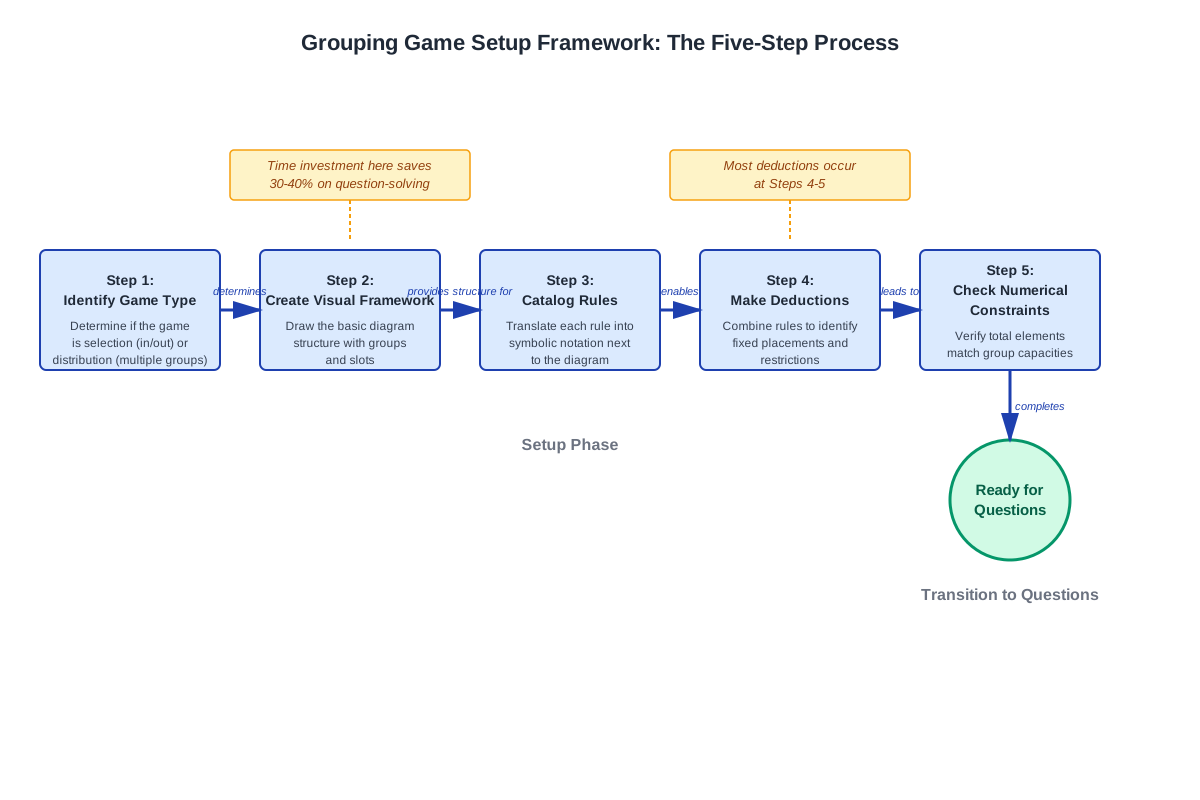
The setup phase involves identifying the game type, creating an effective visual representation, cataloging all rules, and making initial deductions before attempting any questions. This foundational work separates high-scoring test-takers from those who struggle with time management and accuracy. A proper lsat grouping game setup transforms what might appear as complex verbal information into a manageable visual framework that reveals hidden relationships and constraints. Students who invest time in developing systematic setup procedures typically complete grouping games 30-40% faster than those who rush into questions without adequate preparation.
Within the broader context of grouping games legacy, the setup phase connects directly to rule representation, deduction-making, and question-answering strategies. The quality of the initial setup cascades through every subsequent step: poor setup leads to missed deductions, which leads to inefficient question-solving and increased error rates. Conversely, an excellent setup often makes questions almost trivial to answer because the visual representation and initial deductions have already done most of the analytical work. This topic serves as the gateway skill for all other grouping game competencies.
Learning Objectives
- [ ] Identify how Grouping game setup appears in LSAT questions
- [ ] Explain the reasoning pattern behind Grouping game setup
- [ ] Apply Grouping game setup to solve LSAT-style problems accurately
- [ ] Distinguish between stable and unstable grouping game structures
- [ ] Create effective visual representations for both selection and distribution grouping games
- [ ] Execute a systematic setup procedure that maximizes deduction opportunities
- [ ] Recognize numerical constraints and their implications during setup
Prerequisites
- Basic logical reasoning skills: Understanding conditional statements, contrapositive relationships, and basic formal logic is essential because grouping game rules frequently employ "if-then" structures and logical operators.
- Familiarity with LSAT question formats: Knowing how LSAT questions are structured helps students understand what information the setup must capture and organize.
- Spatial reasoning ability: Creating and interpreting visual diagrams requires the ability to translate verbal information into spatial representations.
- Attention to detail: Grouping games contain precise language that determines rule interpretation; missing a single word like "exactly" versus "at most" can invalidate an entire setup.
Why This Topic Matters
Grouping games constitute approximately 25-35% of all Analytical Reasoning Legacy games on the LSAT, making them one of the two most common game types alongside sequencing games. Within a typical LSAT administration, test-takers can expect to encounter at least one grouping game, and often two. The setup phase is particularly high-yield because it affects performance on all 5-7 questions associated with each game, meaning that a strong setup can secure 5-7 points while a weak setup can cost the same number.
In real-world applications, grouping game logic mirrors committee formation, team selection, resource allocation, and classification problems that attorneys regularly encounter. The analytical skills developed through grouping game mastery—recognizing constraints, identifying implications, and systematically exploring possibilities—transfer directly to legal reasoning tasks such as analyzing case precedents, determining which laws apply to specific situations, and constructing arguments.
On the LSAT, grouping games typically appear with scenario descriptions involving selecting team members, assigning people to committees, choosing items from a menu, or distributing elements across categories. The setup phase determines whether students can efficiently navigate questions asking "Which could be true?", "Which must be false?", "If X is selected, which must also be selected?", and "What is the maximum number of elements that could be in Group A?" The difference between a 160 and a 170+ score often comes down to setup efficiency and the deductions made during this critical phase.
Core Concepts
Identifying Grouping Game Types
The first critical step in any grouping game setup involves recognizing that the game is indeed a grouping game rather than a sequencing, matching, or hybrid game. Grouping games feature language about selection, inclusion, exclusion, or distribution. Key phrases include "will be selected," "must be chosen," "assigned to teams," "divided into groups," or "included in the committee." The defining characteristic is that the primary task involves determining which elements belong to which groups, not the order or sequence of elements.
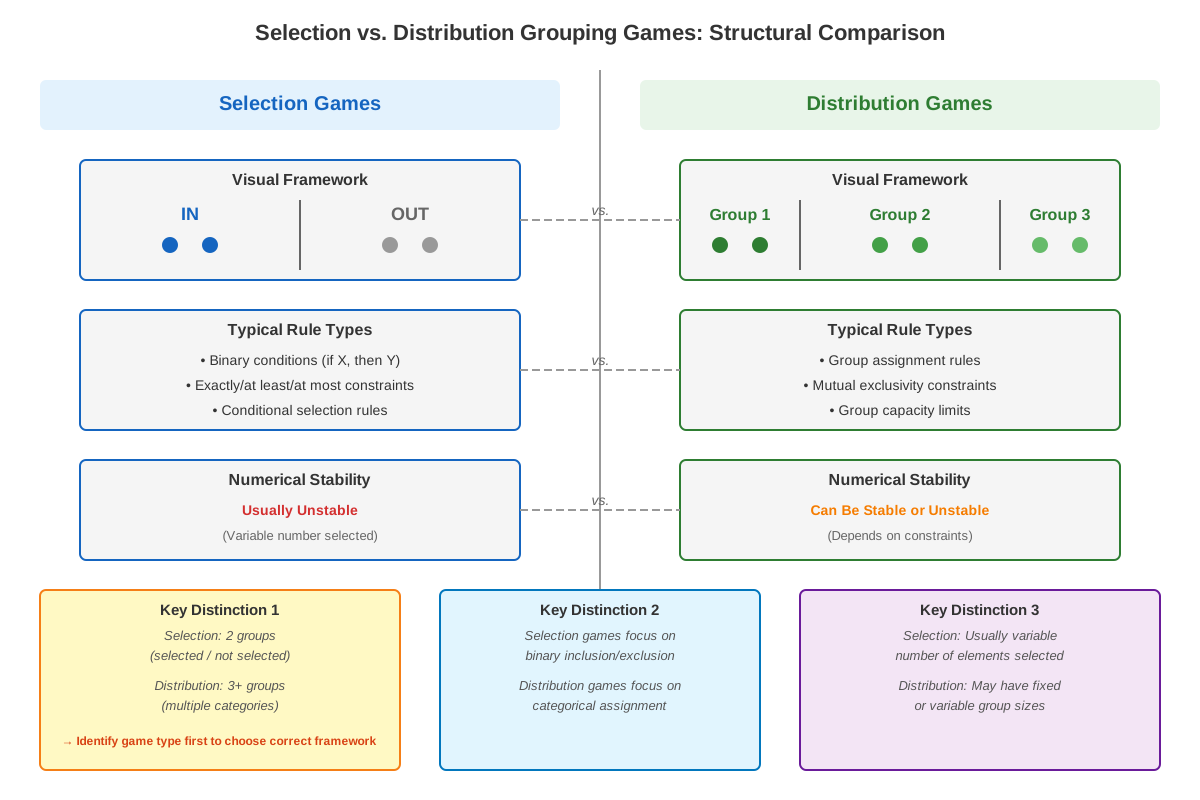
Grouping games divide into two major subtypes: selection games and distribution games. Selection games involve choosing some elements from a larger set (e.g., "Five of eight candidates will be selected for the team"). Distribution games involve assigning all elements to two or more groups (e.g., "Eight students will be divided among three study groups"). Recognizing this distinction during setup is crucial because it affects how the diagram is constructed and what numerical constraints apply.
Creating the Visual Framework
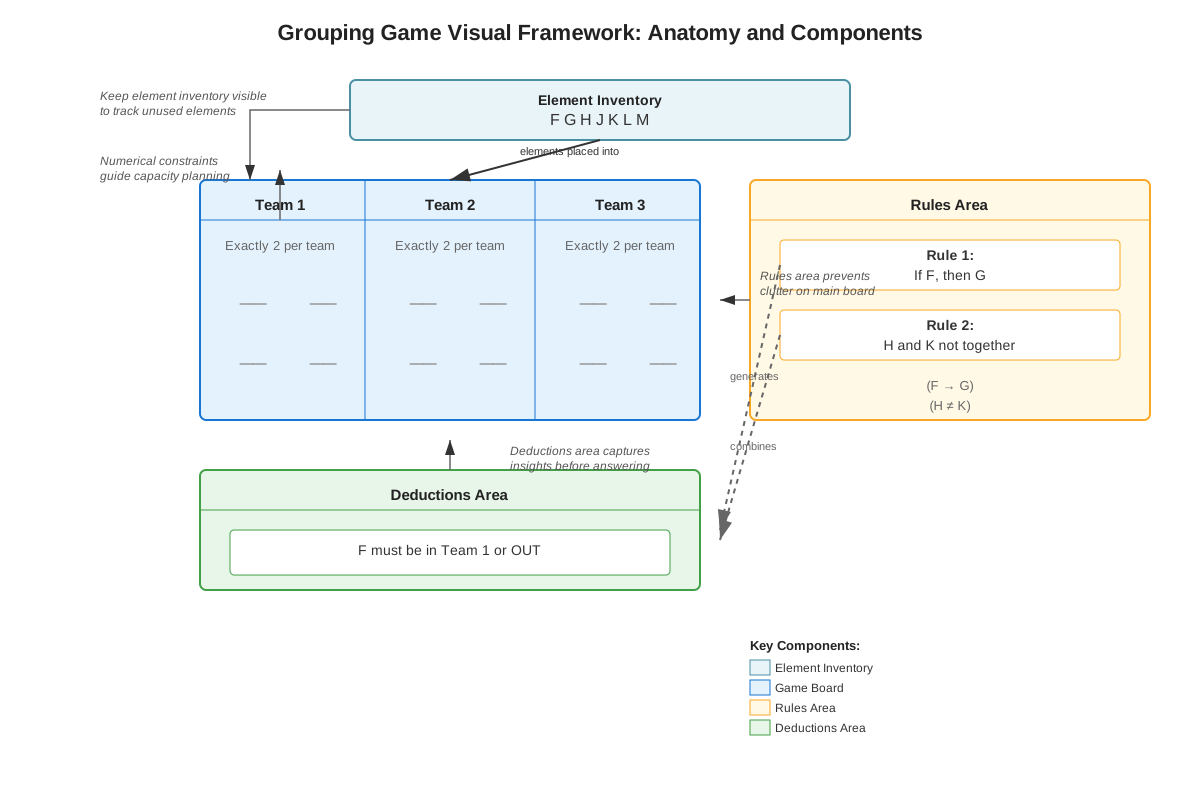
An effective visual representation forms the backbone of successful grouping game performance. For selection games, the standard setup includes two spaces: an "IN" group for selected elements and an "OUT" group for rejected elements. Some test-takers prefer a single row with selected elements and simply track rejected elements separately. The key is consistency and clarity.
For distribution games, create clearly labeled columns or boxes for each group. If the game involves three committees (A, B, and C), draw three distinct spaces and label them. Include any numerical constraints directly in the diagram—if Committee A must have exactly three members, write "3" above or below that space. If Committee B must have at least two members, write "≥2" to maintain constant visual reference.
Inventory and Roster Management
Every grouping game provides a roster of elements (the "players" in the game). During setup, create a clear inventory list, typically written vertically along the left side of the diagram. Use consistent notation: if the game involves eight people named Alice, Bob, Carol, David, Emma, Frank, Grace, and Henry, write them as A, B, C, D, E, F, G, H. Maintain this notation throughout all work to avoid confusion.
Track the total number of elements and the total number of spaces. In selection games, note how many elements will be selected versus how many remain unselected. In distribution games, verify that the sum of all group sizes equals the total number of elements (or identify if some elements might be excluded). This numerical awareness prevents errors and often reveals important deductions.
Rule Representation and Notation
Translating verbal rules into symbolic notation is perhaps the most critical setup skill. Common rule types include:
Conditional rules: "If Alice is selected, then Bob must also be selected" becomes A → B (with contrapositive ~B → ~A). Place these near the diagram with their contrapositives clearly written.
Block rules: "Carol and David must be in the same group" can be represented as CD (circled or bracketed together). "Emma and Frank cannot be in the same group" becomes E/F with a slash or E ≠ F.
Numerical rules: "Exactly three members will be selected for Committee A" or "At least two but no more than four elements will be in Group B" should be written directly on the diagram in the relevant space.
Distribution rules: "Grace must be in a different group than Henry" requires notation showing they cannot share a group, often written as G ≠ H or with a visual indicator.
Numerical Analysis and Constraints
Many grouping games hinge on numerical relationships that must be identified during setup. Calculate the total number of elements, the total number of available spaces, and any fixed requirements. If eight elements must be distributed across three groups with sizes 3, 2, and 3, that accounts for all eight elements with no flexibility—a crucial deduction. If seven elements are distributed across groups of "at least 2" each in three groups, the minimum is six elements, meaning one group gets an extra member—another important constraint.
Create a numerical summary during setup. For example:
- Total elements: 8
- Group A: exactly 3
- Group B: at least 2
- Group C: remaining elements
- Calculation: C must have 8 - 3 - 2 = 3 elements (if B has exactly 2) or 2 elements (if B has 3)
Initial Deductions
The setup phase should include making all immediately available deductions before attempting questions. Common deduction types include:
Forced placements: If a rule states "Alice must be selected" in a selection game, place A in the IN group immediately. If "Bob must be in Committee A" in a distribution game, place B in Committee A's space.
Forced exclusions: If two elements cannot be together and one is forced into a group, the other cannot be in that group. If Alice must be in Committee A and the rules state Alice and Carol cannot be together, Carol cannot be in Committee A.
Numerical deductions: If exactly three elements must be selected and two are forced IN, exactly one more element must be selected. If two elements are forced OUT, none of the remaining elements can be forced OUT (since we need three IN).
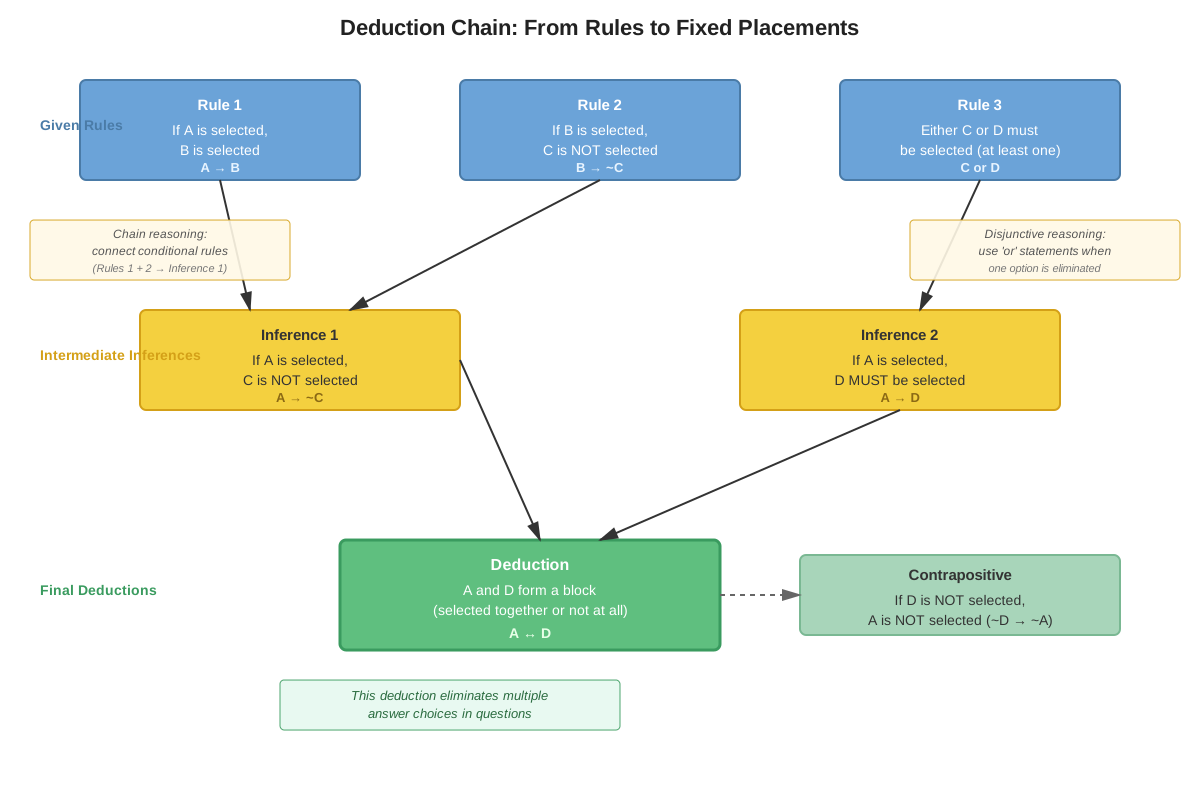
Chain deductions: Follow conditional chains to their conclusions. If A → B and B → C, then A → C. If the game forces A to be selected, both B and C must also be selected.
Stable vs. Unstable Grouping Games
Some grouping games have stable structures where group sizes are fixed and determinate. Others are unstable with variable group sizes that depend on which elements are selected or how they're distributed. Identifying stability during setup affects strategy: stable games often yield more concrete deductions, while unstable games require more hypothetical testing and flexibility.
A stable selection game might state: "Exactly five of eight candidates will be selected." The IN group always has five elements; the OUT group always has three. An unstable selection game might state: "At least three but no more than six of eight candidates will be selected." The IN group could have 3, 4, 5, or 6 elements, requiring different analytical approaches.
Concept Relationships
The components of grouping game setup form an interconnected system where each element supports and informs the others. The process flows logically: Game type identification → Visual framework creation → Inventory listing → Rule representation → Numerical analysis → Initial deductions. Each step builds on the previous one, and skipping or rushing any step compromises the entire setup.
Rule representation directly enables initial deductions—conditional rules written with contrapositives immediately reveal forced placements when combined with other constraints. Numerical analysis interacts with rule representation to expose hidden limitations: knowing that exactly three elements must be selected while two conditional rules force four elements together reveals an impossibility that must be resolved.
The distinction between stable and unstable games affects how aggressively to pursue deductions during setup. Stable games reward extensive upfront deduction work because the fixed structure allows more definitive conclusions. Unstable games require a lighter setup touch, focusing on rule representation and basic deductions while remaining flexible for question-specific scenarios.
This topic connects to prerequisite knowledge of formal logic through conditional rule representation and contrapositive formation. It leads directly to advanced grouping game topics including complex deduction chains, question-specific hypotheticals, and time-management strategies. The setup skills developed here transfer partially to sequencing games (which also require systematic setup) but with different visual frameworks and rule types.
High-Yield Facts
⭐ Grouping games appear in approximately 25-35% of all Analytical Reasoning Legacy games on the LSAT, making setup mastery essential for competitive scoring.
⭐ The two major grouping game subtypes are selection games (choosing some elements from a larger set) and distribution games (assigning all elements to groups).
⭐ Every conditional rule must be written with its contrapositive during setup to maximize deduction opportunities.
⭐ Numerical constraints often provide the most powerful deductions in grouping games—always calculate totals, minimums, and maximums during setup.
⭐ Forced placements and forced exclusions should be identified and marked in the diagram before attempting any questions.
- Block rules (elements that must be together) and anti-block rules (elements that cannot be together) are among the most common rule types in grouping games.
- Stable grouping games have fixed group sizes; unstable grouping games have variable group sizes that depend on element selection or distribution.
- A complete setup should take 2-3 minutes for a typical grouping game, with the time investment paying dividends across all 5-7 questions.
- Chain deductions (following conditional rules through multiple steps) frequently appear in grouping games and should be traced during setup.
- Visual clarity in the diagram directly correlates with accuracy—ambiguous or cluttered setups lead to errors under time pressure.
- The inventory list should remain visible and accessible throughout question-solving to prevent accidentally forgetting about elements.
- Distribution games where group sizes are unspecified often require tracking minimum and maximum possible sizes for each group.
Quick check — test yourself on Grouping game setup so far.
Try Flashcards →Common Misconceptions
Misconception: All grouping games involve selecting elements, so the IN/OUT framework works for every game.
Correction: Distribution games require a different framework with separate spaces for each group. Using an IN/OUT setup for a distribution game where all elements must be assigned to specific groups creates confusion and missed deductions. Always identify whether the game is selection-based or distribution-based before creating the visual framework.
Misconception: Rules should be represented exactly as written in the game scenario without translation.
Correction: Verbal rules must be translated into symbolic notation to enable efficient analysis. The rule "If Alice is selected, then Bob cannot be selected" should be written as A → ~B (with contrapositive B → ~A), not left in sentence form. Symbolic notation reveals relationships and enables deduction-making that verbal rules obscure.
Misconception: The setup phase should be completed as quickly as possible to maximize time for questions.
Correction: Rushing through setup leads to missed deductions, poor rule representation, and inefficient question-solving that ultimately costs more time than it saves. A thorough 2-3 minute setup typically enables answering all questions in 4-5 minutes, while a 30-second setup often results in 8-10 minutes of confused question-solving with multiple errors.
Misconception: Numerical constraints are secondary details that can be checked when needed during questions.
Correction: Numerical analysis is often the key to unlocking grouping games and should be performed during setup. Calculating totals, identifying fixed requirements, and determining variable ranges frequently reveals forced placements and impossible scenarios that make questions trivial to answer.
Misconception: If no immediate deductions are apparent during setup, the game must be unusually difficult or trick-based.
Correction: Some grouping games, particularly unstable ones, yield fewer upfront deductions by design. This doesn't indicate unusual difficulty—it means the game requires question-specific analysis. Complete the setup with clear rule representation and numerical analysis, then proceed to questions where specific constraints will trigger additional deductions.
Misconception: Once the initial setup is complete, the diagram should never be modified or annotated during question-solving.
Correction: The master diagram should remain clean, but creating question-specific diagrams or adding temporary notations is essential for hypothetical questions. Many questions provide additional constraints ("If Alice is selected...") that warrant creating a new diagram or clearly marked section to explore that scenario without corrupting the master setup.
Worked Examples
Example 1: Selection Game Setup
Scenario: A committee will select exactly four of seven candidates—F, G, H, J, K, L, and M—to receive scholarships. The selection must conform to the following conditions:
- If F is selected, then G must also be selected.
- If H is selected, then J cannot be selected.
- K and L cannot both be selected.
- M must be selected.
Setup Process:
Step 1 - Identify game type: This is a selection game (choosing 4 of 7 elements). The phrase "will select exactly four" confirms selection type with stable group sizes.
Step 2 - Create visual framework:
IN (4):  ___  ___  ___  ___
OUT (3): ___  ___  ___

Inventory: F, G, H, J, K, L, M
Step 3 - Represent rules symbolically:
- Rule 1: F → G (contrapositive: ~G → ~F)
- Rule 2: H → ~J (contrapositive: J → ~H)
- Rule 3: K ≠ L (cannot both be selected; at least one must be OUT)
- Rule 4: M is selected (forced placement)
Step 4 - Make initial deductions:
- M must be IN (place M in one of the four IN spaces)
- Since exactly 4 are selected and M is forced IN, exactly 3 more must be selected
- Since exactly 3 are OUT, and we need to exclude 3 of the remaining 6 candidates
- If F is selected, G must also be selected (2 spaces used beyond M)
- If both F and G are selected, only 1 more candidate can be selected (4 total with M)
- K and L cannot both be selected, so at least one must be OUT
Step 5 - Updated diagram with deductions:
IN (4):  M  ___  ___  ___
OUT (3): ___  ___  ___

Rules:
F → G (~G → ~F)
H → ~J (J → ~H)
K ≠ L (at least one OUT)

Note: If F is IN, then G is IN (uses 2 of remaining 3 spaces)
This setup is now ready for questions. The forced placement of M, the conditional relationships, and the numerical constraints are all clearly represented and will guide efficient question-solving.
Example 2: Distribution Game Setup
Scenario: Eight students—R, S, T, U, V, W, X, and Y—will be assigned to exactly three study groups—Group 1, Group 2, and Group 3. Each student is assigned to exactly one group. The assignment must conform to the following conditions:
- Group 1 has exactly three students.
- Group 2 has at least two students.
- R and S must be in the same group.
- T and U cannot be in the same group.
- If V is in Group 1, then W must be in Group 2.
Setup Process:
Step 1 - Identify game type: This is a distribution game (assigning all 8 elements to 3 groups). Every student must be assigned; no one is excluded.
Step 2 - Create visual framework:
Group 1 (3):  ___  ___  ___
Group 2 (≥2): ___  ___  (___)
Group 3 (?):  ___  (___) (___)

Inventory: R, S, T, U, V, W, X, Y (8 total)
Step 3 - Numerical analysis:
- Total students: 8
- Group 1: exactly 3
- Group 2: at least 2 (could be 2, 3, 4, or 5)
- Group 3: remaining students
- Calculation: If Group 2 has 2, then Group 3 has 3 (8 - 3 - 2 = 3)
- If Group 2 has 3, then Group 3 has 2 (8 - 3 - 3 = 2)
- Group 2 cannot have more than 5 (would leave 0 for Group 3)
- Most likely distributions: 3-2-3 or 3-3-2
Step 4 - Represent rules symbolically:
- Rule 1: Already incorporated (Group 1 = 3)
- Rule 2: Already incorporated (Group 2 ≥ 2)
- Rule 3: RS (block—must be together in same group)
- Rule 4: T ≠ U (anti-block—cannot be in same group)
- Rule 5: V₁ → W₂ (contrapositive: ~W₂ → ~V₁)
Step 5 - Make initial deductions:
- RS block must be placed together in one of the three groups
- If RS is in Group 1 (which has exactly 3), only 1 more student can be in Group 1
- T and U must be in different groups (at least two groups must have at least one of T or U)
- The conditional V₁ → W₂ means if V is in Group 1, W must be in Group 2
Step 6 - Updated diagram with deductions:
Group 1 (3):  ___  ___  ___
Group 2 (≥2): ___  ___  (___)
Group 3 (?):  ___  (___) (___)

Inventory: R, S, T, U, V, W, X, Y

Rules:
RS (together)
T ≠ U (different groups)
V₁ → W₂ (~W₂ → ~V₁)

Numerical: Most likely 3-2-3 or 3-3-2 distribution
If RS in Group 1, only 1 more space in Group 1
This setup captures all constraints, represents rules clearly, and includes numerical analysis that will prove valuable when answering questions about possible and impossible distributions.
Exam Strategy
When approaching grouping games on the LSAT, begin by reading the scenario and rules carefully to identify the game type. Look for trigger phrases: "will be selected," "must be chosen," "assigned to," or "divided into" signal grouping games. Distinguish between selection (some elements chosen from a larger set) and distribution (all elements assigned to groups) immediately, as this determines the visual framework.
Allocate 2-3 minutes for setup regardless of time pressure. This investment pays dividends across all questions. Students who rush through setup in 30-60 seconds typically spend 8-10 minutes on questions with multiple errors, while those who invest in thorough setup complete questions in 4-5 minutes with higher accuracy. The math strongly favors comprehensive setup.
During setup, write every conditional rule with its contrapositive. This doubles the visible information and frequently reveals deductions. When rules state "If X, then Y," immediately write "If not Y, then not X" beneath it. This practice alone can improve grouping game performance by 20-30%.
Watch for numerical constraint language: "exactly," "at least," "at most," "no more than," and "no fewer than" are high-yield trigger phrases. These words determine whether group sizes are fixed or variable, which affects the entire analytical approach. Circle or underline these phrases in the scenario to maintain awareness.
Create a clean master diagram that remains unmodified throughout the game. For questions that add constraints ("If R is selected..."), create a new mini-diagram or clearly marked section. Never write question-specific information on the master diagram, as this causes confusion when moving to subsequent questions.
Use process of elimination aggressively. In "Which could be true?" questions, eliminate answer choices that violate rules or contradict deductions. In "Which must be false?" questions, eliminate answer choices that could be true. Often, 3-4 answer choices can be eliminated quickly, leaving only 1-2 that require careful analysis.
For questions asking about maximum or minimum numbers ("What is the greatest number of elements that could be in Group A?"), refer to the numerical analysis performed during setup. These questions directly test whether the setup included proper numerical constraint identification.
Memory Techniques
GRID - A mnemonic for the setup process:
- Game type identification (selection vs. distribution)
- Roster inventory (list all elements)
- Initial framework (create visual diagram)
- Deductions (make all immediate inferences)
FORCE - Remember what to look for in initial deductions:
- Forced placements (elements that must be in specific groups)
- Opposites (elements that cannot be together)
- Required pairs (elements that must be together)
- Conditional chains (following if-then rules through multiple steps)
- Exclusions (elements that cannot be in specific groups)
Visualize grouping games as physical sorting: Imagine actually sorting objects into boxes or selecting items from a shelf. This concrete visualization helps maintain clarity about what the game is asking and prevents abstract confusion.
The "3-2-1" rule: Spend 3 minutes on setup, 2 minutes on the first question (which often requires the most analysis), and 1 minute or less on subsequent questions (which benefit from setup and prior work).
Conditional rule visualization: For rules like "If A, then B," visualize A pulling B along with it. For "If A, then not B," visualize A pushing B away. These spatial metaphors help remember rule directions under pressure.
Summary
Grouping game setup represents the foundational skill for successfully navigating one of the LSAT's most common Analytical Reasoning Legacy game types. The setup phase involves systematically identifying whether the game is selection-based or distribution-based, creating an appropriate visual framework, listing all elements in a clear inventory, translating verbal rules into symbolic notation with contrapositives, performing numerical analysis to identify constraints, and making all immediately available deductions before attempting questions. A thorough setup typically requires 2-3 minutes but enables efficient, accurate question-solving that more than compensates for the time investment. The key distinction between selection games (choosing some elements) and distribution games (assigning all elements to groups) determines the visual framework and analytical approach. Numerical constraints often provide the most powerful deductions, particularly in stable games with fixed group sizes. Students who master systematic setup procedures, maintain clean visual diagrams, and consistently write conditional rules with contrapositives position themselves to score in the top percentiles on grouping games.
Key Takeaways
- Grouping games divide into selection games (choosing some elements) and distribution games (assigning all elements), requiring different visual frameworks for each type.
- A systematic setup process—game type identification, visual framework creation, rule representation, numerical analysis, and initial deductions—is essential for efficient question-solving.
- Every conditional rule must be written with its contrapositive during setup to maximize deduction opportunities and prevent missed inferences.
- Numerical constraints (exactly, at least, at most) often provide the most powerful deductions and should be analyzed carefully during setup, including calculating totals and identifying fixed requirements.
- Investing 2-3 minutes in thorough setup pays dividends across all 5-7 questions associated with each game, typically reducing total game time and increasing accuracy.
- Forced placements, forced exclusions, block rules, and anti-block rules should be identified and clearly marked in the diagram before attempting any questions.
- Maintaining a clean master diagram while creating question-specific mini-diagrams for hypothetical scenarios prevents confusion and enables efficient navigation through all questions.
Related Topics
Advanced Grouping Game Deductions: Building on setup skills, this topic explores complex deduction chains, numerical distribution analysis, and advanced inference techniques that emerge from combining multiple rules. Mastering setup is prerequisite to recognizing these sophisticated deduction opportunities.
Grouping Game Question Types: Understanding the seven common question types in grouping games (could be true, must be true, could be false, must be false, complete and accurate list, maximum/minimum, and rule substitution) and specific strategies for each. Setup mastery enables efficient approaches to each question type.
Hybrid Games: Many LSAT games combine grouping with sequencing or matching elements, requiring integrated setup approaches that capture multiple dimensions simultaneously. Strong grouping game setup skills transfer directly to the grouping component of hybrid games.
Unstable Grouping Games: Advanced techniques for games with variable group sizes, including scenario-based analysis, numerical range tracking, and flexible diagramming approaches. These games require the foundational setup skills covered here but with additional strategic considerations.
Practice CTA
Now that you understand the systematic approach to grouping game setup, it's time to apply these concepts to actual LSAT-style problems. Complete the practice questions associated with this topic to reinforce your understanding of game type identification, visual framework creation, rule representation, and initial deductions. Pay special attention to the numerical analysis component, as this frequently separates strong performances from average ones. The flashcards will help you memorize key rule types, common deduction patterns, and trigger phrases that signal grouping games. Remember: setup mastery is the foundation for all grouping game success, and deliberate practice with these materials will build the automaticity you need to perform confidently under timed conditions. Your investment in mastering this topic will pay dividends across 25-35% of all Analytical Reasoning Legacy games you encounter!
Sign up free to keep reading
Create a free AnvayaPrep account to finish this LSAT guide on Grouping game setup — plus flashcards and practice questions.