Overview
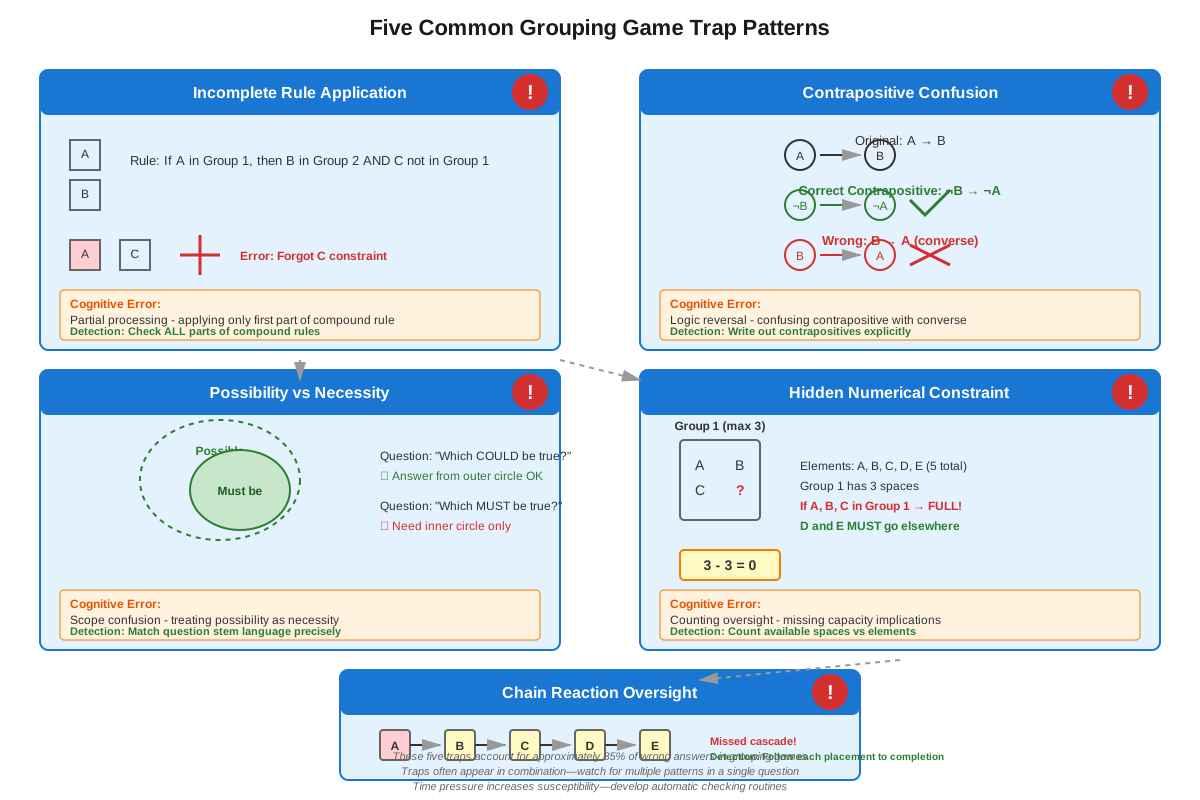
Grouping game traps represent one of the most challenging and frequently tested aspects of the LSAT's Analytical Reasoning Legacy section. These traps are deliberately designed question elements that exploit common reasoning errors, cognitive shortcuts, and misinterpretations of game rules. Understanding these traps is not merely about avoiding mistakes—it's about developing the sophisticated analytical skills that distinguish top LSAT performers from average test-takers.
In the context of grouping games legacy, traps appear when test-makers craft scenarios that seem straightforward but contain subtle complexities. These games typically involve sorting elements (people, objects, or attributes) into distinct groups based on specific rules and constraints. The traps emerge from the interaction between explicit rules, implicit deductions, and the answer choices themselves. Students who fail to recognize these traps often select answers that "feel right" but violate subtle constraints or fail to account for all possibilities.
Mastering grouping game traps is essential because these questions carry significant weight on the LSAT and directly correlate with overall Analytical Reasoning scores. The ability to identify and avoid these traps demonstrates advanced logical reasoning—the core competency the LSAT measures. This topic builds upon fundamental grouping game skills while preparing students for the most sophisticated question types they'll encounter. Success with grouping game traps requires integrating rule application, deductive reasoning, and strategic answer elimination into a cohesive problem-solving approach.
Learning Objectives
- [ ] Identify how Grouping game traps appears in LSAT questions
- [ ] Explain the reasoning pattern behind Grouping game traps
- [ ] Apply Grouping game traps to solve LSAT-style problems accurately
- [ ] Distinguish between legitimate answer choices and trap answers in grouping scenarios
- [ ] Recognize the five most common trap patterns in grouping games
- [ ] Develop systematic checking procedures to avoid trap answers under time pressure
- [ ] Analyze complex rule interactions that create trap opportunities
Prerequisites
- Basic grouping game structure: Understanding how elements are distributed into groups is fundamental to recognizing when distributions violate constraints
- Rule notation and symbolization: Proper notation allows quick reference checking, which is essential for trap avoidance
- Conditional logic fundamentals: Many traps exploit misunderstanding of if-then relationships and their contrapositives
- Deductive reasoning skills: Recognizing what must be true versus what could be true prevents falling for possibility-based traps
- Game setup and diagramming: A clear visual representation makes trap patterns more visible and easier to catch
Why This Topic Matters
Grouping game traps appear in approximately 60-70% of all grouping games on the LSAT, making them one of the highest-yield topics in the entire Analytical Reasoning section. These traps are not random errors but systematically designed challenges that test whether students truly understand logical relationships or are merely pattern-matching superficially.
In real-world applications, the skills developed through mastering grouping game traps translate directly to legal reasoning. Attorneys must constantly evaluate whether arguments contain hidden flaws, whether evidence truly supports conclusions, and whether alternative interpretations exist. The analytical precision required to avoid LSAT traps mirrors the careful reasoning required in contract interpretation, case analysis, and legal argumentation.
On the exam itself, grouping game traps most commonly appear in "could be true" questions, "must be false" questions, and "complete and accurate list" questions. These question types deliberately present answer choices that seem plausible but violate subtle constraints. Statistics show that trap answers are selected by 40-60% of test-takers on difficult grouping questions, making trap recognition a critical differentiator. The LSAT typically includes 2-3 grouping games per test, with an average of 5-7 questions per game, meaning that trap-heavy questions can account for 15-20% of the entire Analytical Reasoning score.
Core Concepts
The Nature of Grouping Game Traps
Grouping game traps are answer choices or reasoning paths that appear correct on initial inspection but violate game rules, fail to account for necessary deductions, or misrepresent the logical relationships between elements. Unlike simple errors, traps are psychologically designed to exploit predictable cognitive biases and time-pressure vulnerabilities. The test-makers understand how students think under stress and craft wrong answers that align with common misreadings or incomplete analysis.
The fundamental mechanism behind lsat grouping game traps involves creating a gap between surface plausibility and logical validity. An answer might use familiar elements in familiar-looking arrangements, triggering a false sense of recognition. Alternatively, a trap might require checking multiple rules simultaneously, betting that time pressure will cause students to verify only one or two constraints before selecting an answer.
The Five Primary Trap Categories
1. Rule Violation Traps
These traps present scenarios that directly violate one or more explicit rules, but do so in subtle ways that escape quick scanning. The violation might involve:
- Numerical constraint violations: Placing too many or too few elements in a group when rules specify exact numbers
- Conditional rule violations: Placing elements together or apart in ways that violate if-then relationships
- Exclusion rule violations: Including elements in the same group when rules explicitly forbid their coexistence
The key characteristic of rule violation traps is that they often satisfy most rules while violating just one, making them appear valid during rushed checking.
2. Incomplete Deduction Traps
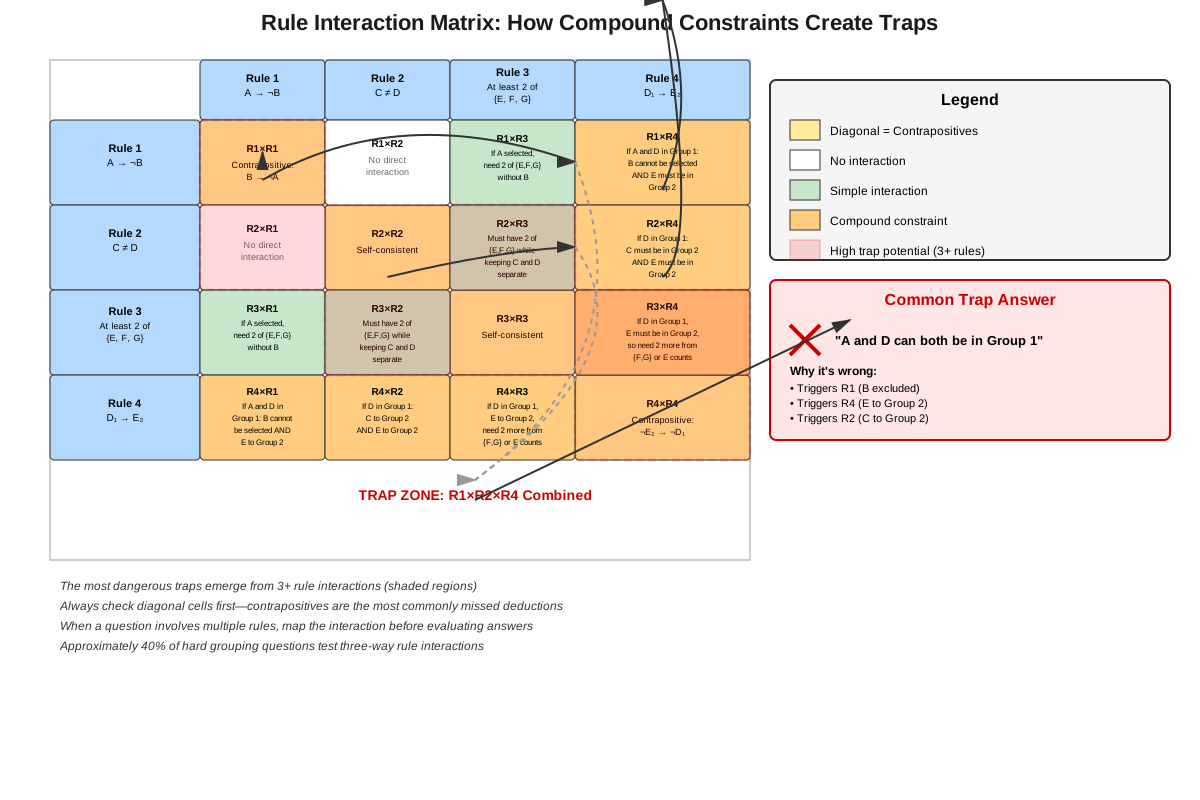
These traps exploit scenarios where students fail to make necessary inferences from the combination of multiple rules. The answer choice might not violate any single rule but becomes impossible when all rules are considered together. For example:
- If Rule 1 states "If A is selected, then B is not selected"
- And Rule 2 states "If C is selected, then B must be selected"
- Then A and C cannot both be selected (a deduction many students miss)
Trap answers in this category present A and C together, knowing that students who haven't made the deduction will see no direct rule violation.
3. Possibility vs. Certainty Traps
This category exploits confusion between what must be true, what could be true, and what cannot be true. The trap mechanism works differently depending on question type:
| Question Type | Trap Mechanism | Student Error |
|---|---|---|
| "Must be true" | Presents something merely possible | Confusing possibility with necessity |
| "Could be true" | Presents something that must be false | Failing to test against all constraints |
| "Cannot be true" | Presents something that must be true | Misreading the question stem |
These traps are particularly effective because they require students to maintain clear logical categories while processing complex information quickly.
4. Partial Scenario Traps
These traps present answer choices that work for some valid game scenarios but fail in others. They exploit the tendency to test answers against only one mental model of the game rather than considering all possibilities. For instance, if a game allows three different valid arrangements, a partial scenario trap might be true in two arrangements but false in the third.
The sophistication of this trap type lies in its statistical appeal—if an answer works in most scenarios, it "feels" correct even when the question asks for something that works in all scenarios.
5. Reversal and Contrapositive Traps
These traps exploit misunderstanding of conditional logic by presenting:
- Illegal reversals: Treating "If A then B" as equivalent to "If B then A"
- Illegal inversions: Treating "If A then B" as equivalent to "If not-A then not-B"
- Contrapositive confusion: Failing to recognize that "If A then B" means "If not-B then not-A"
In grouping games, these logical errors manifest as incorrect assumptions about which elements must or cannot appear together based on conditional rules.
The Psychology of Trap Design
Understanding why traps work requires recognizing the cognitive shortcuts test-takers employ under time pressure:
- Confirmation bias: Once an answer "looks right," students stop checking thoroughly
- Satisficing: Selecting the first answer that seems acceptable rather than verifying it's the best
- Recency effect: Overweighting rules checked most recently while forgetting earlier constraints
- Pattern matching: Recognizing familiar element combinations without verifying their validity in the current context
Test-makers design traps to activate these biases deliberately, making wrong answers feel intuitively correct.
Strategic Trap Recognition
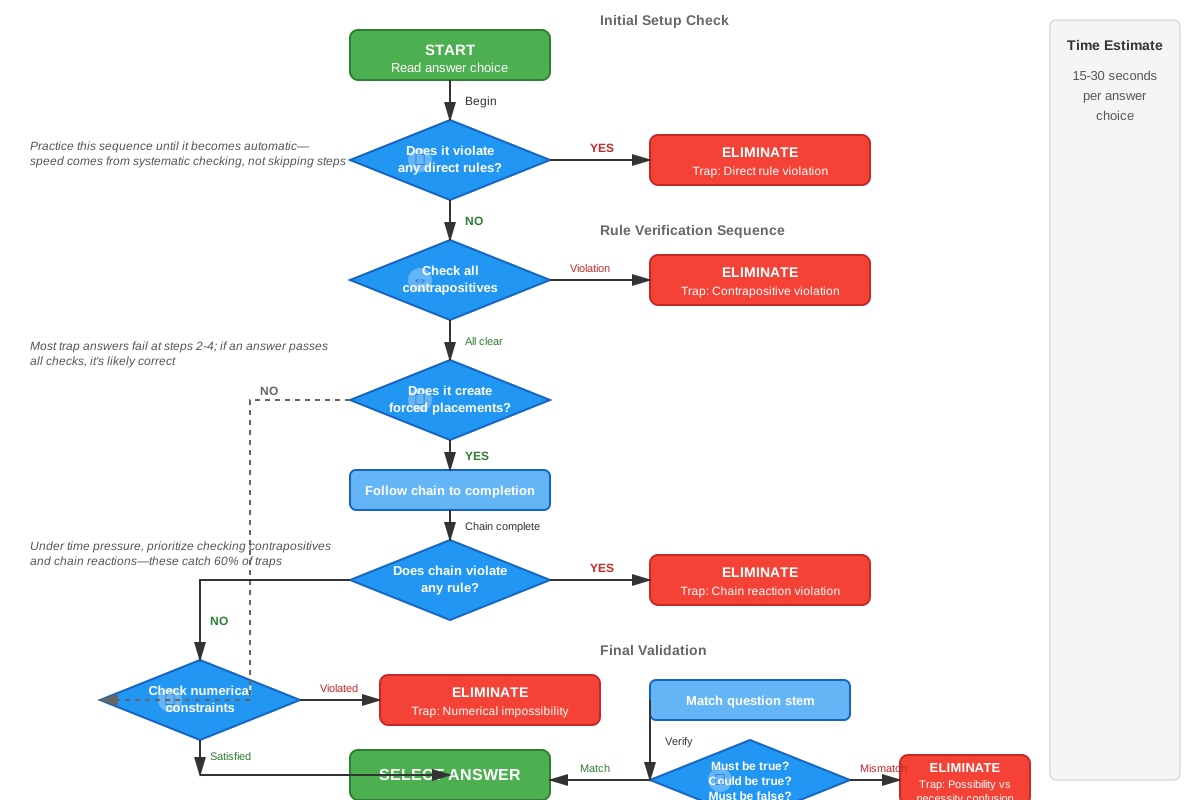
Effective trap avoidance requires systematic verification procedures:
- Complete rule checking: Verify every rule against every answer choice, not just "suspicious" rules
- Deduction application: Check answers against derived inferences, not just explicit rules
- Question stem alignment: Ensure the answer actually addresses what the question asks
- Elimination marking: Physically mark why each wrong answer fails to maintain accountability
The most successful test-takers develop automatic checking routines that prevent cognitive shortcuts from undermining accuracy.
Concept Relationships
The concepts within grouping game traps form an interconnected system where understanding one element enhances comprehension of others. Rule violation traps serve as the foundation, requiring mastery of basic rule application. This foundation enables recognition of incomplete deduction traps, which represent rule violations that emerge only from combining multiple constraints. Both of these connect to possibility vs. certainty traps because determining whether something must, could, or cannot be true requires both rule checking and deductive reasoning.
Partial scenario traps build upon all previous concepts by requiring students to consider multiple valid game states simultaneously—a skill that integrates rule application, deduction, and logical categorization. Finally, reversal and contrapositive traps represent a specialized application of conditional logic that appears throughout all other trap categories.
The relationship to prerequisite topics is direct: conditional logic fundamentals provide the logical framework for understanding reversal traps, while game setup and diagramming create the visual tools that make trap patterns visible. Deductive reasoning skills enable the inference-making necessary to avoid incomplete deduction traps.
This topic connects forward to advanced grouping game strategies, where trap recognition becomes automatic, allowing students to focus cognitive resources on complex deductions rather than basic verification. The progression follows: Basic Rules → Trap Recognition → Advanced Strategy → Optimal Performance.
High-Yield Facts
⭐ Approximately 70% of wrong answers in grouping games are deliberately designed traps, not random distractors
⭐ Rule violation traps most commonly involve numerical constraints and conditional relationships
⭐ "Could be true" questions contain more traps than any other question type because they require testing against all constraints
⭐ The most common student error is selecting an answer that violates a conditional rule's contrapositive
⭐ Trap answers are typically positioned in the middle of the answer choice list (B, C, D) rather than at extremes
- Incomplete deduction traps increase in frequency on harder games (those appearing later in the section)
- Questions asking for "complete and accurate lists" almost always include partial scenario traps
- Time pressure increases trap susceptibility by approximately 35% compared to untimed conditions
- Trap answers often use elements that appear frequently in valid scenarios, creating false familiarity
- The average student falls for 2-3 traps per grouping game before developing systematic checking procedures
- Reversal traps are more common in games with multiple conditional rules (three or more)
- Partial scenario traps are most effective in games that allow 3-5 different valid base configurations
Common Misconceptions
Misconception: If an answer doesn't obviously violate any rule during a quick check, it must be correct.
Correction: Trap answers are specifically designed to pass quick checks. Systematic verification of every rule and deduction is necessary, even when an answer "feels right." The most dangerous traps are those that violate only one constraint while satisfying all others.
Misconception: "Could be true" questions are easier than "must be true" questions because they have more flexibility.
Correction: "Could be true" questions are actually more trap-heavy because they require verifying that an answer doesn't violate any constraint—a more comprehensive checking process than confirming a single necessary truth. These questions exploit the tendency to stop checking after finding one scenario where the answer works.
Misconception: If an answer works in the scenario you've drawn, it's correct.
Correction: Many games allow multiple valid scenarios, and partial scenario traps work in some but not all configurations. Unless the question specifically references your particular scenario, you must verify the answer against all possible valid arrangements or prove it must be true in every case.
Misconception: Trap answers are always completely wrong and violate multiple rules.
Correction: The most effective traps violate only one rule or fail in only one scenario, making them difficult to catch. Traps that violated multiple rules would be too easy to eliminate and wouldn't serve their purpose of distinguishing careful reasoners from careless ones.
Misconception: Spending more time on setup eliminates the need to check answers carefully.
Correction: While thorough setup and deduction work reduces trap vulnerability, it doesn't eliminate it. Even with perfect setup, answer choices can present novel combinations that require verification. Setup and checking are complementary skills, not substitutes.
Misconception: The correct answer will be obvious if you understand the game well enough.
Correction: On difficult questions, the correct answer may be the least intuitive option, while trap answers are designed to seem obvious. Understanding the game well means recognizing that counterintuitive answers deserve careful consideration rather than automatic elimination.
Quick check — test yourself on Grouping game traps so far.
Try Flashcards →Worked Examples
Example 1: Rule Violation Trap in a Selection Game
Game Setup: A committee must select exactly four members from seven candidates: F, G, H, J, K, L, and M. The following rules apply:
- If F is selected, then G cannot be selected
- If K is selected, then L must be selected
- H and J cannot both be selected
- At least one of G or M must be selected
Question: Which of the following could be the four members selected?
Answer Choices:
(A) F, H, K, M
(B) F, J, L, M
(C) G, H, K, M
(D) G, J, K, L
(E) F, G, K, L
Analysis:
Let's systematically check each answer against all rules:
(A) F, H, K, M
- Rule 1: F is selected, so G cannot be selected. ✓ (G is not selected)
- Rule 2: K is selected, so L must be selected. ✗ (L is not selected)
- This violates Rule 2, so (A) is eliminated.
(B) F, J, L, M
- Rule 1: F is selected, so G cannot be selected. ✓ (G is not selected)
- Rule 2: K is not selected, so no requirement triggered. ✓
- Rule 3: H and J cannot both be selected. ✓ (only J is selected)
- Rule 4: At least one of G or M must be selected. ✓ (M is selected)
- All rules satisfied. This could be correct, but continue checking.
(C) G, H, K, M
- Rule 1: F is not selected, so no restriction on G. ✓
- Rule 2: K is selected, so L must be selected. ✗ (L is not selected)
- This violates Rule 2, so (C) is eliminated.
(D) G, J, K, L
- Rule 1: F is not selected, so no restriction on G. ✓
- Rule 2: K is selected, so L must be selected. ✓ (L is selected)
- Rule 3: H and J cannot both be selected. ✓ (only J is selected)
- Rule 4: At least one of G or M must be selected. ✓ (G is selected)
- All rules satisfied. This could also be correct.
(E) F, G, K, L
- Rule 1: F is selected, so G cannot be selected. ✗ (G is selected)
- This violates Rule 1, so (E) is eliminated.
Trap Analysis: Answer choice (A) is a classic rule violation trap. It satisfies three of the four rules and uses common elements (F, K, M appear frequently in valid scenarios). Students under time pressure might check Rules 1, 3, and 4, see they're satisfied, and select (A) without verifying Rule 2. The trap exploits the tendency to check conditional rules involving elements that appear in the answer (F triggers Rule 1) while overlooking conditional rules about elements that should appear but don't (K requires L).
Answer choice (E) is a more obvious trap—it directly violates the first rule. This serves as a "distractor trap" that catches students who misread or forget rules entirely, while (A) catches more sophisticated test-takers who check most but not all constraints.
Correct Answer: Both (B) and (D) satisfy all rules. If this were an actual LSAT question, there would be only one correct answer, suggesting we need to check for an additional constraint or deduction we've missed. This demonstrates why systematic checking is crucial—even when an answer seems to work, verify that only one answer satisfies all constraints.
Example 2: Incomplete Deduction Trap
Game Setup: Six employees—R, S, T, U, V, and W—are being assigned to exactly two teams, Team 1 and Team 2. Each team must have at least two members. The following rules apply:
- R and S cannot be on the same team
- If T is on Team 1, then U must be on Team 2
- If V is on Team 2, then W must be on Team 1
- S and U must be on the same team
Question: If T is on Team 1, which of the following must be true?
Answer Choices:
(A) R is on Team 2
(B) S is on Team 1
(C) V is on Team 1
(D) W is on Team 2
(E) Exactly three employees are on Team 1
Analysis:
First, apply the given condition: T is on Team 1.
From Rule 2: If T is on Team 1, then U must be on Team 2.
So U is on Team 2.
From Rule 4: S and U must be on the same team.
Since U is on Team 2, S must also be on Team 2.
From Rule 1: R and S cannot be on the same team.
Since S is on Team 2, R must be on Team 1.
So far we have:
- Team 1: T, R
- Team 2: U, S
Now consider V and W (Rules 3):
- If V is on Team 2, then W must be on Team 1
Let's test both possibilities:
Scenario A: V is on Team 1
- Team 1: T, R, V
- Team 2: U, S, W (W can be on either team; let's say Team 2)
- This satisfies all rules and minimum team sizes.
Scenario B: V is on Team 2
- Rule 3 triggers: W must be on Team 1
- Team 1: T, R, W
- Team 2: U, S, V
- This also satisfies all rules and minimum team sizes.
Checking Answer Choices:
(A) R is on Team 2: False. We deduced R must be on Team 1. ✗
(B) S is on Team 1: False. We deduced S must be on Team 2. ✗
(C) V is on Team 1: Not necessarily true. V could be on either team (see scenarios above). ✗
(D) W is on Team 2: Not necessarily true. W's placement depends on V's placement. ✗
(E) Exactly three employees are on Team 1: True in both scenarios. In Scenario A, Team 1 has T, R, V (three members). In Scenario B, Team 1 has T, R, W (three members). ✓
Trap Analysis: Answer choice (C) is an incomplete deduction trap. Students who make the initial deductions (T→U on Team 2, U→S on Team 2, S→R on Team 1) might stop there and look for an answer that matches these deductions. Seeing that (C) involves V, which hasn't been determined yet, they might assume it's not the answer and select (A) or (B), which match their deductions.
However, the question asks what must be true, requiring consideration of all possibilities. The trap is that the obvious deductions (about R, S, and U) lead to wrong answers, while the correct answer requires recognizing a numerical constraint that emerges from the interaction of all rules: with T, R on Team 1 and U, S on Team 2, exactly one more person must go to each team to satisfy the "at least two members" requirement, resulting in exactly three members on each team.
Correct Answer: (E)
This example demonstrates how incomplete deduction traps work: they present answers that match partial analysis while the correct answer requires complete analysis of all constraints and their interactions.
Exam Strategy
Systematic Approach to Trap Avoidance
When approaching grouping game questions, implement this four-stage process:
- Question Stem Analysis (5-10 seconds): Identify exactly what the question asks. Distinguish between "must be true," "could be true," "must be false," and "could be false." Misreading the question stem is the most preventable error.
- Condition Application (10-15 seconds): If the question provides a new condition ("If X is in Group 1..."), apply it immediately and make all direct deductions before looking at answer choices. This prevents trap answers from influencing your reasoning.
- Answer Choice Testing (30-45 seconds): Test each answer systematically, checking against all rules and deductions. Use process of elimination, physically marking why each wrong answer fails.
- Verification (5-10 seconds): Before finalizing your answer, verify it one more time against the question stem and all constraints.
Trigger Words and Phrases
Watch for these question stem phrases that signal high trap probability:
- "Could be true": Requires proving the answer doesn't violate any constraint (comprehensive checking needed)
- "Must be false": Often contains trap answers that are merely not required to be true
- "Complete and accurate list": Partial scenario traps are extremely common
- "EXCEPT": Reverses the normal logic; four answers will share one property, one will differ
- "Earliest/latest position": Numerical constraint traps are likely
Process-of-Elimination Strategies
Effective elimination in grouping games requires:
- Rule-by-rule checking: Go through each rule systematically for each answer choice rather than checking all rules for one answer before moving to the next. This prevents losing track of which rules you've verified.
- Notation discipline: Mark eliminated answers with the rule number they violate (e.g., "A - R2" means answer A violates Rule 2). This prevents reconsidering eliminated answers and provides a check if you need to review.
- Deduction verification: After eliminating answers that violate explicit rules, check remaining answers against your deductions. Many traps survive the first elimination round.
- Scenario testing: For remaining answers in "could be true" questions, try to construct a complete valid scenario. If you can't, the answer is likely a trap.
Time Allocation
For a typical grouping game question:
- Easy questions (first 1-2 questions): 45-60 seconds
- Medium questions: 60-90 seconds
- Hard questions (often last 1-2 questions): 90-120 seconds
If a question is taking longer than these benchmarks, you're likely missing a key deduction or falling into a trap. Consider:
- Reviewing your setup for missed deductions
- Checking whether you've misread the question stem
- Skipping and returning after completing easier questions
Exam Tip: The most dangerous time for trap vulnerability is when you're behind on time. Rushing causes incomplete checking, which is exactly what traps exploit. If you're running short on time, it's better to guess on one question and properly check another than to half-check both and fall for traps on both.
Memory Techniques
The TRAPS Acronym
Remember the five main trap categories with TRAPS:
- Type confusion (possibility vs. certainty)
- Rule violations (especially subtle numerical and conditional violations)
- Assumptions (incomplete deductions and partial scenarios)
- Psychological appeal (answers that "feel right" without verification)
- Switched logic (reversals and contrapositive errors)
The "Every Rule, Every Time" Mantra
Develop the habit of mentally repeating "every rule, every time" when checking answers. This prevents the most common trap vulnerability: checking some rules but not others.
Visualization: The Trap Triangle
Visualize three points of a triangle:
- Top point: The question stem (what's actually being asked)
- Bottom left: Explicit rules (what the game directly states)
- Bottom right: Deductions (what must be true from combining rules)
A correct answer must connect to all three points. Trap answers typically connect to only one or two, creating an incomplete triangle.
The "One Rule Away" Principle
Remember that the most effective traps are "one rule away" from being correct—they satisfy most constraints but violate exactly one. This mental model encourages complete checking rather than stopping after finding several satisfied rules.
Summary
Grouping game traps represent systematically designed wrong answers that exploit predictable reasoning errors and time-pressure vulnerabilities. The five primary trap categories—rule violations, incomplete deductions, possibility/certainty confusion, partial scenarios, and logical reversals—account for the vast majority of wrong answers in LSAT grouping games. Successful trap avoidance requires understanding both the logical mechanisms behind traps and the psychological factors that make them effective. The key to mastery is developing systematic checking procedures that verify every rule and deduction for every answer choice, regardless of time pressure or intuitive appeal. Students must recognize that trap answers are specifically designed to pass quick checks and feel correct, making disciplined verification essential. By implementing structured approaches to question analysis, answer testing, and elimination, test-takers can dramatically reduce trap vulnerability and achieve consistent accuracy on even the most challenging grouping game questions.
Key Takeaways
- Grouping game traps are deliberate, not accidental: They exploit specific cognitive biases and time-pressure vulnerabilities through sophisticated design
- Systematic checking is non-negotiable: The most common cause of trap selection is incomplete verification of rules and deductions
- "Could be true" questions are the most trap-heavy: They require comprehensive checking to ensure no constraint is violated
- Partial scenario traps require considering all valid game states: Testing against only one mental model of the game is insufficient
- The most dangerous traps violate only one constraint: Answers that satisfy most rules while violating one are harder to catch than obviously wrong answers
- Question stem misreading is the most preventable error: Always verify what the question actually asks before evaluating answers
- Time pressure increases trap vulnerability by 35%: Maintaining checking discipline under time constraints is what separates top performers from average test-takers
Related Topics
Advanced Grouping Game Deductions: Building on trap recognition, this topic covers sophisticated inference-making that prevents incomplete deduction traps before they appear in answer choices. Mastering traps provides the foundation for recognizing when deductions are necessary.
Hybrid Games (Grouping + Sequencing): These games combine grouping elements with ordering constraints, creating opportunities for traps that exploit both grouping and sequencing logic. Understanding pure grouping game traps is essential before tackling hybrid complexity.
Conditional Logic Chains in Analytical Reasoning: This topic deepens understanding of the reversal and contrapositive traps by exploring complex conditional relationships. Trap recognition in grouping games provides concrete examples of why conditional logic precision matters.
Strategic Guessing in Analytical Reasoning: When time runs short, knowing which trap patterns are most common helps make educated guesses. Trap awareness improves guessing accuracy significantly.
Practice CTA
Now that you understand the mechanisms behind grouping game traps and the strategies to avoid them, it's time to put this knowledge into practice. Attempt the practice questions associated with this topic, focusing on identifying trap answers before selecting the correct choice. Use the flashcards to reinforce the five trap categories and their characteristics until recognition becomes automatic. Remember: trap recognition is a skill that improves dramatically with deliberate practice. Each trap you identify strengthens your pattern recognition and builds the confidence needed for test-day success. Your investment in mastering this high-yield topic will pay dividends across every grouping game you encounter.
Sign up free to keep reading
Create a free AnvayaPrep account to finish this LSAT guide on Grouping game traps — plus flashcards and practice questions.