Overview
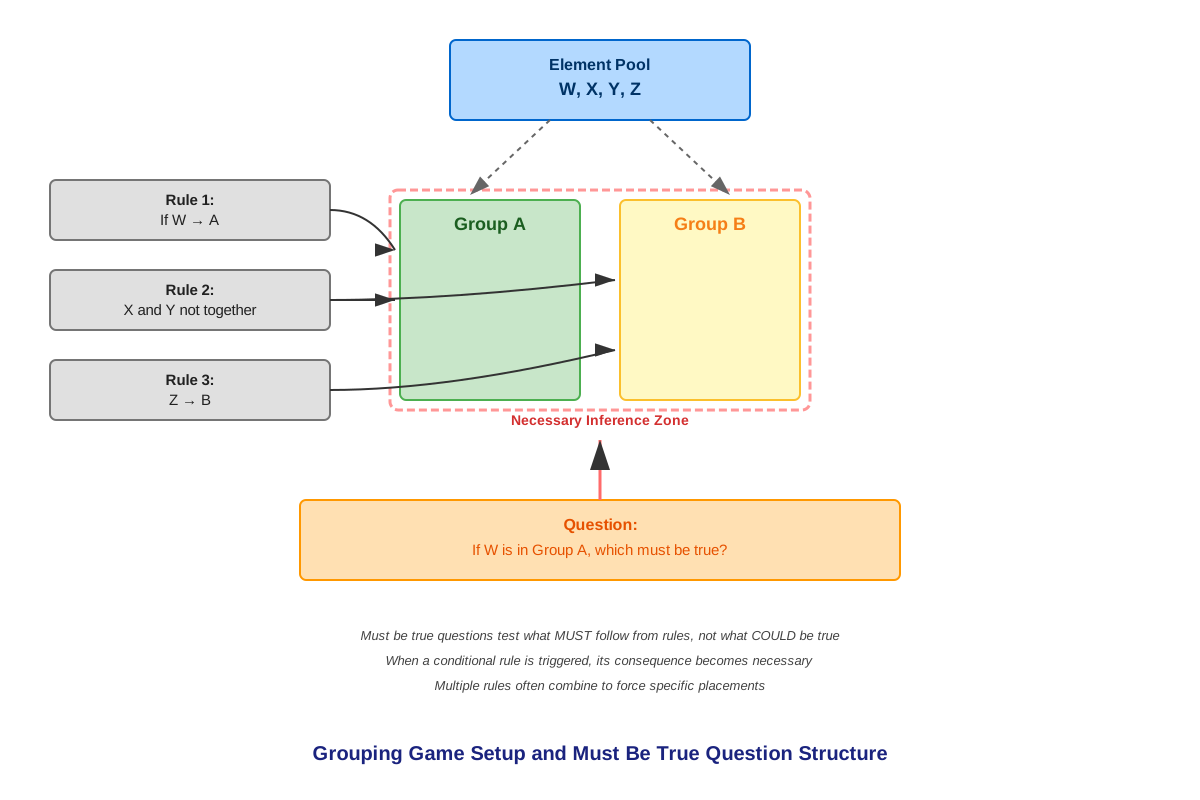
Grouping must be true questions represent one of the most critical question types within LSAT grouping games legacy problems. These questions challenge test-takers to identify statements that must be accurate given the game's rules and constraints, requiring rigorous deductive reasoning rather than speculation about what could be true. Within the analytical reasoning legacy section of the LSAT, grouping games ask students to sort elements into distinct categories or groups, and "must be true" questions specifically test whether students can recognize necessary logical consequences of the established rules.
Mastering this question type is essential because it appears with high frequency on the LSAT and directly measures the core analytical skill the exam seeks to evaluate: the ability to draw valid inferences from a set of constraints. Unlike "could be true" questions that allow for multiple possibilities, must be true questions demand absolute certainty. Students must eliminate all scenarios except those that are logically required by the game's structure. This precision distinguishes strong performers from average test-takers.
The relationship between grouping must be true questions and broader analytical reasoning concepts is foundational. These questions build upon basic rule interpretation, constraint application, and deductive inference skills. They connect directly to conditional reasoning, contrapositive logic, and the ability to recognize when rules combine to force specific outcomes. Success with must be true questions in grouping games translates to improved performance across all logic game types, as the underlying reasoning patterns—identifying necessary versus possible outcomes—apply universally throughout the analytical reasoning section.
Learning Objectives
- [ ] Identify how Grouping must be true questions appears in LSAT questions
- [ ] Explain the reasoning pattern behind Grouping must be true questions
- [ ] Apply Grouping must be true questions to solve LSAT-style problems accurately
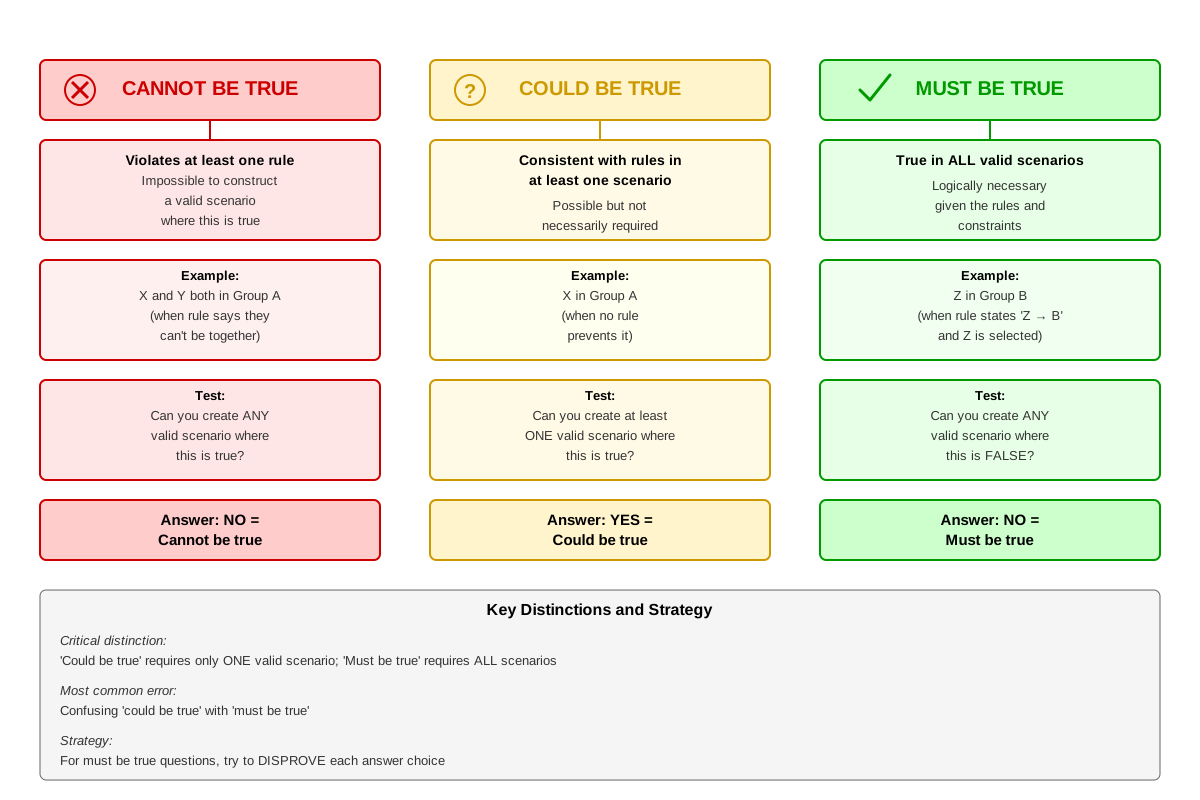
- [ ] Distinguish between "must be true," "could be true," and "cannot be true" answer choices in grouping contexts
- [ ] Recognize when multiple rules combine to create necessary inferences in grouping scenarios
- [ ] Develop systematic approaches to testing answer choices against all game constraints efficiently
Prerequisites
- Basic logic game setup and diagramming: Understanding how to represent grouping games visually is essential for tracking which elements can or must be placed in which groups
- Rule interpretation and notation: Students must be able to translate written constraints into symbolic form to work efficiently with multiple rules simultaneously
- Conditional reasoning fundamentals: Many grouping rules take conditional form ("If X is selected, then Y must be selected"), requiring fluency with if-then logic
- Understanding of game types: Recognizing grouping games as distinct from sequencing or hybrid games helps students apply appropriate strategies
- Deductive versus inductive reasoning: Must be true questions require deductive certainty, not probabilistic thinking or pattern recognition
Why This Topic Matters
Grouping must be true questions appear in approximately 60-70% of all grouping games on the LSAT, making them one of the highest-yield question types for analytical reasoning preparation. The LSAT typically includes 1-2 grouping games per test, and each game usually contains 2-4 must be true questions among its 5-7 questions. This frequency means that mastering this question type can directly impact 4-8 points on the analytical reasoning section alone—a significant score differential.
Beyond exam performance, the reasoning skills developed through these questions have practical applications in legal analysis. Attorneys must regularly determine what conclusions necessarily follow from statutes, precedents, and facts versus what merely might be true. The ability to distinguish between logical necessity and possibility is fundamental to legal argumentation, contract interpretation, and case analysis.
On the LSAT, grouping must be true questions typically appear in several formats: direct "which one of the following must be true?" questions, "if X is in Group 1, which must be true?" conditional questions, and "which one of the following is a complete and accurate list of elements that could be in Group 2?" questions that require identifying necessary constraints. These questions often appear after students have worked through the initial setup, testing whether they've identified all the game's implications. The most challenging versions combine multiple rules or require students to recognize what must be true across all possible valid scenarios, not just one particular arrangement.
Core Concepts
Understanding "Must Be True" Logic
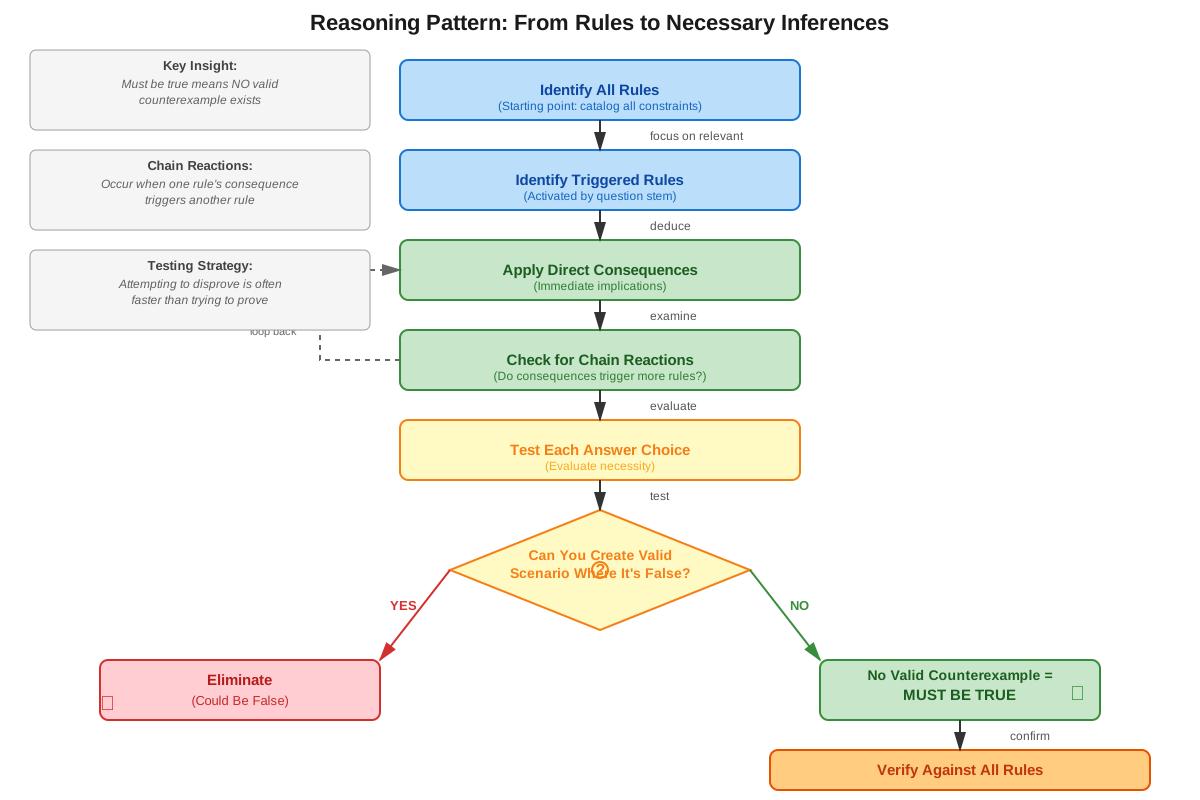
The foundation of lsat grouping must be true questions lies in understanding logical necessity. A statement "must be true" when it is accurate in every possible valid arrangement of the game. This differs fundamentally from "could be true" (true in at least one valid scenario) or "could be false" (false in at least one valid scenario). For a statement to qualify as "must be true," there can be no valid game scenario in which it is false.
In grouping games, this typically means that the rules and constraints, when properly combined, eliminate all possibilities except one specific outcome for a particular element or relationship. For example, if a game states "Either F or G must be selected, but not both" and another rule states "If F is selected, then H cannot be selected," and a third rule requires "H must be selected," then G must be selected (because F would violate the H requirement). This chain of reasoning demonstrates logical necessity.
Rule Combination and Inference Chains
The most powerful technique for identifying must be true answers involves recognizing how multiple rules interact. Individual rules rarely create must be true scenarios on their own; instead, the combination of constraints forces specific outcomes. Students must develop the skill of "rule chaining"—following one rule's consequence to trigger another rule, which may trigger a third.
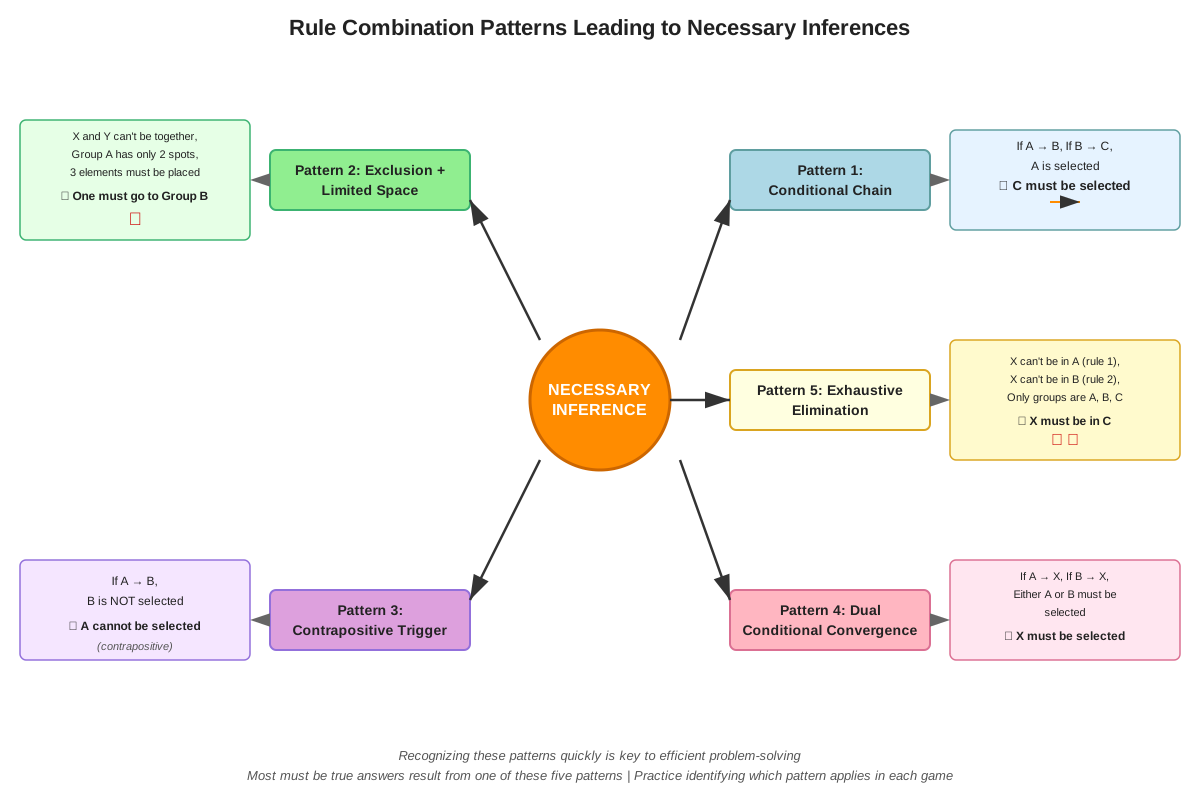
Consider this pattern: Rule 1 states "If A is in Group 1, then B is in Group 2." Rule 2 states "If B is in Group 2, then C is in Group 1." Rule 3 states "D and C cannot both be in Group 1." If the question stem establishes that A is in Group 1, then through rule chaining: A in Group 1 → B in Group 2 → C in Group 1 → D cannot be in Group 1. Therefore, "D is not in Group 1" must be true.
Contrapositive Application in Grouping Contexts
Conditional rules in grouping games have contrapositives that are equally valid and often more useful for identifying must be true answers. If a rule states "If X is selected, then Y is selected," the contrapositive is "If Y is not selected, then X is not selected." In grouping contexts, this translates to: "If Y is out, then X is out."
The strategic value of contrapositives in must be true questions cannot be overstated. Often, the direct application of a rule doesn't immediately reveal what must be true, but the contrapositive does. For instance, if you know that element M must be excluded from selection (perhaps due to other constraints), and you have a rule "If L is selected, then M is selected," the contrapositive tells you that L cannot be selected—a must be true inference.
Exhaustive Scenario Testing
Some grouping must be true questions require students to recognize that across all possible valid arrangements, a particular statement holds true. This demands a systematic approach to scenario generation. Students should identify the game's key decision points (often binary choices or limited options) and work through each possibility to determine what remains constant.
For example, if a game has a rule "Either J or K must be in Group A," this creates two main scenarios to explore. By working through both scenarios and applying all other rules, students can identify elements or relationships that appear in both scenarios—these represent must be true statements. This technique is particularly valuable when answer choices seem plausible but only one is universally necessary.
Distinguishing Necessary from Sufficient Conditions
A critical skill for must be true questions involves recognizing the difference between necessary and sufficient conditions in grouping contexts. A sufficient condition guarantees an outcome (if X, then Y), while a necessary condition is required for an outcome (Y only if X). Must be true questions often test whether students understand that satisfying a sufficient condition doesn't mean it's the only way to achieve that outcome.
For instance, if a rule states "If P is selected, then Q is selected," this makes P sufficient for Q but doesn't make P necessary for Q. Q could be selected for other reasons. However, Q is necessary for P (P cannot be selected without Q). Understanding this distinction prevents students from incorrectly concluding that Q being selected means P must be selected.
Numerical Constraints and Must Be True Inferences
Grouping games often include numerical constraints (e.g., "exactly three elements must be selected" or "at least two elements must be in Group B"). These constraints frequently combine with other rules to create must be true inferences. When the number of available elements that satisfy certain criteria equals the required number, all those elements must be included.
For example, if a game requires exactly four elements to be selected, and rules eliminate all but four elements as possibilities, then all four remaining elements must be selected. Similarly, if Group A must contain exactly two elements, and only two elements are eligible for Group A based on the rules, both must be in Group A—a must be true inference.
Concept Relationships
The concepts within grouping must be true questions form an interconnected reasoning system. Rule combination serves as the foundation, enabling inference chains that connect multiple constraints. These chains often rely on contrapositive application to work backward from what cannot be true to what must be true. Exhaustive scenario testing provides a verification method, ensuring that identified inferences hold across all valid arrangements. Necessary versus sufficient condition analysis prevents logical errors during inference generation, while numerical constraints often serve as the catalyst that transforms multiple possibilities into single necessary outcomes.
The relationship flows as follows: Individual rules → Contrapositive formulation → Rule combination → Inference chains → Scenario testing → Must be true identification. Each step builds upon the previous, and weakness in any area compromises the entire analytical process.
These concepts connect to prerequisite knowledge of conditional reasoning (providing the logical framework), game setup skills (enabling efficient rule tracking), and basic deductive logic (ensuring valid inference generation). They also relate to other question types within grouping games: must be true questions often share inference chains with "could be false" questions (the logical complement) and inform "complete and accurate list" questions (which require identifying all and only the necessary elements).
High-Yield Facts
- ⭐ A statement must be true only if it is accurate in every single valid arrangement of the game; one counterexample eliminates an answer choice
- ⭐ The contrapositive of conditional rules is equally valid and often more useful for identifying must be true inferences in grouping games
- ⭐ When multiple rules chain together, the final inference in the chain represents a must be true statement if the initial condition is established
- ⭐ Numerical constraints combined with eligibility rules frequently create must be true scenarios when available options equal required selections
- ⭐ Must be true questions often test inferences that require combining 2-3 rules rather than applying a single rule in isolation
- Answer choices that describe what "could" happen or what is "possible" are incorrect for must be true questions even if they're true in some scenarios
- If an element has no rules restricting its placement, statements about that element's specific placement rarely must be true
- Conditional rules with the same sufficient condition can be combined: "If A then B" and "If A then C" means "If A then both B and C"
- When a game establishes that exactly one of two elements must be selected, eliminating one makes the other a must be true inference
- Must be true inferences often involve negative statements (what cannot happen) rather than positive placements, especially in selection games
Quick check — test yourself on Grouping must be true questions so far.
Try Flashcards →Common Misconceptions
Misconception: If a statement could be true in the scenario you've drawn, it must be true for the question.
Correction: Must be true requires the statement to be accurate in all valid scenarios, not just one. Students must verify that no valid arrangement contradicts the statement before selecting it as a must be true answer.
Misconception: Conditional rules work in both directions (if X then Y means if Y then X).
Correction: Conditional rules are unidirectional. "If X then Y" does not mean "if Y then X." Only the contrapositive (if not Y then not X) is logically equivalent. Reversing conditionals is a common trap in must be true questions.
Misconception: When a rule says "if X is selected, then Y is selected," and Y is selected, then X must be selected.
Correction: This confuses necessary and sufficient conditions. X is sufficient for Y, but not necessary. Y can be selected without X being selected. Only when Y is not selected can you conclude that X is not selected (via contrapositive).
Misconception: Must be true questions always have complex answers requiring multiple inference steps.
Correction: While many must be true questions do require rule combination, some test straightforward application of a single rule or the contrapositive. Students should check simple inferences before assuming complexity.
Misconception: If four of five answer choices could be false, the remaining answer must be the correct "must be true" answer.
Correction: While process of elimination is valuable, students should verify that the remaining answer actually must be true rather than assuming it by default. Sometimes all answers could be false, indicating an error in reasoning or setup.
Worked Examples
Example 1: Basic Rule Combination
Game Setup: Six volunteers—F, G, H, J, K, and L—are being assigned to two committees, Committee 1 and Committee 2. Each volunteer is assigned to exactly one committee. The following rules apply:
- If F is on Committee 1, then G is on Committee 2
- If H is on Committee 1, then J is on Committee 1
- K and L cannot both be on Committee 2
- G is on Committee 1
Question: Which one of the following must be true?
Answer Choices:
(A) F is on Committee 2
(B) H is on Committee 2
(C) J is on Committee 1
(D) K is on Committee 1
(E) L is on Committee 2
Solution Process:
Step 1: Identify the fixed information. We know G is on Committee 1 (given in the rules).
Step 2: Apply the contrapositive of the first rule. The rule states "If F is on Committee 1, then G is on Committee 2." The contrapositive is "If G is on Committee 1, then F is on Committee 2." Since G is on Committee 1, F must be on Committee 2.
Step 3: Verify this is the only must be true statement.
- (A) F is on Committee 2: MUST BE TRUE (from our inference)
- (B) H could be on either committee (no rule forces H's placement)
- (C) J is on Committee 1 only if H is on Committee 1, which isn't established
- (D) K could be on either committee as long as L isn't on Committee 2 with K
- (E) L could be on either committee
Answer: (A)
Learning Objective Connection: This example demonstrates identifying must be true questions (objective 1) and applying contrapositive reasoning (objective 2) to solve the problem accurately (objective 3).
Example 2: Complex Inference Chain with Numerical Constraints
Game Setup: A company must select exactly four of seven employees—R, S, T, U, V, W, and X—for a special project. The following conditions apply:
- If R is selected, then S is not selected
- If T is selected, then U is selected
- If V is selected, then W is selected
- Either V or X must be selected, but not both
- S is selected
Question: If T is selected, which one of the following must be true?
Answer Choices:
(A) R is not selected
(B) U is selected
(C) V is not selected
(D) W is not selected
(E) X is selected
Solution Process:
Step 1: Establish what we know from the setup. S is selected (given). Exactly four employees must be selected.
Step 2: Apply the contrapositive of the first rule. Since S is selected, R cannot be selected (contrapositive: if S is selected, then R is not selected).
Step 3: Apply the conditional from the question stem. If T is selected, then U is selected (given rule).
Step 4: Track our selections so far. We have: S (given), T (question stem), U (from T), and R is out. We need exactly four total, so we need one more person from {V, W, X}.
Step 5: Apply the either/or rule. Either V or X must be selected, but not both. Since we need exactly one more person and either V or X must be selected, one of them will be our fourth selection.
Step 6: Consider if V is selected. If V is selected, then W is selected (given rule). But this would give us five people (S, T, U, V, W), which violates the "exactly four" constraint.
Step 7: Conclude V cannot be selected. Therefore, X must be selected (from the either/or rule).
Step 8: Verify answer choices:
- (A) R is not selected: TRUE, but this is true regardless of whether T is selected
- (B) U is selected: TRUE, but this follows directly from T being selected
- (C) V is not selected: MUST BE TRUE (from our numerical constraint analysis)
- (D) W is not selected: TRUE (because V isn't selected), but follows from (C)
- (E) X is selected: TRUE (because V isn't selected), but follows from (C)
Answer: (C) is the most direct must be true inference, though (D) and (E) also must be true as consequences.
Learning Objective Connection: This example demonstrates complex rule combination (objective 5), distinguishing between multiple true statements to find the most fundamental inference (objective 4), and applying systematic problem-solving approaches (objective 6).
Exam Strategy
When approaching grouping must be true questions on the LSAT, begin by carefully reading the question stem to identify any additional conditions ("If X is in Group 1, which must be true?"). These conditional question stems create temporary rules that apply only to that question. Immediately apply these conditions to your master diagram and work through the inference chains before looking at answer choices.
Trigger words and phrases to watch for include: "must be true," "must be the case," "cannot be false," "is required," "is necessary," and "follows logically." These all indicate you're looking for logical necessity, not possibility. Conversely, be alert to trap answers that use language like "could be," "might be," or "is possible"—these indicate insufficient certainty for must be true questions.
Process of elimination strategy: For each answer choice, ask "Can I construct a valid scenario where this is false?" If yes, eliminate it immediately. This approach is often faster than trying to prove each answer must be true. However, always verify your final answer by confirming it must be true in all valid scenarios, not just the one you've drawn.
Time allocation: Spend 30-45 seconds on initial analysis (applying question stem conditions and identifying immediate inferences) before evaluating answer choices. If you cannot eliminate at least three answers within 60 seconds, you may have missed a key inference—return to your diagram and look for rule combinations. Don't spend more than 90 seconds total on any single must be true question; if stuck, mark it and return after completing easier questions.
Advanced technique: For questions that seem to have multiple plausible answers, create a quick two-column chart testing each remaining answer against the rules. The answer that survives all rule applications without contradiction is your must be true answer. This systematic approach prevents careless errors under time pressure.
Memory Techniques
MUST acronym for evaluating answer choices:
- Multiple scenarios checked (verified across all valid arrangements)
- Universal truth (true in every case, no exceptions)
- Sufficient evidence (rules directly support the conclusion)
- Tested contrapositives (considered reverse implications)
Visualization strategy: Picture rules as physical barriers or requirements. If a rule says "If A is selected, then B is selected," visualize A and B connected by a chain—selecting A pulls B along with it. If a rule says "C and D cannot both be selected," visualize them repelling each other like magnets. This spatial reasoning helps identify must be true inferences intuitively.
The "No Exception Rule": Create a mental stamp that says "NO EXCEPTIONS" and mentally stamp it on your answer before selecting it. This reinforces that must be true means absolutely no valid scenario contradicts the statement.
Contrapositive Quick Check: Remember "flip and negate" for conditional rules. If you can't immediately see how a rule applies, flip the terms and negate both—the contrapositive often reveals the must be true inference more clearly.
Summary
Grouping must be true questions represent a cornerstone of LSAT analytical reasoning, testing the ability to identify logically necessary conclusions from a set of constraints. Success requires understanding that "must be true" means true in every valid scenario without exception, distinguishing this from mere possibility. The key skills involve combining multiple rules through inference chains, applying contrapositives to work backward from what cannot be true, and recognizing when numerical constraints force specific outcomes. Students must systematically test answer choices against all game rules, eliminating any statement that could be false in even one valid arrangement. The most challenging questions require recognizing how three or more rules interact to create necessary inferences that aren't obvious from any single rule. Mastery comes from practicing the systematic application of rules, developing fluency with contrapositive reasoning, and building the discipline to verify that selected answers truly must be true rather than merely could be true.
Key Takeaways
- Must be true means true in every valid scenario; a single counterexample eliminates an answer choice
- Contrapositive application is essential—"if A then B" means "if not B then not A," often revealing must be true inferences
- Most must be true answers require combining 2-3 rules rather than applying a single rule in isolation
- Numerical constraints (exactly X elements, at least Y elements) frequently create must be true scenarios when combined with eligibility rules
- Process of elimination is powerful: ask "Can this be false?" for each answer choice rather than trying to prove each must be true
- Distinguish necessary from sufficient conditions to avoid reversing conditional logic incorrectly
- Always verify your final answer must be true in all scenarios, not just the one arrangement you've drawn
Related Topics
Grouping "Could Be True" Questions: After mastering must be true questions, students should study could be true questions, which require identifying statements that are possible in at least one valid scenario. The logical relationship between these question types (must be true is the complement of could be false) makes them natural companions for study.
Grouping "Must Be False" Questions: These questions ask for statements that are impossible in any valid scenario, representing the logical opposite of must be true questions. Understanding both types simultaneously strengthens overall logical reasoning skills.
Conditional Logic Chains in Sequencing Games: The inference chain techniques developed for grouping must be true questions apply directly to sequencing games, where conditional rules about order create similar must be true scenarios.
Complete and Accurate List Questions: These questions require identifying all elements that must (or could) satisfy certain criteria, building directly on must be true reasoning by requiring comprehensive analysis of all possibilities.
Practice CTA
Now that you've mastered the core concepts of grouping must be true questions, it's time to solidify your understanding through active practice. Attempt the practice questions associated with this topic, focusing on applying the systematic approaches outlined in this guide. Use the flashcards to reinforce key concepts like contrapositive application and rule combination techniques. Remember, expertise in analytical reasoning comes from deliberate practice—each question you work through builds the pattern recognition and logical fluency that will make these questions feel intuitive on test day. You've built the foundation; now construct mastery through application.
Sign up free to keep reading
Create a free AnvayaPrep account to finish this LSAT guide on Grouping must be true questions — plus flashcards and practice questions.