Overview
Selection games represent one of the most frequently tested question types within the Analytical Reasoning Legacy section of the LSAT, specifically falling under the broader category of grouping games legacy. In these games, test-takers must determine which elements from a larger set should be chosen (selected in) and which should be excluded (selected out) based on a series of conditional rules and constraints. Unlike sequencing games that focus on order, or distribution games that assign elements to multiple groups, selection games center on the binary decision of inclusion versus exclusion.
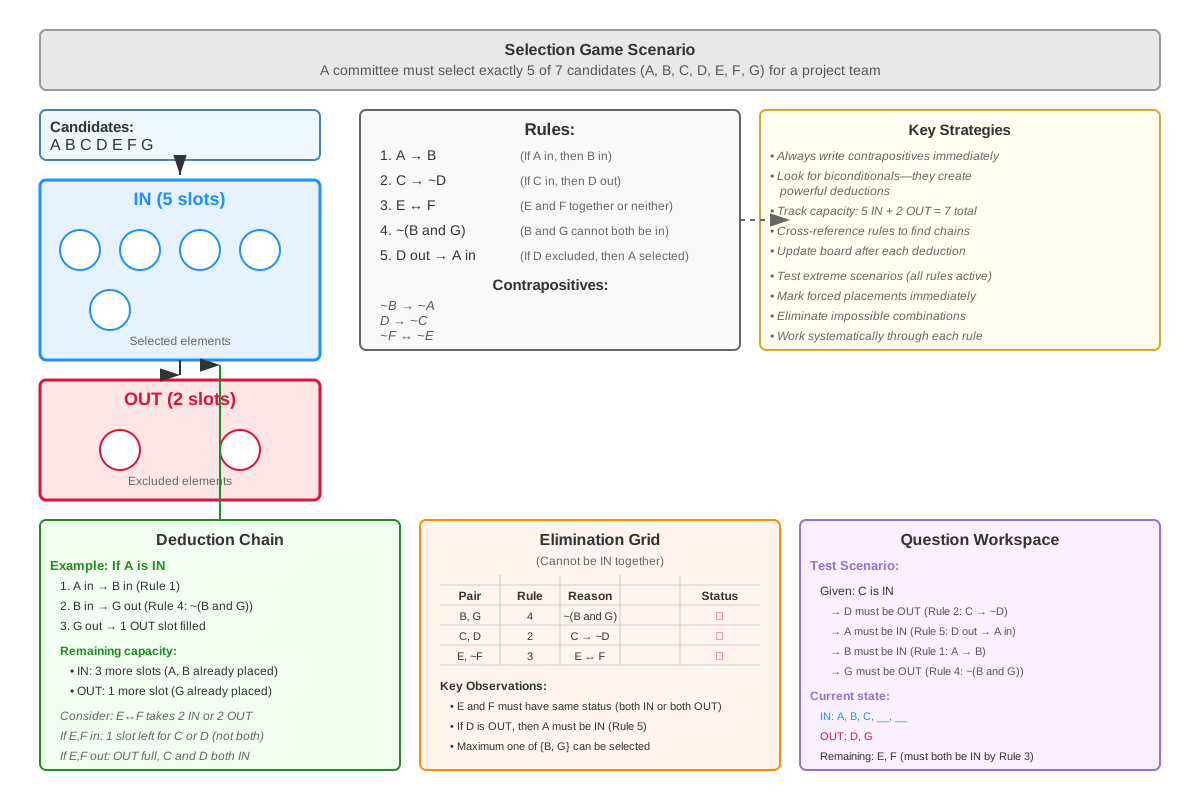
The fundamental challenge of LSAT selection games lies in tracking multiple conditional relationships simultaneously while understanding how selecting one element can trigger a cascade of required selections or exclusions. These games test logical reasoning, conditional logic mastery, and the ability to work through complex rule interactions. A typical selection game might present seven candidates for a committee with only five positions available, then provide rules about which candidates must be selected together, which cannot both be selected, and which selections trigger other mandatory choices.
Mastering selection games is essential for LSAT success because they appear in approximately 15-20% of all Analytical Reasoning sections and often serve as the foundation for understanding more complex hybrid games. The logical reasoning patterns developed through selection games—particularly conditional logic, contrapositive thinking, and rule-chain analysis—transfer directly to other game types and even to the Logical Reasoning section of the LSAT. Students who excel at selection games typically demonstrate strong performance across the entire Analytical Reasoning Legacy section because these games distill the core logical reasoning skills that underpin all analytical reasoning questions.
Learning Objectives
- [ ] Identify how Selection games appears in LSAT questions
- [ ] Explain the reasoning pattern behind Selection games
- [ ] Apply Selection games to solve LSAT-style problems accurately
- [ ] Construct complete and accurate game boards for selection scenarios
- [ ] Recognize and properly notate conditional rules specific to selection games
- [ ] Determine valid and invalid selections through rule application and contrapositive reasoning
- [ ] Identify forced selections and forced exclusions based on rule chains
Prerequisites
- Basic conditional logic: Understanding "if-then" statements is essential because selection games rely heavily on conditional rules that determine which elements must be included or excluded based on other selections.
- Contrapositive formation: The ability to form contrapositives is critical since many selection game deductions come from understanding that "if A is selected, then B is selected" means "if B is not selected, then A is not selected."
- Basic set theory: Understanding concepts of membership, inclusion, and exclusion helps visualize the selection process and track which elements belong to the "in" group versus the "out" group.
- Rule notation systems: Familiarity with standard LSAT notation conventions allows for efficient game board setup and rule tracking.
Why This Topic Matters
Selection games represent a high-yield topic for LSAT preparation because they combine frequency, predictability, and transferable skills. Approximately 15-20% of all Analytical Reasoning sections contain at least one selection game, making them nearly as common as basic sequencing games. More importantly, the conditional reasoning patterns that selection games test appear throughout the entire LSAT, including in Logical Reasoning questions involving sufficient and necessary conditions.
In real-world applications, selection game logic mirrors countless practical scenarios: hiring decisions where certain qualifications require or exclude others, committee formation with representation requirements, project team assembly with skill dependencies, and resource allocation with compatibility constraints. Legal professionals regularly engage in this type of reasoning when selecting jury members, determining which evidence to present, or deciding which arguments to include in a brief.
On the LSAT, selection games typically appear as scenarios involving committee formation, team selection, course enrollment, item purchasing, or event attendance. The most common question types include: "Which of the following could be a complete and accurate list of selected elements?", "If X is selected, which of the following must be true?", "Which of the following CANNOT be selected together?", and "What is the maximum/minimum number of elements that could be selected?" Understanding the underlying logic patterns allows test-takers to move through these questions efficiently and accurately, often completing selection games faster than other game types once the initial setup is mastered.
Core Concepts
The Selection Framework
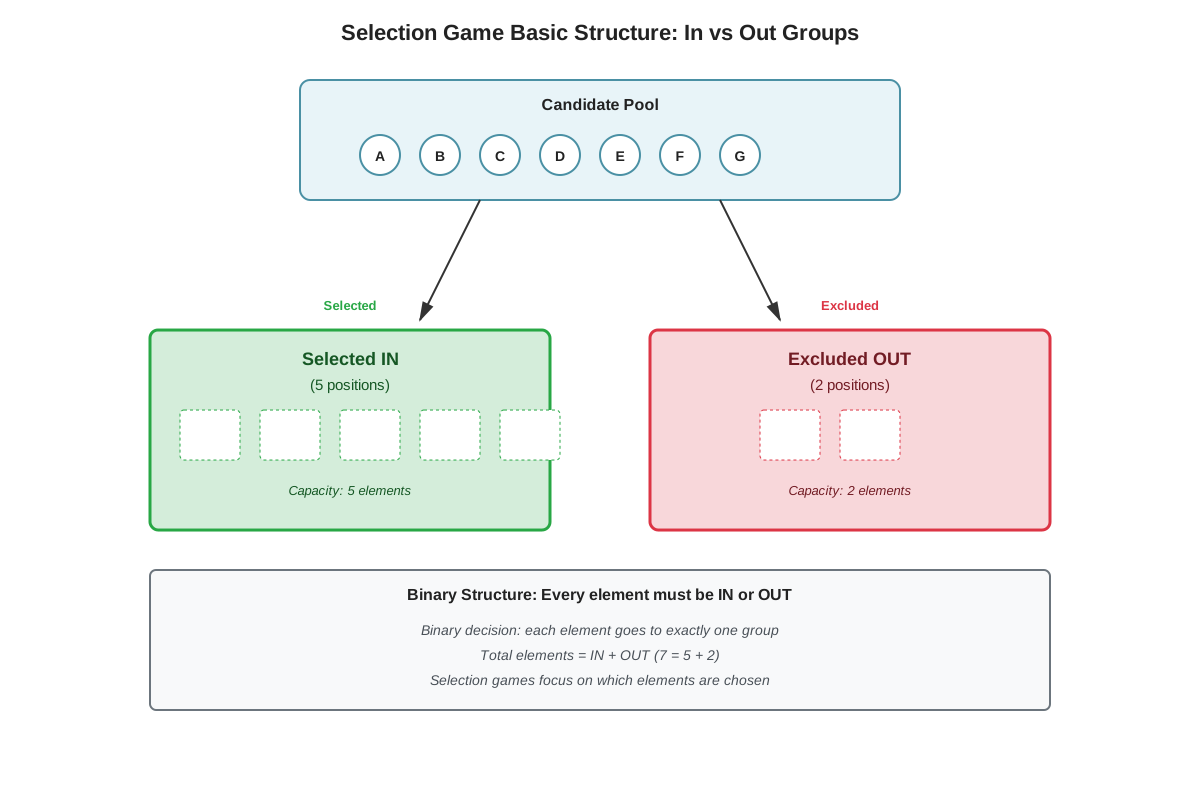
The fundamental structure of selection games involves a universal set of elements and a selection constraint that determines how many elements will be chosen. The universal set represents all available options (typically 6-8 elements), while the selection constraint specifies exactly how many must be selected, provides a range (e.g., "at least three but no more than five"), or leaves the number open to determination through the rules.
The game board for selection games typically uses a two-column or two-row structure: one area for "IN" (selected elements) and one for "OUT" (excluded elements). This binary organization reflects the core decision-making process. Some test-takers prefer a single-row approach with selection indicated by position or marking, but the two-area method provides clearer visual tracking of the selection status for each element.
Rule Types in Selection Games
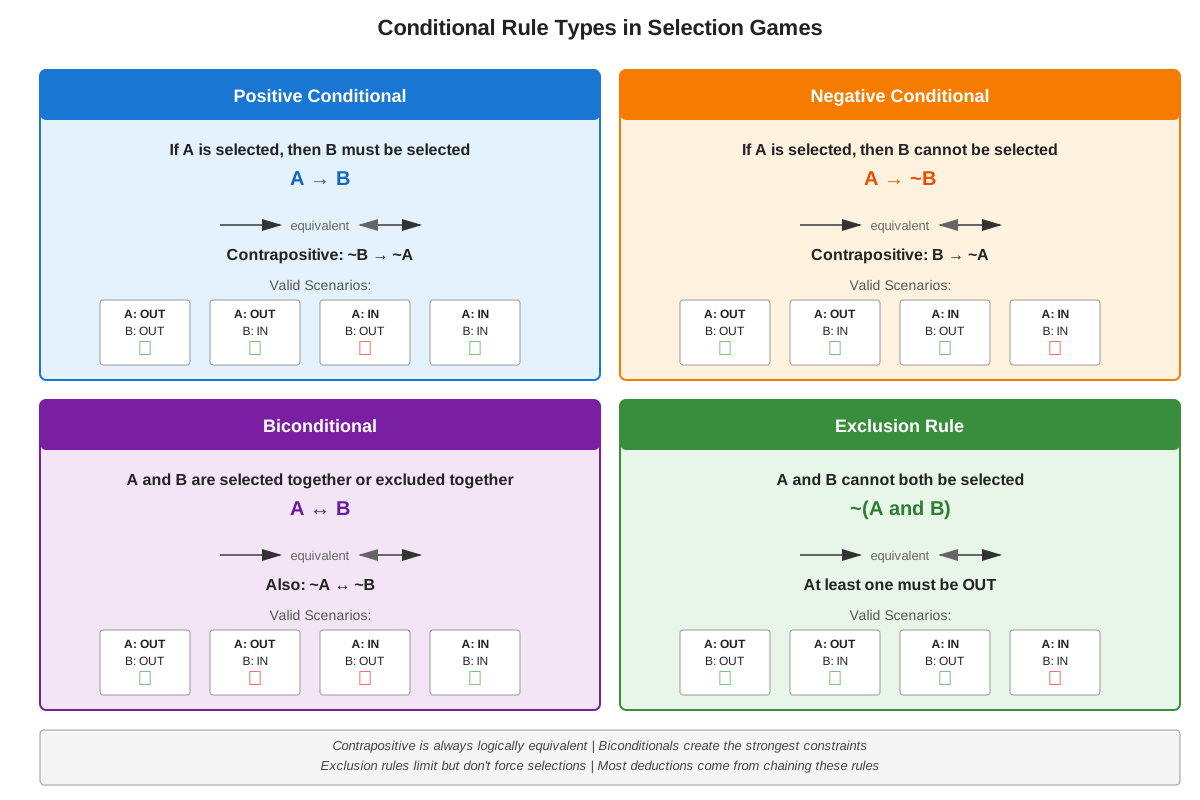
Conditional selection rules form the backbone of most selection games. These rules establish relationships between elements using "if-then" logic. The most common forms include:
- Positive conditionals: "If A is selected, then B must be selected" (A → B)
- Negative conditionals: "If A is selected, then B cannot be selected" (A → ~B)
- Contrapositive relationships: Every conditional rule has a contrapositive that provides equally valid information (~B → ~A for the first example above)
Biconditional rules create mutual dependencies: "A is selected if and only if B is selected" (A ↔ B). These rules mean both elements must share the same selection status—either both in or both out.
Numerical constraints limit or require specific quantities: "Exactly three elements must be selected," "At least two but no more than four," or "More elements from Group X than Group Y must be selected."
Block rules require or prohibit certain combinations: "A and B cannot both be selected" or "If either C or D is selected, both must be selected."
Rule Notation and Diagramming
Effective notation is crucial for selection game success. Standard notation includes:
| Rule Type | Notation | Contrapositive |
|---|---|---|
| If A selected, B selected | A → B | ~B → ~A |
| If A selected, B not selected | A → ~B | B → ~A |
| A and B both selected or both not | A ↔ B | ~A ↔ ~B |
| A and B cannot both be selected | ~(A & B) | A → ~B and B → ~A |
| At least one of A or B selected | A ∨ B | ~A → B and ~B → A |
The notation system should be consistent and immediately readable. Many successful test-takers develop a personal notation system that builds on these standards while adding visual cues like arrows, slashes, or positioning that enhance quick reference during question-solving.
Deduction Chains and Forced Selections
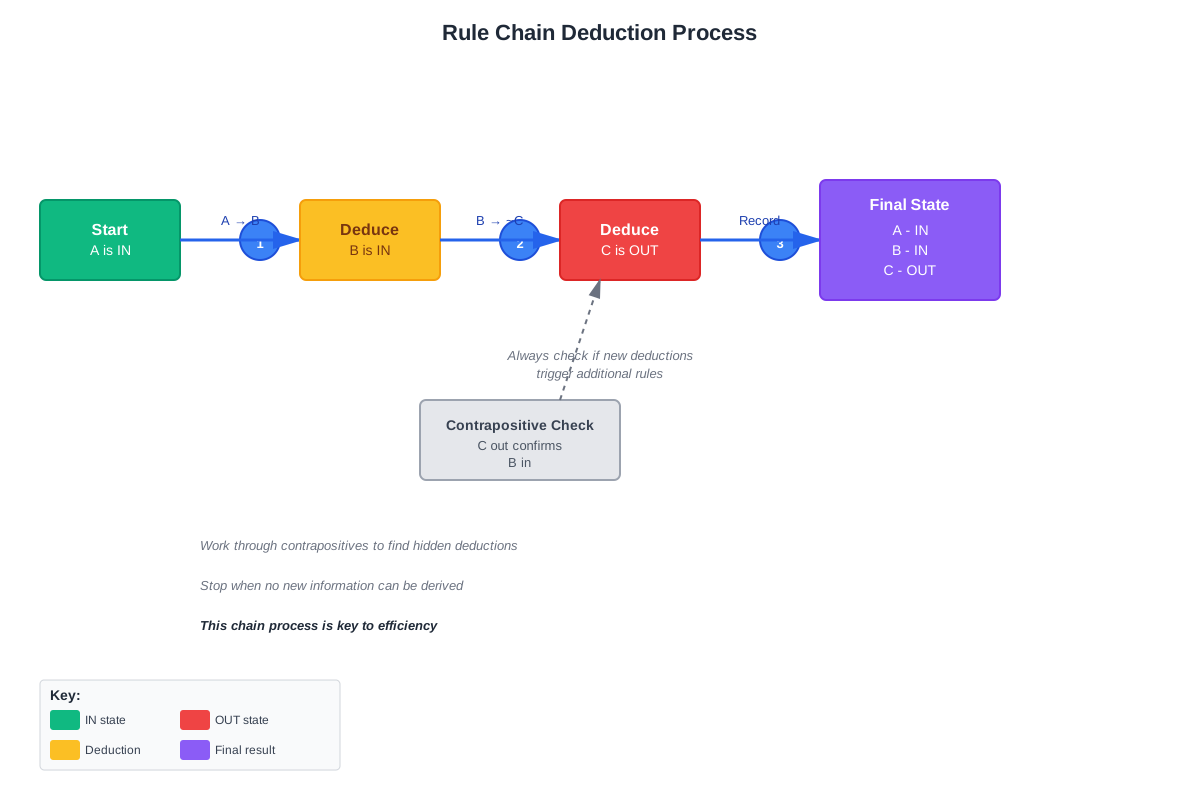
The most powerful deductions in selection games come from rule chains—sequences where one selection triggers another, which triggers another, creating a cascade of forced decisions. For example, if the rules state "A → B," "B → C," and "C → D," then selecting A forces the selection of B, C, and D. Recognizing these chains during setup saves significant time during question-solving.
Forced selections occur when an element must be selected regardless of other choices, often because its exclusion would violate a rule or make it impossible to satisfy the selection constraint. Similarly, forced exclusions occur when including an element would create an impossible situation. Identifying these during initial setup provides immediate deductions that constrain the game significantly.
Selection Game Scenarios
Selection games present various scenario types, each with characteristic features:
Committee/Team Selection: The most common scenario involves choosing members for a committee, team, or group from a larger pool of candidates. Rules typically involve expertise requirements, personality conflicts, or representation needs.
Course/Activity Selection: These games involve choosing courses, activities, or events from available options, with rules about prerequisites, scheduling conflicts, or requirement fulfillment.
Item/Feature Selection: Games about selecting items for purchase, features for a product, or components for a system, with rules about compatibility, budget constraints, or functional requirements.
The Selection Number Determination
Some selection games specify exactly how many elements must be selected, while others require determining the selection number through rule analysis. When the number is not specified, test-takers must:
- Examine rules for minimum requirements (elements that must be selected)
- Check for maximum constraints (incompatible elements that limit total selections)
- Test different selection numbers against all rules to find valid ranges
- Look for questions that reveal the selection number through their phrasing
Concept Relationships
Selection games build directly on conditional logic fundamentals, with each rule representing a conditional statement that must be properly understood and notated. The relationship between a conditional and its contrapositive forms the foundation for most deductions: Conditional Rules → Contrapositive Formation → Rule Chain Deductions → Forced Selections/Exclusions.
The binary nature of selection (in or out) connects to basic set theory and logical operators. When rules state "A and B cannot both be selected," this represents a logical constraint on set membership that can be expressed through conditional logic: Set Membership Constraints → Conditional Rule Translation → Notation and Tracking.
Within selection games themselves, concepts build hierarchically. The game setup and rule notation must be completed before deductions can be made: Game Board Setup → Rule Notation → Initial Deductions → Question-Specific Hypotheticals. Each stage depends on the accuracy of previous stages, making systematic setup crucial.
Selection games also connect forward to more complex game types. Hybrid games often combine selection with sequencing or distribution, requiring test-takers to first determine which elements are selected, then arrange or assign them: Pure Selection Games → Selection-Sequencing Hybrids → Selection-Distribution Hybrids. Mastering pure selection games provides the foundation for these more complex scenarios.
The relationship between rules creates a network of logical dependencies. When multiple rules share common elements, they create rule intersection points where deductions emerge. For example, if "A → B" and "B → C" both exist, element B becomes a critical junction point where selecting or excluding B has cascading effects on both A and C.
High-Yield Facts
⭐ Selection games always involve a binary decision: every element is either selected (in) or not selected (out), with no middle ground or partial selection.
⭐ The contrapositive of every conditional rule is equally valid and often more useful: if you cannot immediately apply a rule in its stated form, check whether its contrapositive applies to the current situation.
⭐ Forced selections and exclusions should be identified during initial setup: any element that must be in or must be out based on the rules alone should be placed immediately, before attempting any questions.
⭐ Rule chains create the most powerful deductions: when one selection triggers another, which triggers another, these chains often determine large portions of the game's structure.
⭐ Biconditional rules (if and only if) create the strongest constraints: elements linked by biconditionals must always share the same selection status, effectively reducing the number of independent decisions.
- When a rule states "at least one of A or B must be selected," the contrapositive means if A is out, B must be in, and if B is out, A must be in.
- Numerical constraints often combine with conditional rules to create forced selections: if exactly three elements must be selected and two are already forced in, only one more can be selected.
- "Cannot both be selected" rules are different from "if one is selected, the other is not" rules—the first allows both to be excluded, while the second only restricts simultaneous selection.
- The maximum number of elements that can be selected is often limited by incompatibility rules rather than stated numerical constraints.
- Questions asking "which could be true" are typically easier than "which must be true" questions because they only require finding one valid scenario rather than proving something holds in all scenarios.
- When rules create a long chain (A → B → C → D), excluding the final element (D) forces exclusion of all previous elements through contrapositive reasoning.
- Selection games with no specified selection number often have questions that reveal the number through phrases like "if exactly four are selected" or "what is the minimum number."
Quick check — test yourself on Selection games so far.
Try Flashcards →Common Misconceptions
Misconception: If a rule states "A cannot be selected unless B is selected," this means "if A is selected, then B is selected" and "if B is selected, then A is selected."
Correction: The rule only establishes one direction: "if A is selected, then B is selected" (A → B). The contrapositive is "if B is not selected, then A is not selected" (~B → ~A). However, B can be selected without A being selected—the rule does not work in reverse.
Misconception: When a rule states "A and B cannot both be selected," this means if A is selected, B cannot be selected, and if B is selected, A cannot be selected, but both must be excluded.
Correction: The rule only prohibits simultaneous selection. Both A and B can be excluded together without violating the rule. The rule creates two conditionals: A → ~B and B → ~A, but does not require that at least one be selected.
Misconception: In a selection game with seven elements where exactly four must be selected, there are four "in" spaces and three "out" spaces that must all be filled.
Correction: While this is true, the misconception lies in thinking that partially filling the spaces is sufficient. Until all four "in" spaces and all three "out" spaces are determined, the selection is incomplete. Many test-takers forget to track both sides of the selection.
Misconception: If a rule states "if A is selected, then B is selected," and another rule states "if B is selected, then C is selected," then selecting C means both A and B must be selected.
Correction: Conditional rules only work in one direction. Selecting C tells us nothing about B or A from these rules. The chain A → B → C means selecting A forces B and C, but selecting C does not force anything backward. The contrapositives (~C → ~B and ~B → ~A) tell us that excluding C forces excluding B, and excluding B forces excluding A.
Misconception: When a question asks "which of the following could be a complete and accurate list of selected elements," any answer choice that does not violate rules is correct.
Correction: The answer must not only avoid violating rules but must also satisfy all positive requirements (elements that must be selected) and respect the numerical constraint. An answer choice might not directly violate any single rule but still be incomplete or incorrect in total number.
Misconception: Biconditional rules (A if and only if B) mean that A and B must both be selected.
Correction: Biconditional rules mean A and B must have the same selection status—both selected OR both not selected. The rule does not require selection; it requires matching status. Both being excluded is just as valid as both being included.
Worked Examples
Example 1: Committee Selection Game
Scenario: A committee of exactly four members will be selected from seven candidates: F, G, H, J, K, L, and M. The selection must conform to the following rules:
- If F is selected, then G must be selected.
- If K is selected, then L cannot be selected.
- Either H or J must be selected, but not both.
- M is selected only if both G and J are selected.
Question: If F is selected for the committee, which of the following must be true?
Solution Process:
Step 1: Note the given condition—F is selected. Place F in the "IN" group.
Step 2: Apply the first rule directly. Since F is selected, G must be selected (F → G). Place G in the "IN" group.
Step 3: Examine the fourth rule about M. The rule states M → (G & J), which means if M is selected, both G and J must be selected. We have G selected, but we need to determine J's status. The contrapositive of this rule is (~G ∨ ~J) → ~M, meaning if either G or J is not selected, M cannot be selected.
Step 4: Apply the third rule about H and J. Exactly one of H or J must be selected. This means we must select either H or J (but not both) to complete our committee.
Step 5: Consider two scenarios:
- Scenario A: Select J (not H). We now have F, G, J selected (3 members). We need exactly one more member. M could potentially be selected since both G and J are selected (satisfying M's requirement). We could select M for our fourth member: F, G, J, M.
- Scenario B: Select H (not J). We now have F, G, H selected (3 members). Since J is not selected, M cannot be selected (from the contrapositive of rule 4). We must select our fourth member from K or L. If we select K, we cannot select L (rule 2). If we select L, we can select it without restriction. Valid committees: F, G, H, K or F, G, H, L.
Step 6: Identify what must be true in ALL valid scenarios. G must be selected (forced by F's selection). Either H or J must be selected (required by rule 3). However, we cannot determine which one must be selected—both scenarios are valid.
Answer: G must be selected for the committee. This is the only element forced in all valid scenarios when F is selected.
Example 2: Course Selection Game
Scenario: A student will select courses from among six available courses: Biology, Chemistry, Drama, Economics, French, and Geography. The following conditions apply:
- If Biology is selected, then Chemistry must also be selected.
- If Drama is selected, then Economics cannot be selected.
- French is selected if and only if Geography is selected.
- At least one science course (Biology or Chemistry) must be selected.
Question: What is the maximum number of courses the student could select?
Solution Process:
Step 1: Identify the goal—maximize the number of selected courses while satisfying all rules.
Step 2: Analyze the biconditional rule (French ↔ Geography). This rule means French and Geography must have the same status. To maximize selections, we should include both. Tentative selection: French, Geography.
Step 3: Examine the science requirement. At least one of Biology or Chemistry must be selected. To maximize, consider selecting both. However, check rule 1: Biology → Chemistry. If we select Biology, we must select Chemistry. If we select only Chemistry, we don't trigger any additional requirements. To maximize, select both Biology and Chemistry. Current selection: Biology, Chemistry, French, Geography (4 courses).
Step 4: Consider Drama and Economics. Rule 2 states Drama → ~Economics (contrapositive: Economics → ~Drama). These courses are incompatible—we can select at most one of them. To maximize, select one. Choose Drama. Current selection: Biology, Chemistry, Drama, French, Geography (5 courses).
Step 5: Verify all rules are satisfied:
- Biology → Chemistry: ✓ (both selected)
- Drama → ~Economics: ✓ (Drama selected, Economics not selected)
- French ↔ Geography: ✓ (both selected)
- Biology ∨ Chemistry: ✓ (both selected)
Step 6: Confirm we cannot add Economics. If we added Economics, we would violate rule 2 since Drama is already selected (Economics → ~Drama contrapositive means if Drama is selected, Economics cannot be).
Answer: The maximum number of courses is 5: Biology, Chemistry, Drama, French, and Geography.
Exam Strategy
When approaching selection games on the LSAT, begin by identifying the game type through trigger phrases: "will be selected," "must be chosen," "committee of X members," "will enroll in," or "will purchase." These phrases signal a selection game rather than sequencing or distribution.
Setup Strategy: Create a clear two-area game board with "IN" and "OUT" sections. Write the selection constraint prominently (e.g., "exactly 4 selected" or "at least 3"). List all elements where you can see them easily. As you read each rule, immediately write both the rule and its contrapositive—this dual notation prevents missing contrapositive deductions.
Rule Processing Order: Process rules in this sequence:
- Identify and mark any biconditional rules (strongest constraints)
- Note all conditional rules and write contrapositives
- Look for rule chains (A → B and B → C creates A → B → C)
- Identify forced selections or exclusions
- Check for numerical implications (if 4 must be selected and 2 are forced in, only 2 more can be selected)
Trigger Words to Watch:
- "Must be selected" vs. "could be selected" (necessity vs. possibility)
- "Cannot both be selected" vs. "cannot be selected together" (same meaning, different phrasing)
- "Only if" (introduces necessary condition: A only if B means A → B)
- "Unless" (introduces necessary condition: A unless B means ~B → A)
- "If and only if" (biconditional: both directions apply)
Question-Specific Approaches:
For "could be true" questions, you only need to find one valid scenario. Start with the most flexible elements (those with fewest rule restrictions) and build a valid selection.
For "must be true" questions, look for forced selections based on the given condition. Apply rules directly, then check contrapositives. If you cannot prove something must be true through rule application, it is not the answer.
For "complete and accurate list" questions, verify each answer choice by checking: (1) Does it satisfy the numerical constraint? (2) Does it include all forced selections? (3) Does it violate any rules? (4) Does it exclude any elements that must be included based on what is included?
Time Management: Spend 2-3 minutes on initial setup and deductions for a selection game. This upfront investment pays dividends across all questions. If a question requires extensive hypothetical testing, skip it temporarily and return after completing faster questions. Selection games typically allow 6-8 minutes total, with setup taking 2-3 minutes and questions taking 30-60 seconds each once setup is complete.
Process of Elimination: In selection games, wrong answers often violate rules in subtle ways. Check each answer choice against rules systematically rather than trying to "see" the right answer. For conditional rules, verify both the stated rule and its contrapositive. Many wrong answers violate contrapositives while appearing to satisfy stated rules.
Memory Techniques
SCONE - Remember the five key steps for selection game setup:
- Set up the game board (IN/OUT areas)
- Constraints (note the selection number)
- Organize rules (write rules and contrapositives)
- Notice chains (identify rule chains and forced selections)
- Evaluate (make initial deductions before questions)
"Both Ways Always" - For every conditional rule, always write both the rule and its contrapositive. Visualize a two-way street where information flows in both directions: forward through the rule, backward through the contrapositive.
The Selection Seesaw - Visualize selection games as a seesaw with "IN" on one side and "OUT" on the other. When an element moves to one side, it cannot be on the other. This mental image reinforces the binary nature of selection and helps prevent errors where students forget to consider both selection and exclusion.
"If-Then-Check-Contra" - When reading any conditional rule, follow this rhythm: read the "if" clause, read the "then" clause, check your understanding, write the contrapositive. This rhythmic approach ensures you never skip the contrapositive step.
The Chain Gang - When you identify a rule chain (A → B → C → D), visualize these elements as prisoners chained together. If the first one moves (gets selected), all must move. If the last one cannot move (cannot be selected), none can move. This vivid image helps remember that chains work in both directions through contrapositives.
FORCE - Remember what to look for in initial deductions:
- Forced selections (must be IN)
- Obligatory exclusions (must be OUT)
- Rule chains (connected conditionals)
- Contrapositive implications (what exclusions force)
- Exact numbers (how many slots remain)
Summary
Selection games represent a fundamental game type in LSAT Analytical Reasoning Legacy, requiring test-takers to determine which elements from a universal set should be included and which should be excluded based on conditional rules and constraints. The core challenge involves tracking binary decisions (in or out) while managing complex rule interactions, particularly conditional relationships and their contrapositives. Success in selection games depends on systematic setup, including creating a clear game board with IN/OUT areas, notating all rules with their contrapositives, identifying rule chains, and determining forced selections or exclusions before attempting questions. The most powerful deductions emerge from recognizing how rules connect through shared elements, creating chains of logical implications that constrain the game significantly. Test-takers must distinguish between different rule types—positive conditionals, negative conditionals, biconditionals, and numerical constraints—and understand how each type generates deductions. Mastery of selection games provides essential skills for the entire Analytical Reasoning section and transfers to Logical Reasoning questions involving conditional logic, making this a high-yield topic for overall LSAT performance.
Key Takeaways
- Selection games involve binary decisions where every element is either selected (IN) or not selected (OUT), with no middle ground or partial membership
- Every conditional rule has an equally valid contrapositive that often provides the key to solving questions; always write both the rule and its contrapositive during setup
- Rule chains (A → B → C) create powerful deductions that work in both directions: selecting the first element forces all subsequent elements, while excluding the last element forces exclusion of all previous elements
- Forced selections and exclusions should be identified during initial setup by analyzing rules and numerical constraints before attempting any questions
- Biconditional rules (if and only if) create the strongest constraints by requiring elements to share the same selection status, effectively reducing the number of independent decisions
- The most common errors in selection games involve forgetting to apply contrapositives, misinterpreting "cannot both be selected" rules, and failing to track both IN and OUT groups simultaneously
- Time invested in thorough setup (2-3 minutes) pays significant dividends by making individual questions answerable in 30-60 seconds each
Related Topics
Sequencing Games: After mastering selection games, students progress to sequencing games where selected elements must be arranged in order. The conditional logic skills from selection games transfer directly, but sequencing adds the dimension of relative position and ordering rules.
Distribution Games: These games involve assigning elements to multiple groups rather than the binary IN/OUT decision of selection games. Understanding selection game logic provides the foundation for tracking which elements can be assigned to which groups based on conditional rules.
Hybrid Games: Advanced LSAT games often combine selection with sequencing or distribution, requiring test-takers to first determine which elements are selected, then arrange or assign them. Mastery of pure selection games is essential before attempting these complex hybrids.
Conditional Logic in Logical Reasoning: The conditional reasoning patterns practiced in selection games appear throughout the Logical Reasoning section, particularly in questions about sufficient and necessary conditions, formal logic, and argument structure.
Grouping Games with Subgroups: Some grouping games involve selecting elements for multiple subgroups simultaneously, building on selection game skills while adding complexity through multiple selection decisions that must be coordinated.
Practice CTA
Now that you have studied the core concepts, strategies, and patterns of selection games, it is time to apply this knowledge through deliberate practice. Attempt the practice questions associated with this topic, focusing on implementing the systematic setup process and rule notation techniques covered in this guide. As you work through problems, refer back to the worked examples and exam strategies to reinforce proper technique. Use the flashcards to drill key concepts, rule types, and common deduction patterns until they become automatic. Remember that selection games reward systematic thinking and careful setup—invest the time in proper technique now, and you will see significant improvements in both accuracy and speed. Each practice problem is an opportunity to strengthen your conditional reasoning skills and build confidence for test day. You have the knowledge; now develop the skill through focused, intentional practice.
Sign up free to keep reading
Create a free AnvayaPrep account to finish this LSAT guide on Selection games — plus flashcards and practice questions.