Overview
Adjacent rules are among the most frequently tested constraint types in LSAT Analytical Reasoning Legacy questions, particularly within sequencing games legacy. These rules establish that two or more elements must be placed directly next to each other in a sequence, with no intervening elements between them. Understanding adjacent rules is fundamental to success on the LSAT because they create powerful deductions that cascade through an entire game setup, often determining the placement of multiple variables at once.
In the context of sequencing games, adjacent rules function as spatial constraints that limit where elements can appear in an ordered arrangement. When the LSAT presents a scenario requiring test-takers to arrange people in a line, schedule events in consecutive time slots, or organize items in sequential positions, adjacent rules dictate which elements must occupy consecutive positions. These rules appear in approximately 60-70% of all sequencing games and frequently serve as the linchpin for solving complex game scenarios efficiently.
Mastering adjacent rules connects directly to broader analytical reasoning skills because they exemplify how local constraints generate global implications. A single adjacent rule can eliminate numerous possible arrangements, create fixed blocks of elements that move together through the sequence, and interact with other rule types to produce definitive placements. This topic builds upon fundamental sequencing concepts while serving as a gateway to more complex game types involving multiple interacting constraints.
Learning Objectives
- [ ] Identify how Adjacent rules appears in LSAT questions
- [ ] Explain the reasoning pattern behind Adjacent rules
- [ ] Apply Adjacent rules to solve LSAT-style problems accurately
- [ ] Recognize the symbolic notation for adjacent rules and translate between verbal and symbolic representations
- [ ] Determine all valid positions for adjacent blocks within constrained sequences
- [ ] Combine adjacent rules with other constraint types to generate compound deductions
- [ ] Distinguish between strict adjacency and flexible ordering within adjacent pairs
Prerequisites
- Basic sequencing notation: Understanding how to represent ordered positions (1, 2, 3, etc.) is essential because adjacent rules operate within sequential frameworks
- Variable representation: Familiarity with using letters to represent game elements allows for efficient diagramming of adjacent constraints
- Rule interpretation: The ability to translate verbal constraints into symbolic notation ensures accurate setup of adjacent rules
- Spatial reasoning: Basic understanding of "next to" and "consecutive" relationships provides the conceptual foundation for adjacent rule mechanics
Why This Topic Matters
Adjacent rules represent one of the highest-yield topics in LSAT preparation because they appear with remarkable consistency across test administrations. Statistical analysis of released LSAT exams reveals that approximately 65% of all sequencing games contain at least one adjacent rule, and many games feature multiple adjacency constraints that interact to create complex deduction chains. Questions testing adjacent rules typically appear 2-3 times per Analytical Reasoning section, making them responsible for roughly 8-12% of all logic games points.
In practical terms, adjacent rules serve as the foundation for what test experts call "block deductions"—powerful inferences that treat multiple elements as a single unit. This technique dramatically reduces the complexity of games by decreasing the number of independent variables that must be tracked. Test-takers who master adjacent rules consistently solve games 30-40% faster than those who treat each element independently, a time savings that can determine overall LSAT performance.
On the exam, adjacent rules commonly appear in scenarios involving: seating arrangements where certain people must sit next to each other; scheduling problems where events must occur in consecutive time slots; ordering tasks where certain steps must be performed back-to-back; and ranking scenarios where items must occupy adjacent positions. The LSAT frequently combines adjacent rules with other constraint types (such as conditional rules or separation requirements) to create multi-layered puzzles that reward systematic analysis.
Core Concepts
Definition and Basic Structure
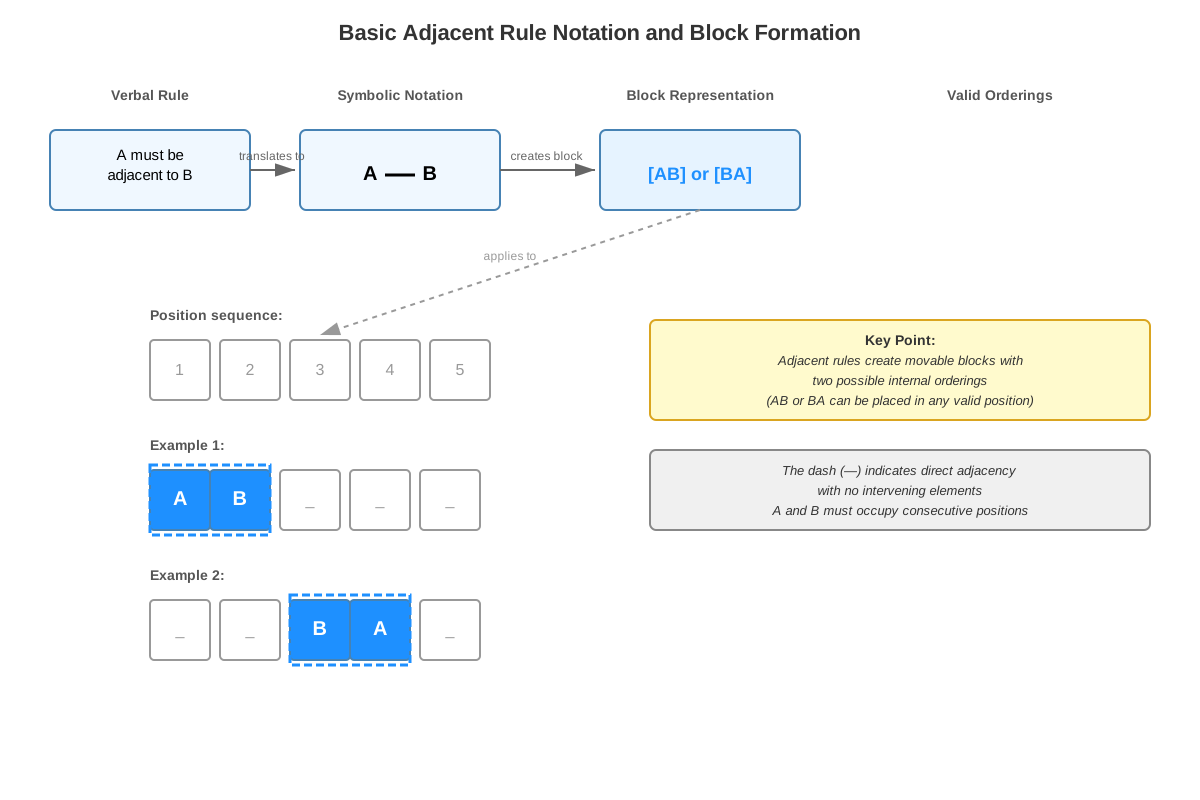
Adjacent rules (also called lsat adjacent rules) establish that two or more elements must occupy consecutive positions in a sequence, with no gaps between them. The fundamental characteristic of adjacency is direct contact—if element A must be adjacent to element B, then A and B must be next to each other in the final arrangement. This constraint is typically expressed in the LSAT using language such as "X is immediately next to Y," "A and B are consecutive," or "M is directly beside N."
The standard symbolic notation for adjacent rules uses a horizontal line connecting the relevant elements: A—B or AB (with a line above or below). This notation captures the essential feature that these elements form a block that moves together through the sequence. Importantly, basic adjacent rules typically allow for either ordering of the elements unless additional constraints specify otherwise. Thus, A—B means either AB or BA is acceptable unless the rule explicitly states a directional requirement.
Directional vs. Non-Directional Adjacency
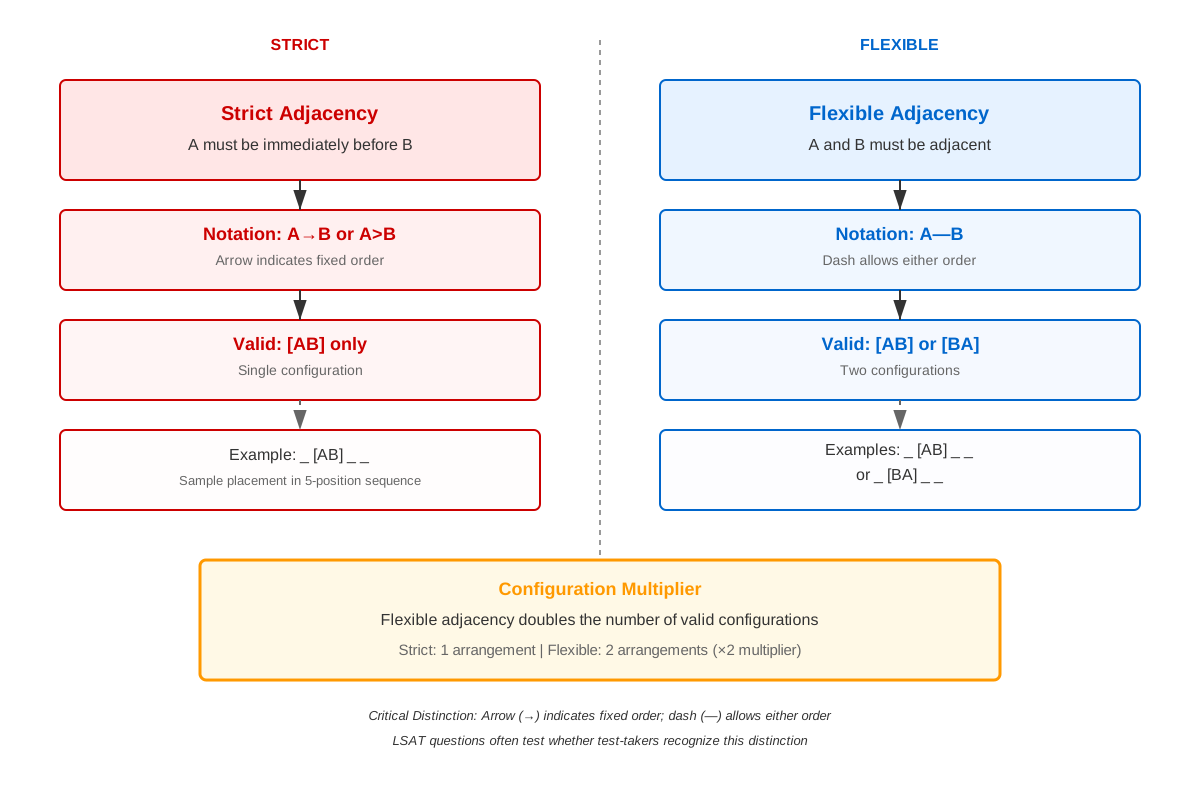
A critical distinction exists between directional adjacent rules and non-directional adjacent rules. Non-directional rules permit either ordering of the adjacent elements. For example, "F and G are adjacent" allows both FG and GF as valid arrangements. This flexibility doubles the placement options for the adjacent block and must be tracked carefully during game execution.
Directional adjacent rules, conversely, specify the exact order of adjacent elements. Language such as "H is immediately before J" or "K is directly to the left of L" creates a fixed internal ordering within the adjacent block. The symbolic notation for directional adjacency uses an arrow: H→J or H—J with an arrow indicating direction. This constraint is more restrictive and often generates stronger deductions because it eliminates half of the potential arrangements.
| Rule Type | Example Language | Notation | Valid Arrangements |
|---|---|---|---|
| Non-directional | "A and B are adjacent" | A—B | AB or BA |
| Directional | "C is immediately before D" | C→D | CD only |
| Directional | "E is directly after F" | F→E | FE only |
Adjacent Blocks as Single Units
The most powerful technique for working with adjacent rules involves treating the constrained elements as a single block or super-element. When two elements must be adjacent, they effectively function as one unit that occupies two consecutive positions. This conceptual shift transforms the game by reducing the number of independent variables.
For example, in a seven-position sequence with elements A, B, C, D, E, F, G, if A and B must be adjacent, the game effectively becomes a six-unit arrangement: (AB), C, D, E, F, G. This block can occupy positions 1-2, 2-3, 3-4, 4-5, 5-6, or 6-7, but wherever it appears, A and B move together. This reduction in complexity accelerates solving and reveals deductions that might otherwise remain hidden.
Multiple Adjacent Rules and Extended Blocks
When a game contains multiple adjacent rules affecting the same elements, these constraints can combine to form extended blocks of three or more elements. For instance, if "A is adjacent to B" and "B is adjacent to C," these rules create a three-element block: ABC (or CBA, or potentially ACB if B must be in the middle). The key analytical task involves determining whether the rules create a fixed extended block or allow for internal variation.
Consider these scenarios:
- "A is adjacent to B" + "B is adjacent to C" → Could be ABC, CBA, or ACB (B must be in middle)
- "A is immediately before B" + "B is immediately before C" → Must be ABC only
- "A is adjacent to B" + "C is adjacent to B" → Could be ABC, CBA, ACB, or BCA (B must be adjacent to both)
The internal structure of extended blocks depends on whether the component rules are directional or non-directional and whether they share common elements that serve as connection points.
Position Restrictions for Adjacent Blocks
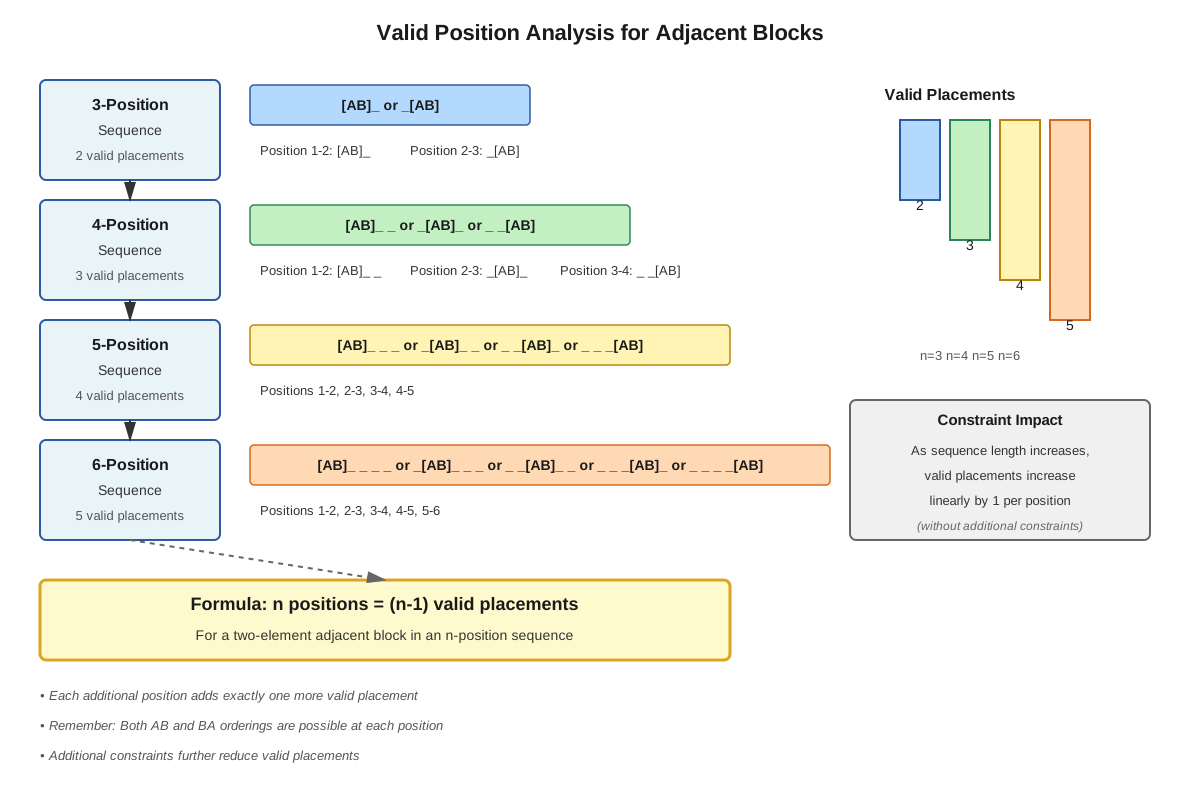
Adjacent blocks face inherent position restrictions based on their size. A two-element block cannot occupy the last position in a sequence (since it needs two consecutive spots), and more generally, an n-element block can only occupy positions 1 through (total positions - n + 1). In a seven-position sequence, a two-element block has six possible placements (positions 1-2, 2-3, 3-4, 4-5, 5-6, 6-7), while a three-element block has only five possible placements.
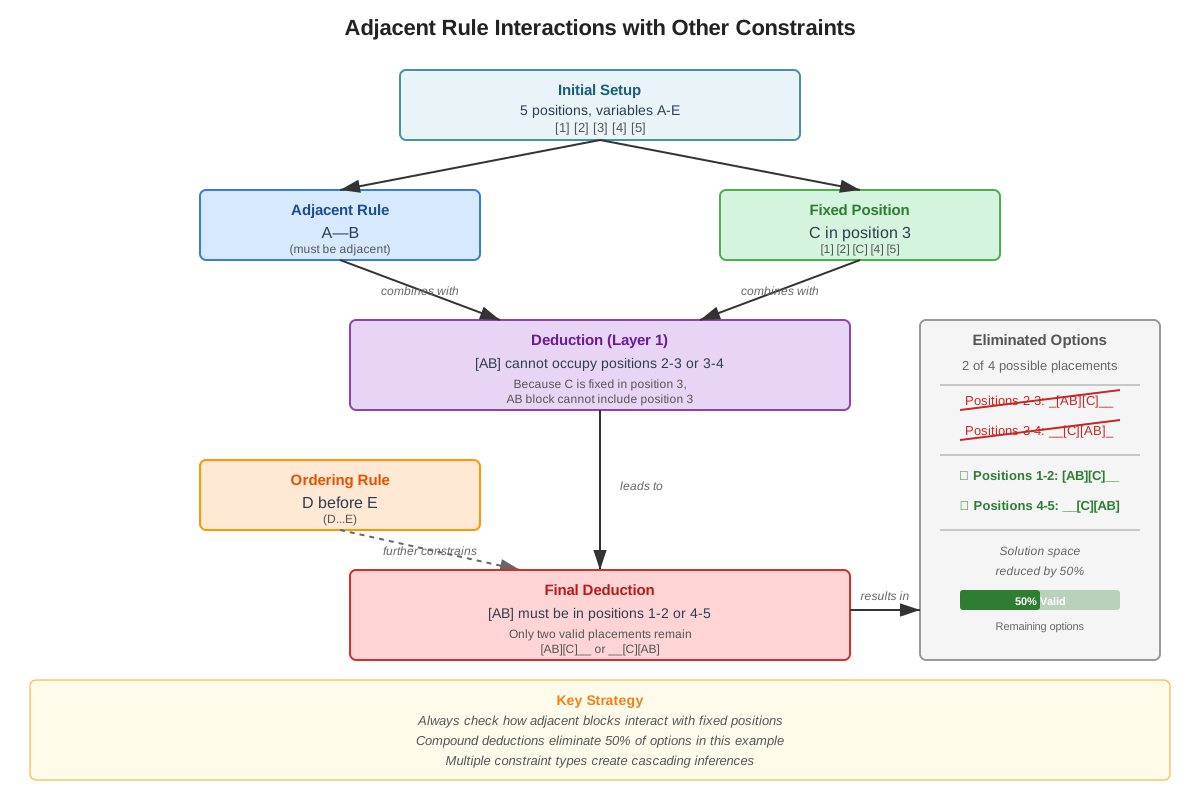
These restrictions become particularly important when combined with other constraints. If a two-element block AB must be adjacent, and a separate rule states that A cannot be in position 1, then the block cannot occupy positions 1-2, immediately eliminating one-sixth of the possible arrangements. Recognizing these compound restrictions generates powerful deductions.
Interaction with Other Rule Types
Adjacent rules frequently interact with other common LSAT constraint types to create compound deductions:
Adjacent + Conditional Rules: If "A is adjacent to B" and "If C is in position 3, then A is in position 5," the conditional rule may force the AB block into specific positions or trigger contrapositive reasoning.
Adjacent + Separation Rules: When "A is adjacent to B" combines with "C and D cannot be adjacent," the game requires careful tracking of which elements must cluster and which must separate, often creating forced placements.
Adjacent + Fixed Position Rules: If "A is adjacent to B" and "B is in position 4," then A must be in position 3 or 5, creating a limited set of scenarios worth exploring through hypotheticals.
Adjacent + Numerical Distribution: In games with multiple adjacent rules, counting the total positions consumed by blocks helps determine how many "free" positions remain for other elements.
Concept Relationships
The concepts within adjacent rules form a hierarchical structure. Basic adjacency (non-directional) serves as the foundation, with directional adjacency adding an additional layer of constraint. Both types feed into the block-building technique, which treats adjacent elements as units. Multiple adjacent rules can combine to form extended blocks, which represent a more complex application of the same principle. All of these concepts interact with position restrictions, which provide the spatial boundaries within which blocks can operate.
Adjacent rules connect to prerequisite sequencing knowledge by applying the fundamental concept of ordered positions to constrained pairs or groups. They extend basic sequencing by introducing relationships between elements rather than treating each element independently. This topic serves as a bridge to more advanced analytical reasoning concepts, including pattern recognition across multiple scenarios and the strategic use of hypotheticals to test possibilities.
The relationship map flows as follows: Basic Sequencing → Adjacent Rules (non-directional) → Directional Adjacent Rules → Block Formation → Extended Blocks → Position Restrictions → Interaction with Other Rules → Complete Game Solution. Each step builds upon the previous, with mastery of earlier concepts enabling success with later, more complex applications.
High-Yield Facts
⭐ Adjacent rules create blocks that function as single units, reducing the effective number of variables in a game
⭐ A two-element adjacent block in an n-position sequence has exactly (n-1) possible placements
⭐ Non-directional adjacent rules (A—B) permit both AB and BA arrangements unless additional constraints specify otherwise
⭐ Directional adjacent rules (A→B) fix the internal ordering and eliminate half of the potential arrangements
⭐ When multiple adjacent rules share a common element, they form extended blocks whose internal structure depends on whether the rules are directional
- Adjacent blocks cannot "wrap around" from the end of a sequence to the beginning unless explicitly stated
- The phrase "immediately next to" always indicates an adjacent rule, while "next to" without "immediately" may allow for intervening elements
- In circular arrangements, every position has two adjacent positions, doubling the complexity of adjacent rule analysis
- Adjacent rules combined with "not adjacent" rules for different pairs often force specific arrangements through elimination
- When an adjacent block includes an element with a fixed position, the entire block's placement becomes highly constrained
Quick check — test yourself on Adjacent rules so far.
Try Flashcards →Common Misconceptions
Misconception: Adjacent rules allow for one element to be between the specified elements as long as they're "close."
Correction: Adjacent means directly next to with no intervening elements. "A is adjacent to B" requires A and B to occupy consecutive positions with no gaps.
Misconception: If A must be adjacent to B, and B must be adjacent to C, then A must be adjacent to C.
Correction: This is not necessarily true. The arrangement ACB satisfies both requirements (A-C are adjacent, C-B are adjacent) but A and B are not adjacent to each other. Only B is guaranteed to be adjacent to both A and C.
Misconception: A two-element adjacent block can occupy any position in the sequence.
Correction: A two-element block cannot occupy the final position alone because it requires two consecutive spots. In a seven-position sequence, the block can occupy positions 1-2, 2-3, 3-4, 4-5, 5-6, or 6-7, but not position 7 by itself.
Misconception: "A is next to B" and "A is immediately next to B" mean different things on the LSAT.
Correction: The LSAT uses these phrases interchangeably to indicate adjacency. The word "immediately" emphasizes the direct contact but doesn't create a different constraint than "next to" in the context of sequencing games.
Misconception: When working with adjacent blocks, you must determine the exact internal ordering before proceeding with the game.
Correction: For non-directional adjacent rules, it's often more efficient to track both possible orderings (AB and BA) simultaneously and only determine the specific ordering when forced by other constraints or when answering a particular question.
Misconception: Adjacent rules are less important than conditional rules because they only affect two elements.
Correction: Adjacent rules often generate more immediate and powerful deductions than conditional rules because they create definite spatial constraints. A single adjacent rule can eliminate numerous possible arrangements and frequently serves as the key to unlocking an entire game.
Worked Examples
Example 1: Basic Adjacent Rule Application
Scenario: Seven students—A, B, C, D, E, F, G—are arranged in a line from position 1 to position 7. The following rules apply:
- A and B must be adjacent
- D is in position 4
- F cannot be in position 1
Question: If C is in position 2, which of the following could be true?
(A) A is in position 1
(B) B is in position 5
(C) E is in position 3
(D) F is in position 7
(E) G is in position 6
Solution:
Step 1: Identify the adjacent rule and represent it as a block. A—B forms a two-element block that can be ordered as AB or BA.
Step 2: Mark the fixed positions. D is in position 4, and C is in position 2 (given in the question stem).
Position: 1  2  3  4  5  6  7
Element:  _  C  _  D  _  _  _
Step 3: Determine possible placements for the AB block. The block needs two consecutive positions. Available consecutive pairs: 1-2 (blocked by C in 2), 2-3 (blocked by C in 2), 3-4 (blocked by D in 4), 5-6, 6-7. Therefore, the AB block can only occupy positions 5-6 or 6-7.
Step 4: Consider position 1. Since the AB block cannot include position 1 (it would need 1-2, but C is in 2), and F cannot be in position 1, position 1 must be filled by E or G.
Step 5: Evaluate each answer choice:
- (A) A is in position 1: Impossible. A must be part of the AB block in positions 5-6 or 6-7.
- (B) B is in position 5: Possible. If the AB block occupies positions 5-6, B could be in position 5 (arrangement BA) or position 6 (arrangement AB).
- (C) E is in position 3: Possible. Position 3 is available for E.
- (D) F is in position 7: Possible. Position 7 is available for F.
- (E) G is in position 6: Possible if the AB block occupies positions 6-7 and G is not part of that block—wait, this is impossible because positions 6-7 must contain A and B.
Answer: Multiple answers could be true (B, C, D), but if this were a real LSAT question asking "could be true," any of these would be correct. The key deduction is that the AB block is forced into positions 5-6 or 6-7 by the placement of C and D.
Example 2: Multiple Adjacent Rules Creating Extended Blocks
Scenario: Six presentations—J, K, L, M, N, O—are scheduled in six consecutive time slots. The following rules apply:
- J is immediately before K
- K is immediately before L
- M is not in slot 1
- N and O are not adjacent
Question: Which of the following is a complete and accurate list of slots in which J could appear?
(A) 1, 2
(B) 1, 2, 3
(C) 1, 2, 3, 4
(D) 2, 3, 4
(E) 1, 3, 4
Solution:
Step 1: Analyze the adjacent rules. "J is immediately before K" creates J→K. "K is immediately before L" creates K→L. These combine into a three-element directional block: J→K→L or simply JKL.
Step 2: Determine possible positions for the JKL block. In six slots, a three-element block can occupy:
- Slots 1-2-3 (J in 1, K in 2, L in 3)
- Slots 2-3-4 (J in 2, K in 3, L in 4)
- Slots 3-4-5 (J in 3, K in 4, L in 5)
- Slots 4-5-6 (J in 4, K in 5, L in 6)
Step 3: Apply the constraint that M is not in slot 1. This doesn't directly restrict the JKL block, but it means if JKL occupies slots 1-2-3, then M must be in slot 4, 5, or 6.
Step 4: Apply the constraint that N and O are not adjacent. This affects which slots remain for N and O after placing the JKL block. Let's test each possible JKL placement:
- If JKL is in 1-2-3: Remaining slots are 4, 5, 6 for M, N, O. Can we place N and O non-adjacently? Slots 4 and 6 work (with M in 5), so this is possible.
- If JKL is in 2-3-4: Remaining slots are 1, 5, 6 for M, N, O. M cannot be in 1, so M must be in 5 or 6. If M is in 5, then N and O must be in 1 and 6 (not adjacent—valid). If M is in 6, then N and O must be in 1 and 5 (not adjacent—valid). This is possible.
- If JKL is in 3-4-5: Remaining slots are 1, 2, 6 for M, N, O. M can be in 2 or 6. If M is in 2, N and O are in 1 and 6 (not adjacent—valid). This is possible.
- If JKL is in 4-5-6: Remaining slots are 1, 2, 3 for M, N, O. M can be in 2 or 3. If M is in 2, N and O must be in 1 and 3 (not adjacent—valid). This is possible.
Step 5: Compile the possible positions for J. J can be in slot 1, 2, 3, or 4.
Answer: (C) 1, 2, 3, 4
This example demonstrates how directional adjacent rules create fixed extended blocks and how those blocks interact with other constraints to determine valid placements.
Exam Strategy
When approaching LSAT questions involving adjacent rules, begin by immediately identifying and symbolizing all adjacency constraints. Use consistent notation (such as A—B for non-directional and A→B for directional) to avoid confusion during time pressure. The first strategic decision involves determining whether to treat adjacent elements as a block from the outset or to track them separately until forced to combine them.
Trigger words and phrases that signal adjacent rules include:
- "immediately next to"
- "directly beside"
- "consecutive"
- "immediately before/after"
- "adjacent to"
- "sits/stands/is placed next to"
- "in consecutive positions/slots/times"
When these phrases appear, immediately create block notation in your diagram. For directional language ("before," "after," "to the left of," "to the right of"), add an arrow to indicate the fixed ordering.
Process-of-elimination strategy: For questions asking what "must be true," eliminate any answer choice that could be false in at least one valid arrangement. For adjacent rules, this often means testing whether the adjacent block can be positioned in a way that makes the answer choice false. Conversely, for "could be true" questions, you only need to find one valid arrangement that satisfies the answer choice along with all game rules.
Time allocation: Spend extra time during initial game setup to identify all implications of adjacent rules, including position restrictions and interactions with other constraints. This upfront investment typically saves 30-60 seconds per question because the deductions are already visible. For games with multiple adjacent rules, spend 15-20 seconds determining whether they form extended blocks before attempting any questions.
Advanced technique: When stuck on a question, consider creating hypotheticals based on the possible positions of adjacent blocks. Since blocks have limited placement options (n-1 positions for a two-element block in an n-position sequence), testing each possibility systematically often reveals the answer quickly.
Memory Techniques
Mnemonic for adjacent rule types: "DINO" - Directional rules have Internal Non-negotiable Ordering. This reminds you that directional adjacent rules fix the sequence of elements within the block.
Visualization strategy: Picture adjacent elements as physically connected by a rigid bar or chain. This mental image reinforces that they move together as a unit and cannot be separated. For extended blocks, visualize a train with multiple cars—the entire train moves together, and the order of cars (if directional) cannot change.
Acronym for block analysis: "SPINE" - Size of block, Possible positions, Internal ordering, Number of arrangements, Effect on other elements. This checklist ensures comprehensive analysis of any adjacent rule.
Memory aid for position counting: "Block size minus one equals lost positions." A two-element block "loses" one possible starting position (can't start in the last position), a three-element block loses two possible starting positions, etc. This helps quickly calculate how many placement options exist.
Rhyme for common error prevention: "Adjacent means touching tight, not just somewhere in sight." This reinforces that adjacency requires direct contact, not merely proximity.
Summary
Adjacent rules constitute a fundamental constraint type in LSAT Analytical Reasoning Legacy, requiring that specified elements occupy consecutive positions in a sequence. These rules appear in approximately 65% of sequencing games and generate powerful deductions by creating blocks that function as single units. The key distinction between directional and non-directional adjacent rules determines whether the internal ordering of elements is fixed or flexible. Multiple adjacent rules can combine to form extended blocks, and all blocks face inherent position restrictions based on their size. Successful application of adjacent rules requires recognizing them through trigger language, symbolizing them consistently, treating them as blocks to reduce game complexity, and analyzing their interactions with other constraint types. The most efficient approach involves identifying all adjacency constraints during initial setup, determining possible block placements, and using these deductions to eliminate impossible arrangements. Mastery of adjacent rules dramatically accelerates game solving and serves as a foundation for more complex analytical reasoning tasks.
Key Takeaways
- Adjacent rules create blocks of elements that must occupy consecutive positions and move together as single units through the sequence
- Directional adjacent rules (A→B) fix internal ordering, while non-directional rules (A—B) permit either arrangement (AB or BA)
- A two-element block in an n-position sequence has exactly (n-1) possible placements, creating significant position restrictions
- Multiple adjacent rules sharing common elements combine to form extended blocks whose structure depends on whether component rules are directional
- Adjacent rules interact powerfully with other constraint types (conditional, separation, fixed position) to generate compound deductions
- Trigger phrases like "immediately next to," "consecutive," and "directly before/after" signal adjacent rules requiring block notation
- The most efficient strategy treats adjacent elements as blocks from the initial setup rather than tracking them as independent variables
Related Topics
Separation Rules in Sequencing Games: After mastering adjacent rules, study separation constraints that require elements to be non-adjacent or separated by a minimum distance. Understanding adjacency provides the foundation for recognizing when elements must be kept apart.
Conditional Rules in Sequencing: Learn how "if-then" statements interact with adjacent rules to create triggered deductions. Many complex games combine adjacency with conditional logic.
Circular Sequencing Games: Explore how adjacent rules function in circular arrangements where the last position is adjacent to the first position, doubling the complexity of block placement analysis.
Grouping Games with Adjacency: Progress to games that combine grouping constraints with adjacency requirements, such as seating arrangements where certain people must sit together at specific tables.
Practice CTA
Now that you've mastered the core concepts of adjacent rules, it's time to cement your understanding through active practice. Attempt the practice questions designed specifically for this topic, focusing on identifying adjacency constraints quickly and building blocks efficiently. Use the flashcards to reinforce trigger language and common deduction patterns. Remember: adjacent rules appear in the majority of sequencing games, making this one of the highest-yield topics for your LSAT preparation. Every minute spent practicing adjacent rules directly translates to faster, more accurate performance on test day. You've built the foundation—now apply it!
Sign up free to keep reading
Create a free AnvayaPrep account to finish this LSAT guide on Adjacent rules — plus flashcards and practice questions.