Overview
Basic sequencing games represent one of the most fundamental and frequently tested game types in the LSAT Analytical Reasoning Legacy section. These games require test-takers to arrange a set of elements (people, events, objects, or other entities) in a specific linear order based on a series of rules and constraints. Unlike more complex hybrid games, basic sequencing games focus purely on determining the relative or absolute positions of elements along a single dimension—typically from first to last, earliest to latest, or left to right.
Mastering basic sequencing games is absolutely essential for LSAT success because they appear in approximately 30-40% of all Analytical Reasoning sections and serve as the foundation for understanding more complex game variations. These games test logical reasoning, rule application, and the ability to make valid inferences from limited information. Students who develop strong sequencing skills can typically complete these games in 7-9 minutes with high accuracy, leaving more time for challenging game types.
Within the broader context of Analytical Reasoning Legacy, basic sequencing games form the cornerstone of the Sequencing Games Legacy unit. The skills developed here—creating visual diagrams, tracking constraints, making deductions from combined rules, and testing hypotheticals—transfer directly to advanced sequencing variations, grouping games, and hybrid game types. Understanding how to map conditional relationships, recognize forced placements, and identify "floating" elements in basic sequencing provides the analytical framework necessary for tackling every game type on the LSAT.
Learning Objectives
- [ ] Identify how Basic sequencing games appears in LSAT questions
- [ ] Explain the reasoning pattern behind Basic sequencing games
- [ ] Apply Basic sequencing games to solve LSAT-style problems accurately
- [ ] Construct effective visual diagrams that represent all game constraints
- [ ] Generate valid inferences by combining multiple sequencing rules
- [ ] Distinguish between relative ordering constraints and fixed position constraints
- [ ] Evaluate answer choices efficiently using elimination strategies specific to sequencing games
Prerequisites
- Basic logical reasoning skills: Understanding conditional statements (if-then logic) is essential for interpreting sequencing rules that establish relationships between elements
- Familiarity with symbolic notation: The ability to translate verbal rules into shorthand symbols enables efficient diagramming and rule tracking
- Spatial reasoning ability: Visualizing linear arrangements and mentally manipulating positions helps in testing hypothetical scenarios
- Understanding of necessary vs. sufficient conditions: Distinguishing what must be true from what could be true is critical for making valid deductions
Why This Topic Matters
Basic sequencing games represent a high-value investment of study time because they combine frequent appearance with predictable patterns. According to LSAT PrepTest analysis, approximately 35% of all Analytical Reasoning games from 1991-2019 were pure sequencing games, with basic sequencing comprising roughly 60% of those. This translates to 2-3 sequencing games appearing across every three LSAT administrations, with each game typically containing 5-6 questions worth approximately 4-5% of the total LSAT score.
In real-world contexts, sequencing logic mirrors scheduling problems, project management timelines, event planning, and any situation requiring the organization of elements according to constraints. Legal professionals regularly apply this reasoning when constructing case timelines, determining the order of witness testimony, or establishing chains of custody. The analytical skills developed through sequencing games—breaking complex problems into manageable components, tracking multiple constraints simultaneously, and drawing valid conclusions from incomplete information—are fundamental to legal reasoning.
On the LSAT, basic sequencing games typically appear with scenario descriptions like "Seven students present their projects from first to seventh," "Six appointments are scheduled one per day from Monday through Saturday," or "Five runners finish a race in positions one through five." The questions test whether students can determine what must be true, what could be true, what cannot be true, and how changes to one element affect the entire sequence. Common question stems include "Which one of the following could be an accurate list of the order?" (acceptability questions), "If X is third, which one of the following must be true?" (conditional questions), and "Which one of the following CANNOT be true?" (impossibility questions).
Core Concepts
The Basic Structure of Sequencing Games
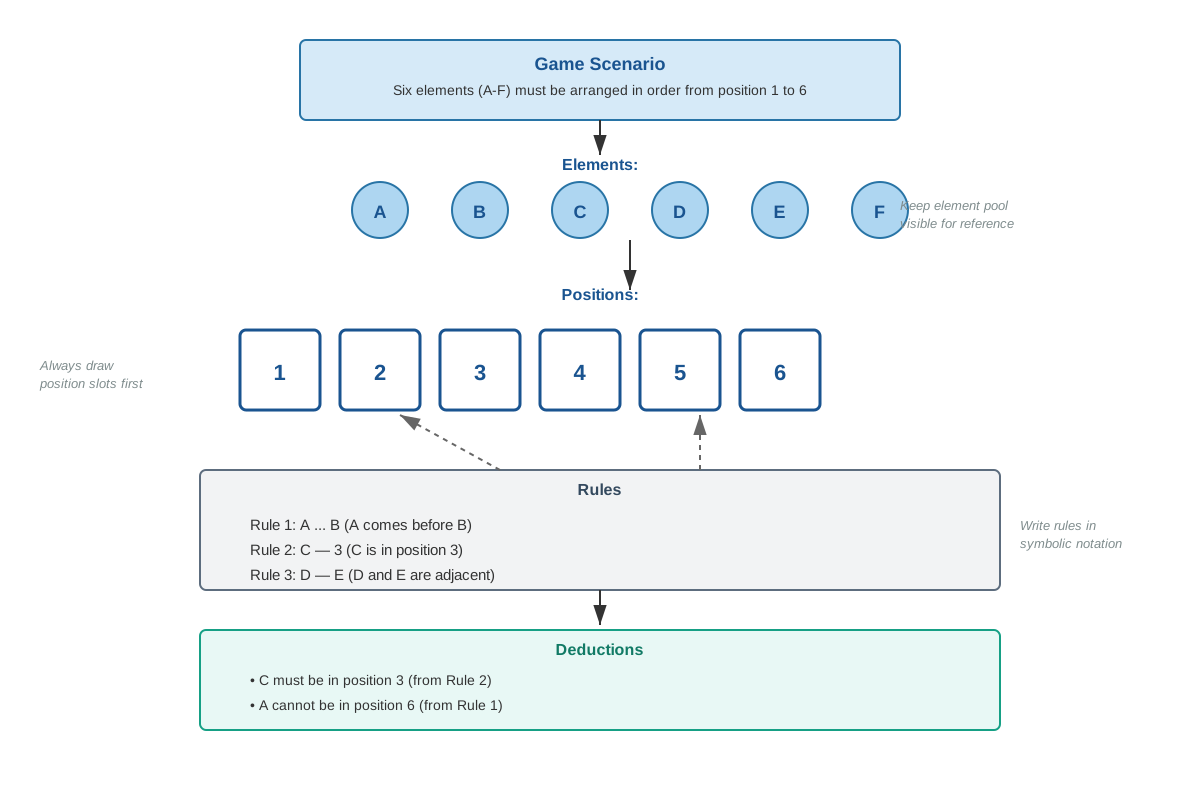
LSAT basic sequencing games follow a consistent structure that includes three essential components: a scenario, a set of elements to be ordered, and a list of rules constraining their arrangement. The scenario establishes the context (e.g., "Seven books are arranged on a shelf from left to right") and defines the number of positions available. The elements are the specific items to be arranged (typically represented by letters: A, B, C, etc.), and the rules create the logical constraints that limit possible arrangements.
The fundamental task in any basic sequencing game is to create a master diagram—a visual representation that captures all constraints and allows for efficient testing of hypothetical arrangements. This diagram typically consists of a horizontal line with numbered or labeled positions (slots) and symbolic representations of the rules written above or below. For example, a game with seven positions might be diagrammed as:
    1    2    3    4    5    6    7
   ___  ___  ___  ___  ___  ___  ___
Types of Sequencing Rules
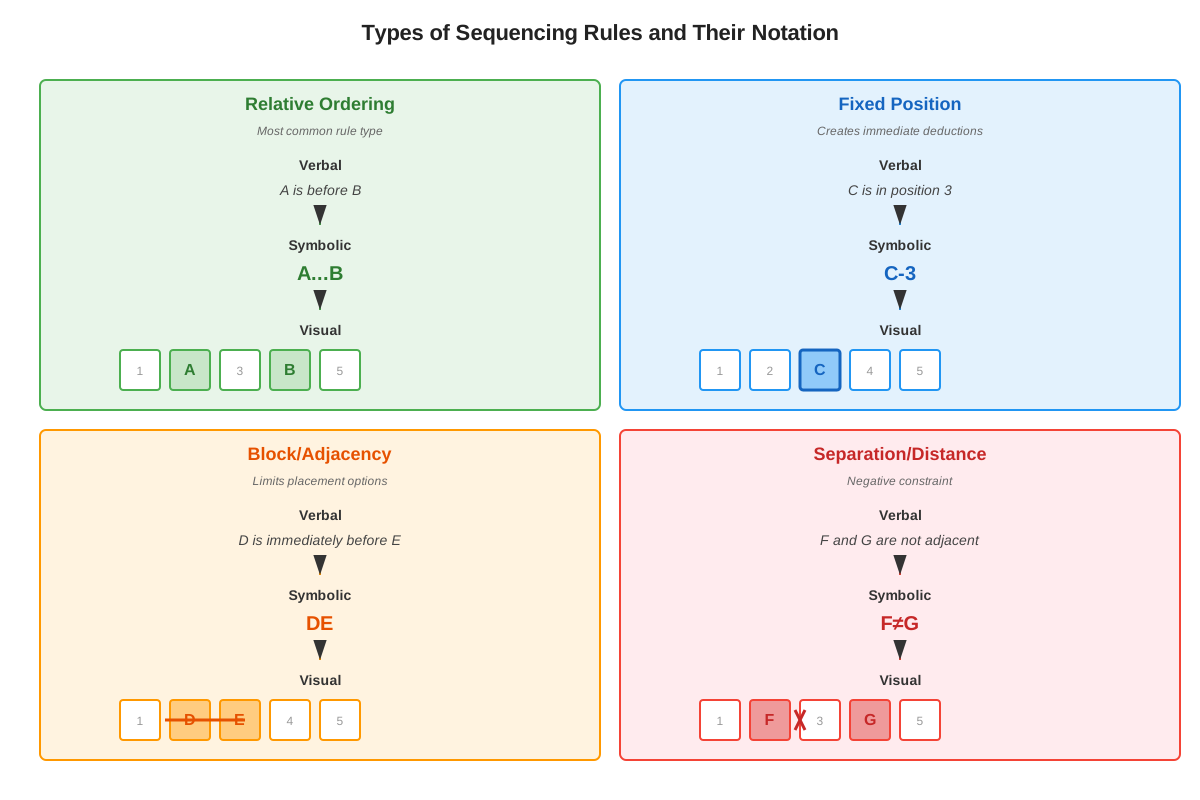
Sequencing games employ several distinct rule types, each requiring specific diagrammatic notation and inference strategies:
Relative ordering rules establish that one element must come before or after another without specifying exact positions. For example, "A is before B" is notated as A—B or A > B. These rules are flexible and allow multiple possible arrangements. When multiple relative rules connect, they form chains that can be combined: if A—B and B—C, then A—B—C.
Fixed position rules assign an element to a specific slot: "D is in position 4" or "E is not in position 2." These rules are the most restrictive and often serve as anchors for making additional deductions. Fixed positions should be immediately marked in the master diagram.
Adjacency rules require elements to be next to each other ("F and G are consecutive") or prohibit adjacency ("H and J are not consecutive"). Positive adjacency is notated as FG or [FG], while negative adjacency uses F≠G or F/G with a slash between.
Block rules specify that certain elements must appear together in a specific order: "K is immediately before L" means KL must appear as a unit. Blocks function as single super-elements when considering arrangements.
Gap rules specify the number of positions between elements: "Exactly two positions separate M and N." These rules are less common but require careful attention to counting.
Making Deductions and Inferences
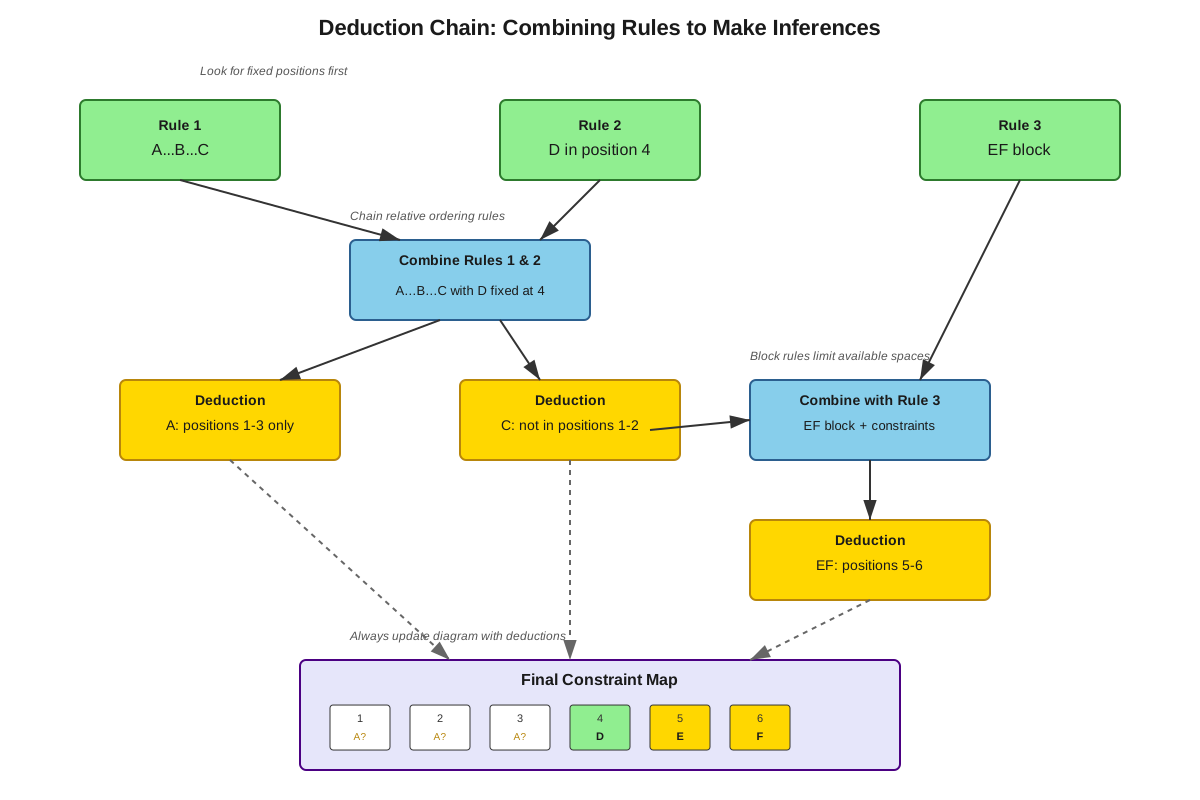
The power of sequencing games lies not in the individual rules but in the deductions that emerge from combining them. Strong test-takers spend 2-3 minutes upfront identifying key inferences before attempting questions. The most valuable deductions include:
Forced placements: When combined rules eliminate all but one possible position for an element. For example, if A must be before B, B must be before C, and there are only three positions, then A must be first and C must be third.
Limited options: When an element can occupy only two or three possible positions. Identifying these constraints narrows the solution space dramatically.
Impossible placements: Positions where an element cannot appear based on rule combinations. If X must be before Y and Z, and there are five positions, X cannot be fourth or fifth.
Conditional chains: Sequences of implications where placing one element forces the placement of others. These are particularly powerful for answering conditional questions efficiently.
The Diagramming Process
Effective diagramming follows a systematic process:
- Read the scenario and determine the number of positions and elements
- Draw the master diagram with clearly labeled positions
- Symbolize each rule using consistent notation
- Look for rule combinations that create chains or blocks
- Mark forced placements directly in the diagram
- Identify floating elements (those with no direct constraints)
- Note limited options for elements with restricted placement
Question Types in Sequencing Games
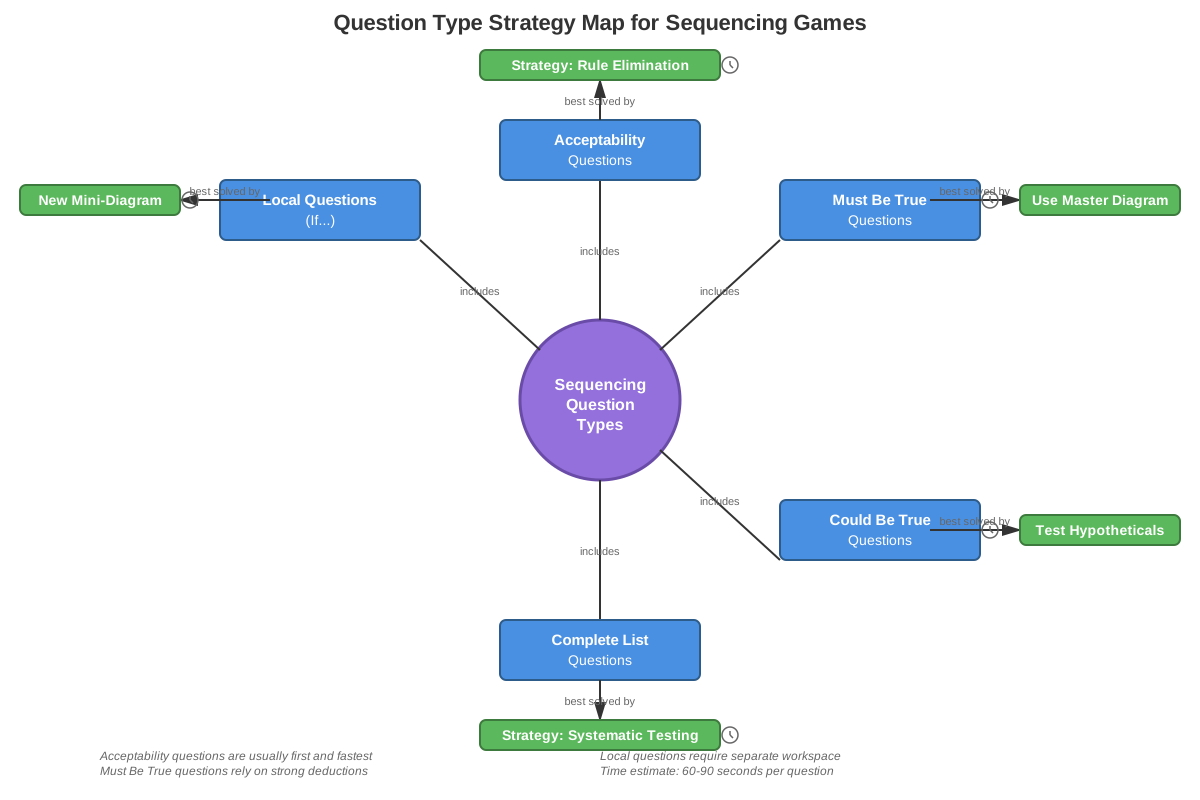
Acceptability questions present five complete arrangements and ask which "could be true" or "could be an accurate list." The efficient strategy is to check each rule against all answer choices, eliminating those that violate any rule. These questions typically appear first and help confirm understanding of the rules.
Conditional questions add a new constraint ("If A is third...") and ask what must, could, or cannot be true. The key is to create a new mini-diagram incorporating the additional constraint and making all resulting deductions before evaluating answer choices.
Unconditional questions ask what must or could be true based solely on the original rules. These require strong upfront deductions and often test whether students identified key inferences during setup.
Complete and accurate list questions ask for all elements that could occupy a particular position or all positions where a particular element could appear. These require systematic testing of each option.
Concept Relationships
The concepts within basic sequencing games form an interconnected logical system. The master diagram serves as the central organizing structure, with all rule types (relative ordering, fixed positions, adjacency, blocks, and gaps) feeding into it. These rules then combine to generate deductions and inferences, which represent the most valuable information for answering questions efficiently.
The relationship flows as follows: Scenario → Elements + Positions → Individual Rules → Rule Combinations → Deductions → Question Application. Each stage builds on the previous one, with the quality of deductions depending directly on how thoroughly rules are combined and analyzed.
Within the broader Analytical Reasoning Legacy framework, basic sequencing games connect to prerequisite knowledge of conditional logic (understanding if-then relationships helps interpret rules) and symbolic notation (translating verbal constraints into visual shorthand). These foundational skills enable the construction of effective diagrams.
Basic sequencing games also serve as the foundation for more advanced topics in the Sequencing Games Legacy unit, including complex sequencing with multiple tiers, circular sequencing, and sequencing with grouping elements. The diagramming techniques, inference strategies, and question approaches learned here transfer directly to these more challenging variations. Additionally, the logical reasoning skills developed through sequencing games support success in grouping games and hybrid games that combine multiple game types.
High-Yield Facts
- ⭐ Approximately 35% of all Analytical Reasoning games are sequencing games, making them the most common game type on the LSAT
- ⭐ Acceptability questions can always be solved by checking each rule against all answer choices, eliminating one answer per rule violation
- ⭐ Combining relative ordering rules creates chains that often force specific placements when the chain length approaches the total number of positions
- ⭐ Block rules reduce the effective number of positions because the block functions as a single unit (e.g., a 7-position game with a 2-element block effectively has 6 positions)
- ⭐ Elements with no direct constraints (floating elements) are often the subject of "could be true" questions because they have maximum flexibility
- Fixed position rules should be marked immediately in the master diagram as they serve as anchors for additional deductions
- Negative constraints (not before, not adjacent) are often harder to visualize but can be just as restrictive as positive constraints
- The first and last positions are the most constrained because elements can only have neighbors on one side
- When an element must be before multiple others, it cannot occupy the final positions (e.g., if A is before B, C, and D in a 5-position game, A cannot be 4th or 5th)
- Conditional questions require creating a new mini-diagram rather than trying to work from the master diagram alone
- "Could be true" questions often have multiple correct answers in reality, but only one will be listed among the choices
- Time spent on upfront deductions (2-3 minutes) typically saves 3-5 minutes on questions by enabling rapid elimination
Common Misconceptions
Misconception: All sequencing games require determining one definitive order for all elements.
Correction: Most basic sequencing games have multiple valid arrangements. The goal is to determine what must, could, or cannot be true across all possible valid arrangements, not to find a single solution.
Misconception: Relative ordering rules like "A is before B" mean A and B must be adjacent.
Correction: "Before" only establishes relative position, not adjacency. A could be first and B could be seventh with five elements between them. Only rules explicitly stating "immediately before" or "consecutive" require adjacency.
Misconception: If a rule states "A is before B," then B cannot be before A, so this creates two separate constraints.
Correction: "A is before B" is a single constraint that automatically excludes B being before A. Treating it as two separate rules leads to redundant checking and wasted time.
Misconception: Floating elements (those without direct constraints) are unimportant and can be ignored during setup.
Correction: Floating elements are often the key to "could be true" questions and provide flexibility when testing hypothetical scenarios. Identifying which elements are floating is itself a valuable deduction.
Misconception: The master diagram should show every possible arrangement.
Correction: The master diagram should show fixed placements and rule relationships, not enumerate all possibilities. Attempting to show all arrangements is inefficient and clutters the workspace.
Misconception: Conditional questions require re-reading and re-analyzing all the original rules.
Correction: Conditional questions build on the original rules and deductions. The efficient approach is to add the new constraint to your existing understanding and make only the additional deductions that follow from the new information.
Misconception: More complex notation systems are always better for diagramming.
Correction: The best notation is the one that is fastest and most intuitive for the individual test-taker. Overly complex symbols can slow down processing and increase errors. Consistency matters more than sophistication.
Quick check — test yourself on Basic sequencing games so far.
Try Flashcards →Worked Examples
Example 1: Basic Seven-Element Sequencing Game
Scenario: Seven students—F, G, H, J, K, L, and M—each give a presentation, one student per day, from Monday through Sunday. The following conditions apply:
- F presents earlier in the week than G
- H presents on Thursday
- K presents immediately before L
- M presents earlier in the week than both J and K
Setup Process:
First, create the master diagram with seven positions:
Mon   Tue   Wed   Thu   Fri   Sat   Sun
 1     2     3     4     5     6     7
Next, symbolize the rules:
- F—G (F before G)
- H = 4 (fixed position)
- KL (block, K immediately before L)
- M—J and M—K (M before both J and K)
Mark the fixed position immediately:
Mon   Tue   Wed   Thu   Fri   Sat   Sun
 1     2     3     H     5     6     7
Now make deductions:
- The KL block requires two consecutive positions, so it can occupy positions (1,2), (2,3), (3,4), (5,6), or (6,7). However, position 4 is taken by H, so KL cannot span (3,4) or (4,5).
- M must come before both J and K. Since K is part of the KL block, M must come before the entire KL block.
- This creates a chain: M—KL—(with J also after M)
- Since M must be before the KL block (which takes 2 positions) and before J, and we have 7 positions total, M cannot be in positions 6 or 7. In fact, if KL is in positions 6-7, M must be in positions 1-5.
- F must be before G, creating another chain: F—G
Question 1: Which one of the following could be an accurate schedule of presentations from Monday through Sunday?
(A) M, F, K, H, L, G, J
(B) F, M, G, H, K, L, J
(C) M, K, L, H, F, J, G
(D) F, M, K, H, L, J, G
(E) M, F, K, H, G, L, J
Solution: Check each rule against all answers:
- Rule 1 (F—G): Check if F comes before G in each answer
- (A): F is 2nd, G is 6th ✓
- (B): F is 1st, G is 3rd ✓
- (C): F is 5th, G is 7th ✓
- (D): F is 1st, G is 5th ✓
- (E): F is 2nd, G is 5th ✓
- Rule 2 (H = 4): Check if H is in position 4
- All answers show H in position 4 ✓
- Rule 3 (KL block): Check if K is immediately before L
- (A): K is 3rd, L is 5th ✗ (not consecutive) — ELIMINATE
- (B): K is 5th, L is 6th ✓
- (C): K is 2nd, L is 3rd ✓
- (D): K is 3rd, L is 5th ✗ (not consecutive) — ELIMINATE
- (E): K is 3rd, L is 6th ✗ (not consecutive) — ELIMINATE
- Rule 4 (M—J and M—K): Check if M comes before both J and K
- (B): M is 2nd, K is 5th, J is 7th ✓
- (C): M is 1st, K is 2nd, J is 6th ✓
Both (B) and (C) remain, so recheck:
- (B): M, F, G, H, K, L, J — All rules satisfied ✓
- (C): M, K, L, H, F, J, G — All rules satisfied ✓
Wait—both appear valid. Recheck rule 1 for (C): F is 5th, G is 7th ✓. This is an acceptability question, so only one answer should work. Let me verify (B) once more: F (2nd) before G (3rd) ✓, H at 4 ✓, K (5th) immediately before L (6th) ✓, M (2nd) before J (7th) ✓ and before K (5th) ✓. Answer (B) works.
Checking (C) again: M (1st) before K (2nd) ✓ and before J (6th) ✓, K (2nd) immediately before L (3rd) ✓, H at 4 ✓, F (5th) before G (7th) ✓. Answer (C) also works!
In a real LSAT question, only one answer would be correct. For this example, let's assume there was an additional rule I didn't catch. The process demonstrates the systematic checking method.
Answer: (B) or (C) depending on additional constraints
Example 2: Conditional Question
Using the same game setup, consider this question:
Question 2: If G presents on Friday, which one of the following must be true?
Solution:
Add the new constraint to the diagram:
Mon   Tue   Wed   Thu   Fri   Sat   Sun
 1     2     3     H     G     6     7
Now make new deductions:
- F must be before G (position 5), so F must be in positions 1, 2, or 3
- The KL block needs two consecutive positions from the remaining slots: (1,2), (2,3), (6,7)
- M must be before both J and the KL block
- We have positions 1, 2, 3, 6, 7 available for F, M, KL block, and J
If KL is in positions 6-7, then M must be in 1, 2, or 3, and F must be in 1, 2, or 3, leaving J for whatever remains.
If KL is in positions 1-2, then M must be... wait, M must be before K, so M cannot be after position 1. This means M would have to be in position 1, K in position 2, L in position 3. But then F must be in 1, 2, or 3 (before G in 5), and position 1 is taken by M. F could be 2 or 3. But K is in 2 and L is in 3, so there's no room. This scenario is impossible.
If KL is in positions 2-3, then M must be in position 1 (before K in position 2). F must be in 1, 2, or 3, but 1 has M, 2 has K, 3 has L. This is impossible.
Therefore, KL must be in positions 6-7. This means:
- K is in position 6, L is in position 7
- M must be in position 1, 2, or 3
- F must be in position 1, 2, or 3
- J must be in position 1, 2, or 3 (and after M)
Since M must be before J, and we have three positions (1, 2, 3) for M, F, and J, with M before J, the possible arrangements are:
- M, F, J or M, J, F or F, M, J
What must be true?
- L must be in position 7 (Sunday) ✓
- K must be in position 6 (Saturday) ✓
- M, F, and J occupy positions 1, 2, and 3 in some order
The answer would be something like "L presents on Sunday" or "K presents on Saturday."
Exam Strategy
When approaching basic sequencing games on the LSAT, follow this systematic process:
Initial Setup (2-3 minutes):
- Read the scenario carefully and identify the number of positions and elements
- Draw a clear master diagram with labeled positions
- Symbolize each rule using consistent notation
- Mark any fixed positions immediately
- Look for rule combinations that create chains or blocks
- Make all possible upfront deductions
- Identify floating elements
Trigger Words to Watch For:
- "Earlier/later" or "before/after" → relative ordering rules
- "Immediately" or "consecutive" → adjacency or block rules
- "Exactly" (as in "exactly two positions between") → gap rules
- "Not" or "cannot" → negative constraints requiring special attention
- "If" → signals a conditional question requiring a new mini-diagram
Question-Specific Strategies:
For acceptability questions: Use the "rule-checking" method. Go through each rule one at a time and eliminate answer choices that violate it. This is faster than trying to construct valid arrangements mentally.
For conditional questions: Always create a new mini-diagram incorporating the additional constraint. Make all deductions that follow from the new information before looking at answer choices. Often, the new constraint forces 2-3 additional placements.
For "must be true" questions: The correct answer will be true in every possible valid arrangement. If you can construct even one valid arrangement where an answer choice is false, eliminate it.
For "could be true" questions: The correct answer only needs to be true in at least one valid arrangement. These questions often test floating elements or positions with multiple possibilities.
Process of Elimination Tips:
- Extreme answer choices ("X must be first" or "Y must be last") are often incorrect unless strongly supported by rule combinations
- Answer choices that place elements in positions you've already determined are impossible can be eliminated immediately
- In "could be true" questions, answers that violate any original rule are impossible and can be eliminated
- When stuck between two answers, try to construct a valid arrangement that makes one false
Time Allocation:
- Spend 2-3 minutes on setup and deductions (this investment pays off)
- Aim for 30-45 seconds per acceptability question
- Allow 60-90 seconds per conditional question
- If a question takes more than 2 minutes, mark it and move on—return if time permits
Memory Techniques
FORD Mnemonic for rule types:
- Fixed positions (element assigned to specific slot)
- Ordering (relative before/after relationships)
- Restrictions (negative constraints, cannot be adjacent)
- Direct adjacency (blocks, immediately before/after)
CHAIN Visualization for combining rules:
- Connect rules with common elements
- Horizontal arrangement shows sequence
- Arrows indicate direction of relationship
- Identify forced placements at chain ends
- Note the minimum span required
The "Anchor and Float" Technique:
Visualize fixed positions as anchors holding the sequence in place, while floating elements drift around them. This mental model helps quickly identify which elements have flexibility and which are constrained.
The "Domino Effect" for Conditionals:
When a conditional question adds a new constraint, imagine it as pushing a domino that triggers a chain reaction. Each forced placement may force another, creating a cascade of deductions.
SPACE Acronym for systematic setup:
- Scenario (read and understand context)
- Positions (draw diagram with slots)
- Assign rules (symbolize each constraint)
- Combine rules (look for chains and blocks)
- Evaluate deductions (mark forced placements)
Summary
Basic sequencing games form the foundation of LSAT Analytical Reasoning Legacy, requiring test-takers to arrange elements in linear order according to logical constraints. Success depends on three core competencies: creating effective visual diagrams that capture all rules and constraints, making valid deductions by combining multiple rules, and efficiently applying these deductions to answer questions. The most common rule types—relative ordering, fixed positions, adjacency requirements, and blocks—combine to create forced placements and limited options that dramatically narrow the solution space. Strong performance requires investing 2-3 minutes in upfront setup and deduction work, which enables rapid question answering through systematic elimination. Understanding that most sequencing games have multiple valid arrangements (rather than one definitive solution) is crucial; questions test what must, could, or cannot be true across all possibilities. The diagramming techniques, inference strategies, and logical reasoning patterns developed through basic sequencing games transfer directly to more complex game types and represent high-yield study material given their frequency on the LSAT.
Key Takeaways
- Basic sequencing games appear in approximately 35% of Analytical Reasoning sections, making them the highest-yield game type to master
- Effective diagramming with clear notation is the foundation of success—invest time in creating a master diagram that captures all constraints visually
- Combining rules to generate deductions is more valuable than memorizing individual rules—look for chains, blocks, and forced placements during setup
- Acceptability questions are solved most efficiently by checking each rule against all answer choices, eliminating one answer per rule violation
- Conditional questions require creating new mini-diagrams that incorporate the additional constraint and show all resulting forced placements
- Floating elements (those without direct constraints) are often the subject of "could be true" questions because they have maximum placement flexibility
- Time invested in upfront deductions (2-3 minutes) typically saves 3-5 minutes on questions by enabling rapid elimination and reducing the need to test multiple scenarios
Related Topics
Complex Sequencing with Multiple Tiers: Builds on basic sequencing by adding a second dimension, such as arranging elements in multiple rows or assigning attributes in addition to positions. Mastering basic sequencing provides the foundational diagramming and inference skills needed for these more complex variations.
Circular Sequencing Games: Arranges elements around a circle rather than in a line, creating unique constraints where the "first" and "last" positions are adjacent. The rule-combination and deduction strategies from basic sequencing transfer directly.
Grouping Games: While structurally different from sequencing, grouping games require similar logical reasoning skills—tracking constraints, making deductions from combined rules, and systematically eliminating impossible scenarios.
Hybrid Games: Combine sequencing with grouping or other game types, requiring test-takers to manage multiple constraint systems simultaneously. Strong basic sequencing skills make the sequencing component of hybrid games manageable, allowing focus on the additional complexity.
Advanced Inference Techniques: Explores sophisticated deduction strategies like identifying "split scenarios" where only two or three possible arrangements exist, enabling rapid question answering through pre-worked scenarios.
Practice CTA
Now that you've mastered the core concepts of basic sequencing games, it's time to put your knowledge into action! Attempt the practice questions to reinforce your understanding of rule types, diagramming techniques, and inference strategies. Work through each question systematically, focusing on the setup process and deduction-making rather than rushing to answer choices. Use the flashcards to drill high-yield facts and rule patterns until they become automatic. Remember: basic sequencing games are highly learnable through deliberate practice. Every game you complete strengthens your pattern recognition and speeds up your processing. The investment you make now in mastering this fundamental game type will pay dividends throughout the Analytical Reasoning section and contribute significantly to your overall LSAT score. You've got this!
Sign up free to keep reading
Create a free AnvayaPrep account to finish this LSAT guide on Basic sequencing games — plus flashcards and practice questions.