Overview
Limited solution sets represent one of the most powerful and efficient strategies in Analytical Reasoning Legacy games, particularly within Sequencing Games Legacy. When a logic game presents a scenario with highly restrictive rules, the number of possible valid arrangements becomes severely constrained—sometimes to just two, three, or four complete solutions. Recognizing when a game has limited solution sets and systematically enumerating all possibilities transforms what might appear to be a complex puzzle into a straightforward matching exercise. Rather than testing hypotheticals for each question, test-takers who identify and map out all valid scenarios can simply reference their complete diagrams to answer questions with speed and certainty.
This approach is essential for the LSAT because it fundamentally changes the problem-solving paradigm. Instead of working through conditional logic and making deductions question by question, students who recognize lsat limited solution sets can invest 2-3 minutes upfront to diagram all possibilities, then answer the entire question set in under 30 seconds per question. This time efficiency is critical on an exam where every second counts, and the accuracy rate for questions answered using complete solution sets approaches 100% when the diagrams are correctly constructed.
Within the broader framework of Analytical Reasoning Legacy, limited solution sets represent the intersection of rule density and constraint propagation. Games with numerous fixed positions, binary choices, or highly restrictive conditional rules naturally collapse into limited possibilities. Understanding this concept builds directly on foundational sequencing skills while preparing students for advanced game-solving strategies that prioritize upfront investment over iterative testing. Mastery of limited solution sets often separates high scorers from average performers on the Analytical Reasoning section.
Learning Objectives
- [ ] Identify how Limited solution sets appears in LSAT questions
- [ ] Explain the reasoning pattern behind Limited solution sets
- [ ] Apply Limited solution sets to solve LSAT-style problems accurately
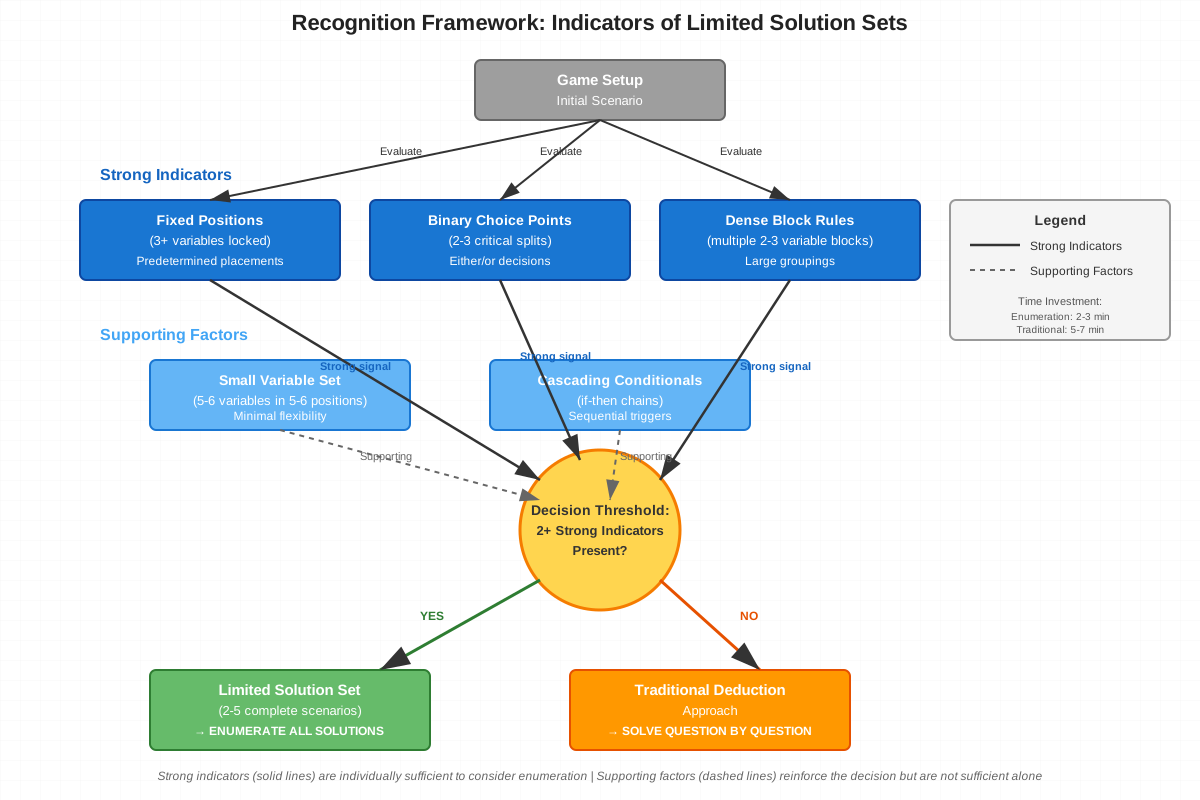
- [ ] Recognize the structural indicators that signal a game has limited solution sets (3-5 complete scenarios)
- [ ] Construct complete and accurate diagrams for all valid arrangements within 3 minutes
- [ ] Evaluate whether investing time in enumerating solutions is more efficient than traditional deduction methods
- [ ] Distinguish between games with truly limited solutions versus games that merely appear constrained
Prerequisites
- Basic sequencing game structure: Understanding how to set up linear ordering games with positions and variables is fundamental, as limited solution sets build upon standard sequencing frameworks
- Rule representation and notation: Familiarity with symbolizing constraints (blocks, anti-blocks, conditional rules) enables efficient tracking of how rules interact to limit possibilities
- Deductive reasoning: The ability to chain inferences from multiple rules is necessary to recognize when constraints have eliminated most potential arrangements
- Game board setup: Competence in creating master diagrams and tracking fixed positions provides the foundation for enumerating complete solutions
Why This Topic Matters
In real-world applications, the limited solution sets approach mirrors constraint satisfaction problems in computer science, scheduling optimization, and decision-making under strict parameters. Professionals in law regularly encounter situations where multiple regulations, precedents, and requirements narrow options to a manageable set of viable approaches. The analytical skill of recognizing when exhaustive enumeration is more efficient than iterative testing translates directly to legal research, case strategy development, and regulatory compliance analysis.
On the LSAT, limited solution sets appear in approximately 15-20% of all Analytical Reasoning games, with higher frequency in recent exams. These games typically generate 5-7 questions each, meaning that mastering this approach can directly impact 8-12 questions per exam—a significant portion of the 22-23 total Analytical Reasoning questions. The strategy is particularly prevalent in strict sequencing games, games with multiple fixed positions, and scenarios involving binary choices or complementary pairs.
Common manifestations include: games where 3-4 of 6-7 positions are fixed or heavily constrained; scenarios with multiple block rules that severely limit arrangement options; games with conditional rules that create forced chains affecting most variables; and situations where two or three key variables have binary placement options that cascade through the entire arrangement. Test-makers often design these games to reward strategic thinking over brute-force deduction, making limited solution sets recognition a high-yield skill for time management and accuracy.
Core Concepts
Recognizing Limited Solution Set Indicators
The first critical skill involves identifying when a game's constraint structure suggests limited possibilities. Limited solution sets emerge when rules interact to create a highly determined system. Key structural indicators include: (1) multiple fixed positions established by rules (e.g., "X is in position 3" and "Y is in position 1"), (2) extensive block rules that lock multiple variables together (e.g., "A and B must be consecutive" combined with "C and D must be consecutive"), (3) conditional rules that create forced chains (e.g., "If X is before Y, then Z is before W" in combination with other constraints that trigger the conditional), and (4) binary choice points that affect multiple downstream positions.
A game with 6 positions and 7 variables might initially seem to have hundreds of possible arrangements. However, if rules establish that position 1 must be A or B, position 6 must be G, and C-D must be consecutive while E-F must be consecutive, the actual number of valid arrangements collapses dramatically. The mathematical principle underlying this phenomenon is constraint propagation: each rule eliminates a percentage of theoretical possibilities, and when rules interact synergistically, they eliminate possibilities multiplicatively rather than additively.
The Enumeration Process
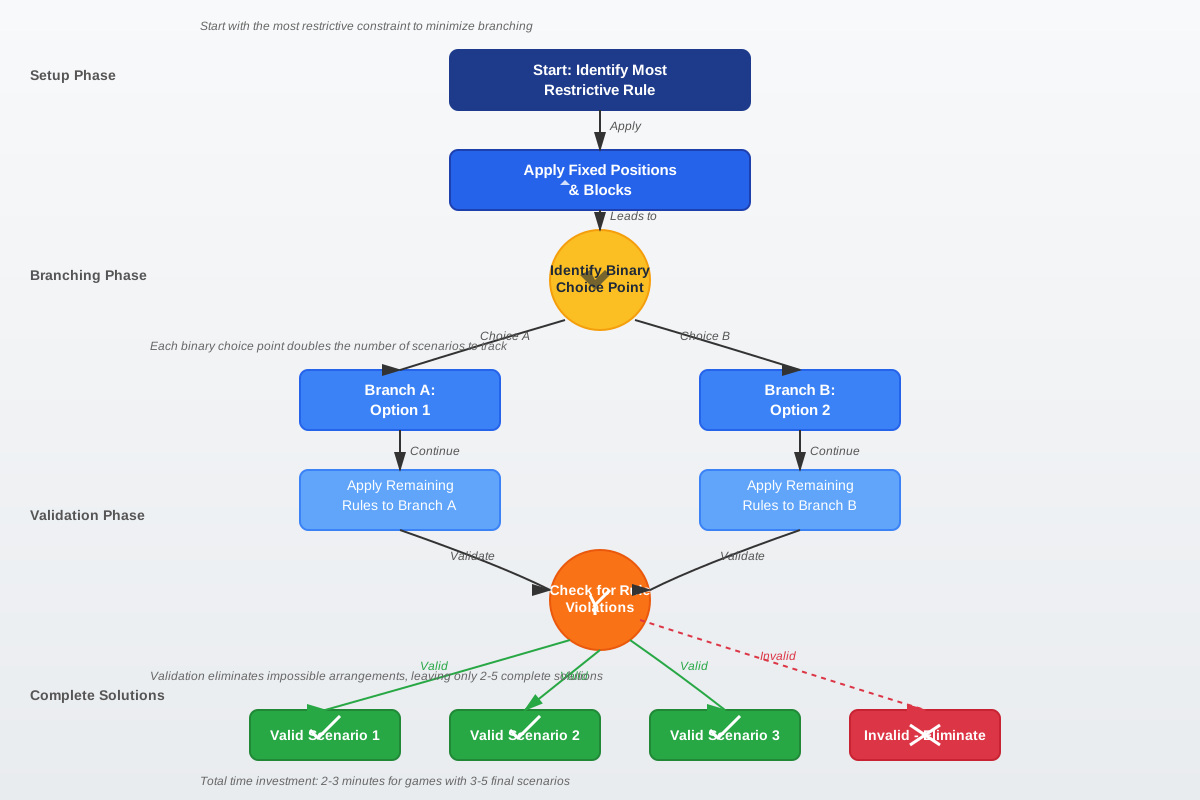
Once a game is identified as having limited solution sets, systematic enumeration follows a structured approach. Begin by identifying the most restrictive rule or the variable with the fewest placement options—this becomes the branching point. Create separate diagrams for each possibility at this branch point, then apply remaining rules to each diagram sequentially. The process resembles a decision tree where each branch represents a valid partial solution that either completes successfully or reaches a contradiction.
For example, if position 1 can only be A or B (due to rule interactions), create two master diagrams: one with A in position 1 and one with B in position 1. Then systematically apply all other rules to each diagram. If the "A in position 1" scenario generates two valid complete arrangements while the "B in position 1" scenario generates one valid arrangement, the game has exactly three limited solution sets. The key is working methodically through each branch, testing all rules, and recognizing when a branch reaches a dead end (contradiction) versus when it yields a valid complete solution.
Efficiency Calculation and Time Investment
A critical judgment call involves determining whether enumerating solutions is worth the time investment. The decision matrix considers: (1) the number of questions in the set (more questions favor upfront investment), (2) the apparent constraint density (tighter constraints suggest fewer solutions), (3) the test-taker's remaining time, and (4) confidence in completing enumeration without errors. As a general guideline, if initial analysis suggests 2-4 complete solutions are possible and the game has 5+ questions, enumeration typically saves time overall.
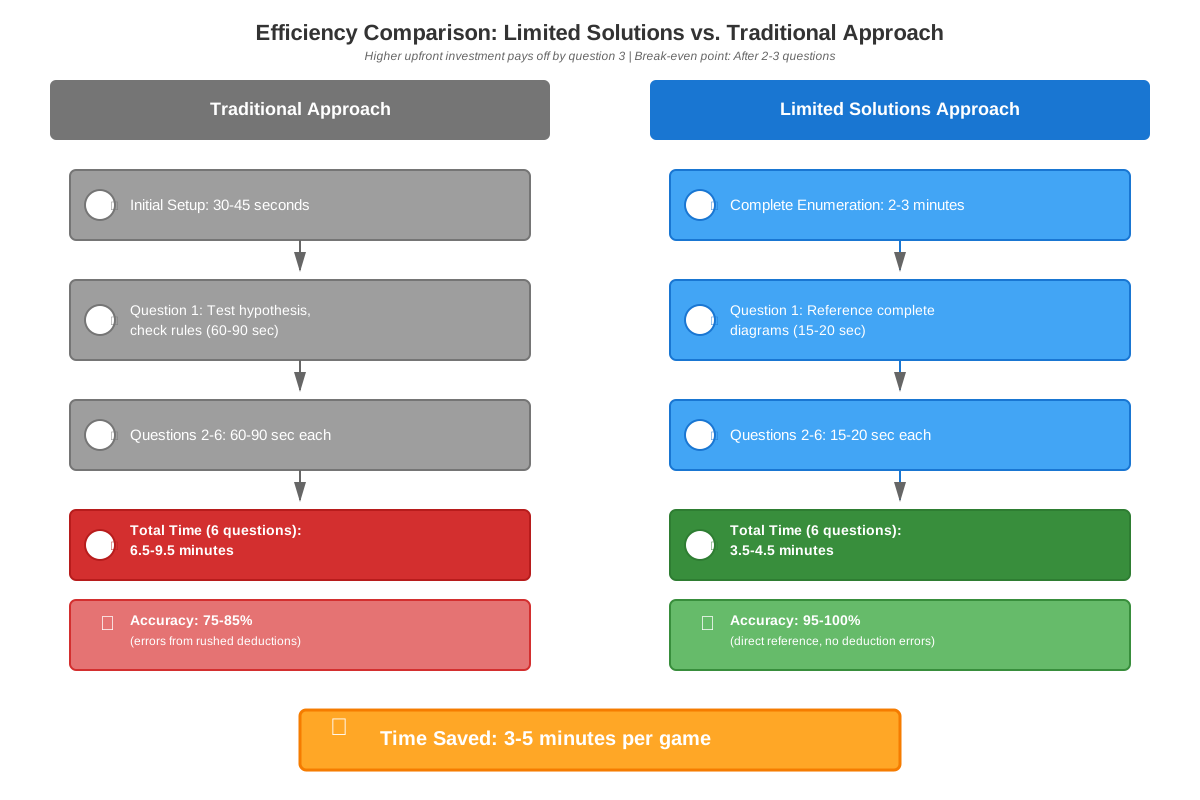
The time economics work as follows: spending 2-3 minutes to enumerate 3-4 complete solutions, then answering 6 questions in 20-30 seconds each (total: 2-3 minutes for setup + 2-3 minutes for questions = 4-6 minutes total) compares favorably to the traditional approach of 1 minute setup + 1-1.5 minutes per question (total: 1 minute + 9 minutes = 10 minutes total). The accuracy differential further favors enumeration, as referencing complete diagrams eliminates the risk of deductive errors under time pressure.
Verification and Completeness
After enumerating what appear to be all solutions, verification ensures no valid arrangements were missed and no invalid arrangements were included. Check each diagram against every rule systematically, marking each rule as satisfied. Then consider whether any other arrangements might exist by examining whether the branching variable truly captured all possibilities. A common error involves branching on a variable that seems constrained but actually has a third option that wasn't immediately apparent.
Completeness verification also involves checking for "mirror" solutions or variations that might exist. For instance, if the rules don't fully determine the order of two variables in certain positions, ensure all permutations are captured. The goal is confidence that the enumerated set is both necessary (all included solutions are valid) and sufficient (no valid solutions were omitted).
Application to Question Types
Different question types leverage limited solution sets differently. "Could be true" questions are answered by checking whether the proposed scenario appears in any of the enumerated solutions. "Must be true" questions require checking whether the statement holds in all enumerated solutions. "Could be false" questions are satisfied if the statement fails in at least one solution. "Cannot be true" questions are confirmed if the statement appears in none of the solutions. "Completely determined if" questions involve checking which new condition would force exactly one of the enumerated solutions.
For "acceptable arrangement" questions (typically question 1), simply compare each answer choice against the complete solution set—the correct answer will match one of the enumerated diagrams exactly. For "how many arrangements" questions, the enumeration provides the direct answer. This systematic matching process eliminates the need for rule-by-rule testing and dramatically reduces error rates.
Concept Relationships
The limited solution sets strategy builds directly on foundational sequencing game skills: rule representation enables tracking constraints, deductive reasoning allows inference chaining, and game board setup provides the framework for enumeration. The relationship flows as: Basic Setup → Rule Application → Constraint Recognition → Solution Enumeration → Question Answering.
Within the topic itself, concepts connect sequentially: Recognition of Indicators (identifying when enumeration is appropriate) → Enumeration Process (systematically generating all solutions) → Verification (ensuring completeness and accuracy) → Application (using solutions to answer questions efficiently). Each stage depends on the previous stage's successful completion.
Limited solution sets also connect to advanced topics in Analytical Reasoning Legacy, particularly game strategy and time management. The decision to enumerate versus deduce represents a meta-strategic choice that affects overall section performance. Additionally, the concept relates to hybrid games and complex rule interactions, where recognizing limited possibilities within one component of a multi-layered game can simplify the entire puzzle. The relationship map extends: Limited Solution Sets → Time Efficiency → Higher Accuracy → Improved Section Score → Strategic Confidence.
High-Yield Facts
- ⭐ Games with 3-4 fixed positions out of 6-7 total positions frequently have limited solution sets (typically 2-4 complete arrangements)
- ⭐ When two or more block rules exist in a 6-position game, check immediately for limited solution sets
- ⭐ If initial setup reveals a key variable has only 2 possible positions, branch on that variable to enumerate solutions
- ⭐ Spending 2-3 minutes enumerating 3-4 solutions saves 4-6 minutes on a 6-question set compared to traditional approaches
- ⭐ Limited solution sets yield near-perfect accuracy (95%+) when diagrams are correctly constructed and verified
- Games with binary choice points that cascade through multiple positions are prime candidates for enumeration
- "Must be true" questions are answered instantly by checking whether a statement holds in all enumerated solutions
- If enumeration generates more than 5-6 distinct solutions, the strategy becomes less efficient than traditional deduction
- Always verify each enumerated solution against every rule before proceeding to questions
- The most common enumeration error is missing a valid solution by overlooking a branching possibility
- Limited solution sets appear most frequently in strict sequencing games and games with complementary pairs
- When rules create forced chains (if-then sequences that trigger automatically), solution sets are often limited
- Enumeration is particularly valuable when questions ask "how many different arrangements" or "which must be true"
- Games published after 2010 show increased frequency of limited solution set designs compared to earlier exams
Quick check — test yourself on Limited solution sets so far.
Try Flashcards →Common Misconceptions
Misconception: Every highly constrained game has limited solution sets worth enumerating.
Correction: Some games have dense rules but still generate 8-12+ valid arrangements, making enumeration inefficient. The key is recognizing when constraints interact to create 2-5 solutions specifically, not just "many constraints."
Misconception: Limited solution sets only apply to sequencing games.
Correction: While most common in sequencing games legacy, the strategy also applies to grouping games and hybrid games when constraints severely limit valid configurations. The principle of exhaustive enumeration works whenever total possibilities are manageable.
Misconception: Enumerating solutions takes too much time and should be avoided under time pressure.
Correction: When correctly identified, enumeration saves significant time overall by eliminating the need for question-by-question deduction. The upfront investment of 2-3 minutes returns 4-6 minutes in faster question answering, creating a net time savings.
Misconception: If you enumerate 3 solutions, you've found all solutions and can proceed immediately.
Correction: Verification is essential. Without checking completeness, test-takers risk missing a fourth or fifth solution, leading to incorrect answers on "must be true" questions. Always verify that the branching variable captured all possibilities.
Misconception: Limited solution sets mean the game is easier and requires less careful attention.
Correction: While the strategy simplifies question answering, constructing accurate diagrams requires meticulous rule application. A single error in enumeration propagates to multiple wrong answers. These games reward precision, not speed in setup.
Misconception: You should always enumerate solutions starting with the first position and working forward.
Correction: Efficient enumeration branches on the most constrained variable or the rule that creates the clearest split, which may involve middle or end positions. Starting with position 1 can lead to unnecessary branching and wasted effort.
Worked Examples
Example 1: Six-Position Sequencing Game
Setup: Six runners—J, K, L, M, N, O—finish a race in positions 1 through 6. The following conditions apply:
- J finishes in position 3
- K finishes immediately before L
- M finishes before N
- O finishes in position 1 or position 6
Analysis: This game exhibits clear limited solution set indicators. Position 3 is fixed (J), and O has only two possible positions (1 or 6), creating a natural branching point. The K-L block and M-before-N constraint will interact with these fixed positions to limit arrangements significantly.
Enumeration Process:
Branch 1: O in position 1
- Positions: O _ J _ _ _
- K-L must be consecutive. Possible placements: positions 2-3 (blocked by J in 3), positions 4-5, or positions 5-6
- If K-L in positions 4-5: O _ J K L _
- M and N remain for positions 2 and 6, with M before N
- M must be in position 2, N in position 6
- Solution 1: O M J K L N
- If K-L in positions 5-6: O _ J _ K L
- M and N remain for positions 2 and 4, with M before N
- M must be in position 2, N in position 4
- Solution 2: O M J N K L
Branch 2: O in position 6
- Positions: _ _ J _ _ O
- K-L consecutive. Possible placements: positions 1-2, positions 2-3 (blocked by J in 3), positions 4-5
- If K-L in positions 1-2: K L J _ _ O
- M and N remain for positions 4 and 5, with M before N
- M in position 4, N in position 5
- Solution 3: K L J M N O
- If K-L in positions 4-5: _ _ J K L O
- M and N remain for positions 1 and 2, with M before N
- M in position 1, N in position 2
- Solution 4: M N J K L O
Verification: Each solution satisfies all rules. No other K-L placements work in either branch. The game has exactly 4 limited solution sets.
Question Application:
- "Which must be true?" → Check all 4 solutions. If a statement holds in all 4, it must be true.
- "K could be in which position?" → Check solutions: K appears in positions 1, 4, and 5 across the four solutions.
- "If M is in position 2, what must be true?" → Only Solutions 1 and 2 have M in position 2; check what's common to both.
Example 2: Seven-Position Game with Conditional Rules
Setup: Seven presentations—A, B, C, D, E, F, G—are scheduled in slots 1 through 7. The conditions are:
- A is in position 4
- If B is before C, then E is in position 7
- If B is after C, then F is in position 1
- D is immediately before or immediately after G
Analysis: Position 4 is fixed (A). The conditional rules create a binary: either B-before-C (triggering E in 7) or C-before-B (triggering F in 1). This binary, combined with the D-G adjacency requirement, suggests limited solutions.
Enumeration Process:
Branch 1: B before C (E in position 7)
- Positions: _ _ _ A _ _ E
- F, B, C, D, G remain for positions 1, 2, 3, 5, 6
- D-G must be adjacent: possible as 1-2, 2-3, 5-6
- B must be before C (both in remaining positions)
- Testing D-G in 1-2: D G _ A _ _ E or G D _ A _ _ E
- Remaining: F, B, C for positions 3, 5, 6 with B before C
- Multiple valid arrangements emerge, suggesting this branch has several solutions
- Testing D-G in 2-3: _ D G A _ _ E or _ G D A _ _ E
- Similar analysis yields multiple arrangements
- Testing D-G in 5-6: _ _ _ A D G E or _ _ _ A G D E
- Remaining: F, B, C for positions 1, 2, 3 with B before C
- Valid arrangements: F B C A D G E, F B C A G D E, B F C A D G E, B F C A G D E, B C F A D G E, B C F A G D E
Branch 2: C before B (F in position 1)
- Positions: F _ _ A _ _ _
- E, B, C, D, G remain for positions 2, 3, 5, 6, 7
- D-G adjacent, C before B
- Testing systematically yields multiple solutions
Strategic Decision: This enumeration reveals 10+ solutions, making complete enumeration inefficient. The better approach is to note the key deductions (the binary conditional structure) and work questions individually using traditional methods. This example demonstrates that not every constrained game benefits from full enumeration—recognizing when to abandon the strategy is equally important.
Exam Strategy
When approaching Analytical Reasoning Legacy questions, scan the rules during initial setup for limited solution set indicators. Trigger phrases include: "X is in position [specific number]," "Y is in the first/last position," "exactly one of A or B," and multiple block rules ("consecutive," "immediately before/after"). If 3+ positions are fixed or heavily constrained in a 6-7 position game, invest 30 seconds testing whether enumeration is viable.
The decision algorithm: (1) Count fixed positions and major constraints, (2) Identify the most restricted variable, (3) Sketch 2-3 branches quickly to estimate total solutions, (4) If estimate is 2-5 solutions and 5+ questions exist, commit to full enumeration, (5) If estimate exceeds 6 solutions, abandon enumeration and use traditional deduction. This 30-second investment prevents wasting 3 minutes on unproductive enumeration attempts.
During enumeration, work systematically through one branch completely before starting the next branch. Mark each completed solution clearly (Solution 1, Solution 2, etc.) and verify against all rules before proceeding. Use consistent notation and spacing to prevent diagram confusion. If a branch reaches a contradiction, mark it clearly as invalid and move to the next branch without second-guessing.
For question answering, develop a matching system: write the question's constraint or query, then check each enumerated solution sequentially. For "must be true" questions, a statement must hold in ALL solutions. For "could be true," it need only appear in ONE solution. For "cannot be true," it must appear in ZERO solutions. This systematic checking prevents errors from hasty pattern recognition.
Time allocation: Allow 2-3 minutes for enumeration in a 6-question set, leaving 5-6 minutes for questions (approximately 50 seconds per question). If enumeration extends beyond 3 minutes, you've likely misidentified the game type—cut losses and switch to traditional methods. The strategy's value lies in time savings; if enumeration consumes excessive time, it defeats the purpose.
Memory Techniques
F.I.B.E.R. mnemonic for recognizing limited solution set indicators:
- Fixed positions (3+ positions determined)
- Interacting blocks (multiple consecutive requirements)
- Binary choices (key variables with only 2 options)
- Extensive conditionals (if-then chains that trigger automatically)
- Restrictive endpoints (first/last positions heavily constrained)
"Branch, Build, Check, Match" for the enumeration process:
- Branch on the most constrained variable
- Build each scenario completely before moving to the next
- Check every solution against all rules
- Match questions to solutions systematically
Visualization strategy: Picture the game board as a tree where the trunk represents the initial setup, major branches represent key variable placements (the branching point), and leaves represent complete valid solutions. If the tree has 2-4 leaves, enumeration works. If it has 10+ leaves, the tree is too bushy for efficient enumeration.
"2-3-5" rule for time investment: Spend 2-3 minutes enumerating if you expect 2-5 solutions. This numerical anchor helps make the strategic decision quickly during the exam.
Summary
Limited solution sets represent a transformative strategy in Analytical Reasoning Legacy, particularly for sequencing games legacy, where highly restrictive rules collapse hundreds of theoretical arrangements into just 2-5 valid solutions. Recognizing structural indicators—fixed positions, block rules, binary choices, and conditional chains—enables test-takers to identify when exhaustive enumeration is more efficient than traditional question-by-question deduction. The systematic process involves branching on the most constrained variable, building complete scenarios, verifying against all rules, and then matching questions to enumerated solutions with near-perfect accuracy. While not every constrained game benefits from enumeration (games with 6+ solutions make the strategy inefficient), correctly identifying and executing lsat limited solution sets can save 4-6 minutes per game while dramatically improving accuracy. The approach requires upfront time investment but pays dividends through rapid question answering and elimination of deductive errors under pressure. Mastery involves both recognizing when to enumerate and when to abandon the strategy in favor of traditional methods, making it a sophisticated tool that separates strategic test-takers from those who rely solely on rule-by-rule analysis.
Key Takeaways
- Limited solution sets occur when rule interactions constrain a game to 2-5 valid complete arrangements, making exhaustive enumeration more efficient than traditional deduction
- Key indicators include 3+ fixed positions, multiple block rules, binary choice points, and cascading conditional rules in 6-7 position games
- The enumeration process requires branching on the most constrained variable, systematically building each scenario, and verifying completeness before answering questions
- Time economics favor enumeration when 5+ questions exist and 2-5 solutions are expected: 2-3 minutes setup saves 4-6 minutes overall
- Question answering becomes pattern matching: "must be true" requires the statement in ALL solutions, "could be true" requires it in ONE solution, "cannot be true" requires it in ZERO solutions
- Strategic judgment is critical—abandon enumeration if initial testing suggests 6+ solutions, as the strategy becomes counterproductive
- Verification prevents the most common error: missing a valid solution leads to incorrect answers on multiple questions, so always check completeness and rule satisfaction
Related Topics
Advanced Sequencing Strategies: Building on limited solution sets, advanced strategies include partial enumeration (mapping 2-3 key variables while leaving others flexible) and hybrid approaches that combine enumeration with conditional deduction. Mastering limited solution sets provides the foundation for these sophisticated techniques.
Grouping Games with Limited Distributions: Similar constraint satisfaction principles apply when grouping games have severely limited valid distributions (e.g., only 2-3 ways to divide variables among groups). The enumeration mindset transfers directly to these scenarios.
Hybrid Games: Complex games combining sequencing and grouping elements often contain sub-components with limited solution sets. Recognizing when one dimension of a hybrid game has limited possibilities simplifies the entire puzzle.
Time Management and Game Selection: Understanding when to invest time in enumeration versus moving to the next game connects to broader section strategy. Limited solution sets mastery improves overall time allocation decisions.
Rule Interaction and Constraint Propagation: Deeper study of how rules combine to eliminate possibilities enhances the ability to recognize limited solution set opportunities quickly during initial game analysis.
Practice CTA
Now that you've mastered the conceptual framework for limited solution sets, it's time to cement your understanding through application. Attempt the practice questions designed specifically for this topic, focusing on recognizing indicators, executing systematic enumeration, and leveraging complete solutions for rapid question answering. The flashcards will reinforce key decision points and common patterns. Remember: the difference between understanding the strategy and executing it flawlessly under time pressure comes from deliberate practice. Each game you analyze strengthens your pattern recognition and strategic judgment. You're building a skill that will serve you across 15-20% of all Analytical Reasoning games—a significant competitive advantage on test day. Approach the practice with the same systematic mindset you've learned here, and watch your speed and accuracy transform.
Sign up free to keep reading
Create a free AnvayaPrep account to finish this LSAT guide on Limited solution sets — plus flashcards and practice questions.