Overview
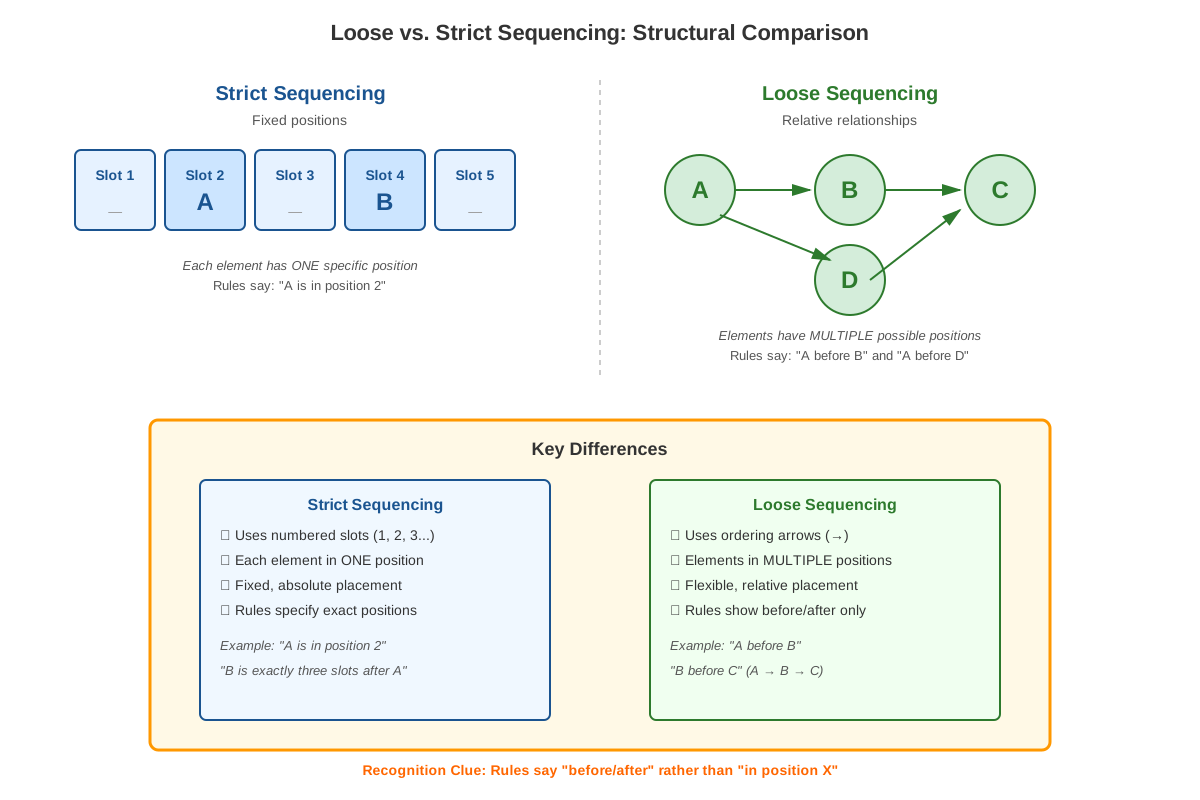
Loose sequencing games represent one of the most frequently tested and strategically important question types within the Analytical Reasoning Legacy section of the LSAT. Unlike strict sequencing games where every element has a precisely defined position, loose sequencing games present ordering relationships that are relative and flexible. These games provide partial information about the order of elements without fixing them into specific slots, creating a web of relationships that test-takers must navigate to answer questions correctly.
The fundamental challenge of LSAT loose sequencing games lies in managing uncertainty while tracking multiple ordering constraints simultaneously. Rather than placing elements into numbered positions (first, second, third, etc.), students must work with relational statements like "A comes before B" or "C comes sometime after D but before E." This requires a different visualization strategy and a more flexible mental model than traditional sequencing games. The ability to recognize when a game is loose rather than strict, and to adapt one's diagramming approach accordingly, often determines whether a test-taker completes the section efficiently or becomes mired in confusion.
Within the broader context of Sequencing Games Legacy, loose sequencing games occupy a middle ground between pure ordering games and hybrid games that combine sequencing with grouping elements. Mastering loose sequencing builds essential skills for handling ambiguity, tracking transitive relationships, and making valid inferences from incomplete information—all critical competencies that extend beyond this specific game type to virtually every analytical reasoning challenge on the LSAT.
Learning Objectives
- [ ] Identify how loose sequencing games appears in LSAT questions
- [ ] Explain the reasoning pattern behind loose sequencing games
- [ ] Apply loose sequencing games to solve LSAT-style problems accurately
- [ ] Construct effective visual diagrams that capture all ordering relationships without over-constraining the solution space
- [ ] Recognize and apply transitive properties to derive secondary inferences from primary rules
- [ ] Distinguish between loose sequencing games and strict sequencing games based on rule structure and question stems
- [ ] Evaluate answer choices by testing them against the complete network of ordering constraints
Prerequisites
- Basic sequencing concepts: Understanding fundamental ordering relationships (before/after, earlier/later) is essential because loose sequencing builds directly on these foundational ideas while adding layers of complexity.
- Conditional logic fundamentals: Recognizing if-then relationships helps interpret rules that establish ordering constraints triggered by specific conditions.
- Diagramming skills: The ability to create visual representations of logical relationships is critical since loose sequencing games require specialized notation systems to track multiple overlapping constraints.
- Transitive reasoning: Understanding that if A > B and B > C, then A > C is fundamental to deriving the secondary inferences that unlock most loose sequencing questions.
Why This Topic Matters
Loose sequencing games appear with remarkable consistency on the LSAT, typically showing up in 1-2 games per test administration. According to historical test data, approximately 20-25% of all analytical reasoning games incorporate loose sequencing elements, either as pure loose sequencing games or as hybrid games combining loose sequencing with other game types. This frequency makes loose sequencing one of the highest-yield topics within the entire Analytical Reasoning section.
The practical significance extends beyond test performance. Loose sequencing games develop critical thinking skills applicable to real-world legal reasoning, project management, and logical analysis. Attorneys regularly encounter situations requiring them to establish timelines from partial information, determine the order of events from witness testimony, or sequence procedural steps when some relationships are fixed while others remain flexible. The mental discipline of tracking multiple constraints while maintaining awareness of what remains undetermined mirrors the analytical demands of legal practice.
On the LSAT, loose sequencing games commonly appear in scenarios involving: scheduling events across multiple days without specific time slots; ranking preferences or priorities without absolute positions; establishing chronological sequences from historical or narrative information; or determining the order of tasks, performances, or presentations when only relative relationships are known. Questions typically ask test-takers to identify what must be true, what could be true, what must be false, or which arrangements are possible given the constraints. The ability to quickly recognize these patterns and deploy appropriate strategies directly impacts both accuracy and timing throughout the Analytical Reasoning section.
Core Concepts
Defining Loose Sequencing Games
Loose sequencing games are analytical reasoning problems where elements must be ordered according to relative relationships rather than fixed positions. The defining characteristic is that rules establish connections between elements (X before Y, A earlier than B) without specifying exact positions in a sequence. This creates a network of relationships where multiple valid arrangements may satisfy all constraints simultaneously.
The key distinction from strict sequencing lies in the nature of the constraints. Strict sequencing games provide rules like "F is in position 3" or "G is exactly two positions after H," which anchor elements to specific slots. Loose sequencing games instead offer rules like "F is before G" or "H is after both J and K," which establish relative order without determining absolute position. This fundamental difference requires a completely different diagramming approach and solution strategy.
The Loose Sequencing Diagram
The standard notation for loose sequencing games uses a horizontal line with elements arranged left-to-right to represent earlier-to-later relationships. When element A must come before element B, this is written as:
A — BWhen multiple elements have ordering relationships, they connect into chains:
A — B — CThis indicates A before B, and B before C, which through transitivity means A before C.
When elements have independent ordering relationships that don't directly connect, they appear as separate chains:
A — B — C
D — E
Here, we know the order within each chain but have no information about how the chains relate to each other. D could come before A, after C, or anywhere in between.
Branching Relationships
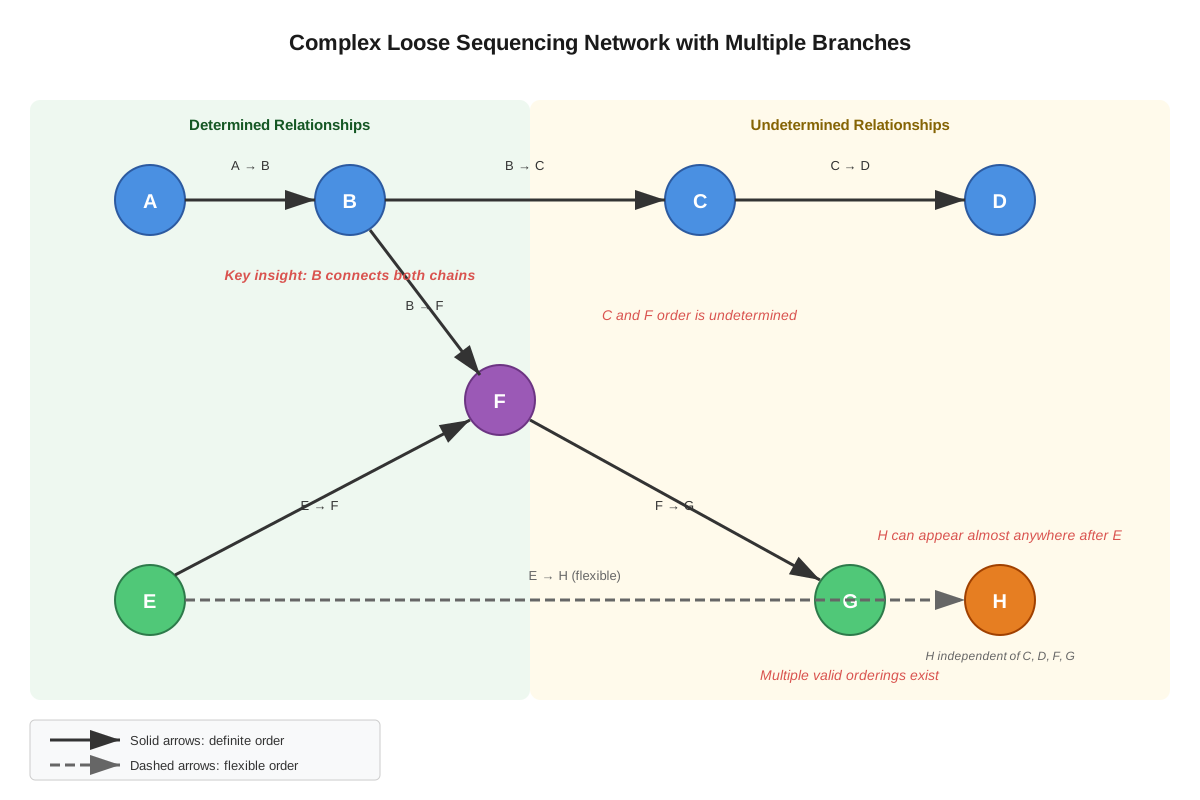
One of the most powerful features of loose sequencing diagrams is their ability to represent branching relationships. When two elements must both come after the same element but have no specified relationship to each other, this creates a fork:
    B
   /
  A
   \
    C
This diagram indicates A comes before both B and C, but B and C have no determined relationship to each other. B could come before C, C could come before B, or they could be simultaneous (if the game allows).
Similarly, when two elements must both come before the same element:
B
 \
  A
 /
C
This shows both B and C come before A, but B and C have no specified relationship to each other.
Transitive Inferences
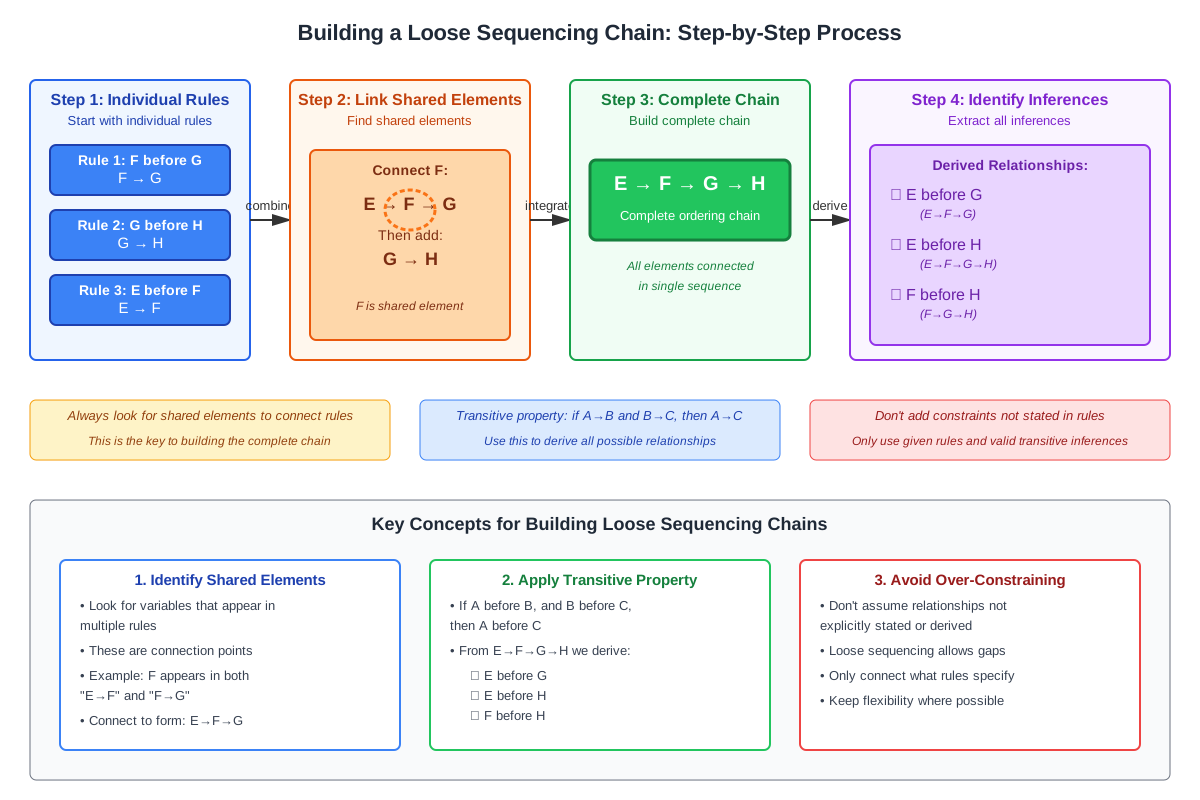
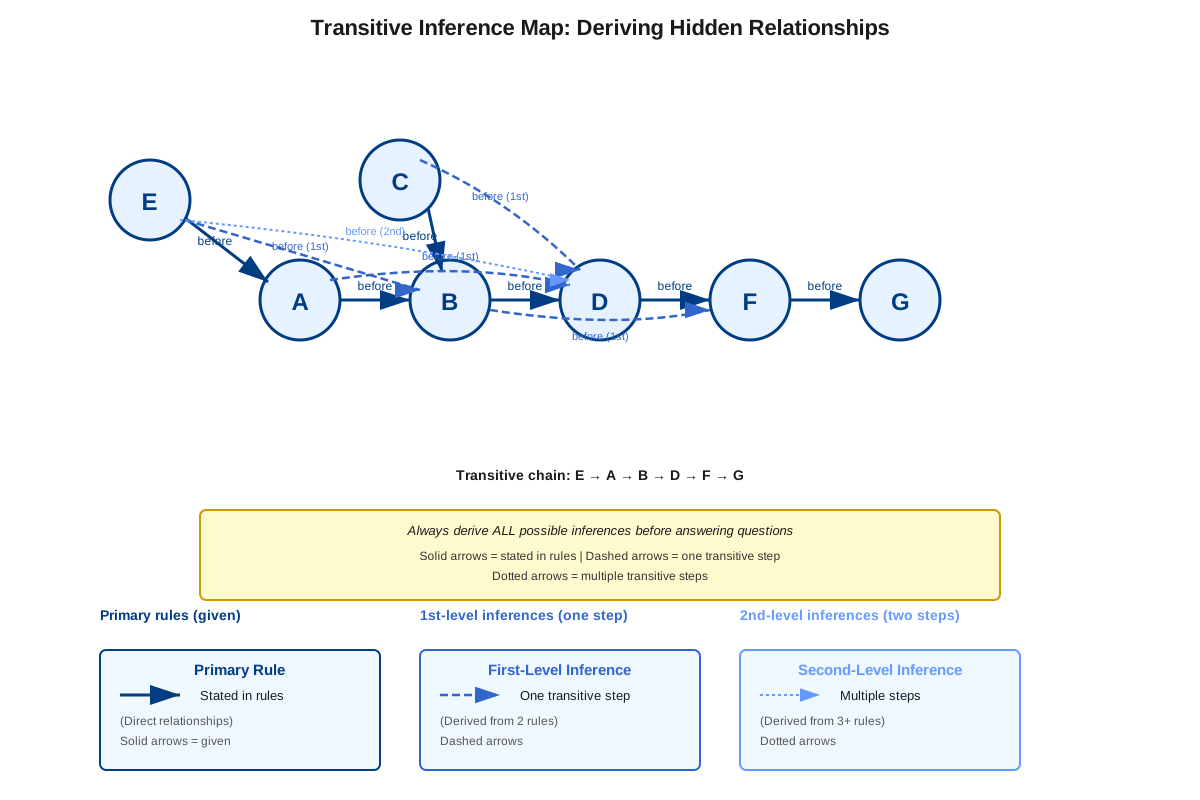
The transitive property is the engine that powers loose sequencing games. If the rules establish that X comes before Y, and Y comes before Z, then X must come before Z—even if no rule directly states this relationship. Recognizing and documenting these transitive inferences is essential for answering questions efficiently.
Consider a game with these rules:
- A is before B
- B is before C
- D is before B
- C is before E
The complete diagram reveals multiple transitive relationships:
    A
   /
  D — B — C — E
From this diagram, we can infer: A before C, A before E, D before C, D before E, B before E, and so on. These secondary inferences often provide the key to answering questions, particularly "must be true" questions.
Handling Negative Constraints
Some loose sequencing games include negative constraints—rules stating what cannot happen rather than what must happen. For example, "F cannot be immediately before G" or "H and J cannot be consecutive." These rules don't fit naturally into the standard loose sequencing diagram and require separate notation, typically written to the side with a symbol like:
F ≠ G (not consecutive)These negative constraints often become crucial in eliminating answer choices or determining which arrangements are possible.
Floating Elements
Elements that have no ordering relationships specified in the rules are called "floating" or "free" elements. These elements can appear anywhere in the sequence that doesn't violate other constraints. Identifying floating elements is critical because they represent maximum flexibility in the game. Questions often test whether test-takers recognize that floating elements can occupy positions that seem counterintuitive.
Integration with Other Game Types
While pure loose sequencing games exist, many LSAT games combine loose sequencing with other elements. Common hybrids include:
| Hybrid Type | Characteristics | Strategy Adjustment |
|---|---|---|
| Loose Sequencing + Grouping | Elements must be ordered AND assigned to categories | Create separate diagrams for sequencing and grouping, then integrate |
| Loose Sequencing + Selection | Must choose which elements to include, then order them | Determine selection constraints first, then apply sequencing |
| Loose Sequencing + Strict Positions | Some elements have fixed positions, others have relative relationships | Anchor fixed elements first, then build loose sequencing around them |
Concept Relationships
The concepts within loose sequencing games form an interconnected system where each element builds upon and reinforces the others. The foundation begins with basic ordering relationships (A before B), which combine through transitive reasoning to create extended chains. These chains may develop branching relationships when multiple elements share common predecessors or successors, creating a network rather than a simple linear sequence.
Diagramming techniques serve as the visual language that makes these abstract relationships concrete and manipulable. The diagram itself becomes a tool for discovering transitive inferences that weren't immediately obvious from the rules alone. Floating elements represent the gaps in the network—the pieces whose positions remain undetermined even after all inferences are drawn.
When negative constraints enter the picture, they add a layer of restriction that operates differently from positive ordering rules. Rather than building the network, negative constraints prune possibilities, eliminating specific arrangements that would otherwise seem viable.
The relationship map flows as follows:
Basic Rules → Diagram Construction → Transitive Inferences → Complete Network → Answer Evaluation
With parallel processes:
Floating Elements Identification (ongoing throughout)
Negative Constraints Tracking (applied during answer evaluation)
This system connects to prerequisite knowledge through conditional logic (rules often contain conditional elements) and basic sequencing (loose sequencing extends these principles). It connects forward to hybrid games (which incorporate loose sequencing as one component) and complex inference chains (which appear in the most difficult analytical reasoning questions).
High-Yield Facts
⭐ Loose sequencing games establish relative order without fixed positions, requiring diagrams that show relationships rather than slots.
⭐ Transitive inferences are the primary source of secondary deductions in loose sequencing games—if A before B and B before C, then A before C.
⭐ Elements with no specified relationships (floating elements) can appear anywhere that doesn't violate established constraints.
⭐ Branching diagrams indicate that multiple elements share a common predecessor or successor but have no determined relationship to each other.
⭐ The complete loose sequencing diagram must be constructed before attempting questions, as most answers depend on seeing the full network of relationships.
- Loose sequencing games typically provide 4-7 ordering rules that must be integrated into a single coherent diagram.
- When two separate chains exist with no connecting relationships, questions often test whether test-takers incorrectly assume a relationship between the chains.
- "Must be true" questions in loose sequencing games almost always depend on transitive inferences or direct rule applications.
- "Could be true" questions require testing whether a proposed arrangement violates any constraint in the network.
- Negative constraints (elements that cannot be adjacent or in specific relationships) must be tracked separately from the main diagram.
- The longest chain in a loose sequencing diagram determines the minimum number of positions required if the game has a strict sequencing component.
- Elements that appear at the beginning of chains (with nothing before them) are candidates for "earliest" positions in questions.
- Elements that appear at the end of chains (with nothing after them) are candidates for "latest" positions in questions.
Common Misconceptions
Misconception: Loose sequencing games require placing elements into numbered positions like strict sequencing games. → Correction: Loose sequencing games focus on relative relationships between elements, not absolute positions. The diagram shows which elements come before or after others without assigning specific position numbers. Only when a question asks about specific positions should test-takers consider converting the loose diagram into possible strict arrangements.
Misconception: If two elements appear in separate chains in the diagram, they cannot be adjacent in any valid arrangement. → Correction: Elements in separate chains have no specified relationship, meaning they could be adjacent, far apart, or in any configuration that doesn't violate other constraints. Separate chains represent lack of information, not prohibition.
Misconception: The loose sequencing diagram shows the only possible arrangement of elements. → Correction: The diagram shows the constraints that all arrangements must satisfy, not a single arrangement. Multiple different sequences may satisfy the same set of constraints. The diagram is a tool for testing possibilities, not a representation of "the answer."
Misconception: Transitive inferences only work with directly connected elements. → Correction: Transitive inferences work across any chain of relationships, no matter how long. If A before B, B before C, C before D, and D before E, then A must come before E, even though they're separated by three intermediate elements. All elements earlier in a chain must come before all elements later in that chain.
Misconception: Floating elements (those with no specified relationships) are irrelevant to answering questions. → Correction: Floating elements are highly relevant because their flexibility often determines which arrangements are possible. Questions frequently test whether test-takers recognize that floating elements can occupy positions that seem counterintuitive, or that floating elements provide the flexibility needed to satisfy all constraints.
Misconception: Once the initial diagram is drawn, no further work is needed until questions are attempted. → Correction: After drawing the initial diagram, test-takers should actively search for all transitive inferences, identify floating elements, note any elements that must be earliest or latest, and consider how separate chains might interact. This upfront investment dramatically speeds up question-answering.
Quick check — test yourself on Loose sequencing games so far.
Try Flashcards →Worked Examples
Example 1: Basic Loose Sequencing Game
Setup: Seven presentations—F, G, H, J, K, L, M—will be scheduled. The following constraints apply:
- F is before G
- G is before H
- K is before G
- L is before M
- M is before H
Step 1: Diagram each rule individually
F — G
G — H
K — G
L — M
M — H
Step 2: Integrate rules that share common elements
Rules 1 and 2 share G: F — G — H
Rule 3 also involves G: K must come before G, which comes before H
Rules 4 and 5 share M: L — M — H
Step 3: Combine chains that share elements
Both chains end with H, so we can integrate:
F — G
     \
      H
     /
K — G

L — M — H
Wait—this shows G appearing twice, which is impossible. Let's reconsider. G appears in rules 1, 2, and 3. H appears in rules 2 and 5. Let's build more carefully:
    F
   /
  K — G — H
       /
  L — M
Step 4: Identify transitive inferences
- F before G (given)
- F before H (transitive: F → G → H)
- K before G (given)
- K before H (transitive: K → G → H)
- L before M (given)
- L before H (transitive: L → M → H)
- M before H (given)
- G before H (given)
Step 5: Identify floating elements
J has no constraints, so J is floating and can appear anywhere.
Sample Question: Which of the following could be the order of the first three presentations?
(A) F, K, G
(B) J, L, F
(C) K, F, H
(D) L, M, G
(E) M, G, H
Solution: Test each answer against the diagram:
(A) F, K, G: Check if this violates any constraints. F before G is required (✓). K before G is required (✓). But is F before K required? Looking at the diagram, F and K are in separate branches leading to G—no relationship is specified between them. This could be valid. Keep as possibility.
(B) J, L, F: J is floating (✓). L before F? The diagram shows no relationship between L and F—they're in separate chains. This could be valid. Keep as possibility.
(C) K, F, H: K before F? No relationship specified (✓). F before H? Yes, required (✓). K before H? Yes, required (✓). But wait—if H is third, then G must come before H (required), and both K and F must come before G. So we'd need K, F, G, H at minimum. H cannot be third. Eliminate.
(D) L, M, G: L before M required (✓). M before G? Looking at the diagram, M must come before H, and G must come before H, but no relationship between M and G is specified. This could be valid. Keep as possibility.
(E) M, G, H: M before G? No relationship specified. G before H required (✓). M before H required (✓). This could be valid. Keep as possibility.
Without additional constraints, multiple answers appear possible. This suggests we need to look more carefully at the question or recognize that this is testing whether we understand that loose sequencing allows flexibility.
Example 2: Loose Sequencing with Negative Constraints
Setup: Six songs—R, S, T, U, V, W—will be performed. The following constraints apply:
- R is performed before S
- S is performed before T
- U is performed before V
- V is performed before T
- W cannot be performed immediately before or immediately after R
Step 1: Build the loose sequencing diagram
R — S — T
    /
U — V
Step 2: Note the negative constraint separately
W ≠ R (not adjacent)
Step 3: Identify key inferences
- R before S before T (given chain)
- U before V before T (given chain)
- R before T (transitive)
- U before T (transitive)
- S before T (given)
- V before T (given)
- W is floating except for the adjacency restriction with R
Sample Question: If W is performed third, which of the following must be true?
(A) R is performed first
(B) U is performed first
(C) S is performed fourth
(D) V is performed before W
(E) T is performed last
Solution: If W is third, let's consider what must come before and after W.
W cannot be adjacent to R, so R cannot be second or fourth.
Looking at the diagram, T must come after R, S, U, and V. If W is third, T must be fourth or later.
Could R be first? If R is first, then S must come after R. S could be second, making W third. This doesn't violate the non-adjacency rule (R first, W third—not adjacent). So R could be first, but must it be?
Could U be first? If U is first, V must come after U. V could be second, W third. This works. So U could be first, but must it be?
Since both R and U could be first, neither (A) nor (B) must be true.
For (C): If W is third, could S be fourth? S must come after R and before T. If S is fourth, then R must be first or second. If R is second, that makes R and W adjacent (second and third), violating the constraint. So if S is fourth, R must be first. Then we'd have R first, something second, W third, S fourth. What could be second? U or V. If U is second, then V must come after U, so V would be fifth or sixth. T must come after S, so T would be fifth or sixth. This could work. But must S be fourth? No—S could be second (R first, S second, W third).
For (D): Must V be performed before W (who is third)? V must come before T. But V's relationship to W is not constrained except through T. Could V be fourth (after W)? If V is fourth, then U must be before V (first, second, or third). If U is third, that's where W is, so U must be first or second. T must come after V, so T would be fifth or sixth. R must come before S and T. S must come before T. Could we have: R first, U second, W third, V fourth, S fifth, T sixth? Check all constraints: R before S (✓), S before T (✓), U before V (✓), V before T (✓), W not adjacent to R (✓). This works! So V doesn't have to be before W. Eliminate (D).
For (E): Must T be last? T must come after R, S, U, and V. If W is third, and T must come after at least four other elements, T must be at least fifth. Could T be fifth? That would mean only one song comes after T. Let's test: R first, U second, W third, S fourth, T fifth, V sixth. Check: R before S (✓), S before T (✓), U before V (✓), V before T (✗)—V is sixth but T is fifth. This violates V before T.
Let's try: R first, U second, W third, V fourth, S fifth, T sixth. Check: R before S (✓), S before T (✓), U before V (✓), V before T (✓), W not adjacent to R (✓). This works, and T is last.
Can T be fifth? We'd need V before T, S before T, R before S. That's at least R, S, V before T. Plus U before V. So R, U, V, S must all be before T. That's four elements before T, making T fifth at earliest. If W is third, we have positions 1, 2, 4 available for R, U, V, S. But we need four elements in three positions—impossible. Therefore, T must be sixth (last).
Answer: (E)
Exam Strategy
When approaching loose sequencing games on the LSAT, begin by reading all rules carefully and identifying the game type. Trigger phrases that signal loose sequencing include: "before," "after," "earlier than," "later than," "precedes," "follows," "comes sometime before/after," and any language establishing relative order without specific positions.
Initial Setup Strategy:
- Read all rules first without diagramming (15-20 seconds)
- Identify which elements appear in multiple rules—these are connection points
- Diagram each rule individually using the standard notation (A — B)
- Integrate rules that share common elements into chains
- Identify branching points where multiple elements share predecessors or successors
- Mark floating elements (those with no constraints)
- Note negative constraints separately
- Actively search for transitive inferences
Time Allocation: Spend 2-3 minutes on the initial setup and inference phase. This upfront investment pays dividends by making questions answerable in 30-45 seconds each rather than 60-90 seconds.
Question-Specific Strategies:
For "Must be true" questions: The answer will either be a direct rule or a transitive inference visible in your diagram. If you've completed the setup properly, these questions should be quick.
For "Could be true" questions: Test the answer choice against your diagram. If it violates any constraint or transitive inference, eliminate it. The correct answer will be consistent with all constraints but not required by them.
For "Must be false" questions: Look for answer choices that directly contradict the diagram or create impossible situations through transitive relationships.
For "If" hypothetical questions: Add the new constraint to your diagram temporarily. Determine what additional inferences follow from this constraint. Often, adding one constraint will trigger a cascade of forced relationships.
Process of Elimination Tips:
- Eliminate any answer that reverses a relationship shown in your diagram (if diagram shows A before B, eliminate any answer suggesting B before A)
- Eliminate answers that assume relationships between elements in separate chains (unless the question provides additional constraints)
- Watch for answers that treat floating elements as constrained
- Be suspicious of answers that place elements at the beginning or end of the sequence unless your diagram shows they must be there
Common Trap Patterns:
- Answer choices that seem reasonable but aren't required by the constraints
- Answers that confuse "could be true" with "must be true"
- Answers that assume relationships between unconnected elements
- Answers that ignore floating elements or negative constraints
Memory Techniques
Mnemonic for Setup Process: "RIDE-IT"
- Read all rules first
- Identify connection points (elements in multiple rules)
- Diagram each rule
- Extend chains by integrating rules
- Infer transitive relationships
- Track floating elements and negative constraints
Visualization Strategy: Picture the loose sequencing diagram as a river system. The main channels (chains) flow from left to right. Tributaries (branches) feed into the main channels. Some streams (floating elements) haven't connected to the system yet. Dams (negative constraints) block certain connections. This metaphor helps maintain the distinction between connected and unconnected elements.
Acronym for Question Approach: "SCAN"
- Setup: Review your diagram before reading answers
- Constraints: Identify which constraints are relevant to this question
- Answers: Test each systematically
- Negate: Eliminate answers that violate any constraint
Memory Aid for Transitive Relationships: "Chain reaction"—if you can trace a chain from element X to element Y in your diagram (even through multiple intermediate elements), then X must come before Y. If you cannot trace such a chain, no required relationship exists.
Summary
Loose sequencing games constitute a high-yield question type within LSAT Analytical Reasoning Legacy, testing the ability to track relative ordering relationships without fixed positions. Success requires constructing visual diagrams that capture all ordering constraints, systematically deriving transitive inferences, and distinguishing between what must be true versus what could be true. The core skill involves building an integrated network from individual rules, identifying branching relationships where multiple elements share common predecessors or successors, and recognizing floating elements that remain unconstrained. Unlike strict sequencing games that assign elements to numbered positions, loose sequencing games demand flexibility in thinking about multiple possible arrangements that satisfy the same constraints. Mastery depends on efficient setup procedures, comprehensive inference-drawing, and strategic question-answering approaches that leverage the complete constraint network rather than testing possibilities randomly.
Key Takeaways
- Loose sequencing games establish relative order (A before B) without fixed positions, requiring specialized diagramming techniques that show relationships rather than slots
- Transitive inferences are the primary source of secondary deductions—systematically trace all chains to identify every required relationship
- Elements in separate chains have no determined relationship unless explicitly stated; avoid assuming connections between unconnected elements
- Floating elements (those with no specified constraints) can appear anywhere that doesn't violate other rules and often provide the flexibility needed for valid arrangements
- Invest 2-3 minutes in comprehensive setup and inference-drawing before attempting questions; this upfront work dramatically accelerates question-answering
- Branching diagrams indicate shared predecessors or successors without determining relationships between the branches themselves
- "Must be true" questions depend on direct rules or transitive inferences; "could be true" questions require testing consistency with all constraints
Related Topics
Strict Sequencing Games: These games assign elements to specific numbered positions, building on loose sequencing concepts but adding the constraint of fixed slots. Mastering loose sequencing provides the foundation for understanding how relative relationships translate into absolute positions.
Hybrid Sequencing-Grouping Games: These combine ordering constraints with assignment to categories, requiring integration of loose sequencing diagrams with grouping frameworks. Success with pure loose sequencing games is essential before tackling these more complex hybrids.
Advanced Inference Chains: The most difficult analytical reasoning questions involve multiple layers of conditional logic combined with sequencing constraints. The inference-drawing skills developed through loose sequencing games directly transfer to these advanced question types.
Temporal Reasoning Games: These games involve scheduling across time periods with various constraints, often incorporating loose sequencing elements alongside strict timing requirements. The relative ordering skills from loose sequencing games apply directly to temporal reasoning scenarios.
Practice CTA
Now that you've mastered the core concepts of loose sequencing games, it's time to cement your understanding through active practice. Attempt the practice questions associated with this topic, focusing on applying the systematic setup process and inference-drawing techniques covered in this guide. Work through the flashcards to reinforce key concepts and trigger phrases. Remember: loose sequencing games reward methodical preparation and strategic thinking. Each practice problem you complete builds the pattern recognition and diagramming fluency that will serve you throughout the Analytical Reasoning section. Your investment in mastering this high-yield topic will pay dividends on test day!
Sign up free to keep reading
Create a free AnvayaPrep account to finish this LSAT guide on Loose sequencing games — plus flashcards and practice questions.