Overview
Ordering rules form the backbone of sequencing games in the Analytical Reasoning Legacy section of the LSAT. These rules establish relationships between elements that must be arranged in a specific sequence, whether temporal, spatial, or hierarchical. Understanding ordering rules is not merely about recognizing constraints—it requires developing a systematic approach to translating verbal statements into visual representations and logical deductions that unlock entire game boards.
In sequencing games legacy, ordering rules determine the relative positions of game pieces, creating a web of constraints that test-takers must navigate to answer questions accurately. These rules appear in various forms: some specify exact positions ("X is third"), others establish relative relationships ("Y comes before Z"), and still others create conditional sequences ("If A is selected, then B must come immediately after C"). Mastery of ordering rules enables students to construct accurate diagrams, make powerful deductions, and eliminate wrong answers efficiently—skills that directly translate to higher scores on test day.
The significance of ordering rules extends beyond individual games. They represent fundamental logical reasoning patterns that appear throughout the LSAT ordering rules landscape, connecting to broader analytical reasoning concepts such as conditional logic, spatial reasoning, and constraint satisfaction. Students who develop fluency with ordering rules gain a competitive advantage not only in sequencing games but also in hybrid games that combine ordering with grouping or selection elements. This topic represents approximately 25-30% of all Analytical Reasoning questions, making it one of the highest-yield areas for focused study.
Learning Objectives
- [ ] Identify how Ordering rules appears in LSAT questions
- [ ] Explain the reasoning pattern behind Ordering rules
- [ ] Apply Ordering rules to solve LSAT-style problems accurately
- [ ] Translate verbal ordering constraints into accurate visual representations
- [ ] Generate valid deductions by combining multiple ordering rules
- [ ] Distinguish between different types of ordering rules and their logical implications
- [ ] Evaluate answer choices efficiently using ordering rule constraints
Prerequisites
- Basic logic and conditional reasoning: Understanding "if-then" statements is essential because many ordering rules contain conditional elements that trigger specific sequences
- Spatial reasoning fundamentals: The ability to visualize linear arrangements helps translate abstract rules into concrete diagrams
- Set theory basics: Recognizing that game pieces form a defined set with specific properties enables proper constraint application
- Reading comprehension skills: Parsing complex rule statements accurately prevents misinterpretation that leads to incorrect diagrams
Why This Topic Matters
Ordering rules constitute the structural foundation of approximately 25-30% of all Analytical Reasoning questions on the LSAT, appearing in nearly every administration of the exam. These rules test a fundamental cognitive skill that law schools value: the ability to organize complex information according to multiple constraints simultaneously. Legal practice frequently requires attorneys to sequence events, establish timelines, determine procedural orders, and reconstruct chronologies from fragmentary evidence—all skills directly assessed through ordering rule questions.
On the LSAT, ordering rules appear in several distinct question formats. Acceptability questions ask which arrangement satisfies all rules. Must-be-true questions require identifying what necessarily follows from the rules. Could-be-true questions test understanding of what remains possible within the constraints. Rule substitution questions assess whether students grasp the logical equivalence between different rule formulations. Each question type demands fluency with ordering rules, making this topic indispensable for competitive scores.
Common manifestations in exam passages include scheduling scenarios (arranging appointments, performances, or presentations), ranking problems (ordering competitors by finish position or preference), temporal sequences (establishing event chronology), and spatial arrangements (positioning objects along a line or in adjacent spaces). The LSAT frequently combines multiple ordering rule types within a single game, creating layered constraints that reward systematic analysis and punish hasty assumptions.
Core Concepts
Types of Ordering Rules
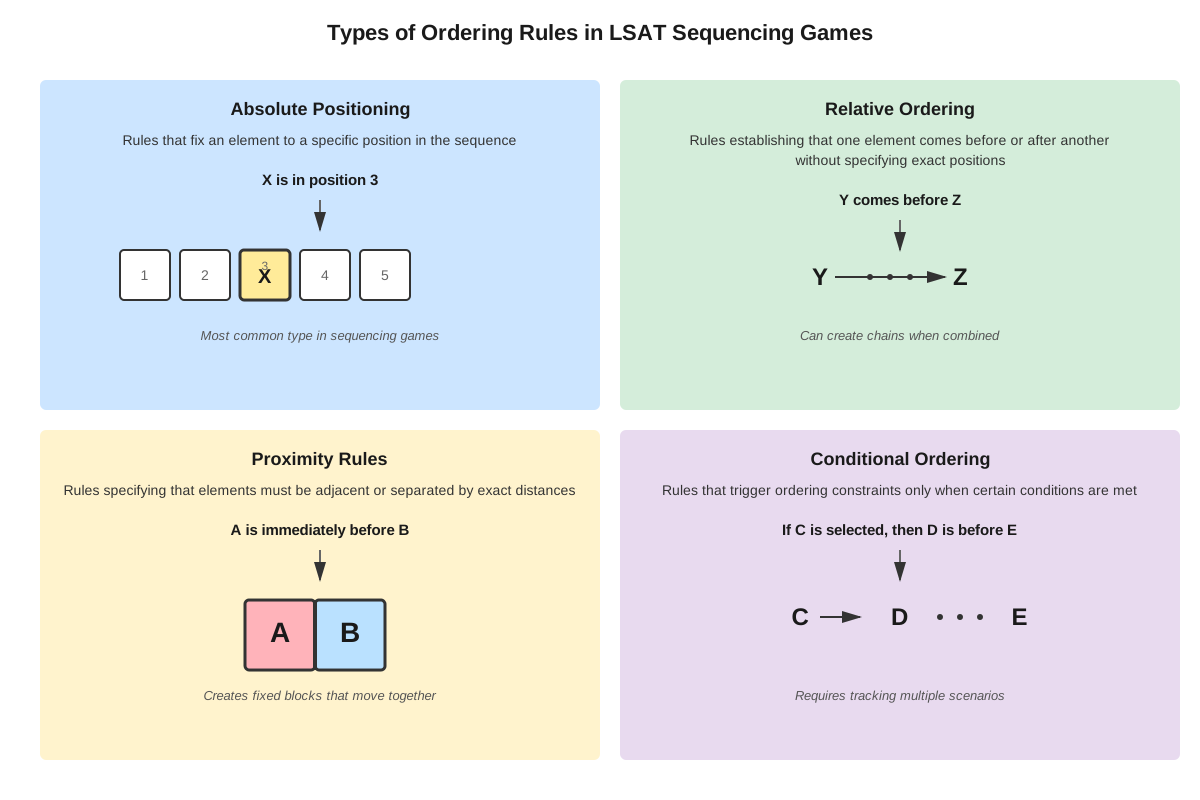
Ordering rules in analytical reasoning legacy games fall into several distinct categories, each with unique logical properties and diagramming conventions. Understanding these categories enables rapid rule identification and appropriate representation.
Absolute position rules specify the exact location of an element within the sequence. For example, "F performs third" or "The green car is in position 5" leaves no ambiguity about placement. These rules provide anchor points around which other elements must be arranged. They represent the most restrictive type of ordering rule and should be diagrammed directly on the game board.
Relative ordering rules establish relationships between elements without specifying exact positions. The statement "J finishes before K" means J must appear somewhere to the left of K in a standard left-to-right diagram, but neither element's exact position is determined. These rules are typically represented using inequality notation (J < K) or arrow diagrams (J → K). Multiple relative rules can be chained together to create longer sequences.
Adjacency rules specify that elements must be immediately next to each other. "M and N are consecutive" means no element can separate them, though their internal order may or may not be specified. These rules significantly constrain possibilities because they create blocks that move together through the sequence. Diagramming adjacency rules as connected units helps visualize their impact.
Separation rules establish minimum or maximum distances between elements. "At least two positions separate P and Q" or "R and S are not adjacent" create negative constraints that eliminate certain arrangements. These rules often generate powerful deductions when combined with other constraints.
Rule Translation and Diagramming
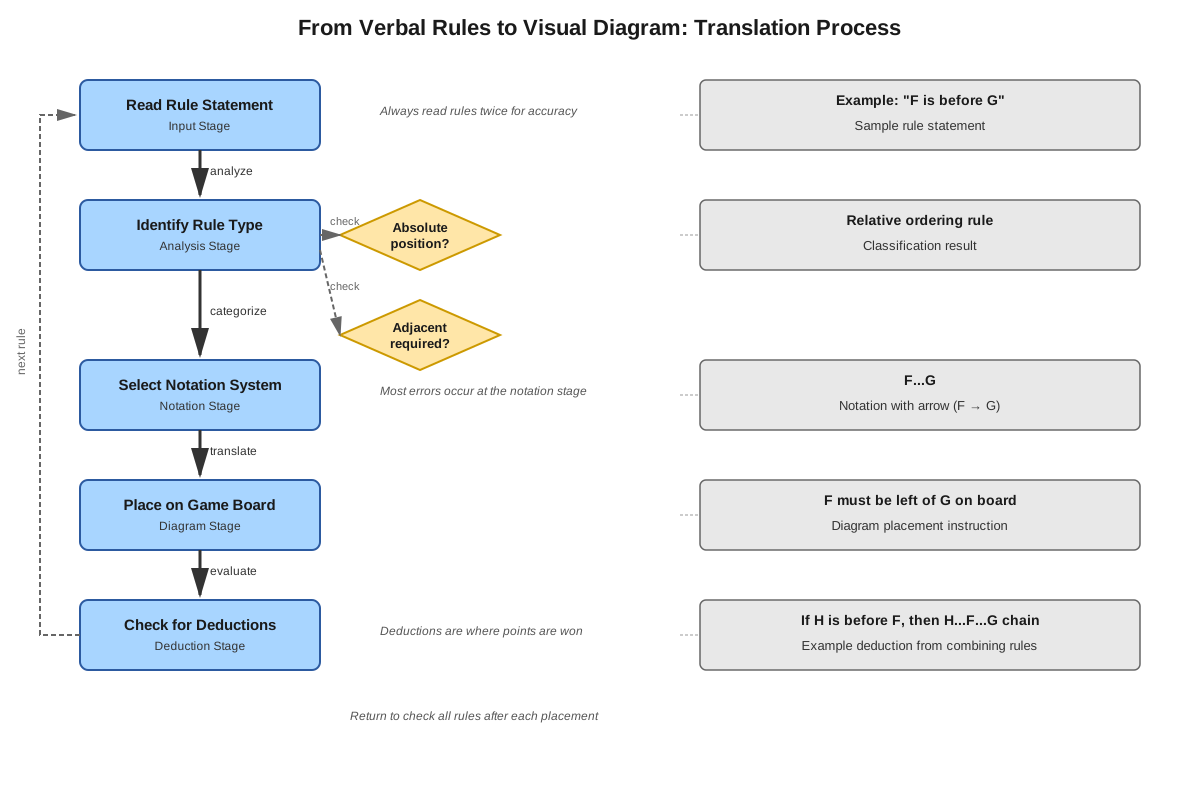
Effective work with lsat ordering rules requires translating verbal statements into visual representations that make logical relationships transparent. The translation process follows systematic steps that prevent errors and reveal hidden implications.
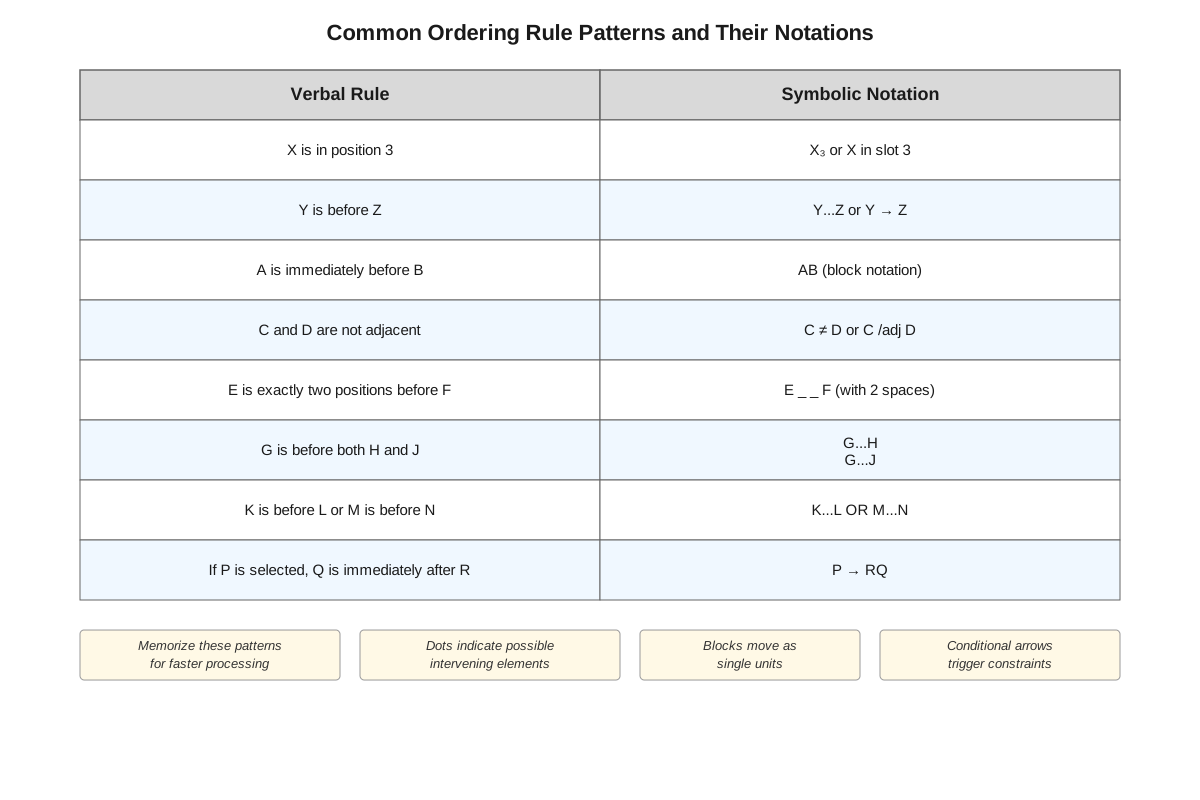
First, identify the rule type by analyzing the language. Words like "before," "after," "earlier," and "later" signal relative ordering. Phrases such as "immediately," "consecutive," or "adjacent" indicate adjacency requirements. Numerical positions ("third," "fifth") mark absolute placement rules. Negative constructions ("not," "cannot," "never") often indicate separation constraints.
Second, select the appropriate diagramming convention. For relative ordering, use either inequality notation (A < B < C) or arrow chains (A → B → C). For adjacency, draw elements in connected boxes or use underscores to show the block (AB or A_B). For absolute positions, write the element directly in the corresponding slot on the game board. For separation rules, use slash marks or "not" symbols between elements that cannot be adjacent.
Third, consider the rule's implications. Does it create a chain that can be extended? Does it interact with other rules to force specific placements? Does it eliminate certain positions for particular elements? This analytical step transforms passive rule recording into active deduction generation.
Combining Rules and Making Deductions
The true power of ordering rules emerges when multiple constraints interact to produce deductions—conclusions that must be true given the rules but aren't explicitly stated. Sequencing games legacy questions reward students who systematically extract these hidden implications.
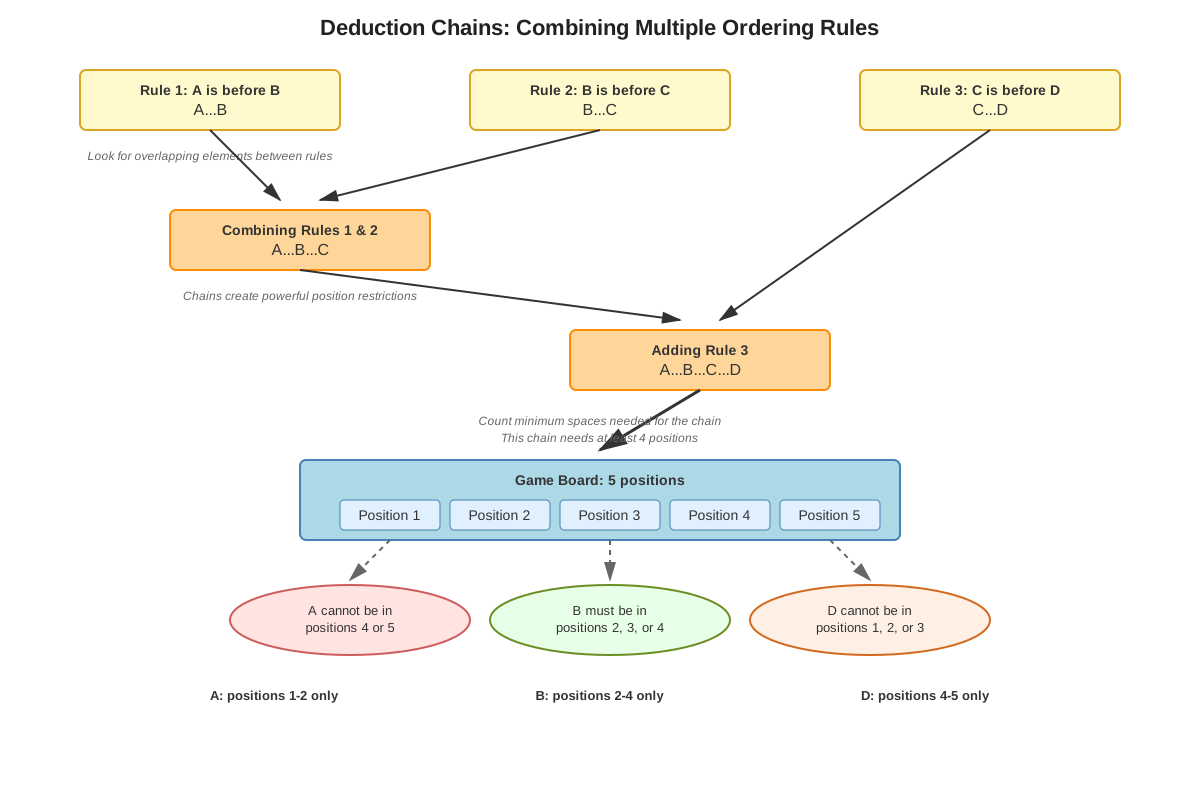
Chain extension occurs when separate relative ordering rules share common elements. If the rules state "A before B" and "B before C," these combine to form the extended chain A → B → C. This longer sequence provides more information about possible positions. For instance, in a five-position game, A cannot be fourth or fifth, while C cannot be first or second.
Position elimination happens when rules collectively prevent certain elements from occupying specific slots. If "D is before E" and "E is before F" in a six-position sequence, D cannot be in positions 5 or 6, E cannot be in positions 1 or 6, and F cannot be in positions 1 or 2. Marking these eliminations on the diagram prevents errors and speeds answer evaluation.
Block placement analysis examines where adjacency blocks can fit within the sequence. A three-element block (ABC) in a seven-position game can only start in positions 1-5. If other rules further constrain the block's placement, powerful deductions emerge about what must or cannot occupy surrounding positions.
Conditional sequence activation applies when rules contain "if-then" structures. "If G is selected, then H immediately follows G" creates a conditional block that only applies in certain scenarios. Recognizing when conditions are triggered versus when they remain hypothetical prevents logical errors.
Rule Interaction Patterns
Certain combinations of ordering rules create predictable patterns that appear repeatedly across LSAT games. Recognizing these patterns accelerates analysis and improves accuracy.
The sandwich pattern occurs when rules establish that one element must fall between two others. If "J before K" and "K before L" combine with "M before K" and "K before N," then K is sandwiched with specific elements on either side. This pattern severely restricts K's possible positions.
The endpoint pattern identifies elements that must occupy extreme positions. If multiple rules place an element before others but no rule places anything before it, that element could be first. Similarly, elements with nothing after them could be last. Identifying potential endpoints helps construct valid arrangements quickly.
The forced adjacency pattern emerges when rules indirectly require elements to be consecutive. If a three-element sequence (A → B → C) must fit in four positions, and another rule places D in position 1, then A, B, and C must occupy positions 2, 3, and 4 consecutively, making them adjacent by necessity rather than explicit rule.
The mutual exclusion pattern occurs when rules make it impossible for certain elements to coexist in specific regions of the sequence. If "P before Q" and "R before S" must both be satisfied in a five-position game, and P and R cannot both be in the first two positions, deductions about their placement follow.
Concept Relationships
Ordering rules function as the primary constraints in sequencing games, but their power derives from systematic interaction with other analytical reasoning concepts. Absolute position rules serve as anchors that limit where relative ordering rules can be satisfied, creating a hierarchy where fixed placements constrain flexible relationships. When adjacency rules combine with relative ordering, they form blocks that move through the sequence as units, and these blocks interact with separation rules to eliminate large swaths of the possibility space.
The relationship flows from rule identification → translation → diagramming → deduction → application. Each ordering rule type contributes different information: absolute rules provide certainty, relative rules establish relationships, adjacency rules create blocks, and separation rules eliminate options. These elements combine multiplicatively rather than additively—three rules together typically provide more than three times the information of a single rule because their interactions generate additional deductions.
Ordering rules connect to broader LSAT concepts through conditional logic (when rules contain "if-then" structures), spatial reasoning (visualizing linear arrangements), and constraint satisfaction (finding arrangements that honor all rules simultaneously). Mastery of ordering rules enables progression to hybrid games that combine sequencing with grouping, selection, or matching elements, as the ordering component remains foundational even when additional complexity layers are added.
High-Yield Facts
⭐ Relative ordering rules are transitive: If A < B and B < C, then A < C, allowing chain extension across multiple rules
⭐ Adjacency rules create blocks that move as units: When two elements must be consecutive, treat them as a single entity when considering placement options
⭐ Absolute position rules should be placed on the diagram immediately: They provide fixed reference points that constrain all other elements
⭐ The number of possible arrangements decreases exponentially as rules accumulate: Each additional constraint typically eliminates multiple possibilities
⭐ Elements at the ends of long chains have severely restricted placement options: In a chain A → B → C → D, element A cannot be in the last three positions
- Separation rules often generate more deductions than they initially appear to provide, especially when combined with adjacency requirements
- Conditional ordering rules only apply when their trigger condition is satisfied; they provide no information when the condition is false
- In circular arrangements, traditional "before" and "after" relationships become ambiguous without additional specification
- Rule substitution questions test whether a new rule produces identical logical constraints to an original rule
- The longest possible chain in an n-element game contains all n elements, creating a completely determined sequence
Quick check — test yourself on Ordering rules so far.
Try Flashcards →Common Misconceptions
Misconception: "Before" and "after" in ordering rules specify immediate adjacency → Correction: Relative ordering rules like "A before B" only establish that A comes somewhere earlier in the sequence than B, not necessarily in the immediately preceding position. Adjacency must be explicitly stated using words like "immediately," "consecutive," or "adjacent."
Misconception: Conditional ordering rules apply in all scenarios → Correction: Rules structured as "If X, then Y before Z" only activate when the condition (X) is satisfied. When X is false or unknown, the rule provides no constraint on Y and Z's relative positions. Treating conditional rules as universal constraints leads to invalid deductions.
Misconception: All elements mentioned in rules must be included in every valid arrangement → Correction: Unless the game explicitly states that all elements must be used, some sequencing games allow elements to be excluded. Rules constrain relationships among selected elements but don't necessarily require selection.
Misconception: Ordering rules can be violated if doing so allows other rules to be satisfied → Correction: All rules must be satisfied simultaneously in valid arrangements. No rule takes precedence over others, and no trade-offs are permitted. If satisfying one rule appears to violate another, the arrangement is invalid.
Misconception: Diagramming rules is optional if you can remember them mentally → Correction: The human working memory capacity limits make mental tracking of multiple ordering constraints highly error-prone. Visual diagrams externalize information, reduce cognitive load, and make deductions visible that would otherwise remain hidden. Consistent diagramming is essential for accuracy and speed.
Worked Examples
Example 1: Basic Rule Combination
Game Setup: Seven students—F, G, H, J, K, L, M—give presentations in sequence from first to seventh. The following rules apply:
- G presents before H
- H presents before J
- K presents fourth
- L presents immediately before M
- F presents before L
Question: Which of the following could be the order of presentations from first to seventh?
Solution Process:
Step 1: Diagram the rules systematically.
- G → H → J (chain of relative ordering)
- K = 4 (absolute position)
- L_M (adjacency block)
- F → L (relative ordering that extends to the block)
Step 2: Combine rules to extend chains.
- Since F → L and L_M form a block, we have F → L_M
- The G → H → J chain is separate from the F → L_M chain
Step 3: Analyze position constraints.
- K is fixed in position 4
- The G → H → J chain requires three consecutive positions
- The F → L_M sequence requires three positions (F somewhere before the L_M block)
Step 4: Consider placement options.
- The L_M block can occupy positions (1,2), (2,3), (3,4)—NO, K is in 4—(5,6), or (6,7)
- If L_M is in (6,7), F must be in positions 1, 2, 3, or 5
- The G → H → J chain needs three slots from the remaining positions
Step 5: Test a valid arrangement.
- Try: G(1), H(2), F(3), K(4), J(5), L(6), M(7)
- Check G → H → J: G(1) < H(2) < J(5) ✓
- Check K = 4: ✓
- Check L_M adjacent: L(6), M(7) ✓
- Check F → L: F(3) < L(6) ✓
- This arrangement satisfies all rules
Key Insight: When an absolute position rule (K = 4) divides the sequence, consider how chains and blocks fit on either side of the fixed element. The L_M block's placement in positions 6-7 allows the G → H → J chain to occupy positions 1, 2, and 5, with F fitting in position 3.
Example 2: Advanced Deduction Through Rule Interaction
Game Setup: Six books—P, Q, R, S, T, U—are arranged on a shelf from left to right. The following rules apply:
- P is somewhere to the left of Q
- Q is somewhere to the left of R
- S is immediately to the left of T
- U is not first
- R is not sixth
Question: If Q is in position 3, which of the following must be true?
Solution Process:
Step 1: Incorporate the new condition (Q = 3) into the diagram.
1    2    3    4    5    6
_    _    Q    _    _    _
Step 2: Apply rules that directly constrain based on Q = 3.
- P → Q → R means P must be in position 1 or 2, and R must be in position 4, 5, or 6
- But R cannot be in position 6 (given rule), so R is in position 4 or 5
Step 3: Analyze the S_T block placement.
- The S_T block requires two consecutive positions
- Available consecutive pairs: (1,2), (2,3)—NO, Q is in 3—(4,5), (5,6)
- So S_T occupies either (1,2), (4,5), or (5,6)
Step 4: Test each S_T placement scenario.
Scenario A: S_T in positions (1,2)
- Then P must be in position 2—NO, S or T is there
- This scenario is impossible
Scenario B: S_T in positions (4,5)
- R must be in position 4 or 5, but S_T occupies both
- This scenario is impossible
Scenario C: S_T in positions (5,6)
- R must be in position 4 or 5
- Since S_T is in (5,6), R must be in position 4
- P must be in position 1 or 2
- U must be in position 1 or 2 (not first means not position 1, so U is in position 2)
- Therefore P is in position 1
Step 5: Determine what must be true.
1    2    3    4    5    6
P U Q R S TAnswer: P must be first, R must be fourth, and S and T must be in positions 5 and 6.
Key Insight: When a question provides a new condition, systematically test how it interacts with existing rules. Here, placing Q in position 3 created a cascade of forced placements because the S_T block had limited valid positions, and each position had implications for where R could go, which in turn determined P's location.
Exam Strategy
When approaching LSAT ordering rules questions, begin by reading all rules carefully before attempting any diagram. Misreading a single rule can invalidate an entire game's work, so invest 30-45 seconds in careful initial reading. As you read, categorize each rule mentally (absolute, relative, adjacency, separation) to select appropriate diagramming conventions.
Trigger words signal specific rule types and should prompt immediate recognition. "Before," "after," "earlier," "later," and "precedes" indicate relative ordering. "Immediately," "consecutive," "adjacent," and "next to" signal adjacency requirements. "First," "second," "third," and other ordinal numbers mark absolute positions. "Not," "cannot," "never," and "except" often introduce separation or exclusion rules. Conditional language like "if," "when," "whenever," and "only if" indicates rules that apply situationally rather than universally.
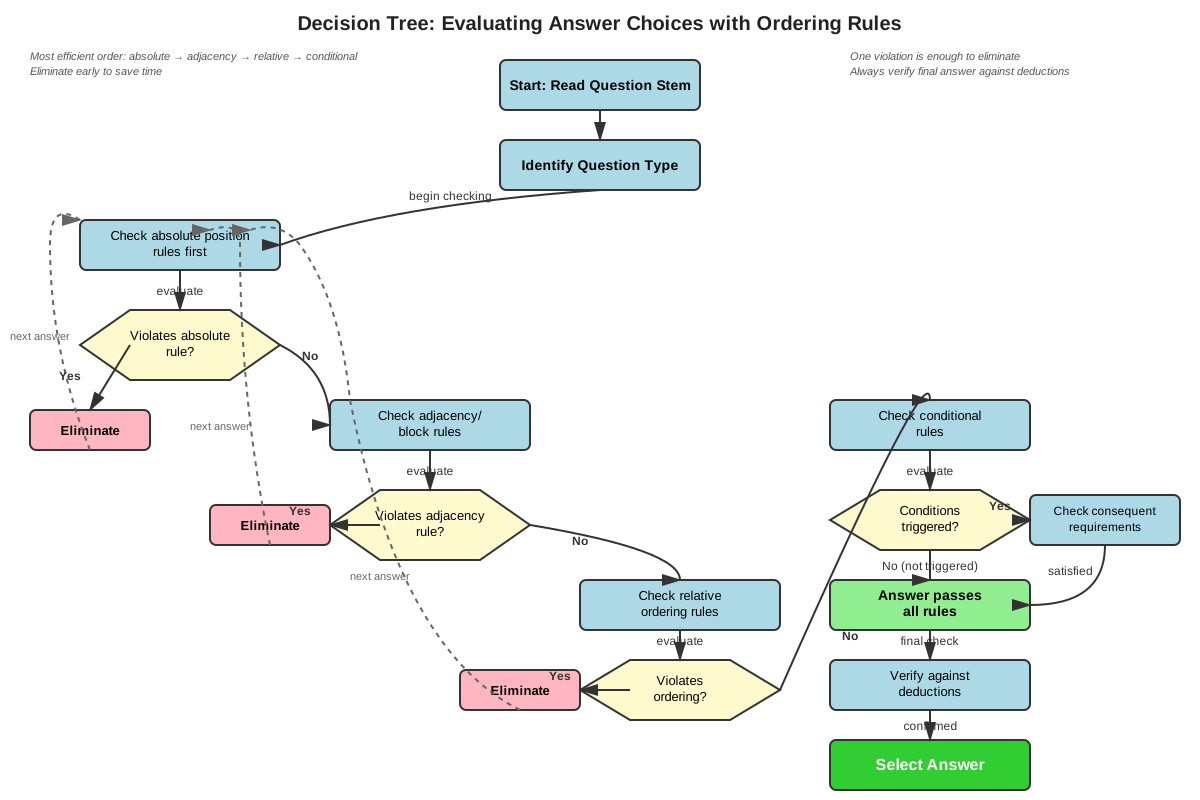
For process-of-elimination efficiency, use absolute position rules first when evaluating answer choices. If a rule states "K is fourth" and an answer choice places K in position 5, eliminate that choice immediately without checking other rules. Next, check adjacency rules, as they're binary (elements are either adjacent or not) and quick to verify. Relative ordering rules require more careful checking but can eliminate multiple wrong answers. Save complex conditional rules for final verification of remaining choices.
Time allocation for ordering games should follow the 8-9 minute per game guideline, with approximately 2 minutes for initial setup and rule diagramming, 1 minute for making upfront deductions, and 5-6 minutes for answering questions. If a particular question requires testing multiple scenarios, limit yourself to 90 seconds before making an educated guess and moving forward. The first question in most ordering games is an acceptability question that can be answered quickly by checking each rule against each answer choice—use this as a confidence builder and rule verification step.
When stuck, return to the diagram and look for elements with the most constraints. Elements appearing in multiple rules often hold the key to unlocking difficult questions. Similarly, look for positions with the most restrictions—if several rules eliminate possibilities for position 3, focusing on what can go there may reveal the answer.
Memory Techniques
RASA helps remember the four main ordering rule types:
- Relative (A before B)
- Absolute (C is third)
- Separation (D and E not adjacent)
- Adjacency (F immediately before G)
"Chain Gang" reminds you to look for opportunities to extend relative ordering chains by connecting rules that share common elements. Visualize prisoners chained together—each connection point (shared element) extends the chain.
"Block Party" helps remember that adjacency rules create blocks that move together through the sequence. Imagine party guests who refuse to separate—wherever one goes, the other follows immediately.
"Anchor Points" emphasizes that absolute position rules should be placed on the diagram first, as they provide fixed reference points. Visualize dropping an anchor that stays in one place while other elements move around it.
The "Cascade Effect" reminds you that in ordering games, one placement often forces multiple others. Visualize dominoes falling—placing one element in a position can trigger a cascade of forced placements through rule interactions.
For remembering that relative ordering is transitive, use "Friendship Chain": If Alice is taller than Bob, and Bob is taller than Carol, then Alice is definitely taller than Carol—the relationship chains together.
Summary
Ordering rules constitute the fundamental constraints in sequencing games, establishing how elements must be arranged relative to each other and within specific positions. Mastery requires recognizing four primary rule types—absolute position, relative ordering, adjacency, and separation—and translating each into appropriate visual representations. The power of ordering rules emerges through systematic combination, where multiple constraints interact to generate deductions that dramatically narrow the possibility space. Successful students develop fluency in identifying rule types from trigger words, diagramming conventions that make relationships transparent, and deduction patterns that reveal hidden implications. On test day, efficient processing of ordering rules enables rapid elimination of wrong answers and confident selection of correct choices, directly translating to higher scores on this high-yield topic that appears in approximately one-quarter of all Analytical Reasoning questions.
Key Takeaways
- Ordering rules fall into four categories (absolute, relative, adjacency, separation), each requiring specific diagramming conventions for optimal clarity
- Relative ordering rules are transitive and can be chained together when they share common elements, creating extended sequences with powerful implications
- Absolute position rules should be placed on the diagram immediately as they provide fixed anchor points that constrain all other elements
- Adjacency rules create blocks that move as units through the sequence, and their placement options are often more limited than individual elements
- Systematic rule combination generates deductions that aren't explicitly stated but must be true given the constraints
- Trigger words in rule statements signal specific rule types and should prompt immediate recognition of appropriate diagramming approaches
- Testing scenarios by placing elements and checking for rule violations is a valid strategy when deductions alone don't reveal the answer
Related Topics
Conditional Sequencing builds on basic ordering rules by introducing "if-then" structures that activate specific sequences only when trigger conditions are met, requiring students to track multiple possible game states simultaneously.
Hybrid Games combine ordering rules with grouping, selection, or matching constraints, testing the ability to satisfy multiple constraint types simultaneously while maintaining accuracy across different reasoning domains.
Circular Arrangements modify traditional linear ordering by connecting the sequence's endpoints, creating unique logical properties where "before" and "after" become ambiguous without additional specification.
Advanced Deduction Techniques explores sophisticated inference patterns that emerge from complex rule interactions, including contrapositive reasoning in conditional sequences and exhaustive scenario mapping.
Practice CTA
Now that you've mastered the core concepts of ordering rules, it's time to cement your understanding through active practice. Attempt the practice questions associated with this topic, focusing on applying the systematic approach outlined in this guide. Work through each problem methodically, diagramming rules carefully and looking for combination opportunities before attempting to answer. Review the flashcards to reinforce rule type recognition and trigger word identification. Remember: ordering rules appear in approximately 25-30% of Analytical Reasoning questions, making this practice time one of your highest-yield investments for LSAT success. Your ability to quickly and accurately process ordering constraints will directly impact your score—make this practice count!
Sign up free to keep reading
Create a free AnvayaPrep account to finish this LSAT guide on Ordering rules — plus flashcards and practice questions.