Overview
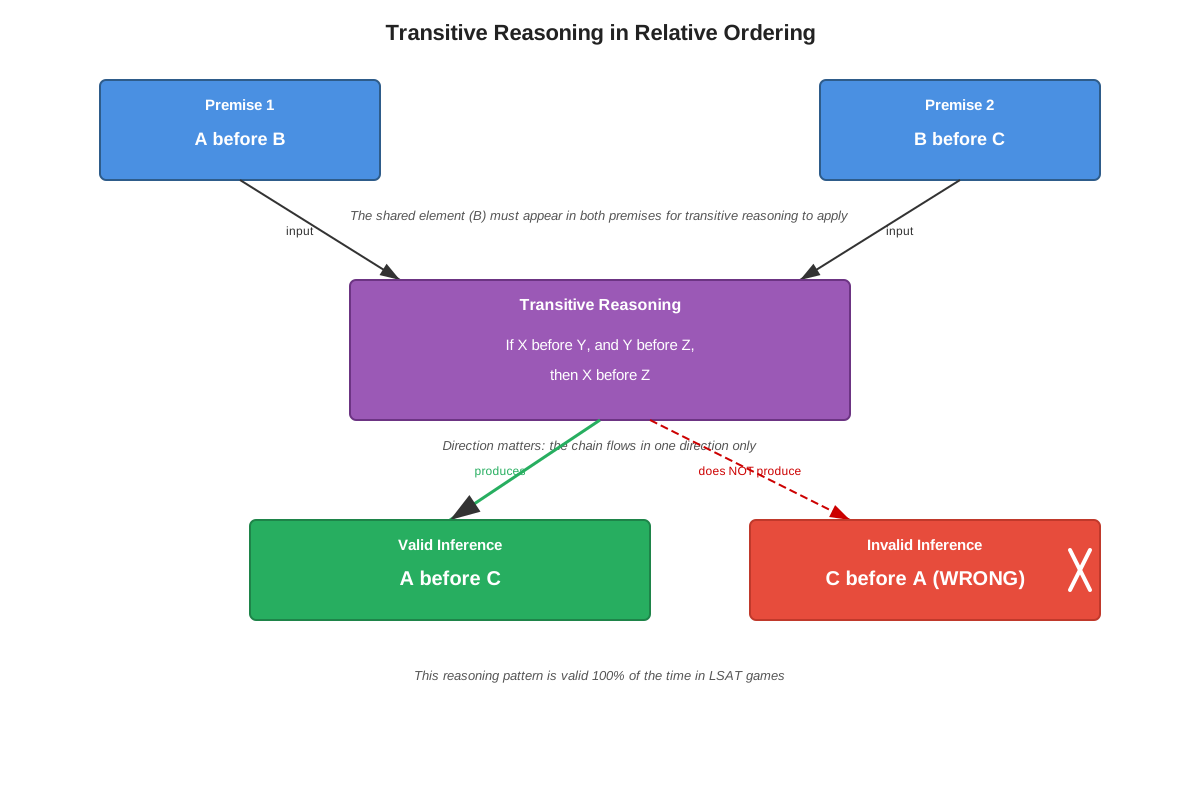
Relative ordering is one of the most fundamental and frequently tested concepts within Analytical Reasoning Legacy on the LSAT, particularly in sequencing games legacy. Unlike absolute positioning problems where each element must be placed in a specific numbered slot, relative ordering establishes relationships between elements without necessarily fixing their exact positions. For example, knowing that "A comes before B" and "B comes before C" allows test-takers to deduce that A comes before C, even without knowing whether A is in position 1, 2, or 3.
This topic represents a critical bridge between basic sequencing concepts and more complex hybrid games. Mastery of relative ordering enables students to construct powerful visual representations, make valid inferences, and eliminate incorrect answer choices efficiently. The LSAT frequently presents scenarios where multiple relative ordering rules must be combined to determine what must be true, what could be true, or what cannot be true about the arrangement of elements. Understanding how to chain these relationships together and recognize their logical implications separates high-scoring test-takers from those who struggle with the Analytical Reasoning section.
Within the broader context of LSAT relative ordering problems, this skill set applies not only to pure sequencing games but also to grouping games with ordering components, matching games with sequential elements, and complex hybrid scenarios. The reasoning patterns developed through relative ordering practice—particularly transitive reasoning and contrapositive thinking—transfer directly to other question types throughout the LSAT, making this a high-leverage topic for overall score improvement.
Learning Objectives
- [ ] Identify how Relative ordering appears in LSAT questions
- [ ] Explain the reasoning pattern behind Relative ordering
- [ ] Apply Relative ordering to solve LSAT-style problems accurately
- [ ] Construct accurate visual representations (chains and diagrams) from relative ordering rules
- [ ] Combine multiple relative ordering statements to generate valid inferences
- [ ] Recognize when relative ordering rules create fixed positions versus flexible arrangements
- [ ] Distinguish between what must be true, could be true, and cannot be true based on relative ordering constraints
Prerequisites
- Basic logical reasoning: Understanding of conditional statements and logical connectives is essential because relative ordering rules function as conditional relationships between elements
- Familiarity with sequencing concepts: Knowledge of what it means to arrange elements in order (first to last, earliest to latest) provides the foundation for understanding relative relationships
- Symbolic notation comfort: Ability to translate verbal statements into symbolic representations helps create efficient diagrams for relative ordering problems
- Transitive property understanding: Recognition that if A > B and B > C, then A > C applies directly to chaining relative ordering statements
Why This Topic Matters
Relative ordering appears in approximately 60-70% of all sequencing games on the LSAT, making it one of the highest-yield topics in the Analytical Reasoning section. Unlike some specialized game types that appear only occasionally, relative ordering skills are tested consistently across multiple administrations and often form the backbone of the most challenging games in each test.
In real-world applications, relative ordering reasoning mirrors the logical thinking required in legal practice: determining the sequence of events in a case, establishing timelines from witness testimony, or understanding procedural requirements that must occur in a specific order. Law schools value this skill because it demonstrates the ability to synthesize multiple pieces of information into a coherent logical structure—a fundamental requirement for legal analysis.
On the LSAT, relative ordering typically appears in several distinct formats: pure sequencing games where all rules are relative (no fixed positions), hybrid games combining relative and absolute positioning rules, and complex scenarios where relative ordering applies to subgroups or categories. Questions may ask test-takers to identify what must be true given the constraints, determine possible positions for specific elements, or recognize which new rule would create specific outcomes. The ability to quickly construct accurate diagrams and make valid inferences from relative ordering rules often determines whether a student completes the Analytical Reasoning section within the time limit.
Core Concepts
Understanding Relative Ordering Relationships
Relative ordering establishes the sequential relationship between two or more elements without specifying their exact positions in an arrangement. The fundamental structure involves statements like "X comes before Y" or "P is earlier than Q," which can be represented symbolically as X—Y or P—Q. This notation indicates that X must appear somewhere to the left of (or before) Y in the final arrangement, but leaves open exactly how many positions separate them.
The power of relative ordering lies in its flexibility and inferential potential. A single relative ordering statement constrains possibilities without over-determining the arrangement. For instance, if there are five positions and the only rule is "A comes before B," then A could be in positions 1-4, and B could be in positions 2-5, as long as A's position number is lower than B's. This creates multiple valid scenarios while still eliminating many impossible arrangements.
Chaining Relative Ordering Statements
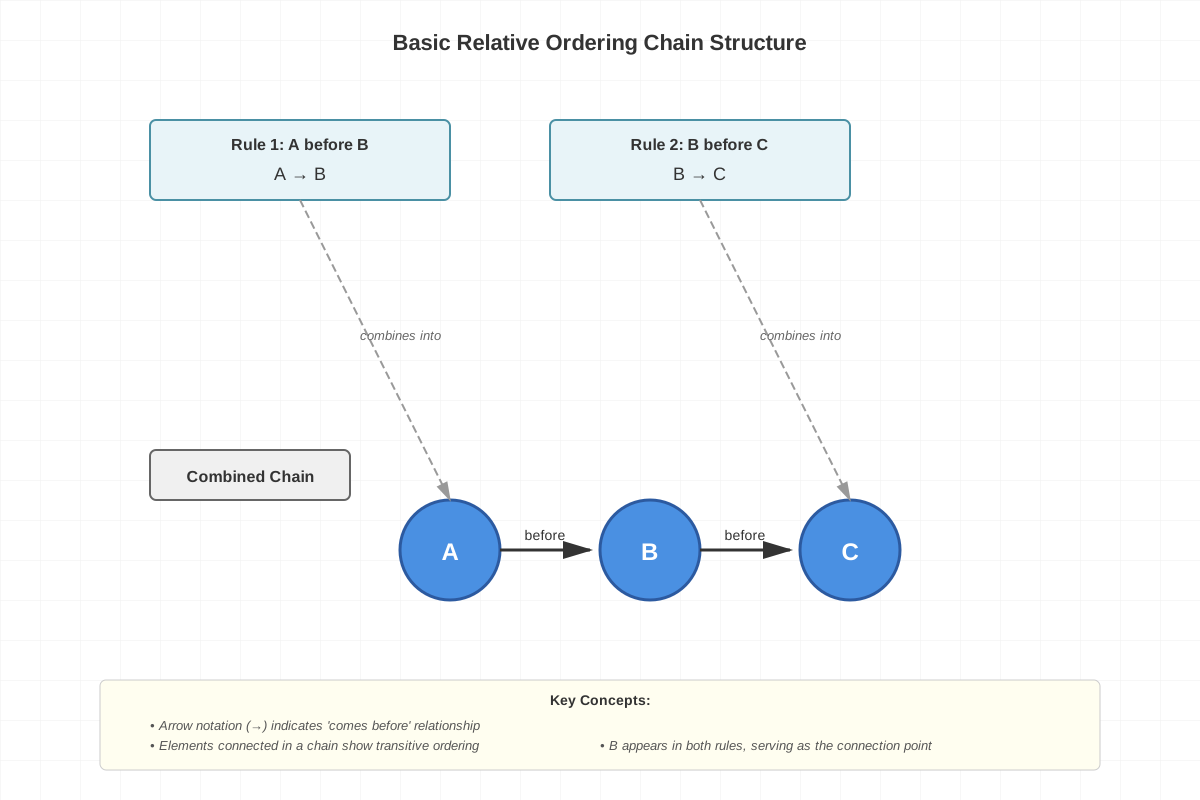
When multiple relative ordering rules share common elements, they can be chained together to create longer sequences. This process follows the transitive property: if A comes before B, and B comes before C, then A must come before C. The resulting chain (A—B—C) represents a more constrained arrangement than any individual rule alone.
Consider three separate rules: "D comes before E," "E comes before F," and "F comes before G." These chain together into a single sequence: D—E—F—G. This chain tells us that D must come before all other elements in this sequence, G must come after all others, and E and F occupy middle positions with E before F. The chain doesn't specify exact positions, but it dramatically reduces the number of possible arrangements.
Chains can also branch when an element appears in multiple rules without creating a single linear sequence. For example, if "A comes before B," "A comes before C," and "B comes before D," the resulting structure looks like:
    B—D
   /
  A
   \
    C
This branching structure indicates that A must come before B, C, and D; B must come before D; but C and B have no determined relationship to each other (C could come before B, after B, or between B and D).
Fixed Positions from Relative Ordering
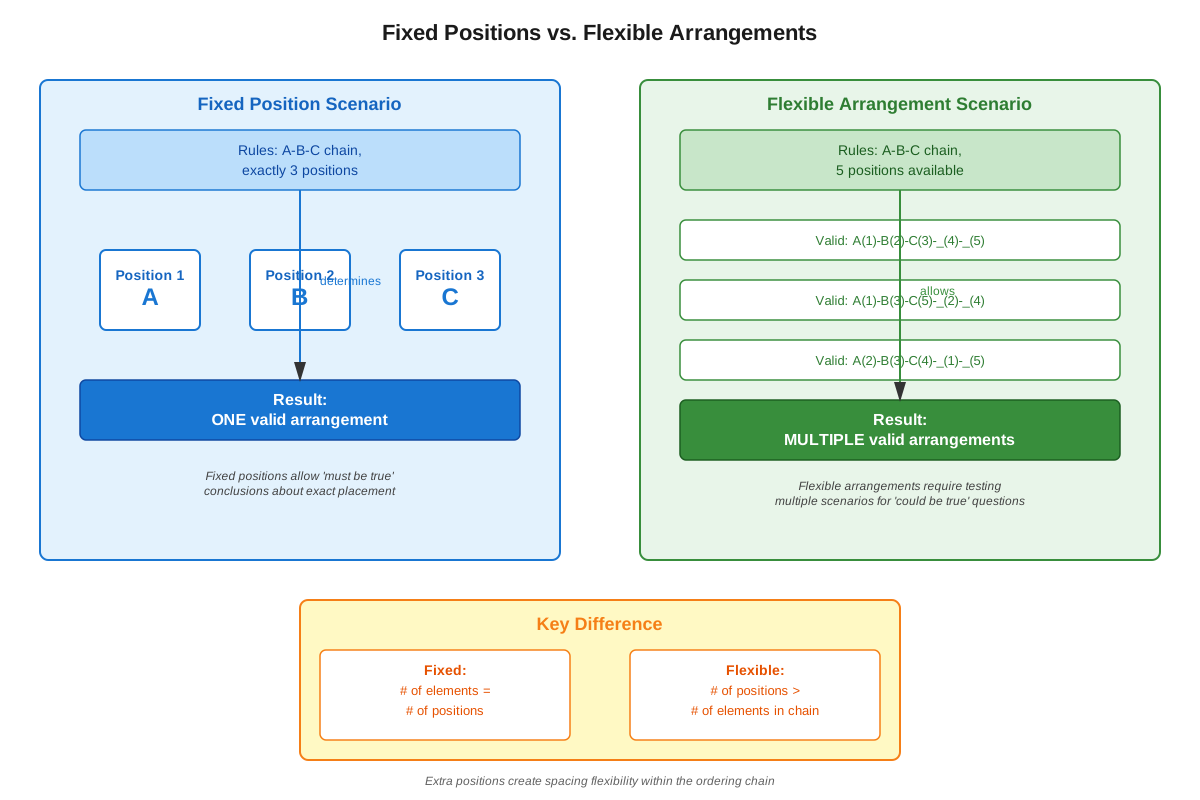
While relative ordering rules don't directly specify positions, combining multiple rules can sometimes force elements into fixed positions. This occurs when the constraints become so restrictive that only one position remains possible for a particular element.
For example, in a five-position sequence with rules "A—B," "A—C," "A—D," and "A—E," element A must be in position 1 because it must come before all four other elements. Similarly, if "W—Z," "X—Z," "Y—Z," and there are only four positions total, then Z must be in position 4 because three other elements must precede it.
Recognizing when relative ordering creates fixed positions is crucial for efficient problem-solving. These fixed positions serve as anchors for the entire arrangement and often provide the key to answering multiple questions about the same game.
Relative Ordering with Blocks and Restrictions
Relative ordering becomes more complex when combined with block rules (elements that must be adjacent) or restriction rules (elements that cannot be adjacent or in certain positions). A block rule like "M and N must be consecutive" combined with relative ordering rules creates a unit that moves through the sequence together while maintaining its internal order.
For instance, if "M and N are consecutive with M before N" and "M—P," then the MN block must come before P. The block functions as a single unit in the relative ordering chain while maintaining the specified internal arrangement.
Restriction rules interact with relative ordering by eliminating certain positions from consideration. If "Q cannot be first" and "Q—R—S," then Q must be in position 2 or later, which means R must be in position 3 or later, and S must be in position 4 or later (in a sequence with at least four positions).
Contrapositives in Relative Ordering
Every relative ordering statement has a contrapositive that provides equivalent information from a different perspective. If "A comes before B" (A—B), then the contrapositive states "B comes after A" or equivalently "B does not come before A." While this might seem redundant, recognizing contrapositives helps identify when answer choices violate relative ordering rules.
More importantly, when relative ordering rules are stated negatively ("X does not come immediately before Y"), the contrapositive reasoning becomes essential. Understanding that "not (X immediately before Y)" means either X and Y are not adjacent, or Y comes before X, or they're adjacent with Y before X, requires careful logical analysis.
Determining Possible Positions
A critical skill in LSAT relative ordering problems involves determining the range of possible positions for each element. This requires analyzing all constraints simultaneously to identify the earliest and latest possible positions for each element.
For element X in a chain, the earliest possible position equals 1 plus the number of elements that must come before X. The latest possible position equals the total number of positions minus the number of elements that must come after X. For example, in a seven-position sequence where two elements must come before X and one element must come after X, X can occupy positions 3 through 6.
| Element | Must Come Before | Must Come After | Earliest Position | Latest Position |
|---|---|---|---|---|
| A | (none) | B, C, D | 1 | 4 |
| B | A | C, D | 2 | 5 |
| C | A, B | D | 3 | 6 |
| D | A, B, C | (none) | 4 | 7 |
This table format helps visualize the constraints and quickly identify which elements have flexibility and which are more constrained.
Concept Relationships
The core concepts within relative ordering build upon each other in a hierarchical structure. Understanding basic relative ordering relationships → enables chaining multiple statements → which can lead to fixed positions → and these foundations support analysis of more complex scenarios involving blocks and restrictions.
Relative ordering connects directly to prerequisite knowledge of transitive reasoning: the ability to chain statements depends on recognizing that the transitive property applies to sequential relationships. The symbolic notation used in relative ordering (A—B—C) builds on general comfort with translating verbal statements into visual representations.
Within the broader context of sequencing games legacy, relative ordering serves as the foundation for more advanced topics like circular arrangements, bidirectional sequences, and multi-tiered ordering problems. Mastery of basic relative ordering is essential before attempting games that combine ordering with grouping or matching elements.
The relationship between relative ordering and contrapositive reasoning creates a bridge to the Logical Reasoning section of the LSAT. The same logical principles that govern "if A then B" statements apply to "A before B" relationships, strengthening overall logical reasoning skills across the entire exam.
Concept flow: Basic relative statements → Chaining and branching → Position range analysis → Fixed position identification → Integration with blocks/restrictions → Complex inference generation
Quick check — test yourself on Relative ordering so far.
Try Flashcards →High-Yield Facts
⭐ Relative ordering rules establish sequence relationships without specifying exact positions—"A before B" means A has a lower position number than B, regardless of how many positions separate them.
⭐ Chaining follows the transitive property—if X—Y and Y—Z, then X—Z is a valid inference that must be true.
⭐ The earliest possible position for an element equals 1 plus the number of elements that must precede it—this calculation quickly identifies minimum position constraints.
⭐ The latest possible position for an element equals total positions minus the number of elements that must follow it—this determines maximum position flexibility.
⭐ When an element must come before all others, it must occupy position 1—this creates a fixed position from relative ordering alone.
- When an element must come after all others, it must occupy the last position—the mirror principle to the previous fact.
- Elements with no relative ordering relationship to each other can appear in either order—absence of a rule means flexibility, not restriction.
- Branching chains indicate that some elements have determined relationships while others remain flexible relative to each other.
- Combining relative ordering with "not adjacent" restrictions requires checking both sequence and spacing constraints.
- The contrapositive of "A before B" is "B after A"—logically equivalent statements that help identify rule violations.
- In a sequence of N positions, a chain of N elements creates exactly one possible arrangement—complete determination from relative rules alone.
- Relative ordering rules can create fixed positions even in the middle of a sequence when elements are constrained from both directions.
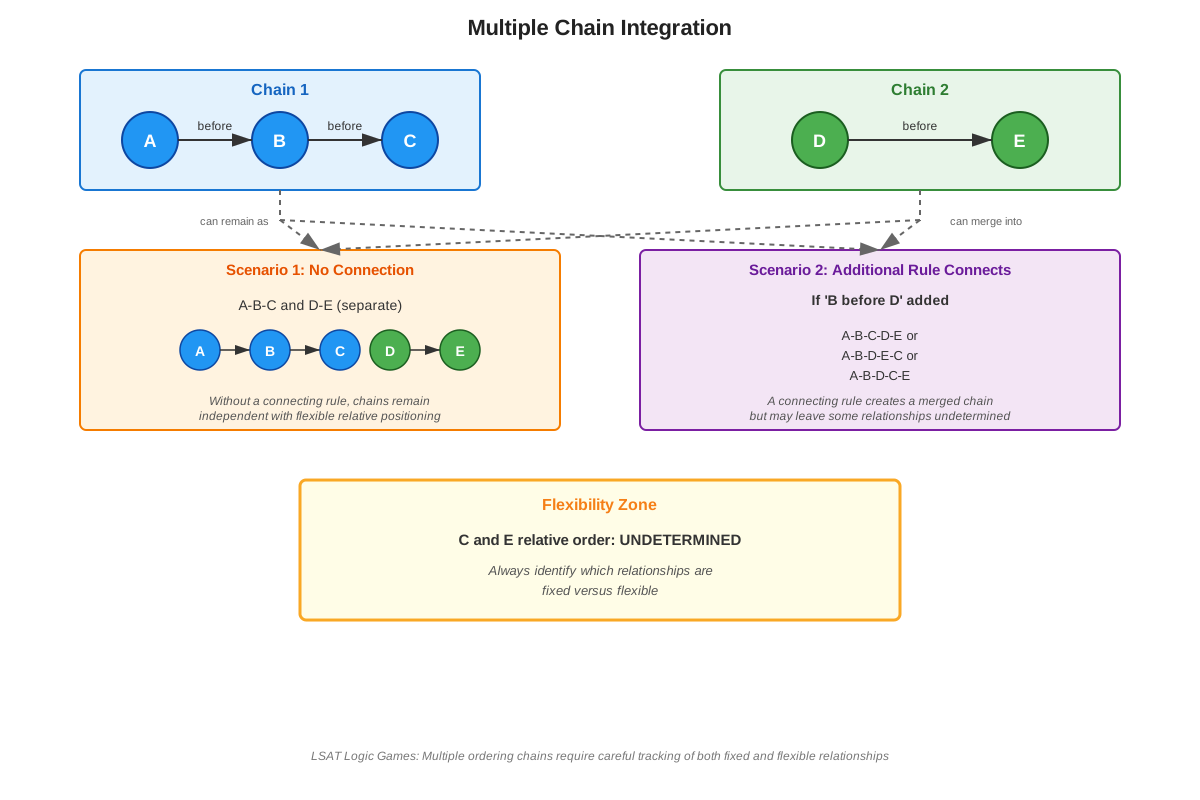
- When two chains cannot be connected through shared elements, they represent independent subsequences that can be interleaved in multiple ways.
Common Misconceptions
Misconception: Relative ordering rules mean elements must be immediately adjacent.
Correction: "A before B" means only that A has a lower position number than B; they can be separated by any number of positions unless an additional rule specifies adjacency.
Misconception: If there's no rule relating two elements, they cannot be placed next to each other.
Correction: Absence of a rule creates flexibility, not restriction. If no rule relates elements X and Y, they can appear in any order and can be adjacent unless a specific restriction prohibits it.
Misconception: Chaining rules always creates a single linear sequence.
Correction: Chains can branch when one element appears in multiple rules without all elements connecting into a single line. The resulting structure may have multiple "branches" with some elements unrelated to others.
Misconception: Relative ordering rules alone never create fixed positions.
Correction: When enough relative ordering rules constrain an element from both directions, or when an element must come before/after all others, relative rules can force fixed positions without any absolute positioning rules.
Misconception: The contrapositive of "A before B" is "not A before not B."
Correction: The contrapositive of "A before B" is simply "B after A" or "B not before A." Contrapositives in ordering relationships flip the direction and elements, not negate both elements.
Misconception: In a branching chain, all elements in one branch must come before all elements in another branch.
Correction: Branching indicates independent relationships. If A—B and A—C branch from A, then B and C have no determined relationship to each other; B could come before C, after C, or between other elements.
Misconception: Relative ordering problems always have multiple possible arrangements.
Correction: When relative ordering rules are sufficiently comprehensive, they can completely determine a single arrangement. A chain covering all N elements in an N-position sequence has exactly one solution.
Worked Examples
Example 1: Basic Chaining and Position Analysis
Problem: Seven presentations (F, G, H, J, K, L, M) will be delivered in sequence. The following rules apply:
- F is delivered before G
- G is delivered before H
- K is delivered before L
- L is delivered before M
- H is delivered before K
Question: Which of the following could be the order of the presentations?
Solution:
Step 1: Create chains from the individual rules.
- From rules 1 and 2: F—G—H
- From rules 3 and 4: K—L—M
- Rule 5 connects the chains: H—K
Step 2: Combine into a single master chain.
- F—G—H—K—L—M
This creates a complete chain of six elements. J has no rules relating it to other elements, so J can appear anywhere in the sequence.
Step 3: Determine position ranges.
- F: earliest = 1, latest = 2 (must leave room for 5 elements after it, or J could come first)
- G: earliest = 2, latest = 3
- H: earliest = 3, latest = 4
- K: earliest = 4, latest = 5
- L: earliest = 5, latest = 6
- M: earliest = 6, latest = 7
- J: earliest = 1, latest = 7 (completely flexible)
Step 4: Evaluate answer choices against the master chain.
Any valid arrangement must maintain the order F—G—H—K—L—M with J inserted anywhere.
Valid example: J, F, G, H, K, L, M or F, G, J, H, K, L, M
Invalid example: F, H, G, K, L, M, J (violates G before H)
Key insight: This problem demonstrates how multiple relative ordering rules chain together to create a nearly complete sequence, with only one element (J) remaining flexible. The master chain F—G—H—K—L—M must be preserved in any correct answer.
Example 2: Branching Chains and Inference
Problem: Six students (P, Q, R, S, T, U) present projects in order. The rules are:
- P presents before Q
- P presents before R
- Q presents before S
- R presents before T
- T presents before U
Question: If S presents fourth, which of the following must be true?
Solution:
Step 1: Construct the chain structure.
    Q—S
   /
  P
   \
    R—T—U
This branching structure shows P must come before both Q and R, Q must come before S, and R must come before T and U.
Step 2: Analyze the constraint "S presents fourth."
- Since Q—S, Q must present before position 4, so Q is in position 1, 2, or 3
- Since P—Q, P must come before Q, so P is in position 1 or 2
- Since P—R—T—U, and there are only 6 positions total, we need to determine where R, T, and U can fit
Step 3: Count minimum positions needed.
- P needs at least 1 position
- Q needs at least 1 position (after P)
- S is in position 4 (given)
- R needs at least 1 position (after P)
- T needs at least 1 position (after R)
- U needs at least 1 position (after T)
Step 4: Determine what must be true.
With S in position 4, positions 5 and 6 remain. The chain R—T—U requires three consecutive positions. Since P must come before R, and we need three positions for R—T—U, let's test possibilities:
If R—T—U occupy positions 4-5-6: This is impossible because S is in position 4.
If R—T—U occupy positions 3-4-5: This is impossible because S is in position 4.
If R—T—U occupy positions 2-3-4: This is impossible because S is in position 4.
Therefore, R—T—U must be split around S, or some must come before S.
Actually, since S is in position 4 and Q—S, Q must be in positions 1-3. Since P—Q, P must be in positions 1-2.
For R—T—U: Since P—R and P is in position 1 or 2, R is in position 2 or later. With S in position 4, and needing three positions for R—T—U, the only way to fit R—T—U is positions 2-3-4 (impossible, S is in 4), or having some after position 4.
Must be true: U must present sixth (last position), because R—T—U requires three consecutive positions, and with S in position 4 and the constraints on P and Q, U must be in the final position.
Key insight: This problem illustrates how branching chains combined with a fixed position constraint force other elements into specific positions through elimination of impossible arrangements.
Exam Strategy
When approaching analytical reasoning legacy questions involving relative ordering, begin by immediately translating verbal rules into symbolic notation. Write "A—B" for "A before B" rather than keeping rules in sentence form. This visual representation makes chaining opportunities obvious and reduces cognitive load.
Trigger words that signal relative ordering include: "before," "after," "earlier than," "later than," "precedes," "follows," "prior to," and "subsequent to." When these words appear, immediately create a symbolic representation and look for chaining opportunities with other rules.
Exam Tip: Always construct a master chain or branching diagram before attempting any questions. Spending 60-90 seconds creating an accurate visual representation saves 3-4 minutes across all questions for that game.
For process of elimination, check answer choices against the master chain systematically. Start with the most constrained elements (those that must come first or last) because violations involving these elements are easiest to spot. If an answer choice places an element before another element that should precede it according to your chain, eliminate that choice immediately.
Time allocation strategy: Spend approximately 25-30% of your time on setup and diagram construction for relative ordering games. This front-loaded investment pays dividends because a well-constructed diagram makes most questions answerable in 20-30 seconds each. Rushing through setup to "save time" typically backfires, leading to errors and repeated re-reading of rules.
When a question asks "which could be true," focus on flexibility points in your chain—elements with no determined relationship or elements that can occupy multiple positions. When a question asks "which must be true," look for forced positions and necessary relationships from your master chain.
For questions introducing new constraints ("If X is third, then..."), add the new constraint to your existing diagram temporarily and trace through the implications. Don't rebuild the entire diagram; modify your master chain to incorporate the new information.
Memory Techniques
Mnemonic for chain construction process: "SLICE"
- Symbolic notation first (translate rules to A—B format)
- Link common elements (find shared elements between rules)
- Identify branches (recognize when chains split)
- Count constraints (determine position ranges)
- Eliminate impossibilities (identify fixed positions)
Visualization strategy: Picture relative ordering chains as a train where each car must stay in order, but the entire train can slide along the track. The train cars (elements) maintain their relative positions, but the train as a whole has flexibility about where it sits on the track (the numbered positions).
Acronym for position analysis: "ELMO"
- Earliest position = 1 + (elements that must come before)
- Latest position = total positions - (elements that must come after)
- Must be true when earliest = latest (fixed position)
- Options exist when earliest < latest (flexibility)
For remembering that absence of a rule means flexibility: "No rule, no restriction"—if two elements have no stated relationship, they can appear in any order.
To remember the contrapositive principle: "Flip the order, flip the elements"—if A before B, then B after A (flip both the relationship direction and which element you're focusing on).
Summary
Relative ordering forms the cornerstone of sequencing games in LSAT Analytical Reasoning, establishing sequential relationships between elements without fixing exact positions. Mastery requires translating verbal rules into symbolic notation (A—B format), chaining rules through shared elements to create master sequences, and recognizing when chains branch versus form single linear sequences. The transitive property enables inference generation: if A—B and B—C, then A—C must be true. Position range analysis determines flexibility by calculating earliest possible position (1 plus elements that must precede) and latest possible position (total positions minus elements that must follow). When these values equal each other, relative ordering rules have created a fixed position. Combining relative ordering with blocks, restrictions, and conditional rules creates complex scenarios requiring systematic diagram construction and careful inference tracking. Success on LSAT relative ordering questions depends on efficient visual representation, recognition of chaining opportunities, and systematic elimination of answer choices that violate the established sequence constraints.
Key Takeaways
- Relative ordering establishes sequence relationships (A before B) without specifying exact positions, creating flexibility within constraints
- Chaining multiple relative ordering rules through shared elements generates powerful inferences and can create fixed positions
- Symbolic notation (A—B—C) is essential for efficient problem-solving and makes chaining opportunities immediately visible
- Position range analysis (earliest and latest possible positions) reveals which elements are constrained versus flexible
- Branching chains occur when one element relates to multiple others without those others relating to each other, creating independent subsequences
- The transitive property is fundamental: if X—Y and Y—Z, then X—Z is a valid and often necessary inference
- Absence of a rule between two elements means complete flexibility—they can appear in any order unless other rules indirectly constrain them
Related Topics
Absolute positioning in sequencing games: Building on relative ordering, absolute positioning adds fixed position constraints ("X must be third"), requiring integration of relative chains with specific position assignments. Mastering relative ordering provides the foundation for these hybrid scenarios.
Circular arrangements: Extends relative ordering concepts to circular sequences where "first" and "last" connect, requiring modified reasoning about adjacency and relative position without a fixed starting point.
Multi-tiered ordering: Applies relative ordering principles to scenarios with multiple independent sequences or categories, such as ordering events across different days or ranking items in separate categories.
Conditional sequencing: Combines relative ordering with conditional logic ("If A is before B, then C must be before D"), requiring integration of relative ordering skills with conditional reasoning patterns.
Grouping games with ordering components: Hybrid games that require both assigning elements to groups and ordering elements within or across groups, building on relative ordering foundations while adding grouping constraints.
Practice CTA
Now that you've mastered the core concepts of relative ordering, it's time to cement your understanding through active practice. Attempt the practice questions designed specifically for this topic, focusing on constructing clear diagrams and making valid inferences from chained rules. Use the flashcards to reinforce key principles and test your ability to quickly recognize relative ordering patterns. Remember: the difference between understanding relative ordering conceptually and executing it flawlessly under timed conditions comes down to deliberate practice. Each practice problem strengthens your pattern recognition and increases your speed, bringing you closer to your target LSAT score. You've built the foundation—now build the skill through repetition and application.
Sign up free to keep reading
Create a free AnvayaPrep account to finish this LSAT guide on Relative ordering — plus flashcards and practice questions.