Overview
Sequencing inference questions represent one of the most frequently tested question types within the Analytical Reasoning Legacy section of the LSAT, specifically within sequencing games legacy. These questions require test-takers to draw logical conclusions from a set of ordering rules and constraints, determining what must be true, could be true, or must be false about the relative positions of elements in a sequence. Unlike questions that simply ask you to apply a single rule, sequencing inference questions demand that you synthesize multiple constraints simultaneously to derive new information that isn't explicitly stated in the original rules.
The ability to master LSAT sequencing inference questions is crucial because they appear in virtually every sequencing game, which itself constitutes approximately 25-30% of all Analytical Reasoning questions on any given LSAT. These questions test your capacity for deductive reasoning—the fundamental skill underlying all logic games. When you encounter a sequencing game about students presenting in order, runners finishing a race, or books arranged on a shelf, the inference questions will push you beyond simple rule application into the realm of logical deduction, where you must recognize what necessarily follows from the combination of constraints.
Within the broader landscape of Analytical Reasoning Legacy, sequencing inference questions serve as a bridge between basic rule comprehension and advanced game strategy. They require you to build upon your understanding of individual sequencing rules (such as "A comes before B" or "C cannot be third") and develop a holistic view of how these constraints interact to limit possibilities. Mastering this topic provides the foundation for tackling more complex hybrid games and strengthens the logical reasoning skills that transfer to other LSAT sections.
Learning Objectives
- [ ] Identify how Sequencing inference questions appears in LSAT questions
- [ ] Explain the reasoning pattern behind Sequencing inference questions
- [ ] Apply Sequencing inference questions to solve LSAT-style problems accurately
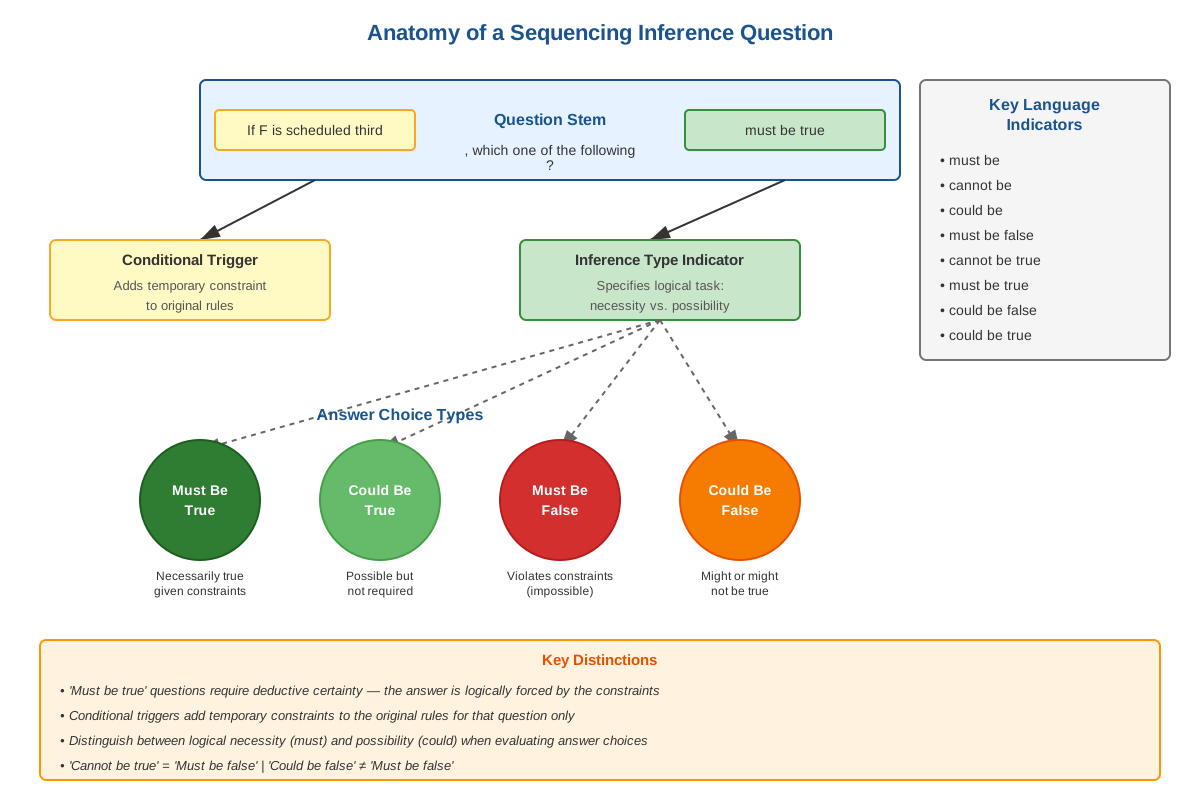
- [ ] Distinguish between "must be true," "could be true," and "must be false" inference questions in sequencing contexts
- [ ] Construct complete or partial ordering diagrams that reveal hidden inferences from multiple constraints
- [ ] Recognize common inference patterns such as forced positions, restricted ranges, and chain reactions in sequencing games
Prerequisites
- Basic sequencing notation: Understanding how to represent ordering relationships using symbols like "A—B" (A before B) or visual diagrams is essential for tracking constraints efficiently
- Rule types in sequencing games: Familiarity with relative ordering rules, fixed position rules, and block rules provides the foundation for combining constraints to generate inferences
- Conditional reasoning fundamentals: Recognizing if-then relationships and their contrapositives enables proper interpretation of conditional sequencing rules
- Game setup methodology: Knowing how to create an initial diagram with slots or positions allows you to visualize where inferences about placement emerge
Why This Topic Matters
Sequencing inference questions appear in approximately 60-70% of all sequencing games on the LSAT, making them one of the highest-yield question types in the Analytical Reasoning section. A typical LSAT contains 4-5 logic games, with at least one being a pure sequencing game and others often incorporating sequencing elements. Within each sequencing game, you can expect 2-4 inference questions that directly test your ability to derive new information from the given constraints.
In real-world applications, the logical reasoning skills developed through sequencing inference questions translate directly to legal analysis, where attorneys must determine what conclusions necessarily follow from a set of facts, statutes, and precedents. The ability to track multiple constraints simultaneously and recognize what must be true given those limitations mirrors the analytical demands of contract interpretation, statutory construction, and case law application.
On the LSAT specifically, these questions commonly appear in several formats: "Which one of the following must be true?", "If X is in position 3, which one of the following could be false?", "Which one of the following is a complete and accurate list of positions where Y could appear?", and "Which one of the following CANNOT be true?" Each format tests your inference-drawing ability but requires slightly different analytical approaches. The questions may appear immediately after the game setup (testing global inferences) or may include additional constraints that create local scenarios requiring new deductions.
Core Concepts
Understanding Inference Questions in Sequencing Games
Sequencing inference questions ask you to determine what logically follows from a set of ordering constraints without adding any new information beyond what the rules provide. Unlike "acceptability" questions that test whether you understand each individual rule, inference questions require you to combine multiple rules to discover relationships that aren't explicitly stated. The key distinction is that inferences are conclusions that must be true based on the logical interaction of constraints, not merely possibilities that don't violate any single rule.
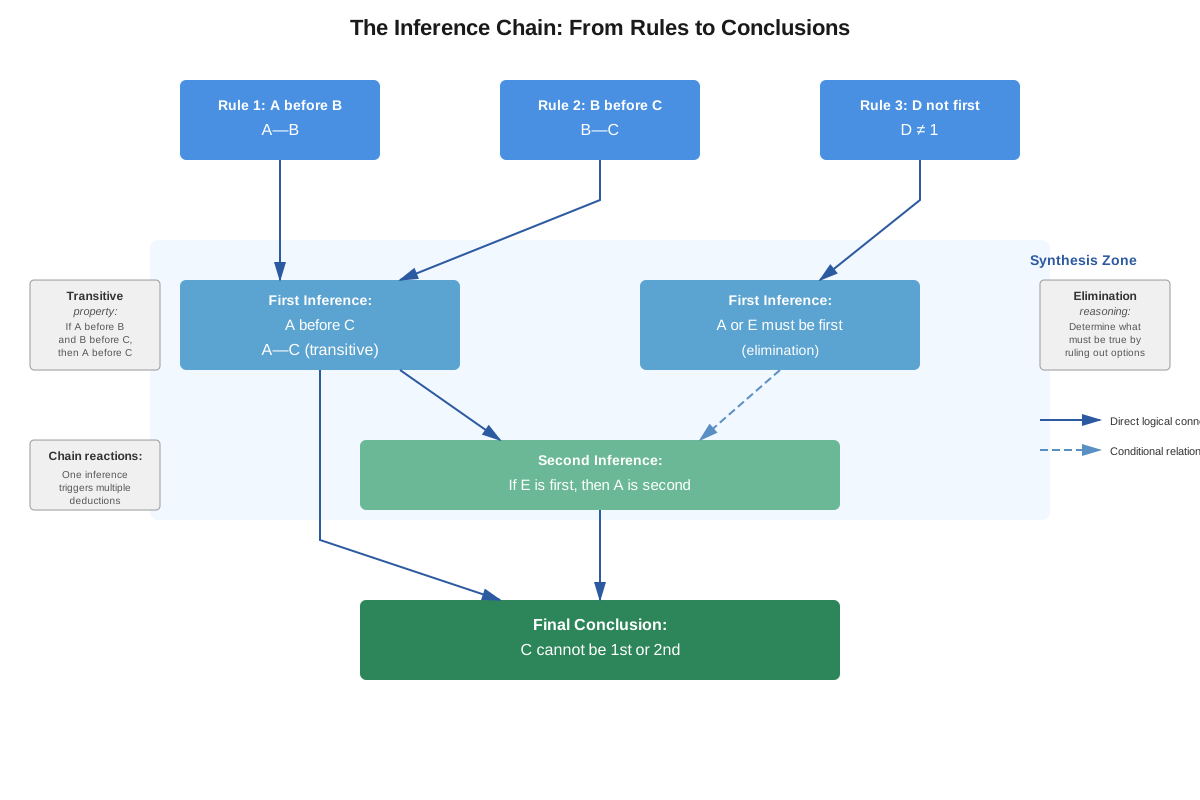
The fundamental principle underlying all sequencing inferences is the concept of constraint propagation: when multiple rules limit where elements can be placed, these limitations often interact to create additional restrictions. For example, if Rule 1 states "A is before B" and Rule 2 states "B is before C," you can infer that "A is before C" even though no rule explicitly states this relationship. This transitive property of ordering is the simplest form of sequencing inference, but games quickly become more complex as they introduce fixed positions, blocks, and conditional rules.
Types of Sequencing Inferences
There are several categories of inferences that repeatedly appear in LSAT sequencing inference questions:
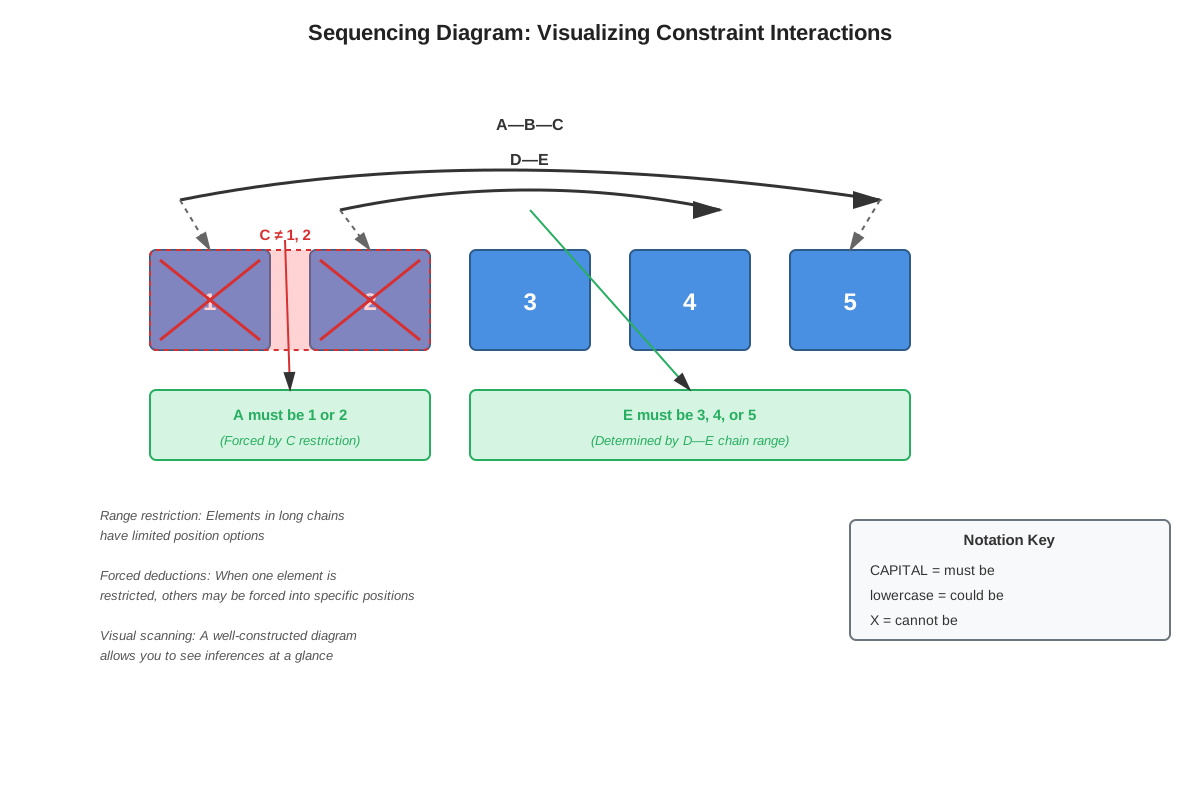
Position-based inferences occur when the combination of rules forces an element into a specific position or eliminates certain positions as possibilities. For instance, in a seven-position sequence, if A must be before B, C, and D, then A cannot occupy positions 5, 6, or 7 because there wouldn't be enough subsequent positions for the three elements that must follow it.
Range restrictions define the earliest and latest positions an element can occupy. If F must come after three other elements in a six-position sequence, F's earliest possible position is 4th. If F must also come before G, then F's latest possible position is 5th. This creates a range: F can only be 4th or 5th.
Forced relationships emerge when rules combine to create new ordering requirements. If "M is before N" and "N is before P" are both rules, then "M is before P" becomes a forced relationship even if unstated. More complex forced relationships can involve multiple chains of constraints.
Exclusion inferences determine what cannot be true. If a game has five positions and the rules establish that A must be before B, C, and D, then A cannot be in position 5, 4, or 3—it must be in position 1 or 2.
The Inference-Drawing Process
Drawing inferences systematically requires a methodical approach:
- Combine direct ordering rules to create extended chains (if A→B and B→C, then A→B→C)
- Apply numerical constraints by counting how many elements must precede or follow a given element
- Test extreme scenarios by asking "What if this element were first?" or "What if this element were last?"
- Identify blocks and anti-blocks (elements that must or cannot be adjacent) and consider their placement restrictions
- Look for elements with the most constraints as these often yield the richest inferences
Question Stem Variations and What They Test
Different question stems in sequencing inference questions test distinct logical skills:
| Question Type | What It Tests | Approach |
|---|---|---|
| "Which must be true?" | Necessary conclusions from all rules | Find what's true in every valid scenario |
| "Which could be true?" | Possible arrangements that don't violate rules | Eliminate what must be false |
| "Which must be false?" | Impossible arrangements | Find what violates rule combinations |
| "Complete and accurate list" | Exhaustive enumeration of possibilities | Systematically test each position |
| "If X is in position N, which..." | Local inferences from additional constraints | Apply new constraint and derive consequences |
Common Inference Patterns
Certain patterns appear repeatedly in sequencing games legacy:
The Squeeze: When an element has many elements that must precede it and many that must follow it, the element gets "squeezed" into a narrow range of possible positions. In a seven-position game, if three elements must precede X and two must follow X, then X can only be in positions 4 or 5.
The Anchor: When one element has a fixed position, it serves as an anchor point for determining the possible positions of other elements. If D is fixed in position 4, and A must be before D, then A can only be in positions 1, 2, or 3.
The Chain Reaction: When a conditional rule triggers, it can create a cascade of forced placements. If "If M is 3rd, then N is 5th" and "N is before P," then placing M in position 3 forces N into position 5 and restricts P to positions 6 or 7.
The Minimum/Maximum Test: For elements with multiple ordering constraints, calculate the minimum number of positions needed to satisfy all constraints. If A must be before B, C, and D, and these four elements must all appear in the sequence, A needs at least three positions after it, limiting where A can be placed.
Concept Relationships
The concepts within sequencing inference questions build upon each other in a hierarchical structure. Understanding basic ordering relationships (A before B) forms the foundation, which leads to recognizing transitive chains (A before B before C, therefore A before C). These chains combine with numerical constraints (counting how many elements must precede or follow) to generate range restrictions (earliest and latest possible positions). Range restrictions for multiple elements can then reveal forced positions where an element must be placed.
The connection to prerequisite topics is direct: basic sequencing notation provides the language for expressing inferences, while rule types determine what kinds of inferences are possible. Conditional reasoning becomes crucial when games include rules like "If X is 3rd, then Y is 5th," requiring you to trace through the implications of triggering conditions.
Within the broader Analytical Reasoning Legacy framework, sequencing inference questions connect to grouping games (which may include sequencing elements), hybrid games (which combine sequencing with other game types), and advanced game strategies (which rely on making inferences efficiently to save time). The logical reasoning skills developed here—particularly the ability to determine what must be true versus what could be true—transfer directly to the Logical Reasoning section of the LSAT.
The relationship map flows as follows: Individual Rules → Combined Constraints → Transitive Relationships → Numerical Analysis → Range Restrictions → Position Inferences → Answer Selection. Each step builds on the previous, and weakness at any stage compromises your ability to answer inference questions accurately.
Quick check — test yourself on Sequencing inference questions so far.
Try Flashcards →High-Yield Facts
⭐ Sequencing inference questions appear in 60-70% of all sequencing games, making them the most common question type in this game category
⭐ When an element must come before N other elements in a sequence of M positions, that element cannot occupy any position greater than (M - N)
⭐ Transitive chains are the most fundamental inference pattern: if A→B and B→C, then A→C always holds
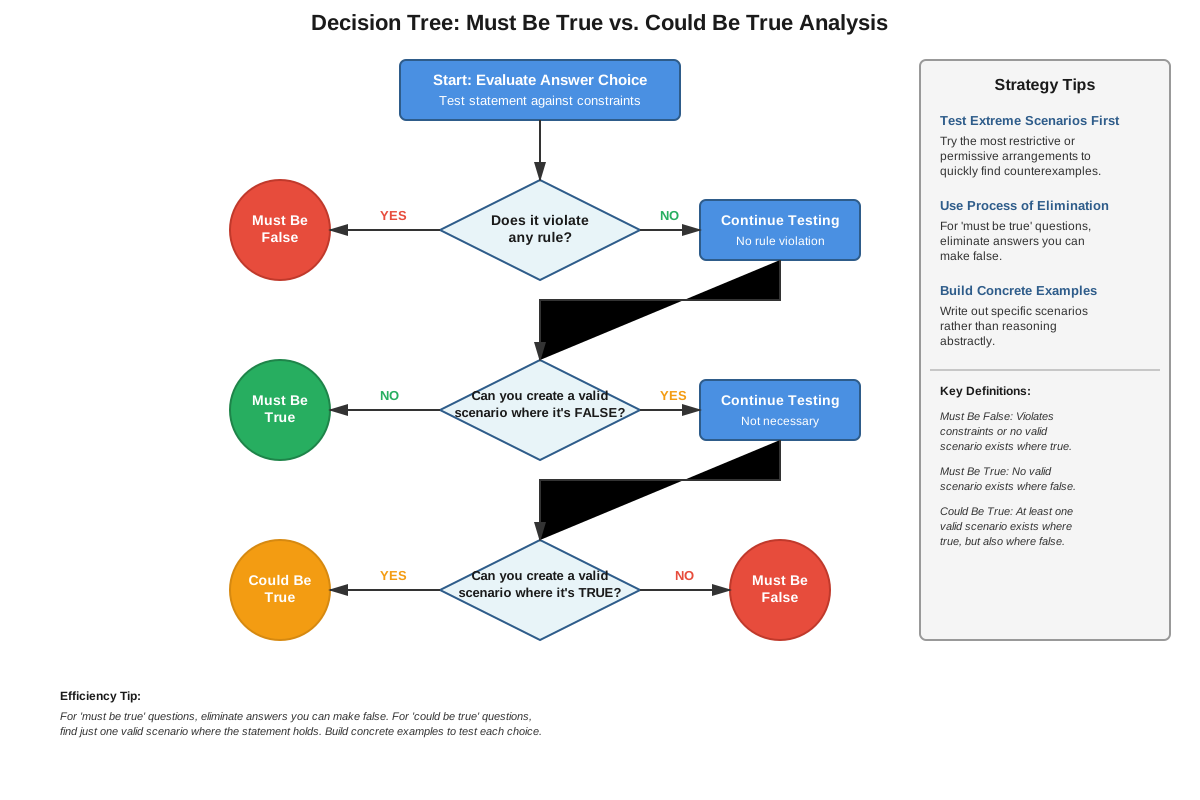
⭐ "Must be true" questions require finding what's true in ALL valid scenarios, while "could be true" questions only need ONE valid scenario
⭐ Elements with the most constraints (most elements before or after them) typically yield the richest inferences and are often the key to solving the game
- Fixed position rules serve as anchor points that restrict the possible positions of all elements related to them through ordering rules
- In a sequence of N positions, if an element must be before X elements and after Y elements, it can occupy at most (N - X) positions and at least (Y + 1) positions
- Conditional sequencing rules create two scenarios: one where the condition is triggered and one where it isn't, requiring separate inference analysis for each
- "Complete and accurate list" questions can often be solved by elimination: test each position systematically and eliminate those that violate constraints
- The contrapositive of conditional sequencing rules often reveals hidden inferences: if "X in position 3 → Y in position 5," then "Y NOT in position 5 → X NOT in position 3"
Common Misconceptions
Misconception: If A must be before B, then A and B must be adjacent in the sequence.
Correction: Ordering rules specify relative position only, not adjacency. "A before B" means A comes somewhere earlier in the sequence than B, but any number of elements could appear between them unless a specific adjacency rule exists.
Misconception: "Could be true" means the same as "not necessarily false."
Correction: While these are logically equivalent, the practical approach differs. For "could be true" questions, you need to construct or envision one valid scenario where the statement holds. Focus on possibility, not necessity.
Misconception: When a question adds a new constraint ("If X is in position 3..."), this constraint applies to all subsequent questions.
Correction: Additional constraints in question stems are local to that question only. Each question returns to the original rules unless it explicitly references a previous question's constraint.
Misconception: The most complex-looking answer choice is usually correct in inference questions.
Correction: Correct inferences often appear simple because they follow directly from the rules. Don't be seduced by complicated answer choices that introduce new relationships not supported by the constraints.
Misconception: You must test every possible arrangement to answer "must be true" questions.
Correction: Strategic inference-drawing eliminates the need for exhaustive testing. Focus on combining rules to derive necessary conclusions rather than enumerating all possibilities.
Misconception: If an element can be in multiple positions, no inference can be drawn about it.
Correction: Even when an element has multiple possible positions, you can often infer what positions it CANNOT occupy, which is equally valuable information for answering questions.
Worked Examples
Example 1: Basic Inference Chain
Game Setup: Seven students—F, G, H, J, K, L, M—present in order from first to seventh. The following constraints apply:
- F presents before G
- G presents before H
- K presents before L
- L presents before M
- J presents before K
Question: Which one of the following must be true?
(A) F presents before M
(B) J presents before H
(C) G presents before L
(D) J presents before M
(E) K presents before H
Solution Process:
First, construct the ordering chains from the rules:
- Chain 1: F → G → H
- Chain 2: J → K → L → M
These are two separate chains with no explicit connection between them. Now examine each answer choice:
(A) F presents before M: These elements are in different chains with no connecting rule. F could present 1st, 2nd, or 3rd (in the F→G→H chain), while M must present after J, K, and L. However, the M chain could start at position 1 (J first), which would place M in position 4, while F could be in position 5, 6, or 7. This is NOT necessarily true.
(B) J presents before H: Again, different chains. The J→K→L→M chain could occupy positions 4-7, while F→G→H occupies positions 1-3, placing H before J. NOT necessarily true.
(C) G presents before L: Different chains, no necessary relationship. NOT necessarily true.
(D) J presents before M: Both elements are in the same chain: J → K → L → M. By transitivity, J must present before M. This MUST be true. ⭐
(E) K presents before H: Different chains, no necessary relationship. NOT necessarily true.
Answer: (D)
Key Takeaway: This question tests your ability to recognize transitive relationships within a single chain while avoiding the trap of assuming relationships between separate chains. The correct answer derives from combining multiple rules within one constraint chain.
Example 2: Range Restriction with Fixed Position
Game Setup: Six books—P, Q, R, S, T, U—are arranged on a shelf from left (position 1) to right (position 6). The following constraints apply:
- P is in position 3
- Q is somewhere to the left of R
- Q is somewhere to the left of S
- T is somewhere to the left of U
- R is somewhere to the left of U
Question: Which one of the following is a complete and accurate list of positions in which Q could be placed?
(A) 1, 2
(B) 1, 2, 4
(C) 1, 2, 3
(D) 1, 2, 4, 5
(E) 2, 4, 5
Solution Process:
Start with the fixed position: P is in position 3.
Analyze Q's constraints:
- Q must be before R
- Q must be before S
This means Q needs at least two positions after it for R and S. In a six-position sequence, Q can be at latest in position 4 (leaving positions 5 and 6 for R and S).
Now test each position for Q:
Position 1: Q could be here with R and S in any of the remaining positions (2, 4, 5, 6). ✓ Valid
Position 2: Q could be here with R and S in positions 4, 5, or 6. ✓ Valid
Position 3: This position is occupied by P (fixed). ✗ Invalid
Position 4: Q could be here with R and S in positions 5 and 6. ✓ Valid
Position 5: Q would need R and S after it, but only position 6 remains—not enough room for both. ✗ Invalid
Position 6: Q would need R and S after it, but no positions remain. ✗ Invalid
Therefore, Q can be in positions 1, 2, or 4.
Answer: (B)
Key Takeaway: This question tests range restriction inference by requiring you to count how many positions an element needs after it. The fixed position (P in 3) eliminates one possibility, while the numerical constraint (Q needs at least 2 positions after it) eliminates the later positions.
Exam Strategy
When approaching sequencing inference questions on the LSAT, begin by thoroughly analyzing the game setup and rules before attempting any questions. Spend 60-90 seconds making upfront inferences: combine ordering rules into chains, identify elements with fixed positions, and note elements with the most constraints. This investment pays dividends across all questions in the game.
Trigger words and phrases that signal inference questions include:
- "must be true" / "must be false" / "cannot be true"
- "could be true" / "could be false"
- "complete and accurate list"
- "which one of the following is possible"
- "which one of the following is impossible"
For "must be true" questions, use the elimination strategy: an answer choice is wrong if you can construct even one valid scenario where it's false. Don't try to prove each answer true; instead, try to prove each answer false, and the one you cannot disprove is correct.
For "could be true" questions, the reverse applies: an answer choice is correct if you can construct even one valid scenario where it's true. Eliminate answers that must be false based on rule violations.
For "complete and accurate list" questions, test systematically. If the question asks for all positions where X could appear, test each position in order. Mark positions as possible or impossible, then match your findings to the answer choices.
Time allocation: Spend more time on the game setup and initial inferences (90-120 seconds) to save time on individual questions (30-45 seconds each). A well-analyzed game with clear inferences makes questions quick to answer. If you find yourself spending more than 60 seconds on a single inference question, you likely missed a key upfront inference—consider returning to the game setup.
Process of elimination tips:
- Eliminate answer choices that contradict explicit rules first
- Then eliminate choices that violate inferences you've already drawn
- For remaining choices, test the simplest or most extreme scenarios
- In "must be true" questions, four answers will be "could be false"—find the one that's true in every scenario
- In "could be true" questions, four answers will be "must be false"—find the one that's possible in at least one scenario
Memory Techniques
CHAIN mnemonic for drawing inferences:
- Combine direct ordering rules
- Hunt for fixed positions (anchors)
- Analyze numerical constraints (count elements before/after)
- Identify range restrictions (earliest/latest positions)
- Note forced relationships and exclusions
The "Squeeze Test" visualization: Imagine each element as a physical object with elements that must come before it pushing from the left and elements that must come after it pushing from the right. The element gets "squeezed" into the middle positions where it fits.
MUST vs. COULD distinction:
- MUST = true in ALL valid scenarios (think "Must = ALL")
- COULD = true in ONE valid scenario (think "Could = ONE")
The Anchor Acronym (FIXED):
- Find the fixed position
- Identify elements related to it
- X-out impossible positions for related elements
- Establish ranges for related elements
- Derive additional inferences
For remembering that ordering rules are transitive: "Before is Transitive" (B.T.) - if A is Before B, and B is Before C, then A is Before C (B.T. = Before is Transitive).
Summary
Sequencing inference questions constitute the highest-yield question type within sequencing games on the LSAT, appearing in the majority of such games and testing your ability to derive logical conclusions from multiple ordering constraints. Success requires mastering the systematic process of combining rules to create transitive chains, applying numerical constraints to determine range restrictions, and distinguishing between what must be true (necessary in all valid scenarios) versus what could be true (possible in at least one valid scenario). The key patterns—position-based inferences, range restrictions, forced relationships, and exclusion inferences—appear repeatedly across different games, making pattern recognition a crucial skill. Effective strategy involves investing time upfront to draw inferences during game setup, using these inferences to eliminate wrong answers quickly, and applying systematic testing methods for "complete and accurate list" questions. Understanding the logical structure of different question stems (must be true, could be true, must be false) and applying the appropriate analytical approach to each ensures accuracy and efficiency.
Key Takeaways
- Sequencing inference questions test your ability to combine multiple constraints to derive conclusions not explicitly stated in the rules
- Transitive chains (if A→B and B→C, then A→C) form the foundation of most sequencing inferences
- Elements with the most constraints typically yield the richest inferences and often hold the key to solving the game efficiently
- "Must be true" requires the statement to hold in ALL valid scenarios, while "could be true" requires only ONE valid scenario
- Numerical analysis—counting how many elements must precede or follow a given element—reveals range restrictions that limit possible positions
- Fixed positions serve as anchors that restrict the placement of all related elements through ordering rules
- Investing 90-120 seconds in upfront inference-drawing during game setup saves significant time on individual questions and improves accuracy across the entire game
Related Topics
Conditional Sequencing Rules: Building on basic sequencing inferences, conditional rules introduce if-then relationships that create multiple scenarios requiring separate inference analysis. Mastering basic inferences is essential before tackling conditional complexity.
Sequencing Games with Blocks: When games include rules about elements that must be adjacent (blocks) or cannot be adjacent (anti-blocks), inference patterns become more complex, requiring you to consider both ordering and adjacency constraints simultaneously.
Hybrid Games with Sequencing Elements: Many advanced LSAT games combine sequencing with grouping or selection elements. The inference skills developed in pure sequencing games transfer directly to these hybrid scenarios.
Advanced Game Diagramming Techniques: As games increase in complexity, sophisticated diagramming methods help visualize inferences more clearly, building on the foundational inference-drawing skills covered in this topic.
Practice CTA
Now that you've mastered the core concepts and strategies for sequencing inference questions, it's time to put your knowledge into action. Attempt the practice questions to reinforce these patterns and build the speed and accuracy needed for test day. Each practice problem you solve strengthens your inference-drawing abilities and builds the confidence essential for LSAT success. Review the flashcards to cement the key patterns and trigger words in your memory. Remember: inference skills improve dramatically with deliberate practice—the patterns that seem challenging now will become automatic recognition with consistent application.
Sign up free to keep reading
Create a free AnvayaPrep account to finish this LSAT guide on Sequencing inference questions — plus flashcards and practice questions.