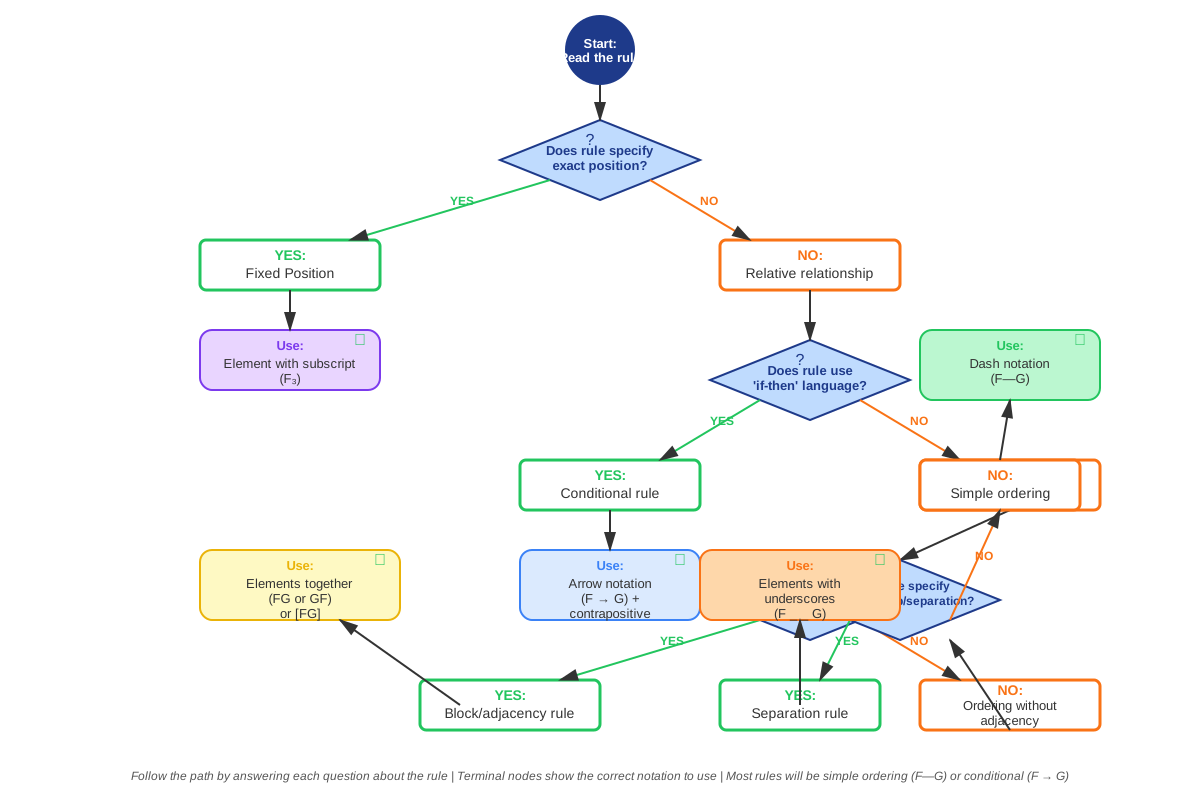
Overview
Sequencing rule diagramming is a foundational skill within the Analytical Reasoning Legacy section of the LSAT, specifically within sequencing games legacy. These games present scenarios where elements must be arranged in a specific order—whether chronologically, spatially, or hierarchically—and success depends entirely on the test-taker's ability to translate verbal rules into visual diagrams that capture all logical relationships. The ability to diagram sequencing rules efficiently and accurately separates high scorers from average performers, as proper diagramming enables rapid deduction-making and prevents costly errors under time pressure.
LSAT sequencing rule diagramming involves converting conditional statements, ordering constraints, and relational rules into standardized symbolic notation that makes implicit relationships explicit. When a rule states "F is presented before G but after H," the skilled test-taker immediately translates this into "H—F—G," creating a visual chain that can be integrated with other rules. This translation process is not merely transcription; it requires understanding the logical structure of each rule type and recognizing how different rules interact to create a complete ordering framework. The diagrams serve as external working memory, allowing test-takers to manipulate complex logical relationships without overwhelming their cognitive capacity.
Within the broader context of Analytical Reasoning, sequencing games represent one of the most predictable and learnable game types. While grouping games test set theory and matching games test correspondence relationships, sequencing games test pure ordering logic. Mastering sequencing rule diagramming provides a reliable foundation for tackling approximately 25-30% of all Analytical Reasoning questions on any given LSAT, making it one of the highest-yield skills in the entire exam. The diagramming techniques learned here also transfer to hybrid games that combine sequencing with other game types, amplifying the value of this skill set.
Learning Objectives
- [ ] Identify how sequencing rule diagramming appears in LSAT questions
- [ ] Explain the reasoning pattern behind sequencing rule diagramming
- [ ] Apply sequencing rule diagramming to solve LSAT-style problems accurately
- [ ] Distinguish between different types of sequencing rules and select appropriate diagramming notation for each
- [ ] Combine multiple sequencing rules to create master diagrams and derive valid inferences
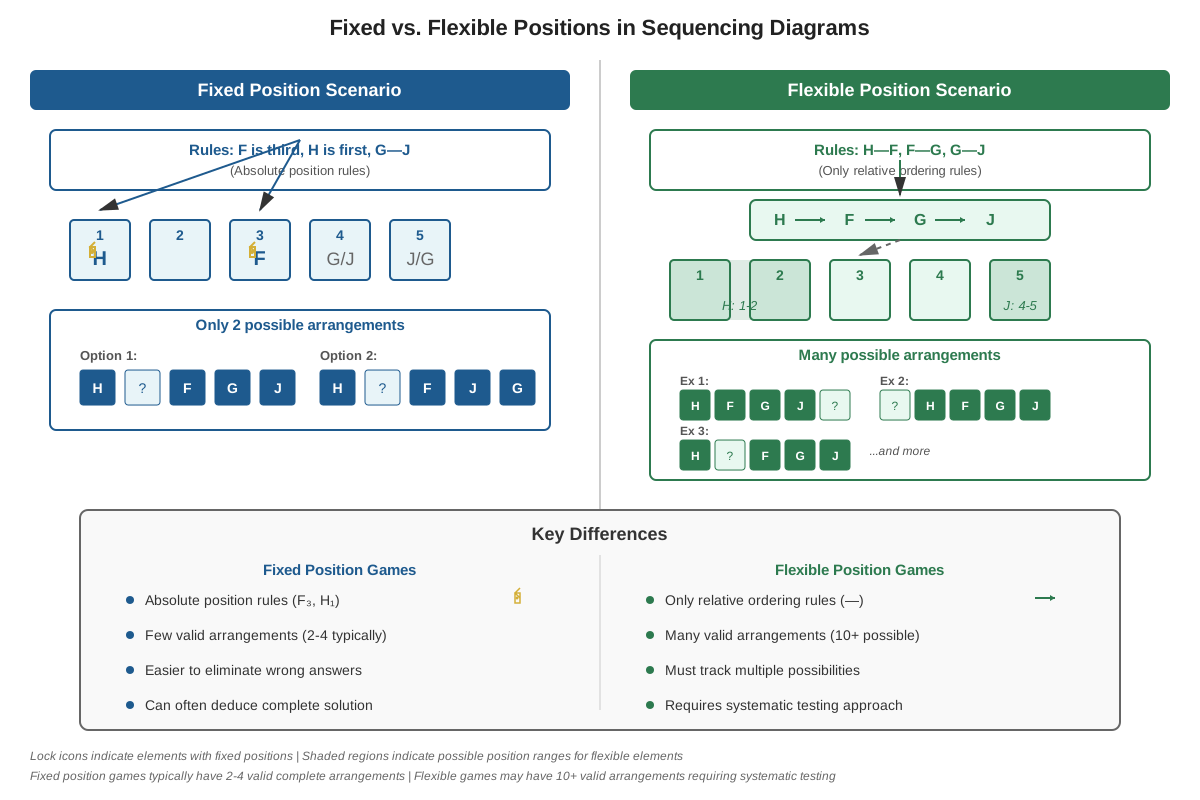
- [ ] Recognize when sequencing rules create fixed positions versus flexible relationships
- [ ] Evaluate answer choices efficiently using properly constructed sequencing diagrams
Prerequisites
- Basic logical reasoning: Understanding of conditional statements (if-then relationships) is essential because many sequencing rules are conditional in nature
- Symbolic notation familiarity: Comfort with using letters, arrows, and other symbols to represent abstract relationships enables efficient diagram construction
- Spatial reasoning: The ability to visualize ordered arrangements mentally supports the translation of verbal rules into spatial diagrams
- Set theory basics: Understanding that game elements form a complete set helps recognize when all elements have been accounted for in the ordering
Why This Topic Matters
Sequencing games appear with remarkable consistency on the LSAT, typically comprising 1-2 games per Analytical Reasoning section. Given that each game contains 5-7 questions, mastering sequencing rule diagramming directly impacts 8-14 questions per exam—a substantial portion of the 22-23 total Analytical Reasoning questions. Test-takers who excel at diagramming sequencing rules typically complete these games 2-3 minutes faster than those who struggle, creating valuable time for more challenging game types.
In real-world applications, the logical skills developed through sequencing rule diagramming transfer directly to legal practice. Attorneys must constantly order events chronologically to establish timelines, sequence procedural steps to ensure compliance, and arrange hierarchical relationships to understand organizational structures. The ability to take complex verbal descriptions and create clear visual representations of ordering relationships is fundamental to case analysis, contract interpretation, and statutory construction.
On the LSAT specifically, sequencing games appear in several common formats: strict linear sequencing (elements in a single line with definite positions), loose sequencing (relative ordering without fixed positions), circular sequencing (elements arranged around a circle), and double sequencing (two parallel orderings). Questions typically ask test-takers to determine what must be true, what could be true, which arrangements are possible, or what happens if a specific condition is added. Approximately 60-70% of sequencing game questions can be answered directly from a well-constructed master diagram with proper rule notation, making diagramming skill the single most important factor in sequencing game performance.
Core Concepts
Basic Sequencing Rule Types
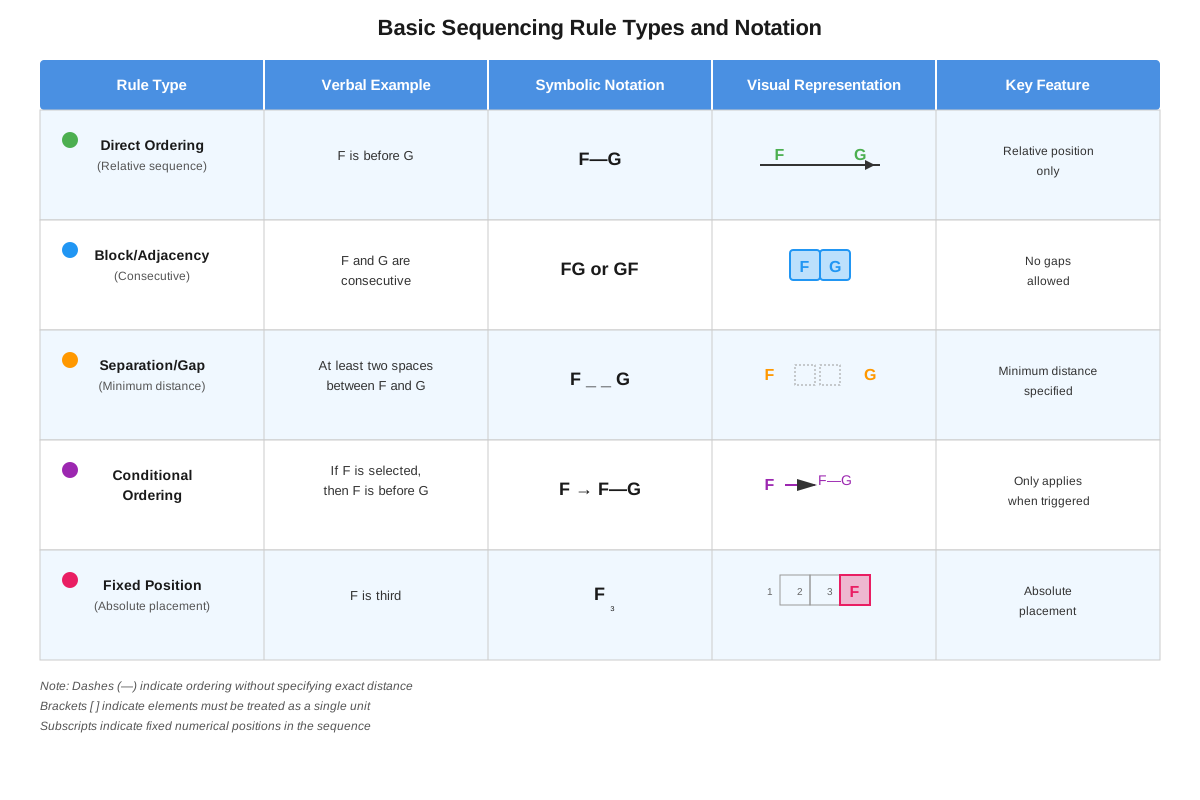
The foundation of lsat sequencing rule diagramming rests on recognizing and properly notating five fundamental rule types. Each rule type has a standard diagramming convention that experienced test-takers use automatically.
Relative ordering rules specify that one element comes before or after another without indicating how many positions separate them. The rule "J is before K" is diagrammed as "J—K" with a single arrow showing the direction of the relationship. The key insight is that this rule says nothing about other elements; L could come before J, between J and K, or after K. The diagram captures only what the rule explicitly states.
Block rules specify that certain elements must be adjacent or separated by a specific number of positions. "M and N are consecutive" is diagrammed as "MN" or "NM" in a box or with a bracket, indicating these elements form an inseparable unit. Conversely, "P and Q are separated by exactly two positions" might be diagrammed as "P _ _ Q" to show the fixed spacing requirement.
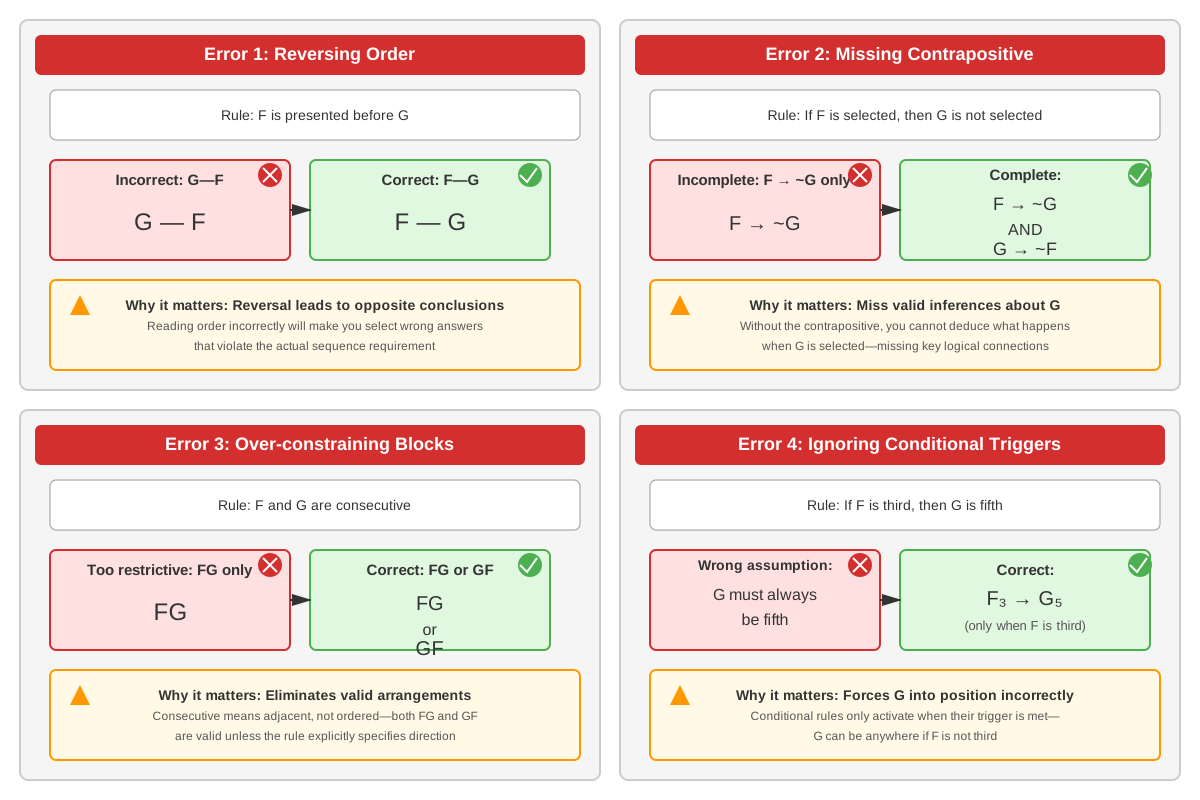
Conditional sequencing rules combine ordering with conditional logic. "If R is included, then R is before S" requires a two-part diagram: "R → R—S" showing both the condition and its consequence. The contrapositive must also be noted: "S—R → ~R" (if S comes before R, then R is not included). These rules are particularly high-yield because they generate multiple inferences.
Position-specific rules assign elements to exact positions or ranges. "T must be in position 3" is simply noted as "T₃" or by writing T directly in the third position of the master diagram. "U must be in one of the first three positions" is noted as "U₁₋₃" or by marking positions 1-3 with a notation indicating U's restriction.
Exclusion rules specify where elements cannot go. "V cannot be last" is diagrammed as "V ≠ last" or by marking the last position with "~V." These negative rules are often overlooked but generate powerful inferences when combined with positive rules.
Diagramming Notation Systems
Consistency in notation prevents errors and speeds up processing. The standard sequencing rule diagramming system uses these conventions:
| Rule Type | Verbal Statement | Standard Notation | Alternative Notation |
|---|---|---|---|
| Before/After | "A before B" | A—B or A→B | A...B |
| Immediately Before | "C immediately before D" | CD or C-D | [CD] |
| Not Adjacent | "E not next to F" | E ≠ F or E ⧸ F | E~F |
| Exactly Between | "G between H and I" | H—G—I | H |
| At Least One Between | "At least one space between J and K" | J _ K | J...K |
| Fixed Position | "L in position 4" | L₄ | L at 4 |
The arrow notation (→) is particularly versatile because it clearly shows directionality and can be chained: "A→B→C" immediately shows that A is before both B and C, and B is before C. This chaining capability makes arrows the preferred notation for most test-takers.
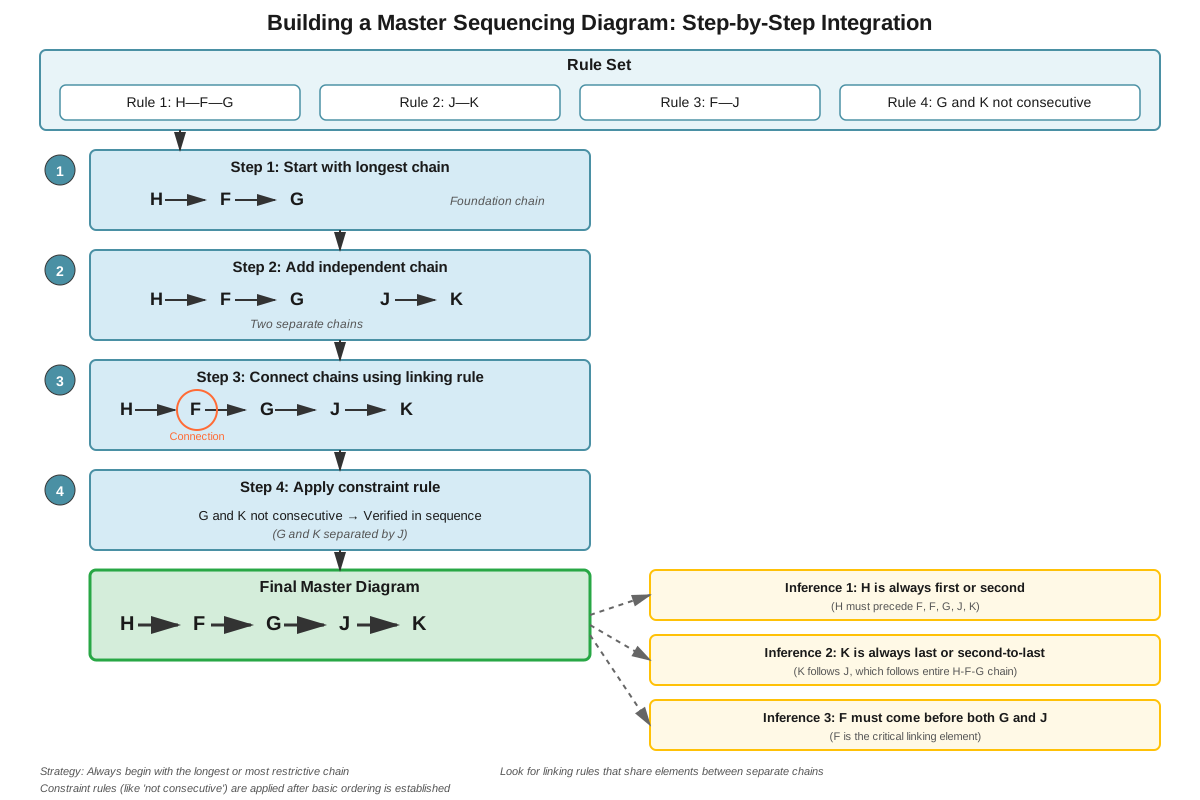
Creating Master Diagrams
The master diagram is the central workspace where all rules are integrated. For a strict linear sequencing game with seven elements (A through G) in seven positions, the master diagram begins as seven blank slots:
__ __ __ __ __ __ __
1  2  3  4  5  6  7
As rules are diagrammed, some information goes directly into the master diagram (position-specific rules), while other information is noted separately (relative ordering rules that don't yet have fixed positions). The goal is to make as many valid inferences as possible by combining rules.
For example, if the rules state:
- "A is before B"
- "B is before C"
- "C is in position 5"
The diagramming process proceeds systematically:
- Rule 3 goes directly into the master diagram: position 5 = C
- Rules 1 and 2 combine: A—B—C
- Since C is in position 5, B must be in position 3 or 4, and A must be in position 1, 2, or 3
- This creates a powerful inference: A cannot be in positions 4-7, B cannot be in positions 1, 6, or 7
This information is captured by marking the master diagram with possibilities and impossibilities, often using a notation system where possible elements are written small above positions and impossible elements are crossed out.
Loose Sequencing Diagrams
When games provide only relative ordering rules without enough information to determine exact positions, loose sequencing diagrams become essential. These diagrams show all relative relationships in a single visual structure without committing to specific positions.
Consider rules stating:
- "D is before E"
- "F is before D"
- "E is before G"
- "H is before F"
Rather than trying to place these in positions, create a chain diagram:
H—F—D—E—GThis single diagram captures all four rules and makes the complete ordering transparent. Additional elements that aren't constrained by these rules would be noted separately. Loose sequencing diagrams are particularly powerful because they allow test-takers to see the "skeleton" of the ordering before worrying about exact positions.
Inference Generation from Diagrams
Proper diagramming naturally generates inferences—conclusions that must be true based on combining rules. The most common inference types in sequencing games are:
Transitive inferences: If A—B and B—C, then A—C. This seems obvious but becomes less apparent in complex games with many elements.
Position elimination inferences: If a chain of three elements must appear in order (X—Y—Z), then X cannot be in the last two positions, Z cannot be in the first two positions, and Y cannot be in the first or last position.
Block placement inferences: If two elements must be consecutive (forming a block of 2) in a 7-position game, that block can only start in positions 1-6, eliminating position 7 as a possibility for the first element of the block.
Conditional chain inferences: If "A → A—B" and "B—C," then "A → A—B—C," creating a longer conditional chain that severely restricts where A can be placed if it's included.
The key to generating inferences is systematically asking: "What does this rule prevent?" and "What happens when I combine this rule with another rule?" Test-takers who actively search for inferences before attempting questions typically answer 2-3 more questions correctly per game than those who don't.
Concept Relationships
The concepts within sequencing rule diagramming form a hierarchical learning structure. Basic rule types (relative ordering, blocks, position-specific) form the foundation that must be mastered first. These feed into notation systems, which provide the language for expressing rules consistently. Both basic rules and notation systems are prerequisites for master diagram construction, which integrates all rules into a single workspace.
Loose sequencing diagrams represent a specialized application of relative ordering rules when insufficient information exists for fixed positioning. They connect back to basic rule types but require additional spatial reasoning to arrange multiple chains optimally. Inference generation sits at the top of the hierarchy, drawing on all previous concepts—it requires understanding rule types, using notation correctly, constructing master diagrams properly, and recognizing patterns across rules.
The relationship to prerequisite topics is direct: logical reasoning provides the conditional logic framework that underlies conditional sequencing rules, while symbolic notation enables the translation from verbal to visual representation. The relationship to subsequent topics in Analytical Reasoning is equally important: the diagramming skills learned here transfer directly to grouping games (where elements are sequenced into groups), matching games (where multiple attributes are sequenced for each element), and hybrid games (which combine sequencing with other game types).
The progression follows this path: Rule Recognition → Notation Selection → Individual Rule Diagramming → Rule Combination → Master Diagram Construction → Inference Generation → Question Application. Each step depends on the previous steps being executed correctly, making sequencing rule diagramming a cumulative skill that improves with deliberate practice.
High-Yield Facts
⭐ Relative ordering rules (A—B) say nothing about other elements' positions relative to A or B; avoid over-inferring from these rules
⭐ When an element appears in multiple rules, it becomes a "hub" that connects those rules and generates inferences
⭐ Block rules reduce the effective number of positions in a game; a 2-element block in a 7-position game creates only 6 possible starting positions
⭐ Position-specific rules should always be placed in the master diagram first, as they provide fixed reference points for other rules
⭐ The contrapositive of conditional sequencing rules is just as important as the original rule and often generates unique inferences
- Loose sequencing diagrams should be constructed before attempting to place elements in specific positions when rules are primarily relative
- Elements that appear in no rules have maximum flexibility and are often the key to "could be true" questions
- When two blocks overlap (share an element), they form a longer chain that severely restricts placement options
- Circular sequencing games require modified notation because "before" and "after" become relative to direction
- Double sequencing games require two parallel master diagrams with rules connecting elements across both sequences
- The number of unrestricted elements equals the number of "floating" positions in most sequencing games
- Exclusion rules (cannot be in position X) are most powerful when combined with other restrictions that limit an element to few positions
- If a game has N positions and N elements with no repeats, every position must be filled exactly once—a constraint that generates inferences
- Sequencing games with ties or equal positions require special notation to indicate multiple elements can occupy the same rank
- The most common error in sequencing rule diagramming is confusing "immediately before" with "before," leading to incorrect spacing assumptions
Quick check — test yourself on Sequencing rule diagramming so far.
Try Flashcards →Common Misconceptions
Misconception: "A—B" means A and B are adjacent with no elements between them.
Correction: "A—B" means only that A comes before B somewhere in the sequence; they could be separated by any number of positions. Adjacency requires specific notation like "AB" in a block or "A immediately before B" in the rule.
Misconception: If the rules don't mention an element, it can go anywhere without restriction.
Correction: While unrestricted elements have maximum flexibility, they still must fit into the remaining positions after restricted elements are placed. Their placement is constrained by what's left available, not truly unlimited.
Misconception: All sequencing rules can be combined into a single linear chain.
Correction: Only rules that share elements can be directly connected. If rules involve completely separate sets of elements (A—B and C—D with no rules connecting these pairs), they form separate chains that must be tracked independently.
Misconception: Conditional sequencing rules apply in all scenarios.
Correction: Conditional rules (If X, then Y) only apply when the condition is met. If X doesn't occur, the rule places no restrictions. Test-takers must track whether conditions are triggered in each question scenario.
Misconception: The master diagram should show every possible arrangement.
Correction: The master diagram shows fixed placements and notes restrictions; it doesn't enumerate all possibilities. That would be impossibly time-consuming. Instead, the diagram captures constraints that allow rapid evaluation of specific scenarios presented in questions.
Misconception: Loose sequencing diagrams are less useful than fixed position diagrams.
Correction: Loose sequencing diagrams are often more powerful because they capture the logical structure of all relative relationships in a single visual. They enable pattern recognition that fixed position diagrams obscure when rules don't determine exact positions.
Misconception: More complex notation systems are more effective.
Correction: The best notation system is the simplest one that captures all necessary information. Overly complex notation slows processing and increases error rates. Consistency matters more than sophistication.
Worked Examples
Example 1: Strict Linear Sequencing with Multiple Rule Types
Game Setup: Seven students—F, G, H, I, J, K, L—present reports in seven consecutive time slots, numbered 1 through 7. The following conditions apply:
- G presents before H
- H presents immediately before I
- J presents in slot 4
- K presents before L
- F does not present in slot 1
Diagramming Process:
First, identify rule types:
- Rule 1: Relative ordering (G—H)
- Rule 2: Block rule (HI)
- Rule 3: Position-specific (J₄)
- Rule 4: Relative ordering (K—L)
- Rule 5: Exclusion (F ≠ 1)
Second, create the master diagram and place fixed information:
__ __ __ J __ __ __
1  2  3  4  5  6  7
Third, combine rules 1 and 2: Since G is before H, and H is immediately before I, we get: G—HI (G before the HI block, but not necessarily immediately before)
Fourth, note that the HI block occupies two consecutive positions. This block cannot start in position 7 (no room for I), so HI can start in positions 1-6.
Fifth, analyze position possibilities:
- J is fixed in position 4
- The HI block needs two consecutive slots
- G must come before the HI block
- K must come before L
- F cannot be in position 1
Sixth, generate inferences:
- Since G must come before HI, and HI is a 2-slot block, the earliest HI can start is position 2 (with G in position 1)
- If HI starts in position 1-2, then G would need to be before position 1, which is impossible
- Therefore, HI cannot start in position 1
- HI can start in positions 2, 3, 5, or 6 (not 4 because J is there)
- If HI is in positions 2-3, then G must be in position 1, but F ≠ 1, so F would be in positions 4-7
- Since J is in position 4, F would be in positions 5, 6, or 7 in this scenario
The complete diagram with inferences:
~F __ __ J __ __ __
1  2  3  4  5  6  7

G—HI (HI is a block, G comes before it)
K—L
F ≠ 1

HI possible starting positions: 2, 3, 5, 6
Question Application: "Which of the following could be the order of presentations from first to seventh?"
Using the diagram, quickly eliminate any answer choice that:
- Places F in position 1
- Places J anywhere except position 4
- Separates H and I
- Places H before G
- Places I before H
- Places L before K
This elimination process, based on properly diagrammed rules, typically eliminates 3-4 answer choices immediately.
Example 2: Loose Sequencing with Conditional Rules
Game Setup: A film festival shows six films—A, B, C, D, E, F—over six days. The following conditions apply:
- A is shown before B
- If C is shown, then C is shown before D
- E is shown before F
- B is shown before E
- If D is shown, then D is shown before F
Diagramming Process:
First, identify rule types:
- Rules 1, 3, 4: Relative ordering
- Rules 2, 5: Conditional sequencing
Second, diagram non-conditional rules and combine:
- A—B (rule 1)
- E—F (rule 3)
- B—E (rule 4)
Combining: A—B—E—F (a chain of four films)
Third, diagram conditional rules:
- Rule 2: C → C—D
- Rule 5: D → D—F
Fourth, combine conditional rules:
If both C and D are shown, then: C—D—F (from rules 2 and 5)
Fifth, integrate conditional chains with main chain:
The main chain is A—B—E—F
If C and D are shown, we have C—D—F
Since F appears in both chains, and we know E—F from the main chain, we can infer:
If C and D are shown: C—D must come before F, and E must come before F
This means: C—D and E both come before F, but their relative order isn't specified
Sixth, create the complete loose sequencing diagram:
Main chain: A—B—E—F

Conditional additions:
If C: C—D (and D—F if D is shown)
If D: D—F

Combined conditional: If C and D: C—D—F

Integration: If C and D are shown:
A—B—E—F with C—D inserted before F
Possible structure: A—B—C—D—E—F or A—B—E—C—D—F or other variations
Question Application: "If C is shown on day 2, which of the following must be true?"
Using the diagram:
- C is shown, so C—D must be true (conditional rule 2 is triggered)
- C is on day 2
- A—B—E—F must still hold
- Since C—D and D—F, we have C—D—F
- A must be before B, so A must be on day 1 (the only day before C on day 2)
- D must be after C (day 2), so D is on day 3 or later
- B must be after A (day 1) and before E
- E must be before F
Working through the positions:
- Day 1: A (must be before B, and C is on day 2, so A must be day 1)
- Day 2: C (given)
- Day 3+: D must follow C
- B must fit between A and E
- E must come before F
This structured analysis, based on the loose sequencing diagram, allows systematic evaluation of what must be true.
Exam Strategy
When approaching sequencing games on the LSAT, follow this systematic process:
Step 1: Identify the game type (15-20 seconds). Look for trigger phrases: "in order," "before," "after," "consecutive," "sequence," "first through seventh," "ranked from highest to lowest." These signal sequencing games requiring rule diagramming.
Step 2: Set up the master diagram (10-15 seconds). Draw blank slots equal to the number of positions. Number them clearly. For seven positions, draw seven slots with numbers 1-7 beneath. This external workspace is essential—don't try to track positions mentally.
Step 3: Diagram each rule individually (30-45 seconds total). Read each rule once, identify its type, and write it in standard notation. Don't try to combine rules yet. Place position-specific rules directly in the master diagram. Write other rules in a list beside the diagram.
Step 4: Combine rules and generate inferences (45-60 seconds). Look for elements that appear in multiple rules—these are connection points. Chain together relative ordering rules. Identify what positions are impossible for each element. Mark these restrictions in or near the master diagram.
Step 5: Create a loose sequencing diagram if appropriate (20-30 seconds). If rules are primarily relative ordering without many fixed positions, draw a chain diagram showing all relationships. This often reveals the game's structure more clearly than trying to force elements into specific positions prematurely.
Exam Tip: Spend 2-2.5 minutes on setup and diagramming before attempting any questions. This upfront investment pays dividends—properly diagrammed games yield answers in 30-45 seconds per question, while poorly diagrammed games require 60-90 seconds per question and generate more errors.
Trigger words for specific rule types:
- "Before" or "after" without "immediately" → relative ordering (use arrow notation)
- "Immediately before," "immediately after," "consecutive," "adjacent" → block rule (use bracket or box notation)
- "In position X," "in slot X," "first," "last" → position-specific (place directly in master diagram)
- "Cannot be," "is not," "must not be" → exclusion rule (mark with ≠ or ~ symbol)
- "If...then" → conditional rule (diagram with arrow, note contrapositive)
Process of elimination strategy: For "could be true" questions, use the diagram to eliminate answer choices that violate any rule. For "must be true" questions, eliminate choices that could be false in any valid scenario. For "completely determines" questions, test whether each answer choice, combined with the rules, leaves only one possible arrangement.
Time allocation: Aim for 8-9 minutes per sequencing game (2-2.5 minutes setup, 6-6.5 minutes for questions). If a question takes more than 90 seconds, mark it and move on—return if time permits. The questions are not ordered by difficulty, so a later question might be easier.
Memory Techniques
BRACE mnemonic for the five basic rule types:
- Block rules (adjacent elements)
- Relative ordering (before/after)
- Assignment rules (position-specific)
- Conditional rules (if-then)
- Exclusion rules (cannot be)
Visualization strategy: Imagine the sequencing game as a physical line of people or objects. When a rule states "A before B," visualize person A standing to the left of person B in a line. This spatial visualization helps prevent errors like reversing the order.
Arrow direction memory aid: The arrow always points from earlier to later, left to right: A→B means A comes first. Think "time flows forward like an arrow."
Block notation memory aid: Elements that must be together are "hugging" in the diagram—write them touching with no space: AB or [AB]. Elements that must be separated have space between them: A _ B.
Conditional rule memory aid: "If-then" rules are "maybe rules"—they only apply IF the condition is met. Write a question mark next to conditional rules as a reminder to check whether the condition is triggered before applying the rule.
Inference generation checklist (memorize this sequence):
- Chain rules with shared elements
- Hunt for position eliminations
- Evaluate block placement restrictions
- Combine conditionals
- Keep track of unrestricted elements
The acronym CHECK reminds you to systematically search for all inference types.
Summary
Sequencing rule diagramming is the essential skill for solving LSAT Analytical Reasoning sequencing games efficiently and accurately. The process begins with recognizing five fundamental rule types—relative ordering, blocks, position-specific assignments, conditional relationships, and exclusions—and translating each into standardized notation using arrows, brackets, and position markers. These individual rule diagrams are then integrated into a master diagram that shows fixed positions and a separate notation area that tracks flexible relationships. The key to success lies in systematically combining rules to generate inferences: chaining relative ordering rules, identifying position eliminations, recognizing block placement restrictions, and tracking conditional triggers. Loose sequencing diagrams provide a powerful alternative when games lack sufficient information for fixed positioning, capturing the complete logical structure in a single visual chain. Proper diagramming transforms complex verbal rules into clear visual relationships that enable rapid question answering, typically allowing test-takers to eliminate 3-4 answer choices immediately and identify correct answers in 30-45 seconds per question. The upfront time investment in careful diagramming—approximately 2-2.5 minutes per game—yields substantial returns in accuracy and speed across all question types.
Key Takeaways
- Sequencing rule diagramming converts verbal ordering rules into visual notation that makes logical relationships explicit and manipulable
- The five fundamental rule types (relative ordering, blocks, position-specific, conditional, exclusion) each require specific notation conventions for accurate representation
- Master diagrams integrate all rules into a single workspace, with fixed positions placed directly in the diagram and flexible relationships noted separately
- Inference generation through systematic rule combination is the highest-yield activity in sequencing games, often determining 60-70% of answers before questions are read
- Loose sequencing diagrams are essential when games provide primarily relative ordering rules without sufficient information for fixed positioning
- Consistent notation systems prevent errors and increase processing speed; simplicity and consistency matter more than sophistication
- The most common errors stem from over-inferring from relative ordering rules, confusing adjacency with mere ordering, and failing to track conditional rule triggers
Related Topics
Grouping Games Legacy: After mastering sequencing rule diagramming, students progress to grouping games where elements are distributed into categories rather than ordered linearly. The diagramming skills transfer directly, as grouping games often include sequencing components (e.g., "Group 1 is formed before Group 2").
Matching Games Legacy: These games require tracking multiple attributes for each element, often including sequential attributes. Sequencing rule diagramming provides the foundation for the more complex multi-dimensional diagrams required in matching games.
Hybrid Games Legacy: The most challenging Analytical Reasoning games combine sequencing with grouping, matching, or both. Mastery of pure sequencing rule diagramming is prerequisite to handling these complex hybrid scenarios.
Conditional Logic in Analytical Reasoning: Deepening understanding of conditional statements, contrapositives, and conditional chains enhances the ability to diagram and apply conditional sequencing rules effectively.
Advanced Inference Techniques: Building on basic inference generation, advanced techniques include recognizing inference patterns, using hypothetical scenarios strategically, and identifying game "bottlenecks" where limited options force specific arrangements.
Practice CTA
Now that you've mastered the core concepts of sequencing rule diagramming, it's time to apply these skills to actual LSAT-style problems. The practice questions and flashcards have been specifically designed to reinforce each rule type, test your inference generation abilities, and build the speed and accuracy required for test day success. Remember: sequencing games are among the most learnable and predictable game types on the LSAT—consistent practice with proper diagramming technique will yield measurable score improvements. Approach each practice problem systematically, focusing on clean diagram construction and thorough inference generation before attempting questions. Your investment in mastering this high-yield skill will pay dividends across approximately 25-30% of all Analytical Reasoning questions you encounter. Begin practicing now to transform these concepts into automatic, reliable test-taking skills.
Sign up free to keep reading
Create a free AnvayaPrep account to finish this LSAT guide on Sequencing rule diagramming — plus flashcards and practice questions.