Overview
Sequencing scenarios form the backbone of one of the most frequently tested question types in the Analytical Reasoning Legacy section of the LSAT. These scenarios require test-takers to determine the order in which events, people, or objects are arranged according to a set of rules and constraints. Unlike other logic game types that focus on grouping or matching, sequencing games challenge students to visualize and manipulate linear or temporal relationships. Mastery of sequencing scenarios is not merely helpful—it is essential for achieving a competitive LSAT score, as these games appear in nearly every administration of the exam and often constitute 25-40% of the Analytical Reasoning section.
The fundamental challenge of LSAT sequencing scenarios lies in translating verbal constraints into a visual representation that allows for efficient deduction-making. Students must learn to recognize ordering relationships (such as "before," "after," "immediately adjacent," or "separated by exactly two positions") and convert these into a workable diagram. The ability to chain together multiple constraints, identify forced placements, and recognize what cannot occur is what separates high scorers from average performers on these questions.
Within the broader context of Analytical Reasoning Legacy, sequencing scenarios represent a pure test of conditional reasoning and spatial visualization. They connect directly to other game types in Sequencing Games Legacy, including complex hybrid games that combine sequencing with grouping elements. Understanding sequencing scenarios provides the foundational skills necessary for tackling more advanced analytical reasoning challenges, making this topic a critical stepping stone in LSAT preparation.
Learning Objectives
- [ ] Identify how Sequencing scenarios appears in LSAT questions
- [ ] Explain the reasoning pattern behind Sequencing scenarios
- [ ] Apply Sequencing scenarios to solve LSAT-style problems accurately
- [ ] Construct effective visual diagrams that represent sequencing constraints
- [ ] Recognize and apply different types of ordering rules (relative, fixed, block, anti-block)
- [ ] Make valid inferences by combining multiple sequencing constraints
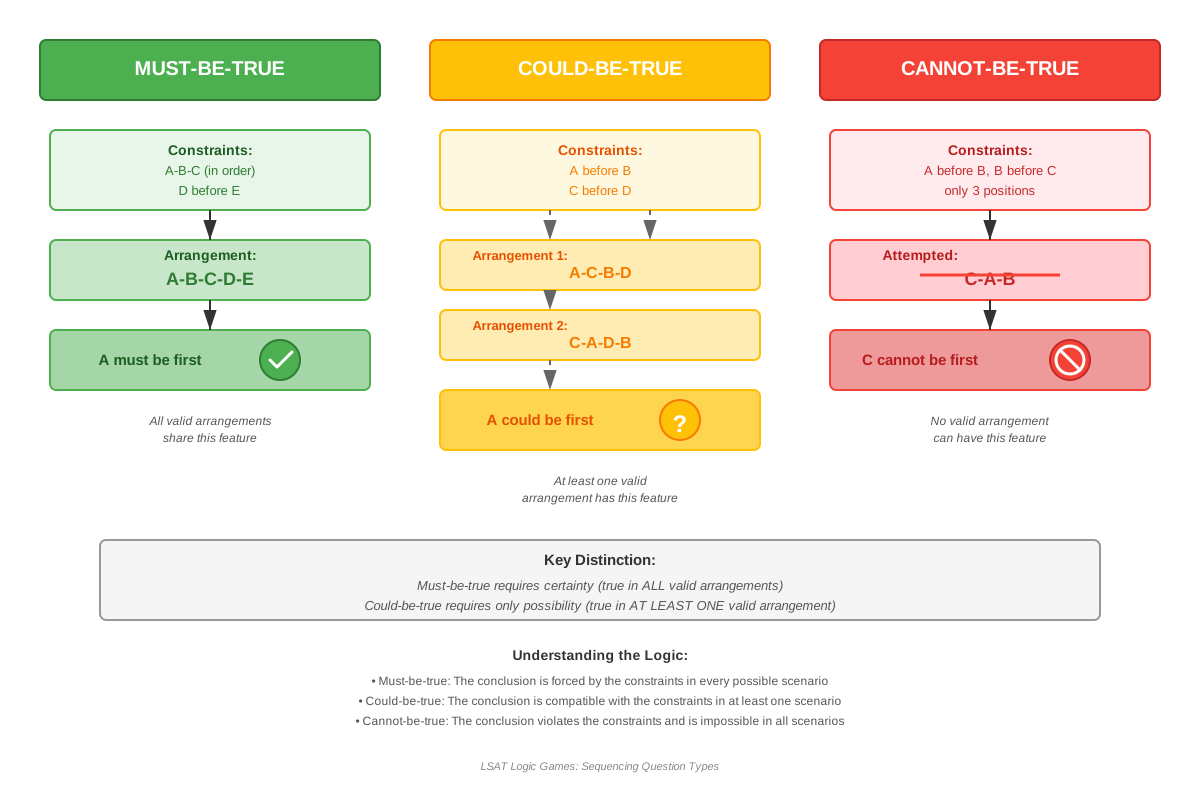
- [ ] Distinguish between must-be-true, could-be-true, and cannot-be-true conclusions in sequencing contexts
Prerequisites
- Basic conditional logic: Understanding "if-then" statements is essential because sequencing rules often express conditional relationships between positions
- Symbolic notation: Familiarity with using letters, numbers, and symbols to represent entities helps in creating efficient diagrams
- Spatial reasoning fundamentals: The ability to visualize linear arrangements and understand positional relationships (left/right, before/after, first/last)
- Rule interpretation: Competence in translating verbal statements into logical constraints, as this skill underlies all analytical reasoning tasks
Why This Topic Matters
Sequencing scenarios represent one of the highest-yield topics for LSAT preparation. Statistical analysis of recent LSAT administrations reveals that sequencing games appear in approximately 60-75% of all Analytical Reasoning sections, with pure sequencing games comprising 1-2 of the 4 games per test. When hybrid games are included, nearly every LSAT contains sequencing elements that require mastery of these core principles.
In real-world applications, sequencing logic mirrors the reasoning required in legal practice: determining the chronological order of events in a case, establishing timelines for procedural requirements, or arranging arguments in a logical sequence. Attorneys regularly construct narratives from disparate facts, much like test-takers must order elements according to given constraints. This practical relevance makes sequencing scenarios not just an arbitrary test hurdle but a genuine assessment of skills valuable in legal reasoning.
On the LSAT, sequencing scenarios typically appear as games involving schedules (appointments, performances, presentations), rankings (finishing positions, preference orders), or spatial arrangements (seating charts, building floors, queue positions). Questions may ask test-takers to identify what must be true given the constraints, determine possible positions for specific elements, or evaluate how new information affects the arrangement. The predictable structure of these games makes them highly learnable, offering students an opportunity to secure reliable points through systematic preparation.
Core Concepts
The Basic Sequencing Framework
A sequencing scenario presents a set of elements (typically 5-8 items) that must be arranged in a specific order according to given rules. The fundamental structure consists of:
- Elements: The items to be ordered (people, events, objects)
- Positions: The slots or places in the sequence (numbered 1-7, or described as first through seventh)
- Constraints: Rules that restrict how elements can be arranged
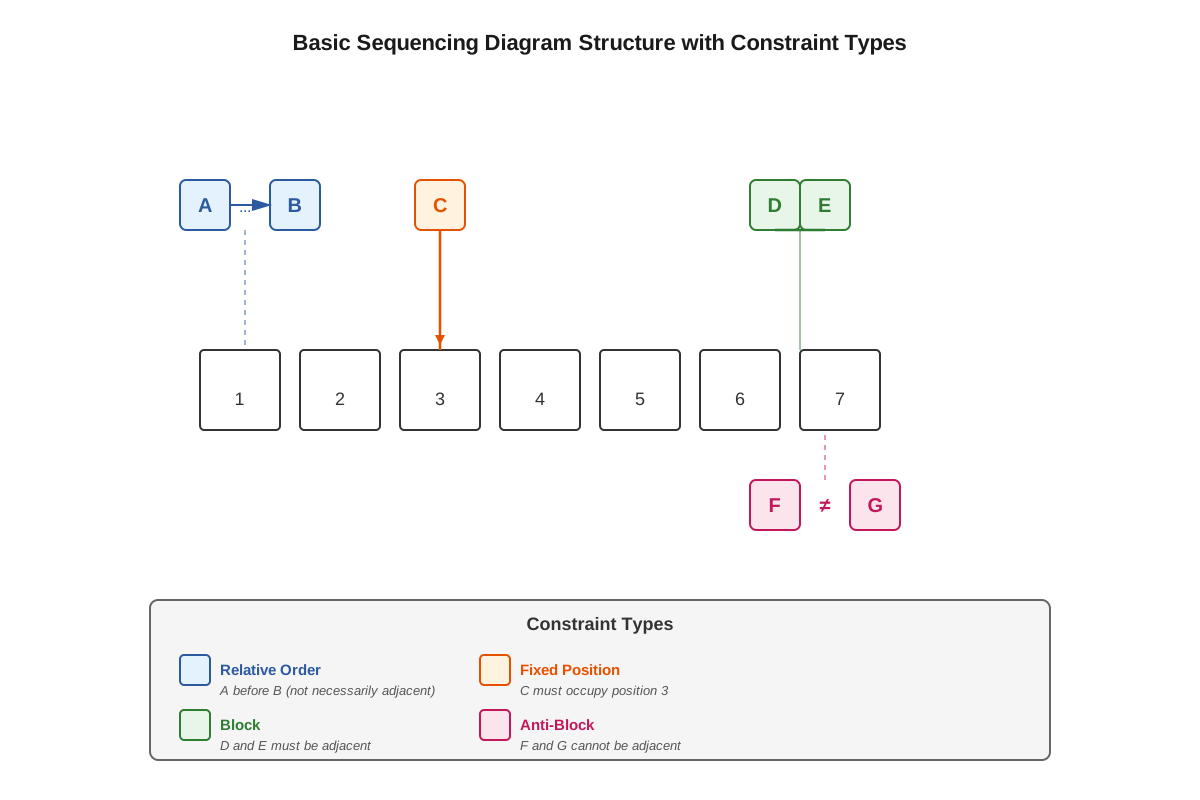
The most effective approach begins with creating a base diagram—a horizontal line with numbered positions representing the sequence. Elements are then placed above or below this line as constraints are applied. This visual representation transforms abstract verbal rules into concrete spatial relationships that the brain can process more efficiently.
Types of Sequencing Constraints
Understanding the different categories of sequencing rules is crucial for rapid diagram construction and inference-making:
| Constraint Type | Description | Notation Example | Key Insight |
|---|---|---|---|
| Relative Ordering | One element comes before/after another | F...G (F before G) | Does not specify exact positions or distance |
| Fixed Position | An element occupies a specific slot | M is third | Creates an anchor point for other deductions |
| Block/Adjacency | Two elements must be consecutive | JK or KJ (adjacent) | Reduces available positions significantly |
| Anti-Block/Separation | Two elements cannot be adjacent | P ≠ Q (not adjacent) | Often overlooked but highly restrictive |
| Distance Constraint | Specific number of spaces between elements | Exactly 2 between R and S | Creates limited placement options |
Relative Ordering Rules
Relative ordering constraints establish that one element precedes another without specifying exact positions. For example, "Alice presents before Bob" means Alice must occupy a lower-numbered position than Bob, but they could be in positions 1 and 7, 2 and 3, or any other valid combination.
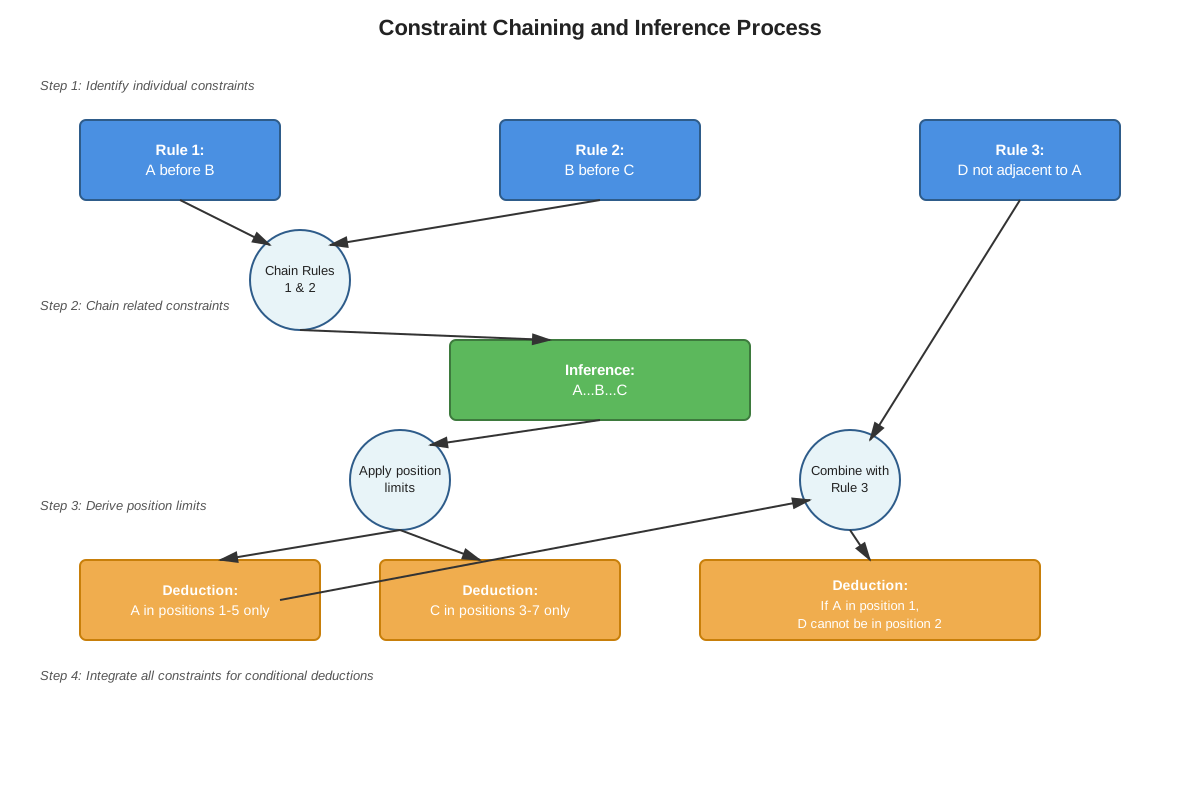
The power of relative ordering rules emerges when multiple constraints are chained together. If Alice comes before Bob, Bob comes before Carol, and Carol comes before David, we can represent this as: A...B...C...D. This chain immediately tells us that Alice cannot be in the last three positions, David cannot be in the first three positions, and Bob and Carol have restricted ranges.
Fixed Position Constraints
When a rule places an element in a specific position, it creates a fixed point around which other deductions revolve. If "Elena is in position 4" in a seven-position sequence, this single constraint can trigger multiple inferences when combined with relative ordering rules. Any element that must come before Elena can only occupy positions 1-3, while elements that must follow Elena are restricted to positions 5-7.
Block Constraints and Their Implications
Block constraints require two or more elements to be adjacent. The notation "FG" indicates F and G must be consecutive, though the order might be flexible (FG or GF) unless specified. Blocks function as single units when considering placement options, dramatically reducing the number of possible arrangements.
For a seven-position sequence with a two-element block, there are only six possible positions for the block (positions 1-2, 2-3, 3-4, 4-5, 5-6, or 6-7). This restriction becomes even more powerful when combined with other constraints. If the block must appear in the first half of the sequence, only three positions remain possible.
Making Valid Inferences
The heart of sequencing mastery lies in inference-making—deriving new information by combining existing constraints. Valid inferences emerge from:
- Constraint combination: When A comes before B, and B comes before C, we can infer A comes before C
- Position elimination: If an element cannot be first and cannot be second, and there are only seven positions, it must be in positions 3-7
- Forced placements: When all but one position are eliminated for an element, that element must occupy the remaining position
- Impossibility recognition: Identifying what cannot occur is often as valuable as knowing what must occur
The Contrapositive in Sequencing
Understanding contrapositives enhances sequencing analysis. If "X is before Y" is a rule, the contrapositive states "If Y is before X, the rule is violated." This logical relationship helps eliminate answer choices and identify impossible scenarios. When a question asks "Which of the following could be true?" recognizing contrapositive violations quickly eliminates incorrect options.
Concept Relationships
The concepts within sequencing scenarios build upon each other in a hierarchical structure. The basic sequencing framework provides the foundation—without understanding elements, positions, and constraints, no further progress is possible. This foundation supports constraint recognition, where students learn to identify and categorize different rule types.
Constraint recognition leads directly to diagram construction, as different constraint types require different notational approaches. A well-constructed diagram enables inference-making, which represents the highest level of sequencing mastery. Inferences emerge from the interaction of multiple constraints, making this skill dependent on all previous concepts.
The relationship flows as: Basic Framework → Constraint Types → Diagram Construction → Inference-Making → Question Answering
This topic connects to prerequisite knowledge of conditional logic through the contrapositive relationship inherent in ordering rules. It also relates to broader Analytical Reasoning Legacy concepts by providing the foundational skills for hybrid games that combine sequencing with grouping or matching elements. Mastery of pure sequencing scenarios enables students to tackle complex multi-dimensional games where sequencing forms one component of a larger logical puzzle.
High-Yield Facts
⭐ Sequencing games appear in 60-75% of LSAT Analytical Reasoning sections, making them the most frequently tested game type
⭐ Relative ordering rules do not specify exact positions or distances, only that one element precedes another in the sequence
⭐ Block constraints reduce the number of possible arrangements exponentially, as multiple elements function as a single unit
⭐ Fixed position rules create anchor points that enable multiple secondary inferences when combined with other constraints
⭐ The contrapositive of "A before B" is "if B is before A, the arrangement is invalid", a relationship crucial for eliminating wrong answers
- Anti-block constraints (elements that cannot be adjacent) are often more restrictive than they initially appear
- Chaining multiple relative ordering rules (A before B, B before C, C before D) creates powerful range restrictions for each element
- In a seven-position sequence with three relative ordering rules, typically 2-3 positions can be definitively determined
- Questions asking "which must be false" are logically equivalent to "which cannot be true" in sequencing contexts
- The first and last positions in a sequence are the most constrained and often yield the quickest deductions
- When two elements have no direct or indirect ordering relationship, they are "floating" and can appear in either order
- Combining a block constraint with a relative ordering rule often forces the block into a narrow range of positions
Quick check — test yourself on Sequencing scenarios so far.
Try Flashcards →Common Misconceptions
Misconception: Relative ordering rules mean elements must be adjacent or close together.
Correction: Relative ordering only establishes sequence, not proximity. "A before B" allows any number of elements between A and B, including zero or all remaining elements.
Misconception: If an element can be in position 3, it must be able to be in positions 1 and 2 as well.
Correction: Constraints can create "holes" in possible positions. An element might be able to occupy position 3 and position 5 but not position 4, depending on the interaction of multiple rules.
Misconception: Block constraints always specify the internal order of the block.
Correction: Unless explicitly stated, a block like "F and G are consecutive" allows both FG and GF arrangements. Always check whether the rule specifies internal ordering.
Misconception: Fixed position rules are less valuable than relative ordering rules.
Correction: Fixed positions are among the most powerful constraints because they create definite anchor points that enable numerous secondary inferences when combined with other rules.
Misconception: All sequencing games have exactly one correct arrangement.
Correction: Most sequencing games have multiple possible valid arrangements. Questions test which statements must be true across all valid arrangements, not whether a single arrangement exists.
Misconception: Making inferences is optional or only for difficult questions.
Correction: Upfront inference-making before attempting questions is essential for efficiency. Students who skip this step waste time re-deriving the same conclusions for each question.
Worked Examples
Example 1: Basic Sequencing with Multiple Constraints
Scenario: Seven students—F, G, H, J, K, L, and M—present projects in sequence from first to seventh. The following constraints apply:
- F presents before G
- G presents before H
- K presents fourth
- L and M present consecutively
- J presents before L
Step 1: Create the base diagram
Positions: 1  2  3  4  5  6  7
Elements:  _  _  _  K  _  _  _
Step 2: Represent relative ordering
- F...G...H (chain showing F before G before H)
- J...L (J before L)
- LM or ML (L and M consecutive)
Step 3: Make inferences
Since K is fixed in position 4, and F...G...H is a chain of three elements, this chain cannot start later than position 2 (because it needs three consecutive positions and position 4 is occupied).
The F-G-H chain could be:
- Positions 1-2-3 (ending before K)
- Positions 5-6-7 (starting after K)
- Split around K (but this would require G or H to be in position 4, which is occupied by K—impossible)
Therefore, F-G-H must be entirely before or entirely after position 4.
Step 4: Consider the LM block with J before L
J...L-M or J...M-L means we need at least three positions for these three elements. If F-G-H occupies positions 1-2-3, then J, L, and M must fit in positions 5-6-7. Since J comes before the LM block, the arrangement must be: J in position 5, then LM or ML in positions 6-7.
Final deduction: The arrangement must be F-G-H in positions 1-2-3, K in position 4, and J-L-M or J-M-L in positions 5-6-7.
Question: Which of the following must be true?
(A) F presents first
(B) H presents third
(C) L presents sixth
(D) M presents seventh
(E) J presents before H
Answer: (A), (B), and (E) must be true. L could be in position 6 or 7, and M could be in position 6 or 7, so (C) and (D) are not necessarily true. This example demonstrates how fixed positions combined with chains and blocks create forced placements.
Example 2: Sequencing with Anti-Block Constraint
Scenario: Six books—P, Q, R, S, T, and U—are arranged on a shelf from left (position 1) to right (position 6). The following rules apply:
- P is somewhere to the left of Q
- R and S are not adjacent
- T is in position 3
- U is immediately to the right of Q
Step 1: Diagram setup
Positions: 1  2  3  4  5  6
Elements:  _  _  T  _  _  _
Step 2: Represent constraints
- P...Q (P before Q)
- QU (Q and U consecutive, with U immediately right of Q)
- R ≠ S (R and S not adjacent)
Step 3: Combine P...Q with QU block
Since U must be immediately to the right of Q, and P must be before Q, we have: P...QU (as a unit)
Step 4: Determine possible positions for QU block
The QU block can be in positions:
- 1-2 (but then P has nowhere to go before Q—impossible)
- 2-3 (but position 3 is T—impossible)
- 3-4 (but position 3 is T—impossible)
- 4-5 (Q in 4, U in 5—possible, with P in positions 1 or 2)
- 5-6 (Q in 5, U in 6—possible, with P in positions 1, 2, or 4)
Step 5: Place remaining elements
We have P, R, and S to place in the remaining positions, with the constraint that R and S cannot be adjacent.
If QU is in positions 4-5: P, R, and S occupy positions 1, 2, and 6. For R and S not to be adjacent, one must be in position 6, and the other two positions (1 and 2) must have one of R/S and P. This works: P-R-T-Q-U-S or R-P-T-Q-U-S or P-S-T-Q-U-R or S-P-T-Q-U-R.
Question: If R is in position 2, which must be true?
Given R in position 2, and R and S cannot be adjacent, S cannot be in position 1 or 3. Position 3 is T anyway, so S cannot be in position 1. If QU is in positions 4-5, S must be in position 6. That leaves P for position 1.
Answer: P must be in position 1, and S must be in position 6. This example shows how anti-block constraints interact with other rules to force specific placements.
Exam Strategy
When approaching sequencing scenarios on the LSAT, follow this systematic process:
1. Immediate identification (5-10 seconds): Recognize the game type by looking for ordering language ("before," "after," "first," "last," "consecutive," "sequence"). Once identified as sequencing, commit to the standard diagramming approach.
2. Diagram construction (30-45 seconds): Draw a horizontal line with numbered positions. Write elements above the line as you place them. Keep relative ordering rules separate, using ellipsis notation (A...B...C) to show chains.
3. Constraint notation (20-30 seconds): Represent each rule symbolically:
- Relative ordering: A...B
- Blocks: AB (adjacent)
- Anti-blocks: A ≠ B
- Fixed positions: Write directly in diagram
4. Upfront inference-making (45-60 seconds): Before reading questions, combine constraints to identify:
- Elements that must be in specific positions
- Elements that cannot be in certain positions
- Ranges for floating elements
5. Question approach:
- For "must be true" questions, look for deductions you've already made
- For "could be true" questions, test against your constraints
- For "cannot be true" questions, identify rule violations
Exam Tip: Spend 60-90 seconds on setup and inferences before attempting any questions. This upfront investment pays dividends across all 5-7 questions for that game.
Trigger words to watch for:
- "Before/after" → relative ordering
- "Immediately" → block constraint
- "Consecutive" → block constraint
- "Not adjacent" → anti-block constraint
- "Exactly [number] between" → distance constraint
- "First/last" → fixed position or range restriction
Process of elimination strategy: In sequencing scenarios, wrong answers typically violate constraints in obvious ways. Quickly scan each answer choice against your diagram, eliminating any that place elements in impossible positions or violate ordering rules. Often, 3-4 answer choices can be eliminated in 10-15 seconds, leaving only 1-2 to consider carefully.
Time allocation: Allocate 7-9 minutes per sequencing game, distributed as:
- Setup and inferences: 90 seconds
- Questions 1-4: 60 seconds each
- Questions 5-7: 75-90 seconds each (typically more complex)
Memory Techniques
Mnemonic for constraint types: "RFBAD"
- Relative ordering (A before B)
- Fixed position (C is third)
- Block (D and E adjacent)
- Anti-block (F and G not adjacent)
- Distance (exactly 2 between H and J)
Visualization strategy: Picture the sequence as a physical line of people or objects. When reading "A before B," visualize A standing to the left of B in a queue. This spatial visualization helps the brain process abstract relationships more concretly.
The "Chain Gang" technique: When multiple relative ordering rules connect, visualize them as prisoners chained together in a line. Each prisoner (element) is connected to the next, and the entire chain must move together. This mental image helps remember that chained elements maintain their relative positions even as the entire chain shifts.
Block notation shortcut: Draw blocks as connected letters (AB) and anti-blocks with a slash between them (A/B). This visual distinction makes it immediately clear which elements must be together and which must be separated.
The "Anchor and Float" system: Mark fixed positions with an anchor symbol (⚓) and floating elements with a tilde (~). This visual coding helps quickly identify which elements are definitively placed versus which remain flexible.
Summary
Sequencing scenarios represent a cornerstone of LSAT Analytical Reasoning Legacy, testing the ability to arrange elements according to multiple constraints. Mastery requires understanding five core constraint types: relative ordering, fixed positions, blocks, anti-blocks, and distance constraints. Success depends on translating verbal rules into effective visual diagrams, then combining constraints to make valid inferences before attempting questions. The most critical skill is recognizing how constraints interact—how a fixed position combined with a relative ordering chain forces specific placements, or how a block constraint dramatically reduces possible arrangements. Students must practice upfront inference-making rather than attempting to solve each question in isolation. The systematic approach of diagram construction, constraint notation, and inference-making transforms these seemingly complex puzzles into manageable, point-scoring opportunities. With consistent practice, sequencing scenarios become one of the most reliable question types on the LSAT.
Key Takeaways
- Sequencing scenarios appear in 60-75% of LSAT Analytical Reasoning sections, making them the highest-yield game type to master
- Five constraint types dominate sequencing games: relative ordering, fixed positions, blocks, anti-blocks, and distance constraints
- Effective diagram construction with clear notation is essential for efficient problem-solving
- Upfront inference-making by combining constraints saves time and increases accuracy across all questions
- Relative ordering rules establish sequence but not proximity—elements can be separated by any number of positions
- Block constraints reduce possible arrangements exponentially by treating multiple elements as a single unit
- The contrapositive relationship in ordering rules helps eliminate impossible scenarios and wrong answer choices
Related Topics
Hybrid Sequencing-Grouping Games: These advanced scenarios combine sequencing elements with grouping constraints, requiring students to both order elements and assign them to categories. Mastering pure sequencing scenarios provides the foundation for tackling these more complex games.
Circular Sequencing: A variation where elements are arranged in a circle rather than a line, creating unique constraint relationships where "first" and "last" are adjacent. Understanding linear sequencing is prerequisite to circular arrangements.
Multi-Tiered Sequencing: Games involving multiple parallel sequences (such as scheduling events across multiple days or floors), requiring students to manage ordering constraints across different dimensions simultaneously.
Conditional Sequencing: Advanced scenarios where ordering rules are triggered only under specific conditions, combining pure sequencing with formal logic. Strong sequencing fundamentals enable students to handle these conditional complications.
Practice CTA
Now that you've mastered the core concepts of sequencing scenarios, it's time to cement your understanding through active practice. Attempt the practice questions designed specifically for this topic, focusing on applying the systematic approach outlined in this guide. Use the flashcards to reinforce constraint types and inference patterns until they become automatic. Remember: sequencing scenarios are highly learnable through deliberate practice. Each game you complete builds pattern recognition and increases your speed. The investment you make in mastering this high-yield topic will pay dividends across multiple LSAT administrations. Start practicing now, and watch your confidence and accuracy soar!
Sign up free to keep reading
Create a free AnvayaPrep account to finish this LSAT guide on Sequencing scenarios — plus flashcards and practice questions.