Overview
Sequencing templates represent one of the most powerful and efficient tools for solving complex LSAT sequencing games. Within the Analytical Reasoning Legacy section of the LSAT, sequencing games require test-takers to arrange elements (people, events, objects) in a specific order based on a set of rules and constraints. While basic sequencing can be approached through simple linear diagrams, many LSAT questions present scenarios with multiple valid arrangements. This is where templates become invaluable—they allow test-takers to systematically map out all possible valid arrangements, or at least the major structural variations, before attempting to answer questions.
The template approach transforms what could be a time-consuming, question-by-question analysis into a comprehensive upfront investment that pays dividends across multiple questions. When a sequencing game contains a particularly restrictive rule or a limited number of possible arrangements (typically 2-4 major scenarios), creating templates enables test-takers to answer questions with certainty and speed. Rather than testing each answer choice against the rules repeatedly, students can simply check which template(s) remain valid for a given question's additional constraint, then read the answer directly from the diagram.
Understanding when and how to deploy sequencing templates is essential for achieving top scores on the Analytical Reasoning Legacy section. This technique builds directly upon foundational sequencing skills—creating basic linear diagrams, making inferences from rules, and identifying key restrictions—but elevates them to a strategic level. Templates represent the intersection of thorough rule analysis, strategic time management, and systematic problem-solving that characterizes high-scoring LSAT performance. Mastery of this approach can reduce the time spent on complex sequencing games by 30-50% while simultaneously increasing accuracy.
Learning Objectives
- [ ] Identify how Sequencing templates appears in LSAT questions
- [ ] Explain the reasoning pattern behind Sequencing templates
- [ ] Apply Sequencing templates to solve LSAT-style problems accurately
- [ ] Determine when creating templates is strategically advantageous versus when a single master diagram suffices
- [ ] Construct complete and accurate template sets that capture all possible valid arrangements
- [ ] Efficiently eliminate answer choices by cross-referencing templates with question-specific constraints
Prerequisites
- Basic linear sequencing diagrams: Understanding how to create a numbered or ordered framework for arranging elements is fundamental, as templates are essentially multiple specialized versions of these diagrams
- Rule representation and notation: Familiarity with standard notation for sequencing rules (e.g., A—B for "A before B," ~AB for "not adjacent") ensures templates can be constructed accurately and efficiently
- Making inferences from combined rules: The ability to derive what must be true when multiple rules interact is essential, as template creation depends on recognizing how constraints limit possible arrangements
- Identifying fixed positions and blocks: Recognizing when rules force elements into specific positions or create inseparable groups helps determine which rules should drive template creation
Why This Topic Matters
In real-world applications, the logical reasoning underlying sequencing templates appears in project management, scheduling, resource allocation, and any scenario requiring the arrangement of elements under constraints. Legal professionals regularly encounter situations where multiple valid sequences exist within defined parameters—from trial scheduling to the order of witness testimony to the sequence of legal arguments.
On the LSAT, sequencing games appear in approximately 40-50% of all Analytical Reasoning sections, making them the most common game type alongside grouping games. Within sequencing games, roughly 30-40% present scenarios where template creation is either beneficial or essential for efficient solving. These games typically appear as one of the four games in a section and often contain 5-7 questions, representing 12-18% of the entire Analytical Reasoning score. The questions that benefit most from templates include "could be true" questions, "must be false" questions, and complete and accurate list questions.
Lsat sequencing templates most commonly appear in games with: (1) a powerful either/or rule that splits the game into distinct scenarios, (2) a limited number of positions for a particular element, (3) multiple rules that interact to create only a few valid arrangements, or (4) a question that explicitly asks for all possible arrangements. Recognizing these triggers during the setup phase allows test-takers to make strategic decisions about time investment that dramatically improve both speed and accuracy across the entire game.
Core Concepts
What Are Sequencing Templates?
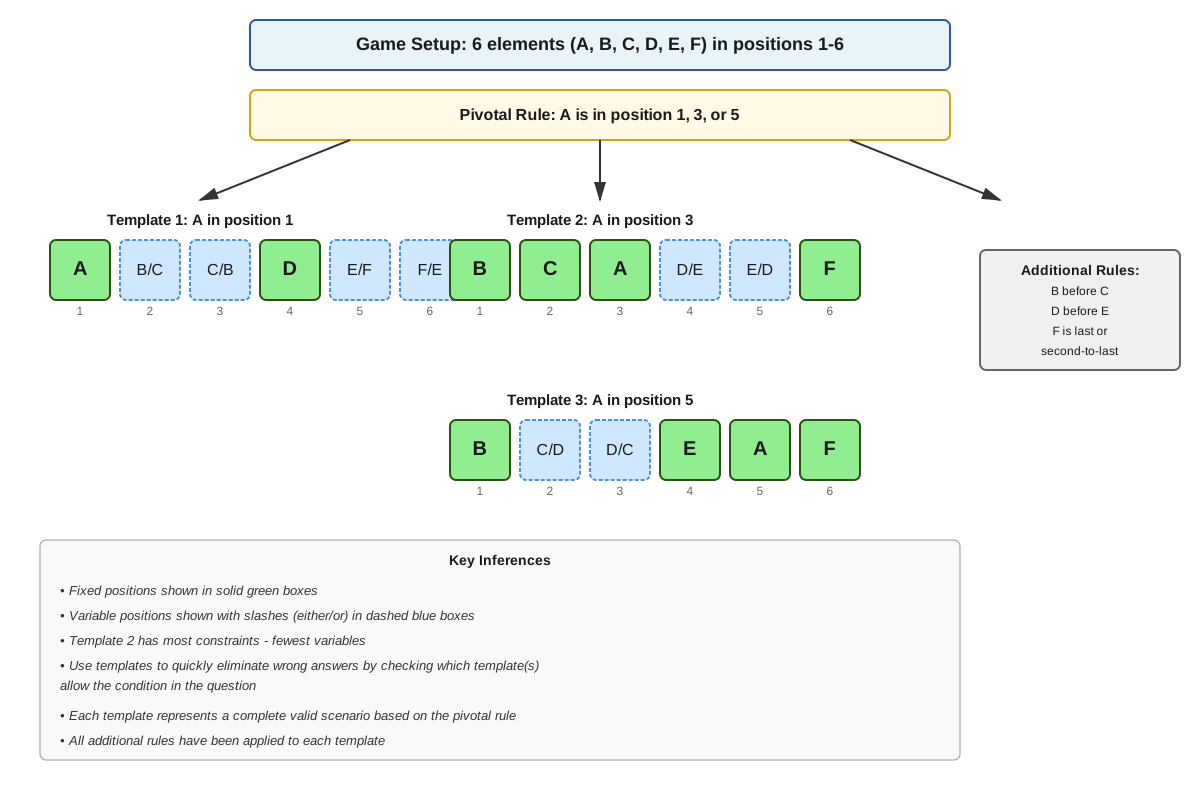
Sequencing templates are multiple complete or partial diagrams that represent all possible valid arrangements of elements in a sequencing game, or all major structural variations when complete enumeration is impractical. Rather than maintaining a single master diagram with notations about what could occur, templates commit to specific arrangements, creating separate diagrams for each distinct scenario. Each template must satisfy all the game's rules and constraints, and together, the complete set of templates must account for every possible valid arrangement.
The fundamental principle behind templates is exhaustive scenario analysis: by identifying a rule or constraint that creates a limited number of possibilities, test-takers can "split" the game into separate worlds. For example, if a rule states "Either F is third or G is third," this creates exactly two scenarios—one template where F occupies position 3, and another where G occupies position 3. All other rules are then applied within each template, often revealing additional inferences that wouldn't be apparent in a single master diagram.
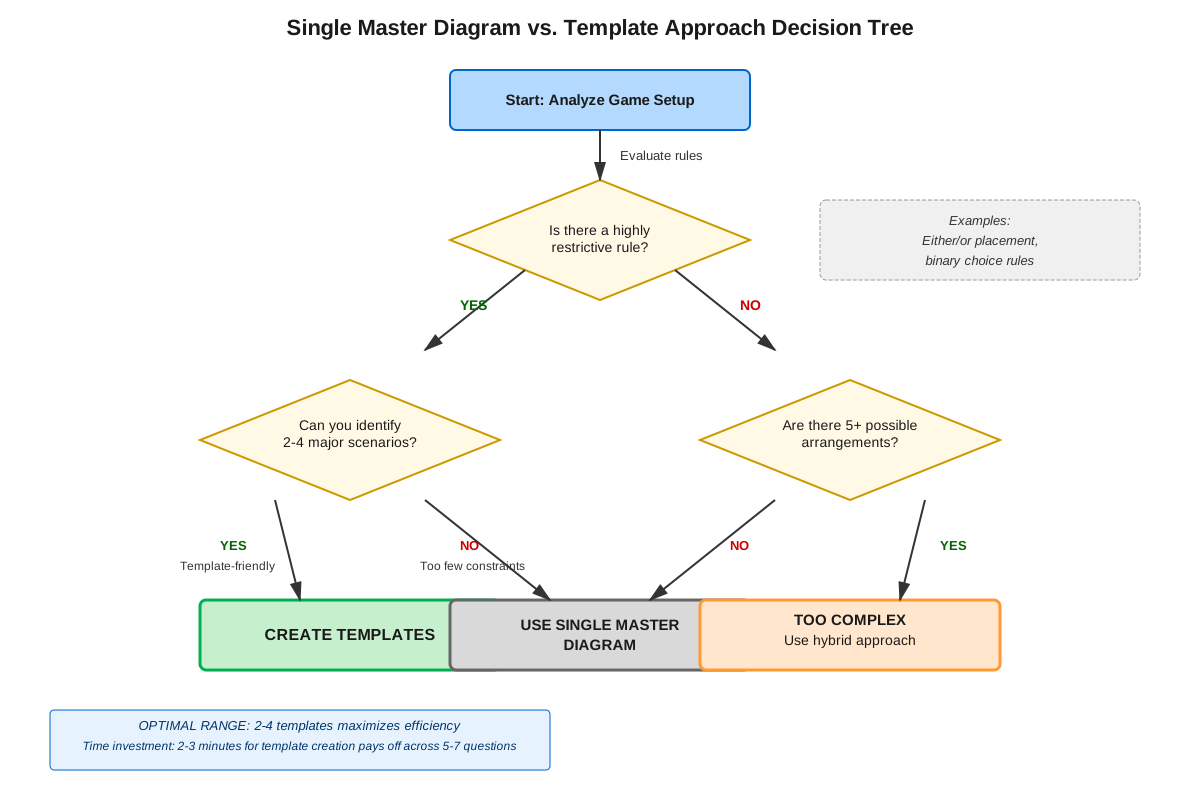
When to Create Templates
The decision to create templates versus using a single master diagram is strategic and time-sensitive. Templates are most valuable when:
- A binary rule exists: Rules containing "either...or" language naturally split the game into distinct scenarios
- An element has limited placement options: When inferences reveal that a particular element can only occupy 2-3 positions, creating a template for each possibility often unlocks additional deductions
- Multiple rules converge on a single position: When several rules restrict what can occur in a specific slot, exploring each possibility separately may be more efficient
- The game has 6 or fewer positions: Shorter sequences are more manageable to template completely
- Questions ask about all possibilities: When a question explicitly requests all valid arrangements, templates become necessary
Templates are generally not advisable when: the game has 8+ positions, rules are primarily negative (stating what cannot occur rather than what must), or only 1-2 questions would benefit from the templates. The upfront time investment (typically 2-4 minutes) must be justified by time savings across multiple questions.
The Template Creation Process
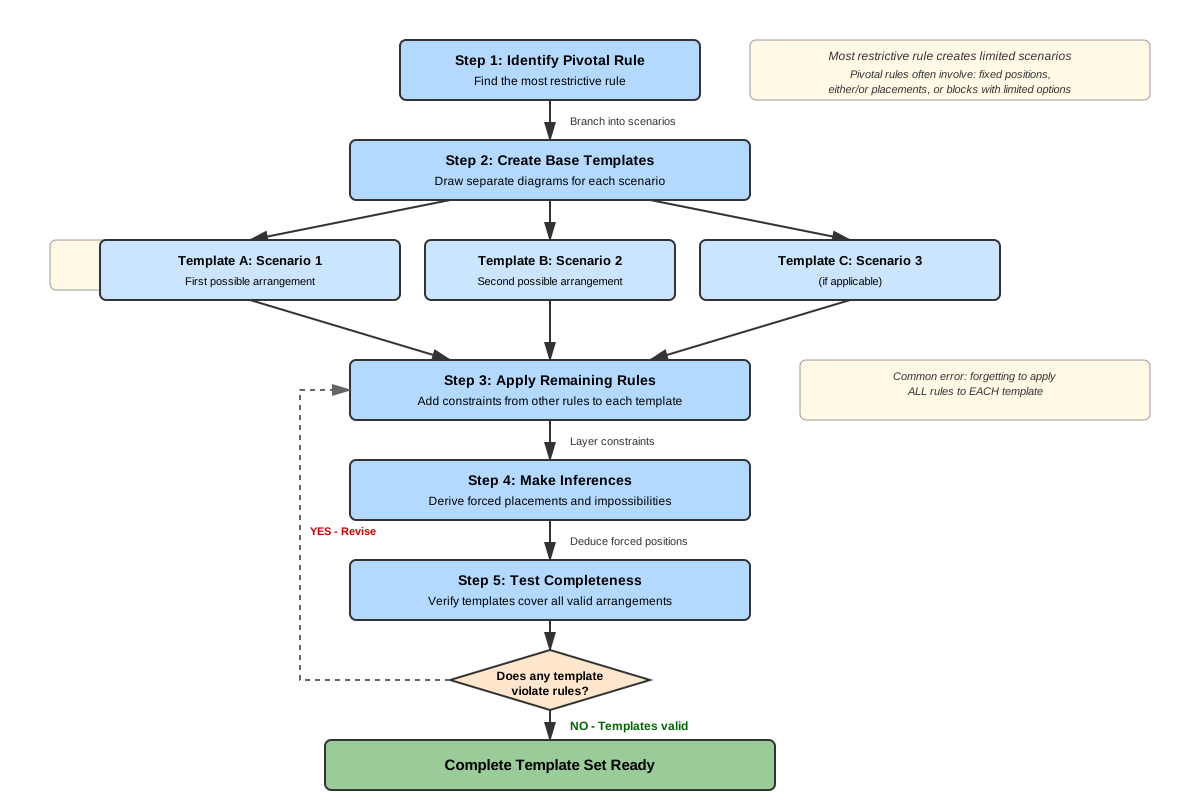
Creating effective templates follows a systematic process:
Step 1: Identify the splitting rule or constraint. Review all rules and inferences to find the most restrictive element—the rule that creates the fewest distinct possibilities. This becomes the foundation for template creation.
Step 2: Create separate diagrams. Draw a complete sequencing framework (numbered positions) for each possibility identified in Step 1. Label each template clearly (Template A, Template B, etc.).
Step 3: Apply all remaining rules to each template. Work through every rule systematically, adding information to each template. Some rules may eliminate entire templates if they create contradictions.
Step 4: Make template-specific inferences. With the splitting rule already committed in each template, other rules often yield stronger inferences than they would in a master diagram. Look for forced placements, eliminated positions, and new blocks or restrictions.
Step 5: Verify completeness. Ensure that the template set accounts for all possibilities and that no template violates any rule.
Types of Template Structures
| Template Type | Description | When to Use | Example Trigger |
|---|---|---|---|
| Complete enumeration | Every possible valid arrangement is diagrammed | 2-4 total possibilities exist | "Exactly three elements can be first" |
| Structural templates | Major frameworks are shown, with some positions remaining flexible | 3-6 major scenarios with internal variation | "Either A is before all others, or A is last" |
| Position-focused templates | Templates organized around where a specific element can be placed | One element has 2-3 possible positions | "G must be in position 2, 4, or 6" |
| Block-based templates | Templates built around different arrangements of a required block | A block can occupy different positions | "M and N are consecutive" in a 6-position game |
Reading and Using Templates During Questions
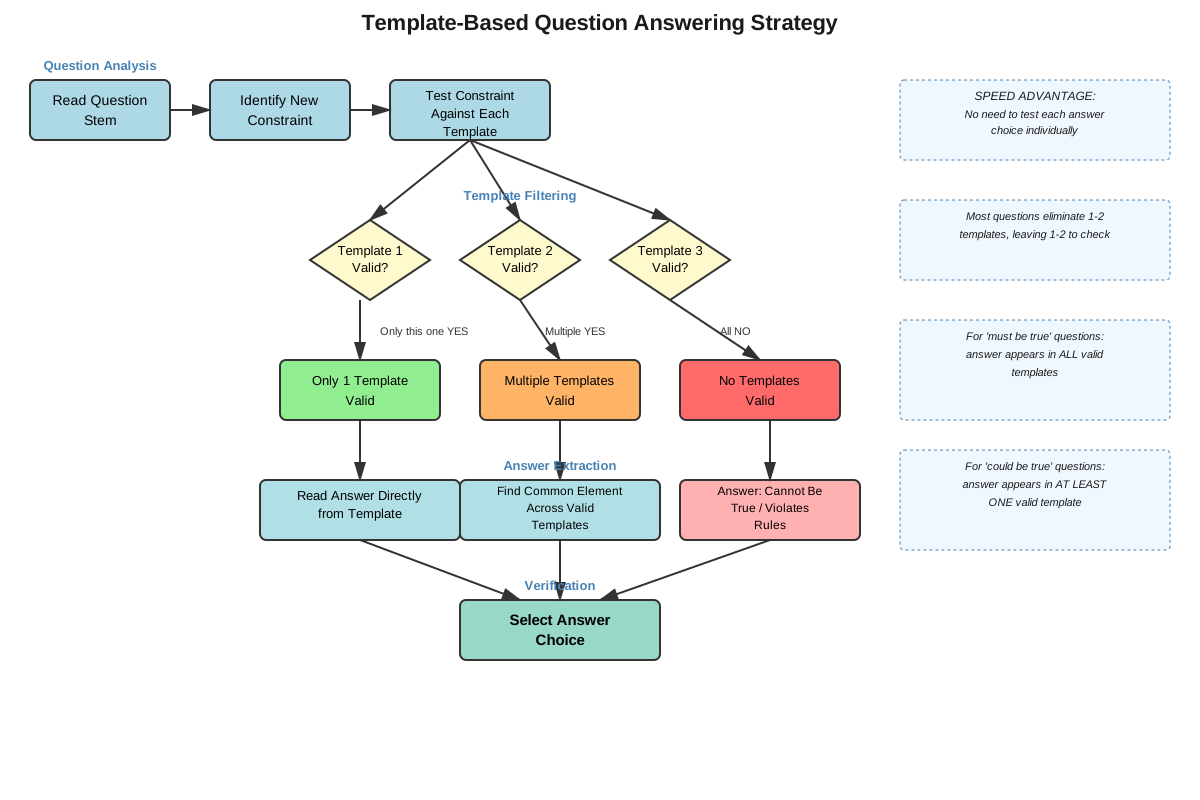
Once templates are created, they become the primary reference for answering questions. The process for each question becomes:
- Read the question stem carefully, noting any additional constraints
- Identify which templates remain valid under the new constraint
- If only one template remains valid, read the answer directly from that template
- If multiple templates remain valid, look for what's true across all valid templates (for "must be true") or what's true in at least one template (for "could be true")
- For "must be false" questions, eliminate any answer that appears in any valid template
This systematic approach eliminates the need to test each answer choice individually, dramatically reducing both time and error rates.
Template Notation and Organization
Effective templates require clear, consistent notation:
- Use solid placements (writing the element in the position) when an element must occupy that position in that template
- Use subscript or superscript to indicate elements that could occupy a position but aren't yet determined
- Cross out positions where an element definitely cannot go within that template
- Label templates prominently (A, B, C or 1, 2, 3) for easy reference
- Note the splitting rule at the top of each template as a reminder of what distinguishes it
Physical organization matters: arrange templates vertically on the page so they can be scanned quickly, and leave space between them for additional notations as questions introduce new constraints.
Concept Relationships
The concept of sequencing templates builds directly upon and integrates several foundational sequencing games legacy skills. Basic linear sequencing diagrams provide the structural framework that templates multiply and specify. Rule representation skills ensure that each template accurately reflects all constraints. The ability to make inferences from combined rules becomes amplified in templates, as the commitment to a specific arrangement in each template often triggers cascading deductions that wouldn't emerge in a more general diagram.
Within the template methodology itself, concepts flow logically: Identifying when to create templates (strategic decision) → Selecting the splitting rule (analytical decision) → Creating the template structures (execution) → Making template-specific inferences (deeper analysis) → Using templates to answer questions (application). Each step depends on the previous one, and weakness in any stage compromises the entire approach.
Templates also connect forward to more advanced analytical reasoning legacy techniques. The same splitting logic used in sequencing templates applies to grouping games (creating scenarios based on which group an element joins) and hybrid games (combining sequencing and grouping templates). The strategic thinking about time investment—spending more time upfront to save time later—applies across all game types and represents a hallmark of sophisticated LSAT reasoning.
The relationship between templates and individual questions is bidirectional: templates make questions faster to answer, but questions can also reveal whether templates are complete or whether additional scenarios need to be considered. This feedback loop helps test-takers verify their work and build confidence in their template set.
High-Yield Facts
⭐ Sequencing templates are most valuable when a game has 2-4 distinct possible arrangements or major structural variations
⭐ The most common trigger for template creation is an either/or rule that creates exactly two scenarios
⭐ Templates should be created during the setup phase, before attempting any questions, to maximize time savings
⭐ Each template must independently satisfy all rules; a template that violates any rule must be eliminated
⭐ For "must be true" questions, the answer must appear in all valid templates; for "could be true" questions, the answer need only appear in one valid template
- Template creation typically requires 2-4 minutes of upfront investment but can save 30-50% of total game time
- Games with 6 or fewer positions are most amenable to complete template enumeration
- When an element can occupy only 2-3 positions based on rule inferences, position-focused templates are often effective
- Templates eliminate the need to test each answer choice against rules individually, reducing error rates
- If template creation reveals that only one valid arrangement exists, all questions become trivial to answer
- Template-specific inferences often emerge that wouldn't be apparent in a single master diagram
- Questions that ask for "a complete and accurate list" of possibilities directly test whether templates have been created
- The physical arrangement of templates on the page matters—vertical stacking allows for quick scanning
- Some games benefit from partial templates that show major structural variations while leaving some positions flexible
- Template creation is a skill that improves with practice; initial attempts may feel slow but become faster with experience
Quick check — test yourself on Sequencing templates so far.
Try Flashcards →Common Misconceptions
Misconception: Templates should be created for every sequencing game to ensure accuracy.
Correction: Templates are a strategic tool, not a universal requirement. They're most valuable when a game has limited possibilities (2-4 major scenarios). For games with many possible arrangements or primarily negative rules, a single master diagram with strong inferences is more efficient. Creating unnecessary templates wastes precious time.
Misconception: Once templates are created, the original rules can be ignored.
Correction: Templates must be continuously verified against all rules, especially when questions introduce new constraints. The templates represent valid arrangements under the original rules, but each question may add restrictions that eliminate some templates or require checking whether remaining templates satisfy the new condition.
Misconception: All templates must show every element in a fixed position.
Correction: Templates can be structural, showing major frameworks while leaving some positions flexible. For example, if the key distinction is whether Element A is first or last, templates might commit to that placement while leaving middle positions variable. Complete enumeration is ideal but not always necessary or efficient.
Misconception: If creating templates takes more than one minute, it's not worth doing.
Correction: Effective template creation typically requires 2-4 minutes, and this investment is worthwhile if it saves time across 5-7 questions. The key is whether the upfront time investment yields greater time savings and accuracy improvements across the entire game, not whether templates can be created instantly.
Misconception: Templates are only useful for "could be true" questions.
Correction: Templates are valuable for all question types. For "must be true" questions, check what appears in all valid templates. For "must be false" questions, eliminate anything that appears in any template. For "could be true EXCEPT" questions, find what doesn't appear in any template. Templates provide a comprehensive reference for any question type.
Misconception: The splitting rule must be explicitly stated as "either...or" in the game setup.
Correction: While explicit either/or rules are common triggers, splitting rules often emerge from inferences. For example, if rules establish that Element G cannot be in positions 1, 2, 4, 5, or 6 in a six-position game, the inference that "G must be in position 3" creates a natural split: arrangements with G in position 3 versus... wait, there is no "versus" here—this would actually suggest a single template. A better example: if inferences reveal that "Either A is first or B is first" (because all other elements must come later), this inference-based either/or creates valid templates even though it wasn't explicitly stated.
Worked Examples
Example 1: Concert Performance Order
Setup: Six musicians—F, G, H, J, K, and L—will perform in a concert, one at a time. The order of performances must conform to the following conditions:
- F performs before G
- H performs before J
- K performs either second or fifth
- G and J perform consecutively, in either order
Question: Which of the following could be the order of performances from first to last?
Solution:
Step 1: Identify the splitting rule. The rule "K performs either second or fifth" creates exactly two scenarios, making this an ideal candidate for templates.
Step 2: Create templates:
- Template A: K in position 2
- Template B: K in position 5
Step 3: Apply remaining rules to Template A (K in position 2):
- F must be before G (F—G)
- H must be before J (H—J)
- G and J are consecutive (GJ or JG block)
With K in position 2, we have positions 1, 3, 4, 5, 6 available for F, G, H, J, L. The GJ/JG block takes two consecutive positions. Since F must be before G, and G is in the block, F must come before the entire block. Similarly, H must come before J, so H must come before the block.
If the block is GJ: F and H must both come before G, so F and H must be in positions 1 and 3 (in some order), the GJ block would be in positions 4-5 or 5-6. But if GJ is in positions 4-5, then L is in position 6. If GJ is in positions 5-6, then L is in position 4.
Testing: Position 1: F or H; Position 2: K; Position 3: H or F; Position 4: G or L; Position 5: J or G; Position 6: L or J
If the block is JG: H must come before J, and F must come before G. This means H comes before the entire JG block, and F must come before G (but could be after J). This creates different possibilities.
Step 4: Apply remaining rules to Template B (K in position 5):
Following similar logic, with K in position 5, we have positions 1, 2, 3, 4, 6 available. The analysis proceeds similarly.
Step 5: Check answer choices against templates. Rather than fully enumerating all possibilities (which could take considerable time), we can check whether each answer choice violates any rules:
This example demonstrates that even when templates are initiated, sometimes checking answer choices directly against rules is more efficient than complete enumeration. The key insight is that K's position creates distinct structural scenarios that limit possibilities.
Example 2: Document Review Order
Setup: A paralegal must review exactly five documents—R, S, T, U, and V—one at a time. The order of review must conform to the following conditions:
- T is reviewed before U
- S is reviewed before V
- R is reviewed either first or last
- U is reviewed immediately before or immediately after V
Question 1: If S is reviewed second, which of the following must be true?
Solution:
Step 1: Identify the splitting rule. "R is reviewed either first or last" creates exactly two templates.
Step 2: Create base templates:
- Template A: R _ _ _ _ (R first)
- Template B: _ _ _ _ R (R last)
Step 3: Apply rules to Template A:
- Position 1: R (fixed)
- T before U (T—U)
- S before V (S—V)
- U and V are consecutive (UV or VU block)
Since UV or VU form a block, and S must be before V, let's consider both:
- If the block is UV: S must come before U (and therefore before the UV block)
- If the block is VU: S must come before V, so S must come before the VU block
In Template A with R in position 1, we have positions 2, 3, 4, 5 for S, T, U, V.
If block is UV: S must be before the UV block, and T must be before U. So the order includes: R, then S, then T, then UV block. This gives: R-S-T-U-V (positions 1-2-3-4-5). But we should verify: T before U ✓, S before V ✓, UV consecutive ✓.
If block is VU: S must be before V, and T must be before U. The order must include: R, then S and T (in some order), then VU block. Possible: R-S-T-V-U or R-T-S-V-U. Check R-T-S-V-U: T before U ✓, S before V ✓, VU consecutive ✓.
So Template A has at least two valid arrangements: R-S-T-U-V and R-T-S-V-U.
Step 4: Apply rules to Template B:
Following similar logic with R in position 5:
- Positions 1, 2, 3, 4 available for S, T, U, V
- UV or VU block with S before V and T before U
If block is UV: S-T-U-V-R (positions 1-2-3-4-5) works.
If block is VU: T-S-V-U-R (positions 1-2-3-4-5) works.
Step 5: Apply the question constraint ("S is reviewed second"):
Template A arrangements with S second: R-S-T-U-V ✓ (S is in position 2)
Template B arrangements with S second: Would need _-S-_-_-R. Testing: T-S-V-U-R has S in position 2 ✓.
Step 6: Identify what must be true in all valid arrangements where S is second:
- R-S-T-U-V: R first, T third, U fourth, V fifth
- T-S-V-U-R: T first, V third, U fourth, R fifth
What's true in both? S is second (given), and U is fourth. Therefore, "U is reviewed fourth" must be true.
This example demonstrates how templates, combined with question-specific constraints, allow test-takers to identify what must be true by checking across all valid scenarios.
Exam Strategy
When approaching LSAT sequencing games that may benefit from templates, follow this strategic framework:
During Initial Setup (30-60 seconds):
- Read all rules quickly to identify either/or statements or highly restrictive rules
- Look for elements that can only occupy 2-3 positions based on rule combinations
- Count the total number of positions (games with ≤6 positions are better template candidates)
- Make a quick judgment: "Does this game have 2-4 major scenarios?"
Trigger Phrases to Watch For:
- "Either...or" (explicit binary choice)
- "Exactly one of X or Y" (creates two scenarios)
- "Must be first or last" (two-position limitation)
- "Immediately before or immediately after" (creates block variations)
- "Cannot be in positions [list]" (when this leaves only 2-3 options)
Decision Point (10-15 seconds):
If templates seem valuable, commit fully—partial template creation wastes time. If uncertain, start with a master diagram and reconsider templates if the first question reveals limited possibilities.
During Template Creation (2-4 minutes):
- Work systematically through each template, applying all rules
- Don't rush—errors in templates compound across all questions
- Eliminate any template that violates a rule immediately
- Make template-specific inferences before moving to questions
During Question-Answering:
- For "could be true": Find the answer in any one template
- For "must be true": Verify the answer appears in all valid templates
- For "must be false": Eliminate anything that appears in any template
- For "could be true EXCEPT": Find what doesn't appear in any template
- For questions with new constraints: Identify which templates remain valid, then work only with those
Time Management:
- If template creation exceeds 4 minutes, cut losses and proceed with what's been created
- Expect to save 20-40 seconds per question with good templates (5-7 questions = 2-4 minutes saved)
- The break-even point is typically 3 questions—if fewer than 3 questions benefit, templates may not be worthwhile
Process of Elimination Tips:
- In "could be true" questions, eliminate answers that violate rules in all templates
- In "must be true" questions, eliminate answers that fail in even one valid template
- Use templates to quickly eliminate 3-4 answer choices, then verify the remaining choice(s)
Memory Techniques
The SPLIT Acronym for Template Decision-Making:
- Scenarios: Are there 2-4 distinct scenarios?
- Positions: Are there 6 or fewer positions?
- Limited: Does an element have limited placement options?
- Investment: Will 2-4 minutes upfront save time overall?
- Trigger: Is there an either/or rule or similar trigger?
If 3+ of these factors are present, create templates.
The "Two-Four Rule": Templates work best with two to four major scenarios. Fewer than two means a single diagram suffices; more than four means templates become unwieldy.
Visualization Strategy: Picture templates as parallel universes—each one is a complete, self-contained world where all rules are satisfied. When a question adds a constraint, some universes "collapse" (become invalid), and you work only with surviving universes.
The CASCADE Principle: In templates, rules create Commitments that Allow Stronger Conclusions, Amplifying Deductions Everywhere. Once you commit to a specific arrangement in a template, other rules yield stronger inferences than they would in a general diagram.
Physical Memory Aid: Always arrange templates vertically on your scratch paper, one above the other. This creates a visual "stack" that's easy to scan. Label them with large, clear letters (A, B, C) in the left margin.
Summary
Sequencing templates represent a powerful strategic approach for solving complex LSAT sequencing games by creating multiple diagrams that capture all possible valid arrangements or major structural variations. The technique is most valuable when games contain either/or rules, elements with limited placement options, or other constraints that create 2-4 distinct scenarios. By investing 2-4 minutes upfront to create comprehensive templates, test-takers can answer subsequent questions with greater speed and accuracy, often saving 30-50% of total game time. The template creation process involves identifying a splitting rule, creating separate diagrams for each scenario, applying all remaining rules to each template, making template-specific inferences, and verifying completeness. During question-answering, templates serve as a reference that eliminates the need to test each answer choice individually—test-takers simply identify which templates remain valid under any new constraints and read answers directly from the diagrams. Success with templates requires strategic judgment about when they're worthwhile, systematic execution during creation, and disciplined application during questions. This approach exemplifies the sophisticated analytical reasoning that distinguishes top LSAT performers.
Key Takeaways
- Sequencing templates are multiple diagrams representing all valid arrangements in a game, most valuable when 2-4 distinct scenarios exist
- The most common trigger for template creation is an either/or rule that naturally splits the game into separate scenarios
- Template creation requires 2-4 minutes upfront but typically saves 20-40 seconds per question across 5-7 questions
- Each template must independently satisfy all rules; templates that violate any rule must be eliminated immediately
- For "must be true" questions, answers must appear in all valid templates; for "could be true" questions, answers need only appear in one template
- Strategic decision-making about when to create templates is as important as the technical skill of creating them
- Templates amplify inferences—committing to specific arrangements in each template often reveals deductions that wouldn't emerge in a general master diagram
Related Topics
Advanced Sequencing Inferences: Building on template mastery, this topic explores sophisticated inference chains, including how to identify "key players" whose placement determines multiple other elements. Templates often reveal these key players more clearly than master diagrams.
Grouping Game Templates: The same splitting logic used in sequencing templates applies to grouping games, where templates represent different scenarios based on which group an element joins. Mastering sequencing templates provides the conceptual foundation for this parallel technique.
Hybrid Game Strategies: Many LSAT games combine sequencing and grouping elements. Template strategies can be adapted to these hybrid games, creating scenarios that specify both order and group membership simultaneously.
Time Management Across Game Types: Understanding when to invest time in templates versus other setup strategies (like extensive inference chains or hypothesis testing) requires broader strategic thinking about the entire Analytical Reasoning section.
Practice CTA
Now that you've mastered the conceptual foundation of sequencing templates, it's time to put this knowledge into practice. The practice questions and flashcards for this topic will challenge you to identify template opportunities, create accurate template sets, and use them efficiently to answer questions. Remember: template creation is a skill that improves dramatically with practice. Your first few attempts may feel slow or uncertain, but with repetition, you'll develop the pattern recognition and execution speed that make templates a powerful weapon in your LSAT arsenal. Approach each practice problem systematically, verify your templates against all rules, and reflect on whether the time investment paid off. You're building the analytical reasoning skills that will serve you throughout the LSAT and beyond!
Sign up free to keep reading
Create a free AnvayaPrep account to finish this LSAT guide on Sequencing templates — plus flashcards and practice questions.