Overview
Either or statements represent a fundamental building block of logical reasoning on the LSAT, appearing frequently across Logical Reasoning sections and occasionally in Logic Games. These statements express a disjunctive relationship between two or more propositions, indicating that at least one of the presented options must be true. Understanding how to properly interpret and manipulate either/or constructions is essential for success on the LSAT, as they form the basis for numerous argument structures, inference questions, and formal logic problems.
The importance of mastering LSAT either or statements cannot be overstated. These logical structures appear in approximately 15-20% of Logical Reasoning questions, either explicitly or embedded within more complex argument patterns. Students who fail to recognize the precise logical implications of disjunctive statements often fall into carefully constructed trap answers. The LSAT tests not only whether students can identify these statements but also whether they understand the nuanced differences between inclusive and exclusive disjunctions, how to negate them properly, and how they interact with other forms of conditional logic.
Within the broader framework of Logical Reasoning, either/or statements occupy a critical position alongside conditional statements (if-then), conjunctions (and statements), and negations. They frequently combine with these other logical operators to create complex argument structures that require careful analysis. Mastering either/or statements provides the foundation for understanding formal logic chains, recognizing sufficient and necessary conditions, and evaluating the validity of deductive arguments—all high-yield skills for achieving a competitive LSAT score.
Learning Objectives
- [ ] Identify how Either or statements appears in LSAT questions
- [ ] Explain the reasoning pattern behind Either or statements
- [ ] Apply Either or statements to solve LSAT-style problems accurately
- [ ] Distinguish between inclusive and exclusive disjunctions in context
- [ ] Correctly negate either/or statements using De Morgan's Laws
- [ ] Recognize equivalent formulations of disjunctive statements
- [ ] Combine either/or statements with conditional logic to draw valid inferences
Prerequisites
- Basic propositional logic: Understanding of logical statements as true or false propositions is necessary to evaluate disjunctive relationships
- Conditional statement fundamentals: Knowledge of if-then structures helps distinguish between conditional and disjunctive logic
- Negation principles: Ability to negate simple statements is required before learning to negate complex disjunctions
- Logical operators: Familiarity with AND, OR, and NOT operations provides the foundation for understanding how either/or statements function
Why This Topic Matters
Either/or statements appear throughout everyday reasoning, legal arguments, and policy debates—the very contexts the LSAT draws upon for its questions. Attorneys must regularly evaluate disjunctive claims: "The defendant was either at the scene or had an accomplice," or "The contract is either valid or voidable." Understanding the logical implications of such statements is fundamental to legal reasoning and argumentation.
On the LSAT specifically, either/or statements appear in multiple question types with high frequency. Inference questions (Must Be True) often require students to recognize what necessarily follows from a disjunctive premise. Assumption questions may hinge on understanding what must be true for a disjunctive conclusion to follow. Flaw questions frequently test whether students can identify invalid reasoning involving disjunctions, such as falsely assuming an either/or is exclusive when it's actually inclusive. Sufficient Assumption questions may require adding a disjunctive premise to make an argument valid.
Statistical analysis of recent LSATs reveals that either/or logic appears in approximately 8-12 questions per test when counting both explicit disjunctions and their logical equivalents. This represents roughly 7-10% of all scored questions. The topic appears most frequently in Logical Reasoning sections but also surfaces in Logic Games involving grouping rules and conditional constraints. Students who master this topic gain a significant competitive advantage, as these questions are highly predictable once the underlying patterns are understood.
Core Concepts
The Basic Structure of Either/Or Statements
An either or statement presents two or more alternatives and asserts that at least one must be true. In formal logic notation, a disjunction between propositions A and B is written as "A ∨ B" (read as "A or B"). On the LSAT, these statements appear in various linguistic forms:
- "Either A or B"
- "A or B"
- "A unless B"
- "A or else B"
- "At least one of A or B"
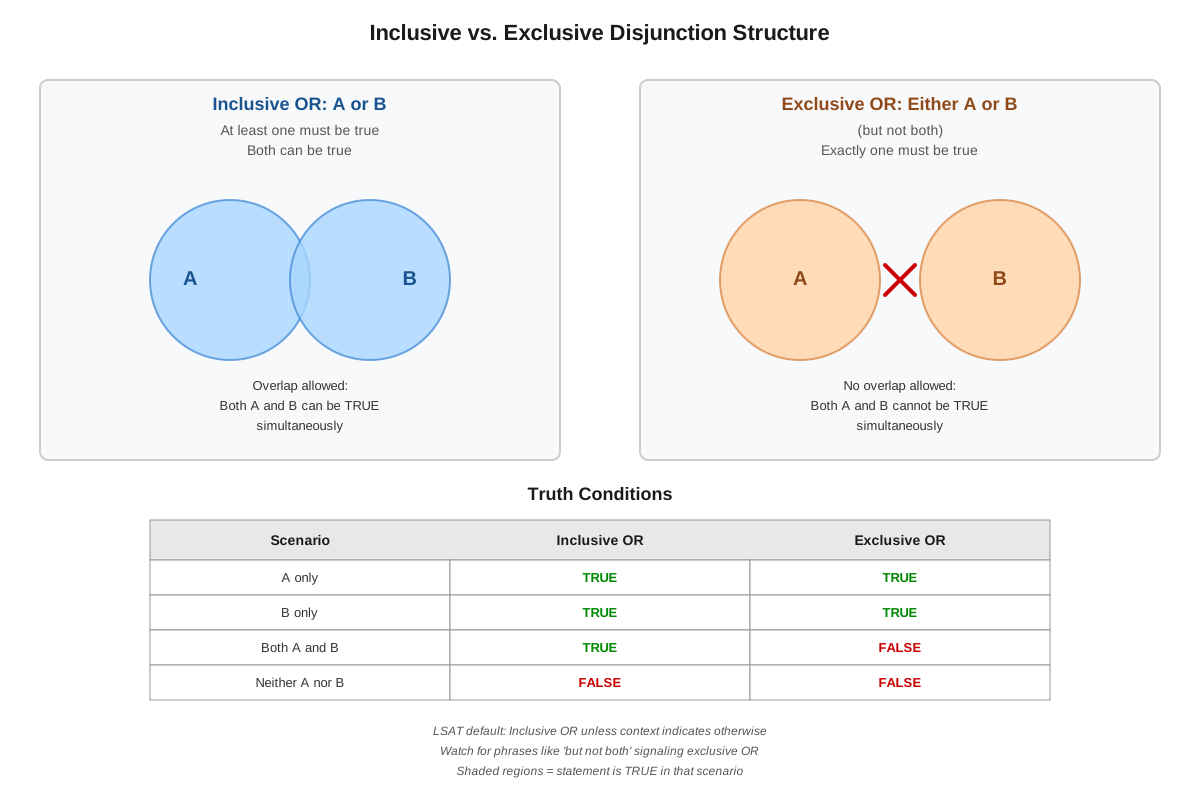
The critical insight is that in standard logical interpretation, a disjunction is inclusive by default—meaning it allows for the possibility that both alternatives are true. When the LSAT states "Either the witness testified truthfully or the defendant is innocent," this permits three scenarios: (1) the witness testified truthfully only, (2) the defendant is innocent only, or (3) both the witness testified truthfully AND the defendant is innocent.
Inclusive vs. Exclusive Disjunction
Understanding the distinction between inclusive and exclusive disjunctions is crucial for LSAT success:
| Type | Meaning | True When | Example |
|---|---|---|---|
| Inclusive OR | At least one is true (possibly both) | A true, B true, or both true | "You need a passport or a driver's license" (both acceptable) |
| Exclusive OR | Exactly one is true (not both) | A true OR B true, but not both | "The light is either on or off" (cannot be both) |
On the LSAT, disjunctions are inclusive unless context clearly indicates otherwise. The test occasionally signals exclusive disjunction through phrases like "either A or B, but not both" or through contextual impossibility (e.g., "The meeting is either Monday or Tuesday" when only one meeting is scheduled).
Logical Equivalences of Either/Or Statements
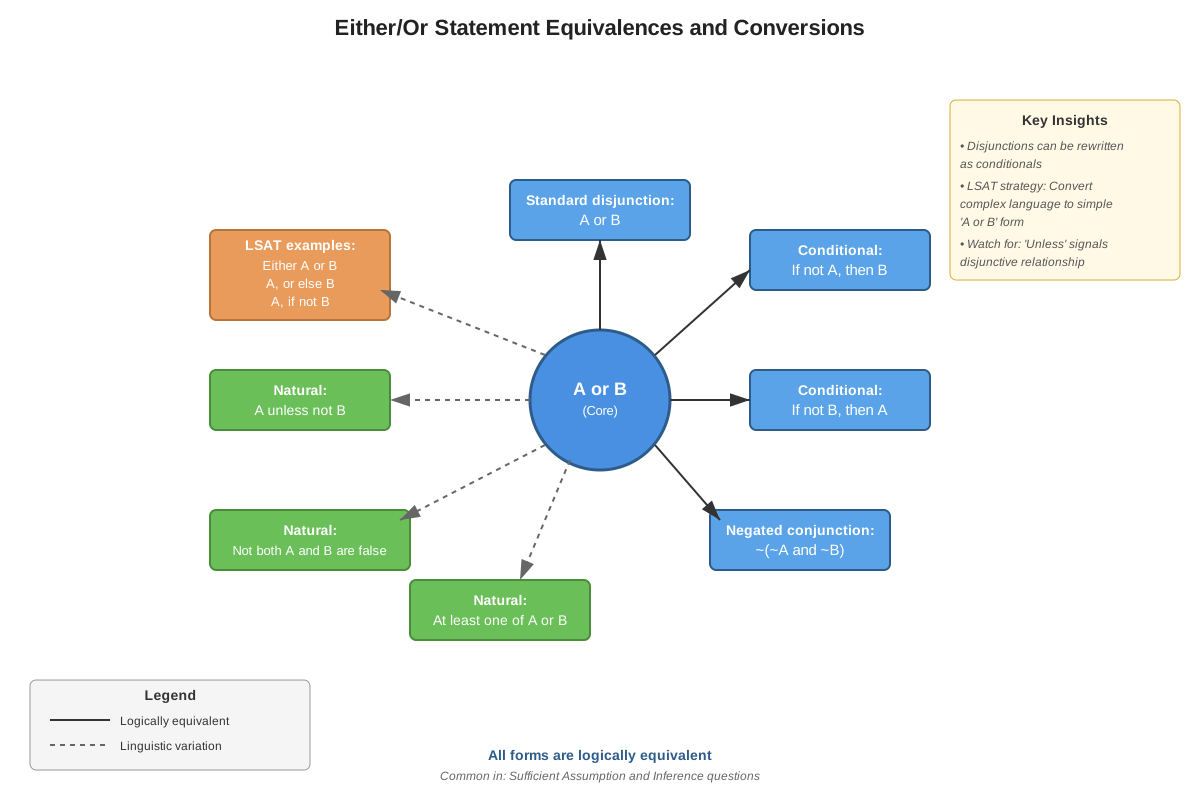
Either/or statements can be expressed in multiple equivalent forms. Recognizing these equivalences is essential for identifying disjunctions that appear in disguised form:
- "A or B" is logically equivalent to "If not A, then B" (and vice versa: "If not B, then A")
- Example: "She studies law or medicine" = "If she doesn't study law, then she studies medicine"
- "A unless B" means "A or B" (which equals "If not B, then A")
- Example: "The defendant is guilty unless the alibi checks out" = "The defendant is guilty or the alibi checks out"
- "A or else B" means "If not A, then B"
- Example: "Pay the fine or else face prosecution" = "If you don't pay the fine, then you face prosecution"
These equivalences allow the LSAT to test the same logical relationship using different linguistic formulations. Students must recognize that a question presenting "If not A, then B" is testing the same logical structure as "A or B."
Negating Either/Or Statements
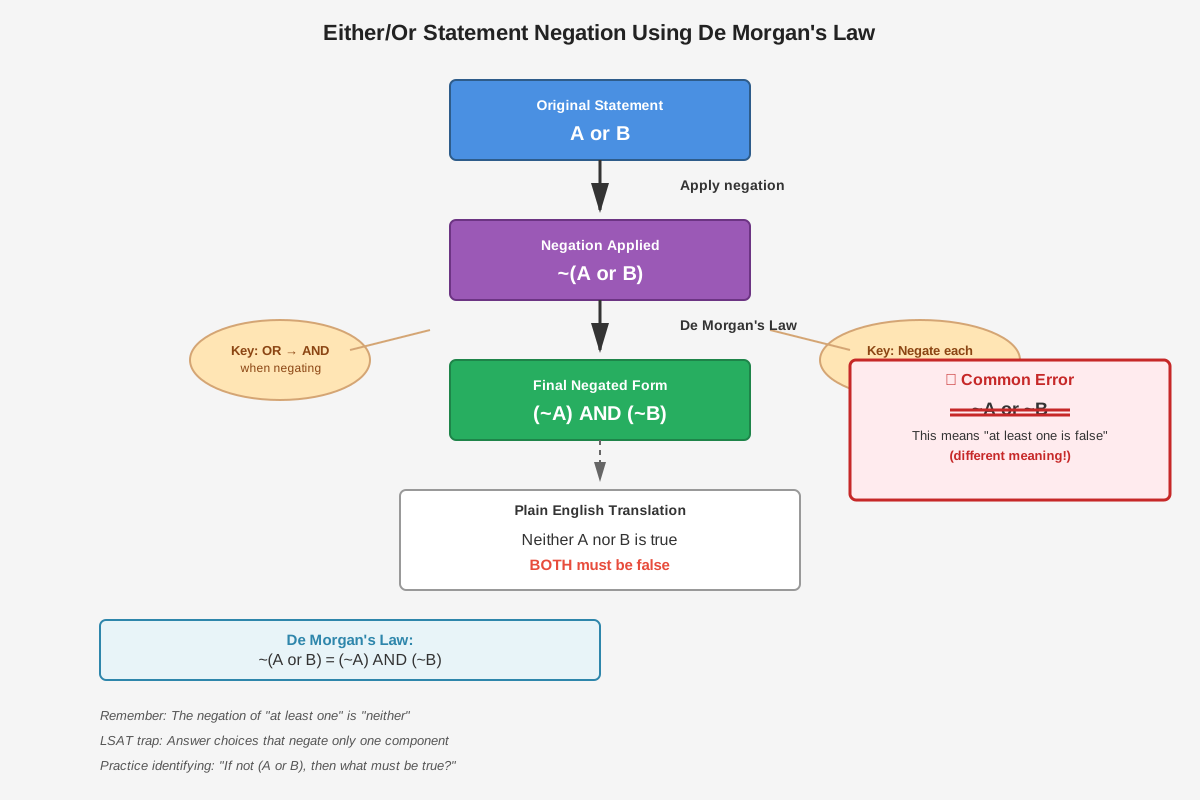
Properly negating disjunctions is a high-yield skill tested frequently on the LSAT. According to De Morgan's Laws, the negation of a disjunction follows this pattern:
NOT (A or B) = (NOT A) and (NOT B)
In other words, to deny that at least one of two things is true, you must assert that both are false.
Example:
- Statement: "Either the contract is valid or it was signed under duress"
- Negation: "The contract is not valid AND it was not signed under duress"
Common error: Students often incorrectly negate "A or B" as "not A or not B." This is wrong. The correct negation requires both alternatives to be false simultaneously, connected by "and."
Combining Either/Or with Conditional Logic
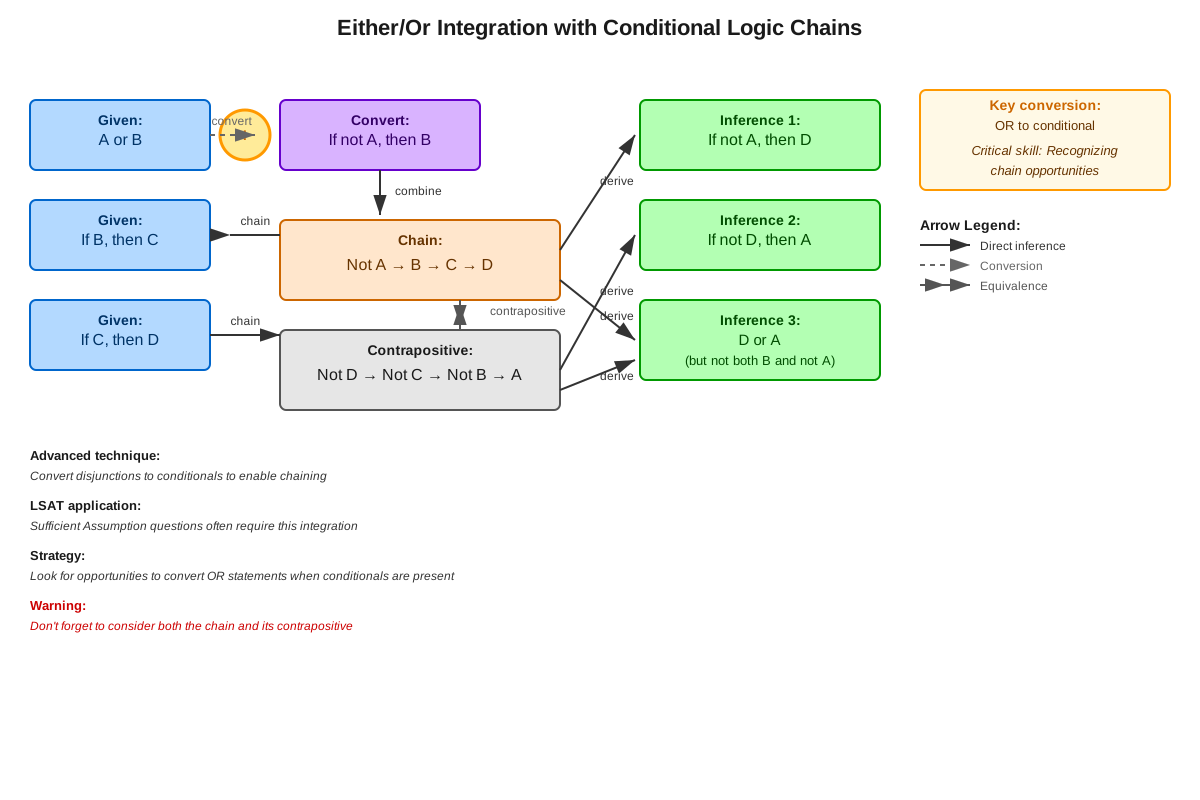
Either/or statements frequently combine with conditional statements to create logical chains. The key equivalence—that "A or B" equals "If not A, then B"—allows disjunctions to function within conditional chains:
Example chain:
- If C, then not A (given)
- A or B (given)
- Therefore: If C, then B (valid inference)
Reasoning: From statement 2, we know "If not A, then B." Statement 1 tells us C leads to not A. Therefore, C leads to B through the chain: C → not A → B.
This type of reasoning appears frequently in both Logical Reasoning and Logic Games, where students must trace implications through multiple connected statements.
Multiple Disjunctions
The LSAT sometimes presents disjunctions with more than two alternatives: "A or B or C." The same principles apply—at least one must be true (inclusive interpretation), and the negation requires all alternatives to be false: NOT (A or B or C) = (NOT A) and (NOT B) and (NOT C).
When working with multiple disjunctions, students should:
- Identify all alternatives clearly
- Determine whether any can be eliminated based on other given information
- Recognize that eliminating all but one alternative establishes that remaining alternative as true
- Apply the equivalence: "A or B or C" = "If not A and not B, then C" (and other permutations)
Concept Relationships
The concepts within either/or statements form an interconnected logical system. The basic disjunctive structure (A or B) serves as the foundation, from which all other concepts derive. Understanding inclusive versus exclusive disjunction refines the basic structure by clarifying exactly what truth conditions satisfy the statement. This distinction directly impacts how we interpret LSAT arguments and evaluate answer choices.
Logical equivalences connect disjunctive statements to conditional logic, creating a bridge between two major LSAT topics. The equivalence "A or B = If not A, then B" means that mastery of either/or statements enhances understanding of conditional reasoning and vice versa. This relationship flows bidirectionally: students can convert disjunctions to conditionals when that form is easier to manipulate, or convert conditionals to disjunctions when that perspective clarifies the logic.
Negation of disjunctions builds upon both the basic structure and the understanding of logical operators (AND, OR, NOT). The negation principle connects to De Morgan's Laws, which also govern the negation of conjunctions (AND statements). This creates a parallel structure: just as "NOT (A or B) = (NOT A) and (NOT B)," we also have "NOT (A and B) = (NOT A) or (NOT B)."
Combining disjunctions with conditionals represents the highest level of complexity, integrating multiple logical structures into chains of reasoning. This synthesis enables students to solve the most challenging LSAT questions, where multiple logical relationships interact to support or undermine conclusions.
Relationship map:
Basic Disjunction → Inclusive/Exclusive Distinction → Contextual Interpretation
Basic Disjunction → Logical Equivalences → Conditional Logic Integration → Complex Chains
Basic Disjunction → Negation Principles → De Morgan's Laws → Conjunction Relationships
High-Yield Facts
⭐ Either/or statements are inclusive by default on the LSAT—"A or B" means at least one is true, possibly both
⭐ "A or B" is logically equivalent to "If not A, then B" and "If not B, then A"
⭐ The negation of "A or B" is "NOT A and NOT B" (both must be false)
⭐ "A unless B" translates to "A or B," which equals "If not B, then A"
⭐ Eliminating all but one option in a disjunction proves the remaining option must be true
- "A or else B" means "If not A, then B"
- Exclusive disjunction (exactly one true) must be explicitly indicated by context or language like "but not both"
- Multiple disjunctions follow the same rules: "A or B or C" means at least one is true
- Either/or statements can be chained with conditionals to create valid inference patterns
- The contrapositive of "If not A, then B" is "If not B, then A," which is equivalent to "A or B"
- When an either/or statement appears in a conclusion, look for answer choices that establish one alternative by eliminating the other
- Disjunctions in sufficient assumption questions often work by creating a conditional chain through the "If not A, then B" equivalence
Quick check — test yourself on Either or statements so far.
Try Flashcards →Common Misconceptions
Misconception: "Either A or B" means exactly one is true, not both.
Correction: On the LSAT, either/or is inclusive unless explicitly stated otherwise. "Either A or B" means at least one is true and allows for both to be true. Only when context makes both impossible (like "either Monday or Tuesday" for a single event) or when explicitly stated ("but not both") should you interpret it as exclusive.
Misconception: The negation of "A or B" is "not A or not B."
Correction: The negation of "A or B" is "not A AND not B." To deny that at least one is true, you must assert that both are false. This follows De Morgan's Laws and is frequently tested on the LSAT through questions asking what would contradict or undermine a disjunctive claim.
Misconception: "A unless B" means "If A, then B."
Correction: "A unless B" means "A or B," which translates to "If not B, then A" (not "If A, then B"). This is one of the most commonly tested translations on the LSAT. The word "unless" introduces the condition that, when false, triggers the other statement.
Misconception: If one alternative in "A or B" is false, the other must be true.
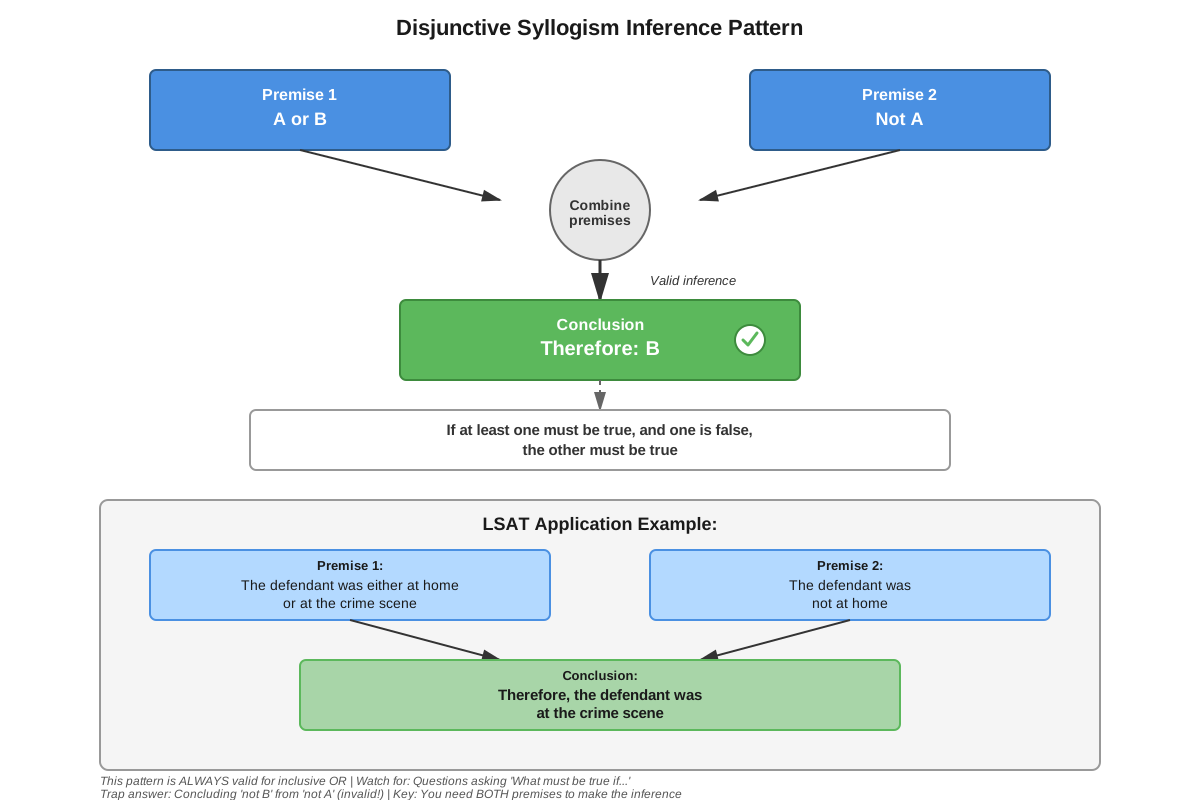
Correction: This is actually correct reasoning and not a misconception—but students sometimes fail to apply it. If you know "A or B" is true and you establish that A is false, you can validly conclude B must be true. This is a high-yield inference pattern.
Misconception: "A or B" and "If A, then B" mean the same thing.
Correction: These are different logical structures. "A or B" means at least one is true, while "If A, then B" means whenever A is true, B must also be true (but says nothing about when A is false). The correct equivalence is "A or B" = "If not A, then B."
Misconception: Either/or statements only appear with the explicit words "either" and "or."
Correction: Disjunctions appear in many linguistic forms including "unless," "or else," "at least one," and conditional statements with negated antecedents. Recognizing these equivalent formulations is essential for identifying all either/or logic on the test.
Worked Examples
Example 1: Inference Question
Stimulus: "The company will either expand into Asian markets or increase its domestic workforce. However, the company will not increase its domestic workforce unless it secures additional funding. The company did not secure additional funding."
Question: Which of the following must be true?
Analysis:
Step 1: Translate the statements into logical form.
- Statement 1: Expand into Asia OR Increase workforce (A or W)
- Statement 2: Increase workforce UNLESS secure funding = Increase workforce OR secure funding = If NOT secure funding, then NOT increase workforce (If ~F, then ~W)
- Statement 3: NOT secure funding (~F)
Step 2: Apply the conditional from Statement 2.
Since we know ~F is true (Statement 3), and we have "If ~F, then ~W," we can conclude ~W (the company will not increase its domestic workforce).
Step 3: Apply this conclusion to Statement 1.
We have "A or W" and we've established ~W. In a disjunction, if one alternative is false, the other must be true. Therefore, A must be true.
Conclusion: The company must expand into Asian markets.
Connection to Learning Objectives: This example demonstrates how to identify either/or statements in LSAT questions (Statement 1), explain the reasoning pattern (using the "unless" translation and disjunctive elimination), and apply the logic to reach a valid conclusion.
Example 2: Flaw Question
Stimulus: "Either the defendant was at the crime scene or someone else committed the crime. The defendant has an alibi proving he was not at the crime scene. Therefore, the defendant is innocent."
Question: The reasoning is flawed because it fails to consider which of the following?
Analysis:
Step 1: Identify the logical structure.
- Premise 1: Defendant at scene OR someone else committed crime (D or S)
- Premise 2: NOT defendant at scene (~D)
- Conclusion: Defendant is innocent
Step 2: Evaluate the inference from premises to conclusion.
From "D or S" and "~D," we can validly conclude S (someone else committed the crime). This inference is valid.
Step 3: Identify the gap.
The flaw is in moving from "someone else committed the crime" to "the defendant is innocent." These are not equivalent. The defendant could still be guilty even if someone else committed the crime—for example, as an accomplice, conspirator, or accessory.
Step 4: Recognize the logical error.
The argument treats "someone else committed the crime" as if it means "only someone else committed the crime" or "the defendant had no involvement." This is an unwarranted assumption. The disjunction "D or S" is inclusive, meaning both could be true—both the defendant and someone else could have been involved.
Correct Answer Type: The answer should point out that the argument fails to consider that the defendant could have been involved in the crime without being at the crime scene, or that multiple people could have committed the crime.
Connection to Learning Objectives: This example shows how the LSAT tests understanding of inclusive disjunction and the reasoning patterns behind either/or statements. The flaw exploits the common misconception that "A or B" with "not A" means "only B" rather than "at least B."
Exam Strategy
When approaching LSAT questions involving either/or statements, follow this systematic process:
Step 1: Identify the disjunction. Look for explicit "either/or" language, but also watch for trigger words: "unless," "or else," "at least one," and conditional statements that can be converted to disjunctions. Underline or circle these statements in the stimulus.
Step 2: Determine if the disjunction is inclusive or exclusive. Assume inclusive unless context clearly indicates otherwise. Ask: "Could both alternatives be true given the context?" If yes, treat it as inclusive.
Step 3: Translate to the most useful form. Depending on the question, convert between "A or B" and "If not A, then B" to whichever form makes the logic clearer. For chaining with other conditionals, the "if-then" form is often more useful. For elimination reasoning, the "or" form may be clearer.
Step 4: Look for elimination opportunities. If the stimulus or answer choices establish that one alternative is false, you can conclude the other must be true. This is one of the most common inference patterns.
Step 5: Check for negation. If the question asks what would contradict or undermine the statement, remember that the negation of "A or B" is "not A AND not B"—both must be false.
Exam Tip: In Must Be True questions, if you see an either/or statement and information that eliminates one option, the correct answer will often be the remaining option or a logical consequence of it.
Time allocation: Either/or questions should typically take 60-90 seconds once you've identified the logical structure. If you find yourself spending more than 2 minutes, you may be overcomplicating the logic. Return to the basic structure: identify the disjunction, check what's been eliminated, and draw the valid inference.
Process of elimination tips:
- Eliminate answers that confuse "A or B" with "If A, then B"
- Eliminate answers that treat inclusive disjunctions as exclusive without justification
- Eliminate answers that incorrectly negate the disjunction (watch for "not A or not B" when it should be "not A and not B")
- In assumption questions, eliminate answers that don't connect to the disjunctive structure in the argument
Trigger phrases to watch for:
- "Unless" (always translates to a disjunction)
- "Or else" (conditional with disjunctive meaning)
- "At least one" (explicit inclusive disjunction)
- "Either...or" (standard disjunction marker)
- "The only way" (can create disjunctive reasoning)
Memory Techniques
Mnemonic for "Unless" Translation: U.N.O. = "Unless" = "Negate" = "Or"
- When you see "A unless B," think: Negate B to get the condition: "If not B, then A," which equals "A or B"
Visualization for Inclusive OR: Picture a Venn diagram with overlapping circles. The "or" statement is true in three regions: left circle only, right circle only, and the overlap. This visual reinforces that both can be true.
Acronym for Negation: BAND = "Both Are Not Done"
- To negate "A or B," remember BAND: Both alternatives are not done (not A and not B)
Equivalence Chain Memory: Create a mental chain: "OR → IF NOT"
- "A or B" → "If not A, then B" → "If not B, then A"
- This chain reminds you that any disjunction can be expressed as two conditional statements
Rhyme for Elimination: "One is out, the other's in"
- When one alternative in a disjunction is eliminated (out), the other must be true (in)
Spatial Memory Technique: Imagine either/or statements as a fork in a road. You must take at least one path (possibly both if there's a connecting trail). This reinforces the "at least one" meaning and helps distinguish from exclusive situations where you must choose exactly one path.
Summary
Either/or statements form a critical component of logical reasoning on the LSAT, appearing in approximately 7-10% of scored questions across multiple question types. These disjunctive statements assert that at least one of two or more alternatives is true, with the inclusive interpretation being standard unless context indicates otherwise. Mastery requires understanding five key elements: (1) the basic inclusive structure of disjunctions, (2) the distinction between inclusive and exclusive interpretations, (3) logical equivalences connecting disjunctions to conditional statements, (4) proper negation using De Morgan's Laws, and (5) integration with conditional logic chains. The most high-yield skills are recognizing that "A or B" equals "If not A, then B," correctly negating disjunctions as "not A and not B," and applying elimination reasoning where establishing one alternative as false proves the other true. Students must also master the translation of "unless" statements, which consistently appear on the LSAT and function as disjunctions. Success with either/or statements requires both recognizing their various linguistic formulations and applying systematic logical analysis to draw valid inferences and identify flawed reasoning.
Key Takeaways
- Either/or statements are inclusive by default: "A or B" means at least one is true, possibly both, unless context clearly indicates exactly one
- Master the key equivalence: "A or B" = "If not A, then B" = "If not B, then A"—this allows conversion between disjunctive and conditional forms
- Negate correctly: NOT (A or B) = (NOT A) AND (NOT B)—both alternatives must be false to deny a disjunction
- "Unless" always means "or": "A unless B" translates to "A or B" or "If not B, then A"
- Elimination reasoning is high-yield: When one alternative in a disjunction is proven false, the other must be true
- Watch for disguised disjunctions: Either/or logic appears in many forms beyond explicit "either...or" language
- Integrate with conditional logic: Disjunctions chain with conditional statements through their equivalent "if-then" forms to create complex valid inferences
Related Topics
Conditional Logic Chains: Building on the equivalence between disjunctions and conditionals, this topic explores how multiple if-then statements connect to create extended chains of reasoning. Mastering either/or statements provides the foundation for recognizing when disjunctions can enter these chains.
Formal Logic in Logic Games: Either/or statements appear frequently in Logic Games as rules constraining possible arrangements. Understanding disjunctive logic enables efficient diagramming and inference-making in grouping and selection games.
Sufficient and Necessary Conditions: The relationship between disjunctions and conditionals deepens understanding of sufficiency and necessity. "A or B" establishes that "not A" is sufficient for B, and "not B" is sufficient for A.
De Morgan's Laws and Logical Equivalences: This broader topic encompasses the negation principles for both disjunctions and conjunctions, providing a complete framework for manipulating complex logical statements.
Argument Structure and Validity: Understanding either/or statements is essential for evaluating whether conclusions follow validly from premises, particularly in Must Be True and Parallel Reasoning questions.
Practice CTA
Now that you've mastered the core concepts of either/or statements, it's time to cement your understanding through active practice. Work through the practice questions to test your ability to identify disjunctions, apply logical equivalences, and draw valid inferences under timed conditions. Use the flashcards to reinforce the key translations and negation patterns until they become automatic. Remember: the LSAT rewards systematic thinking and pattern recognition. Every practice question you complete builds the mental pathways that will allow you to quickly and accurately handle either/or logic on test day. You've learned the theory—now make it instinctive through deliberate practice. Your investment in mastering this high-yield topic will pay dividends across multiple question types and significantly boost your Logical Reasoning score.
Sign up free to keep reading
Create a free AnvayaPrep account to finish this LSAT guide on Either or statements — plus flashcards and practice questions.