Overview
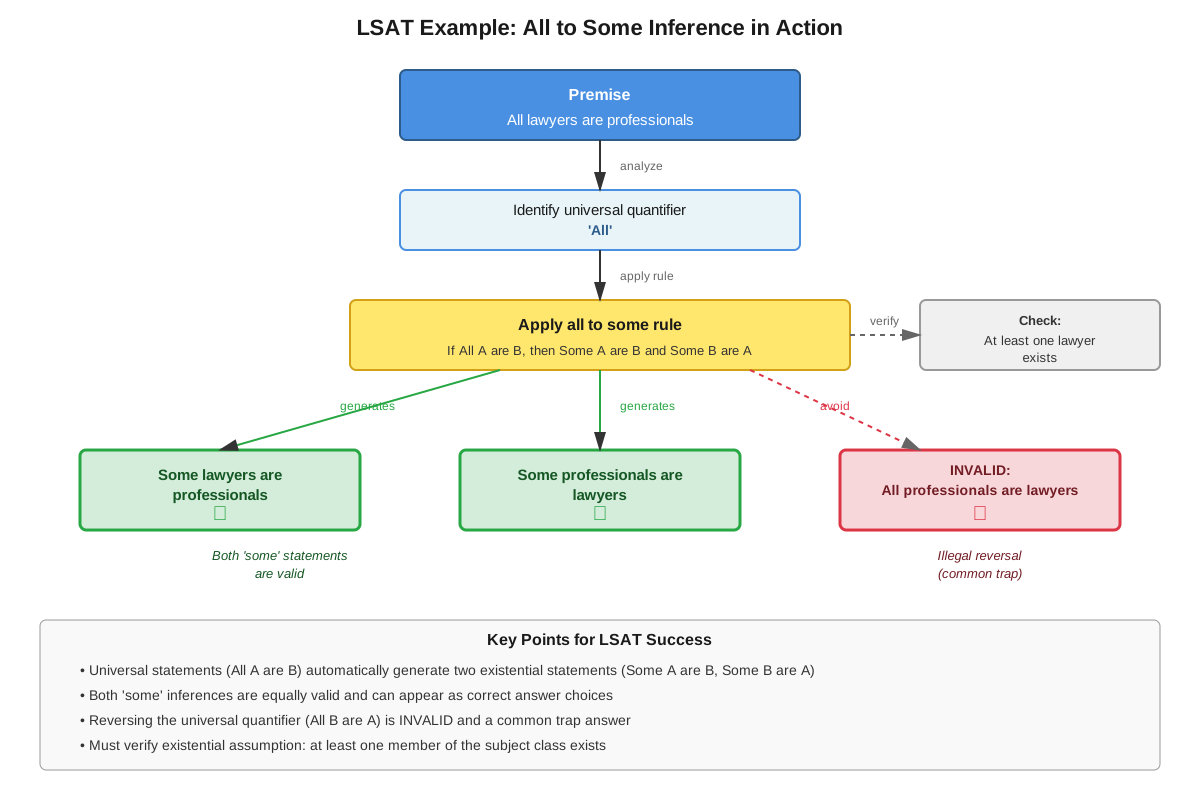
All to some inference is a fundamental principle in formal logic and quantifiers that allows test-takers to derive valid conclusions from universal statements. This inference pattern states that whenever a universal quantifier ("all," "every," "any") applies to a category, one can validly infer that the statement also applies to "some" members of that category—provided at least one member exists. For example, if "All lawyers are professionals," then it logically follows that "Some lawyers are professionals" and "Some professionals are lawyers."
This topic represents a cornerstone of logical reasoning on the LSAT, appearing across multiple question types including Must Be True, Inference, and Formal Logic questions. The LSAT all to some inference pattern tests whether candidates can recognize valid deductions from categorical statements, distinguish between reversible and non-reversible inferences, and avoid common logical fallacies. Mastery of this concept directly impacts performance on approximately 15-20% of Logical Reasoning questions and forms the foundation for understanding more complex logical relationships.
Within the broader landscape of LSAT Logical Reasoning, all to some inference connects directly to conditional reasoning, contrapositive formation, and quantifier manipulation. It serves as a bridge between simple categorical statements and complex logical chains, enabling test-takers to extract maximum information from premises and evaluate argument validity with precision. Understanding this inference pattern also prevents common errors in formal logic, such as illegal reversals and negations that trap unprepared test-takers.
Learning Objectives
- [ ] Identify how All to some inference appears in LSAT questions
- [ ] Explain the reasoning pattern behind All to some inference
- [ ] Apply All to some inference to solve LSAT-style problems accurately
- [ ] Distinguish between valid and invalid "some" inferences from universal statements
- [ ] Recognize when existential assumptions are necessary for all to some inferences
- [ ] Combine all to some inferences with other formal logic rules to create inference chains
- [ ] Evaluate answer choices that attempt to exploit misunderstandings of all to some inference patterns
Prerequisites
- Basic categorical logic: Understanding of "all," "some," and "no" statements is essential because all to some inference operates on these fundamental quantifiers
- Conditional statement structure: Familiarity with sufficient and necessary conditions helps distinguish when all to some inference applies versus when conditional logic rules govern
- Logical notation: Ability to translate English statements into symbolic form (A → B) enables efficient manipulation of complex logical relationships
- Contrapositive formation: Knowledge of how to form valid contrapositives prevents confusion between legitimate all to some inferences and illegal reversals
Why This Topic Matters
All to some inference represents one of the most frequently tested formal logic concepts on the LSAT, appearing in approximately 3-5 questions per test across both Logical Reasoning sections. This translates to roughly 6-10% of the total Logical Reasoning score, making it a high-yield topic for focused study. Questions testing this concept appear most commonly in Must Be True questions, where test-takers must identify what necessarily follows from given premises, and in Inference questions, where valid deductions must be distinguished from tempting but invalid conclusions.
In real-world applications, all to some inference underlies legal reasoning, policy analysis, and logical argumentation. Attorneys regularly use this pattern when arguing that evidence about a general category applies to specific instances, or when demonstrating that universal rules have particular applications. Understanding this inference pattern develops critical thinking skills applicable to case analysis, statutory interpretation, and logical brief writing.
On the LSAT, this topic appears in several distinct formats: direct inference questions where premises contain universal statements and answer choices offer "some" conclusions; complex formal logic chains where all to some inference must be combined with other rules; and argument evaluation questions where recognizing valid versus invalid inferences determines whether reasoning is sound. The LSAT frequently uses all to some inference as a distractor mechanism, presenting invalid reversals alongside valid inferences to test whether candidates truly understand the logical structure rather than relying on intuition.
Core Concepts
The Basic All to Some Inference Rule
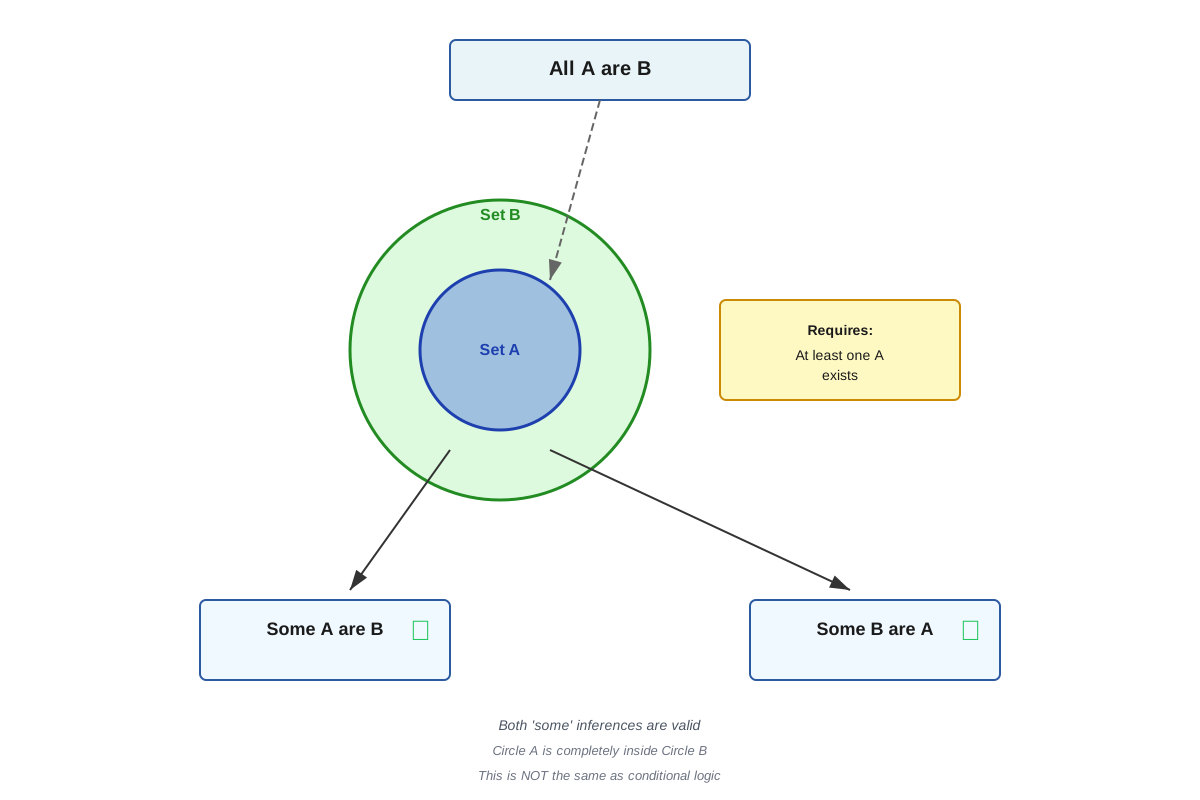
The fundamental principle of all to some inference states: If all members of category A are members of category B, then some members of category A are members of category B, AND some members of category B are members of category A. Symbolically, if A → B (all A are B), then we can validly infer both "Some A are B" and "Some B are A."
This inference pattern works because the universal statement "All A are B" guarantees that wherever we find an A, we also find a B. If at least one A exists, then that A is also a B, satisfying the "some" requirement in both directions. The bidirectional nature of the "some" inference distinguishes it from the original conditional statement, which only flows in one direction.
Existential Assumption
A critical but often overlooked component of all to some inference involves the existential assumption—the requirement that at least one member of the category actually exists. Without this assumption, the inference fails. For example, "All unicorns are magical creatures" does not allow us to infer "Some unicorns are magical creatures" if unicorns don't exist.
On the LSAT, test-makers typically assume existence unless the context explicitly indicates otherwise. Questions will generally present scenarios where the categories discussed contain actual members. However, sophisticated questions occasionally exploit this assumption by presenting empty categories or hypothetical scenarios where the inference breaks down.
The Bidirectional Nature of Some Statements
Unlike conditional statements, which flow in only one direction, "some" statements are inherently bidirectional. If "Some A are B," then it automatically follows that "Some B are A." This symmetry makes "some" statements more flexible than universal statements but also less informative about the full relationship between categories.
The bidirectionality of "some" statements means that all to some inference produces two valid conclusions from a single universal premise:
| Universal Statement | Valid "Some" Inference 1 | Valid "Some" Inference 2 |
|---|---|---|
| All dogs are mammals | Some dogs are mammals | Some mammals are dogs |
| All LSAT takers are test-takers | Some LSAT takers are test-takers | Some test-takers are LSAT takers |
| All valid arguments are sound arguments | Some valid arguments are sound arguments | Some sound arguments are valid arguments |
Combining All to Some with Other Logical Rules
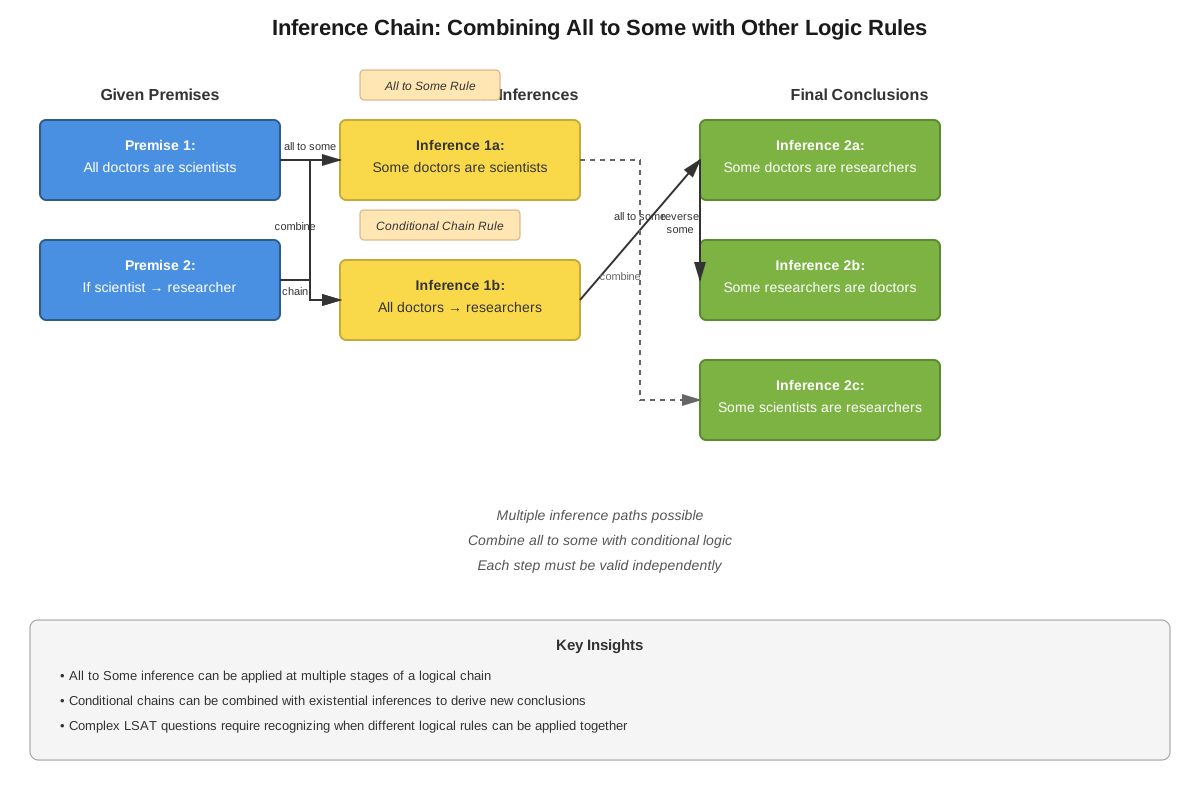
All to some inference becomes particularly powerful when combined with other formal logic principles. When multiple universal statements chain together (A → B and B → C, therefore A → C), all to some inference can be applied at any point in the chain to generate "some" conclusions.
For example:
- All professors are educators (P → E)
- All educators are professionals (E → Pr)
- Therefore, all professors are professionals (P → Pr)
From these premises, we can derive multiple "some" statements:
- Some professors are educators
- Some educators are professors
- Some educators are professionals
- Some professionals are educators
- Some professors are professionals
- Some professionals are professors
Distinguishing Valid from Invalid Inferences
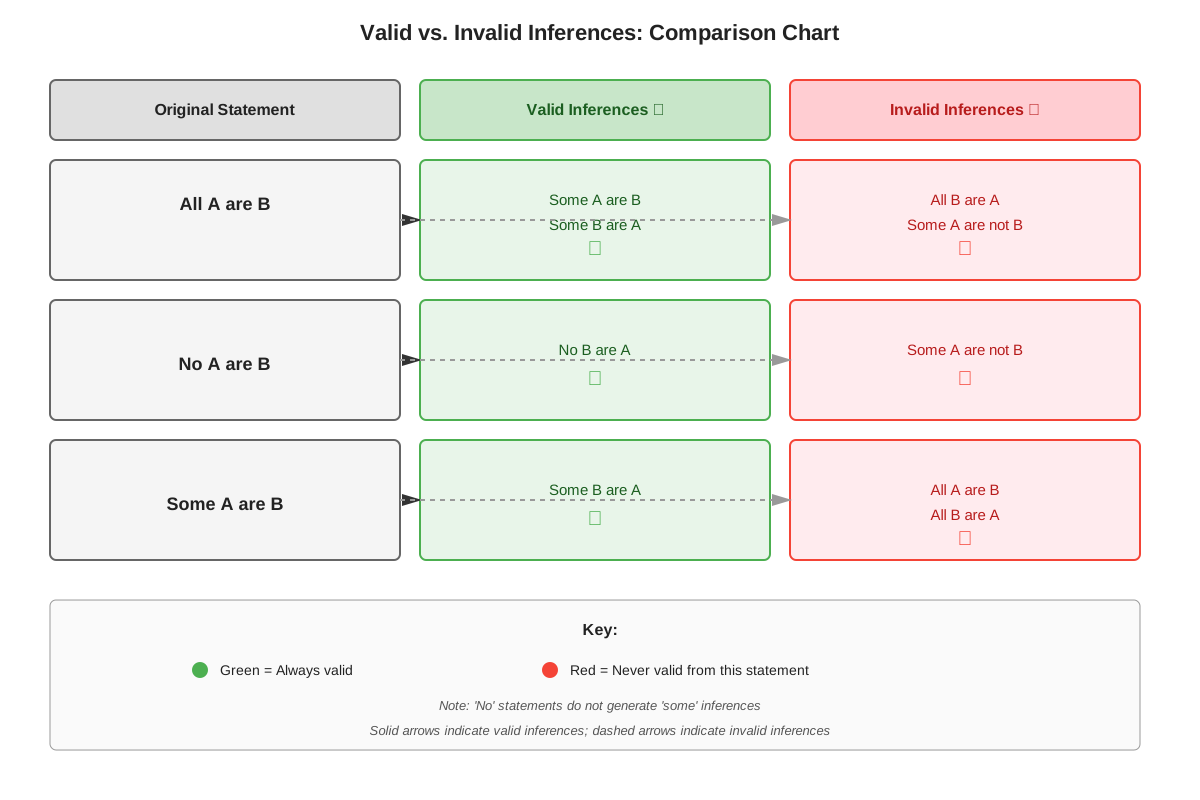
The most common error involving all to some inference is the illegal reversal—incorrectly inferring "All B are A" from "All A are B." While all to some inference allows us to conclude "Some B are A," it never permits the conclusion "All B are A" without additional information.
Consider: "All LSAT instructors are test prep experts"
- Valid inference: Some test prep experts are LSAT instructors
- Invalid inference: All test prep experts are LSAT instructors
The LSAT frequently presents invalid reversals as trap answers, testing whether candidates understand the limits of all to some inference. Recognizing that "some" is the strongest valid inference in the reverse direction is crucial for avoiding these traps.
Quantifier Relationships and Inference Strength
Understanding the hierarchy of quantifier strength helps clarify when all to some inference applies:
- All/Every/Any (universal affirmative): Strongest claim, applies to entire category
- Some/Most (particular affirmative): Weaker claim, applies to portion of category
- No/None (universal negative): Strong negative claim, excludes entire category
All to some inference moves from the strongest affirmative quantifier (all) to a weaker affirmative quantifier (some). This downward movement in strength is always valid—we can always infer a weaker claim from a stronger one. However, the reverse (inferring "all" from "some") is never valid without additional premises.
Negation and All to Some Inference
When universal statements are negated, all to some inference patterns change significantly. "No A are B" does NOT allow the inference "Some A are not B" in the same straightforward way. Instead, "No A are B" means that the categories are completely separate, which actually implies "All A are not B."
The relationship between negation and all to some inference:
- "All A are B" → "Some A are B" (valid)
- "No A are B" → "Some A are not B" (valid, but this is actually a weaker claim than the premise)
- "All A are not B" → "Some A are not B" (valid)
Concept Relationships
All to some inference serves as a foundational concept that connects to multiple areas of formal logic. The relationship begins with categorical logic, where universal and particular statements form the basic building blocks. All to some inference represents the bridge between these two types of statements, showing how universal claims generate particular claims.
The concept flows directly into conditional reasoning: Universal statements (All A are B) can be expressed as conditional statements (If A, then B), and all to some inference demonstrates how conditional statements generate existential claims. This connection is crucial because many LSAT questions present universal claims in conditional form, requiring test-takers to recognize when all to some inference applies.
Moving outward, all to some inference connects to contrapositive formation. While the contrapositive of "All A are B" is "All not-B are not-A," all to some inference from the contrapositive yields "Some not-B are not-A" and "Some not-A are not-B." Understanding this relationship prevents confusion when questions present contrapositives and ask for valid inferences.
The concept also relates to logical equivalence: Two statements are logically equivalent if they always have the same truth value. All to some inference demonstrates that universal statements are stronger than (but not equivalent to) their corresponding "some" statements—the universal statement guarantees the "some" statement, but not vice versa.
Relationship Map:
Categorical Logic → Universal Statements → All to Some Inference → Particular Statements → Bidirectional Some Statements → Inference Chains → Complex Formal Logic Arguments
High-Yield Facts
⭐ All to some inference allows two valid "some" conclusions from any universal statement: "Some A are B" and "Some B are A"
⭐ The inference requires an existential assumption—at least one member of the category must exist
⭐ "Some" statements are always bidirectional: if "Some A are B," then "Some B are A"
⭐ All to some inference never permits inferring "All B are A" from "All A are B"—this is an illegal reversal
⭐ The inference can be applied at any point in a logical chain, generating multiple valid "some" conclusions
- All to some inference moves from stronger quantifiers (all) to weaker quantifiers (some), which is always valid
- The pattern applies to conditional statements expressed as "If A, then B" just as it applies to "All A are B"
- Combining all to some inference with contrapositive formation generates additional valid conclusions
- "Most" statements allow limited all to some inference: "Most A are B" implies "Some A are B" but not necessarily "Some B are A"
- The LSAT frequently uses invalid reversals as trap answers in questions testing all to some inference
- All to some inference is distinct from "some to all" reasoning, which is never valid without additional premises
- When multiple universal statements chain together, all to some inference can be applied to any link or to the final conclusion
Quick check — test yourself on All to some inference so far.
Try Flashcards →Common Misconceptions
Misconception: If "All A are B," then "All B are A" → Correction: This is an illegal reversal. From "All A are B," we can only infer "Some B are A," not "All B are A." The original statement tells us nothing about what percentage of B's are A's.
Misconception: All to some inference works the same way with "most" as it does with "all" → Correction: "Most A are B" allows us to infer "Some A are B," but it does NOT necessarily allow us to infer "Some B are A" because "most" is not bidirectional in the same way "some" is. If most of a small group A are in a large group B, B might contain very few A's proportionally.
Misconception: "Some" means "some but not all" → Correction: In formal logic and on the LSAT, "some" means "at least one, possibly all." When we infer "Some A are B" from "All A are B," this is perfectly valid because "some" includes the possibility of "all."
Misconception: All to some inference requires no assumptions → Correction: The inference requires the existential assumption that at least one member of the category exists. Without this assumption, we cannot validly infer "Some A are B" from "All A are B."
Misconception: If "Some A are B," then "All A are B" might be true → Correction: While "All A are B" is consistent with "Some A are B," we cannot infer the universal statement from the particular statement. The "some" statement provides no information about the remaining members of category A.
Misconception: All to some inference only works in one direction → Correction: The inference produces two valid conclusions: both "Some A are B" and "Some B are A" follow from "All A are B." The bidirectional nature of "some" statements is essential to understanding this inference pattern.
Misconception: Negating an all to some inference produces a valid conclusion → Correction: From "All A are B," we cannot infer "Some A are not B." This would contradict the original premise. Negation must be applied carefully and follows different rules than affirmative inference.
Worked Examples
Example 1: Basic All to Some Inference
Question: All successful LSAT test-takers are disciplined studiers. If this statement is true, which of the following must also be true?
(A) All disciplined studiers are successful LSAT test-takers
(B) Some disciplined studiers are successful LSAT test-takers
(C) Most successful LSAT test-takers are disciplined studiers
(D) No undisciplined studiers are successful LSAT test-takers
(E) Some successful LSAT test-takers are not disciplined studiers
Solution Process:
Step 1: Identify the logical structure. The premise states "All successful LSAT test-takers are disciplined studiers," which we can symbolize as: SLSAT → DS
Step 2: Apply all to some inference. From this universal statement, we can validly infer:
- Some successful LSAT test-takers are disciplined studiers (Some SLSAT are DS)
- Some disciplined studiers are successful LSAT test-takers (Some DS are SLSAT)
Step 3: Evaluate each answer choice:
- (A) Illegal reversal—we cannot infer "All DS are SLSAT" from "All SLSAT are DS"
- (B) Valid all to some inference—this is one of the two valid "some" conclusions
- (C) Changes quantifier inappropriately—"most" is not supported by the premise
- (D) Valid contrapositive ("All not-DS are not-SLSAT"), but this is not what the question asks for
- (E) Contradicts the premise—if ALL successful test-takers are disciplined, then NONE can be undisciplined
Answer: (B)
Connection to Learning Objectives: This example demonstrates how to identify all to some inference in LSAT questions (Objective 1), apply the reasoning pattern (Objective 3), and distinguish valid from invalid inferences (Objective 4).
Example 2: Complex Inference Chain
Question: All philosophy majors are critical thinkers. All critical thinkers are effective communicators. Some effective communicators are published authors. Which of the following can be properly inferred from these statements?
(A) Some philosophy majors are published authors
(B) Some published authors are philosophy majors
(C) Some philosophy majors are effective communicators
(D) All effective communicators are philosophy majors
(E) Most critical thinkers are published authors
Solution Process:
Step 1: Map the logical relationships:
- Premise 1: All PM → CT (philosophy majors → critical thinkers)
- Premise 2: All CT → EC (critical thinkers → effective communicators)
- Premise 3: Some EC are PA (some effective communicators are published authors)
Step 2: Create the logical chain:
From Premises 1 and 2: All PM → CT → EC, therefore All PM → EC
Step 3: Apply all to some inference:
From "All PM → CT": Some PM are CT, and Some CT are PM
From "All CT → EC": Some CT are EC, and Some EC are CT
From "All PM → EC": Some PM are EC, and Some EC are PM
Step 4: Evaluate answer choices:
- (A) Cannot be inferred—we know some EC are PA, and some PM are EC, but these "some" groups might not overlap
- (B) Cannot be inferred—same reasoning as (A)
- (C) Valid—this follows directly from all to some inference applied to "All PM → EC"
- (D) Illegal reversal—we cannot infer "All EC → PM" from "All PM → EC"
- (E) Not supported—Premise 3 only tells us "some," not "most"
Answer: (C)
Connection to Learning Objectives: This example shows how to combine all to some inference with other formal logic rules (Objective 6), apply the pattern to complex problems (Objective 3), and avoid common traps involving "some" statements (Objective 4).
Exam Strategy
When approaching LSAT questions involving all to some inference, follow this systematic process:
Step 1: Identify Universal Statements
Scan the stimulus for trigger words indicating universal quantifiers: "all," "every," "any," "each," "only," "always." These signal opportunities for all to some inference. Also watch for conditional statements ("if...then") which function identically to universal statements for inference purposes.
Step 2: Translate to Symbolic Form
Convert complex English statements into simple symbolic notation (A → B). This reduces cognitive load and makes inference patterns more visible. Write down the symbols as you read to maintain clarity.
Step 3: Apply All to Some Inference Immediately
As soon as you identify a universal statement, mentally note (or jot down) both valid "some" inferences: "Some A are B" and "Some B are A." This proactive approach prevents missing valid inferences when evaluating answer choices.
Step 4: Watch for Trap Answers
The LSAT consistently includes these common traps:
- Illegal reversals: "All B are A" when only "All A are B" is given
- Illegal negations: "Some A are not B" when "All A are B" is given
- Quantifier shifts: "Most" or "many" when only "some" is supported
- Unwarranted combinations: Combining two "some" statements to create a new "some" conclusion (invalid without overlap)
Step 5: Eliminate Aggressively
In Must Be True questions, eliminate any answer that goes beyond what can be proven. Remember that all to some inference produces only "some" conclusions in the reverse direction—never "all," "most," or "many."
Exam Tip: If an answer choice contains "all" or "every" in the reverse direction of a premise, it's almost certainly wrong unless additional premises support it.
Time Allocation: Spend 15-20 seconds identifying and mapping logical relationships, then 30-40 seconds evaluating answer choices. All to some inference questions should be among the faster questions to complete once the pattern is mastered.
Process of Elimination Specific Tips:
- Eliminate any answer that contradicts a premise
- Eliminate answers that require assuming facts not in the stimulus
- Eliminate answers that combine "some" statements without justification
- Keep answers that weaken claims from the premises (moving from "all" to "some")
Memory Techniques
Mnemonic: "ALL falls to SOME"
Visualize the word "ALL" literally falling down to become "SOME"—this represents the downward movement from stronger to weaker quantifiers. The fall is always valid; climbing back up (some to all) never is.
Mnemonic: "BOTH WAYS with SOME"
Remember that "some" statements work in BOTH directions. Visualize a two-way street sign whenever you see "some" to remind yourself that "Some A are B" automatically means "Some B are A."
Acronym: VIBE for Valid Inferences
- Verify the universal statement exists
- Identify both "some" conclusions
- Bidirectional—remember both directions work
- Existence—check that the category has members
Visualization Strategy: The Container Method
Imagine category A as a small container and category B as a large container. "All A are B" means the small container A sits entirely inside the large container B. Now visualize scooping some items from container A—those items are also in container B (Some A are B). Then visualize scooping from container B in the area where A sits—those items are also in A (Some B are A). This visual reinforces both valid inferences.
Pattern Recognition Phrase: "All guarantees some, but some suggests nothing about all"
Repeat this phrase when practicing to internalize the unidirectional nature of the inference—it only works from universal to particular, never the reverse.
Summary
All to some inference represents a fundamental logical principle enabling test-takers to derive valid particular conclusions from universal premises. The core rule states that "All A are B" permits two valid inferences: "Some A are B" and "Some B are A," reflecting the bidirectional nature of "some" statements. This inference pattern requires an existential assumption—at least one member of the category must exist—and never permits inferring universal statements in the reverse direction, which would constitute an illegal reversal. On the LSAT, this concept appears frequently in Must Be True and Inference questions, often combined with conditional reasoning and logical chains. Mastery requires recognizing universal quantifiers, applying the inference systematically, distinguishing valid from invalid conclusions, and avoiding common traps such as illegal reversals and unwarranted quantifier shifts. The pattern's power lies in its simplicity and reliability: whenever a universal affirmative statement appears, two "some" conclusions automatically follow, providing test-takers with guaranteed valid inferences that frequently appear in correct answer choices.
Key Takeaways
- All to some inference produces exactly two valid conclusions from any universal statement: "Some A are B" and "Some B are A"
- The inference moves from stronger quantifiers (all) to weaker quantifiers (some), which is always logically valid
- "Some" statements are inherently bidirectional—if true in one direction, they're automatically true in the reverse direction
- The most common trap is the illegal reversal: inferring "All B are A" from "All A are B" is never valid without additional premises
- All to some inference requires assuming at least one member of the category exists (existential assumption)
- The pattern can be applied at any point in logical chains, generating multiple valid "some" conclusions from connected universal statements
- On the LSAT, recognizing when all to some inference applies and when it doesn't is crucial for eliminating trap answers and identifying correct inferences
Related Topics
Conditional Logic and Contrapositives: Understanding how to form and use contrapositives deepens mastery of all to some inference, as contrapositives of universal statements also permit all to some inferences. This topic builds directly on the foundation established here.
Quantifier Negation: Learning how to properly negate statements with different quantifiers ("all," "some," "no") extends the inference patterns covered here and prevents common logical errors.
Formal Logic Chains: Combining multiple conditional statements into extended chains requires applying all to some inference at various points, making this topic essential preparation for complex formal logic questions.
Most and Many Statements: Understanding how "most" differs from "all" and "some" in terms of valid inferences builds on the quantifier hierarchy introduced in this topic.
Sufficient and Necessary Conditions: Deepening understanding of conditional relationships helps clarify when all to some inference applies versus when other inference rules govern.
Practice CTA
Now that you've mastered the theoretical foundation of all to some inference, it's time to cement your understanding through active practice. Attempt the practice questions associated with this topic, focusing on identifying universal statements quickly and applying the inference pattern systematically. Use the flashcards to drill the key distinctions between valid and invalid inferences until recognizing these patterns becomes automatic. Remember: all to some inference appears on virtually every LSAT, and mastering this high-yield topic will directly improve your score. The pattern is simple, reliable, and testable—make it second nature through deliberate practice, and you'll confidently handle these questions under timed conditions.
Sign up free to keep reading
Create a free AnvayaPrep account to finish this LSAT guide on All to some inference — plus flashcards and practice questions.