Overview
Categorical logic is a foundational system of reasoning that deals with statements about categories or groups and the relationships between them. On the LSAT, categorical logic appears frequently in Logical Reasoning sections, where test-takers must analyze arguments that make claims about entire classes of things, some members of classes, or no members of classes. This system, rooted in Aristotelian logic, provides the framework for understanding how universal and particular statements interact, how categories overlap or exclude one another, and how valid inferences can be drawn from categorical premises.
Understanding LSAT categorical logic is essential because it underlies many argument structures you'll encounter on test day. Questions involving categorical statements require you to recognize patterns like "All A are B," "Some C are not D," or "No E are F," and then determine what must, might, or cannot be true based on these relationships. Mastery of categorical logic enables you to quickly identify valid and invalid inferences, spot logical flaws in arguments, and eliminate incorrect answer choices with confidence. This skill set directly impacts your performance on Must Be True, Cannot Be True, Inference, Flaw, and Strengthen/Weaken questions.
Within the broader landscape of Logical Reasoning and formal logic and quantifiers, categorical logic serves as a bridge between basic conditional reasoning and more complex argument analysis. While conditional logic focuses on "if-then" relationships between specific conditions, categorical logic addresses membership in groups and the quantified relationships between those groups. Together, these formal logic systems provide the analytical toolkit necessary to deconstruct virtually any LSAT argument, making categorical logic an indispensable component of your preparation strategy.
Learning Objectives
- [ ] Identify how Categorical logic appears in LSAT questions
- [ ] Explain the reasoning pattern behind Categorical logic
- [ ] Apply Categorical logic to solve LSAT-style problems accurately
- [ ] Translate natural language statements into standard categorical form
- [ ] Determine valid and invalid inferences from categorical premises using immediate inferences and syllogisms
- [ ] Recognize and avoid common logical fallacies involving categorical statements
- [ ] Diagram categorical relationships to visualize logical connections between groups
Prerequisites
- Basic set theory and group membership: Understanding that objects can belong to categories and that categories can overlap, be separate, or contain one another is fundamental to categorical logic.
- Quantifier recognition: Familiarity with terms like "all," "some," "none," and "most" is necessary because these quantifiers define the scope of categorical statements.
- Logical negation: Knowing how to negate statements correctly ensures accurate understanding of what categorical claims exclude or deny.
- Argument structure identification: Recognizing premises and conclusions helps in applying categorical logic to actual LSAT arguments.
Why This Topic Matters
Categorical logic represents one of the oldest and most reliable systems of formal reasoning, dating back to Aristotle's work over two millennia ago. In real-world applications, categorical reasoning appears in legal arguments, scientific classification, policy analysis, and everyday decision-making. When a legislator argues "All citizens who meet certain criteria are entitled to benefits," or when a scientist claims "No organisms in this genus exhibit photosynthesis," they're employing categorical logic. Legal reasoning, in particular, relies heavily on categorical statements about classes of people, actions, and legal principles—making this topic directly relevant to your future law school studies.
On the LSAT, categorical logic appears with remarkable frequency. Approximately 15-20% of Logical Reasoning questions involve categorical statements as their primary logical structure, and many additional questions incorporate categorical elements within more complex arguments. You'll encounter categorical logic most commonly in:
- Must Be True/Most Supported questions: Where you must identify what necessarily follows from categorical premises
- Cannot Be True questions: Requiring you to recognize what contradicts given categorical statements
- Inference questions: Where categorical relationships form the basis for drawing conclusions
- Flaw questions: Where arguments commit errors in categorical reasoning
- Parallel Reasoning questions: Where matching categorical structures is essential
The LSAT frequently embeds categorical logic within dense, abstract language or real-world scenarios about business practices, scientific research, or social policies. Recognizing the underlying categorical structure beneath this surface complexity is a high-yield skill that directly translates to points on test day.
Core Concepts
The Four Standard Categorical Forms
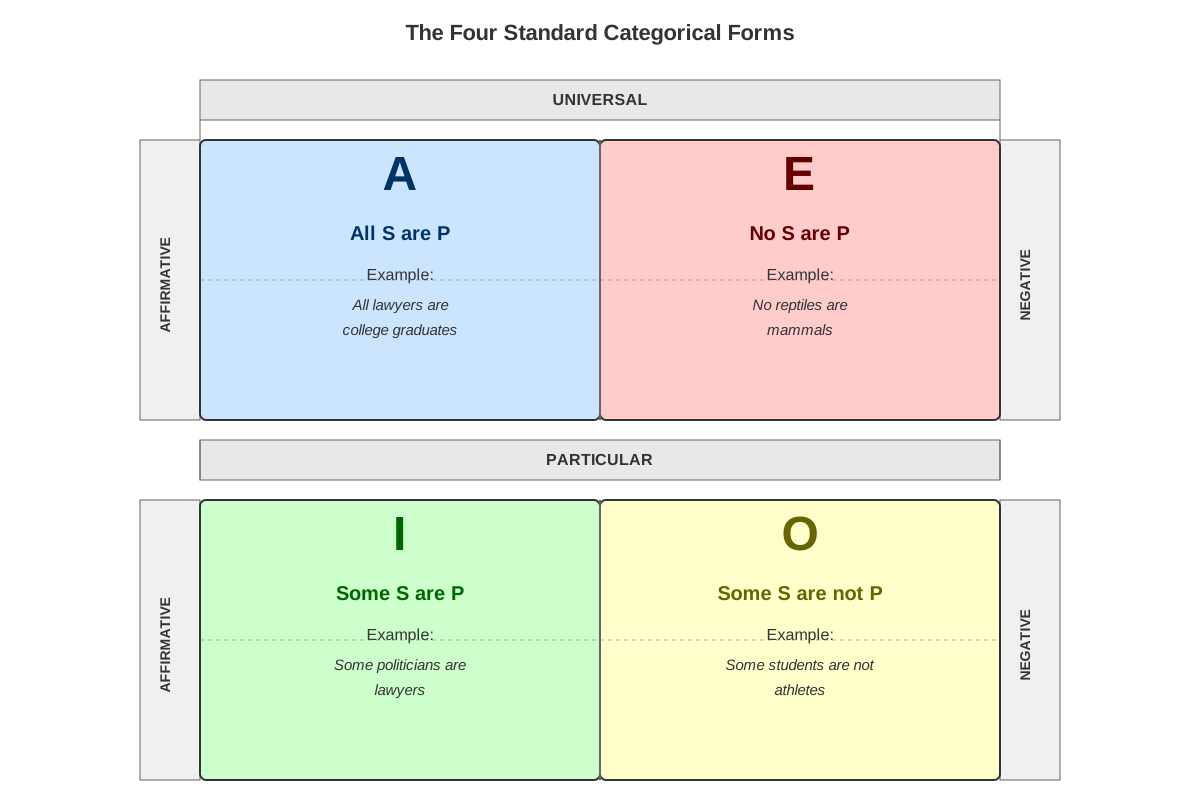
Categorical logic operates through four standard statement types, each expressing a different relationship between two categories or classes. These forms, traditionally labeled A, E, I, and O, constitute the building blocks of all categorical reasoning:
| Form | Structure | Example | Meaning |
|---|---|---|---|
| A (Universal Affirmative) | All S are P | All lawyers are professionals | Every member of category S is also in category P |
| E (Universal Negative) | No S are P | No reptiles are mammals | No member of category S is in category P |
| I (Particular Affirmative) | Some S are P | Some students are athletes | At least one member of category S is in category P |
| O (Particular Negative) | Some S are not P | Some politicians are not honest | At least one member of category S is not in category P |
Understanding these forms requires recognizing that "some" in formal logic and quantifiers means "at least one" and possibly "all." This differs from conversational English, where "some" often implies "not all." On the LSAT, when a statement says "Some doctors are researchers," this is true even if all doctors are researchers—as long as at least one doctor is a researcher.
Distribution of Terms
A critical concept in categorical logic is distribution. A term is distributed when a statement makes a claim about every member of that category. Understanding distribution is essential for determining valid inferences:
- In A statements (All S are P): The subject (S) is distributed, but the predicate (P) is not. "All dogs are animals" tells us about every dog, but not about every animal.
- In E statements (No S are P): Both subject and predicate are distributed. "No cats are reptiles" tells us about every cat and every reptile.
- In I statements (Some S are P): Neither term is distributed. "Some birds are predators" doesn't tell us about all birds or all predators.
- In O statements (Some S are not P): The predicate is distributed, but the subject is not. "Some vehicles are not cars" tells us about every car (none of them are these particular vehicles), but not about every vehicle.
Immediate Inferences
Immediate inferences are conclusions drawn from a single categorical statement without requiring additional premises. The LSAT frequently tests three types:
Conversion
Conversion switches the subject and predicate. This operation is valid only for E and I statements:
- E statement: "No S are P" converts validly to "No P are S"
- Example: "No mammals are reptiles" → "No reptiles are mammals" ✓
- I statement: "Some S are P" converts validly to "Some P are S"
- Example: "Some lawyers are women" → "Some women are lawyers" ✓
- A statement: "All S are P" does NOT convert validly to "All P are S"
- Example: "All dogs are animals" → "All animals are dogs" ✗
- O statement: "Some S are not P" does NOT convert validly
- Example: "Some birds are not penguins" → "Some penguins are not birds" ✗
Obversion
Obversion changes the quality (affirmative to negative or vice versa) and replaces the predicate with its complement (non-P). Obversion is valid for all four statement types:
- A: "All S are P" → "No S are non-P"
- Example: "All whales are mammals" → "No whales are non-mammals" ✓
- E: "No S are P" → "All S are non-P"
- Example: "No fish are mammals" → "All fish are non-mammals" ✓
- I: "Some S are P" → "Some S are not non-P"
- Example: "Some students are athletes" → "Some students are not non-athletes" ✓
- O: "Some S are not P" → "Some S are non-P"
- Example: "Some cars are not electric" → "Some cars are non-electric" ✓
Contraposition
Contraposition switches subject and predicate AND replaces both with their complements. This operation is valid only for A and O statements:
- A statement: "All S are P" → "All non-P are non-S"
- Example: "All doctors are professionals" → "All non-professionals are non-doctors" ✓
- O statement: "Some S are not P" → "Some non-P are not non-S"
- Example: "Some animals are not pets" → "Some non-pets are not non-animals" ✓
Categorical Syllogisms
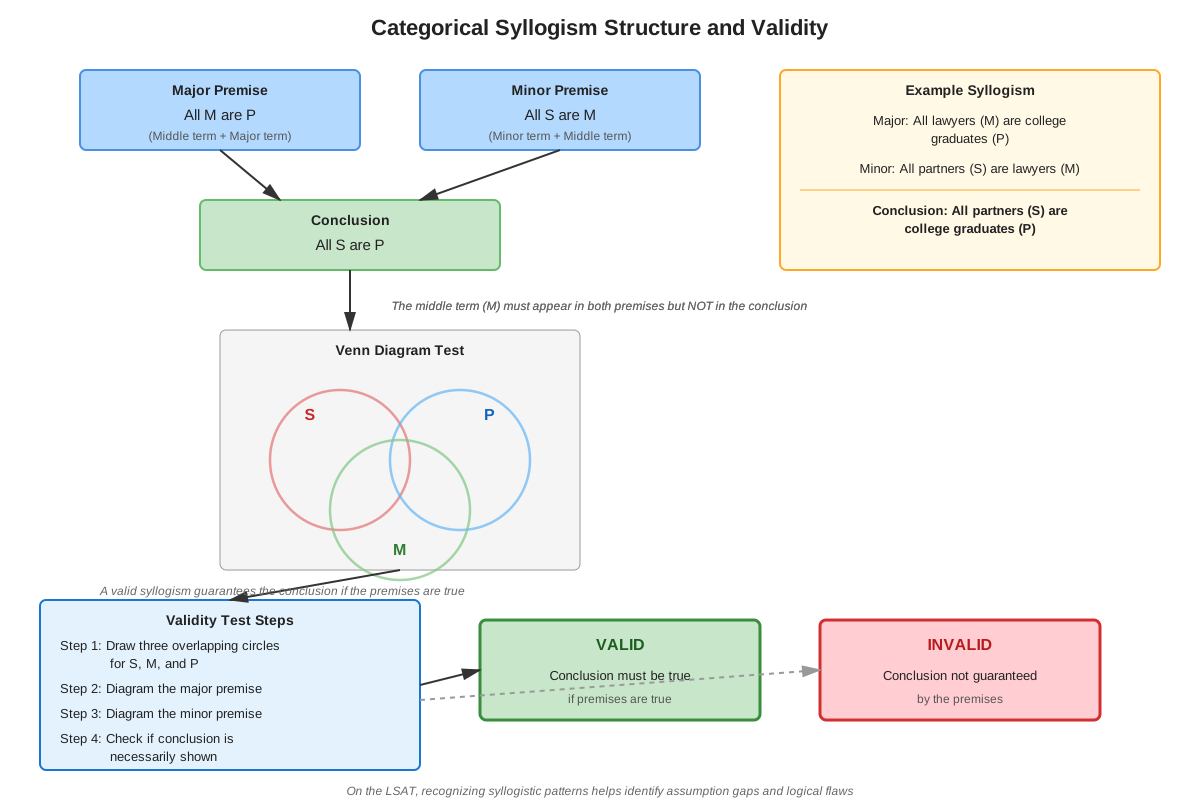
A categorical syllogism consists of three categorical statements: two premises and a conclusion. Each syllogism contains exactly three terms, with each term appearing in exactly two statements. The LSAT tests your ability to recognize valid syllogistic patterns and identify invalid ones.
For a syllogism to be valid, it must satisfy these rules:
- The middle term (appearing in both premises but not the conclusion) must be distributed at least once
- Any term distributed in the conclusion must be distributed in its premise
- Two negative premises yield no valid conclusion
- A negative premise requires a negative conclusion, and vice versa
- Two particular premises yield no valid conclusion
Example of a valid syllogism:
- Premise 1: All mammals are warm-blooded (A statement)
- Premise 2: All whales are mammals (A statement)
- Conclusion: All whales are warm-blooded (A statement)
This is valid because the middle term "mammals" is distributed in Premise 2, and no rules are violated.
Venn Diagrams for Categorical Logic
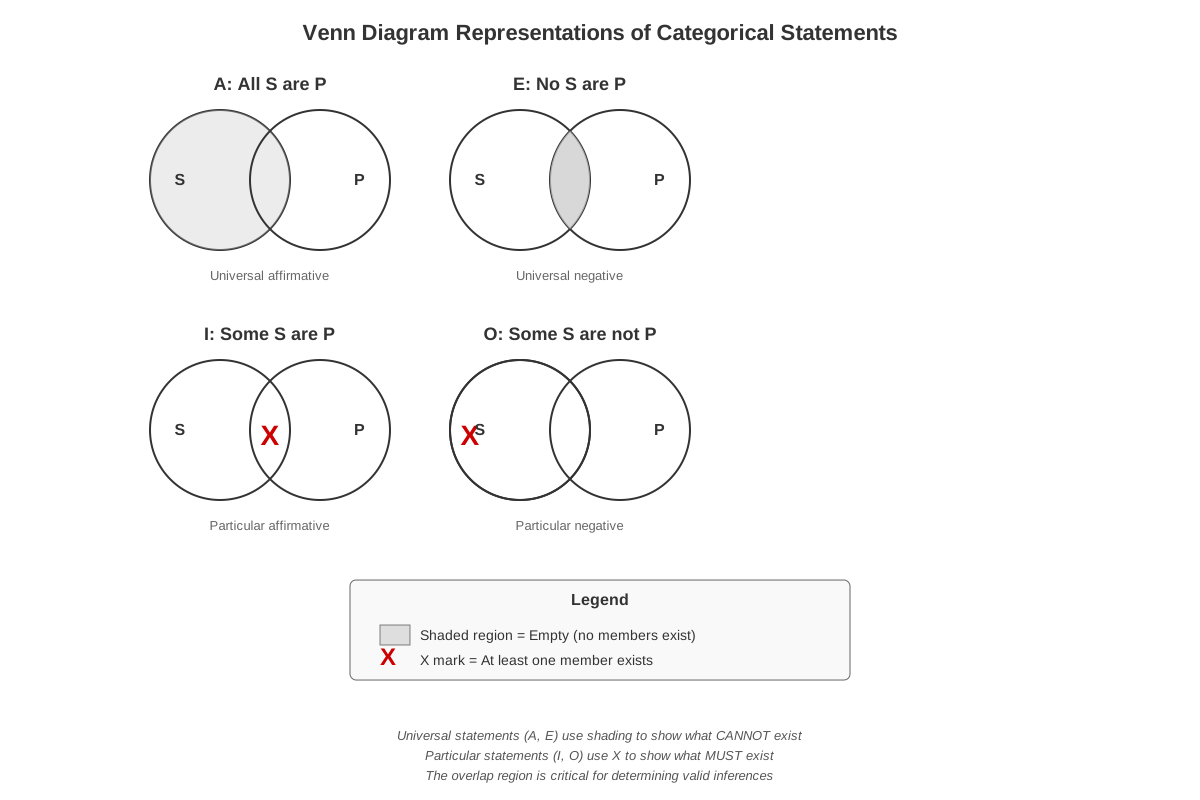
Venn diagrams provide a visual method for representing categorical relationships and testing validity. Each category is represented by a circle, and the relationships between circles show how categories overlap or exclude one another:
- Shading represents areas that are empty (no members)
- X marks represent areas that contain at least one member
- Overlapping circles show potential shared membership
For "All S are P," shade the area of S that doesn't overlap with P (showing no S exists outside P). For "No S are P," shade the overlapping area (showing no shared members). For "Some S are P," place an X in the overlapping area. For "Some S are not P," place an X in the area of S that doesn't overlap with P.
Concept Relationships
The concepts within categorical logic form an interconnected system where understanding one element strengthens comprehension of others. The four standard forms (A, E, I, O) serve as the foundation, and from these, all other concepts derive. Distribution emerges directly from analyzing what each standard form claims about its terms, which then determines the validity of immediate inferences.
The relationship flows as follows: Standard Forms → Distribution Rules → Immediate Inferences (Conversion, Obversion, Contraposition) → Categorical Syllogisms. Each immediate inference type relies on distribution to determine validity—conversion works for E and I because of their distribution patterns, while contraposition works for A and O for the same reason.
Categorical syllogisms represent the culmination of these concepts, requiring simultaneous application of standard forms, distribution rules, and inference patterns. The five rules of syllogistic validity all trace back to distribution: the middle term rule, the distribution rule for terms in conclusions, and the rules about negative and particular statements all depend on understanding which terms are distributed in which statement types.
Connecting to prerequisite knowledge, categorical logic builds directly on quantifier recognition by formalizing how "all," "some," and "no" function in logical systems. It extends basic set theory by adding rules for valid inference. Looking forward, categorical logic connects to conditional logic through the relationship between universal statements and conditionals (All S are P can be expressed as: If S, then P), and it provides the foundation for understanding formal fallacies and argument structure in more complex LSAT questions.
High-Yield Facts
⭐ "Some" in categorical logic means "at least one" and possibly "all"—never interpret "some" as excluding "all" on the LSAT.
⭐ Only E and I statements convert validly—switching subject and predicate in A or O statements produces invalid inferences.
⭐ All four statement types obvert validly—obversion is the most reliable immediate inference operation.
⭐ The middle term in a syllogism must be distributed at least once—this is the most frequently violated rule in invalid syllogisms.
⭐ A statements distribute the subject only; E statements distribute both terms—understanding distribution is essential for determining valid inferences.
- O statements distribute the predicate only—this counterintuitive fact often appears in trap answers.
- Two negative premises never yield a valid conclusion—if both premises are E or O statements, no valid inference follows.
- Contraposition works only for A and O statements—attempting to contrapose E or I statements produces invalid results.
- If a term is distributed in the conclusion, it must be distributed in its premise—violating this rule creates the fallacy of illicit process.
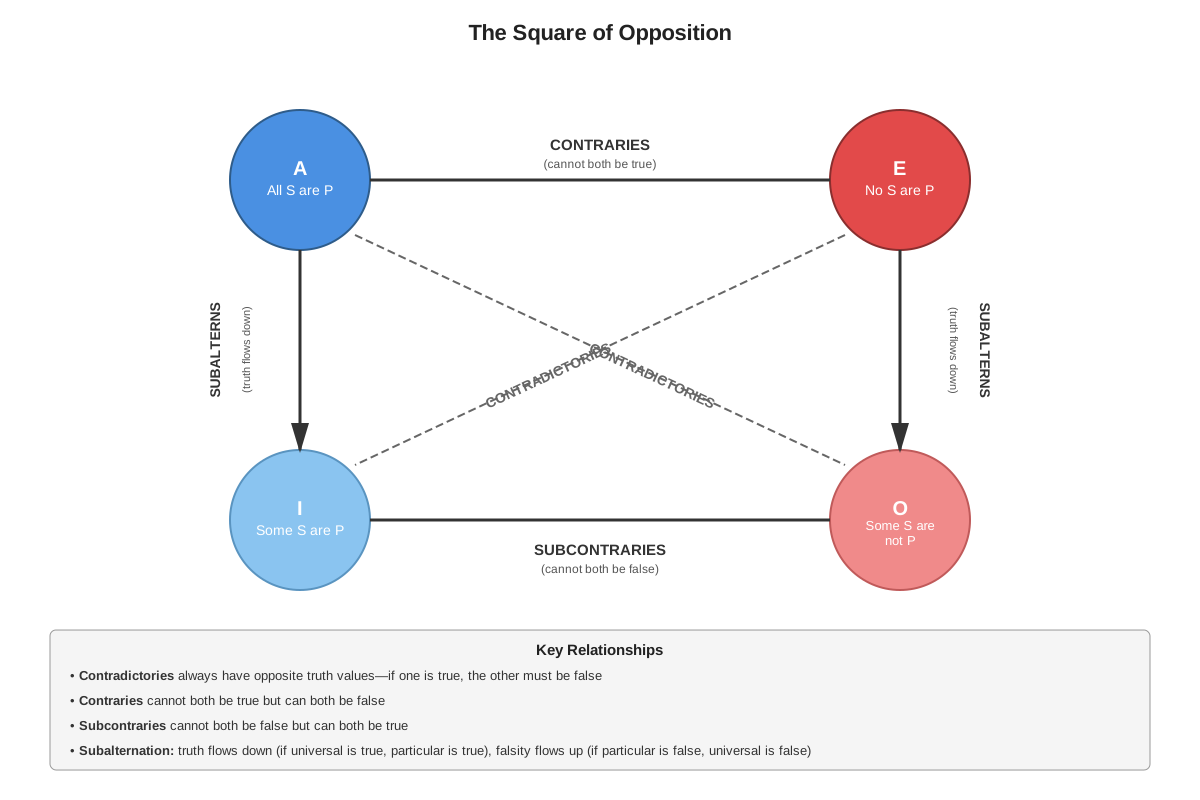
- Particular statements (I and O) cannot be contradicted by other particular statements—"Some S are P" and "Some S are not P" can both be true simultaneously.
- Universal statements (A and E) are contradictories—"All S are P" and "Some S are not P" cannot both be true or both be false.
- Venn diagrams can prove invalidity but not always validity—if the diagram shows the conclusion doesn't necessarily follow, the argument is invalid.
Quick check — test yourself on Categorical logic so far.
Try Flashcards →Common Misconceptions
Misconception: "Some S are P" means "some but not all S are P."
Correction: In formal logic, "some" means "at least one" and is compatible with "all." If all S are P, then it's also true that some S are P. The LSAT uses the logical definition, not the conversational implication.
Misconception: "All S are P" converts to "All P are S."
Correction: A statements do not convert validly. "All dogs are animals" does not mean "all animals are dogs." This is one of the most common errors in categorical reasoning and appears frequently in wrong answer choices.
Misconception: If "All S are P" is true, then "No S are P" is false, making them contradictories.
Correction: A and E statements are contraries, not contradictories. Both can be false (when some S are P and some S are not P), but both cannot be true. The true contradictory of "All S are P" is "Some S are not P."
Misconception: Distribution means a term appears in both premises of a syllogism.
Correction: Distribution means a statement makes a claim about every member of a category. A term can appear in both premises without being distributed in either, or it can be distributed in one statement where it appears but not the other.
Misconception: Venn diagrams are unnecessary if you understand the rules.
Correction: While rules-based approaches work, Venn diagrams provide a visual verification method that can catch errors and clarify complex relationships, especially under time pressure. They're particularly valuable for checking your work on difficult questions.
Misconception: "Most S are P" follows the same logical rules as "Some S are P."
Correction: "Most" is a distinct quantifier that doesn't fit into traditional categorical logic's four forms. "Most" statements have unique inference rules—for example, if most S are P and most S are Q, then some P must be Q (which doesn't work with "some").
Misconception: If a syllogism has true premises and a true conclusion, it must be valid.
Correction: Validity concerns logical structure, not truth. A syllogism can have true premises and a true conclusion while still being invalid if the conclusion doesn't follow necessarily from the premises. Conversely, a valid syllogism can have false premises and a false conclusion.
Worked Examples
Example 1: Immediate Inference Question
Question: If it is true that no professional athletes are amateur competitors, which of the following must also be true?
(A) All amateur competitors are professional athletes
(B) Some professional athletes are not amateur competitors
(C) No amateur competitors are professional athletes
(D) Some amateur competitors are professional athletes
(E) All non-amateur competitors are professional athletes
Solution:
Step 1: Identify the statement type and structure.
The given statement is "No professional athletes are amateur competitors." This is an E statement (No S are P), where S = professional athletes and P = amateur competitors.
Step 2: Determine what immediate inferences are valid for E statements.
E statements validly convert (switch subject and predicate) and validly obvert (change quality and negate predicate).
Step 3: Apply conversion.
"No professional athletes are amateur competitors" converts to "No amateur competitors are professional athletes." This matches answer choice (C).
Step 4: Evaluate other answer choices.
- (A) is invalid—it attempts to convert and change the quality, which produces an invalid inference
- (B) is actually true (if no professional athletes are amateur competitors, then certainly some professional athletes are not amateur competitors), but it's weaker than necessary; the statement tells us about ALL professional athletes
- (D) directly contradicts the original statement
- (E) commits the fallacy of illicit conversion and introduces a term (non-amateur competitors) not in the original statement
Step 5: Verify the answer.
Choice (C) is the valid conversion of the E statement and must be true if the original statement is true.
Answer: (C)
Connection to learning objectives: This example demonstrates how to identify categorical logic in LSAT questions (Objective 1), apply the reasoning pattern of immediate inference through conversion (Objective 2), and accurately solve the problem using categorical logic rules (Objective 3).
Example 2: Categorical Syllogism Evaluation
Question: All effective managers are good communicators. Some good communicators are introverts. Therefore, some effective managers are introverts.
Is this argument valid?
Solution:
Step 1: Identify the categorical statements and their forms.
- Premise 1: All effective managers are good communicators (A statement)
- Premise 2: Some good communicators are introverts (I statement)
- Conclusion: Some effective managers are introverts (I statement)
Step 2: Identify the three terms.
- S (minor term, in conclusion's subject): effective managers
- P (major term, in conclusion's predicate): introverts
- M (middle term, in both premises): good communicators
Step 3: Check distribution of the middle term.
The middle term "good communicators" appears as:
- Predicate of an A statement in Premise 1 (NOT distributed)
- Subject of an I statement in Premise 2 (NOT distributed)
The middle term is never distributed, violating Rule 1 of valid syllogisms.
Step 4: Visualize with a Venn diagram (described).
Draw three overlapping circles for effective managers, good communicators, and introverts. Premise 1 requires shading the area of "effective managers" that doesn't overlap with "good communicators" (all effective managers must be in the good communicators circle). Premise 2 requires placing an X somewhere in the overlap between "good communicators" and "introverts." However, this X could be placed in the area where good communicators and introverts overlap but effective managers don't. The conclusion (some effective managers are introverts) would require an X in the three-way overlap, but the premises don't force this.
Step 5: State the conclusion.
The argument is invalid. The middle term is undistributed, and the Venn diagram shows the conclusion doesn't necessarily follow. It's possible that all effective managers are good communicators, some good communicators are introverts, but no effective managers are introverts (if the introverted good communicators are a completely different subset from the effective managers).
Connection to learning objectives: This example shows how to recognize categorical syllogisms in LSAT arguments (Objective 1), explain why the reasoning pattern fails by identifying the violated rule (Objective 2), and apply systematic analysis to evaluate validity (Objective 3). It also demonstrates the value of diagramming (Objective 7) and translating natural language into standard form (Objective 4).
Exam Strategy
When approaching LSAT questions involving categorical logic, implement this systematic process:
Step 1: Identify trigger language. Watch for quantifiers: "all," "every," "each," "any" (universal affirmatives); "no," "none," "not any" (universal negatives); "some," "a few," "at least one," "several" (particular affirmatives); "some...not," "not all" (particular negatives). These signal categorical logic is in play.
Step 2: Translate to standard form. Convert natural language into one of the four standard forms (A, E, I, O). The LSAT often disguises categorical statements with complex wording. "Anyone who exercises regularly is healthy" becomes "All people who exercise regularly are healthy people."
Step 3: Diagram when helpful. For complex questions or when checking your work, quickly sketch Venn diagrams. Under time pressure, use diagrams selectively—they're most valuable for Must Be True questions with multiple categorical premises or for verifying your answer on difficult questions.
Step 4: Apply rules systematically. For immediate inferences, know which operations work for which statement types. For syllogisms, check the five validity rules in order, stopping when you find a violation. This prevents wasting time on unnecessary analysis.
Step 5: Eliminate aggressively. Wrong answers in categorical logic questions often commit predictable errors:
- Invalid conversions (especially converting A statements)
- Confusing "some" with "some but not all"
- Reversing the relationship between terms
- Introducing new terms not in the premises
- Claiming something "must be true" when it only "could be true"
Exam Tip: If a question asks what "must be true" based on categorical premises, the correct answer will follow necessarily through valid immediate inference or syllogism. If you find yourself making assumptions or adding information, you've likely chosen a trap answer.
Time allocation: Categorical logic questions typically require 60-90 seconds. Spend 20-30 seconds identifying and translating the statements, 20-30 seconds applying the relevant rules or drawing a diagram, and 20-30 seconds evaluating answer choices. If you're exceeding 90 seconds, make your best educated guess and move on—categorical logic questions, while high-yield, shouldn't consume disproportionate time.
Common trigger phrases to watch for:
- "If the statements above are true, which of the following must also be true?" → Apply immediate inferences or syllogistic rules
- "Which of the following can be properly inferred?" → Look for valid conversions, obversions, or contrapositions
- "The conclusion follows logically if which of the following is assumed?" → Identify the missing premise in a syllogism
- "The reasoning is flawed because..." → Look for violations of syllogistic rules or invalid immediate inferences
Memory Techniques
AEIO Mnemonic: Remember the four forms with "All Employees In Offices"
- All = Universal Affirmative (All S are P)
- Employees = Universal Negative (No S are P / Exclude all)
- In = Particular Affirmative (Some S are P / Include some)
- Offices = Particular Negative (Some S are not P / Omit some)
Distribution Memory Device: "All Subjects, Every Term, Only Predicates"
- A statements distribute the Subject
- E statements distribute Every Term (both subject and predicate)
- O statements distribute Only the Predicate
Conversion Validity: "Easy Inferences" convert validly
- E and I statements convert validly
- A and O do not
Contraposition Validity: "Always Opposite" contrapose validly
- A and O statements contrapose validly
- E and I do not
Obversion: "Obversion Operates on All" (all four types)
- All four statement types (A, E, I, O) obvert validly
- This is the universal operation
Syllogism Rules Acronym: "Middle Distributed, No Negatives, Particulars Problematic"
- Middle term must be distributed
- Distributed terms in conclusion must be distributed in premises
- No conclusion from two Negative premises
- Negative premise requires negative conclusion
- Particulars (two particular premises) are Problematic (no valid conclusion)
Visualization Strategy: Picture categories as physical containers. "All S are P" means the S container fits entirely inside the P container. "No S are P" means the containers are completely separate. "Some S are P" means the containers overlap with at least one item in the shared space. This concrete visualization helps prevent abstract reasoning errors under pressure.
Summary
Categorical logic provides a formal system for reasoning about relationships between groups and categories, forming a crucial component of LSAT Logical Reasoning. The four standard forms—A (All S are P), E (No S are P), I (Some S are P), and O (Some S are not P)—serve as building blocks for all categorical reasoning. Understanding distribution (which terms a statement makes claims about) enables you to determine valid immediate inferences through conversion, obversion, and contraposition. Categorical syllogisms, consisting of two premises and a conclusion with three terms total, must satisfy five validity rules to produce logically necessary conclusions. The LSAT tests categorical logic through Must Be True, Inference, Flaw, and Parallel Reasoning questions, requiring you to recognize categorical structures beneath complex language, apply formal rules systematically, and distinguish between what must be true versus what merely could be true. Mastery requires translating natural language into standard forms, applying inference rules accurately, and avoiding common errors like invalid conversion of A statements or misinterpreting "some" as excluding "all."
Key Takeaways
- The four standard categorical forms (A, E, I, O) represent all possible relationships between two categories, and recognizing these forms is the first step in solving categorical logic questions
- "Some" means "at least one" in formal logic, not "some but not all"—this distinction appears frequently in trap answers
- Only E and I statements convert validly; only A and O statements contrapose validly; all four statements obvert validly—memorizing these patterns enables quick, accurate inference
- Distribution determines validity: a term is distributed when a statement makes a claim about every member of that category, and understanding distribution is essential for evaluating syllogisms and immediate inferences
- Valid categorical syllogisms must satisfy five rules, with the middle term distribution rule being the most commonly violated and tested
- Venn diagrams provide a visual verification method that can clarify complex relationships and catch errors, especially valuable under time pressure
- Wrong answers predictably commit specific errors: invalid conversions, misinterpreting "some," reversing relationships, or claiming necessity when only possibility exists—recognizing these patterns accelerates elimination
Related Topics
Conditional Logic: While categorical logic deals with group membership and quantified relationships, conditional logic addresses "if-then" relationships between specific conditions. Mastering categorical logic provides the foundation for understanding how universal categorical statements (All S are P) can be expressed as conditionals (If S, then P), creating a bridge between these two formal logic systems.
Formal Fallacies: Many formal fallacies involve errors in categorical reasoning, such as illicit conversion, undistributed middle, or illicit process. Understanding valid categorical inference patterns enables you to identify these fallacies quickly in Flaw questions.
Quantifier Logic: Beyond the basic "all," "some," and "no" of categorical logic, LSAT questions incorporate quantifiers like "most," "many," "few," and "several." These require modified inference rules that build on categorical logic foundations while introducing new patterns.
Argument Structure Analysis: Categorical logic provides tools for analyzing how premises support conclusions in formal arguments. This skill transfers directly to evaluating argument structure in Strengthen, Weaken, and Assumption questions where categorical relationships form part of the reasoning.
Practice CTA
Now that you've mastered the core concepts of categorical logic, it's time to cement your understanding through active practice. Attempt the practice questions designed specifically for this topic, focusing on applying the immediate inference rules and syllogistic validity tests you've learned. Use the flashcards to drill the high-yield facts until recognizing valid and invalid inferences becomes automatic. Remember: categorical logic is a skill that improves dramatically with deliberate practice. Each question you work through strengthens your pattern recognition and speeds up your analysis, directly translating to points on test day. You've built the foundation—now build the fluency that will make you unstoppable on LSAT Logical Reasoning!
Sign up free to keep reading
Create a free AnvayaPrep account to finish this LSAT guide on Categorical logic — plus flashcards and practice questions.