Overview
Majority reasoning is a critical component of formal logic and quantifiers tested extensively on the LSAT's Logical Reasoning section. This reasoning pattern involves drawing conclusions about groups based on statements about what most, more than half, or the majority of members possess or do. Unlike universal quantifiers ("all" or "none") that apply to every member of a group, majority reasoning deals with probabilistic claims that apply to more than 50% but not necessarily all members.
Understanding LSAT majority reasoning is essential because the test frequently presents arguments that make logical leaps involving overlapping majorities, combined groups, or invalid inferences about what must be true based on majority statements. Test-makers exploit common intuitive errors students make when reasoning about majorities, such as assuming that if most As are Bs and most Bs are Cs, then most As must be Cs (which is invalid). The LSAT tests whether students can distinguish between valid and invalid majority inferences, identify flawed reasoning patterns, and recognize when conclusions overreach the evidence provided.
Within the broader landscape of logical reasoning, majority reasoning sits at the intersection of quantifier logic and probability reasoning. It requires more nuanced thinking than categorical logic because majority statements leave room for exceptions and uncertainty. Mastering this topic strengthens overall analytical skills needed for Assumption, Flaw, Strengthen/Weaken, and Must Be True question types—all high-frequency question categories on the LSAT.
Learning Objectives
- [ ] Identify how Majority reasoning appears in LSAT questions
- [ ] Explain the reasoning pattern behind Majority reasoning
- [ ] Apply Majority reasoning to solve LSAT-style problems accurately
- [ ] Distinguish between valid and invalid majority inferences
- [ ] Recognize common majority reasoning fallacies in argument structures
- [ ] Construct counterexamples to test majority reasoning claims
- [ ] Evaluate the logical strength of conclusions drawn from multiple majority premises
Prerequisites
- Basic quantifier logic (all, some, none): Understanding universal and existential quantifiers provides the foundation for grasping how majority quantifiers differ and what they can validly prove.
- Set theory fundamentals: Recognizing how groups overlap, intersect, and relate to one another is essential for visualizing majority relationships.
- Conditional reasoning basics: Many majority reasoning questions involve conditional statements combined with majority claims, requiring integration of both logical structures.
- Argument structure identification: Students must recognize premises and conclusions to evaluate whether majority statements adequately support the argument's conclusion.
Why This Topic Matters
Majority reasoning appears in real-world contexts constantly—from political polling ("most voters support this policy") to medical research ("the majority of patients experienced improvement") to business decisions ("most customers prefer this feature"). The ability to reason correctly about majorities prevents costly logical errors in professional and personal decision-making.
On the LSAT, majority reasoning appears in approximately 10-15% of Logical Reasoning questions across various question types. It most commonly surfaces in:
- Flaw questions: Identifying invalid inferences from majority premises
- Must Be True questions: Determining what necessarily follows from majority statements
- Assumption questions: Finding unstated premises needed to make majority-based arguments valid
- Strengthen/Weaken questions: Evaluating how additional information affects majority-based conclusions
- Parallel Reasoning questions: Matching argument structures involving majority claims
The LSAT specifically tests majority reasoning because it reveals sophisticated analytical thinking. Students who rely on intuition often make predictable errors, while those who understand the formal logic underlying majority statements can systematically evaluate arguments. This topic separates high scorers from average performers because it requires precision rather than approximation.
Core Concepts
The Majority Quantifier
The majority quantifier indicates that more than half of a group possesses a particular characteristic. Synonymous terms include "most," "more than 50%," "the majority of," and "over half." Formally, if a group contains N members, a majority means at least (N/2) + 1 members.
Key properties of majority statements:
- They guarantee more than half but provide no information about the remaining portion
- They do not specify how much more than half (could be 51% or 99%)
- They allow for exceptions—some members of the group do not possess the characteristic
- They are stronger than "some" (which means at least one) but weaker than "all"
Valid Majority Inferences
Understanding what can and cannot be validly concluded from majority statements is crucial for LSAT success.
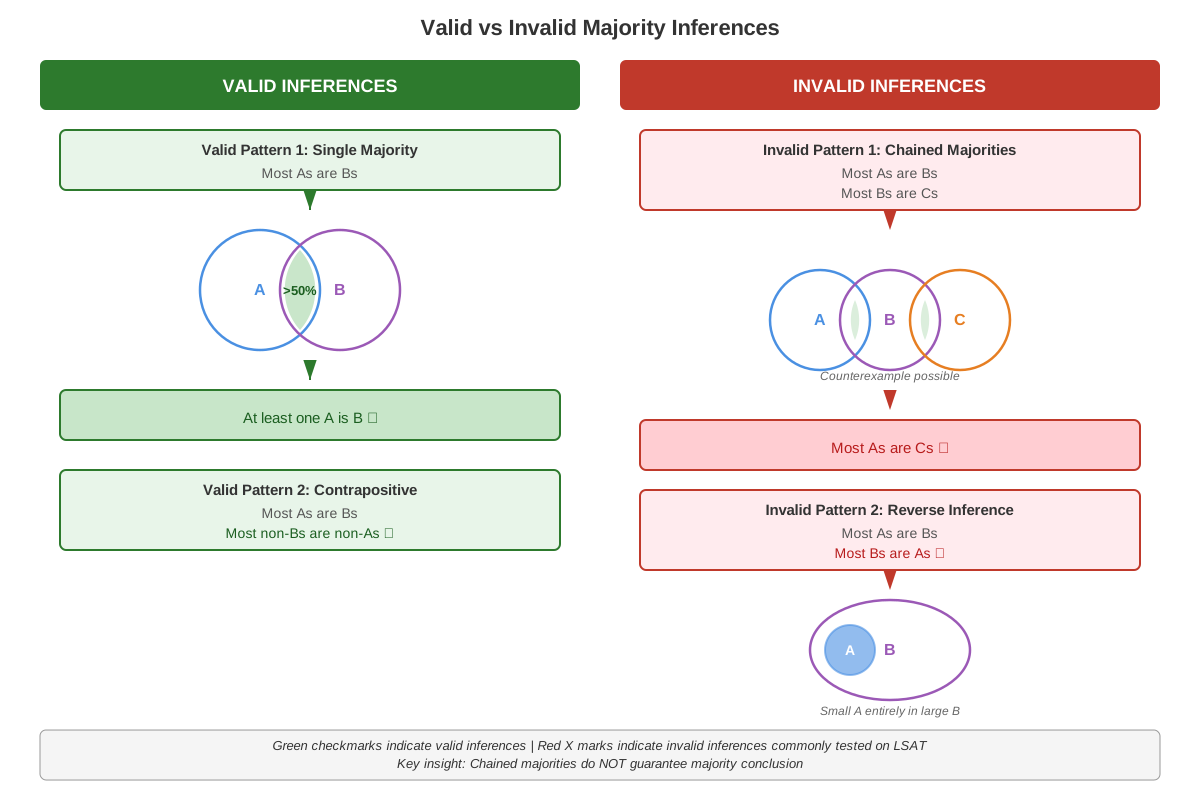
Valid Inference Pattern 1: Overlapping Majorities in the Same Group
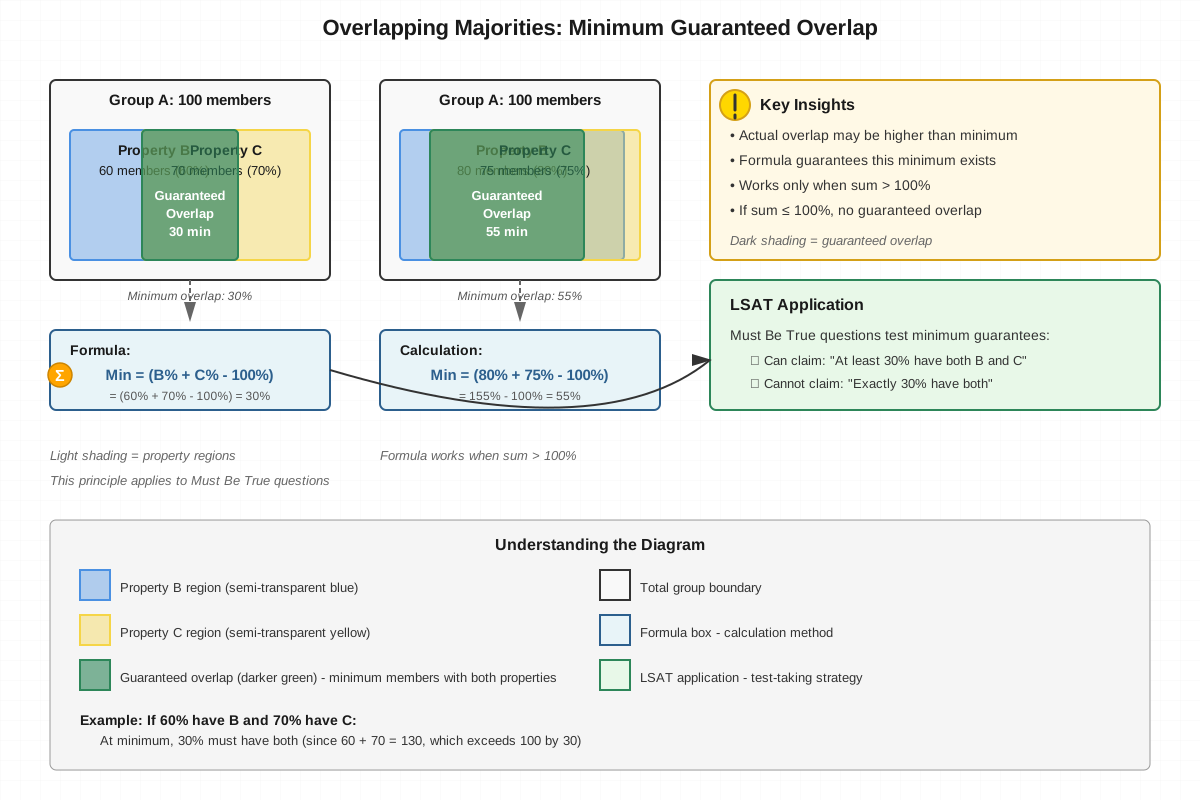
If most members of group X have property A, and most members of group X have property B, then at least some members of X must have both properties A and B.
Logical proof: If more than 50% have A and more than 50% have B, the overlap must be at least 1% (since 50% + 50% = 100%, and anything over 100% represents necessary overlap).
Valid Inference Pattern 2: Majority of a Majority
If most As are Bs, and we're examining only the As that are Bs, then statements about "most" of this subset refer to most of a majority—which could be less than half of all As.
Valid Inference Pattern 3: Contrapositive with Majorities
If most As are Bs, we can validly conclude that at least some Bs are As (assuming both groups exist). However, we cannot conclude that most Bs are As.
Invalid Majority Inferences
The LSAT frequently tests these common fallacies:
Invalid Pattern 1: Chaining Majorities
If most As are Bs, and most Bs are Cs, it does NOT follow that most As are Cs.
Counterexample: Suppose 100 As exist. 51 As are Bs (most). Among 1000 total Bs, 501 are Cs (most Bs are Cs). But those 51 As that are Bs might all be among the 499 Bs that are NOT Cs. Therefore, possibly zero As are Cs.
Invalid Pattern 2: Assuming Majority Means All
If most As are Bs, we cannot conclude that a randomly selected A is definitely B. We only know it's more likely than not.
Invalid Pattern 3: Reversing Majority Relationships
If most As are Bs, it does NOT follow that most Bs are As. The groups may be vastly different in size.
Example: Most professional basketball players are over 6 feet tall, but most people over 6 feet tall are not professional basketball players.
Majority Reasoning in Combined Groups
When arguments involve combining groups or subsets, special care is required:
| Scenario | Valid Conclusion | Invalid Conclusion |
|---|---|---|
| Most of Group A have property X; Most of Group B have property X | At least some members of A∪B have property X | Most members of A∪B have property X |
| Most of Group A have property X; Group A is a subset of Group B | At least some members of B have property X | Most members of B have property X |
| Most of Group A have property X; Most of Group A have property Y | At least some members of A have both X and Y | Most members of A have both X and Y |
Quantifying Majority Statements
The LSAT sometimes provides specific percentages or numbers. Converting between formats helps clarify reasoning:
- "Most" = More than 50%
- "Majority" = More than 50%
- "Nearly all" = Significantly more than 50%, approaching 100%
- "Few" = Less than 50%, but more than zero
- "Minority" = Less than 50%
When exact numbers are given, calculate precisely whether claims about majorities hold true.
Majority Reasoning with Conditional Statements
Complex LSAT questions combine majority reasoning with conditional logic:
Pattern: "Most As are Bs" + "If B, then C" → Valid conclusion: "Most As are Cs"
This works because the conditional guarantees that every B is a C, so the majority of As that are Bs must also be Cs.
Pattern: "Most As are Bs" + "If A, then C" → Valid conclusion: "Most Cs are Bs" is INVALID
The conditional tells us about all As, but doesn't establish the relationship between the majority of As that are Bs and the total population of Cs.
Concept Relationships
Majority reasoning builds directly on quantifier logic, representing a middle ground between existential quantifiers ("some") and universal quantifiers ("all"). While "some" requires only one instance and "all" requires every instance, "most" requires more than half—creating unique logical properties.
The relationship flows as follows:
Basic Quantifiers → Majority Quantifiers → Complex Majority Inferences → Majority Fallacies
Within majority reasoning itself, concepts connect hierarchically:
- Understanding the majority quantifier enables recognition of what majority statements claim
- Valid inference patterns show what logically follows from majority premises
- Invalid inference patterns reveal common logical errors the LSAT exploits
- Combined group reasoning applies majority logic to complex scenarios with multiple groups or overlapping sets
Majority reasoning also connects to probability and statistics (though the LSAT doesn't test mathematical calculation). A majority statement implies that randomly selecting a member from the group gives a >50% probability of selecting one with the stated property.
The topic relates to argument evaluation broadly because many LSAT arguments make claims about groups. Recognizing whether the argument validly applies majority reasoning determines whether the argument succeeds or contains a flaw.
High-Yield Facts
⭐ Most + Most in the same group = At least some overlap: If most As have property X and most As have property Y, then at least some As must have both X and Y.
⭐ Chaining majorities is invalid: "Most As are Bs" and "Most Bs are Cs" does NOT mean most As are Cs.
⭐ Majority does not reverse: "Most As are Bs" does NOT imply "Most Bs are As."
⭐ Majority + Conditional works forward: If most As are Bs, and all Bs are Cs, then most As are Cs.
⭐ Majority allows exceptions: "Most As are Bs" means some As are definitely not Bs.
- "Most" means more than 50%, not just "many" or "a lot"
- You cannot determine what's true about a specific individual from a majority statement alone
- Combining majorities from different-sized groups requires careful analysis of proportions
- "Most" is logically equivalent to "more than half" but not to "almost all"
- A majority of a subset may not constitute a majority of the whole group
- Two overlapping majorities guarantee at least 1% overlap (if both are exactly 51%, overlap is at least 2%)
- Majority statements are compatible with extreme distributions (51% vs 99% both satisfy "most")
- The contrapositive of a majority statement is NOT another majority statement
- Majority reasoning questions often appear in Flaw and Must Be True question types
- Recognizing invalid majority chains is one of the highest-yield skills for Logical Reasoning
Quick check — test yourself on Majority reasoning so far.
Try Flashcards →Common Misconceptions
Misconception: If most As are Bs and most Bs are Cs, then most As are Cs.
Correction: This is the classic majority chaining fallacy. The two majority statements could be true while zero As are Cs. The first majority tells us about a subset of Bs (those that are As), while the second tells us about a potentially different subset of Bs (those that are Cs). These subsets might not overlap at all.
Misconception: "Most" means the same as "many" or "a large number."
Correction: "Most" is a precise logical term meaning more than 50%. "Many" is vague and could mean 30%, 60%, or any substantial number. On the LSAT, these terms have different logical implications and are not interchangeable.
Misconception: If most As are Bs, then most Bs are As.
Correction: Majority relationships do not reverse. Consider: Most professional athletes are under 40 years old, but most people under 40 are not professional athletes. The size of the groups matters, and the relationship is not symmetrical.
Misconception: If most As are Bs, then any randomly selected A is definitely a B.
Correction: Majority statements indicate probability, not certainty. A randomly selected A is more likely than not to be a B, but it's not guaranteed. Some As are not Bs—that's what makes it "most" rather than "all."
Misconception: Two overlapping majorities mean that most members have both properties.
Correction: Two overlapping majorities guarantee only that at least some members have both properties. If 51% have property X and 51% have property Y, the overlap could be as small as 2% (though it could also be as large as 51%).
Misconception: "Most" and "more than half" are different logical concepts.
Correction: These are logically equivalent terms on the LSAT. Both mean the same thing: greater than 50%. Test-makers use varied language, but the logical meaning remains identical.
Worked Examples
Example 1: Identifying Invalid Majority Chaining
Question: "Most doctors recommend daily exercise. Most people who exercise daily take vitamin supplements. Therefore, most doctors take vitamin supplements."
Analysis:
Step 1: Identify the argument structure
- Premise 1: Most doctors recommend daily exercise
- Premise 2: Most people who exercise daily take vitamin supplements
- Conclusion: Most doctors take vitamin supplements
Step 2: Recognize the reasoning pattern
This argument attempts to chain two majority statements. Let's denote:
- D = doctors
- R = people who recommend daily exercise
- E = people who exercise daily
- V = people who take vitamin supplements
Step 3: Evaluate validity
The first premise tells us most Ds are Rs (most doctors recommend exercise). But this doesn't tell us whether doctors themselves exercise daily. The argument conflates "recommending exercise" with "exercising daily."
Even if we charitably interpret the first premise as "most doctors exercise daily," we still have:
- Most doctors exercise daily (most Ds are Es)
- Most people who exercise daily take vitamins (most Es are Vs)
- Conclusion: Most doctors take vitamins (most Ds are Vs)
This is invalid majority chaining. The doctors who exercise daily might all be among the minority of exercisers who don't take vitamins.
Step 4: Construct a counterexample
Suppose 100 doctors exist, and 51 exercise daily (most). Suppose 1,000 people exercise daily total, and 501 of them take vitamins (most). Those 51 doctors could all be among the 499 exercisers who don't take vitamins. Therefore, possibly zero doctors take vitamins, making the conclusion false despite true premises.
Answer: The argument commits the majority chaining fallacy and is invalid.
Example 2: Valid Overlapping Majority Inference
Question: "Most of the 200 students in the senior class play a sport. Most of the 200 students in the senior class are in the honor society. Which of the following must be true?"
(A) Most students who play a sport are in the honor society
(B) At least one student both plays a sport and is in the honor society
(C) Most students in the honor society play a sport
(D) More than 100 students play a sport and are in the honor society
(E) All students either play a sport or are in the honor society
Analysis:
Step 1: Translate the premises
- More than 100 students (of 200) play a sport
- More than 100 students (of 200) are in the honor society
Step 2: Evaluate each answer choice
(A) Invalid. This reverses a majority relationship. We know most students (in general) play a sport, but we don't know what proportion of sport-players are in the honor society.
(B) Valid. This must be true. If more than 100 play a sport and more than 100 are in the honor society, there must be overlap. Minimum overlap calculation: 101 + 101 = 202, which exceeds 200, so at least 2 students must have both properties. Even with exactly 101 in each group, at least 2 must overlap.
(C) Invalid. Same reversal error as (A).
(D) Invalid. While there must be overlap, we cannot determine it's more than 100. The overlap could be as small as 2 students (if 101 play sports and 101 are in honor society, with 99 having only one property each).
(E) Invalid. This would require that all 200 students have at least one property, but the premises don't guarantee this. If 101 play sports and 101 are in honor society, up to 98 students might have neither property.
Answer: (B) is correct. This question tests the valid inference that overlapping majorities in the same group guarantee at least some overlap.
Exam Strategy
Recognition Triggers
Watch for these words and phrases that signal majority reasoning:
- "Most," "majority," "more than half"
- "The greater part," "predominantly"
- Specific percentages over 50%
- "Typically," "generally," "usually" (often imply majority)
- "More [noun] than not"
Systematic Approach
Step 1: Identify all majority claims
Underline or note every statement involving "most" or equivalent terms. Distinguish these from universal claims ("all") and existential claims ("some").
Step 2: Map the logical structure
Draw a simple diagram showing groups and their relationships. Use circles or Venn diagrams to visualize overlaps.
Step 3: Check for common fallacies
- Is the argument chaining majorities? (Invalid)
- Is it reversing a majority relationship? (Invalid)
- Is it combining majorities from different-sized groups without accounting for proportions? (Likely invalid)
Step 4: Test with extreme cases
For Must Be True questions, try to construct a scenario where the premises are true but the conclusion is false. If you can, the conclusion doesn't "must be true."
Process of Elimination Tips
- Eliminate answers that chain majorities: If the argument or answer choice connects "most A are B" with "most B are C" to conclude "most A are C," it's wrong.
- Eliminate answers that reverse relationships: "Most A are B" does not support "most B are A."
- Eliminate answers requiring certainty: Majority statements don't guarantee what's true about specific individuals.
- Keep answers recognizing overlap: When two majorities apply to the same group, "at least some" overlap is valid.
Time Allocation
Majority reasoning questions typically require 1:15-1:45 to solve accurately. They're worth the time investment because they're:
- Highly predictable in their patterns
- Solvable with systematic analysis
- Often medium-to-hard difficulty (worth more for scoring)
Don't rush these questions. The test-makers know the intuitive wrong answer and make it tempting. Taking an extra 15 seconds to verify your logic often prevents costly errors.
Exam Tip: When you see "most" appear twice in an argument, immediately check whether the argument is attempting to chain majorities or identify overlap in the same group. This single distinction resolves many questions quickly.
Memory Techniques
The "51% Rule" Mnemonic
Remember: "MOST = More Over Fifty-one Threshold"
This reminds you that "most" is a precise logical term meaning >50%, not a vague quantity.
The "Chain Breaks" Visualization
Imagine a physical chain with two links:
- Link 1: Most As → Bs
- Link 2: Most Bs → Cs
Picture the chain breaking between the links—the connection doesn't carry through. This visual reminds you that chaining majorities is invalid.
The "Overlap Guarantee" Formula
"Two Majorities, One Group = Overlap Guaranteed"
When you see two "most" statements about the same group, immediately think "overlap." This pattern appears frequently and is always valid.
The "No Reverse" Traffic Sign
Visualize a "No U-Turn" traffic sign when you see a majority statement. This reminds you that majority relationships don't reverse: most As are Bs ≠ most Bs are As.
The "VALID" Acronym for Majority + Conditional
Verify the conditional applies to All members
Link the majority to the conditional's trigger
Infer the conclusion about the majority
Don't reverse or chain beyond this point
This helps remember that "Most As are Bs" + "All Bs are Cs" validly yields "Most As are Cs."
Summary
Majority reasoning is a high-yield LSAT topic that tests precise logical thinking about statements involving "most," "majority," or "more than half." The key to mastering this topic is understanding what can and cannot be validly inferred from majority premises. Valid inferences include recognizing that overlapping majorities in the same group guarantee at least some overlap, and that majority statements combined with universal conditionals allow forward inference. Invalid inferences—which the LSAT frequently tests—include chaining majorities (most As are Bs, most Bs are Cs, therefore most As are Cs), reversing majority relationships (most As are Bs, therefore most Bs are As), and treating majority statements as guarantees about individuals. Success requires systematic analysis rather than intuition, careful attention to group sizes and relationships, and the ability to construct counterexamples to test whether conclusions necessarily follow. Students who master majority reasoning gain a significant advantage on Flaw, Must Be True, Assumption, and Strengthen/Weaken questions, as these patterns appear throughout the Logical Reasoning section.
Key Takeaways
- Majority means more than 50%—a precise logical threshold, not a vague quantity
- Chaining majorities is invalid—the most commonly tested fallacy in majority reasoning
- Overlapping majorities guarantee at least some overlap—a valid and frequently tested inference
- Majority relationships don't reverse—most As are Bs does not imply most Bs are As
- Majority + conditional works forward—if most As are Bs and all Bs are Cs, then most As are Cs
- Construct counterexamples to test conclusions—if you can make premises true and conclusion false, it's invalid
- Watch for trigger words—"most," "majority," "more than half," and percentage claims over 50%
Related Topics
Conditional Logic: Majority reasoning frequently combines with conditional statements (if-then logic). Understanding how conditionals interact with majority claims enables solving complex hybrid questions.
Quantifier Logic (All, Some, None): Majority quantifiers sit between existential ("some") and universal ("all") quantifiers. Mastering the full spectrum of quantifiers provides comprehensive logical reasoning skills.
Formal Logic Translations: Converting English statements into formal logical notation helps clarify majority relationships and test validity systematically.
Probability and Statistics Reasoning: While the LSAT doesn't test mathematical calculation, understanding basic probability concepts reinforces why certain majority inferences are valid or invalid.
Argument Structure and Flaws: Majority reasoning errors constitute a specific category of logical flaws. Studying broader flaw types provides context for where majority reasoning fits in argument evaluation.
Practice CTA
Now that you understand the logical principles underlying majority reasoning, it's time to apply these concepts to actual LSAT questions. The practice questions and flashcards will reinforce your ability to quickly identify majority reasoning patterns, distinguish valid from invalid inferences, and avoid common traps. Remember: majority reasoning is highly predictable once you know the patterns. Each practice question you complete strengthens your pattern recognition and builds the confidence needed to tackle these questions efficiently on test day. Start practicing now—mastery comes through application!
Sign up free to keep reading
Create a free AnvayaPrep account to finish this LSAT guide on Majority reasoning — plus flashcards and practice questions.