Overview
Most plus most inference is a critical formal logic pattern that appears regularly on the LSAT Logical Reasoning section. This inference type involves combining two statements that each use the quantifier "most" to derive a valid conclusion. Understanding this pattern is essential because the LSAT frequently tests whether students can recognize when two "most" statements allow for a definite inference versus when they do not. The ability to navigate these quantifier relationships separates high-scoring test-takers from those who struggle with formal logic questions.
The lsat most plus most inference pattern represents a specific application of formal logic and quantifiers where test-takers must understand the mathematical implications of overlapping majorities. When properly structured, two "most" statements can guarantee that at least some members of one group possess a particular characteristic. This reasoning pattern appears in Must Be True questions, Inference questions, and occasionally in Strengthen/Weaken questions where understanding the logical relationship between premises is crucial.
Within the broader landscape of logical reasoning, most plus most inference sits at the intersection of quantifier logic and conditional reasoning. While conditional statements deal with sufficient and necessary conditions, quantifier statements deal with proportions and overlaps. Mastering this topic provides a foundation for understanding more complex argument structures and enables students to quickly identify valid versus invalid inferences—a skill that saves precious time during the exam and prevents falling for attractive wrong answer choices that seem plausible but lack logical necessity.
Learning Objectives
- [ ] Identify how Most plus most inference appears in LSAT questions
- [ ] Explain the reasoning pattern behind Most plus most inference
- [ ] Apply Most plus most inference to solve LSAT-style problems accurately
- [ ] Distinguish between valid and invalid most plus most inference patterns
- [ ] Calculate the minimum guaranteed overlap when combining two "most" statements
- [ ] Recognize when additional "most" statements do NOT yield valid inferences
- [ ] Evaluate answer choices that attempt to exploit common most plus most reasoning errors
Prerequisites
- Basic quantifier understanding: Familiarity with terms like "all," "some," "most," and "none" is essential because most plus most inference builds upon these foundational quantifier relationships.
- Set theory fundamentals: Understanding how groups overlap and relate to one another provides the conceptual framework for visualizing most plus most relationships.
- Conditional reasoning basics: While distinct from conditional logic, most plus most inference requires similar analytical thinking about how statements connect and what conclusions they support.
- Percentage and proportion concepts: Recognizing that "most" means "more than 50%" enables the mathematical reasoning underlying valid inferences.
Why This Topic Matters
Most plus most inference appears with remarkable frequency on the LSAT, making it one of the highest-yield formal logic patterns to master. Approximately 15-20% of Logical Reasoning questions involve quantifier relationships, and most plus most patterns constitute a significant portion of these questions. This topic appears most commonly in Must Be True questions, where students must identify what necessarily follows from the premises, and in Inference questions, where the correct answer is the one statement that must be accurate given the information provided.
Beyond exam performance, understanding most plus most inference develops critical thinking skills applicable to real-world reasoning. Legal professionals regularly encounter arguments involving proportions, majorities, and overlapping groups. Whether analyzing jury composition, evaluating statistical evidence, or assessing the scope of legal precedents, the ability to reason accurately about quantified statements proves invaluable. The LSAT tests this skill because it reflects the type of precise logical thinking required in legal practice.
The LSAT presents most plus most inference in various disguises. Sometimes the word "most" appears explicitly, but test-makers also use equivalent expressions like "more than half," "the majority of," "over 50%," or "a greater proportion than not." Questions may present the premises in separate sentences or embed them within a longer argument. Recognizing these patterns regardless of their presentation format is crucial for consistent performance. Additionally, the LSAT frequently includes wrong answer choices that represent invalid inferences from most statements, testing whether students truly understand the logical boundaries of what can be concluded.
Core Concepts
The Basic Most Plus Most Pattern
The fundamental most plus most inference follows a specific structure: when most members of Group A are also members of Group B, and most members of Group B are also members of Group C, then we can validly infer that at least some members of Group A must be members of Group C. This inference works because of the mathematical necessity created by overlapping majorities.
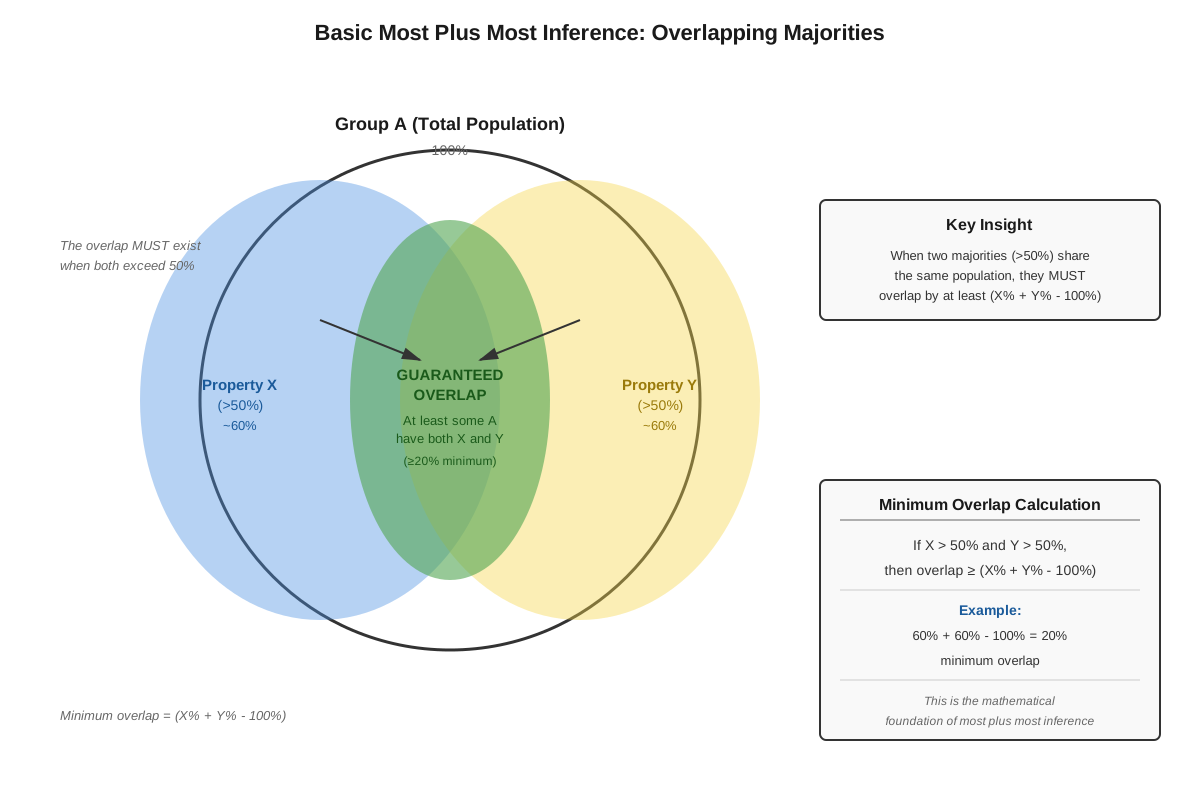
To understand why this inference is valid, consider the quantitative meaning of "most." In formal logic and quantifiers, "most" means "more than 50%" or "more than half." When more than 50% of Group A belongs to Group B, and more than 50% of Group B belongs to Group C, there must be overlap between the A members who are in B and the B members who are in C. The minimum guaranteed overlap can be calculated, ensuring that the inference is not merely probable but logically necessary.
The Mathematical Foundation
The mathematical reasoning underlying most plus most inference relies on understanding minimum guaranteed overlaps. If Group A contains 100 members and most (at least 51) are in Group B, and Group B contains 100 members and most (at least 51) are in Group C, then we can determine the minimum number of A members who must be in C.
Consider the worst-case scenario: the fewest possible A members in C would occur when the overlap is minimized. If 51 of A are in B, and 51 of B are in C, then in the worst case, the 49 members of B who are NOT in C could include up to 49 members from A. This would leave at least 2 members of A who must be in C (51 - 49 = 2). Therefore, we can always conclude that "some" members of A are in C, where "some" means "at least one" in LSAT logic.
The general formula for minimum overlap is: (percentage of A in B) + (percentage of B in C) - 100% = minimum percentage of A in C. For two "most" statements (each representing more than 50%), the calculation is: 50% + 50% - 100% = 0%+, meaning at least some overlap must exist, though the exact amount cannot be determined without more specific information.
Valid Inference Patterns
Several valid patterns emerge from most plus most reasoning:
- Chain Pattern: Most A → B, Most B → C, therefore Some A → C
- Reverse Chain: Most A → B, Most B → A, therefore Most A ↔ B (substantial overlap)
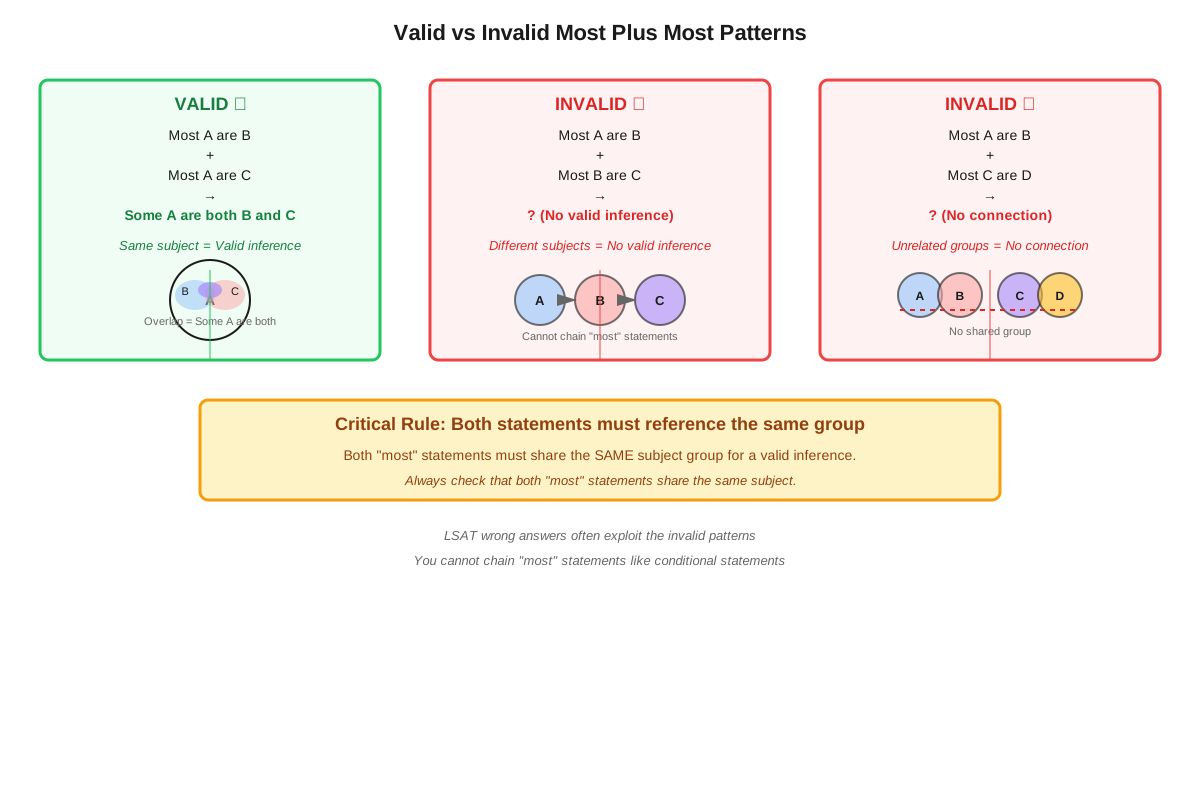
- Multiple Characteristics: Most A → B, Most A → C, therefore Some B → C (when applied to the same group)
The chain pattern represents the classic most plus most inference. The reverse chain shows that when most of each group belongs to the other, the groups substantially overlap. The multiple characteristics pattern demonstrates that when most members of a group share two different properties, some members must possess both properties.
Invalid Inference Patterns
Understanding what cannot be inferred is equally important for LSAT success. Several patterns appear valid but are actually invalid:
| Invalid Pattern | Why It Fails | Example |
|---|---|---|
| Most A → B, Most C → B, therefore Most A → C | Two groups can both mostly belong to a third without overlapping each other | Most dogs are mammals, most cats are mammals, but dogs are not cats |
| Most A → B, Some B → C, therefore Most A → C | "Some" is too weak to guarantee significant overlap | Most students study, some who study succeed, but we cannot conclude most students succeed |
| Most A → B, Most B → NOT C, therefore Most A → NOT C | The inference only guarantees "some," not "most" | Most lawyers are analytical, most analytical people are not artists, but we cannot conclude most lawyers are not artists |
Recognizing "Most" Equivalents
The LSAT rarely makes most plus most inference obvious by using the word "most" repeatedly. Instead, test-makers employ various equivalent expressions:
- "More than half"
- "The majority of"
- "Over 50 percent"
- "A greater proportion than not"
- "More [X] than not"
- "Most often"
- "Usually" (in some contexts)
- "Typically" (in some contexts)
Recognizing these equivalents allows students to identify most plus most patterns even when they are linguistically disguised. However, caution is necessary: words like "many," "often," and "frequently" do NOT necessarily mean "most" and cannot be used in most plus most inferences without additional information.
The Contrapositive and Most Statements
Unlike conditional statements, most statements do not have valid contrapositives in the traditional sense. If most A are B, we cannot conclude that most non-B are non-A. This represents a crucial difference between conditional logic and quantifier logic. However, we can make certain negative inferences: if most A are B, then it is not the case that most A are non-B (since both cannot be true simultaneously).
Concept Relationships
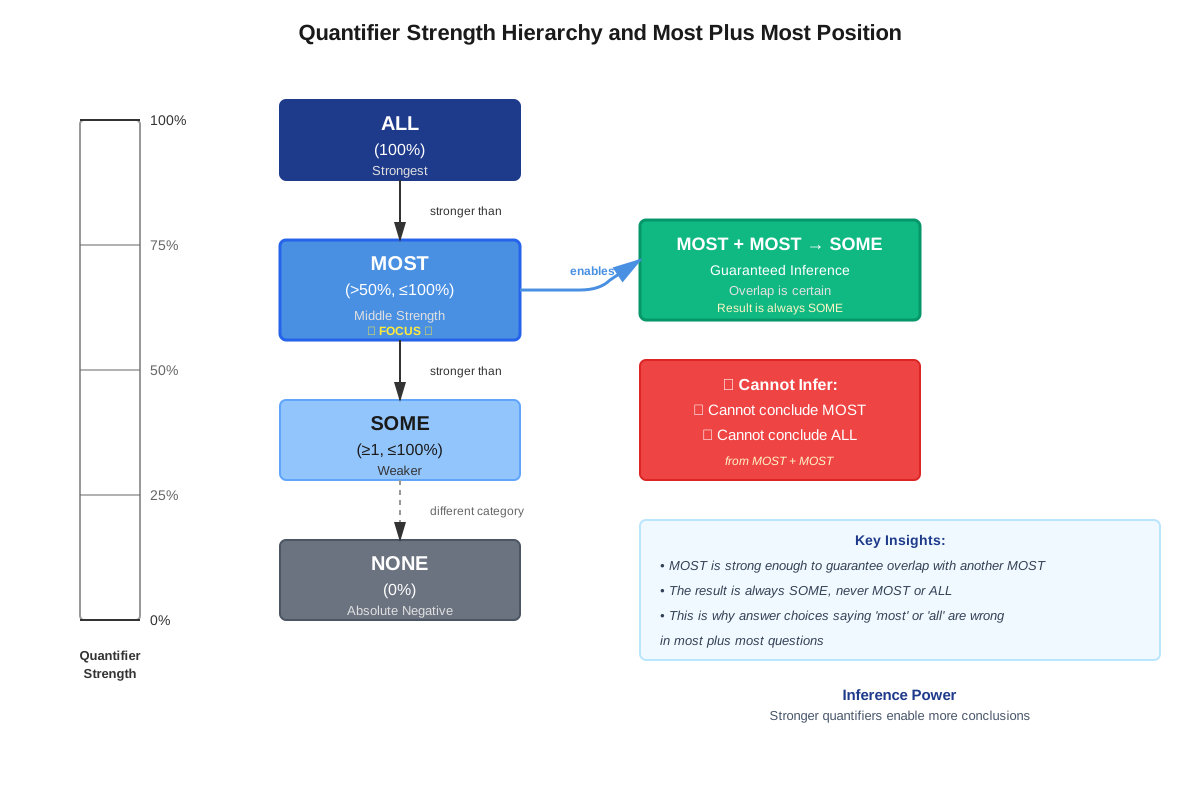
The most plus most inference pattern connects directly to broader quantifier logic, forming part of a hierarchy of logical strength. "All" statements are stronger than "most" statements, which are stronger than "some" statements, which are stronger than "could be" statements. Understanding this hierarchy helps students recognize when an inference is too strong or too weak given the premises.
Most plus most inference relates to conditional reasoning through structural similarity: both involve connecting statements to derive conclusions. However, the key difference lies in certainty versus proportion. Conditional statements (if A, then B) guarantee outcomes for individual cases, while most statements describe group proportions without certainty for any specific individual. This distinction is crucial: Most A → B does NOT mean "If A, then B."
The relationship map for this topic flows as follows: Basic quantifier understanding → Recognition of "most" and equivalents → Understanding overlap mathematics → Application of most plus most pattern → Distinction between valid and invalid inferences → Integration with broader argument analysis. Each step builds upon the previous, creating a comprehensive framework for handling quantifier-based reasoning on the LSAT.
Most plus most inference also connects to probability and statistics, though the LSAT tests logical necessity rather than likelihood. When two "most" statements combine, the inference represents what must be true in all possible scenarios consistent with the premises, not what is merely probable. This logical necessity distinguishes LSAT reasoning from statistical reasoning, where conclusions are expressed in terms of confidence levels rather than absolute requirements.
Quick check — test yourself on Most plus most inference so far.
Try Flashcards →High-Yield Facts
⭐ Most means "more than 50%" or "more than half" in LSAT logic, which is the foundation for all most plus most inferences.
⭐ Two "most" statements in a chain (Most A → B, Most B → C) always yield "at least some A → C" as a valid inference.
⭐ Two "most" statements converging on the same group (Most A → B, Most C → B) do NOT allow any inference about the relationship between A and C.
⭐ The minimum guaranteed overlap from two "most" statements is always at least one member (represented as "some" in LSAT logic).
⭐ "Most" statements do not have valid contrapositives in the way conditional statements do.
- When most A are B and most A are C, then some B must be C (applying both properties to the same group).
- The LSAT uses various synonyms for "most" including "majority," "more than half," and "over 50 percent."
- Three or more "most" statements in a chain still only guarantee "some" in the final inference, not "most."
- If most A are B, then it cannot also be true that most A are non-B (mutual exclusivity of majority claims).
- The exact number of overlapping members cannot be determined from "most" statements alone—only the minimum can be established.
- Most plus most inference appears most frequently in Must Be True and Inference question types.
- Wrong answer choices often present invalid inferences that seem intuitively plausible but lack logical necessity.
Common Misconceptions
Misconception: If most A are B and most B are C, then most A are C.
Correction: The valid inference is only that "some" A are C, not "most." The overlapping majorities guarantee at least some overlap but do not guarantee that a majority of A belongs to C. The minimum overlap could be as small as one or two members.
Misconception: If most A are B and most C are B, then most A are C.
Correction: This pattern yields no valid inference about the relationship between A and C. Both groups can predominantly belong to a larger third group without significantly overlapping each other, just as most dogs and most cats are mammals without dogs being cats.
Misconception: "Most" statements work exactly like conditional statements and can be chained indefinitely with the same strength.
Correction: While most statements can be chained, each link weakens the inference. Two "most" statements yield "some," and adding more "most" statements still only guarantees "some," never strengthening back to "most." Conditional statements, by contrast, maintain their strength through chains.
Misconception: If most A are B, then most B are A.
Correction: This reversal is invalid. Group A could be much smaller than Group B. For example, most professional basketball players are tall, but it is not true that most tall people are professional basketball players. The relationship is not symmetric.
Misconception: Words like "many," "often," and "frequently" can be treated as equivalent to "most" for inference purposes.
Correction: These words indicate a significant quantity but do not necessarily mean "more than half." Without explicit indication that the quantity exceeds 50%, these terms cannot be used in most plus most inferences. The LSAT is precise about this distinction.
Misconception: If you know most A are B and most B are C, you can determine exactly how many A are C.
Correction: You can only determine the minimum number (at least some), not the exact number. The actual overlap could range from the minimum to nearly all members of A, depending on the specific distribution.
Worked Examples
Example 1: Classic Most Plus Most Chain
Premise 1: Most attorneys who specialize in corporate law have studied economics.
Premise 2: Most people who have studied economics understand financial markets.
Question: Which of the following must be true?
Analysis:
Let's identify the structure. We have:
- Most corporate attorneys → studied economics
- Most studied economics → understand financial markets
This is a classic most plus most chain pattern. Let's verify the inference mathematically. If we assume 100 corporate attorneys, at least 51 have studied economics (most). If we assume 100 people who studied economics, at least 51 understand financial markets (most).
In the worst-case scenario for overlap, the 49 people who studied economics but don't understand financial markets could include up to 49 of our corporate attorneys. This would leave at least 2 corporate attorneys (51 - 49 = 2) who must understand financial markets.
Valid Inference: At least some attorneys who specialize in corporate law understand financial markets.
Invalid Inferences to Avoid:
- "Most corporate attorneys understand financial markets" (too strong—we only know "some")
- "Most people who understand financial markets are corporate attorneys" (reversal error)
- "All corporate attorneys who studied economics understand financial markets" (changes "most" to "all")
This example demonstrates the core most plus most inference pattern and shows why the conclusion must be limited to "some" rather than "most."
Example 2: Invalid Convergence Pattern
Premise 1: Most of the books in the library are fiction.
Premise 2: Most of the books in the library were published after 2000.
Question: Which of the following can be properly inferred?
Analysis:
This presents a different structure:
- Most library books → fiction
- Most library books → published after 2000
Both "most" statements apply to the same group (library books) but describe different properties. This is NOT a chain pattern but rather a multiple characteristics pattern.
Since most books are fiction (more than 50%) and most books were published after 2000 (more than 50%), there must be overlap. Using our formula: 50% + 50% - 100% = 0%+, meaning at least some books must be both fiction AND published after 2000.
Valid Inference: At least some fiction books in the library were published after 2000.
Invalid Inferences to Avoid:
- "Most fiction books were published after 2000" (we don't know the proportion within the fiction subset)
- "Most books published after 2000 are fiction" (we don't know the proportion within the post-2000 subset)
- "All fiction books published after 2000 are in the library" (introduces information not in the premises)
This example illustrates how most plus most inference works when both statements apply to the same group with different characteristics, yielding a guaranteed overlap.
Exam Strategy
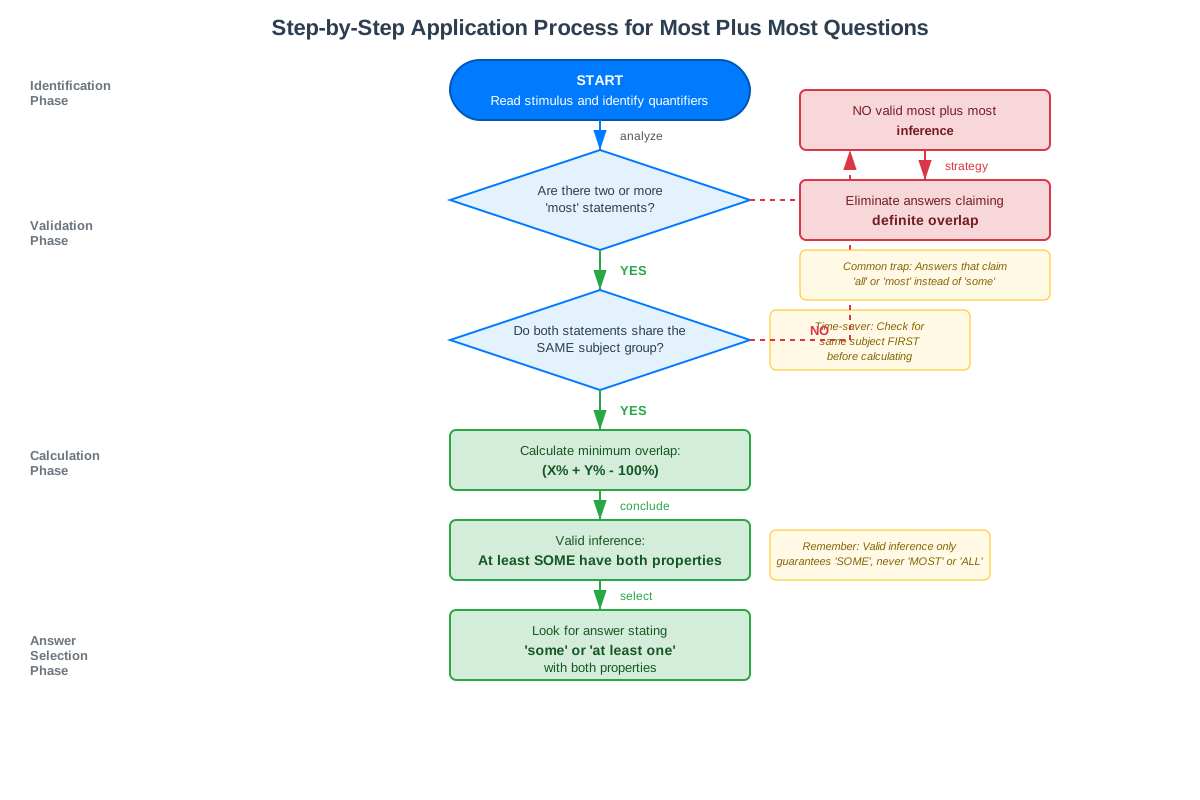
When approaching LSAT questions involving most plus most inference, begin by identifying all quantifier words in the stimulus. Circle or underline "most," "majority," "more than half," and equivalent expressions. This visual marking helps you quickly recognize potential most plus most patterns.
Exam Tip: If you see two "most" statements, immediately ask yourself: "Are these in a chain (A→B, B→C) or converging (A→B, C→B)?" This distinction determines whether a valid inference exists.
Trigger words and phrases to watch for:
- "Most," "majority," "more than half," "over 50%"
- "More [X] than not" (e.g., "more often than not")
- "The greater part," "the bulk of"
- "Predominantly," "primarily" (context-dependent)
Process-of-elimination strategy:
- Eliminate answer choices that claim "most" or "all" when the premises only support "some"
- Eliminate answer choices that reverse the direction of the inference without justification
- Eliminate answer choices that introduce new terms not connected by the premises
- Eliminate answer choices that confuse converging patterns with chain patterns
Time allocation advice: Most plus most inference questions should take 60-90 seconds once you recognize the pattern. If you find yourself spending more than two minutes, you may be overcomplicating the logic. Return to the basic structure: identify the pattern type, determine if it's valid, and select the answer that matches the guaranteed minimum inference (usually "some").
For Must Be True questions, remember that the correct answer must be true in every possible scenario consistent with the premises. If you can imagine even one scenario where an answer choice is false, eliminate it. Most plus most inferences guarantee only the minimum overlap, so any answer claiming more than this minimum is incorrect.
Memory Techniques
Mnemonic for valid chain pattern: "Most Chains Some" (Most + Most in a Chain = Some)
Visualization strategy: Picture two overlapping circles where each circle is more than half filled. The overlapping region represents the guaranteed inference. For a chain (A→B→C), imagine three circles where the first two overlap significantly, and the second two overlap significantly, forcing at least some overlap between the first and third.
The "51-49 Rule": Remember that "most" means at least 51 out of 100. When combining two "most" statements in a chain, visualize 51 + 51 - 100 = 2 minimum overlap. This concrete calculation helps anchor the abstract logic.
Acronym for invalid patterns: "Converging Never Concludes" (CNC) - When two "most" statements converge on the same group from different starting points, you can Never Conclude anything about the relationship between those starting points.
The "Majority Math" reminder: Most + Most = Some (guaranteed), but Most + Most ≠ Most (not guaranteed). This simple equation captures the essential limitation of most plus most inference.
Summary
Most plus most inference represents a critical formal logic pattern where two statements using the quantifier "most" (meaning more than 50%) can be combined to yield a valid conclusion. The fundamental valid pattern is the chain: when most A are B and most B are C, then at least some A must be C. This inference works because overlapping majorities mathematically guarantee at least minimal overlap. However, the inference only supports "some," never "most" or "all," regardless of how many "most" statements are chained together. Invalid patterns include convergence (most A are B, most C are B) which yields no inference about A and C, and reversal (most A are B does not mean most B are A). The LSAT tests this pattern frequently in Must Be True and Inference questions, often disguising "most" with equivalent expressions like "majority" or "more than half." Success requires recognizing the pattern type, applying the correct logical rule, and avoiding answer choices that overstate the strength of the inference or confuse valid with invalid patterns.
Key Takeaways
- Most plus most inference in a chain pattern (A→B, B→C) always yields "at least some A are C" as a valid conclusion
- "Most" means "more than 50%" and this mathematical definition underlies all valid inferences
- Two "most" statements converging on the same group from different sources do not allow inferences about the relationship between those sources
- The LSAT uses various synonyms for "most" including "majority," "more than half," and "over 50 percent"
- Valid inferences from most plus most patterns are limited to "some"—never "most" or "all"—regardless of chain length
- Most statements do not have valid contrapositives like conditional statements do
- Recognizing the pattern type (chain versus convergence) is the critical first step in determining whether a valid inference exists
Related Topics
Conditional Logic and Sufficient/Necessary Conditions: Understanding how conditional statements differ from quantifier statements helps prevent confusion between "if-then" reasoning and "most" reasoning. Mastering most plus most inference provides a foundation for distinguishing these logical structures.
Formal Logic Translations: The ability to translate everyday language into formal logical structures builds directly on most plus most inference skills, extending the pattern recognition to more complex argument forms.
Some and All Quantifiers: Most sits between "some" and "all" in logical strength. Understanding how these quantifiers interact and combine enables comprehensive analysis of quantifier-based arguments.
Overlapping Sets and Venn Diagrams: Visual representation of group relationships reinforces the mathematical foundation of most plus most inference and aids in quickly assessing valid versus invalid patterns.
Must Be True Question Types: Most plus most inference appears most frequently in these questions, so mastering this inference pattern directly improves performance on a high-yield question category.
Practice CTA
Now that you understand the mechanics and applications of most plus most inference, it's time to cement your knowledge through practice. Attempt the practice questions designed specifically for this topic, paying careful attention to distinguishing valid chain patterns from invalid convergence patterns. Use the flashcards to drill the key distinctions and trigger words until pattern recognition becomes automatic. Remember: most plus most inference is one of the highest-yield patterns on the LSAT, and mastering it will directly improve your Logical Reasoning score. Every practice question you complete builds the pattern recognition speed that separates good scores from great scores on test day.
Sign up free to keep reading
Create a free AnvayaPrep account to finish this LSAT guide on Most plus most inference — plus flashcards and practice questions.