Overview
Overlapping groups is a critical reasoning pattern that appears frequently on the LSAT, particularly in Logical Reasoning sections. This concept deals with situations where two or more categories or sets share common members, requiring test-takers to understand the logical relationships between these groups and draw valid inferences about their intersections. The ability to visualize and manipulate these relationships is essential for success on questions involving formal logic and quantifiers, as many LSAT problems present information about multiple groups and ask students to determine what must, could, or cannot be true about their overlap.
Understanding overlapping groups enables students to navigate complex argument structures where categorical statements interact. For instance, when an LSAT question states "All lawyers are professionals" and "Some professionals are wealthy," students must recognize that these groups overlap in specific ways and avoid drawing unwarranted conclusions about lawyers being wealthy. This type of logical reasoning requires precision in tracking which members belong to which groups and understanding the boundaries of valid inference.
The concept of LSAT overlapping groups connects directly to broader formal logic principles, including conditional reasoning, quantifier logic, and set theory. Mastery of this topic provides the foundation for tackling Must Be True questions, Inference questions, and certain Flaw questions where the error involves improper reasoning about group membership. Students who develop strong skills in analyzing overlapping groups gain a significant advantage across multiple question types and can more quickly identify both valid deductions and logical errors in LSAT arguments.
Learning Objectives
- [ ] Identify how overlapping groups appears in LSAT questions
- [ ] Explain the reasoning pattern behind overlapping groups
- [ ] Apply overlapping groups to solve LSAT-style problems accurately
- [ ] Diagram overlapping group relationships using Venn diagrams and logical notation
- [ ] Distinguish between valid and invalid inferences when groups overlap
- [ ] Recognize common trap answers that exploit misunderstandings of group overlap
- [ ] Evaluate arguments that make claims about the intersection or union of multiple categories
Prerequisites
- Basic set theory concepts: Understanding of sets, members, and basic set operations is necessary to visualize how groups can overlap and interact
- Categorical statements (All, Some, None): Familiarity with quantifiers is essential since overlapping group problems rely on interpreting statements about entire categories or portions thereof
- Conditional logic fundamentals: Knowledge of sufficient and necessary conditions helps in understanding how group membership in one category may or may not guarantee membership in another
- Venn diagram basics: Ability to read and construct simple Venn diagrams aids in visualizing the spatial relationships between overlapping groups
Why This Topic Matters
Overlapping groups reasoning appears in approximately 15-20% of Logical Reasoning questions on the LSAT, making it one of the most frequently tested formal logic concepts. This topic is particularly prevalent in Must Be True questions, Inference questions, and Method of Reasoning questions where the argument structure involves categorical relationships. Understanding overlapping groups is also crucial for identifying flaws in arguments that improperly conflate or separate categories.
In real-world applications, overlapping groups reasoning is fundamental to legal analysis, where attorneys must constantly navigate relationships between different legal categories, precedents, and jurisdictions. For example, determining whether a particular case falls within multiple legal doctrines or understanding how different statutory definitions overlap requires precisely the same logical skills tested in LSAT overlapping groups questions.
On the exam, overlapping groups typically appears in several forms: arguments that present information about multiple categories and ask what can be concluded about their intersection; questions that test whether students can recognize when group membership in one category does or doesn't guarantee membership in another; and problems requiring students to identify the minimum or maximum possible overlap between groups. The LSAT frequently uses overlapping groups in combination with other logical reasoning patterns, such as conditional chains or quantifier logic, making this a foundational skill that enhances performance across multiple question types.
Core Concepts
Understanding Group Overlap
Overlapping groups refers to situations where two or more sets or categories share at least some common members. In formal logic terms, this involves understanding the intersection, union, and complement of sets. When the LSAT presents information about multiple groups, students must track which members belong to which categories and what logical relationships exist between these groups.
The fundamental principle is that groups can relate to each other in several ways: they may be completely separate (disjoint), partially overlapping, or one may be entirely contained within another (subset relationship). Each configuration supports different valid inferences and prohibits others. For example, if "All A are B" is true, then group A is entirely contained within group B, but this tells us nothing definitive about whether all B are A.
The Three Basic Relationships
When analyzing overlapping groups on the LSAT, three primary relationships emerge:
- Complete Overlap (Identity or Subset): One group is entirely contained within another, or the groups are identical
- Partial Overlap (Intersection): Some members belong to both groups, but each group also has members not in the other
- No Overlap (Disjoint): The groups share no common members
| Relationship Type | Logical Form | Example | Valid Inference |
|---|---|---|---|
| Complete Overlap | All A are B | All dogs are mammals | If something is a dog, it's a mammal |
| Partial Overlap | Some A are B | Some lawyers are politicians | At least one thing is both a lawyer and a politician |
| No Overlap | No A are B | No reptiles are mammals | If something is a reptile, it's not a mammal |
Quantifier Logic in Overlapping Groups
The LSAT uses specific quantifiers that determine how groups overlap. Understanding these quantifiers is essential for formal logic and quantifiers mastery:
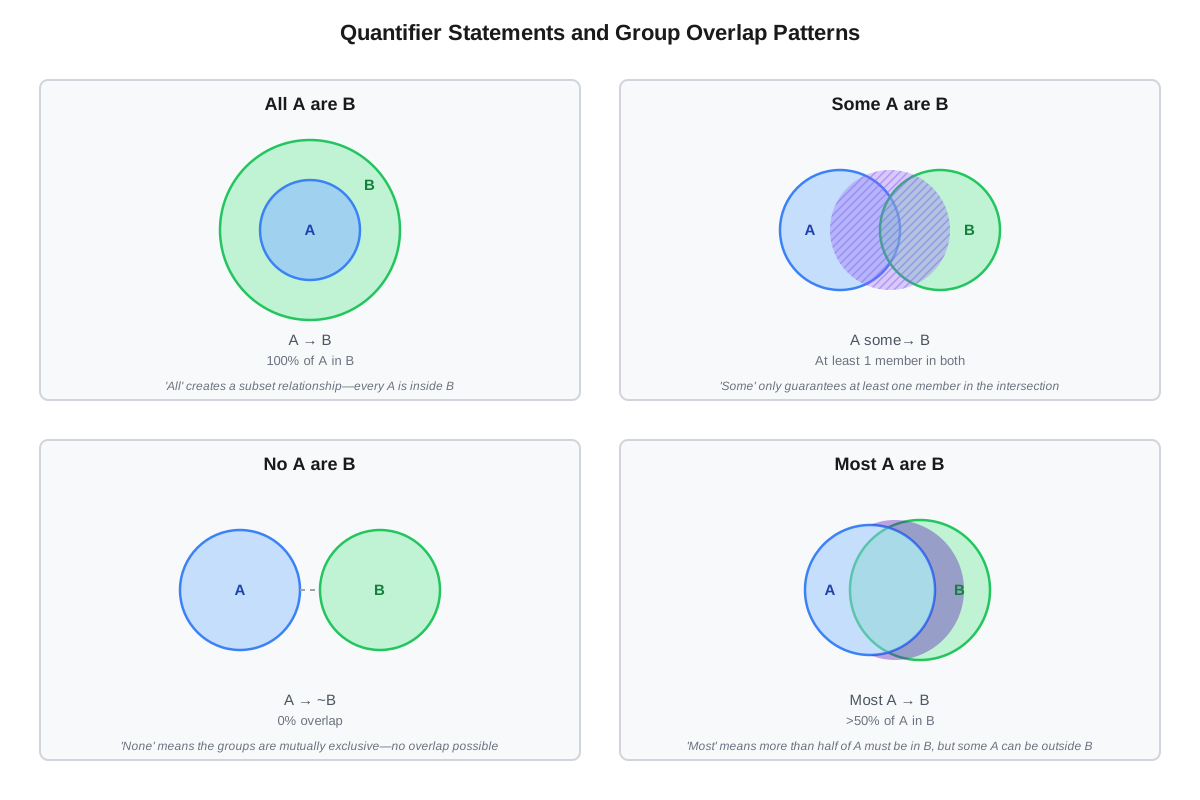
- "All": Indicates complete inclusion of one group within another (All A are B means the A group is entirely within the B group)
- "Some": Indicates at least one member is shared between groups, establishing partial overlap (Some A are B means at least one thing is both A and B)
- "None": Indicates complete separation with no shared members (No A are B means the groups are disjoint)
- "Most": Indicates more than half of one group belongs to another, which creates specific inference patterns
Valid Inference Patterns
When working with overlapping groups, certain inference patterns are always valid while others are never valid:
Valid patterns:
- From "All A are B" and "All B are C," we can conclude "All A are C" (transitive property)
- From "Some A are B" and "All B are C," we can conclude "Some A are C"
- From "No A are B" and "All C are A," we can conclude "No C are B"
Invalid patterns (common traps):
- From "All A are B," we CANNOT conclude "All B are A" (reversing the relationship)
- From "Some A are B," we CANNOT conclude "All A are B" (overgeneralizing)
- From "All A are B" and "All C are B," we CANNOT conclude anything definite about the relationship between A and C (they might overlap, or might not)
Visualizing with Venn Diagrams
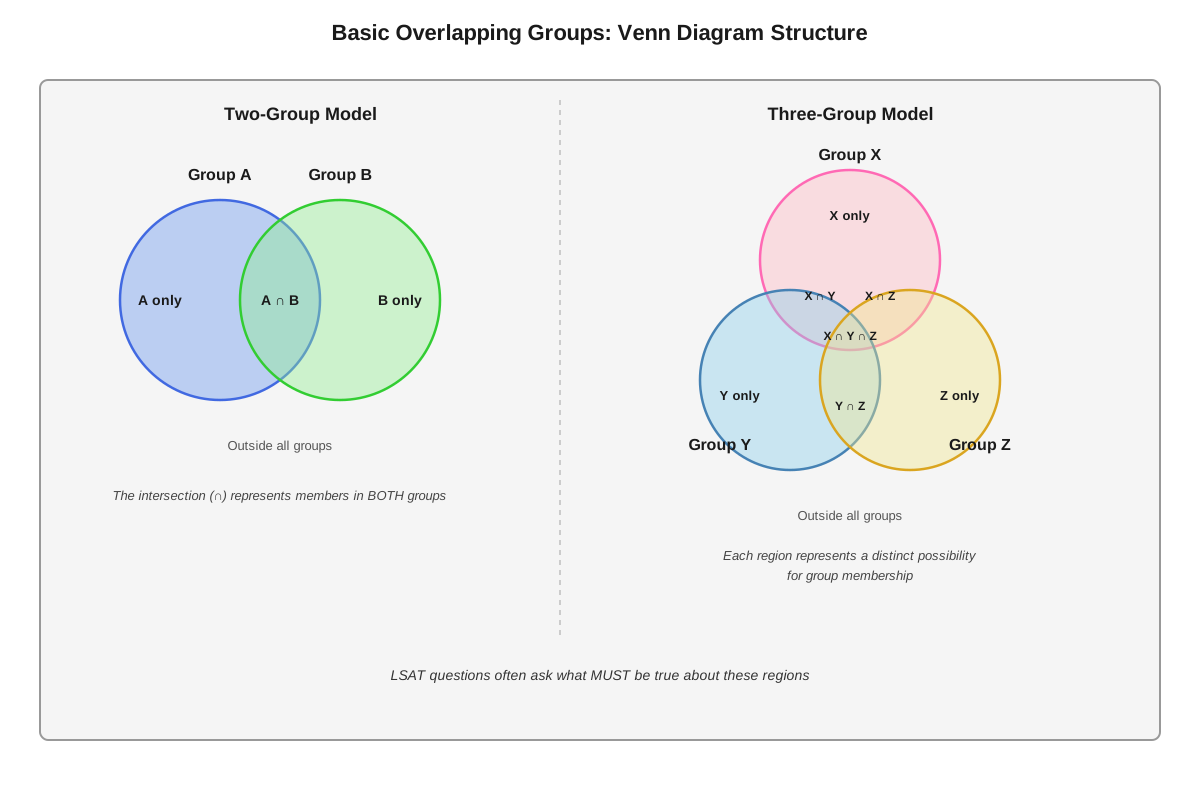
Venn diagrams provide a powerful tool for analyzing overlapping groups. In these diagrams, each circle represents a group, and the spatial relationships show how groups overlap:
- Concentric circles: Represent complete containment (All A are B shows circle A entirely inside circle B)
- Overlapping circles: Represent partial overlap (Some A are B shows circles A and B with a shared region)
- Separate circles: Represent disjoint groups (No A are B shows circles A and B with no contact)
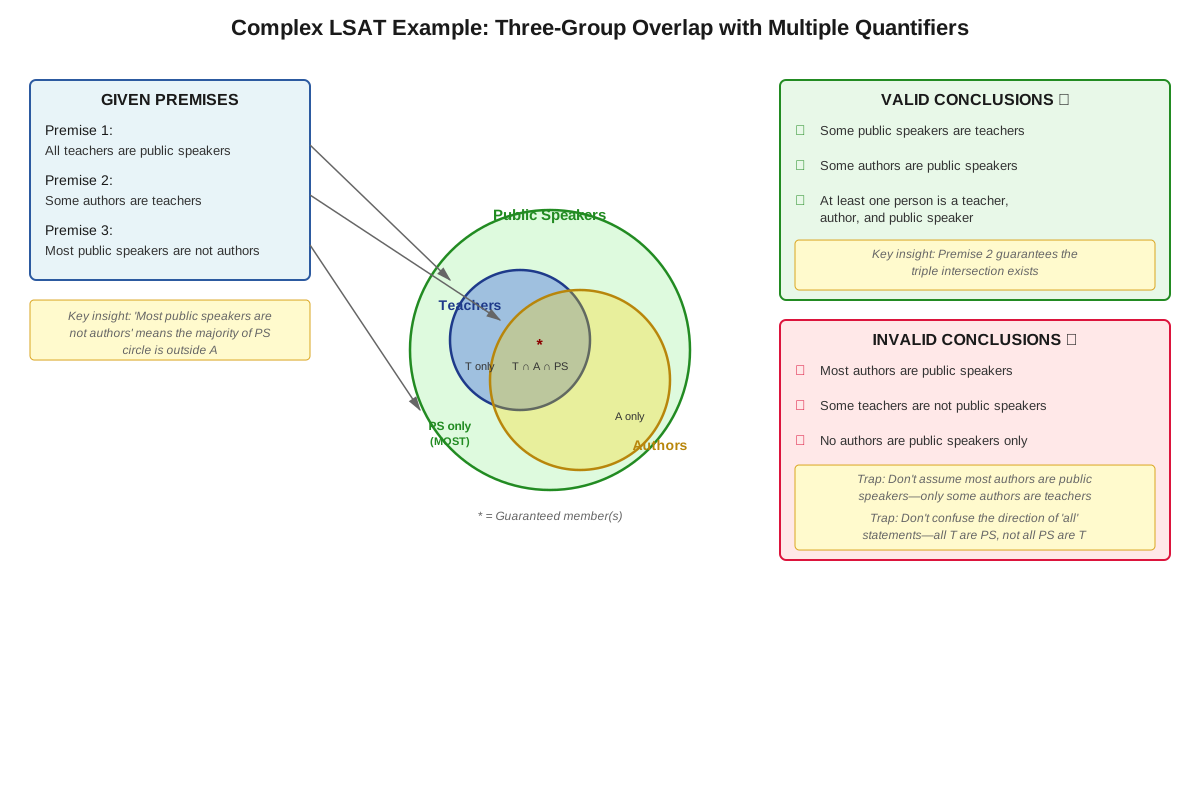
When the LSAT presents multiple categorical statements, constructing a mental or physical Venn diagram helps track all relationships simultaneously and identify what must be true based on the given information.
Maximum and Minimum Overlap
Many LSAT questions ask about the possible extent of overlap between groups. Understanding maximum and minimum overlap is crucial:
Minimum overlap occurs when we're told "Some A are B." This guarantees at least one member is shared, but the overlap could be as small as a single member.
Maximum overlap is constrained by the smaller group's size. If we know "Some A are B," the maximum overlap is limited by whichever group (A or B) is smaller. If we're told "Most A are B," then more than half of group A overlaps with B, but we still don't know the full extent.
Combining Multiple Statements
The LSAT frequently presents multiple statements about overlapping groups, requiring students to synthesize information:
When given "All A are B" and "Some B are C," we can conclude "Some A might be C" (possible but not certain) but cannot conclude "All A are C" or "No A are C." The key is tracking what each statement tells us and recognizing when we lack sufficient information to draw stronger conclusions.
Concept Relationships
The concepts within overlapping groups form a hierarchical structure where understanding basic group relationships enables analysis of more complex scenarios. Basic set relationships (complete overlap, partial overlap, no overlap) → serve as building blocks for → quantifier interpretation (All, Some, None, Most) → which enables → valid inference patterns → that support → complex multi-group analysis.
Overlapping groups connects directly to prerequisite knowledge of conditional logic: when we say "All A are B," this is equivalent to the conditional "If A, then B," creating a bridge between categorical and conditional reasoning. This connection is bidirectional—skills in one domain reinforce the other.
The relationship to formal logic and quantifiers is foundational: overlapping groups represents the practical application of quantifier logic to LSAT questions. Understanding how quantifiers (all, some, none, most) determine group relationships is essential for both identifying overlapping groups problems and solving them accurately.
Within the broader Logical Reasoning curriculum, overlapping groups serves as a gateway to more advanced topics like formal logic games, complex conditional chains, and argument structure analysis. Mastery of overlapping groups enables students to quickly recognize categorical reasoning patterns in arguments and evaluate whether conclusions follow validly from premises.
Quick check — test yourself on Overlapping groups so far.
Try Flashcards →High-Yield Facts
⭐ "All A are B" means every member of A is also in B, but does NOT mean every member of B is in A
⭐ "Some A are B" guarantees at least one member is shared between groups, establishing definite overlap
⭐ From "All A are B" and "All B are C," you can always conclude "All A are C" (transitive property)
⭐ "No A are B" means the groups are completely separate with zero shared members
⭐ You cannot determine the relationship between A and C from "All A are B" and "All C are B" alone—they might overlap or might not
- "Most A are B" means more than 50% of group A is in group B, but tells us nothing definite about what percentage of B is in A
- When two "Some" statements share a common term (Some A are B, Some B are C), you cannot conclude anything definite about the relationship between A and C
- The minimum overlap for "Some A are B" is exactly one member; the maximum is the size of the smaller group
- "All A are B" is logically equivalent to "No A are non-B"
- If you know "All A are B" and "No B are C," you can conclude "No A are C"
- Reversing an "All" statement (from "All A are B" to "All B are A") is one of the most common logical errors on the LSAT
- When groups overlap, members in the intersection possess characteristics of both groups
Common Misconceptions
Misconception: If "All A are B," then "All B are A" must also be true → Correction: This reverses the relationship incorrectly. "All A are B" only tells us that A is contained within B, not that B is contained within A. B may contain many other things besides A.
Misconception: "Some A are B" means "exactly some but not all" → Correction: In formal logic, "some" means "at least one" and is compatible with "all." If all A are B, then it's also true that some A are B. The LSAT uses "some" to mean "at least one, possibly all."
Misconception: If two groups both overlap with a third group, they must overlap with each other → Correction: From "Some A are C" and "Some B are C," we cannot conclude that A and B overlap. They might both overlap with C in completely different regions, remaining separate from each other.
Misconception: "Most A are B" and "Most B are A" can both be false simultaneously → Correction: If most A are B and most B are A, there must be substantial overlap. However, "Most A are B" alone doesn't tell us whether most B are A—these are independent claims about different groups.
Misconception: When visualizing overlapping groups, the size of circles in a Venn diagram represents the actual size of the groups → Correction: In logical analysis, Venn diagrams show relationships, not proportions. The relative sizes of circles don't matter unless the problem specifically provides information about group sizes.
Misconception: "No A are B" means "All A are not-B" in a way that tells us something about all non-B things → Correction: While "No A are B" does mean all A are outside B, it tells us nothing about non-B things that aren't A. Many things can be non-B without being A.
Worked Examples
Example 1: Multiple Group Analysis
Question: Consider the following statements:
- All professors are educators
- Some educators are administrators
- No administrators are students
What can we validly conclude?
Step 1: Identify the groups and relationships
- Groups: Professors (P), Educators (E), Administrators (A), Students (S)
- Statement 1: All P are E (professors completely contained in educators)
- Statement 2: Some E are A (educators and administrators partially overlap)
- Statement 3: No A are S (administrators and students are disjoint)
Step 2: Visualize the relationships
Mentally construct a Venn diagram:
- Circle P sits entirely inside circle E
- Circle A overlaps with circle E (but we don't know if it overlaps with P)
- Circle S is completely separate from circle A
Step 3: Test possible conclusions
Can we conclude "Some professors are administrators"?
- NO. While all professors are educators and some educators are administrators, we don't know if the professors are among the educators who are administrators. The overlap between E and A might not include any professors.
Can we conclude "No professors are students"?
- CANNOT BE DETERMINED from the given information. We know no administrators are students, but we don't know the relationship between professors and students directly. Professors might or might not be students.
Can we conclude "Some educators are not administrators"?
- YES. Since "Some educators are administrators" means at least one but not necessarily all, there must be at least some educators who are not administrators (unless we're told "All educators are administrators," which we're not).
Can we conclude "No students are professors"?
- CANNOT BE DETERMINED. We lack information about the relationship between students and professors.
Step 4: Identify the valid inference
The only statement we can validly conclude is that some educators are not administrators, based on the logical interpretation of "some" as "at least one, possibly but not necessarily all."
Connection to learning objectives: This example demonstrates how to identify overlapping groups in LSAT questions, apply the reasoning pattern to track multiple group relationships, and distinguish between valid and invalid inferences.
Example 2: Maximum Overlap Problem
Question: In a law firm, there are 30 attorneys. We know that 20 attorneys specialize in corporate law, and 18 attorneys specialize in litigation. What is the minimum number of attorneys who must specialize in both corporate law and litigation?
Step 1: Identify what we're looking for
We need the minimum overlap between two groups within a larger set.
Step 2: Apply the overlapping groups principle
- Total attorneys: 30
- Corporate specialists: 20
- Litigation specialists: 18
- If these groups overlapped as little as possible, we'd maximize the number of attorneys in only one category
Step 3: Calculate using the principle of maximum separation
If we want minimum overlap, we maximize the number of attorneys who are in only one group:
- Maximum attorneys in only corporate law: 20 (if no overlap)
- Maximum attorneys in only litigation: 18 (if no overlap)
- Total if no overlap: 20 + 18 = 38 attorneys
Step 4: Recognize the constraint
But we only have 30 attorneys total! This means the groups MUST overlap.
- The "excess" is 38 - 30 = 8
- Therefore, at minimum, 8 attorneys must specialize in both areas
Step 5: Verify the logic
If 8 attorneys do both:
- Attorneys doing only corporate: 20 - 8 = 12
- Attorneys doing only litigation: 18 - 8 = 10
- Attorneys doing both: 8
- Total: 12 + 10 + 8 = 30 ✓
Connection to learning objectives: This example shows how to apply overlapping groups reasoning to quantitative problems, demonstrating the mathematical relationship between group sizes and necessary overlap—a common LSAT pattern.
Exam Strategy
When approaching LSAT questions involving overlapping groups, follow this systematic process:
Step 1: Identify the trigger language
Watch for categorical statements using "all," "some," "none," "most," or "many." These quantifiers signal overlapping groups reasoning. Also look for phrases like "everyone who," "anything that," or "no one who."
Step 2: Map the groups
Quickly identify all groups mentioned and their relationships. Create a mental or scratch-paper Venn diagram if the question involves three or more groups. Label each group clearly and track which statements connect which groups.
Step 3: Apply valid inference patterns
Use only the valid inference patterns you've memorized. Be especially cautious about:
- Reversing "all" statements (invalid)
- Assuming two groups overlap just because they both overlap with a third group (invalid)
- Concluding "all" from "some" (invalid)
Step 4: Eliminate trap answers
The LSAT systematically includes wrong answers that represent common logical errors:
- Answers that reverse relationships
- Answers that overgeneralize from "some" to "all"
- Answers that assume overlap where none is guaranteed
- Answers that claim certainty where only possibility exists
Exam Tip: When you see "must be true," you need certainty. When you see "could be true," you need possibility. Overlapping groups questions often hinge on this distinction.
Time allocation: Spend 15-20 seconds mapping the relationships, then 30-40 seconds evaluating answer choices. If you find yourself spending more than 90 seconds total, mark the question and return to it later.
Process of elimination specific to overlapping groups:
- Eliminate any answer that reverses a categorical relationship
- Eliminate answers that claim definite overlap when only possible overlap exists
- Eliminate answers that make claims about groups not mentioned in the stimulus
- Keep answers that follow valid transitive patterns or properly apply quantifier logic
Memory Techniques
Mnemonic for valid "All" statement inferences: "TRAN-SWITCH"
- TRANsitive: All A→B + All B→C = All A→C (chains forward)
- SWITCH to contrapositive: All A→B = No non-B→A (but don't reverse!)
Visualization strategy: "Circle Containment"
When you see "All A are B," visualize a small circle (A) completely inside a larger circle (B). This image prevents the reversal error because you can see that B contains more than just A.
Acronym for quantifiers: "ASNM"
- All = complete containment
- Some = at least one overlap
- None = complete separation
- Most = more than half
Memory device for "Some" statements: "At Least One, Maybe All"
Repeat this phrase when you encounter "some" to remember that it doesn't exclude "all."
The "Two Alls Make a Chain" rule:
Whenever you see two "All" statements sharing a common term, they chain together. Visualize links connecting: All A→B + All B→C creates a chain A→B→C.
Overlap minimum formula: "Add and Subtract Total"
For minimum overlap between two groups within a larger set:
Minimum overlap = (Group 1 size + Group 2 size) - Total set size
(Only works when the sum exceeds the total)
Summary
Overlapping groups is a fundamental logical reasoning pattern on the LSAT that requires understanding how categorical statements determine relationships between sets. The core principle involves recognizing that groups can be completely contained within one another, partially overlapping, or entirely separate, and that different quantifiers (all, some, none, most) establish different relationships. Valid inference patterns include transitive chains with "all" statements, while common errors include reversing relationships and overgeneralizing from "some" to "all." Success with overlapping groups questions requires careful mapping of group relationships, often using Venn diagrams, and systematic application of valid inference rules while avoiding trap answers that exploit common misconceptions. The ability to analyze overlapping groups appears across multiple LSAT question types and serves as a foundation for more complex formal logic reasoning.
Key Takeaways
- All A are B means A is completely contained in B, but does NOT mean B is contained in A—reversing this relationship is the most common error
- Some A are B guarantees at least one shared member and is compatible with all A being B
- Valid transitive chains form when two "all" statements share a common term: All A→B + All B→C = All A→C
- Venn diagrams are powerful tools for visualizing group relationships and identifying valid inferences
- Maximum overlap is limited by the smaller group's size; minimum overlap can be calculated when group sizes and total set size are known
- Watch for trigger words (all, some, none, most) that signal overlapping groups reasoning
- Eliminate answer choices that reverse relationships, overgeneralize, or assume overlap without sufficient evidence
Related Topics
Conditional Logic and Sufficient/Necessary Conditions: Overlapping groups connects directly to conditional reasoning, as "All A are B" translates to "If A, then B." Mastering overlapping groups provides a foundation for understanding more complex conditional chains and contrapositive reasoning.
Formal Logic in Logic Games: The same principles of group overlap and categorical relationships appear in Logic Games, particularly in grouping games where elements must be assigned to categories with specific rules about overlap and separation.
Quantifier Scope and Negation: Advanced understanding of how quantifiers interact with negation (e.g., "not all" vs. "none") builds on overlapping groups fundamentals and appears in complex Logical Reasoning questions.
Argument Structure and Validity: Recognizing valid and invalid inference patterns in overlapping groups enhances the ability to evaluate argument structure more broadly, identifying when conclusions follow necessarily from premises.
Practice CTA
Now that you've mastered the core concepts of overlapping groups, it's time to reinforce your understanding through active practice. Attempt the practice questions to test your ability to identify group relationships, draw valid inferences, and avoid common traps. Use the flashcards to drill the key inference patterns and quantifier rules until they become automatic. Remember, overlapping groups appears in 15-20% of Logical Reasoning questions—your investment in mastering this topic will pay dividends across multiple sections of the LSAT. Approach each practice problem systematically, mapping relationships carefully and applying the valid inference patterns you've learned. With consistent practice, you'll develop the pattern recognition and logical precision needed to excel on even the most challenging overlapping groups questions.
Sign up free to keep reading
Create a free AnvayaPrep account to finish this LSAT guide on Overlapping groups — plus flashcards and practice questions.