Overview
Quantifier must be true questions represent a critical category within LSAT Logical Reasoning that tests a student's ability to draw valid inferences from statements containing quantified language. These questions require examinees to understand the precise logical relationships expressed through words like "all," "some," "most," "none," and "few," then determine what conclusions necessarily follow from the given premises. Unlike questions that ask what could be true or what strengthens an argument, quantifier must be true questions demand absolute certainty—the correct answer must be logically guaranteed by the stimulus.
This topic sits at the intersection of formal logic and quantifiers and inference-based reasoning, making it essential for success on the LSAT. Approximately 15-20% of Logical Reasoning questions involve quantifier relationships, and many of these specifically ask what "must be true" based on the information provided. Students who master quantifier logic gain a significant advantage because these questions follow predictable patterns and can be solved with mechanical precision once the underlying rules are understood.
The relationship between quantifier must be true questions and broader LSAT quantifier must be true concepts extends throughout the Logical Reasoning section. Understanding quantifier relationships enables students to evaluate argument validity, identify logical flaws, recognize sufficient and necessary conditions, and navigate complex conditional reasoning chains. This foundational skill supports performance not only on direct inference questions but also on assumption, strengthen/weaken, and flaw questions where quantifier precision determines correct answers.
Learning Objectives
- [ ] Identify how Quantifier must be true appears in LSAT questions
- [ ] Explain the reasoning pattern behind Quantifier must be true
- [ ] Apply Quantifier must be true to solve LSAT-style problems accurately
- [ ] Distinguish between valid and invalid inferences from quantified statements
- [ ] Recognize the logical relationships between different quantifier types (all, some, most, none)
- [ ] Translate complex natural language statements into formal quantifier notation
- [ ] Combine multiple quantified premises to derive compound inferences
Prerequisites
- Basic conditional logic (if-then statements): Understanding conditional relationships provides the foundation for recognizing how quantifiers express universal and particular claims about groups.
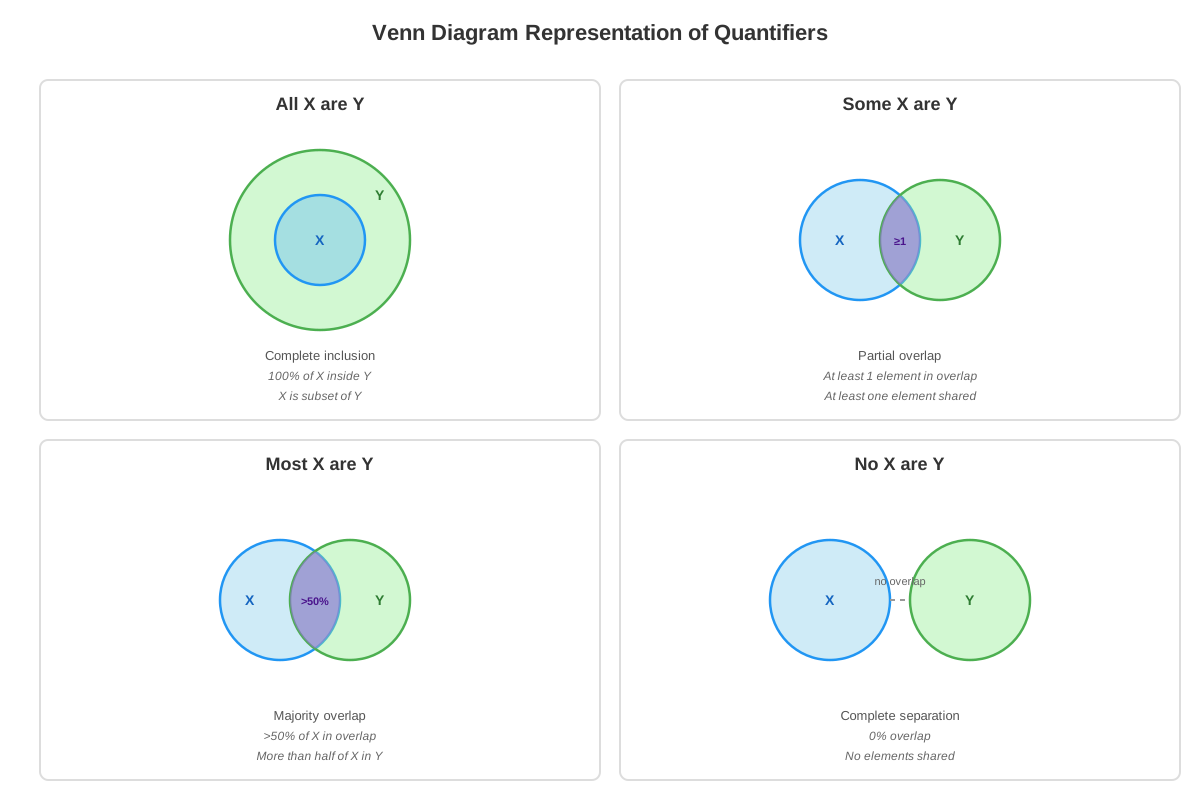
- Set theory fundamentals: Familiarity with concepts like subsets, intersections, and complements helps visualize the relationships quantifiers describe between categories.
- Logical validity vs. truth: Distinguishing between what must be true based on logical structure versus what happens to be factually true enables proper evaluation of inference questions.
- Contrapositive reasoning: The ability to form valid contrapositives is essential because many quantifier inferences rely on this logical operation.
Why This Topic Matters
Quantifier must be true questions appear with remarkable consistency on every LSAT administration, typically comprising 3-5 questions per test across both Logical Reasoning sections. These questions appear most frequently as "inference" or "must be true" question types, but quantifier reasoning also underlies "cannot be true," "most strongly supported," and certain "principle" questions. The predictable nature of quantifier logic makes this one of the highest-yield topics for score improvement—students who invest time mastering these patterns can convert previously challenging questions into reliable points.
In legal practice, attorneys constantly work with quantified statements in statutes, regulations, contracts, and case law. Understanding whether a rule applies to "all" parties or "some" parties, whether an exception covers "most" cases or merely "few" cases, and what conclusions necessarily follow from legislative language represents core legal reasoning. The LSAT tests this skill because it directly predicts success in legal analysis, where precision with quantified language can determine case outcomes.
On the exam, quantifier must be true questions typically present 2-4 premises containing quantified statements, followed by a question stem asking what must be true, can be properly inferred, or is most strongly supported. The stimulus may describe relationships between categories (all lawyers are professionals), numerical proportions (most students study logic), or existential claims (some arguments are valid). Answer choices often include tempting options that could be true or are likely true but don't necessarily follow from the premises—testing whether students can maintain the rigorous standard of logical necessity.
Core Concepts
Understanding Quantifier Types
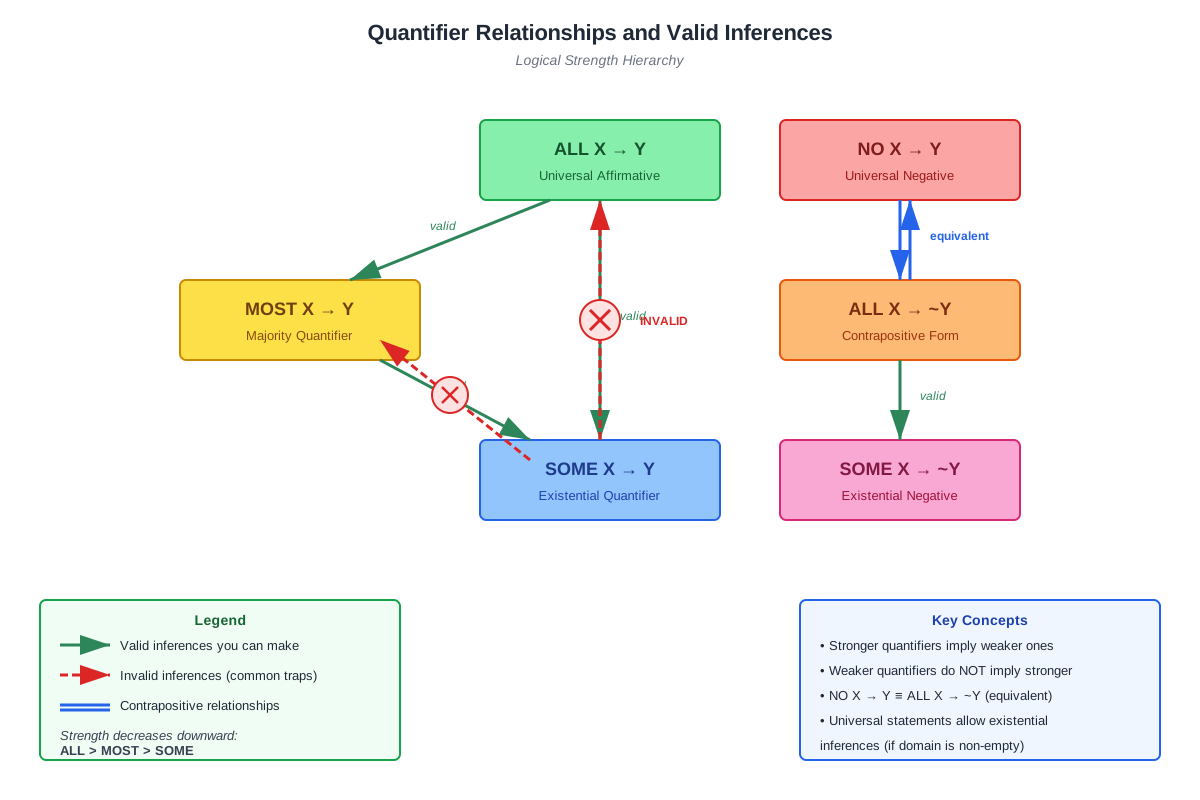
Quantifiers are linguistic expressions that specify the quantity or scope of a statement's application. The LSAT primarily tests five quantifier types, each with distinct logical properties:
Universal affirmative ("All"): Statements of the form "All A are B" establish that every member of category A is also a member of category B. This creates a subset relationship where A is entirely contained within B. For example, "All dolphins are mammals" means the set of dolphins is a subset of the set of mammals. Universal affirmatives support strong inferences: if all A are B, and X is an A, then X must be B.
Universal negative ("No/None"): Statements like "No A are B" establish complete exclusion between two categories. The sets have no overlap whatsoever. "No reptiles are mammals" means these categories are mutually exclusive. Universal negatives also support strong inferences: if no A are B, and X is an A, then X is definitely not B.
Particular affirmative ("Some"): The quantifier "some" means "at least one" in formal logic. "Some lawyers are judges" establishes only that at least one lawyer is a judge—it could be exactly one, several, most, or even all. This is the weakest affirmative quantifier and supports limited inferences. Importantly, "some" is logically equivalent to "at least one" and does not mean "some but not all" on the LSAT.
Majority quantifier ("Most"): Statements using "most" indicate more than half. "Most students study logic" means greater than 50% of students study logic. Most-statements enable specific inference patterns, particularly when combined with other quantified premises. Two "most" statements about the same category can yield a "some" conclusion through overlap reasoning.
Minority quantifier ("Few"): While less common, "few" typically means a small number but at least some. The LSAT occasionally uses "few" to mean "not many" without specifying an exact threshold, requiring careful attention to context.
Valid Inference Patterns
Several mechanical inference patterns appear repeatedly on LSAT quantifier questions:
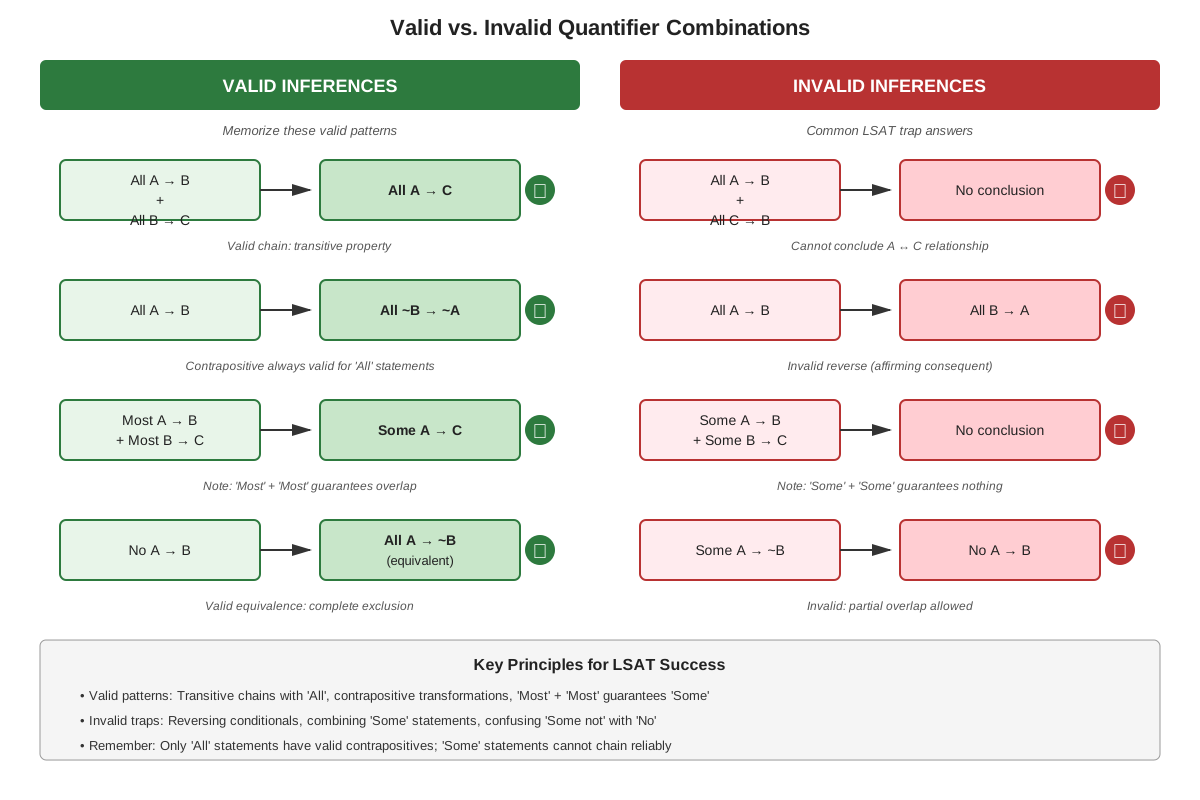
Contrapositive formation: Universal statements have valid contrapositives. "All A are B" converts to "All non-B are non-A" (if something isn't B, it can't be A). This pattern is crucial because LSAT questions frequently require recognizing contrapositive relationships. "No A are B" converts to "No B are A" (the relationship is symmetric).
Categorical syllogisms: When two premises share a common term, they may support a conclusion linking the other terms. The classic pattern: "All A are B" + "All B are C" → "All A are C" (transitive property). However, students must recognize invalid patterns: "All A are B" + "All C are B" does NOT prove any relationship between A and C (they could overlap, be identical, or be separate subsets of B).
Most-overlap reasoning: When two "most" statements share a category, they guarantee overlap. If "most A are B" and "most A are C," then "some B are C" must be true. The logic: if more than half of A are B, and more than half of A are C, these two groups must share at least some members (they can't both be majorities without overlapping).
Existential instantiation: From "some A are B," we can infer "some B are A" (the relationship is symmetric). We can also infer "at least one A exists" and "at least one B exists." However, we cannot infer anything about specific individuals or make universal claims.
Quantifier Negations
Understanding how to negate quantified statements is essential for contrapositive reasoning and evaluating answer choices:
| Original Statement | Logical Negation |
|---|---|
| All A are B | Some A are not B |
| No A are B | Some A are B |
| Some A are B | No A are B |
| Most A are B | Most A are not B (or: It's not true that most A are B) |
The negation of "all" is NOT "none"—it's "some are not." This distinction frequently appears in wrong answer choices designed to trap students who conflate opposites with negations.
Combining Multiple Premises
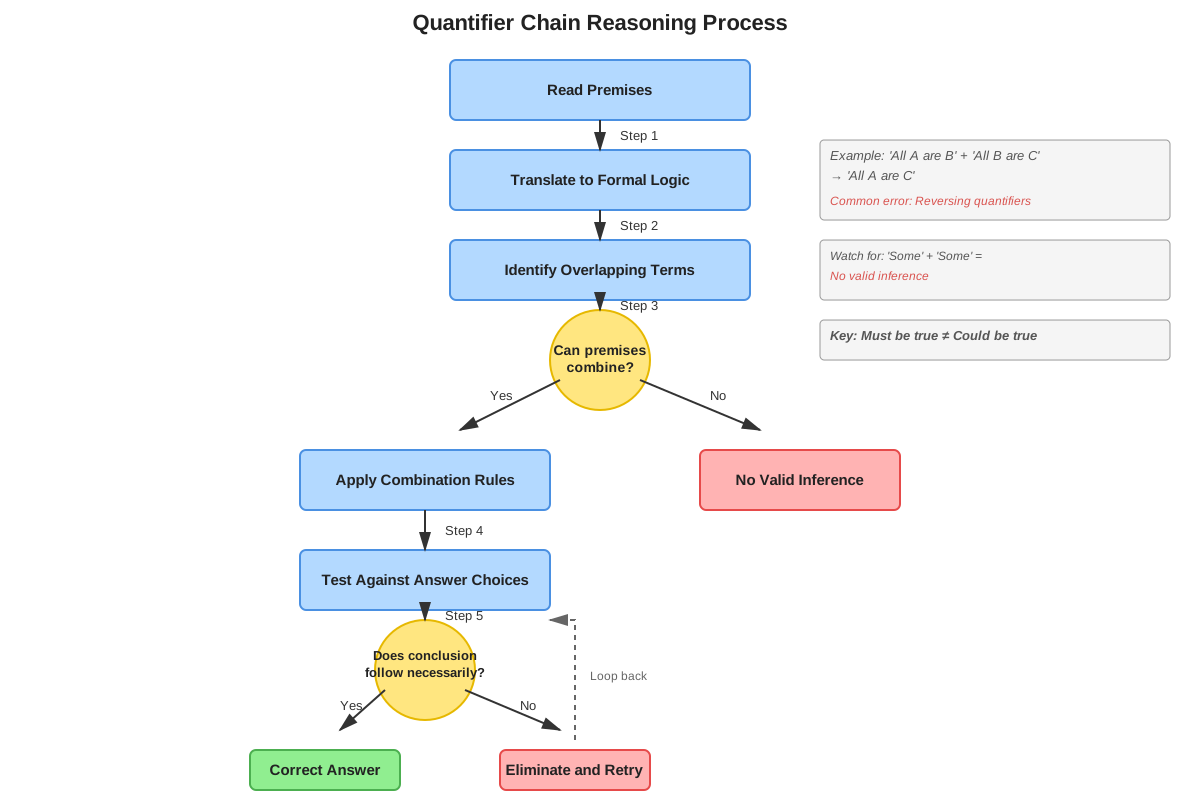
LSAT stimuli often provide 3-4 quantified premises that must be combined to reach a valid conclusion. The systematic approach:
- Diagram each premise using consistent notation (arrows, Venn diagrams, or symbolic logic)
- Identify common terms that appear in multiple premises
- Apply valid inference rules to combine premises
- Check for transitive chains where conclusions from one combination become premises for further inferences
- Verify the conclusion by confirming each logical step
For example, given: "All professors are educators," "Some educators are administrators," and "No administrators are students," we can validly infer "Some professors are not students" (combining the first two gives us "some professors are administrators," which combined with the third gives us the conclusion).
Distinguishing Must Be True from Could Be True
The critical distinction in quantifier reasoning is between logical necessity and mere possibility. An inference must be true if it is logically guaranteed by the premises—there is no possible scenario consistent with the premises where the inference is false. An inference could be true if it is consistent with the premises but not required by them.
Consider: "Most lawyers are litigators." Does it follow that "Some lawyers are not litigators"? This could be true (if "most" means 51-99%), but it doesn't must be true (because "most" could mean 100%, which equals "all"). LSAT correct answers for must-be-true questions require absolute certainty, not high probability.
Concept Relationships
The concepts within quantifier must be true reasoning form an interconnected logical system. Quantifier types (all, some, most, none) establish the foundational vocabulary, defining the strength and scope of claims. These quantifiers determine which valid inference patterns can be applied—universal quantifiers enable contrapositive and transitive reasoning, while particular quantifiers enable symmetric inferences and overlap reasoning. Quantifier negations connect to contrapositive formation, as creating valid contrapositives requires correctly negating both the sufficient and necessary conditions.
The relationship flows: Quantifier Types → Valid Inference Patterns → Combining Multiple Premises → Must Be True Conclusions. Each stage builds on the previous, with quantifier types constraining which inferences are valid, valid patterns enabling premise combination, and proper combination yielding conclusions that must be true.
Connections to prerequisite topics include: Conditional logic provides the if-then framework that universal quantifiers express (all A are B = if A, then B). Set theory offers visualization tools for understanding quantifier relationships through Venn diagrams and subset notation. Contrapositive reasoning directly applies to universal quantifiers, as "all A are B" and "all non-B are non-A" are logically equivalent.
Related topics that build on quantifier must be true include: Sufficient and necessary conditions (universal quantifiers express these relationships), formal logic diagramming (systematic notation for complex quantifier chains), and argument evaluation (recognizing when conclusions validly follow from quantified premises versus when they commit quantifier shift fallacies).
High-Yield Facts
⭐ "Some" means "at least one" in formal logic—it does not mean "some but not all" and is compatible with "all."
⭐ The contrapositive of "All A are B" is "All non-B are non-A," not "All B are A" (which is the invalid converse).
⭐ Two "most" statements about the same category guarantee a "some" overlap between the other categories.
⭐ "Most" means "more than half" (>50%), which is stronger than "some" but weaker than "all."
⭐ The negation of "All A are B" is "Some A are not B," not "No A are B."
- "Some A are B" is logically equivalent to "Some B are A" (particular affirmatives are symmetric).
- "No A are B" is logically equivalent to "No B are A" (universal negatives are symmetric).
- From "All A are B" and "All B are C," you can validly conclude "All A are C" (transitive property).
- From "All A are B" and "Some C are A," you can validly conclude "Some C are B" (combining universal and particular).
- You cannot validly conclude anything about the relationship between A and C from "All A are B" and "All C are B" alone (both could be separate subsets of B).
- "Most A are B" does NOT allow you to conclude "Most B are A" (the relationship is not symmetric for majority quantifiers).
- From "Some A are B" alone, you cannot conclude anything about "most" or "all" relationships.
- Three "most" statements about the same category can sometimes yield an "all" conclusion if the percentages force complete overlap.
Quick check — test yourself on Quantifier must be true so far.
Try Flashcards →Common Misconceptions
Misconception: "Some" means "some but not all," so if some A are B, then some A are not B.
Correction: In formal logic, "some" means "at least one" and is fully compatible with "all." "Some A are B" could be true even if every single A is a B. The statement only guarantees at least one A is B, not that at least one A isn't B.
Misconception: The opposite of "All A are B" is "All A are not B" (or "No A are B").
Correction: The logical negation of "All A are B" is "Some A are not B"—meaning at least one A is not B. The negation only needs to show the universal claim is false, which requires just one counterexample, not a universal negative claim.
Misconception: If "All A are B," then "All B are A" (confusing a statement with its converse).
Correction: The converse is not logically valid. "All dolphins are mammals" does not mean "All mammals are dolphins." The valid inference is the contrapositive: "All non-B are non-A" (All non-mammals are non-dolphins).
Misconception: If "Most A are B" and "Most B are C," then "Most A are C."
Correction: This pattern is invalid. Most-statements don't chain transitively like all-statements. You can only conclude "Some A are C" from this combination, not "Most A are C." The overlap could be minimal even though each individual "most" statement is true.
Misconception: From "Some A are B," you can conclude specific information about particular individuals.
Correction: Existential statements only guarantee that at least one member exists with the property; they don't tell you which specific individuals have it or allow conclusions about any particular A or B.
Misconception: "Few A are B" means "No A are B" or allows the same inferences as "No."
Correction: "Few" still means "some" (at least one), just a small number. It's a weak particular affirmative, not a universal negative. You cannot make the strong inferences that "No" allows.
Worked Examples
Example 1: Basic Quantifier Chain
Stimulus: All successful entrepreneurs are risk-takers. Most risk-takers are optimists. Some optimists are wealthy.
Question: Which one of the following can be properly inferred from the statements above?
Answer Choices:
(A) All successful entrepreneurs are optimists.
(B) Some successful entrepreneurs are wealthy.
(C) Most successful entrepreneurs are optimists.
(D) Some risk-takers are wealthy.
(E) Some successful entrepreneurs are optimists.
Solution:
Step 1: Diagram the premises.
- All entrepreneurs → risk-takers
- Most risk-takers → optimists
- Some optimists → wealthy
Step 2: Identify what we can validly infer.
From premise 1 (All entrepreneurs → risk-takers) and premise 2 (Most risk-takers → optimists):
We can infer that most entrepreneurs are optimists. Since ALL entrepreneurs are risk-takers, and MOST risk-takers are optimists, then MOST entrepreneurs must be optimists.
Step 3: Evaluate answer choices.
(A) "All successful entrepreneurs are optimists" - Too strong. We only know MOST risk-takers are optimists, not all, so we can't conclude all entrepreneurs are optimists. Incorrect.
(B) "Some successful entrepreneurs are wealthy" - We know some optimists are wealthy, and most entrepreneurs are optimists, but these groups might not overlap. We can't guarantee any entrepreneur is in the "some optimists who are wealthy" group. Incorrect.
(C) "Most successful entrepreneurs are optimists" - This follows from combining premises 1 and 2 as shown above. This must be true.
(D) "Some risk-takers are wealthy" - We know some optimists are wealthy, and most risk-takers are optimists, so there must be overlap. At least some risk-takers are both optimists and wealthy. This must be true.
(E) "Some successful entrepreneurs are optimists" - This is true (it follows from C), but it's weaker than C. Since C must be true, E must be true as well.
Best Answer: (C) is the strongest inference, though both (C), (D), and (E) must be true. In actual LSAT questions, only one answer would be defensible as the best answer, but this example illustrates how to work through the logical chain systematically.
Example 2: Most-Overlap Reasoning
Stimulus: Most of the students in Professor Chen's class are philosophy majors. Most of the students in Professor Chen's class are also members of the debate team.
Question: If the statements above are true, which one of the following must also be true?
Answer Choices:
(A) Most philosophy majors are members of the debate team.
(B) Most debate team members are philosophy majors.
(C) Some philosophy majors are members of the debate team.
(D) All students in Professor Chen's class are either philosophy majors or debate team members.
(E) Most students who are philosophy majors are in Professor Chen's class.
Solution:
Step 1: Identify the quantifier pattern.
- Most of Chen's students → philosophy majors (>50%)
- Most of Chen's students → debate team members (>50%)
Step 2: Apply most-overlap reasoning.
When two "most" statements share the same category (Chen's students), they guarantee overlap. If more than 50% are philosophy majors AND more than 50% are debate team members, these groups must share at least some members. The minimum overlap occurs when the percentages are just over 50% each—even then, they must overlap by at least a few students.
Step 3: Evaluate answer choices.
(A) "Most philosophy majors are members of the debate team" - This reverses the relationship. We know about Chen's students, not about all philosophy majors everywhere. Incorrect.
(B) "Most debate team members are philosophy majors" - Again, this reverses the relationship. We know about Chen's students, not about all debate team members. Incorrect.
(C) "Some philosophy majors are members of the debate team" - This must be true based on the overlap reasoning. Since most of Chen's students are philosophy majors and most are debate team members, at least some students must be both. This must be true.
(D) "All students in Professor Chen's class are either philosophy majors or debate team members" - Too strong. The statements allow for some students to be neither (up to 49% could be neither). Incorrect.
(E) "Most students who are philosophy majors are in Professor Chen's class" - This reverses the scope. We know about Chen's students, not about all philosophy majors. Incorrect.
Correct Answer: (C)
Key Takeaway: This example demonstrates the most-overlap principle—when two "most" statements share a common category, they guarantee a "some" relationship between the other categories. This pattern appears frequently on the LSAT.
Exam Strategy
Trigger Words: When you see question stems containing "must be true," "can be properly inferred," "logically follows," "must also be true," or "is most strongly supported," immediately activate quantifier analysis mode. These phrases signal that the correct answer must be logically guaranteed, not merely possible or probable.
Systematic Approach:
- Read the stimulus carefully, identifying every quantifier (all, some, most, none, few)
- Diagram or notate each quantified statement using consistent symbols
- Look for common terms that appear in multiple premises—these enable inference chains
- Apply valid inference patterns mechanically before looking at answer choices
- Predict the conclusion if possible, then find the matching answer
- Eliminate wrong answers by identifying logical gaps or invalid inference patterns
Process of Elimination Tips:
- Eliminate answers that are too strong: If the stimulus says "most," eliminate answers claiming "all"
- Eliminate reversed relationships: "All A are B" doesn't mean "All B are A"
- Eliminate scope shifts: If premises discuss "students in this class," eliminate answers about "all students everywhere"
- Eliminate "could be true" answers: The correct answer must be guaranteed, not merely possible
- Watch for negation errors: The negation of "all" is "some...not," not "none"
Time Allocation: Spend 60-90 seconds on the stimulus, carefully identifying quantifier relationships. Spend 30-45 seconds evaluating answer choices. These questions reward careful analysis over speed—rushing leads to missing subtle quantifier distinctions. If you've properly analyzed the stimulus, answer choice evaluation should be relatively quick.
Common Traps: The LSAT frequently includes wrong answers that commit the converse error (reversing a conditional), affirm the consequent, or make scope shifts. Also watch for answers that would be true in most real-world scenarios but aren't logically guaranteed by the premises—the LSAT tests logical necessity, not practical likelihood.
Memory Techniques
Quantifier Strength Hierarchy - Remember "AMSN" (All, Most, Some, None):
- All = strongest affirmative (100%)
- Most = majority affirmative (>50%)
- Some = weakest affirmative (≥1)
- None = strongest negative (0%)
Contrapositive Formation - "Flip and Negate":
To form a valid contrapositive, flip the order of terms and negate both terms. "All A → B" becomes "All not-B → not-A."
Most-Overlap Rule - "Two Mosts Make Some":
When two "most" statements share a category, visualize two overlapping circles each covering more than half of a box. They MUST overlap in the middle—that overlap is your "some" conclusion.
Negation Pairs - Remember these opposites:
- All ↔ Some...not
- None ↔ Some...are
- Most ↔ Most...not
Valid Syllogism - "ABC Chain":
All A → B, All B → C, therefore All A → C (transitive property works for universal affirmatives)
Symmetric Relationships - "Some and None Swing Both Ways":
"Some A are B" = "Some B are A"
"No A are B" = "No B are A"
But "All" and "Most" do NOT swing both ways!
Summary
Quantifier must be true questions test the ability to draw logically necessary conclusions from premises containing quantified language. Success requires mastering five quantifier types (all, none, some, most, few), understanding their logical properties, and applying valid inference patterns mechanically. Universal quantifiers (all, none) support strong inferences including contrapositives and transitive chains, while particular quantifiers (some) support only weak symmetric inferences. The majority quantifier (most) enables special overlap reasoning when two "most" statements share a category. Critical skills include distinguishing must-be-true from could-be-true, recognizing invalid patterns like the converse error, properly negating quantified statements, and combining multiple premises systematically. These questions appear frequently on every LSAT (3-5 per test), making them high-yield for score improvement. The mechanical nature of quantifier logic means students can achieve near-perfect accuracy through deliberate practice and pattern recognition.
Key Takeaways
- "Some" means "at least one" in formal logic and is compatible with "all"—it does not mean "some but not all"
- Universal quantifiers (all, none) support strong inferences including contrapositives and transitive chains; particular quantifiers (some) support only weak inferences
- Two "most" statements about the same category guarantee a "some" overlap between the other categories
- The contrapositive of "All A are B" is "All non-B are non-A," and the negation is "Some A are not B"
- Valid inference requires logical necessity, not mere possibility—eliminate answers that could be true but don't must be true
- Common traps include the converse error (reversing conditionals), scope shifts, and confusing negation with opposition
- Systematic diagramming and mechanical application of inference rules yields consistent accuracy on these high-frequency questions
Related Topics
Sufficient and Necessary Conditions: Quantifier logic directly connects to conditional reasoning, as "All A are B" expresses that being A is sufficient for being B, while being B is necessary for being A. Mastering quantifiers enables deeper understanding of conditional logic.
Formal Logic Diagramming: Advanced notation systems for representing complex quantifier relationships, including symbolic logic and formal proof techniques. This builds on basic quantifier understanding to handle multi-step inference chains.
Argument Evaluation and Flaws: Many logical fallacies involve improper quantifier reasoning, such as hasty generalization (inferring "all" from "some") or quantifier shifts (changing "some" to "most" without justification). Quantifier mastery enables identification of these flaws.
Conditional Logic Chains: Complex if-then reasoning often incorporates quantified statements, requiring integration of conditional and quantifier logic to derive valid conclusions.
Logical Oppositions and Negations: The traditional square of opposition in formal logic describes relationships between quantified statements (all, none, some, some-not), providing a systematic framework for understanding logical relationships.
Practice CTA
Now that you've mastered the core concepts of quantifier must be true reasoning, it's time to cement your understanding through active practice. Attempt the practice questions associated with this topic, focusing on applying the systematic approach outlined in the exam strategy section. Work through each question deliberately, diagramming premises and identifying valid inference patterns before evaluating answer choices. Review the flashcards to reinforce high-yield facts and inference rules until they become automatic. Remember: quantifier questions reward precision and pattern recognition—skills that improve dramatically with focused practice. Every question you work through builds the mental models that will make these questions feel mechanical on test day. You've got this!
Sign up free to keep reading
Create a free AnvayaPrep account to finish this LSAT guide on Quantifier must be true — plus flashcards and practice questions.