Overview
Set relationships form a foundational component of formal logic and quantifiers on the LSAT, appearing frequently in Logical Reasoning sections where test-takers must analyze how groups, categories, and classes relate to one another. Understanding set relationships means recognizing how collections of objects or individuals overlap, exclude, or contain one another—skills that directly translate to evaluating arguments, identifying logical flaws, and drawing valid inferences. On the LSAT, these relationships often appear disguised in everyday language, requiring students to translate verbal statements into precise logical structures that reveal hidden assumptions or necessary conclusions.
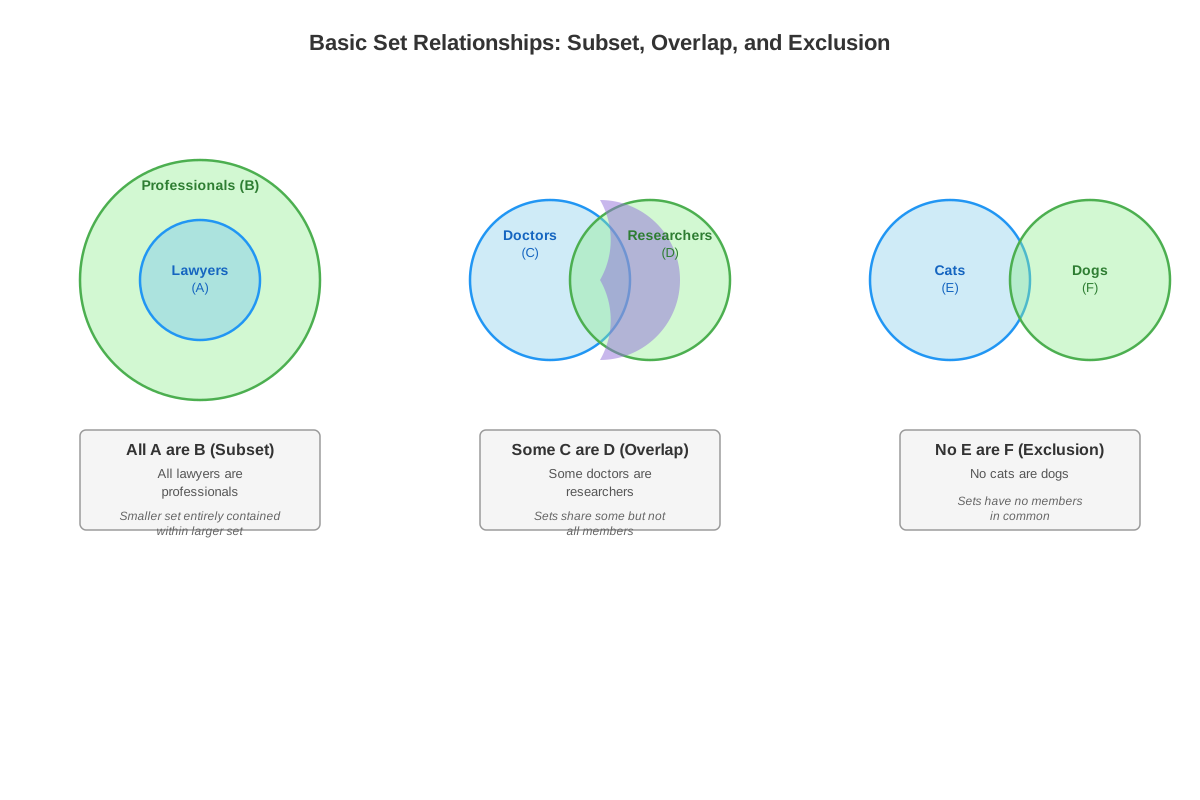
The LSAT tests set relationships through various question types, including Must Be True, Cannot Be True, Sufficient Assumption, and Flaw questions. Test-makers frequently construct arguments that depend on proper understanding of subset relationships, overlapping categories, or mutually exclusive groups. A statement like "All lawyers are professionals" establishes a subset relationship, while "Some doctors are researchers" indicates partial overlap between two sets. Misunderstanding these relationships leads to incorrect inferences and flawed reasoning—exactly what the LSAT is designed to detect.
Mastering lsat set relationships provides the logical foundation for more complex reasoning patterns throughout the exam. Set theory underlies conditional reasoning (which can be understood as relationships between sets of conditions and outcomes), helps identify scope shifts in arguments, and enables precise evaluation of quantified statements. This topic connects directly to formal logic notation, Venn diagram reasoning, and the broader skill of translating natural language into logical structures—all high-yield competencies for achieving a competitive LSAT score.
Learning Objectives
- [ ] Identify how Set relationships appears in LSAT questions
- [ ] Explain the reasoning pattern behind Set relationships
- [ ] Apply Set relationships to solve LSAT-style problems accurately
- [ ] Translate natural language statements into set relationship diagrams
- [ ] Distinguish between necessary and sufficient conditions using set logic
- [ ] Recognize invalid inferences that violate set relationship rules
- [ ] Combine multiple set relationships to draw valid compound conclusions
Prerequisites
- Basic categorical logic: Understanding of universal and particular statements (all, some, none) is essential because set relationships are expressed through these quantifiers
- Conditional reasoning fundamentals: Familiarity with if-then statements helps because conditional logic can be represented as set relationships where one set is contained within another
- Logical operators: Knowledge of "and," "or," and "not" is necessary because set relationships often involve combinations and exclusions of multiple categories
- Argument structure recognition: Ability to identify premises and conclusions enables students to see where set relationships function within LSAT arguments
Why This Topic Matters
Set relationships represent one of the most testable concepts in LSAT Logical Reasoning, appearing in approximately 15-20% of all Logical Reasoning questions either as the primary logical structure or as a component of more complex arguments. The LSAT frequently tests whether students can recognize valid versus invalid inferences from categorical statements, making this topic essential for both accuracy and speed.
In real-world applications, set relationship reasoning underlies legal analysis, policy evaluation, and categorical classification—all core competencies for law school and legal practice. Attorneys regularly work with statutory language that defines categories ("all persons who..."), exceptions ("except those who..."), and overlapping jurisdictions. The ability to precisely understand how groups relate prevents misapplication of rules and identifies gaps in legal coverage.
On the LSAT, set relationships most commonly appear in:
- Must Be True questions where the correct answer follows necessarily from categorical premises
- Flaw questions where arguments make invalid inferences about set membership or relationships
- Sufficient Assumption questions requiring an answer that bridges a gap between sets mentioned in premises and conclusion
- Parallel Reasoning questions where matching the set relationship structure is key to identifying equivalent arguments
- Cannot Be True questions testing understanding of what set relationships logically prohibit
Core Concepts
Basic Set Terminology and Notation
A set is a collection of distinct objects or individuals that share a common property. In LSAT contexts, sets typically represent categories like "lawyers," "professionals," "people who exercise regularly," or "countries with democratic governments." Understanding how these sets relate to one another forms the foundation of formal logic reasoning.
Sets can be represented using various notations. Capital letters often denote sets (e.g., L = lawyers, P = professionals), while membership is indicated by statements like "x ∈ L" (x is a member of set L). However, the LSAT rarely uses mathematical notation explicitly; instead, it expresses set relationships through natural language that students must decode.
The Four Fundamental Set Relationships
1. Subset Relationship (Complete Containment)
A subset relationship exists when every member of one set is also a member of another set. The statement "All A are B" establishes that set A is completely contained within set B. For example, "All dolphins are mammals" means the set of dolphins is entirely contained within the larger set of mammals.
Key characteristics:
- If something is in the subset, it must be in the superset
- The superset may contain additional members not in the subset
- This relationship is transitive: if A ⊂ B and B ⊂ C, then A ⊂ C
- Translates to conditional logic: A → B (if dolphin, then mammal)
2. Overlap Relationship (Partial Intersection)
An overlap relationship occurs when some members belong to both sets, but each set also contains members not in the other. The statement "Some A are B" indicates at least one member exists in both sets, but doesn't specify whether all members of either set are included.
Key characteristics:
- At least one member belongs to both sets
- Each set may contain members outside the intersection
- "Some" means "at least one" in formal logic (could be all, but not necessarily)
- Cannot infer the reverse: "Some A are B" does NOT guarantee "Some B are A" (though it's often true)
3. Disjoint Relationship (Complete Exclusion)
A disjoint relationship exists when two sets share no common members. The statement "No A are B" establishes complete separation between sets. For example, "No reptiles are mammals" means these sets have zero overlap.
Key characteristics:
- Zero members belong to both sets simultaneously
- If something is in set A, it cannot be in set B
- Symmetric relationship: if no A are B, then no B are A
- Translates to conditional logic: A → ~B (if reptile, then not mammal)
4. Identity Relationship (Complete Equivalence)
An identity relationship exists when two sets contain exactly the same members. The statement "All A are B AND all B are A" establishes that the sets are coextensive, though they may be described differently.
Key characteristics:
- Every member of A is in B, and every member of B is in A
- The sets have identical membership despite potentially different descriptions
- Relatively rare in LSAT questions
- Translates to biconditional logic: A ↔ B
Quantifier Translation
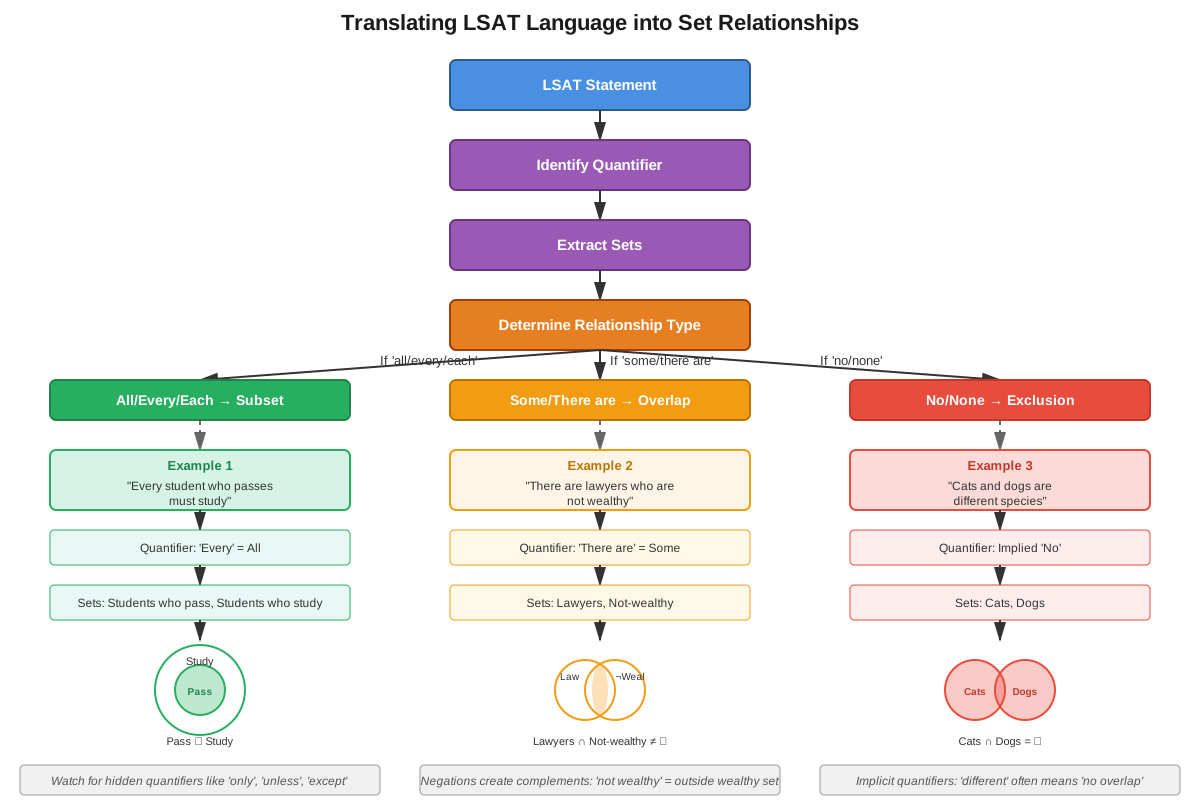
Understanding how natural language quantifiers map to set relationships is crucial for LSAT success:
| Natural Language | Set Relationship | Logical Meaning | What It Does NOT Mean |
|---|---|---|---|
| All A are B | A ⊂ B (subset) | Every member of A is in B | All B are A |
| Some A are B | A ∩ B ≠ ∅ (overlap) | At least one A is also B | Most A are B |
| No A are B | A ∩ B = ∅ (disjoint) | Zero members in both | Some A are not B is sufficient |
| Most A are B | Majority of A in B | More than 50% of A are B | All A are B |
| Not all A are B | At least one A is not B | Negation of universal | No A are B |
Venn Diagram Representation
While the LSAT doesn't provide visual diagrams, mentally constructing Venn diagrams helps clarify set relationships. A Venn diagram uses overlapping circles to represent sets:
- Subset: One circle completely inside another
- Overlap: Two circles with a shared region
- Disjoint: Two circles with no contact
- Identity: Two circles perfectly overlapping (same circle)
When analyzing LSAT arguments, mentally sketching these relationships reveals what must be true, what could be true, and what cannot be true based on the given information.
Combining Multiple Set Relationships
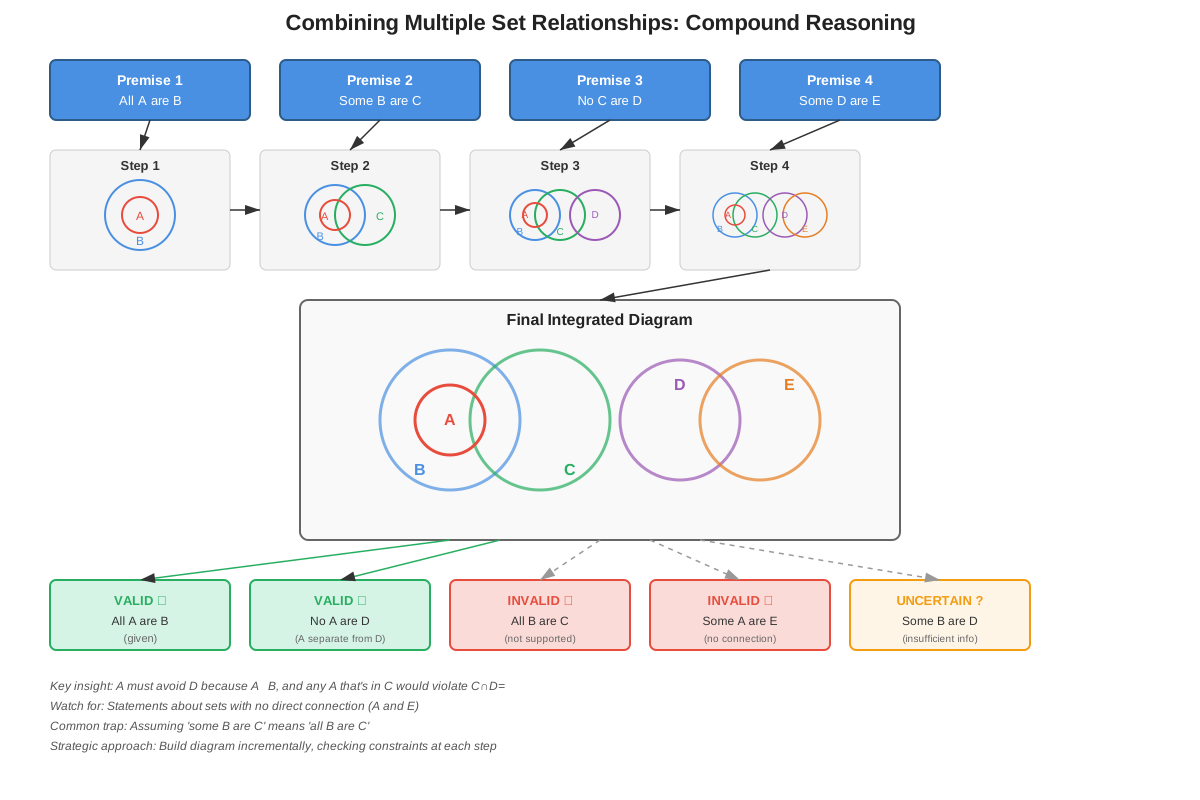
LSAT questions frequently present multiple categorical statements that must be integrated. For example:
- Premise 1: All A are B
- Premise 2: All B are C
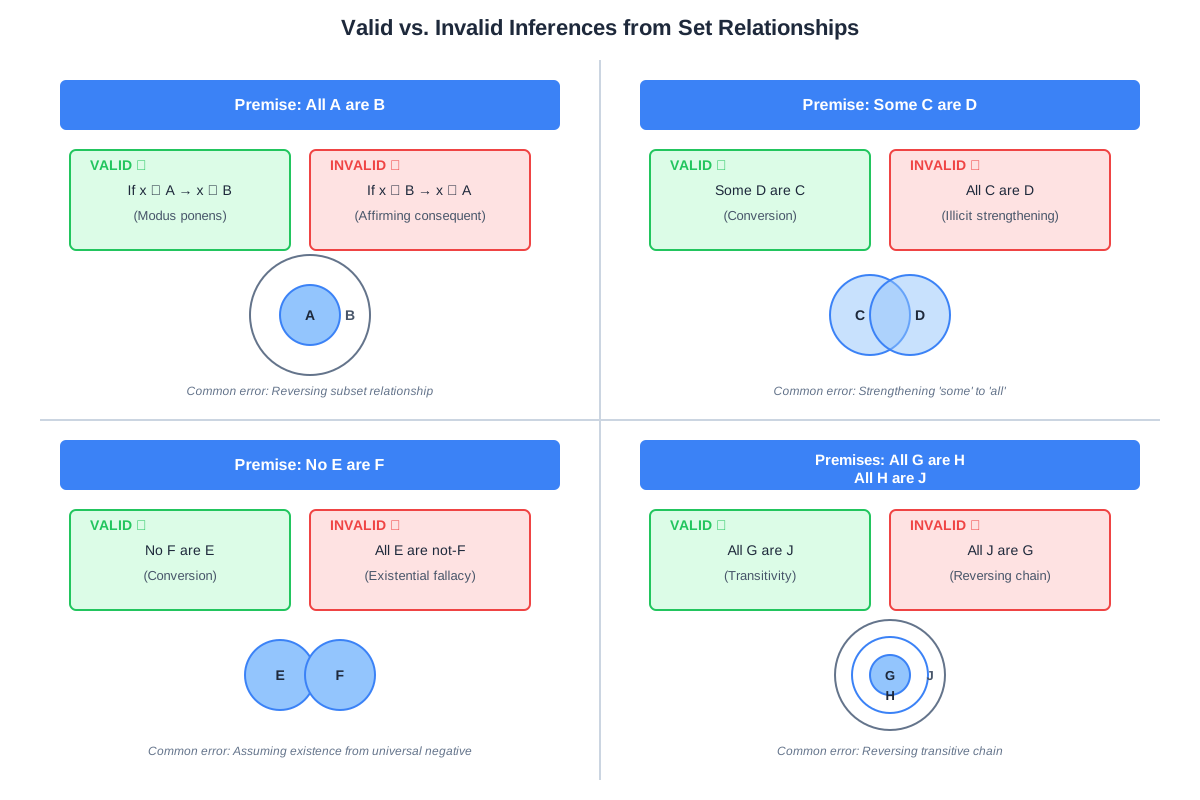
- Valid conclusion: All A are C (transitivity)
However, invalid combinations are common traps:
- Premise 1: All A are B
- Premise 2: All C are B
- Invalid conclusion: All A are C (both could be subsets of B without overlapping)
The key is tracking what each statement establishes and recognizing that subset relationships work in only one direction unless explicitly stated otherwise.
Negations and Set Complements
Understanding set complements (everything NOT in a set) is essential for evaluating negated statements:
- "Not all A are B" means at least one A is outside B (but some A might still be in B)
- "No A are B" means all A are outside B (complete exclusion)
- These are different statements with different logical implications
The LSAT frequently tests whether students confuse these negations, particularly in Flaw questions where arguments treat "not all" as equivalent to "none."
Concept Relationships
Set relationships form the logical foundation for multiple LSAT reasoning patterns. The subset relationship directly connects to conditional reasoning: "All A are B" can be expressed as "If A, then B," making set logic and conditional logic two representations of the same underlying structure. This connection means that mastering set relationships simultaneously strengthens conditional reasoning skills.
The overlap relationship connects to existential claims and counterexample reasoning. When an argument claims "All A are B," finding even one A that is not B (demonstrating overlap between A and "not-B") is sufficient to refute the universal claim. This principle underlies many Weaken and Flaw questions.
Disjoint relationships connect to necessary and sufficient conditions through contrapositive reasoning. If no A are B, then being A is sufficient for not being B, and being B is sufficient for not being A. This bidirectional exclusion differs from subset relationships, which work in only one direction.
Within the topic itself, concepts build hierarchically: Basic set terminology → Individual relationship types → Quantifier translation → Combining multiple relationships → Complex inference patterns. Each level depends on solid understanding of previous levels, making this a cumulative learning process.
The relationship map flows as follows:
Basic Set Concepts → Four Fundamental Relationships → Quantifier Translation → Venn Diagram Visualization → Multiple Statement Integration → Valid vs. Invalid Inferences → Application to LSAT Question Types
High-Yield Facts
⭐ "All A are B" means A is a subset of B, but does NOT mean all B are A (the most common reversal error on the LSAT)
⭐ "Some A are B" means at least one member exists in both sets (could be all, but minimum is one)
⭐ "No A are B" is logically equivalent to "No B are A" (disjoint relationships are symmetric)
⭐ Subset relationships are transitive: If all A are B and all B are C, then all A are C
⭐ "Not all A are B" means at least one A is not B, but some A might still be B (this is NOT the same as "No A are B")
- "Most A are B" means more than 50% of A are in B, but cannot be combined with another "most" statement to draw definite conclusions
- Two sets can both be subsets of a third set without overlapping each other at all
- "Some A are not B" is logically equivalent to "Not all A are B"
- If all A are B and no B are C, then no A are C (combining subset and disjoint relationships)
- The absence of information about a set relationship means nothing can be concluded (cannot assume overlap or disjointness)
- "Only A are B" means all B are A (reverses the typical direction), not that all A are B
- Existential statements ("some") cannot be negated to universal statements ("all" or "none") without additional information
Quick check — test yourself on Set relationships so far.
Try Flashcards →Common Misconceptions
Misconception: "All A are B" means the same as "All B are A"
Correction: These are completely different statements. "All A are B" means A is a subset of B, while "All B are A" means B is a subset of A. The first does not imply the second. For example, "All dolphins are mammals" is true, but "All mammals are dolphins" is obviously false. This reversal error is the single most common mistake in set relationship reasoning.
Misconception: "Some A are B" means "Some B are A" is automatically true
Correction: While "Some A are B" does typically imply "Some B are A" in standard logic, the LSAT occasionally tests edge cases. More importantly, students often incorrectly extend this to think "Some A are B" means "Most A are B" or make other unwarranted quantitative assumptions. "Some" means only "at least one"—nothing more.
Misconception: "Not all A are B" is the same as "No A are B"
Correction: These statements have completely different meanings. "Not all A are B" means at least one A is not in B (but others might be), while "No A are B" means zero A are in B (complete exclusion). The first allows for partial overlap; the second prohibits any overlap whatsoever.
Misconception: If two sets are both subsets of a third set, they must overlap
Correction: Two sets can both be completely contained within a larger set without sharing any members. For example, "All cats are mammals" and "All dogs are mammals" are both true, but cats and dogs are distinct sets with no overlap. This misconception leads to invalid inferences in questions presenting multiple subset relationships.
Misconception: "Most A are B" and "Most B are C" means most A are C
Correction: Two "most" statements cannot be combined to guarantee a conclusion about the relationship between the first and third sets. It's possible that the "most A" that are B and the "most B" that are C don't overlap sufficiently to ensure most A are C. The LSAT frequently includes this trap in Must Be True questions.
Misconception: If no information is given about a relationship between two sets, they must be disjoint
Correction: Absence of information means nothing can be concluded. Two sets might overlap, be disjoint, or have a subset relationship—without explicit statements, all possibilities remain open. The LSAT tests this by including answer choices that assume relationships not established in the stimulus.
Worked Examples
Example 1: Must Be True Question
Stimulus: All members of the city council are elected officials. Some elected officials are former business owners. No former business owners serve on the zoning committee.
Question: If the statements above are true, which one of the following must also be true?
Analysis:
Let's identify the sets and relationships:
- C = city council members
- E = elected officials
- B = former business owners
- Z = zoning committee members
Translating the statements:
- All C are E (city council ⊂ elected officials)
- Some E are B (overlap between elected officials and former business owners)
- No B are Z (former business owners and zoning committee are disjoint)
Now let's trace what must be true:
From statement 1: Every city council member is an elected official (C is completely contained in E)
From statement 2: At least one elected official is a former business owner (E and B overlap)
From statement 3: No former business owner serves on the zoning committee (B and Z are completely separate)
Key inference: Can we conclude anything about city council members and the zoning committee?
We know all city council members are elected officials, and some elected officials are former business owners. However, we don't know whether any city council members are among those elected officials who are former business owners. Therefore, we cannot conclude that no city council members serve on the zoning committee.
What MUST be true: If someone is both a city council member AND a former business owner, that person cannot serve on the zoning committee. This follows from combining statements 1 and 3: city council members are elected officials, and if any of them are also former business owners, statement 3 prohibits them from the zoning committee.
Correct answer pattern: "No city council member who is a former business owner serves on the zoning committee."
Learning objective connection: This example demonstrates how to combine multiple set relationships (subset and disjoint) to draw valid inferences while avoiding the trap of assuming relationships not explicitly stated.
Example 2: Flaw Question
Stimulus: All successful entrepreneurs are risk-takers. Maria is a risk-taker. Therefore, Maria is a successful entrepreneur.
Question: The reasoning in the argument is flawed because it:
Analysis:
Let's identify the set relationships:
- S = successful entrepreneurs
- R = risk-takers
Premise: All S are R (successful entrepreneurs ⊂ risk-takers)
Premise: Maria ∈ R (Maria is a member of the risk-taker set)
Conclusion: Maria ∈ S (Maria is a member of the successful entrepreneur set)
Visualizing with Venn diagrams: The first premise tells us that the circle representing successful entrepreneurs is completely inside the larger circle representing risk-takers. The second premise tells us Maria is somewhere in the risk-taker circle. But Maria could be anywhere in that larger circle—she might be in the smaller successful entrepreneur circle, or she might be in the part of the risk-taker circle that's outside the successful entrepreneur circle.
The flaw: This argument commits the classic subset reversal error. The premise establishes that being a successful entrepreneur is sufficient for being a risk-taker (S → R), but the argument treats this as if being a risk-taker is sufficient for being a successful entrepreneur (R → S). This is invalid reasoning.
Just because all members of set S are in set R doesn't mean all members of set R are in set S. The risk-taker set could include many people who are not successful entrepreneurs—perhaps failed entrepreneurs, gamblers, extreme sports enthusiasts, etc.
Correct answer pattern: "Treats a characteristic that is necessary for being a successful entrepreneur as if it were sufficient for being a successful entrepreneur" or "Mistakes a condition required for successful entrepreneurship for one that guarantees successful entrepreneurship."
Learning objective connection: This example illustrates the most common flaw involving set relationships—confusing subset direction. Recognizing this pattern enables quick identification of flawed reasoning in multiple question types.
Exam Strategy
Trigger Words and Phrases
Watch for these quantifiers that signal set relationships:
- All, every, each, any → subset relationship (complete containment)
- Some, several, a few, at least one → overlap relationship (partial intersection)
- No, none, not any → disjoint relationship (complete exclusion)
- Most, majority, more than half → majority overlap (special quantifier)
- Only, solely, exclusively → reversed subset (if "only A are B," then all B are A)
Systematic Approach to Set Relationship Questions
Step 1: Identify and label all sets mentioned in the stimulus. Use abbreviations (first letter of each set) to track them efficiently.
Step 2: Translate each statement into set relationship notation or mentally visualize the Venn diagram configuration.
Step 3: Note the direction of subset relationships carefully. "All A are B" flows from A to B, not the reverse.
Step 4: Combine relationships systematically, checking for transitive connections (A ⊂ B and B ⊂ C means A ⊂ C) and disjoint implications (A ⊂ B and B disjoint from C means A disjoint from C).
Step 5: Eliminate answer choices that:
- Reverse subset relationships
- Assume overlap where none is established
- Treat "some" as "all" or "most"
- Combine "most" statements invalidly
- Conclude disjointness from absence of information
Time Allocation
Set relationship questions should take 60-90 seconds once you've mastered the patterns. If you find yourself taking longer:
- You may be overcomplicating the relationships (stick to the basic four types)
- You might be trying to visualize too precisely (rough mental Venn diagrams suffice)
- You could be second-guessing valid inferences (trust the logical rules)
Process of Elimination Tips
In Must Be True questions: Eliminate any answer that requires assuming information not stated. The correct answer follows necessarily from the given relationships.
In Flaw questions: Look first for subset reversal errors (treating "All A are B" as if it means "All B are A"), then check for invalid quantifier combinations.
In Sufficient Assumption questions: The correct answer will bridge the gap between sets mentioned in premises and conclusion, often by establishing a subset relationship that makes the conclusion follow necessarily.
In Cannot Be True questions: The correct answer will violate a stated set relationship, such as placing something in two disjoint sets simultaneously.
Memory Techniques
The "Container" Mnemonic
Remember subset relationships by visualizing physical containers:
- "All A are B" = All of container A fits inside container B
- The smaller container (A) might not fill the larger container (B)
- You can't reverse the containers and expect the same fit
The "Some" Minimum Rule
S.O.M.E. = Sufficient with One Member Existing
When you see "some," remember it means "at least one"—nothing more. This prevents overinterpreting existential claims.
The "No-No" Symmetry
"No A are B" = "No B are A" (both directions prohibited)
Unlike subset relationships, disjoint relationships work both ways. Visualize a "no entry" sign pointing in both directions.
The Reversal Warning: "ALL-WAYS Check Direction"
ALL-WAYS reminds you that "ALL" statements always require checking direction. "All A are B" is not the same as "All B are A"—the most common error on set relationship questions.
The Transitivity Chain
A → B → C (if all A are B, and all B are C, then all A are C)
Visualize a chain of containers, each fitting inside the next. The smallest fits inside all larger ones.
Summary
Set relationships form the logical foundation for analyzing categorical statements on the LSAT, requiring students to understand how groups relate through subset, overlap, disjoint, and identity relationships. Mastery involves translating natural language quantifiers (all, some, no, most) into precise logical structures, recognizing that "All A are B" establishes A as a subset of B without implying the reverse, and understanding that "some" means merely "at least one." The LSAT tests these concepts through Must Be True, Flaw, Sufficient Assumption, and other question types, with the most common trap being subset reversal errors. Success requires systematic identification of sets, careful attention to relationship direction, valid combination of multiple statements through transitivity, and recognition of invalid inferences that assume unstated relationships. Mental Venn diagram visualization helps clarify what must be true, what could be true, and what cannot be true given categorical premises, while understanding set complements and negations prevents confusion between "not all" and "none."
Key Takeaways
- "All A are B" means A ⊂ B, never the reverse—subset direction is the most tested concept in set relationships
- "Some" means "at least one"—resist the temptation to interpret it as "most" or make quantitative assumptions
- Disjoint relationships are symmetric ("No A are B" = "No B are A"), unlike subset relationships which work in only one direction
- Subset relationships are transitive—if all A are B and all B are C, then all A are C, enabling multi-step inferences
- "Not all" is not "none"—these negations have completely different logical implications and are frequently confused
- Absence of information means nothing can be concluded—don't assume overlap or disjointness without explicit statements
- Combine relationships systematically—track each set and relationship carefully, checking for valid transitive connections while avoiding invalid quantifier combinations
Related Topics
Conditional Logic and Sufficient/Necessary Conditions: Set relationships provide the foundation for understanding conditional statements, as "If A, then B" can be represented as A being a subset of B. Mastering set relationships makes conditional logic more intuitive.
Formal Logic Notation: Learning to translate set relationships into symbolic notation (→, ∧, ∨, ~) enables faster processing of complex logical structures and strengthens overall formal reasoning skills.
Categorical Syllogisms: Traditional syllogistic reasoning (All A are B, All B are C, therefore All A are C) is simply the application of set relationship rules, making this topic essential for evaluating deductive arguments.
Quantifier Scope and Interpretation: Understanding how quantifiers like "all," "some," and "most" function in set relationships prepares students for more nuanced questions about quantifier scope in complex sentences.
Argument Structure and Validity: Recognizing valid versus invalid inferences from set relationships is fundamental to evaluating argument structure across all Logical Reasoning question types.
Practice CTA
Now that you understand the core principles of set relationships, it's time to cement your mastery through active practice. Work through the practice questions methodically, applying the systematic approach outlined in the exam strategy section. Pay special attention to identifying trigger words, translating statements into set relationships, and avoiding the common reversal error. Use the flashcards to reinforce high-yield facts and test your ability to quickly recognize relationship types. Remember: set relationships appear in 15-20% of Logical Reasoning questions, making this one of the highest-yield topics for score improvement. Every question you practice strengthens your pattern recognition and speeds up your processing time on test day. You've built the foundation—now apply it!
Sign up free to keep reading
Create a free AnvayaPrep account to finish this LSAT guide on Set relationships — plus flashcards and practice questions.