Overview
Universal quantifiers are fundamental building blocks of logical reasoning that appear throughout the LSAT, particularly in Logical Reasoning and Analytical Reasoning sections. These linguistic markers—words like "all," "every," "any," "each," and "none"—establish absolute relationships between categories or groups. Understanding how universal quantifiers function is essential for correctly interpreting argument structure, identifying logical flaws, drawing valid inferences, and navigating conditional reasoning chains that form the backbone of many LSAT questions.
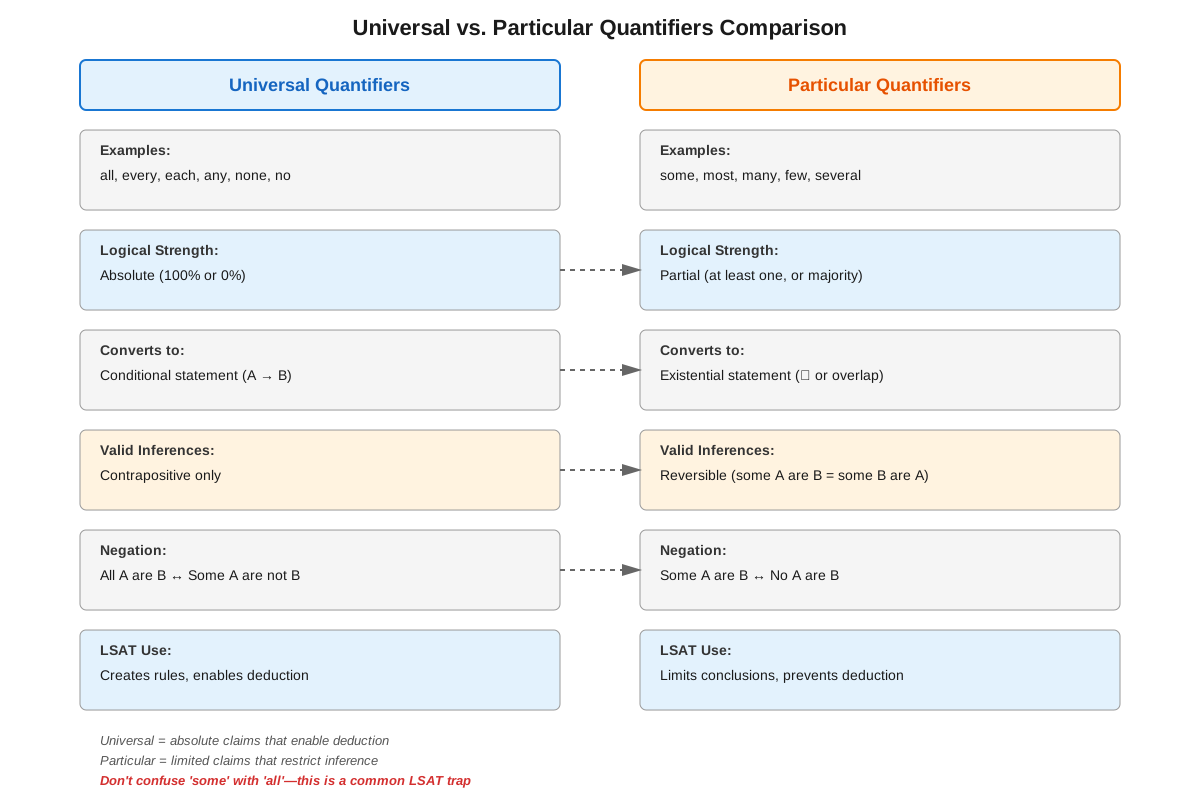
On the LSAT, universal quantifiers create statements that apply without exception to every member of a specified group. When an argument states "All lawyers are professionals," it makes an absolute claim about the entire category of lawyers. The ability to recognize these quantifiers, understand their logical implications, and manipulate them through contraposition and inference is critical for success on Must Be True questions, Sufficient Assumption questions, Flaw questions, and many others. Universal quantifiers differ fundamentally from particular quantifiers (like "some" or "most"), and confusing these categories represents one of the most common errors test-takers make.
Within the broader framework of formal logic and quantifiers, universal quantifiers serve as the foundation for conditional statements and categorical logic. They connect directly to sufficient and necessary conditions, form the basis for valid deductive reasoning, and appear in nearly every question type across the exam. Mastering universal quantifiers enables students to diagram complex argument structures, predict valid inferences, and eliminate incorrect answer choices with confidence and speed.
Learning Objectives
- [ ] Identify how Universal quantifiers appears in LSAT questions
- [ ] Explain the reasoning pattern behind Universal quantifiers
- [ ] Apply Universal quantifiers to solve LSAT-style problems accurately
- [ ] Distinguish between universal and particular quantifiers in argument contexts
- [ ] Translate universal quantifier statements into conditional logic notation
- [ ] Recognize contrapositive relationships created by universal quantifiers
- [ ] Identify invalid inferences that violate universal quantifier rules
Prerequisites
- Basic conditional logic: Understanding "if-then" relationships is essential because universal quantifiers create conditional statements (e.g., "All A are B" translates to "If A, then B")
- Categorical relationships: Familiarity with how groups and categories relate helps interpret statements about entire classes of objects or people
- Logical operators: Knowledge of negation and basic logical connectives enables proper manipulation of universal quantifier statements
- Argument structure: Recognizing premises and conclusions allows students to see how universal quantifiers function within complete arguments
Why This Topic Matters
Universal quantifiers appear in approximately 60-70% of all Logical Reasoning questions and form the structural foundation of most Analytical Reasoning games. They create the absolute rules and relationships that test-takers must manipulate to reach correct answers. In real-world contexts, universal quantifiers represent the language of laws, regulations, scientific principles, and logical necessity—the very domains that legal reasoning addresses daily.
On the LSAT, universal quantifiers most commonly appear in:
- Must Be True / Inference questions: Where valid deductions from universal statements are required
- Sufficient Assumption questions: Where universal quantifiers bridge logical gaps
- Flaw questions: Where overgeneralization or improper universal claims create reasoning errors
- Parallel Reasoning questions: Where matching universal quantifier structures is essential
- Analytical Reasoning: Where absolute rules govern game setups and deductions
The LSAT tests universal quantifiers both explicitly (through obvious indicator words) and implicitly (through context and meaning). Questions may present universal claims in the stimulus and ask what must follow, or they may require identifying when an argument improperly treats a particular statement as universal. Understanding these patterns directly translates to 10-15 additional correct answers for well-prepared test-takers.
Core Concepts
Definition and Function of Universal Quantifiers
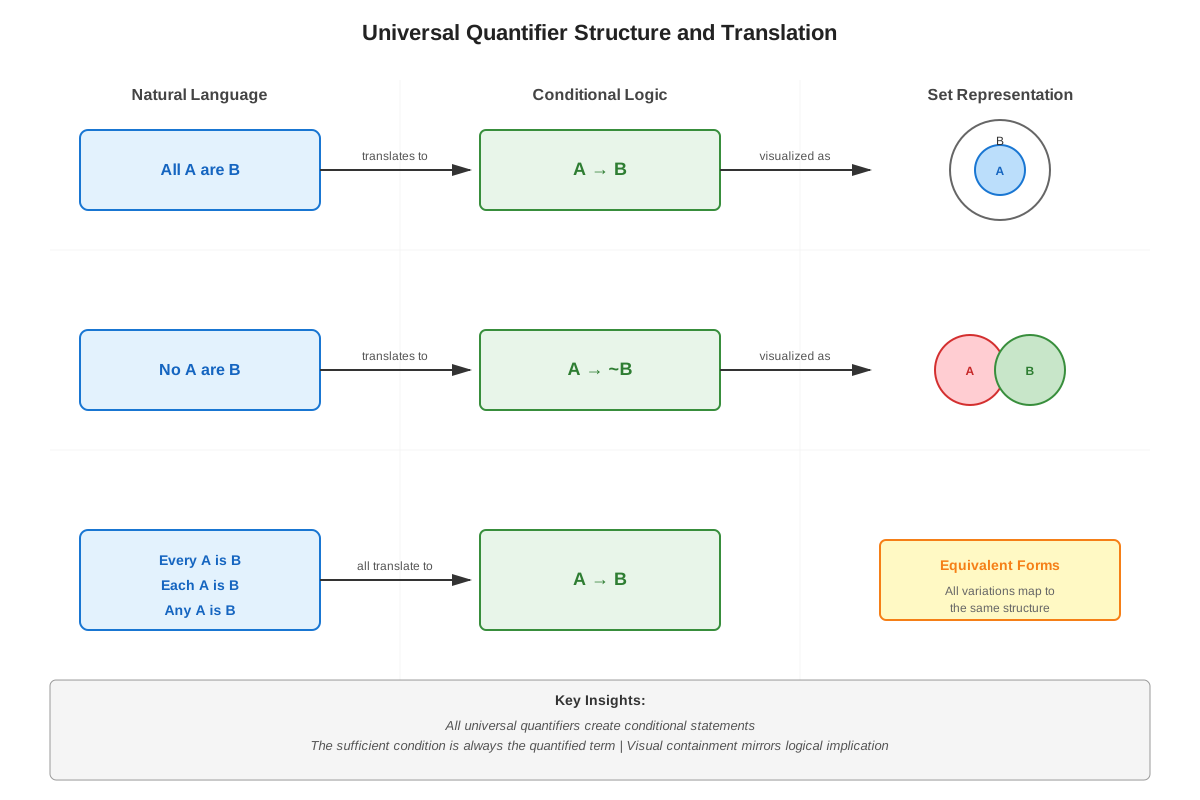
Universal quantifiers are linguistic expressions that indicate a statement applies to all members of a specified category without exception. The most common universal quantifiers include: "all," "every," "each," "any," "always," "necessarily," "only," "none," "no," and "never." These words create categorical statements that establish absolute relationships.
When a statement uses a universal quantifier, it makes a claim about 100% of the referenced group. "All dogs are mammals" means that if something is a dog, it is definitely a mammal—no exceptions exist. This absolute nature distinguishes universal quantifiers from particular quantifiers like "some" (which means "at least one") or "most" (which means "more than half").
Standard Forms and Translations
Universal quantifier statements appear in several standard forms, each translatable into conditional logic notation:
| Statement Form | Example | Conditional Translation | Contrapositive |
|---|---|---|---|
| All A are B | All cats are animals | A → B | ~B → ~A |
| Every A is B | Every student passed | A → B | ~B → ~A |
| No A are B | No reptiles are mammals | A → ~B | B → ~A |
| Only A are B | Only members can vote | B → A | ~A → ~B |
| Any A is B | Any violation results in penalty | A → B | ~B → ~A |
The arrow (→) represents the conditional relationship, where the sufficient condition (left side) guarantees the necessary condition (right side). The tilde (~) represents negation. Understanding these translations allows test-takers to manipulate universal statements logically and identify valid inferences.
Positive Universal Quantifiers
Positive universal quantifiers (all, every, each, any) create inclusive relationships. "All A are B" establishes that the entire category A falls within category B. This creates a sufficient condition: being an A is sufficient to guarantee being a B.
Consider: "All attorneys must pass the bar exam." This statement means:
- If someone is an attorney → they passed the bar exam
- Contrapositive: If someone didn't pass the bar exam → they are not an attorney
Critically, this statement does NOT tell us:
- Whether all bar exam passers become attorneys (some might not)
- Whether passing the bar exam is sufficient to be an attorney (other requirements might exist)
Negative Universal Quantifiers
Negative universal quantifiers (no, none, never) create exclusive relationships. "No A are B" establishes that categories A and B have no overlap—they are mutually exclusive.
Consider: "No undergraduate students serve on the faculty committee." This means:
- If someone is an undergraduate student → they do not serve on the faculty committee
- Contrapositive: If someone serves on the faculty committee → they are not an undergraduate student
The logical structure differs from positive universals because the necessary condition is negated in the original statement rather than in the contrapositive.
The "Only" Construction
The word "only" creates a particularly tricky universal quantifier because it reverses the intuitive direction of the conditional. "Only A are B" means "If B, then A" (not "If A, then B").
Consider: "Only seniors can take advanced seminars." This means:
- If someone takes an advanced seminar → they are a senior
- Contrapositive: If someone is not a senior → they cannot take advanced seminars
Students frequently misinterpret "only" statements by reversing the logic. The statement does NOT mean all seniors take advanced seminars—it means that being a senior is necessary (but not sufficient) for taking them.
Universal Quantifiers and Scope
The scope of a universal quantifier determines exactly which group the absolute claim applies to. Ambiguous scope creates logical problems and frequently appears in LSAT flaw questions.
Consider: "All the witnesses testified that the defendant was present." Does this mean:
- All witnesses (universally) testified, and their testimony was that the defendant was present?
- Some witnesses testified, and all of them said the defendant was present?
The scope ambiguity matters for logical validity. LSAT questions exploit these ambiguities to create attractive wrong answers.
Implicit Universal Quantifiers
Not all universal statements use explicit quantifier words. Context and meaning can create universal claims:
- "Diamonds are carbon structures" (means "All diamonds...")
- "Violating this policy results in termination" (means "Any violation...")
- "Students must complete the prerequisite" (means "All students...")
Recognizing implicit universal quantifiers prevents misinterpretation of argument structure and helps identify the actual logical relationships at play.
Concept Relationships
Universal quantifiers serve as the foundation for conditional logic, which in turn enables formal logic reasoning throughout the LSAT. The relationship flows: Universal Quantifiers → Conditional Statements → Contrapositive Relationships → Valid Inferences.
Within the topic itself, positive and negative universal quantifiers function as complementary structures—both create absolute relationships but with opposite polarities. The "only" construction connects to necessary conditions, while standard "all" statements connect to sufficient conditions. These relationships form a coherent system where each element reinforces understanding of the others.
Universal quantifiers connect to prerequisite knowledge of categorical relationships by providing the linguistic tools to express those relationships precisely. They extend into more advanced topics like formal logic chains (where multiple universal statements link together), quantifier negation (understanding what contradicts a universal claim), and modal logic (where necessity and possibility interact with universal claims).
The progression moves from: Recognition of quantifier words → Translation into conditional form → Application of contrapositive rules → Generation of valid inferences → Identification of logical flaws. Each step builds on the previous, creating a comprehensive framework for analyzing LSAT arguments.
Quick check — test yourself on Universal quantifiers so far.
Try Flashcards →High-Yield Facts
⭐ Universal quantifiers create conditional statements where the quantified category serves as the sufficient condition (except "only," which reverses this)
⭐ "All A are B" translates to "If A, then B" with contrapositive "If not B, then not A"
⭐ "No A are B" translates to "If A, then not B" with contrapositive "If B, then not A"
⭐ "Only A are B" translates to "If B, then A" (reversing the intuitive direction)
⭐ Universal statements can be disproven by a single counterexample but never proven by examples alone
- The contrapositive of a universal statement is always logically equivalent to the original
- "Any" functions identically to "all" or "every" in creating universal claims
- Universal quantifiers do not allow for exceptions—"almost all" or "generally" are not universal
- Confusing "all" with "only" is one of the most common LSAT errors
- Multiple universal statements can chain together: If A→B and B→C, then A→C
- The negation of "all A are B" is "some A are not B" (not "no A are B")
- Universal quantifiers in the conclusion of an argument require universal support in the premises
- Temporal universal quantifiers ("always," "never") function identically to categorical ones
- "Each" and "every" are interchangeable with "all" for logical purposes
- Implicit universal quantifiers appear in definitions, rules, and categorical statements
Common Misconceptions
Misconception: "All A are B" means "All B are A" (reversing the relationship)
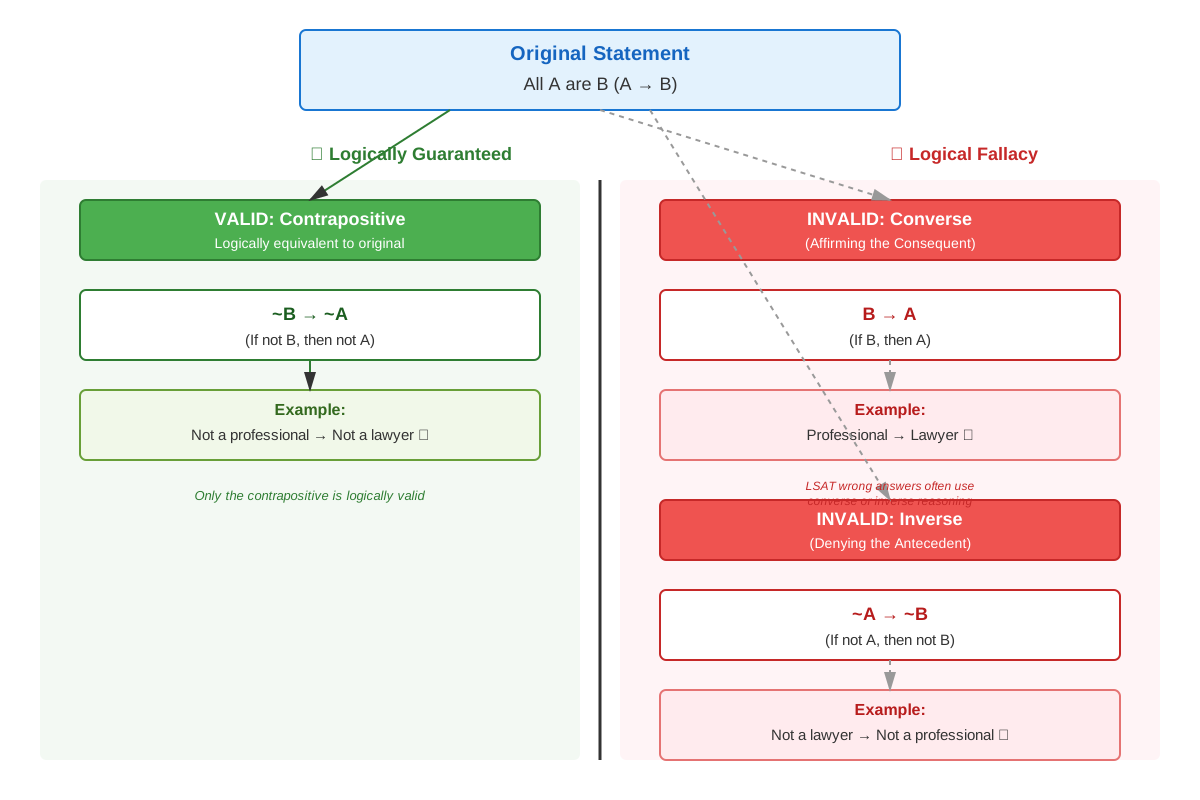
Correction: Universal statements are directional. "All dogs are animals" does not mean "all animals are dogs." The conditional flows one way: A→B does not imply B→A. Only the contrapositive (~B→~A) is logically equivalent.
Misconception: "Only A are B" means "All A are B"
Correction: "Only" establishes necessity, not sufficiency. "Only seniors can enroll" means if you enroll, you must be a senior (B→A), but it doesn't mean all seniors enroll. The "only" construction reverses the conditional direction from the intuitive reading.
Misconception: A single example can prove a universal statement
Correction: No number of confirming examples can prove a universal claim because the next instance might be a counterexample. However, a single counterexample definitively disproves a universal statement. This asymmetry is frequently tested.
Misconception: "Most A are B" is a type of universal quantifier
Correction: "Most" is a particular quantifier indicating more than 50% but not 100%. It does not create the absolute relationships that universal quantifiers establish and follows entirely different logical rules (most statements cannot be contrapositived).
Misconception: Universal quantifiers in everyday speech always mean absolute universality
Correction: While conversational language often uses "all" or "every" loosely (with implied exceptions), LSAT logic treats these as absolute. "All students must attend" means every single student without exception in LSAT contexts, even if casual speech might allow for excused absences.
Misconception: "No A are B" is the same as "All A are not B"
Correction: While these are logically equivalent, the phrasing "all A are not B" is ambiguous in English (it could mean "not all A are B"). The clearer formulation "No A are B" or "All A are non-B" avoids this ambiguity. LSAT questions exploit such ambiguities in wrong answers.
Misconception: Universal quantifiers only appear in formal, technical language
Correction: Universal quantifiers appear in everyday arguments, often implicitly. "Violators will be prosecuted" contains an implicit universal quantifier (all violators). Recognizing these implicit quantifiers is essential for accurate argument analysis.
Worked Examples
Example 1: Must Be True Question
Stimulus: "All members of the city council voted for the new zoning ordinance. Everyone who voted for the ordinance supports increased commercial development. No one who supports increased commercial development opposes the downtown renovation project."
Question: Which of the following must be true?
Analysis:
Let's translate each statement into conditional logic:
- "All members of the city council voted for the ordinance" → Council Member → Voted For
- "Everyone who voted for the ordinance supports increased commercial development" → Voted For → Supports Development
- "No one who supports increased commercial development opposes the downtown renovation" → Supports Development → ~Opposes Renovation (or equivalently: Supports Renovation)
Now we can chain these universal statements:
Council Member → Voted For → Supports Development → ~Opposes Renovation
Valid Inference: All city council members do not oppose the downtown renovation project (or: all city council members support the renovation project).
Invalid Inferences to Avoid:
- "Everyone who supports the renovation is a council member" (reverses the logic)
- "Some council members oppose commercial development" (contradicts our chain)
- "Most people who support development voted for the ordinance" (reverses the second statement and changes the quantifier)
This example demonstrates how lsat universal quantifiers create chains of logical necessity that allow definitive conclusions.
Example 2: Flaw Question
Stimulus: "Every successful entrepreneur takes calculated risks. Maria takes calculated risks. Therefore, Maria is a successful entrepreneur."
Question: The reasoning is flawed because it:
Analysis:
The argument structure uses a universal quantifier improperly:
- Premise: All successful entrepreneurs → take calculated risks (SE → CR)
- Premise: Maria → takes calculated risks (M → CR)
- Conclusion: Maria → successful entrepreneur (M → SE)
The flaw is affirming the consequent. The universal statement tells us that being a successful entrepreneur is sufficient for taking calculated risks, but it does NOT tell us that taking calculated risks is sufficient for being a successful entrepreneur. Many people might take calculated risks without being successful entrepreneurs.
The contrapositive of the first premise is: ~CR → ~SE (if you don't take calculated risks, you're not a successful entrepreneur). This doesn't help us conclude anything about Maria, who DOES take calculated risks.
Correct Flaw Description: The argument treats a necessary condition (taking calculated risks) as if it were a sufficient condition for being a successful entrepreneur.
This example illustrates how misunderstanding universal quantifier logic creates common LSAT argument flaws. The formal logic and quantifiers framework reveals exactly where the reasoning breaks down.
Exam Strategy
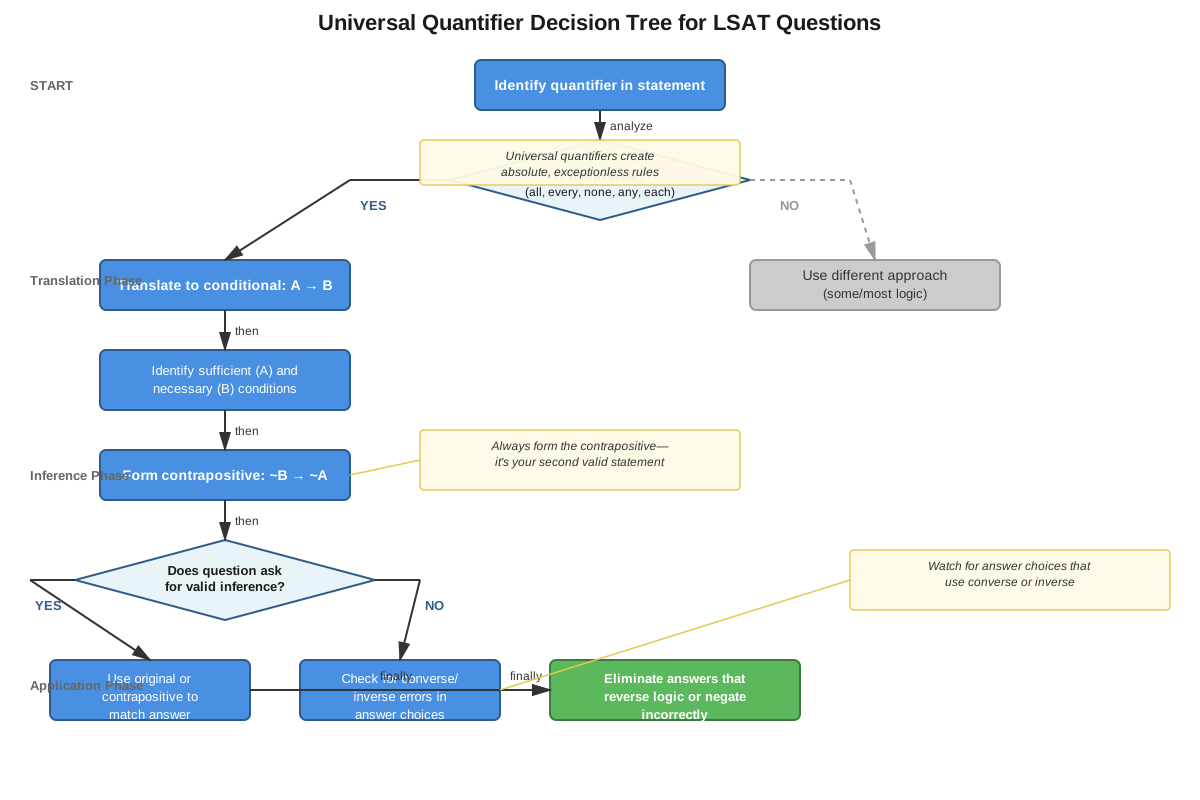
When approaching LSAT questions involving universal quantifiers, follow this systematic process:
Step 1: Identify all quantifier words in the stimulus. Circle or underline "all," "every," "no," "only," "any," and their synonyms. Don't miss implicit universal quantifiers in definitions or rules.
Step 2: Translate universal statements into conditional notation as you read. Write "A → B" in the margin for "All A are B" statements. This external representation prevents mental errors and speeds up inference generation.
Step 3: Write the contrapositive for each universal statement immediately. Many correct answers directly state the contrapositive, and having it written prevents time-consuming reconstruction.
Step 4: Look for chains where the necessary condition of one statement matches the sufficient condition of another. These chains generate powerful inferences that frequently appear in correct answers.
Exam Tip: When you see "only" in a stimulus, immediately write the conditional with the arrow pointing TOWARD the word following "only." This prevents the most common reversal error.
Trigger words to watch for:
- "All," "every," "each," "any": Standard positive universals (A → B)
- "No," "none," "never": Negative universals (A → ~B)
- "Only," "the only," "no one except": Reversed conditionals (B → A)
- "Must," "requires," "necessary": Often signal necessary conditions
- "Always," "invariably," "without exception": Temporal universals
Process of elimination strategies:
- Eliminate any answer choice that reverses a universal statement without proper contraposition
- Eliminate choices that weaken universal claims to particular ones ("some" instead of "all")
- Eliminate choices that claim the converse (if the stimulus says A→B, eliminate answers claiming B→A)
- Eliminate choices that introduce new categories not connected by universal statements in the stimulus
Time allocation: Spend 10-15 seconds translating universal statements into notation before reading answer choices. This upfront investment saves 30-45 seconds during answer evaluation and dramatically improves accuracy.
Memory Techniques
Mnemonic for "Only" reversal: Only Reverses Direction Every Round (ORDER)
When you see "only," remember ORDER and reverse the intuitive conditional direction.
Visualization for universal quantifiers: Picture a large circle (category A) entirely contained within a larger circle (category B) for "All A are B." For "No A are B," picture two circles that don't touch at all. This visual representation makes contrapositive relationships intuitive.
Acronym for common universal quantifiers: AEON (All, Every, Only, No/None)
These four cover the vast majority of explicit universal quantifiers on the LSAT.
Contrapositive shortcut: "Flip and Negate"
To form the contrapositive, flip the order of the terms and negate both. This two-step process (flip + negate) prevents errors.
Chain-building technique: Write universal statements vertically with arrows connecting them:
A → B
B → C
C → D
Therefore: A → D
This visual stacking makes chains obvious and prevents missing valid inferences.
Summary
Universal quantifiers form the logical foundation of LSAT reasoning by creating absolute relationships between categories. These linguistic markers—including "all," "every," "no," "only," and "any"—translate into conditional statements that enable valid deductive inferences. Mastering universal quantifiers requires three core competencies: accurate identification (including implicit quantifiers), proper translation into conditional logic notation, and correct application of contrapositive rules. The most critical distinctions involve recognizing that "all A are B" means A→B (not B→A), that "only A are B" reverses to B→A, and that "no A are B" creates A→~B. Universal statements chain together to create extended inferences, can be disproven by single counterexamples, and appear in approximately two-thirds of all Logical Reasoning questions. Common errors include reversing conditionals, confusing universal with particular quantifiers, and treating necessary conditions as sufficient. Success requires systematic translation, contrapositive generation, and careful attention to logical direction.
Key Takeaways
- Universal quantifiers create absolute, exceptionless relationships that translate into conditional logic statements
- "All A are B" means A→B with contrapositive ~B→~A, never B→A
- "Only" reverses the conditional direction: "Only A are B" means B→A
- Universal statements chain together when the necessary condition of one matches the sufficient condition of another
- A single counterexample disproves a universal claim, but no number of examples can prove one
- Implicit universal quantifiers appear in rules, definitions, and categorical statements without explicit quantifier words
- The contrapositive is always logically equivalent to the original universal statement and frequently appears in correct answers
Related Topics
Particular Quantifiers ("Some" and "Most"): After mastering universal quantifiers, understanding particular quantifiers reveals how different quantifier types interact and what inferences each type permits. Particular quantifiers follow different logical rules and cannot be contrapositived.
Conditional Logic Chains: Building on universal quantifiers, conditional chains connect multiple statements to generate extended inferences. This topic deepens the ability to work with complex argument structures.
Necessary vs. Sufficient Conditions: Universal quantifiers create both necessary and sufficient conditions depending on their form. Distinguishing these condition types enables more sophisticated argument analysis.
Formal Logic Diagramming: Advanced diagramming techniques build on universal quantifier translation to handle complex logical relationships, including those with multiple conditions and embedded quantifiers.
Quantifier Negation: Understanding what contradicts or negates a universal statement (the negation of "all A are B" is "some A are not B") connects to assumption and weaken questions.
Practice CTA
Now that you understand the logical structure and application of universal quantifiers, it's time to cement this knowledge through active practice. Attempt the practice questions associated with this topic, focusing on translating statements into conditional notation before evaluating answer choices. Use the flashcards to drill quantifier recognition and contrapositive formation until these processes become automatic. Remember: universal quantifiers appear in the majority of LSAT questions, making this one of the highest-yield topics for score improvement. Every minute spent mastering this foundation pays dividends across the entire exam. You've built the conceptual framework—now build the speed and accuracy that lead to top scores.
Sign up free to keep reading
Create a free AnvayaPrep account to finish this LSAT guide on Universal quantifiers — plus flashcards and practice questions.