Overview
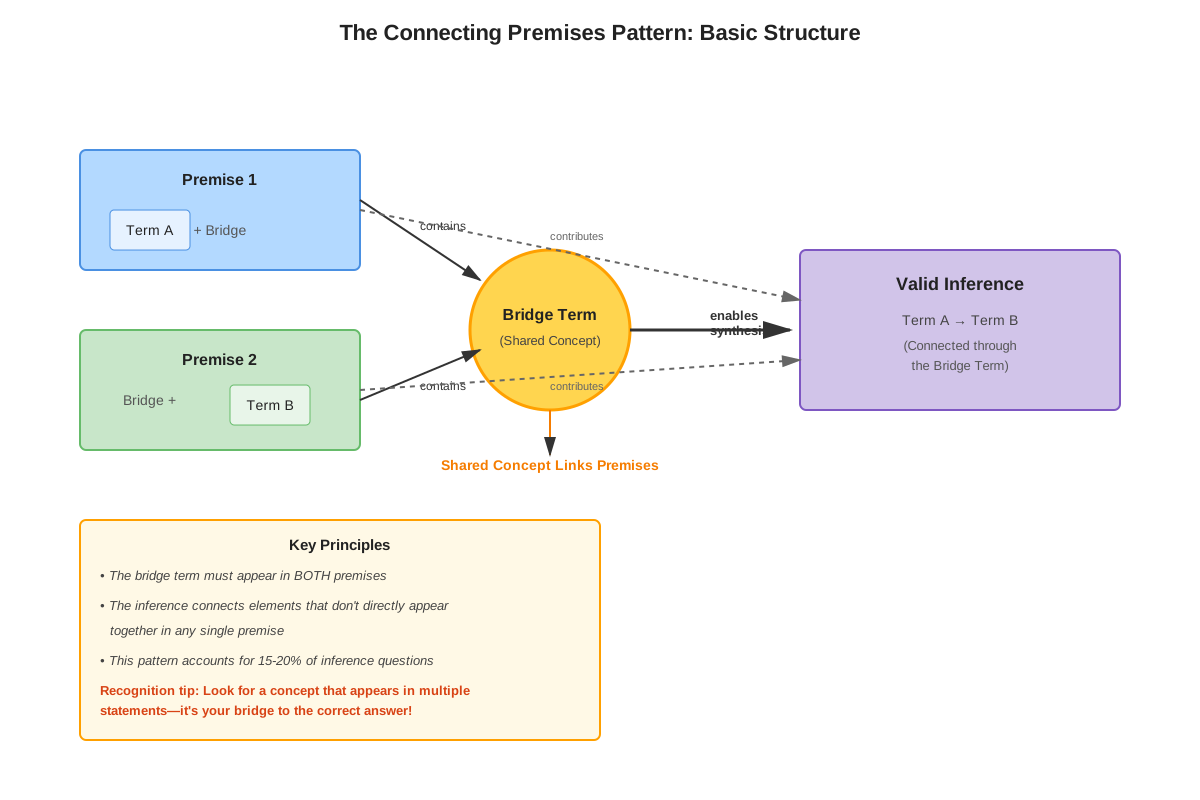
Connecting premises represents one of the most powerful and frequently tested inference patterns on the LSAT Logical Reasoning section. This technique involves identifying two or more separate statements that share a common term or concept, then combining them to derive a new conclusion that neither premise states explicitly. The LSAT tests this skill extensively because it mirrors the fundamental reasoning lawyers must perform daily: synthesizing information from multiple sources to reach sound conclusions. When you encounter inference questions that present seemingly disconnected facts, the test makers are often evaluating your ability to recognize how these statements link together through shared elements.
The connecting premises pattern appears in approximately 15-20% of all inference questions on the LSAT, making it one of the highest-yield topics within the Logical Reasoning section. Unlike assumption questions that require you to identify missing links, or strengthen/weaken questions that ask you to evaluate arguments, inference questions with connecting premises provide you with complete information—your task is simply to recognize what must be true when you properly combine the given statements. This skill builds directly on your understanding of conditional reasoning, formal logic, and categorical statements, but adds the critical dimension of synthesis across multiple propositions.
Within the broader landscape of LSAT connecting premises questions, this reasoning pattern serves as a bridge between basic comprehension and advanced analytical skills. Mastering this topic enables you to approach complex stimulus passages with confidence, knowing that even when premises appear scattered or unrelated, you possess a systematic method for extracting valid inferences. The ability to connect premises efficiently separates high-scoring test takers from those who struggle with the Logical Reasoning section, as it demonstrates both careful reading and sophisticated logical thinking.
Learning Objectives
- [ ] Identify how Connecting premises appears in LSAT questions
- [ ] Explain the reasoning pattern behind Connecting premises
- [ ] Apply Connecting premises to solve LSAT-style problems accurately
- [ ] Recognize the common term or concept that links two or more premises
- [ ] Distinguish valid inferences from attractive but unsupported answer choices
- [ ] Combine multiple premises systematically to derive compound conclusions
- [ ] Evaluate answer choices by tracing them back to the connected premises
Prerequisites
- Basic conditional logic: Understanding "if-then" statements is essential because connecting premises often involves linking conditional statements through shared terms
- Categorical reasoning: Familiarity with "all," "some," and "no" statements enables recognition of how categories overlap and connect
- Formal logic notation: The ability to represent statements symbolically helps visualize connections between premises more clearly
- Inference question structure: Understanding what inference questions ask for (what must be true) versus what they don't ask for (what could be true or is likely true)
Why This Topic Matters
In legal practice, attorneys constantly synthesize information from statutes, precedents, contracts, and testimony to construct arguments and advise clients. The connecting premises skill directly mirrors this professional competency, which explains why the LSAT emphasizes it so heavily. Beyond law school, this reasoning pattern appears in business analysis, medical diagnosis, scientific research, and any field requiring evidence-based conclusions from multiple data sources.
On the LSAT specifically, connecting premises questions appear in 3-5 questions per Logical Reasoning section, accounting for roughly 15-20% of all inference questions. These questions typically appear at medium to medium-high difficulty levels, making them critical for students aiming to score above the 160 threshold. The LSAT tests this skill through various question stems including "If the statements above are true, which one of the following must also be true?" and "The statements above, if true, most strongly support which one of the following?"
Common manifestations in LSAT passages include: (1) two conditional statements sharing a middle term that allows you to chain them together; (2) categorical statements about overlapping groups that enable conclusions about the intersection; (3) comparative statements that can be combined to establish transitive relationships; and (4) statements about parts and wholes that connect to form conclusions about complete systems. Recognizing these patterns immediately upon reading the stimulus gives you a significant strategic advantage.
Core Concepts
The Fundamental Pattern of Connecting Premises
The core mechanism behind connecting premises involves identifying a shared element between two or more statements and using that commonality to derive a new conclusion. Think of premises as puzzle pieces—when they share an edge (a common term), they can fit together to reveal a larger picture. The shared element acts as a logical bridge, allowing information to flow from one premise to another.
Consider this basic structure:
- Premise 1: All A are B
- Premise 2: All B are C
- Shared element: B
- Valid inference: All A are C
The term "B" appears in both premises, creating the connection point. Information about A's relationship to B (from Premise 1) combines with information about B's relationship to C (from Premise 2) to establish A's relationship to C. This transitive property forms the foundation of connecting premises reasoning.
Types of Connections
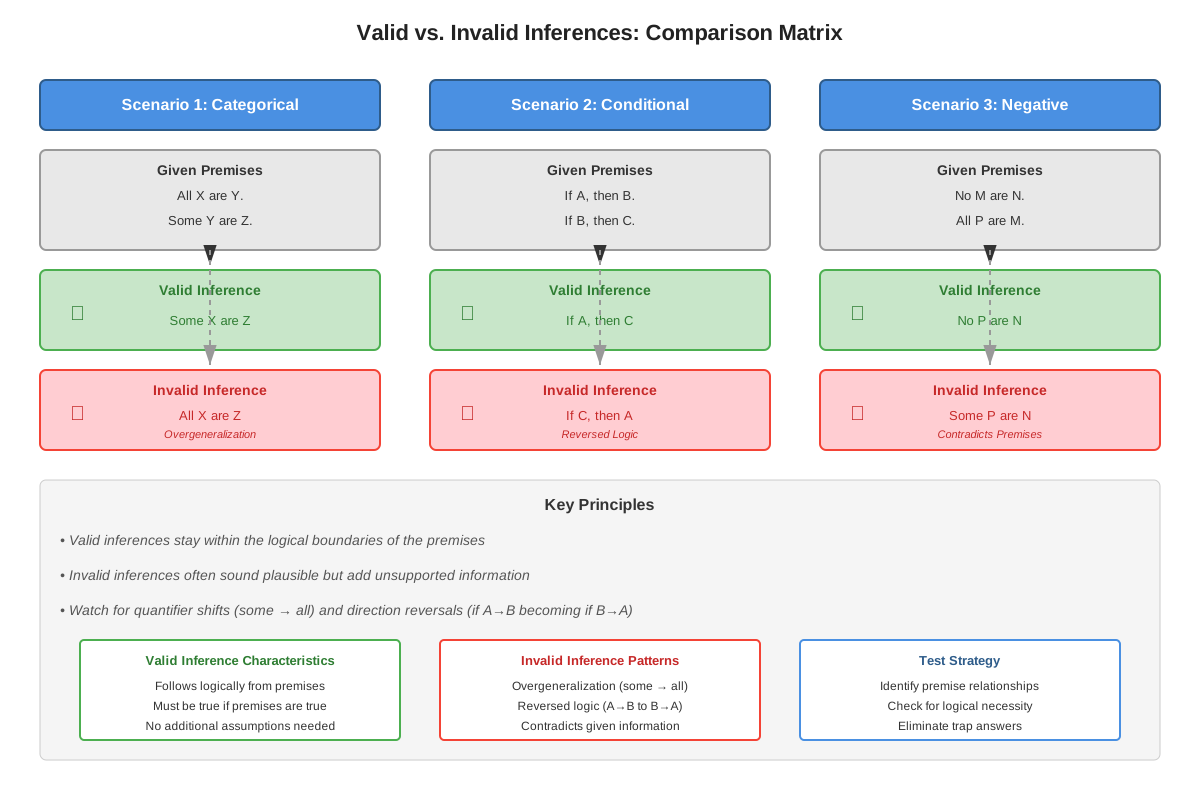
Conditional Chains represent the most common connection pattern on the LSAT. When one conditional statement's consequent matches another conditional statement's antecedent, they link together:
- If P → Q (If P, then Q)
- If Q → R (If Q, then R)
- Therefore: If P → R (If P, then R)
The shared term Q allows the chain to form. The LSAT frequently tests whether you can recognize these chains even when the premises appear in non-sequential order or use varied language to express the same concept.
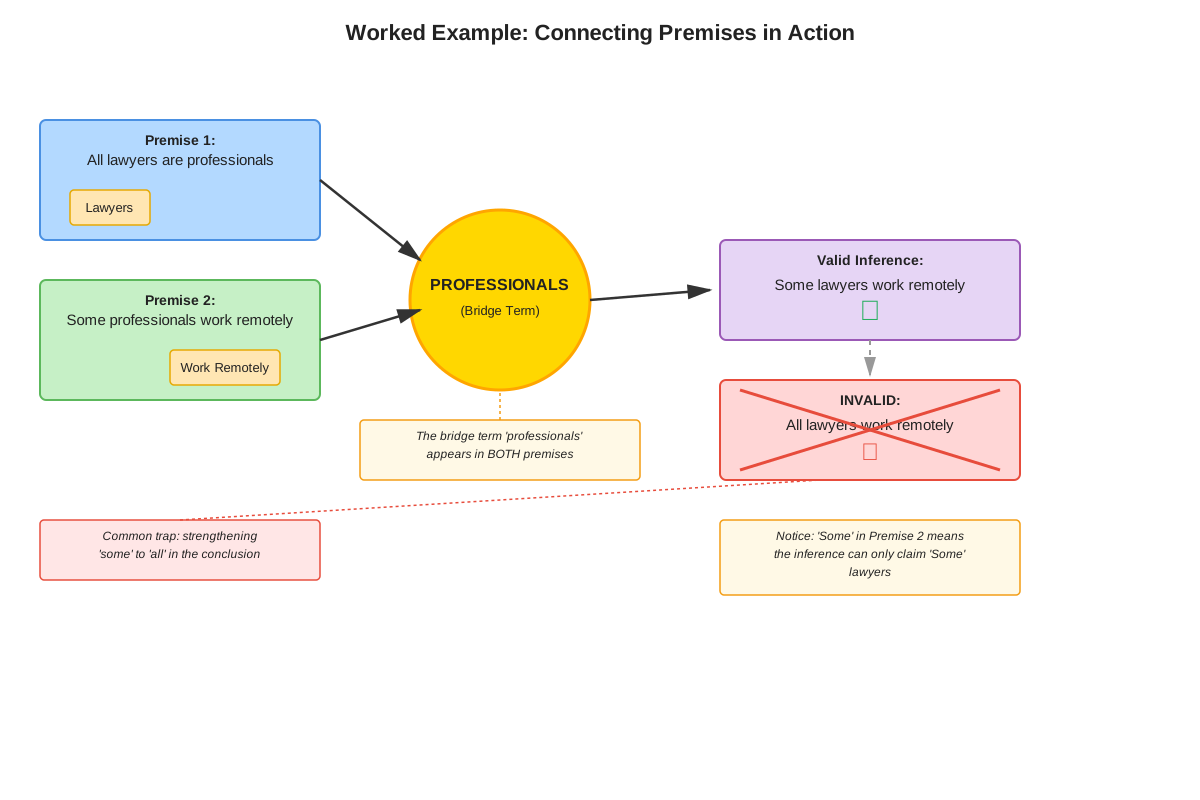
Categorical Overlaps involve statements about groups or categories that share members:
- All professors are educators
- Some educators are published authors
- Therefore: Some professors are published authors
The shared category "educators" enables the inference. Notice that the strength of the conclusion (some rather than all) depends on the weakest link in the chain—a critical consideration for LSAT accuracy.
Comparative Connections link statements involving relationships like greater than, faster than, or more expensive than:
- Product X costs more than Product Y
- Product Y costs more than Product Z
- Therefore: Product X costs more than Product Z
The transitive property of comparative relationships allows these connections, but test takers must be careful about the direction of the comparison and whether the relationship is truly transitive (not all relationships are).
The Shared Term Requirement
For premises to connect validly, they must share not just similar-sounding words but genuinely identical concepts. The LSAT often includes trap answers that exploit superficial similarities between different concepts. For example:
- Valid connection: "economic growth" in both premises refers to GDP increase
- Invalid connection: "growth" in one premise means physical size while in another means numerical increase
Careful reading ensures you identify true shared terms rather than merely similar vocabulary. The shared term must function as a logical bridge—it must be the same entity, property, or relationship in both contexts.
Directionality and Order
The order in which premises appear in the stimulus does not determine the order in which you should connect them. Successful test takers mentally rearrange premises to identify connections:
Stimulus order:
- All mammals are warm-blooded
- All dogs are mammals
- Some pets are dogs
Logical connection order:
- All dogs are mammals (start with most specific)
- All mammals are warm-blooded (connect to broader category)
- Some pets are dogs (connect to conclusion about pets)
Valid inference: Some pets are warm-blooded
This rearrangement reveals the logical chain more clearly than the presentation order.
Multiple Connection Points
Advanced LSAT questions may require connecting three or more premises through multiple shared terms. These questions test your ability to track complex logical relationships:
- Premise 1: A → B
- Premise 2: B → C
- Premise 3: C → D
- Premise 4: Some X are A
Valid inference: Some X are D (by connecting all four premises)
The key is systematic processing: identify all shared terms, map the connections, then trace the logical path from the starting point to the conclusion.
Strength Limitations
When connecting premises, the strength of your conclusion cannot exceed the strength of the weakest premise in the chain. This principle prevents overstatement:
| Premise Strength | Example | Conclusion Limitation |
|---|---|---|
| All + All | All A are B; All B are C | Can conclude "All A are C" |
| All + Some | All A are B; Some B are C | Can only conclude "Some A are C" |
| Some + Some | Some A are B; Some B are C | Cannot conclude anything definite about A and C |
| Most + Most | Most A are B; Most B are C | Cannot conclude "Most A are C" (overlap uncertain) |
Understanding these limitations prevents selecting answer choices that overstate what the premises support.
Concept Relationships
The connecting premises technique builds directly on conditional logic fundamentals—you must understand how conditional statements work individually before you can chain them together. The relationship flows: Basic Conditionals → Contrapositive Understanding → Conditional Chains (connecting premises) → Complex Inference Questions.
Categorical reasoning provides another foundation, as connecting premises often involves linking categorical statements (all, some, no). The progression is: Simple Categorical Statements → Venn Diagram Relationships → Categorical Overlaps (connecting premises) → Multi-Category Inferences.
Within the topic itself, concepts connect as follows:
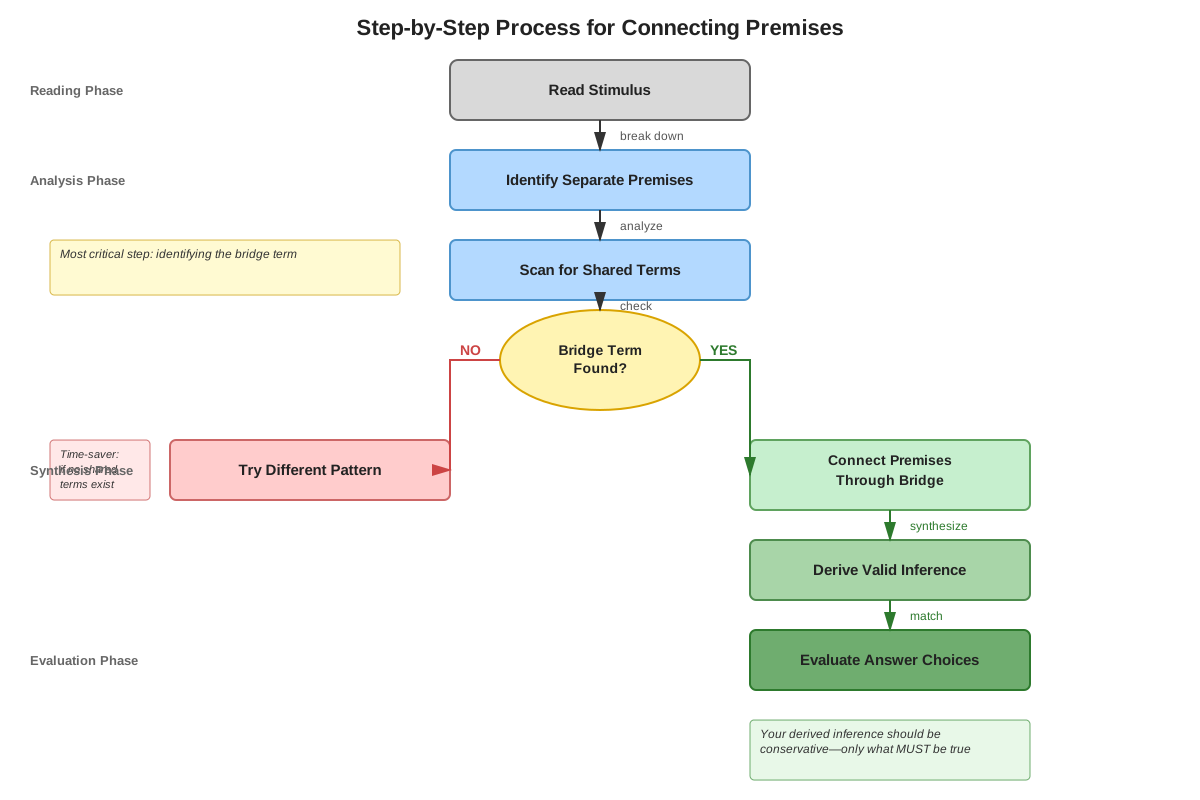
Shared Term Identification → Connection Type Recognition → Systematic Combination → Strength Assessment → Valid Inference
Each step depends on the previous one. You cannot combine premises without first identifying shared terms, and you cannot assess inference strength without understanding how the premises connect. This sequential relationship means that weakness in any early step undermines your ability to execute later steps successfully.
Connecting premises also relates to assumption questions through contrast: in assumption questions, you identify missing connections between premises and conclusions; in connecting premises inference questions, all necessary connections are provided, and you must recognize what they establish. This inverse relationship helps clarify both question types.
High-Yield Facts
⭐ The shared term between premises must refer to the identical concept, not merely similar words
⭐ When connecting conditional statements, the consequent of one must match the antecedent of another to form a valid chain
⭐ The strength of your inference cannot exceed the strength of the weakest premise in the connection
⭐ "Some" statements can connect with "all" statements, but the conclusion must be "some," not "all"
⭐ Two "most" statements cannot be reliably connected to conclude "most" about the combined relationship
- Premises can be connected regardless of the order they appear in the stimulus
- Comparative relationships (greater than, faster than) typically follow transitive properties that allow connection
- Negative statements (no, none) can connect with positive statements to yield negative conclusions
- The LSAT often presents premises in scrambled order to test whether you can identify logical connections
- Answer choices that introduce new terms not present in the premises cannot be valid inferences from connecting premises
- Temporal relationships (before, after, during) can serve as shared terms for connecting premises
- Connecting three or more premises requires tracking multiple shared terms simultaneously
- Valid inferences from connected premises must be true in all possible scenarios consistent with the premises
Quick check — test yourself on Connecting premises so far.
Try Flashcards →Common Misconceptions
Misconception: If two premises share any similar words, they can be connected to form an inference.
Correction: Premises can only be validly connected when they share identical concepts, not merely similar vocabulary. The LSAT deliberately includes premises with similar-sounding but distinct terms to test precise reading. Always verify that the shared term refers to the exact same entity or property in both premises.
Misconception: When connecting "most" statements, if most A are B and most B are C, then most A are C.
Correction: Two "most" statements cannot be reliably connected to yield a "most" conclusion. It's possible that the "most" groups don't overlap sufficiently. For example, if most students are undergraduates (60%) and most students are female (60%), it doesn't follow that most students are female undergraduates—the overlap could be as small as 20%.
Misconception: The order premises appear in the stimulus indicates the order they should be connected.
Correction: The LSAT frequently presents premises in non-logical order to test your ability to recognize connections independently of presentation sequence. Successful test takers mentally rearrange premises to identify the logical chain, starting with the most specific or restrictive statement and building outward.
Misconception: If you can connect premises to reach a conclusion, that conclusion must be the correct answer.
Correction: While connecting premises correctly is necessary, you must also verify that your inference is actually stated in one of the answer choices and that no stronger or more direct inference is available. Sometimes multiple valid inferences exist, but only one appears in the answer choices.
Misconception: Connecting premises always involves exactly two statements.
Correction: LSAT questions frequently require connecting three, four, or even more premises through multiple shared terms. Advanced questions test your ability to track complex chains of reasoning across numerous statements. Practice identifying all possible connection points in a stimulus, not just the first one you notice.
Misconception: If premises can be connected, the resulting inference is always certain (must be true).
Correction: The certainty of your inference depends on the strength of the premises involved. Connecting an "all" statement with a "some" statement yields only a "some" conclusion, not a certain conclusion about all members. Always assess the strength of each link in your logical chain.
Worked Examples
Example 1: Conditional Chain Connection
Stimulus:
"All members of the debate team have strong analytical skills. Everyone with strong analytical skills performs well on standardized tests. No one who performs well on standardized tests struggles with the LSAT Logical Reasoning section."
Question: If the statements above are true, which one of the following must also be true?
Step 1: Identify and symbolize the premises
- Premise 1: Debate team member → Strong analytical skills (DT → SA)
- Premise 2: Strong analytical skills → Performs well on standardized tests (SA → PW)
- Premise 3: Performs well on standardized tests → NOT struggle with LSAT LR (PW → ~SL)
Step 2: Identify shared terms
- "Strong analytical skills" appears in Premises 1 and 2
- "Performs well on standardized tests" appears in Premises 2 and 3
Step 3: Connect the premises in logical order
DT → SA → PW → ~SL
This creates a complete chain from "debate team member" to "not struggle with LSAT LR"
Step 4: Derive the valid inference
If someone is a debate team member, they do not struggle with the LSAT Logical Reasoning section.
(DT → ~SL)
Step 5: Evaluate answer choices
The correct answer would state something equivalent to: "No member of the debate team struggles with the LSAT Logical Reasoning section" or "All debate team members find the LSAT Logical Reasoning section manageable."
Connection to Learning Objectives: This example demonstrates how to identify connecting premises in LSAT questions (Objective 1), explains the conditional chain reasoning pattern (Objective 2), and shows systematic application to solve the problem (Objective 3). The shared terms "strong analytical skills" and "performs well on standardized tests" serve as the bridges linking the premises.
Example 2: Categorical Overlap Connection
Stimulus:
"Some of the company's engineers are certified project managers. All certified project managers have completed leadership training. Every employee who has completed leadership training is eligible for promotion to director level."
Question: Which one of the following can be properly inferred from the statements above?
Step 1: Identify and represent the premises
- Premise 1: Some engineers are certified project managers (Some E are CPM)
- Premise 2: All certified project managers have completed leadership training (All CPM are LT)
- Premise 3: All who completed leadership training are eligible for director promotion (All LT are EDP)
Step 2: Identify shared terms
- "Certified project managers" appears in Premises 1 and 2
- "Completed leadership training" appears in Premises 2 and 3
Step 3: Connect systematically
Starting with Premise 1 (most specific): Some engineers are certified project managers
Adding Premise 2: Those certified project managers (who are engineers) have completed leadership training
Adding Premise 3: Those engineers who completed leadership training are eligible for director promotion
Step 4: Assess strength limitations
Because Premise 1 uses "some" (not "all"), the conclusion can only be "some," even though Premises 2 and 3 use "all."
Valid inference: Some engineers are eligible for promotion to director level.
Step 5: Recognize invalid inferences
- INVALID: "All engineers are eligible for director promotion" (overstates—only some engineers are certified project managers)
- INVALID: "Most engineers have completed leadership training" (no information about "most")
- INVALID: "Some engineers are directors" (eligibility ≠ actual promotion)
Connection to Learning Objectives: This example shows how to recognize shared terms across categorical statements (Objective 4), distinguish valid from invalid inferences (Objective 5), and combine multiple premises while respecting strength limitations (Objective 6). The progression from "some" through two "all" statements demonstrates why the conclusion must remain "some."
Exam Strategy
Immediate Recognition Triggers: When you see an inference question with multiple factual statements (rather than a single argument), immediately scan for shared terms. Look for repeated nouns, pronouns referring to the same entity, or synonymous expressions. Circle or underline these shared terms as you read—this visual marking helps you see connections quickly.
The Systematic Connection Process:
- Read the entire stimulus first without trying to predict the answer
- Identify all shared terms between premises (30 seconds)
- Determine the type of connection (conditional, categorical, comparative)
- Mentally or physically map the logical chain
- Assess the strength of the weakest link
- Predict the general form of the inference before reading answer choices
Answer Choice Evaluation Strategy: For connecting premises questions, use the "trace-back method." For each answer choice, ask: "Can I trace a path from the premises through shared terms to reach this conclusion?" If you cannot identify the specific premises and shared terms that support an answer choice, eliminate it. The correct answer will always have a clear logical path back to connected premises.
Exam Tip: If you're stuck between two answer choices, check whether either introduces a new term not present in the stimulus. Connecting premises inferences can only involve terms that appear in the given statements—any answer introducing new concepts is automatically wrong.
Time Allocation: Spend approximately 1:15-1:30 on connecting premises questions. Allocate 30-40 seconds to reading and mapping the stimulus, 20-30 seconds to predicting the inference type, and 25-30 seconds to evaluating answer choices. These questions reward careful upfront analysis, so don't rush the stimulus reading phase.
Process of Elimination Specifics:
- Eliminate answers that reverse the direction of a conditional relationship
- Eliminate answers that strengthen a "some" conclusion to "all" or "most"
- Eliminate answers that connect premises without a shared term
- Eliminate answers that require assuming information not stated in the premises
- Keep answers that use different words but express the same logical relationship as your predicted inference
Red Flag Phrases in Wrong Answers:
- "Probably" or "likely" (inference questions ask what must be true, not what's probable)
- "All" when the premises only support "some"
- "Most" when the premises don't establish majority relationships
- New terms that don't appear in the stimulus
- Reversed conditional relationships (confusing sufficient and necessary conditions)
Memory Techniques
The BRIDGE Acronym for connecting premises:
- Both premises must share a term
- Read carefully to ensure identical concepts, not just similar words
- Identify the type of connection (conditional, categorical, comparative)
- Direction matters—trace the logical flow correctly
- Gauging strength—your conclusion cannot exceed the weakest premise
- Eliminate answers that introduce new terms
The Chain Visualization: Picture premises as physical chain links. Each shared term is a connection point where links join. If you can't see how the links connect (no shared term), they can't form a chain. If one link is weak ("some" or "most"), the entire chain has that weakness.
The Venn Diagram Mental Model: For categorical connections, visualize overlapping circles. When premises state relationships between categories, imagine the circles overlapping at the shared term. Your inference describes what must be in the overlapping region or in one circle based on its relationship to another.
The "Same Word, Same World" Rule: The shared term must refer to the same concept in the same context—same word, same world. If "growth" means economic growth in one premise but population growth in another, they're different worlds and cannot connect.
The Strength Cascade Mnemonic: "Water flows to the lowest point"—when connecting premises, the strength of your conclusion flows down to match the weakest premise. All + All = All, but All + Some = Some (flows down to "some").
Summary
Connecting premises represents a fundamental inference pattern on the LSAT Logical Reasoning section, requiring test takers to identify shared terms between multiple statements and combine them to derive valid conclusions. The core mechanism involves recognizing that when two or more premises share an identical concept, information can flow through that shared element to establish new relationships. Success depends on three critical skills: accurately identifying truly shared terms (not merely similar words), understanding the type of logical connection (conditional chains, categorical overlaps, or comparative relationships), and respecting strength limitations (ensuring conclusions don't overstate what the premises support). The LSAT tests this skill extensively because it mirrors essential legal reasoning—synthesizing information from multiple sources to reach sound conclusions. Mastery requires systematic processing: identify all shared terms, map the logical connections, trace the path from premises to conclusion, and verify that answer choices reflect valid inferences without introducing new concepts or overstating the strength of the conclusion.
Key Takeaways
- Connecting premises requires identifying shared terms between statements and using those commonalities to derive new conclusions that must be true
- The shared term must represent an identical concept in both premises, not merely similar vocabulary—precise reading is essential
- Conditional chains form when one statement's consequent matches another's antecedent, allowing information to flow through the shared term
- The strength of your inference cannot exceed the weakest premise in the chain: All + Some = Some, not All
- Two "most" statements cannot be reliably connected to yield a "most" conclusion about the combined relationship
- Premises can and should be mentally rearranged from their presentation order to identify logical connections more clearly
- Valid inferences from connecting premises never introduce new terms not present in the original statements
Related Topics
Conditional Logic Fundamentals: Mastering connecting premises enables progression to more complex conditional reasoning, including sufficient/necessary condition identification, contrapositive formation, and conditional logic games. The skills developed here form the foundation for advanced formal logic questions.
Assumption Questions: Understanding how premises connect naturally leads to recognizing when connections are missing. Assumption questions ask you to identify the unstated premise that would complete a logical chain—the inverse of connecting premises questions where all connections are provided.
Parallel Reasoning: Once you can identify how premises connect in one argument, you can recognize the same connection pattern in a different context. Parallel reasoning questions test whether you can match logical structures across different content areas.
Formal Logic in Logic Games: The premise-connecting skills developed here transfer directly to Logic Games, where you must combine multiple rules (premises) to make deductions about what must be true in various scenarios.
Practice CTA
Now that you understand the mechanics and strategy behind connecting premises, the next crucial step is application. Attempt the practice questions designed for this topic, focusing on identifying shared terms before reading answer choices. Work through the flashcards to reinforce recognition of different connection types. Remember: connecting premises questions reward systematic analysis over speed—invest the time upfront to map the logical relationships, and the correct answer will become clear. Each practice question you complete strengthens your pattern recognition, making these questions faster and more intuitive on test day. You've built the foundation; now build the fluency through deliberate practice.
Sign up free to keep reading
Create a free AnvayaPrep account to finish this LSAT guide on Connecting premises — plus flashcards and practice questions.