Overview
Logical consequence is one of the most fundamental concepts tested in LSAT Logical Reasoning sections, appearing in approximately 25% of all Logical Reasoning questions. Understanding logical consequence means grasping what must be true, what can be true, or what is supported by a given set of premises. This concept forms the backbone of inference questions, which ask test-takers to identify statements that follow necessarily or are strongly supported by the information provided in a stimulus.
On the LSAT, logical consequence questions require students to distinguish between what is explicitly stated, what logically follows from what is stated, and what merely could be true but isn't necessarily supported. The ability to recognize valid logical consequences separates high scorers from average performers because it demands precise analytical thinking rather than intuitive leaps. These questions test whether students can trace the logical chain from premises to conclusions without introducing outside assumptions or making unwarranted inferences.
LSAT logical consequence questions connect intimately with other Logical Reasoning concepts including assumption identification, argument structure analysis, and formal logic. Mastering logical consequence provides the foundation for understanding how arguments work, what makes reasoning valid, and how to evaluate whether conclusions are properly supported. This skill translates directly to Must Be True questions, Some/Most/All questions, and even strengthening/weakening questions where understanding what follows from given information is essential.
Learning Objectives
- [ ] Identify how Logical consequence appears in LSAT questions
- [ ] Explain the reasoning pattern behind Logical consequence
- [ ] Apply Logical consequence to solve LSAT-style problems accurately
- [ ] Distinguish between necessary consequences and possible but unsupported inferences
- [ ] Recognize the difference between logical consequence and causal consequence
- [ ] Evaluate answer choices by testing whether they must follow from the stimulus
- [ ] Identify when additional assumptions are being introduced that break logical consequence
Prerequisites
- Basic conditional logic: Understanding if-then statements is essential because logical consequence often involves recognizing what must follow when conditions are met
- Argument structure recognition: Identifying premises and conclusions helps determine what information serves as the foundation for logical consequences
- Formal logic fundamentals: Knowledge of quantifiers (all, some, none) enables proper evaluation of what follows from categorical statements
- Reading comprehension skills: Accurate understanding of stimulus content is necessary before determining what logically follows from it
Why This Topic Matters
Logical reasoning skills centered on logical consequence extend far beyond standardized testing into legal practice, policy analysis, scientific reasoning, and everyday decision-making. Lawyers must constantly determine what conclusions are supported by evidence, what follows from legal precedents, and what inferences are warranted by facts. The ability to distinguish between what must be true versus what might be true prevents faulty reasoning and strengthens argumentation.
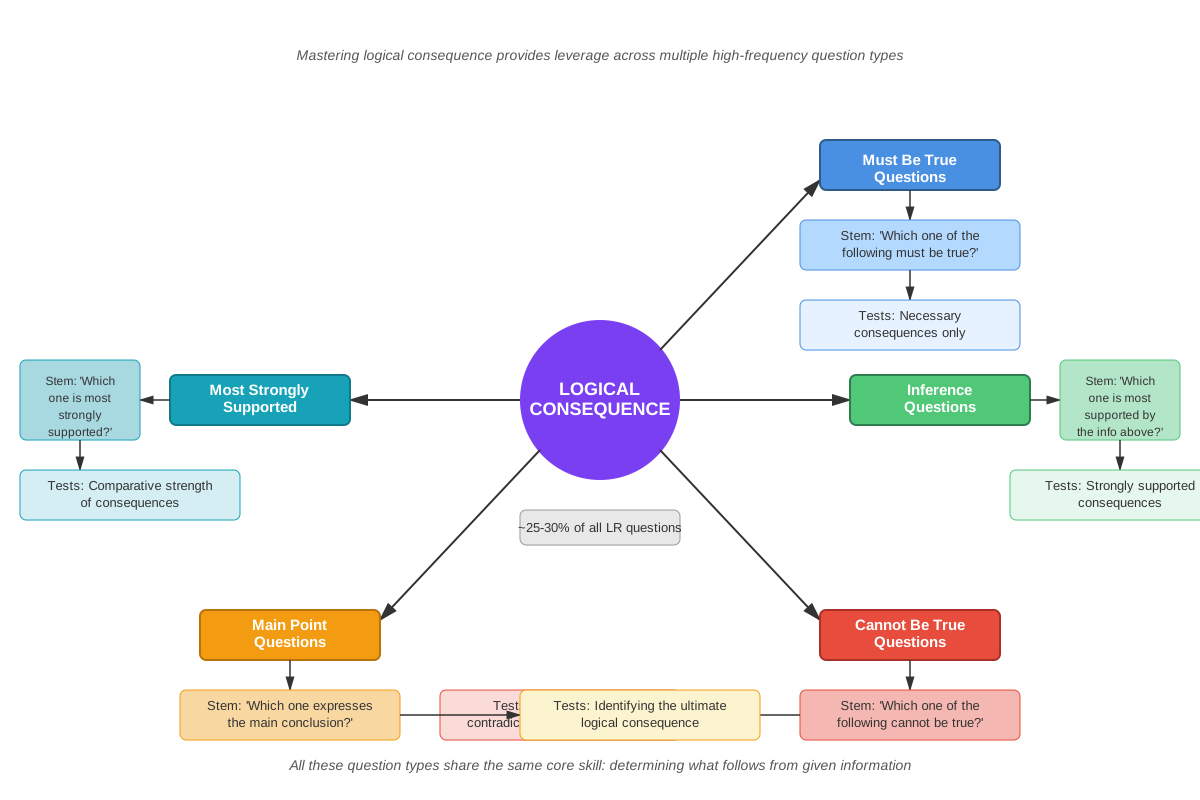
On the LSAT specifically, logical consequence appears in multiple question types with high frequency. Must Be True questions (appearing 4-6 times per test) directly test this concept. Inference questions (3-5 per test) require identifying logical consequences. Main Point questions (2-3 per test) often involve recognizing what conclusion follows from premises. Additionally, Cannot Be True questions test the inverse understanding of logical consequence. Combined, these question types constitute approximately 25-30% of all Logical Reasoning questions, making this one of the highest-yield topics for score improvement.
Inference questions typically present a stimulus containing factual statements, observations, or premises without an explicit conclusion. The question stem then asks what must be true, what is most supported, or what can be properly inferred. Common phrasings include: "Which one of the following can be properly inferred from the passage?", "If the statements above are true, which one of the following must also be true?", and "The statements above, if true, most strongly support which one of the following?" Each variation tests the student's ability to identify logical consequences while avoiding unsupported leaps.
Core Concepts
Definition of Logical Consequence
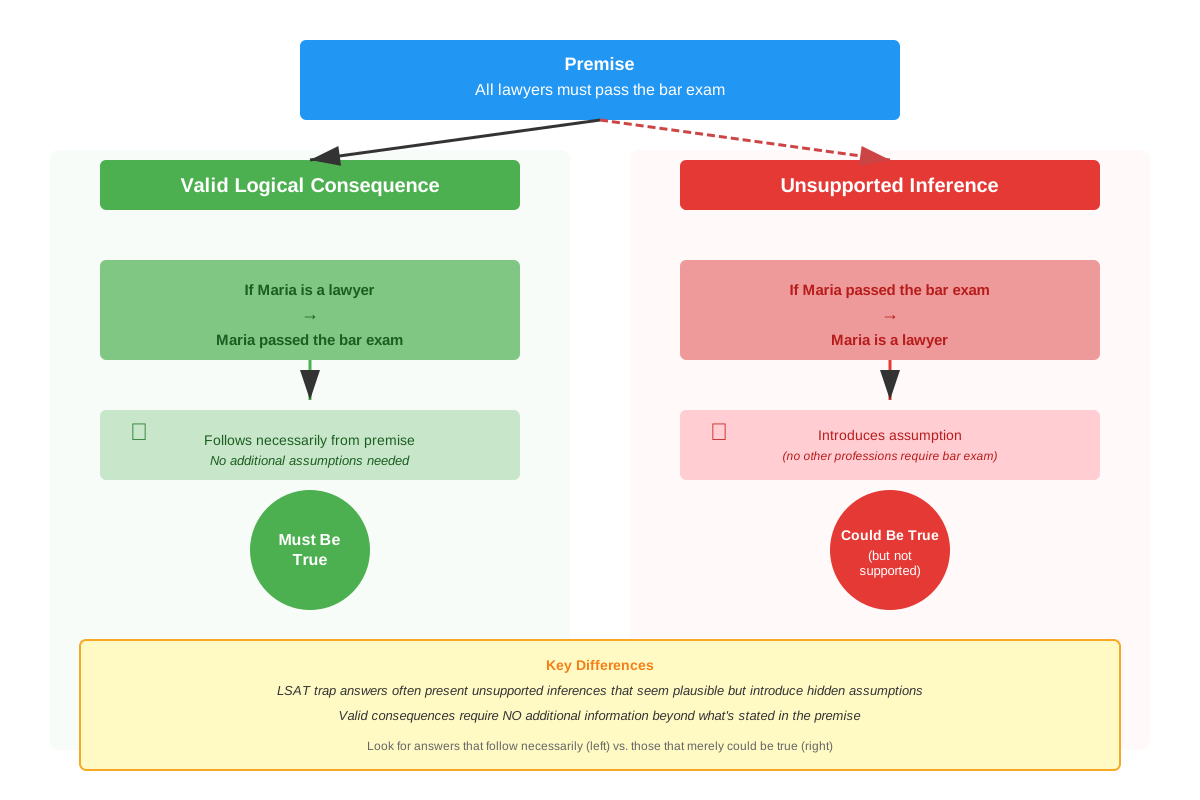
A logical consequence is a statement that necessarily follows from one or more premises through valid reasoning. If the premises are true, a logical consequence must also be true—there is no possible scenario where the premises hold but the consequence does not. This differs from statements that are merely consistent with premises or that could be true but aren't required by the premises.
The formal definition states: Statement B is a logical consequence of statement A if and only if it is impossible for A to be true while B is false. This relationship is also called "entailment"—the premises entail the conclusion. On the LSAT, recognizing logical consequence means identifying what is guaranteed by the given information, not what is likely, plausible, or consistent with it.
Types of Logical Consequence on the LSAT
Deductive Consequence
Deductive logical consequence involves conclusions that follow with absolute certainty from premises. If the premises are true, the conclusion cannot possibly be false. This represents the strongest form of logical consequence tested on the LSAT.
Example:
- Premise: All lawyers must pass the bar exam
- Premise: Sarah is a lawyer
- Logical Consequence: Sarah passed the bar exam
This conclusion must be true if the premises are true—there's no scenario where both premises hold but Sarah didn't pass the bar exam.
Inductive Support
While technically not "logical consequence" in the strict philosophical sense, the LSAT also tests inductive support where conclusions are strongly supported but not guaranteed by premises. Questions asking what is "most supported" or "most strongly supported" fall into this category.
Example:
- Premise: 95% of students who study 20+ hours improve their LSAT score
- Premise: Marcus studied 25 hours
- Strongly Supported: Marcus likely improved his LSAT score
This isn't a necessary consequence (Marcus could be in the 5%), but it's strongly supported by the evidence.
The Logical Consequence Test
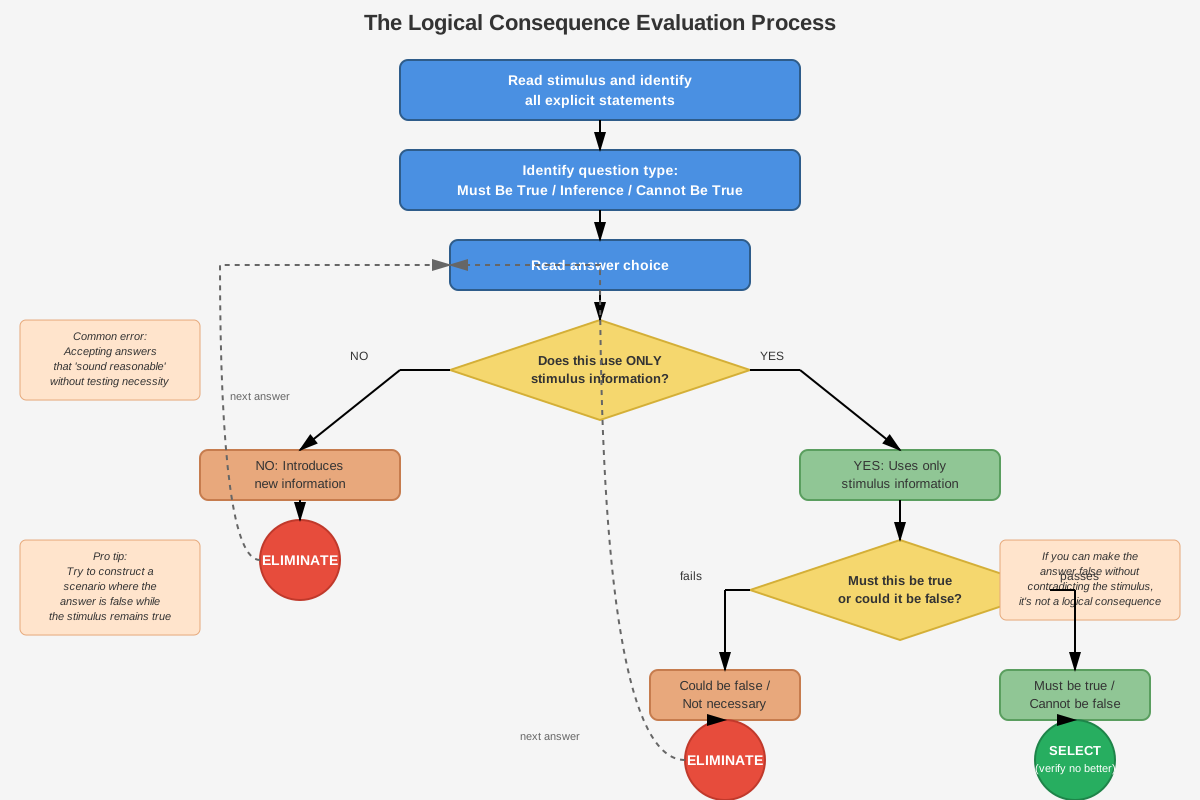
To determine whether a statement is a logical consequence of given premises, apply this three-step test:
- Assume the premises are true: Accept all given information as fact
- Examine the proposed consequence: Consider whether it could be false while premises remain true
- Apply the necessity test: If there's any possible scenario where premises are true but the proposed consequence is false, it's not a logical consequence
| Test Result | Interpretation | LSAT Application |
|---|---|---|
| No scenario exists where premises are true and conclusion false | Valid logical consequence | Correct answer for "must be true" |
| Some scenarios exist where premises are true and conclusion false | Not a logical consequence | Incorrect answer for "must be true" |
| Most scenarios support conclusion but exceptions possible | Strong inductive support | Potentially correct for "most supported" |
| Conclusion consistent with premises but not required | Possible but unsupported | Incorrect answer (common trap) |
Common Logical Consequence Patterns
Conditional Chain Reasoning
When premises establish a chain of conditional relationships, logical consequences follow from connecting the chain:
- If A → B (If A, then B)
- If B → C (If B, then C)
- Logical Consequence: If A → C (If A, then C)
The LSAT frequently tests whether students can recognize valid chains and avoid invalid inferences like confusing sufficient and necessary conditions.
Quantifier Logic
Statements using quantifiers (all, some, most, none) generate specific logical consequences:
- "All X are Y" logically entails "Some Y are X" (if any X exist)
- "No X are Y" logically entails "No Y are X"
- "Most X are Y" combined with "Most X are Z" logically entails "Some Y are Z"
Understanding these patterns allows rapid identification of valid consequences in formal logic questions.
Constraint Satisfaction
When premises establish constraints or limitations, logical consequences involve what must be true given those constraints:
Example:
- Premise: Exactly three of five committee members voted yes
- Premise: John and Maria voted no
- Logical Consequence: Exactly three of the remaining three members (Sarah, Tom, Lisa) voted yes
- Further Consequence: Sarah, Tom, and Lisa all voted yes
This pattern appears frequently in analytical reasoning but also in logical reasoning questions involving numerical constraints.
What Logical Consequence Is NOT
Understanding logical consequence requires recognizing what doesn't qualify:
Causal Relationships: Just because B follows A temporally or causally doesn't mean B is a logical consequence of A. The statement "It rained, therefore the ground is wet" involves causal consequence, not logical consequence. The ground being wet doesn't follow purely from logical necessity—it requires empirical knowledge about rain and ground.
Probable Outcomes: High probability doesn't equal logical necessity. "Most doctors recommend this treatment" doesn't logically entail "Dr. Smith recommends this treatment," even though it's probable.
Consistent Possibilities: A statement can be consistent with premises without being a logical consequence. If "All cats are mammals," the statement "Some cats are black" is consistent but not a logical consequence—it could be true or false regardless of the premise.
Concept Relationships
Logical consequence serves as the foundational concept connecting multiple aspects of LSAT Logical Reasoning. The relationship map flows as follows:
Premises → Logical Consequence → Valid Conclusions
Understanding logical consequence depends on accurately identifying premises (the given information) and distinguishing them from conclusions. Once premises are identified, logical consequence determines what validly follows, which in turn defines what conclusions are justified.
Logical Consequence ↔ Assumption Identification
These concepts are inverse relationships. An assumption is an unstated premise required for a conclusion to follow as a logical consequence. If a conclusion doesn't follow as a logical consequence from stated premises alone, identifying what's missing reveals the assumption. Conversely, when an argument's conclusion is a valid logical consequence of its premises, no assumptions are needed.
Conditional Logic → Logical Consequence → Inference Questions
Conditional logic provides the formal structure (if-then relationships) that generates many logical consequences. These consequences then appear as correct answers in inference questions. Mastering conditional logic enables recognition of what must follow, which is precisely what inference questions test.
Logical Consequence → Strengthening/Weakening
Understanding logical consequence helps evaluate how additional premises affect arguments. Strengthening an argument means adding premises that make the conclusion a stronger logical consequence. Weakening means introducing information that breaks the logical connection between premises and conclusion.
High-Yield Facts
⭐ A logical consequence must be true whenever the premises are true—there is no possible exception
⭐ "Must be true" questions require identifying statements that are logical consequences, not merely probable or possible outcomes
⭐ If you can imagine any scenario where the premises are true but the answer choice is false, that choice is not a logical consequence
⭐ Logical consequence does not require causal connection—it's about logical necessity, not real-world causation
⭐ The correct answer to a Must Be True question is often narrower in scope than wrong answers, which tend to overreach
- Combining "most" statements can yield logical consequences: "Most A are B" + "Most A are C" → "Some B are C"
- Conditional contrapositives are always logical consequences: If A → B, then Not B → Not A
- Existential claims (some, at least one) are weaker than universal claims (all, every) but can be logical consequences of universal claims
- Logical consequence is transitive: If A entails B, and B entails C, then A entails C
- The absence of information about something does not logically entail that thing is false (absence of evidence ≠ evidence of absence)
Quick check — test yourself on Logical consequence so far.
Try Flashcards →Common Misconceptions
Misconception: If something is likely or probable based on the premises, it's a logical consequence.
Correction: Logical consequence requires necessity, not probability. Even if something is 99% likely, if there's any possible scenario where premises are true but the conclusion is false, it's not a logical consequence. For "must be true" questions, only statements that are 100% guaranteed qualify.
Misconception: Real-world knowledge can be used to determine logical consequences.
Correction: Logical consequence depends only on the logical relationship between premises and conclusion, not on external facts. Even if you know something is true in reality, it's only a logical consequence if it follows from the stated premises alone. The LSAT tests logical reasoning, not factual knowledge.
Misconception: If a conclusion is consistent with premises, it's a logical consequence.
Correction: Consistency is much weaker than logical consequence. Many statements can be consistent with premises (not contradicting them) without being required by them. A logical consequence must be true given the premises, not merely compatible with them.
Misconception: Longer, more detailed answer choices are more likely to be logical consequences.
Correction: The opposite is often true. Logical consequences tend to be narrow and precisely supported. Longer answer choices frequently add unsupported details that break the logical connection. The LSAT rewards precision, not elaboration.
Misconception: Causal relationships in the stimulus mean causal conclusions are logical consequences.
Correction: Even when premises describe causal relationships, conclusions must still follow through logical necessity, not just causal plausibility. The statement "Smoking causes cancer" doesn't logically entail "John smokes, therefore John will get cancer"—the causal relationship is probabilistic, not logically necessary.
Misconception: Negating a premise produces a logical consequence.
Correction: Simply negating information from the stimulus doesn't create a logical consequence. If a premise states "Some doctors recommend treatment X," you cannot conclude "Some doctors don't recommend treatment X" as a logical consequence—it's possible all doctors recommend it. Only specific logical operations (like contrapositive) validly transform premises.
Worked Examples
Example 1: Must Be True Question
Stimulus: "Every member of the debate team has taken a public speaking course. Some members of the debate team are also members of the drama club. No member of the drama club has taken a public speaking course without also taking an acting course."
Question: Which one of the following must be true?
Answer Choices:
(A) Some members of the debate team have taken an acting course
(B) All members of the drama club have taken a public speaking course
(C) Most members of the debate team are also in the drama club
(D) Some people who have taken acting courses are on the debate team
(E) Everyone who has taken a public speaking course is on the debate team
Solution Process:
Step 1: Identify the premises and translate them:
- P1: All debate team members → took public speaking
- P2: Some debate team members → drama club members
- P3: All drama club members who took public speaking → took acting
Step 2: Combine premises to find logical consequences:
From P2, we know at least one person is both on the debate team AND in the drama club.
From P1, this person (being on debate team) must have taken public speaking.
From P3, this person (being in drama club and having taken public speaking) must have taken acting.
Therefore: At least one debate team member took acting → "Some debate team members took acting"
Step 3: Evaluate each answer:
- (A) CORRECT - This must be true based on our reasoning above
- (B) Wrong - We only know some drama club members took public speaking (those also on debate team)
- (C) Wrong - "Some" doesn't mean "most"—this overreaches
- (D) Wrong - While possibly true, we can't confirm anyone who took acting is on debate team (the logic flows the other way)
- (E) Wrong - Massive overreach—many people could take public speaking without being on debate team
Key Lesson: This example demonstrates how logical consequence often requires combining multiple premises. The correct answer (A) is narrower than wrong answers and follows necessarily from connecting the logical chain.
Example 2: Inference Question with Quantifiers
Stimulus: "Most of the company's software engineers have advanced degrees. Most of the company's software engineers work on artificial intelligence projects. Everyone working on artificial intelligence projects receives specialized training."
Question: If the statements above are true, which one of the following must also be true?
Answer Choices:
(A) Most people with advanced degrees work on artificial intelligence projects
(B) Some software engineers with advanced degrees receive specialized training
(C) All software engineers receive specialized training
(D) Most people who receive specialized training are software engineers
(E) Some people with advanced degrees do not work on artificial intelligence projects
Solution Process:
Step 1: Translate quantifier statements:
- P1: Most software engineers → advanced degrees
- P2: Most software engineers → AI projects
- P3: All AI project workers → specialized training
Step 2: Apply the "most-most" rule:
When "most X are Y" and "most X are Z," there must be overlap—some things are both Y and Z.
Therefore: Some software engineers have both advanced degrees AND work on AI projects
Step 3: Apply universal statement:
From P3, everyone on AI projects gets specialized training.
Therefore: Those software engineers with advanced degrees who work on AI projects (we know at least some exist) must receive specialized training.
Step 4: Evaluate answers:
- (A) Wrong - Reverses the logic; we don't know what most people with advanced degrees do
- (B) CORRECT - Must be true based on our reasoning
- (C) Wrong - Overreach; only those on AI projects must receive training
- (D) Wrong - We don't know the composition of all people receiving training
- (E) Wrong - Could be true but not required; possibly all people with advanced degrees work on AI
Key Lesson: This example shows how quantifier logic generates logical consequences. The "most-most" overlap principle is a high-yield pattern on the LSAT. The correct answer precisely captures what must be true without overreaching.
Exam Strategy
Approaching Logical Consequence Questions
Step 1: Identify the Question Type
Recognize logical consequence questions through trigger phrases:
- "must be true"
- "must also be true"
- "properly inferred"
- "conclusion follows logically"
- "if the statements above are true"
- "most strongly supported"
Step 2: Read the Stimulus Carefully
Focus on:
- Quantifiers (all, some, most, none, many, few)
- Conditional indicators (if, then, only if, unless, when)
- Constraints and limitations
- Relationships between categories or groups
Step 3: Predict Before Looking at Answers
After reading the stimulus, pause and think: "What must be true based on this information?" Even a general sense of the logical consequence helps avoid trap answers.
Step 4: Apply the Negation Test
For each answer choice, ask: "Can I imagine a scenario where the premises are true but this answer is false?" If yes, eliminate it.
Time Management
Allocate approximately 1:15-1:30 per logical consequence question:
- 30-40 seconds: Read and understand stimulus
- 10-15 seconds: Identify question type and predict
- 35-45 seconds: Evaluate answer choices
- 10 seconds: Confirm and move on
If a question takes longer than 2 minutes, mark it and return if time permits. Logical consequence questions should be among the faster question types since they don't require identifying flaws or evaluating argument structure.
Process of Elimination Tips
Eliminate answers that:
- Introduce new information not mentioned in the stimulus
- Reverse the logical direction (confuse sufficient and necessary conditions)
- Use stronger quantifiers than justified (changing "some" to "most" or "all")
- Make causal claims when only correlations are established
- Require real-world knowledge beyond the stimulus
- Are too broad or sweeping compared to narrow premises
Keep answers that:
- Use the same or weaker quantifiers than the premises
- Combine information from multiple premises
- Apply valid logical operations (contrapositive, quantifier logic)
- Stay narrow and specific
- Can be directly traced back to the stimulus
Trigger Words to Watch
In the stimulus:
- "Only," "only if," "unless" (sufficient/necessary conditions)
- "Most," "majority," "more than half" (quantifier logic)
- "Some," "at least one," "a few" (existential claims)
- "All," "every," "each," "any" (universal claims)
- "None," "no," "not any" (universal negations)
In answer choices:
- "Must," "necessarily," "definitely" (claiming logical consequence)
- "Could," "might," "possibly" (weaker claims, often wrong for "must be true")
- "Probably," "likely" (probability, not logical necessity)
Memory Techniques
The VALID Acronym for Testing Logical Consequence
Verify premises are accepted as true
Assess whether conclusion could be false
Look for scenarios where premises hold but conclusion doesn't
Identify any assumptions being added
Determine if the connection is necessary, not just possible
The Necessity Test Visualization
Imagine the premises as a locked box. A logical consequence is something that must be inside the box—there's no version of the box where it's not there. Possible but unsupported statements are things that could be in the box but might not be. This mental image helps distinguish between necessity and possibility.
The Quantifier Hierarchy
Remember quantifier strength from strongest to weakest:
ALL → MOST → MANY/SEVERAL → SOME → AT LEAST ONE
A logical consequence can move down the hierarchy (All → Some is valid) but never up (Some → All is invalid). Think of it as a waterfall—logic flows downward, never upward.
The Contrapositive Flip
For conditional statements, remember: "If A then B" automatically means "If not B then not A"
Mnemonic: FLIP and FLIP (Flip the order, Flip the signs)
Original: A → B
Contrapositive: ~B → ~A
The Most-Most Overlap Rule
When "Most X are Y" and "Most X are Z," visualize two overlapping circles each covering more than half of X. They must overlap—that's the logical consequence. Think: "Two majorities must meet"
Summary
Logical consequence represents the foundation of inference and Must Be True questions on the LSAT, testing whether students can identify what necessarily follows from given premises. A statement is a logical consequence if and only if it must be true whenever the premises are true—no exceptions possible. The LSAT tests this concept through various question types, requiring students to distinguish between necessary consequences, probable outcomes, and merely possible statements. Success requires understanding quantifier logic (all, most, some), conditional reasoning (if-then relationships), and the principle that logical consequences follow from logical structure alone, not real-world knowledge or causal relationships. The key skill is applying the necessity test: if any scenario exists where premises are true but the proposed conclusion is false, it's not a logical consequence. High scorers recognize that correct answers tend to be narrow and precisely supported, while wrong answers typically overreach by introducing unsupported information, reversing logical relationships, or confusing possibility with necessity. Mastering logical consequence provides the analytical foundation for excelling across all Logical Reasoning question types.
Key Takeaways
- Logical consequence requires necessity, not probability—even 99% likelihood isn't enough for "must be true" questions
- Apply the negation test: if you can imagine premises being true while the answer is false, eliminate that answer
- Correct answers are typically narrower than wrong answers, which tend to overreach beyond what's supported
- Combine premises systematically—many logical consequences emerge only when connecting multiple statements
- Quantifier logic is high-yield: master the "most-most" overlap rule and the quantifier hierarchy
- Distinguish logical consequence from causal consequence—the LSAT tests logical necessity, not real-world causation
- Never add outside knowledge or assumptions—logical consequences must follow from stated premises alone
Related Topics
Conditional Logic and Contrapositives: Understanding if-then relationships and their logical equivalents deepens mastery of logical consequence, as conditional chains generate many necessary inferences tested on the LSAT.
Formal Logic and Quantifiers: Advanced study of how "all," "some," "most," and "none" interact provides the technical foundation for recognizing complex logical consequences involving multiple quantified statements.
Assumption Questions: These test the inverse of logical consequence—identifying what unstated premise is required for a conclusion to follow necessarily, building on the same logical reasoning skills.
Sufficient and Necessary Conditions: Distinguishing these concepts enables precise identification of what must follow (necessary) versus what guarantees something (sufficient), critical for advanced logical consequence questions.
Argument Structure Analysis: Understanding how premises support conclusions provides context for evaluating whether conclusions are valid logical consequences or require additional support.
Practice CTA
Now that you understand logical consequence, it's time to apply these concepts to actual LSAT questions. The practice questions and flashcards will reinforce your ability to identify what must be true, distinguish necessity from possibility, and avoid common traps. Remember: logical consequence is a skill that improves dramatically with deliberate practice. Each question you work through strengthens your ability to trace logical connections and recognize valid inferences. Approach the practice materials systematically, reviewing any questions you miss to understand exactly where your reasoning diverged from the correct logical consequence. Your investment in mastering this high-yield topic will pay dividends across every Logical Reasoning section you encounter.
Sign up free to keep reading
Create a free AnvayaPrep account to finish this LSAT guide on Logical consequence — plus flashcards and practice questions.