Overview
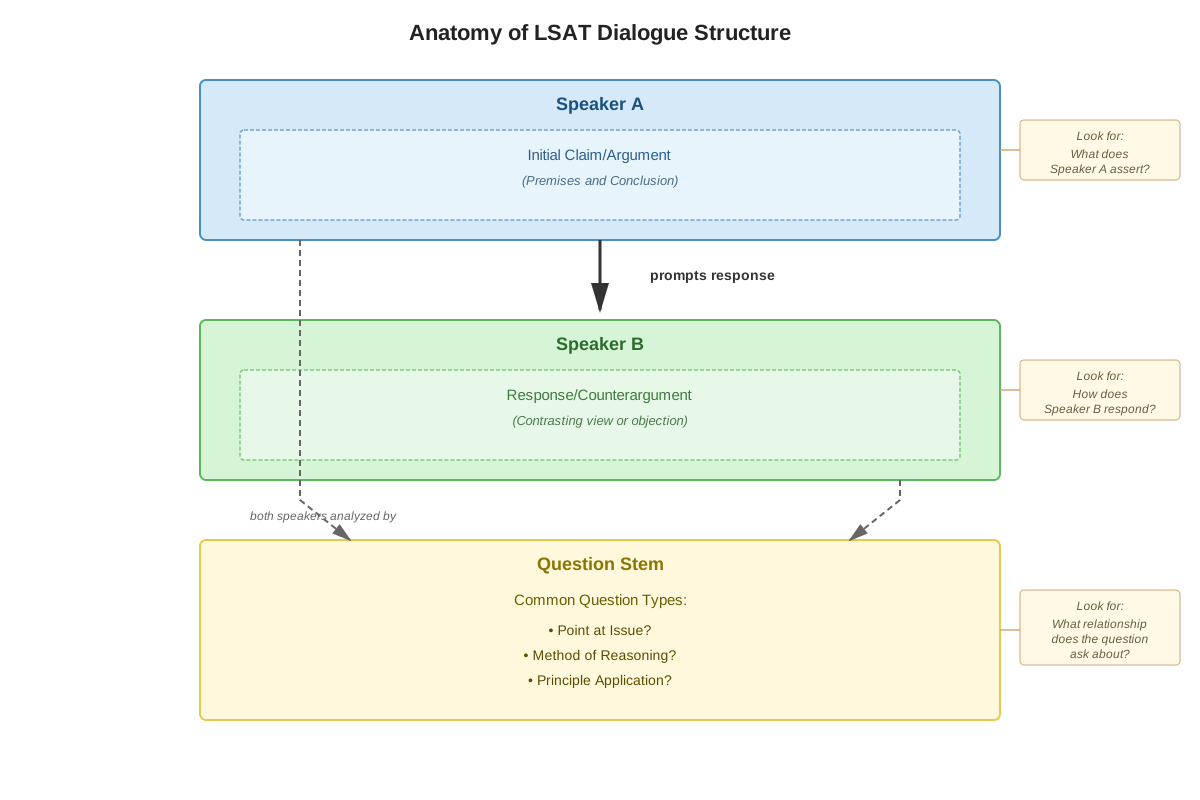
Dialogue structure is a fundamental question format in LSAT Logical Reasoning that presents two speakers expressing different viewpoints on a topic. These questions typically feature Speaker A making a claim or argument, followed by Speaker B responding with a contrasting perspective, objection, or alternative interpretation. Understanding dialogue structure is essential because it forms the foundation for multiple question types, including Point at Issue questions, Method of Reasoning questions, and Principle questions that involve two-party exchanges.
The LSAT frequently uses dialogue structure to test a student's ability to identify precise points of disagreement, recognize argumentative techniques, and understand how two speakers relate to each other's claims. Unlike single-passage arguments, dialogue questions require tracking two distinct lines of reasoning simultaneously while identifying where they intersect, diverge, or directly contradict each other. This format mirrors real-world legal discourse, where attorneys must understand opposing arguments, identify exact points of contention, and respond to counterarguments effectively.
Mastering lsat dialogue structure connects directly to broader logical reasoning skills essential throughout the exam. The ability to parse dialogue structure enhances performance on point at issue and disagreement questions specifically, but also strengthens skills in identifying assumptions, evaluating evidence, and recognizing logical relationships that appear across all Logical Reasoning question types. Students who excel at dialogue structure questions demonstrate sophisticated reading comprehension and analytical skills that translate to higher overall LSAT scores.
Learning Objectives
- [ ] Identify how Dialogue structure appears in LSAT questions
- [ ] Explain the reasoning pattern behind Dialogue structure
- [ ] Apply Dialogue structure to solve LSAT-style problems accurately
- [ ] Distinguish between genuine disagreements and mere differences in emphasis or scope
- [ ] Recognize the specific claim or sub-claim that two speakers are disputing
- [ ] Evaluate answer choices by testing whether both speakers would have committed positions on the statement
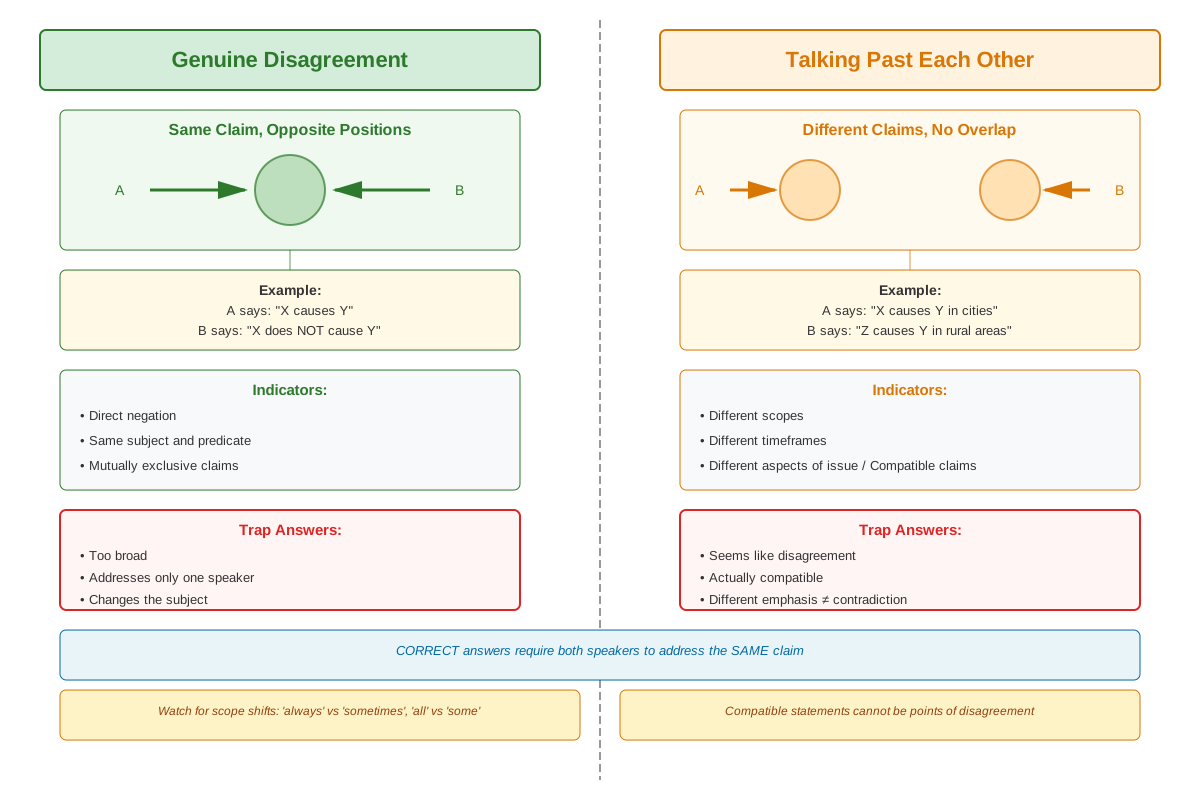
- [ ] Identify when speakers are talking past each other versus directly engaging with the same issue
Prerequisites
- Basic argument structure: Understanding premises, conclusions, and how claims support one another is essential because dialogue questions require tracking multiple argument structures simultaneously.
- Conditional reasoning: Many dialogue exchanges involve conditional statements and their contrapositives, which speakers may interpret or apply differently.
- Assumption identification: Recognizing unstated assumptions helps identify where speakers' reasoning diverges even when they don't explicitly state their disagreement.
- Scope recognition: Understanding the boundaries of claims is crucial because speakers often disagree about specific aspects while agreeing on broader points.
Why This Topic Matters
Dialogue structure questions appear with remarkable consistency on the LSAT, typically comprising 3-5 questions per exam across both Logical Reasoning sections. This frequency makes dialogue structure a high-yield topic that directly impacts overall scores. Point at Issue questions, which rely entirely on dialogue structure, appear in virtually every LSAT administration, while Method of Reasoning and Principle questions frequently employ dialogue formats as well.
Beyond exam performance, dialogue structure skills mirror essential legal reasoning abilities. Attorneys must constantly identify precise points of disagreement in depositions, negotiations, and courtroom arguments. The ability to pinpoint exactly what parties dispute—and equally important, what they don't dispute—is fundamental to legal practice. Law school classroom discussions, particularly in first-year courses, heavily emphasize Socratic dialogue where students must track competing interpretations and identify exact points of contention.
On the LSAT, dialogue structure most commonly appears in these formats: Point at Issue questions asking what the speakers are committed to disagreeing about; Method of Reasoning questions asking how Speaker B responds to Speaker A; and Principle questions asking which principle both speakers accept or which principle their disagreement illustrates. Less frequently, dialogue structure appears in Strengthen/Weaken questions where students must identify which piece of evidence would support one speaker's position over the other's.
Core Concepts
The Basic Dialogue Format
The standard dialogue structure on the LSAT presents two speakers, typically labeled with names (e.g., "Jordan" and "Taylor") or generic labels ("Critic" and "Historian"). Speaker A presents an initial position, argument, or claim spanning 2-4 sentences. Speaker B then responds, usually with a contrasting viewpoint, objection, or qualification. The entire exchange rarely exceeds 100 words, requiring students to extract maximum information from compact text.
The key to understanding dialogue structure lies in recognizing that Speaker B's response always relates to Speaker A's position in a specific way. Speaker B might directly contradict a claim, accept the premises but reject the conclusion, introduce a counterexample, question an assumption, or reinterpret evidence differently. Identifying this relationship is crucial for answering questions correctly.
Types of Disagreement
Not all dialogues present the same type of disagreement. Understanding these categories helps predict question types and eliminate wrong answers:
Direct Factual Disagreement: The speakers dispute whether something is true or false. For example, Speaker A claims "Most voters support the policy," while Speaker B claims "Most voters oppose the policy." Both speakers cannot be correct simultaneously.
Interpretive Disagreement: The speakers agree on facts but interpret their significance differently. Speaker A might argue that increased sales indicate product quality, while Speaker B argues the same sales figures reflect successful marketing rather than quality.
Normative Disagreement: The speakers dispute what should be done or what is desirable, even if they agree on factual matters. Speaker A might claim "We should prioritize economic growth," while Speaker B argues "We should prioritize environmental protection."
Scope Disagreement: The speakers make claims that differ in scope or generality. Speaker A might make a universal claim ("All X are Y"), while Speaker B objects with a particular counterexample ("Some X are not Y").
The Point at Issue Test
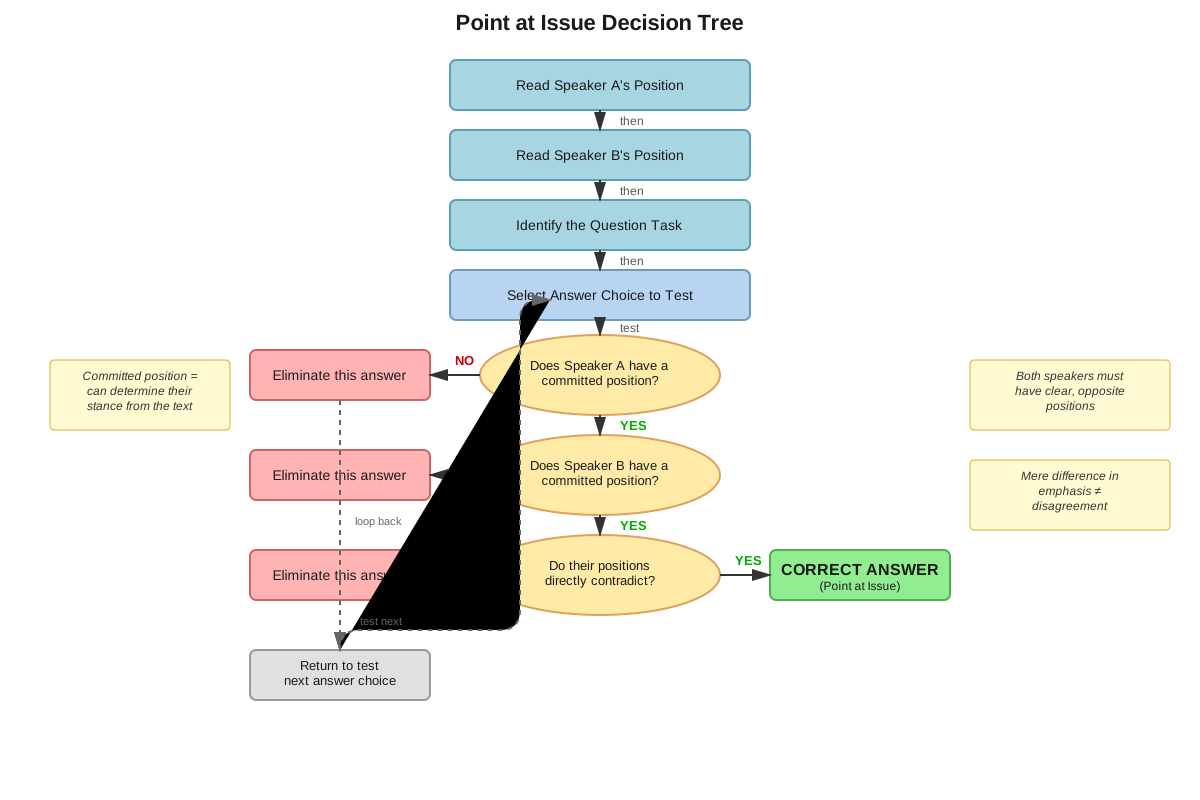
For Point at Issue questions specifically, the LSAT tests whether students can identify statements about which both speakers have committed, opposing positions. The correct answer must satisfy a two-part test:
- Commitment Test: Both speakers must have taken a clear position on the statement, either explicitly or by clear implication from their remarks.
- Opposition Test: The speakers must hold opposing positions—one would agree with the statement while the other would disagree.
Many wrong answers fail one or both parts of this test. A statement might be something only one speaker addressed (failing the commitment test) or something both speakers would agree about (failing the opposition test).
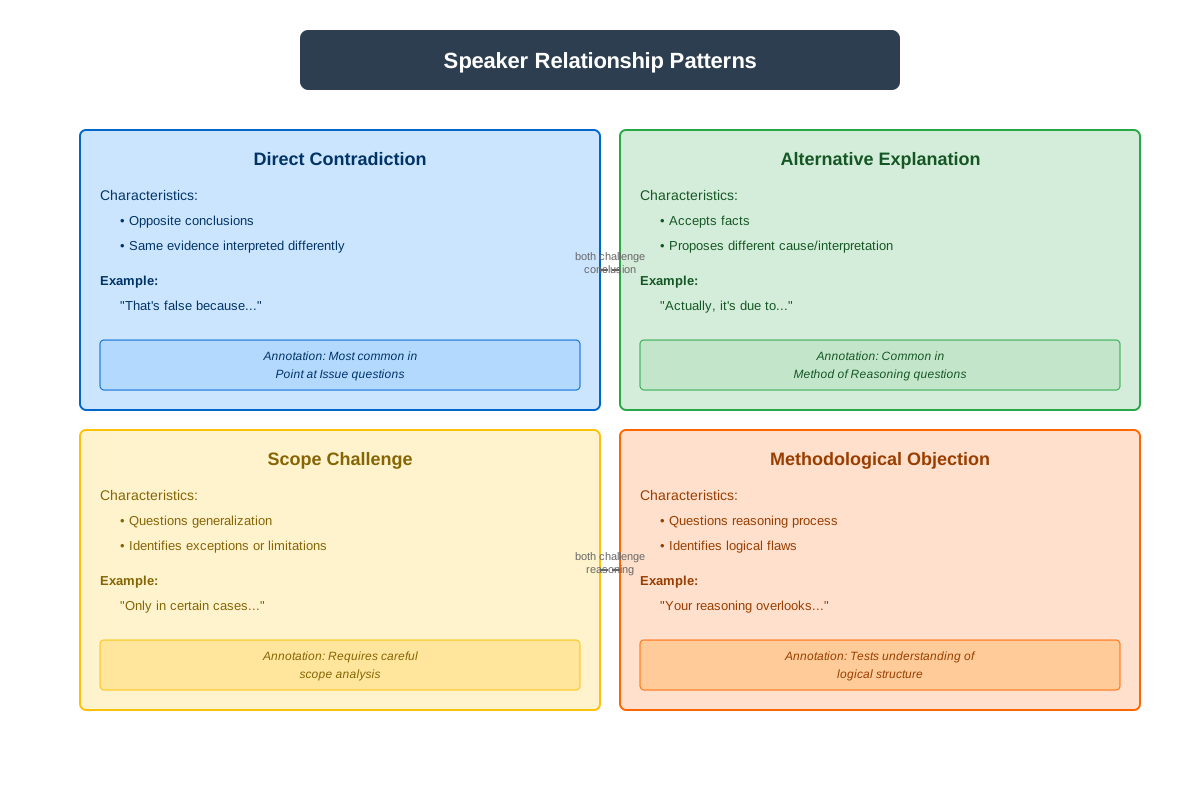
Common Response Patterns
Speaker B's responses typically follow recognizable patterns that help predict the point of disagreement:
| Response Pattern | Description | Example Signal Phrases |
|---|---|---|
| Direct Contradiction | Denies Speaker A's main claim | "That's incorrect," "Actually," "On the contrary" |
| Counterexample | Provides a case that contradicts A's generalization | "However, consider," "But what about" |
| Alternative Explanation | Accepts A's evidence but offers different interpretation | "Those facts could also mean," "A better explanation" |
| Questioning Assumptions | Challenges unstated premises in A's argument | "You're assuming," "That presupposes" |
| Scope Limitation | Accepts A's claim in some cases but not all | "That may be true for X, but not Y," "Only in certain circumstances" |
Implicit vs. Explicit Disagreement
The LSAT frequently tests whether students can identify implicit disagreements—points where speakers would disagree based on logical implications of their stated positions, even if they don't explicitly address the point. For example:
- Speaker A: "The new policy will reduce costs, which is the most important consideration."
- Speaker B: "The new policy may reduce costs, but it will harm employee morale, which matters more."
These speakers implicitly disagree about whether cost reduction is the most important consideration, even though Speaker B doesn't explicitly say "Cost reduction is not the most important consideration."
What Speakers Don't Disagree About
Equally important is recognizing what speakers don't dispute. Wrong answers in Point at Issue questions often present statements that:
- Only one speaker addressed
- Both speakers would accept
- Neither speaker has sufficient information to evaluate
- Fall outside the scope of the discussion
Eliminating these wrong answers efficiently is crucial for time management on the LSAT.
Concept Relationships
The concepts within dialogue structure form an interconnected system. Understanding the basic dialogue format enables recognition of types of disagreement, which in turn allows application of the point at issue test. Recognizing common response patterns helps quickly identify the type of disagreement present, while understanding implicit vs. explicit disagreement refines application of the commitment test within the point at issue framework.
Dialogue structure connects to prerequisite topics through multiple pathways: Basic argument structure → enables tracking two arguments simultaneously in dialogue format. Conditional reasoning → appears within individual speaker's claims and helps identify disagreements about necessary/sufficient conditions. Assumption identification → reveals implicit disagreements where speakers rely on incompatible unstated premises. Scope recognition → distinguishes genuine disagreements from cases where speakers address different aspects of an issue.
The relationship map flows as follows:
Basic Dialogue Format → Types of Disagreement → Point at Issue Test → Answer Evaluation
Common Response Patterns → Types of Disagreement (reinforcing relationship)
Implicit vs. Explicit Disagreement → Commitment Test (component of Point at Issue Test)
These dialogue structure skills then enable progression to advanced topics like Principle questions with multiple speakers, Complex method of reasoning questions, and Comparative argument evaluation.
High-Yield Facts
⭐ Point at Issue questions require both speakers to have committed positions on the correct answer—if only one speaker addressed it, it's wrong.
⭐ The correct answer to a Point at Issue question must be something one speaker would agree with and the other would disagree with—if both would agree or both would disagree, it's wrong.
⭐ Speaker B's response always relates specifically to Speaker A's position; understanding this relationship is key to identifying the disagreement.
⭐ Implicit disagreements are just as valid as explicit ones; speakers can disagree about logical implications of their positions even without directly stating opposition.
⭐ Scope differences often create wrong answers—speakers may agree on a general principle but disagree about its application to specific cases.
- Wrong answers in dialogue questions frequently present statements that are too broad or too narrow relative to what the speakers actually discussed.
- The phrase "committed to disagreeing" in Point at Issue questions means both speakers must have clear, opposing positions, not merely different emphases.
- Many dialogue questions feature speakers who agree on facts but disagree on interpretation, evaluation, or appropriate response.
- Speaker B often accepts some aspect of Speaker A's position while rejecting another part; identifying which part is rejected reveals the disagreement.
- Dialogue questions reward careful attention to qualifiers like "most," "some," "always," and "never," which often mark the precise scope of disagreement.
- When speakers use different terminology, determine whether they're discussing the same concept with different words or actually addressing different issues.
- The LSAT rarely presents dialogues where speakers completely talk past each other; there's almost always a genuine point of intersection.
Quick check — test yourself on Dialogue structure so far.
Try Flashcards →Common Misconceptions
Misconception: If two speakers discuss the same topic, they must disagree about it. → Correction: Speakers can discuss the same topic while agreeing on many aspects of it. The disagreement is typically narrow and specific, not comprehensive. Many wrong answers present statements both speakers would accept.
Misconception: The point of disagreement is always explicitly stated in the dialogue. → Correction: The LSAT frequently tests implicit disagreements where the opposing positions follow logically from what speakers say but aren't directly stated. Students must infer what each speaker would think about statements that follow from their expressed positions.
Misconception: If Speaker B criticizes Speaker A's argument, they disagree about the conclusion. → Correction: Speaker B might accept Speaker A's conclusion while objecting to the reasoning used to reach it. Alternatively, Speaker B might reject the conclusion for entirely different reasons than those Speaker A considered. The specific point of disagreement requires careful analysis.
Misconception: Longer answer choices are more likely to be correct because they're more specific. → Correction: Length is irrelevant to correctness. Wrong answers are often lengthy because they include qualifications or details that one or both speakers never addressed. The correct answer must match what both speakers actually committed to, regardless of length.
Misconception: If Speaker A makes multiple claims, Speaker B disagrees with all of them. → Correction: Speaker B typically responds to a specific aspect of Speaker A's position. Speaker B might accept some claims while rejecting others, or might accept the facts while disputing their interpretation. Identifying the specific point of response is crucial.
Misconception: Point at Issue questions ask what the speakers are "discussing" or "talking about." → Correction: The question asks what they disagree about, which is much more specific. Speakers might discuss many topics while disagreeing about only one narrow point. Wrong answers often present the general topic rather than the specific disagreement.
Worked Examples
Example 1: Point at Issue Question
Dialogue:
Keisha: The city should ban plastic bags because they harm the environment. Studies show that plastic bags take hundreds of years to decompose and often end up polluting waterways and harming wildlife.
Marcus: Banning plastic bags won't solve the environmental problems you're concerned about. Paper bags, which would replace plastic bags, actually require more energy to produce and generate more greenhouse gases during manufacturing than plastic bags do.
Question: Keisha and Marcus are committed to disagreeing about which one of the following?
Analysis:
First, identify what each speaker claims:
- Keisha: Plastic bags should be banned (normative claim) because they harm the environment (factual claim about decomposition and pollution)
- Marcus: Banning plastic bags won't solve environmental problems (predictive claim) because paper bag alternatives are worse in some environmental respects (factual claim about energy and emissions)
Now apply the Point at Issue test to potential answers:
Potential Answer A: "Plastic bags harm the environment."
- Keisha's position: Clearly agrees (explicitly stated)
- Marcus's position: No clear position stated or implied; Marcus doesn't dispute that plastic bags harm the environment, only that banning them will solve the problem
- Verdict: WRONG—fails commitment test for Marcus
Potential Answer B: "Banning plastic bags would benefit the environment overall."
- Keisha's position: Would agree (implied by her support for the ban based on environmental harm)
- Marcus's position: Would disagree (his argument suggests the ban wouldn't solve environmental problems and might create others)
- Verdict: CORRECT—both speakers are committed to opposing positions
Potential Answer C: "Paper bags require more energy to produce than plastic bags."
- Keisha's position: No position stated or implied
- Marcus's position: Agrees (explicitly stated)
- Verdict: WRONG—fails commitment test for Keisha
Potential Answer D: "Environmental considerations should influence city policy."
- Keisha's position: Would agree (her entire argument is based on environmental considerations)
- Marcus's position: Would likely agree (he's making an environmental argument, just a different one)
- Verdict: WRONG—fails opposition test; both would agree
Connection to Learning Objectives: This example demonstrates how to identify dialogue structure (two speakers with contrasting positions), explain the reasoning pattern (Keisha supports a policy for environmental reasons; Marcus opposes it by arguing it won't achieve its environmental goals), and apply the structure to solve the problem accurately (using the two-part Point at Issue test).
Example 2: Method of Reasoning in Dialogue
Dialogue:
Scientist: The recent decline in bee populations is primarily caused by pesticide use. In regions where certain pesticides have been banned, bee populations have stabilized or recovered.
Farmer: Your conclusion is premature. Those regions where bee populations recovered also implemented other changes, including planting more diverse crops and preserving natural habitats. Any of these factors could explain the recovery.
Question: The farmer responds to the scientist by:
Analysis:
Identify the scientist's reasoning structure:
- Evidence: Correlation between pesticide bans and bee population recovery
- Conclusion: Pesticides are the primary cause of bee decline
- Implicit assumption: The correlation indicates causation; no other factors explain the recovery
Identify the farmer's response strategy:
- Accepts the scientist's evidence (doesn't dispute that populations recovered where pesticides were banned)
- Challenges the causal inference by introducing alternative explanations
- Points out that correlation doesn't prove causation when multiple factors changed simultaneously
The farmer's method is to question the scientist's reasoning by presenting alternative explanations for the observed correlation. The farmer doesn't dispute the facts but argues the scientist hasn't ruled out other possible causes.
Correct Answer Pattern: "Presenting alternative explanations for the evidence cited by the scientist" or "Questioning whether the scientist has established a causal relationship"
Wrong Answer Patterns:
- "Contradicting the scientist's factual claims" (the farmer accepts the facts)
- "Providing additional evidence for the scientist's conclusion" (the farmer opposes the conclusion)
- "Arguing that the scientist's conclusion is irrelevant" (the farmer engages directly with the conclusion's validity)
Connection to Learning Objectives: This example shows how dialogue structure appears in Method of Reasoning questions, explains the reasoning pattern (challenging causal inference by introducing confounding variables), and demonstrates how to apply this understanding to eliminate wrong answers and identify the correct characterization of Speaker B's response.
Exam Strategy
When approaching dialogue structure questions on the LSAT, follow this systematic process:
Step 1: Read Speaker A carefully and identify the main claim. Underline or mentally note the conclusion and key premises. Don't rush this step—understanding Speaker A's position is essential for understanding how Speaker B responds.
Step 2: Before reading Speaker B, predict possible responses. Will Speaker B likely contradict the conclusion, challenge the reasoning, introduce a counterexample, or offer an alternative interpretation? This prediction primes your mind to recognize the actual response pattern.
Step 3: Read Speaker B and identify the specific relationship to Speaker A. Look for signal phrases like "however," "but," "actually," "on the contrary," or "that assumes." These markers often indicate the precise point of disagreement or the nature of the response.
Step 4: For Point at Issue questions, apply the two-part test to each answer choice. Ask: (1) Does Speaker A have a committed position on this statement? (2) Does Speaker B have a committed position on this statement? (3) Are their positions opposite? Eliminate any answer that fails any part of this test.
Exam Tip: In Point at Issue questions, physically or mentally check each answer against both speakers. Many students only check whether Speaker A would agree/disagree and forget to verify Speaker B's position, leading to errors.
Trigger words and phrases to watch for:
- "Committed to disagreeing": Requires both speakers to have clear, opposing positions
- "Responds to [Speaker A] by": Signals a Method of Reasoning question; focus on the technique, not just the content
- "Vulnerable to criticism": Often appears in dialogue format; identify the flaw in one speaker's reasoning
- "Principle underlying": May ask which principle both speakers accept or which their disagreement illustrates
Process-of-elimination strategies specific to dialogue:
- Eliminate "one-speaker" answers first: If only one speaker addressed the topic in the answer choice, eliminate it immediately in Point at Issue questions.
- Eliminate "agreement" answers: If both speakers would agree with the statement, it cannot be the point of disagreement.
- Watch for scope shifts: Wrong answers often present claims that are broader or narrower than what speakers actually discussed.
- Check for implicit positions carefully: Don't eliminate an answer just because a speaker didn't explicitly state a position; consider what logically follows from what they did say.
Time allocation advice: Dialogue questions typically require 1:15-1:30 minutes each. They're often faster than complex single-argument questions because the structure is predictable and the passages are shorter. However, don't rush the two-part test in Point at Issue questions—spending an extra 15 seconds to carefully verify both speakers' positions prevents careless errors.
Memory Techniques
Mnemonic for Point at Issue Test: "C.O." (Commitment and Opposition)
Both speakers must be Committed to positions, and those positions must be Opposite. Visualize a CEO (C-E-O) where the "E" represents "Each speaker" who must satisfy both C and O.
Acronym for Common Response Patterns: "DCAQS"
- Direct contradiction
- Counterexample
- Alternative explanation
- Questioning assumptions
- Scope limitation
Visualize "DCAQS" as "D-CAKES"—Speaker B serves up different flavors of disagreement like different cakes.
Visualization Strategy: The Venn Diagram Approach
When reading a dialogue, mentally visualize two overlapping circles. The overlapping area represents what speakers agree on or both discuss. The non-overlapping areas represent unique claims. The point of disagreement typically sits at the boundary between the circles—where they're discussing the same specific issue but taking opposite positions.
The "Both-Opposite" Mantra
Before selecting an answer in Point at Issue questions, repeat: "Both speakers, opposite positions." This simple phrase reminds you to check both parts of the test.
The Response Relationship Map
Remember that Speaker B's response always relates to Speaker A in one of these ways:
- Accepts facts, rejects conclusion (most common)
- Rejects facts (less common)
- Accepts conclusion, rejects reasoning (method questions)
- Reinterprets evidence (alternative explanation)
Visualize these as four paths Speaker B can take, branching from Speaker A's position.
Summary
Dialogue structure is a high-frequency, high-yield LSAT format that presents two speakers with contrasting positions on an issue. Mastering dialogue structure requires understanding that Speaker B's response always relates specifically to Speaker A's position in predictable ways: direct contradiction, counterexample, alternative explanation, questioning assumptions, or scope limitation. The key to Point at Issue questions—the most common dialogue question type—is applying the two-part test: both speakers must have committed positions on the correct answer, and those positions must be opposite. Many wrong answers fail because only one speaker addressed the topic or because both speakers would actually agree. Students must distinguish between what speakers explicitly state and what their positions logically imply, as the LSAT frequently tests implicit disagreements. Efficient dialogue question strategy involves carefully identifying each speaker's main claim, recognizing the response pattern, and systematically testing answer choices against both speakers' positions. Success with dialogue structure translates directly to points on test day and develops essential legal reasoning skills for law school and practice.
Key Takeaways
- Dialogue structure questions require tracking two distinct arguments simultaneously and identifying their precise relationship, particularly where they intersect and diverge.
- The Point at Issue test has two mandatory components: both speakers must be committed to positions on the statement (commitment test), and those positions must be opposite (opposition test).
- Speaker B's response follows predictable patterns—direct contradiction, counterexample, alternative explanation, questioning assumptions, or scope limitation—that help identify the disagreement quickly.
- Implicit disagreements are just as valid as explicit ones; speakers can disagree about logical implications of their stated positions even without directly addressing a point.
- Wrong answers in dialogue questions typically fail by presenting statements only one speaker addressed, statements both speakers would agree on, or statements that shift the scope beyond what speakers actually discussed.
- Careful attention to qualifiers, scope, and the specific claims each speaker makes prevents common errors and improves accuracy on these high-yield questions.
- Dialogue structure skills directly translate to legal reasoning abilities essential for law school success, making this topic valuable beyond test preparation.
Related Topics
Complex Method of Reasoning: After mastering basic dialogue structure, students can progress to more sophisticated Method of Reasoning questions that involve multiple argumentative techniques, nested reasoning, and subtle response patterns. Understanding dialogue structure provides the foundation for analyzing how arguments interact.
Principle Questions with Multiple Speakers: These questions ask which principle both speakers accept, which principle their disagreement illustrates, or which principle would resolve their disagreement. Mastering dialogue structure enables students to identify common ground and points of divergence necessary for these questions.
Parallel Reasoning in Dialogue Format: Some Parallel Reasoning questions present dialogues and ask students to identify another dialogue with the same argumentative structure. Strong dialogue structure skills make these questions more manageable by enabling quick identification of argument patterns.
Strengthen/Weaken Questions with Competing Arguments: Understanding how two positions relate helps identify which evidence would support one position over another, a skill that appears in comparative Strengthen/Weaken questions.
Practice CTA
Now that you've mastered the core concepts of dialogue structure, it's time to put your knowledge into practice. Attempt the practice questions to reinforce your understanding of the two-part Point at Issue test, recognition of response patterns, and systematic answer evaluation. The flashcards will help you internalize key concepts and trigger phrases that appear repeatedly on the LSAT. Remember: dialogue structure questions are high-yield opportunities to gain points quickly once you've mastered the systematic approach. Each practice question you complete strengthens your pattern recognition and builds the confidence you need for test day success. You've built a strong foundation—now apply it!
Sign up free to keep reading
Create a free AnvayaPrep account to finish this LSAT guide on Dialogue structure — plus flashcards and practice questions.