Overview
Strength of disagreement is a sophisticated concept within LSAT Logical Reasoning that tests a student's ability to evaluate not just whether two speakers disagree, but how much they disagree. Unlike basic Point at Issue questions that ask students to identify the existence of a disagreement, strength of disagreement questions require nuanced analysis of the scope, intensity, and nature of the conflict between two positions. This topic represents an evolution in complexity from simple disagreement identification to precise measurement of argumentative distance.
Understanding strength of disagreement is essential for the LSAT because it appears in multiple question types and tests critical reading skills that law schools value highly. These questions assess whether students can distinguish between fundamental disagreements about core principles versus minor disputes about peripheral details, between absolute contradictions versus partial overlaps in reasoning, and between explicit disagreements versus implied tensions. The ability to calibrate disagreement accurately reflects the analytical precision required in legal reasoning, where understanding the exact nature and extent of opposing positions determines case strategy and argumentation.
Within the broader landscape of Logical Reasoning, strength of disagreement connects intimately with point at issue and disagreement questions while requiring additional analytical layers. Students must first master basic disagreement identification before progressing to evaluating disagreement strength. This topic also intersects with argument structure analysis, scope recognition, and conditional reasoning—all fundamental LSAT skills. The concept demands that students move beyond binary thinking (agree/disagree) toward spectrum-based analysis, mirroring the sophisticated reasoning patterns that characterize successful legal thinking.
Learning Objectives
- [ ] Identify how Strength of disagreement appears in LSAT questions
- [ ] Explain the reasoning pattern behind Strength of disagreement
- [ ] Apply Strength of disagreement to solve LSAT-style problems accurately
- [ ] Distinguish between strong, moderate, and weak disagreements based on textual evidence
- [ ] Evaluate whether speakers address the same specific claim or merely related topics
- [ ] Recognize when answer choices overstate or understate the actual disagreement strength
- [ ] Analyze the logical relationship between speakers' positions to determine compatibility or incompatibility
Prerequisites
- Basic Point at Issue identification: Understanding how to determine whether two speakers disagree at all is foundational before measuring disagreement strength
- Argument structure recognition: Identifying conclusions, premises, and reasoning patterns enables students to pinpoint exactly where disagreements occur
- Scope analysis: Recognizing the boundaries of claims helps determine whether disagreements are broad or narrow
- Conditional reasoning basics: Many disagreements involve different interpretations of sufficient/necessary conditions, requiring familiarity with conditional logic
Why This Topic Matters
In legal practice, attorneys must constantly evaluate the strength of opposing positions to develop effective strategies. A fundamental disagreement about constitutional interpretation requires different preparation than a minor dispute about factual details. Similarly, judges must assess whether precedents genuinely conflict or can be harmonized. The lsat strength of disagreement concept directly tests this real-world legal skill.
On the LSAT, strength of disagreement appears in approximately 2-4 questions per test, typically within Point at Issue questions but also in Method of Reasoning and Parallel Reasoning contexts. These questions carry high difficulty ratings because they require multiple analytical steps: identifying the disagreement, evaluating its scope, assessing its intensity, and matching it to precisely worded answer choices. According to LSAT data, these questions have lower average accuracy rates (approximately 45-55%) compared to standard Point at Issue questions (60-70%), making them high-value targets for score improvement.
Common manifestations include: (1) questions asking which statement both speakers would disagree about, where wrong answers present disagreements that are too strong or too weak; (2) questions asking what the speakers' "central point of disagreement" is, requiring identification of the most significant rather than peripheral conflicts; (3) questions presenting multiple potential disagreements and asking which is "most strongly supported" by the dialogue; and (4) questions asking whether speakers' positions are "compatible" or "incompatible," which directly tests disagreement strength assessment.
Core Concepts
Defining Strength of Disagreement
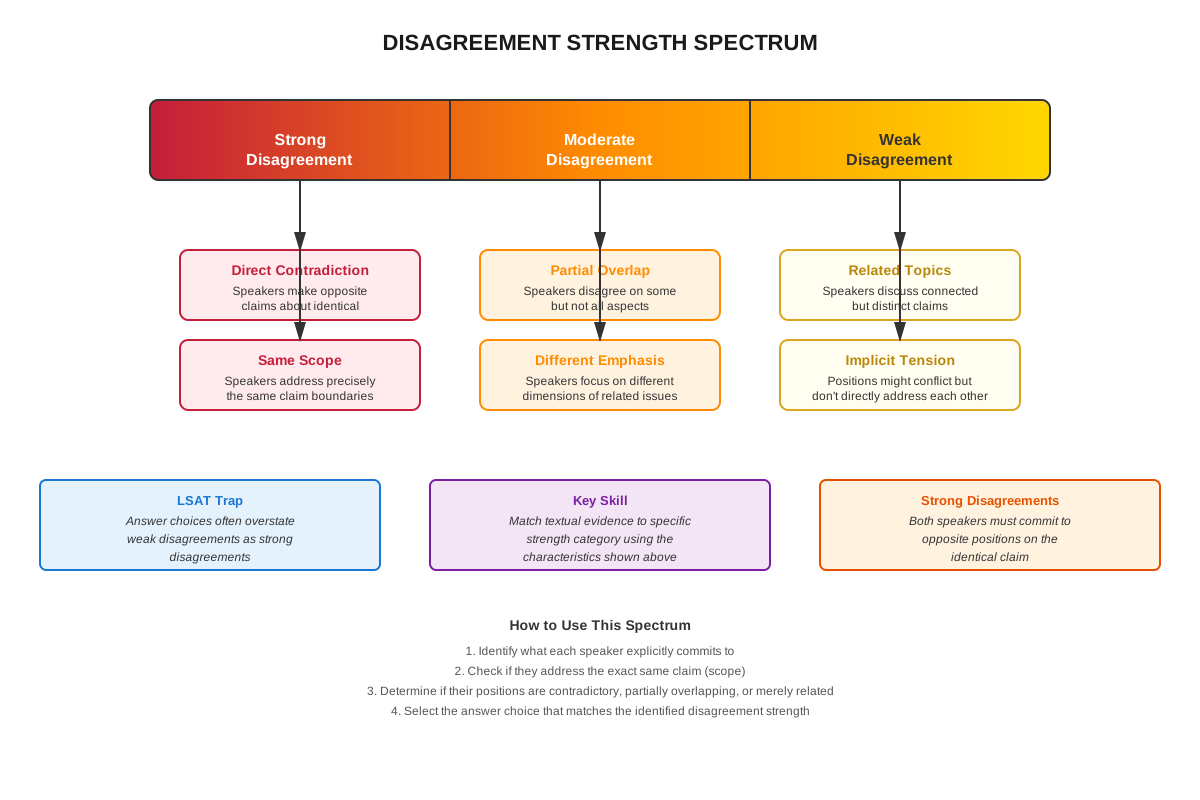
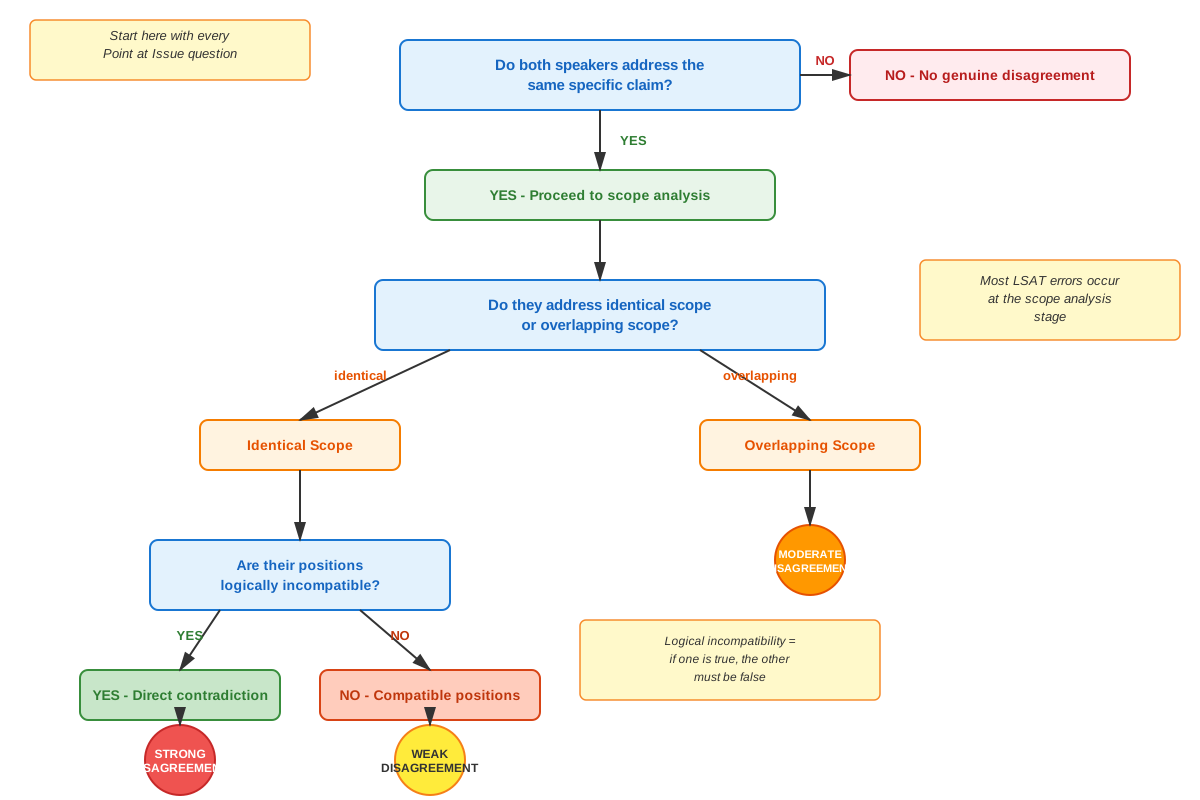
Strength of disagreement refers to the degree of incompatibility between two positions, measured along multiple dimensions including scope, directness, and fundamentality. A strong disagreement exists when speakers take directly contradictory positions on the same specific claim—one affirms what the other denies, with no possibility of both being correct. A moderate disagreement occurs when speakers' positions conflict on related but not identical claims, or when their reasoning patterns lead to incompatible conclusions without directly contradicting each other's explicit statements. A weak disagreement involves positions that merely differ in emphasis, focus, or peripheral details while remaining compatible on core claims.
The LSAT tests this concept by presenting dialogues where the disagreement strength is deliberately ambiguous or where answer choices mischaracterize the actual strength. Students must evaluate whether speakers genuinely contradict each other or merely discuss different aspects of a topic without true logical incompatibility.
The Spectrum of Disagreement Strength
| Disagreement Type | Characteristics | Example Pattern |
|---|---|---|
| Strong/Direct | Speakers take opposite positions on identical claim; one affirms, other denies | A: "X is always true" / B: "X is sometimes false" |
| Moderate/Indirect | Speakers' positions logically conflict but don't directly contradict same statement | A: "Y causes Z" / B: "W causes Z, not Y" |
| Weak/Tangential | Speakers emphasize different aspects; positions are compatible | A: "Factor M is important" / B: "Factor N is also important" |
| No Disagreement | Speakers discuss related topics without logical conflict | A: "Process X has benefit B" / B: "Process X has cost C" |
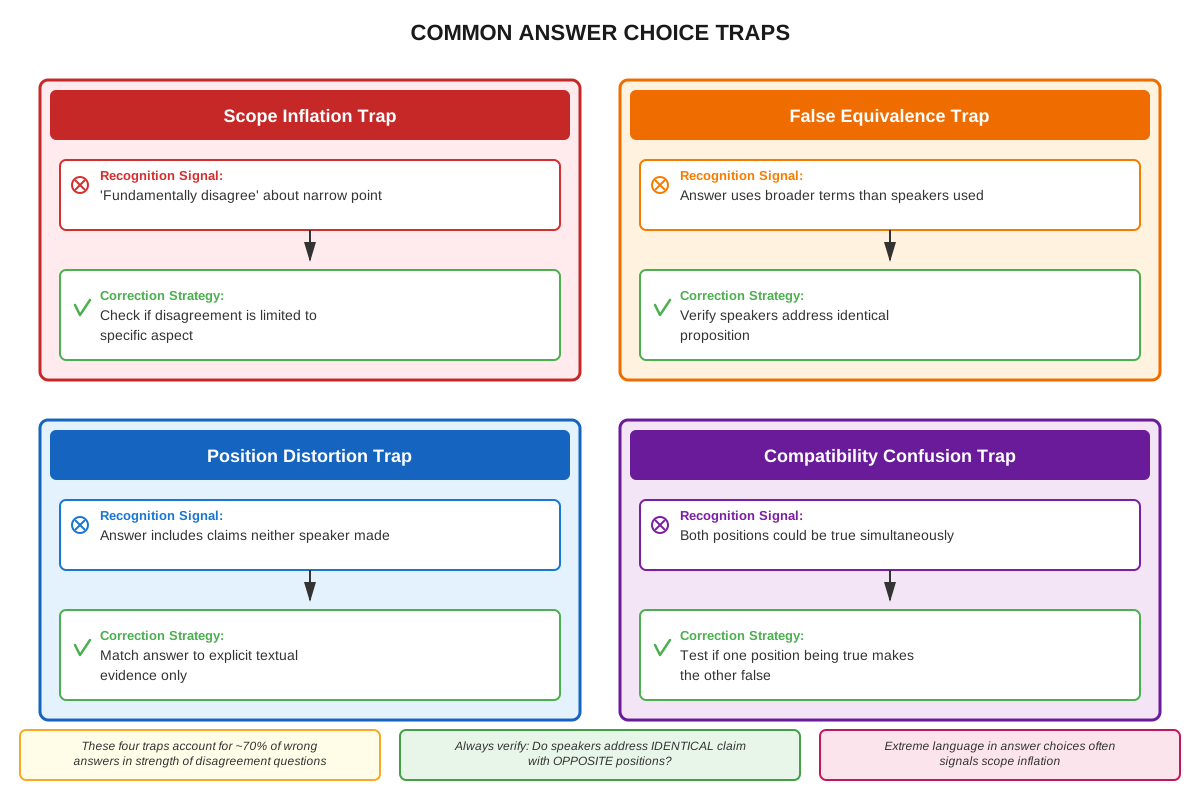
Understanding this spectrum is crucial because LSAT wrong answers frequently mischaracterize disagreement strength—presenting strong disagreements where only weak ones exist, or claiming compatibility where genuine conflict occurs.
Scope and Specificity in Disagreement
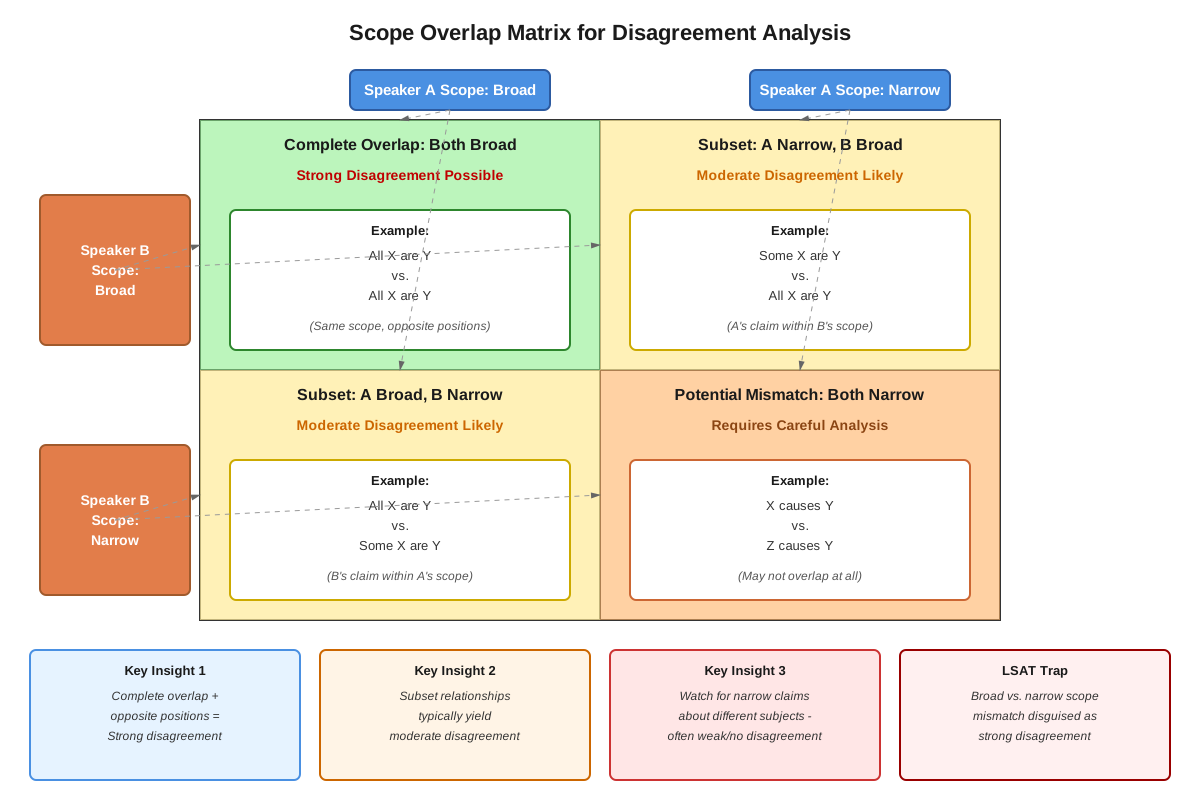
The scope of a disagreement determines its strength. Speakers who disagree about a universal claim ("all X are Y") have a stronger disagreement than those who disagree about a particular instance ("this specific X is Y"). Similarly, disagreements about necessary conditions create stronger conflicts than disagreements about sufficient conditions.
Consider this pattern: Speaker A claims "Economic factor X is the primary cause of phenomenon Y," while Speaker B claims "Social factor Z is the primary cause of phenomenon Y." This represents a strong disagreement because "primary cause" implies exclusivity—both cannot be the primary cause simultaneously. However, if Speaker A claims "Economic factor X contributes to phenomenon Y" and Speaker B claims "Social factor Z contributes to phenomenon Y," no disagreement exists; both contributions are compatible.
The LSAT exploits scope differences by crafting answer choices that subtly shift from the specific claim speakers address to broader or narrower claims. A speaker who says "this policy will not solve the entire problem" disagrees with someone claiming "this policy will solve the entire problem" but does NOT necessarily disagree with "this policy will help address the problem."
Explicit vs. Implicit Disagreement
Strong disagreements typically involve explicit statements where speakers directly address the same claim. However, LSAT questions also test implicit disagreement—where speakers' positions logically entail contradictory conclusions even without directly stating them.
For example, if Speaker A argues "We should implement Policy X because it will reduce costs without sacrificing quality" and Speaker B argues "Policy X will inevitably reduce quality," they implicitly disagree about whether Policy X can maintain quality, even though neither explicitly states "Policy X will/will not maintain quality." Recognizing these implicit disagreements requires understanding the logical commitments of each speaker's position.
The LSAT frequently includes wrong answers that identify explicit disagreements on peripheral points while the correct answer captures a stronger implicit disagreement on a central issue. Students must evaluate which disagreement is more fundamental to the speakers' overall positions.
Commitment and Disagreement Strength
A speaker is only committed to claims they explicitly state or that logically follow from their statements. Overestimating speaker commitment is a primary error in strength of disagreement questions. If Speaker A says "Most experts believe X," Speaker A is not committed to "X is true"—only to "Most experts believe X." Therefore, Speaker A cannot strongly disagree with Speaker B who says "X is false"; they could only disagree about what experts believe.
Similarly, speakers who remain silent on an issue are not committed to any position on it. If Speaker A discusses factor X and Speaker B discusses factor Y, without either addressing the other's factor, no disagreement exists—they're simply discussing different topics. The LSAT tests this by including answer choices that assume speakers disagree merely because they emphasize different factors, when in fact their positions are compatible.
Conditional Disagreements
Many strength of disagreement questions involve conditional reasoning. Speakers may disagree about:
- Whether a sufficient condition exists ("If X, then Y" vs. "X exists but Y doesn't")
- Whether a necessary condition is required ("Y requires X" vs. "Y can occur without X")
- The direction of a conditional relationship ("X causes Y" vs. "Y causes X")
These disagreements vary in strength. Disagreeing about whether a necessary condition exists creates a strong disagreement because the positions are logically incompatible. Disagreeing about which of multiple sufficient conditions is most important creates a weaker disagreement because multiple sufficient conditions can coexist.
Concept Relationships
The strength of disagreement concept builds directly on basic point at issue and disagreement identification. Students must first determine WHETHER speakers disagree (prerequisite skill) before evaluating HOW MUCH they disagree (current topic). This relationship is sequential: disagreement identification → disagreement strength evaluation.
Within this topic, the core concepts connect as follows: Defining strength of disagreement establishes the framework → The spectrum of disagreement strength provides categories for classification → Scope and specificity offers tools for measuring strength → Explicit vs. implicit disagreement expands the types of disagreements to evaluate → Commitment analysis prevents overestimation of disagreement → Conditional disagreements applies the framework to a specific logical structure.
Strength of disagreement also connects forward to Method of Reasoning questions, where students must identify how speakers respond to each other (direct refutation vs. tangential response), and to Parallel Reasoning questions, where matching disagreement strength between stimulus and answer choice is often required. The analytical skills developed here—precise scope analysis, commitment evaluation, and logical relationship assessment—transfer to virtually all Logical Reasoning question types.
The relationship map: Basic disagreement identification → Strength evaluation → Scope analysis → Commitment assessment → Answer choice matching → Correct response selection.
High-Yield Facts
⭐ Strong disagreements require speakers to take opposite positions on the same specific claim, not merely related claims
⭐ Speakers who emphasize different factors without addressing each other's claims typically do not disagree
⭐ A speaker is only committed to what they explicitly state or what logically follows from their statements
⭐ Disagreements about "primary" or "main" causes are stronger than disagreements about contributing factors
⭐ Answer choices that use absolute language ("completely," "entirely," "always") often overstate disagreement strength
- Implicit disagreements can be stronger than explicit disagreements on peripheral points
- Speakers who agree on a conclusion but disagree on reasoning do not disagree about the conclusion itself
- Conditional disagreements about necessary conditions create stronger conflicts than disagreements about sufficient conditions
- Scope shifts between stimulus and answer choice are the most common wrong answer pattern
- Speakers discussing different time periods, contexts, or populations may not disagree even if their claims seem contradictory
- The "central" disagreement is the one most fundamental to each speaker's overall position, not necessarily the most explicitly stated
Quick check — test yourself on Strength of disagreement so far.
Try Flashcards →Common Misconceptions
Misconception: If two speakers discuss the same topic and reach different conclusions, they must strongly disagree.
Correction: Speakers can discuss the same topic while addressing different aspects or questions about it. Strong disagreement requires addressing the same specific claim. For example, one speaker discussing benefits and another discussing costs of the same policy are not disagreeing—both benefits and costs can exist simultaneously.
Misconception: When a speaker doesn't address a claim, they implicitly disagree with it.
Correction: Silence is not disagreement. Speakers are only committed to positions they state or that logically follow from their statements. If Speaker A never mentions factor X that Speaker B discusses, Speaker A has no position on factor X and cannot disagree about it.
Misconception: Disagreements about reasoning strength are as strong as disagreements about conclusions.
Correction: Speakers can agree on a conclusion while disagreeing about whether specific evidence supports it. "Your evidence doesn't prove X" is compatible with "X is true for other reasons." These represent weaker disagreements than direct contradictions about X itself.
Misconception: Using different terminology means speakers are discussing different things.
Correction: Speakers may use different words to describe the same concept. "Economic incentive" and "financial motivation" likely refer to the same factor. Conversely, using the same term doesn't guarantee speakers mean the same thing—context determines whether they're addressing identical claims.
Misconception: The longest or most detailed answer choice identifies the strongest disagreement.
Correction: Answer choice length correlates poorly with accuracy. Correct answers precisely capture the disagreement scope without overstating or understating it. Longer answers often add unnecessary qualifications that make them incorrect, while concise answers may perfectly capture the disagreement.
Misconception: If speakers would choose different policies, they must disagree about the policies' effects.
Correction: Speakers can agree completely about a policy's effects while disagreeing about values or priorities. One might say "Policy X reduces freedom but increases security" while another says "Policy X increases security but reduces freedom"—they agree on effects but might choose differently based on which value they prioritize.
Worked Examples
Example 1: Evaluating Disagreement Strength
Stimulus:
Alex: The new traffic regulation will reduce accidents at the intersection. Studies show that similar regulations decreased accidents by 30% in comparable locations.
Jordan: The regulation might reduce some accidents, but it will create severe traffic congestion during peak hours, which could actually increase accidents on surrounding streets.
Question: Alex and Jordan disagree most strongly about which of the following?
Answer Choices:
(A) Whether the regulation will reduce accidents at the intersection itself
(B) Whether the regulation will have any positive effects
(C) Whether the regulation will reduce overall accidents in the area
(D) Whether studies of comparable locations are relevant
(E) Whether traffic congestion is an important consideration
Analysis:
First, identify what each speaker is committed to:
- Alex claims: The regulation will reduce accidents at the intersection (supported by studies)
- Jordan claims: The regulation might reduce some accidents at the intersection BUT will increase accidents on surrounding streets
Now evaluate each answer choice for disagreement strength:
(A) Weak disagreement or none: Jordan concedes "might reduce some accidents" at the intersection, which doesn't directly contradict Alex's claim. Jordan doesn't deny the intersection will be safer.
(B) No disagreement: Jordan acknowledges the regulation "might reduce some accidents," which is a positive effect. Both speakers recognize at least some positive effects.
(C) STRONG DISAGREEMENT: This is the key. Alex's argument implies the regulation will reduce accidents (overall positive effect). Jordan's argument concludes that while intersection accidents may decrease, surrounding street accidents will increase, potentially resulting in no overall reduction or even an increase. These positions are logically incompatible regarding the net effect on total accidents in the area.
(D) No disagreement: Jordan never challenges the relevance or validity of Alex's studies. Jordan simply adds additional considerations.
(E) No disagreement: Alex doesn't address congestion at all, so Alex has no position on whether it's important. Silence ≠ disagreement.
Correct Answer: (C)
Key Lesson: The strongest disagreement concerns the claim where speakers' positions are most directly incompatible. Alex's reasoning supports an overall accident reduction; Jordan's reasoning suggests the opposite when considering the full area. This represents a strong disagreement about net effects, even though they might agree about the specific intersection.
Example 2: Distinguishing Commitment from Implication
Stimulus:
Pat: Most nutritionists recommend eating five servings of vegetables daily. This recommendation is based on extensive research showing health benefits.
Sam: Many people find it difficult to eat five servings of vegetables daily due to cost, availability, and time constraints. Alternative approaches, like taking vitamin supplements, might be more practical for these individuals.
Question: Pat and Sam disagree about whether:
Answer Choices:
(A) Eating five servings of vegetables daily provides health benefits
(B) Most nutritionists make the five-serving recommendation
(C) Vitamin supplements can provide nutritional value
(D) The five-serving recommendation is practical for everyone to follow
(E) Research supports nutritional recommendations
Analysis:
Identify commitments carefully:
- Pat is committed to: (1) Most nutritionists make this recommendation, (2) The recommendation is research-based, (3) Research shows health benefits
- Pat is NOT committed to: Whether the recommendation is practical, whether alternatives exist, whether everyone should follow it
- Sam is committed to: (1) Many people face barriers to following the recommendation, (2) Supplements might be more practical for some people
- Sam is NOT committed to: Whether vegetables provide benefits, whether the recommendation is valid, whether nutritionists are wrong
Evaluate answer choices:
(A) No disagreement: Sam never questions whether vegetables provide health benefits. Sam only discusses practical barriers and alternatives. These positions are compatible—vegetables can be beneficial while also being impractical for some people.
(B) No disagreement: Sam doesn't challenge Pat's claim about what nutritionists recommend.
(C) No disagreement: Pat never addresses supplements, so Pat has no position on them. Sam's mention of supplements doesn't create a disagreement.
(D) MODERATE DISAGREEMENT: This is tempting but overstates the disagreement. Pat doesn't explicitly claim the recommendation is practical for everyone. Pat only states that nutritionists recommend it based on research. However, Pat's argument might implicitly suggest people should follow the recommendation, which could conflict with Sam's emphasis on practical barriers. This is the closest to a disagreement, but it's not as strong as it might appear because Pat never directly addresses practicality.
(E) No disagreement: Sam doesn't challenge whether research supports recommendations generally.
Correct Answer: (D) (though this is a weaker disagreement than in Example 1)
Key Lesson: Distinguish between what speakers explicitly state versus what students might infer. Pat's silence on practicality means Pat isn't strongly committed to the recommendation being universally practical. The disagreement here is moderate at best—Sam raises a consideration Pat didn't address rather than directly contradicting Pat's claims. Many students incorrectly choose (A) by assuming Sam disagrees with the benefits claim, but Sam never questions the benefits, only the practical implementation.
Exam Strategy
When approaching lsat strength of disagreement questions, follow this systematic process:
Step 1: Read both speakers' statements carefully and identify their explicit claims. Underline or mentally note the main conclusion and key premises of each speaker. Don't make assumptions about what they "probably think"—focus only on what they actually say.
Step 2: Determine the scope of each claim precisely. Pay special attention to qualifiers like "some," "most," "all," "primary," "contributing," "might," "will," and "must." These words dramatically affect disagreement strength. "X is the main cause" differs significantly from "X is a contributing cause."
Step 3: Identify areas of potential disagreement. Look for places where speakers address the same topic, but don't assume they're addressing the same specific claim just because they use similar terminology.
Step 4: Evaluate commitment levels. Ask: "Is this speaker actually committed to this position, or am I inferring it?" If a speaker doesn't address a topic, they have no position on it and cannot disagree about it.
Step 5: Before looking at answer choices, predict the disagreement. Formulate in your own words what the speakers most strongly disagree about. This prevents answer choices from misleading you.
Step 6: Eliminate answer choices systematically:
- Eliminate choices where one or both speakers have no position (no commitment = no disagreement)
- Eliminate choices where speakers' positions are compatible (different emphases ≠ disagreement)
- Eliminate choices that overstate disagreement strength (using absolute language not present in stimulus)
- Eliminate choices that understate disagreement strength (identifying peripheral rather than central conflicts)
Trigger words and phrases to watch for:
In the stimulus:
- "Primary," "main," "most important" (suggests exclusivity, stronger disagreement potential)
- "Might," "could," "possibly" (weakens commitment, reduces disagreement strength)
- "Some," "many," "most" (scope limiters that affect disagreement strength)
- "However," "but," "although" (signals potential disagreement)
In answer choices:
- "Whether" (introduces the claim speakers allegedly disagree about)
- "Completely," "entirely," "always," "never" (often indicates overstated disagreement)
- "Can," "might," "possibly" (often indicates understated disagreement)
Time allocation: Spend 1:15-1:30 on these questions. They require more careful analysis than basic Point at Issue questions but shouldn't consume excessive time. If you find yourself re-reading multiple times, you're likely overcomplicating the analysis. Focus on explicit commitments and direct logical relationships.
Process of elimination tip specific to this topic: Wrong answers typically fall into three categories: (1) No disagreement exists (one speaker has no position), (2) Disagreement is overstated (answer uses stronger language than stimulus supports), (3) Disagreement is peripheral (answer identifies a minor point while missing the central conflict). Identifying which category a wrong answer falls into helps eliminate it confidently.
Memory Techniques
SCOPE Mnemonic for Evaluating Disagreement Strength:
- Same claim? (Do speakers address identical claims or just related topics?)
- Commitment? (Are both speakers actually committed to positions on this claim?)
- Opposite positions? (Do they take contradictory stances, or are positions compatible?)
- Peripheral or central? (Is this disagreement fundamental or tangential to their arguments?)
- Explicit or inferred? (Is the disagreement clearly stated or am I assuming it?)
Visualization Strategy: Picture disagreement strength as a tug-of-war rope. Strong disagreements have speakers pulling in exactly opposite directions on the same rope (same claim, opposite positions). Moderate disagreements have speakers pulling on different parts of the same rope (related claims, conflicting positions). Weak disagreements have speakers pulling on different ropes entirely (different claims, no real conflict). This mental image helps evaluate whether speakers are truly in conflict.
The "Silence ≠ Disagreement" Rule: Create a mental stop sign that appears whenever you're tempted to assume a speaker disagrees with something they never addressed. If Speaker A doesn't mention factor X, mentally visualize a stop sign before concluding Speaker A disagrees about factor X.
Acronym for Common Wrong Answer Patterns - NOSE:
- No commitment (speaker has no position on the claim)
- Overstated (answer uses stronger language than stimulus supports)
- Scope shift (answer changes the scope of the claim)
- Emphasis confusion (different emphases mistaken for disagreement)
Summary
Strength of disagreement questions test the ability to evaluate not just whether speakers disagree, but the degree and nature of their disagreement. Strong disagreements occur when speakers take directly contradictory positions on the same specific claim, making their positions logically incompatible. Moderate disagreements involve related but not identical claims or implicit conflicts in reasoning. Weak disagreements or no disagreements occur when speakers merely emphasize different aspects of a topic without true logical conflict. Success on these questions requires precise scope analysis, careful evaluation of speaker commitment (speakers are only committed to what they state or what logically follows), and recognition that silence on a topic does not constitute disagreement. The most common errors involve assuming disagreement where speakers simply discuss different aspects of a topic, overestimating disagreement strength by inferring positions speakers never took, and selecting answer choices that shift the scope of the actual disagreement. Mastering this topic requires moving beyond binary agree/disagree thinking toward nuanced evaluation of argumentative distance, a skill fundamental to legal reasoning and tested extensively on the LSAT.
Key Takeaways
- Strong disagreements require speakers to take opposite positions on the same specific claim, not merely discuss related topics with different emphases
- Speakers are only committed to positions they explicitly state or that logically follow from their statements—silence is not disagreement
- Scope qualifiers ("primary," "some," "might," "will") dramatically affect disagreement strength and must be analyzed precisely
- The strongest disagreement is typically the most fundamental to both speakers' overall positions, not necessarily the most explicitly stated point
- Wrong answers commonly overstate disagreement strength, identify peripheral rather than central conflicts, or assume disagreement where one speaker has no position
- Systematic evaluation using the SCOPE framework (Same claim, Commitment, Opposite positions, Peripheral or central, Explicit or inferred) prevents common errors
- Distinguishing between explicit and implicit disagreements while avoiding overinference is essential for accurate strength assessment
Related Topics
Point at Issue - Basic Identification: Before mastering disagreement strength, students must reliably identify whether any disagreement exists. This foundational skill involves recognizing when speakers address the same claim versus different claims.
Method of Reasoning - Response Types: Understanding how speakers respond to each other (direct refutation, providing counterexample, questioning assumptions) builds on disagreement strength analysis and adds another dimension to evaluating argumentative relationships.
Scope and Precision in Arguments: The analytical skills developed for evaluating disagreement strength—particularly precise scope analysis and attention to qualifiers—transfer directly to identifying scope errors in arguments and evaluating whether evidence supports conclusions.
Parallel Reasoning with Multiple Speakers: Advanced parallel reasoning questions may require matching not just argument structure but also disagreement strength between stimulus and answer choices, making this topic essential for those challenging questions.
Practice CTA
Now that you understand the nuanced concept of strength of disagreement, it's time to apply these skills to actual LSAT questions. The practice questions and flashcards for this topic will challenge you to distinguish between strong, moderate, and weak disagreements in realistic test scenarios. Pay special attention to scope qualifiers and speaker commitments as you work through the problems—these are the keys to accuracy on test day. Remember, mastering this topic significantly improves performance on Point at Issue questions and builds analytical skills that benefit all Logical Reasoning question types. Approach each practice question systematically using the SCOPE framework, and you'll develop the precision that separates good scores from great scores.
Sign up free to keep reading
Create a free AnvayaPrep account to finish this LSAT guide on Strength of disagreement — plus flashcards and practice questions.