Overview
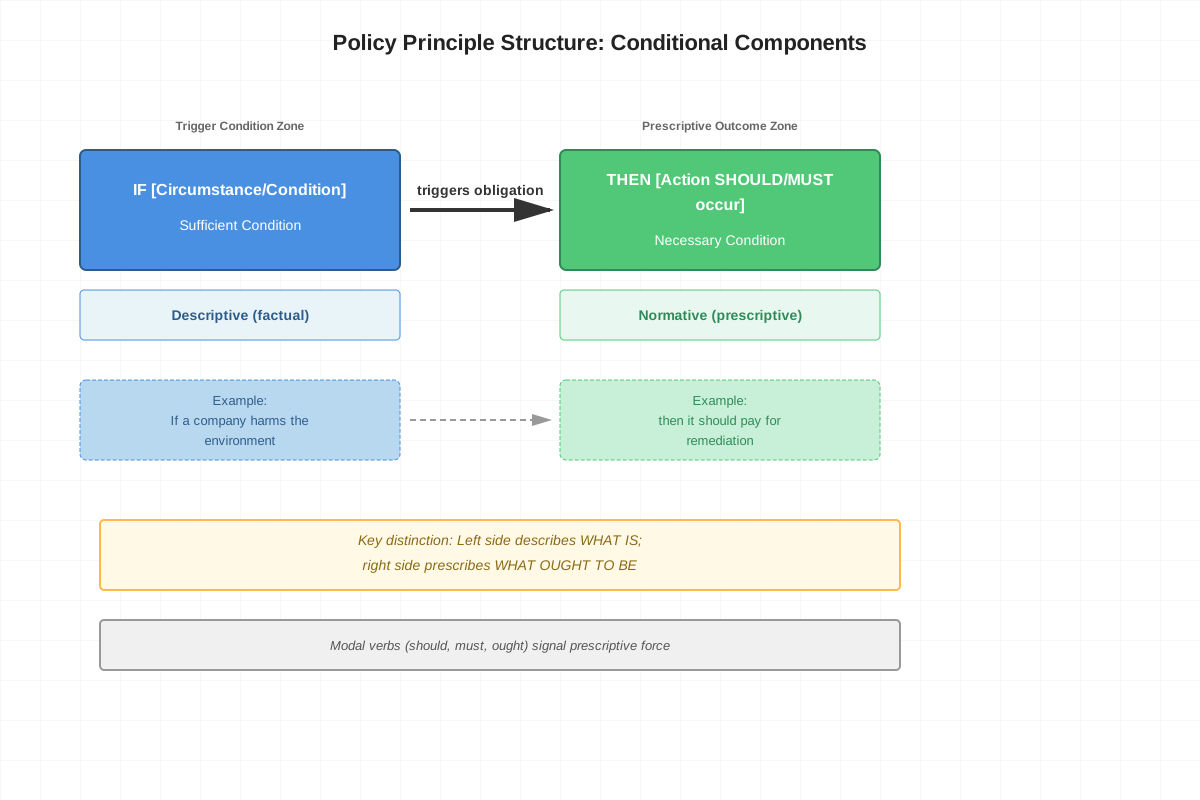
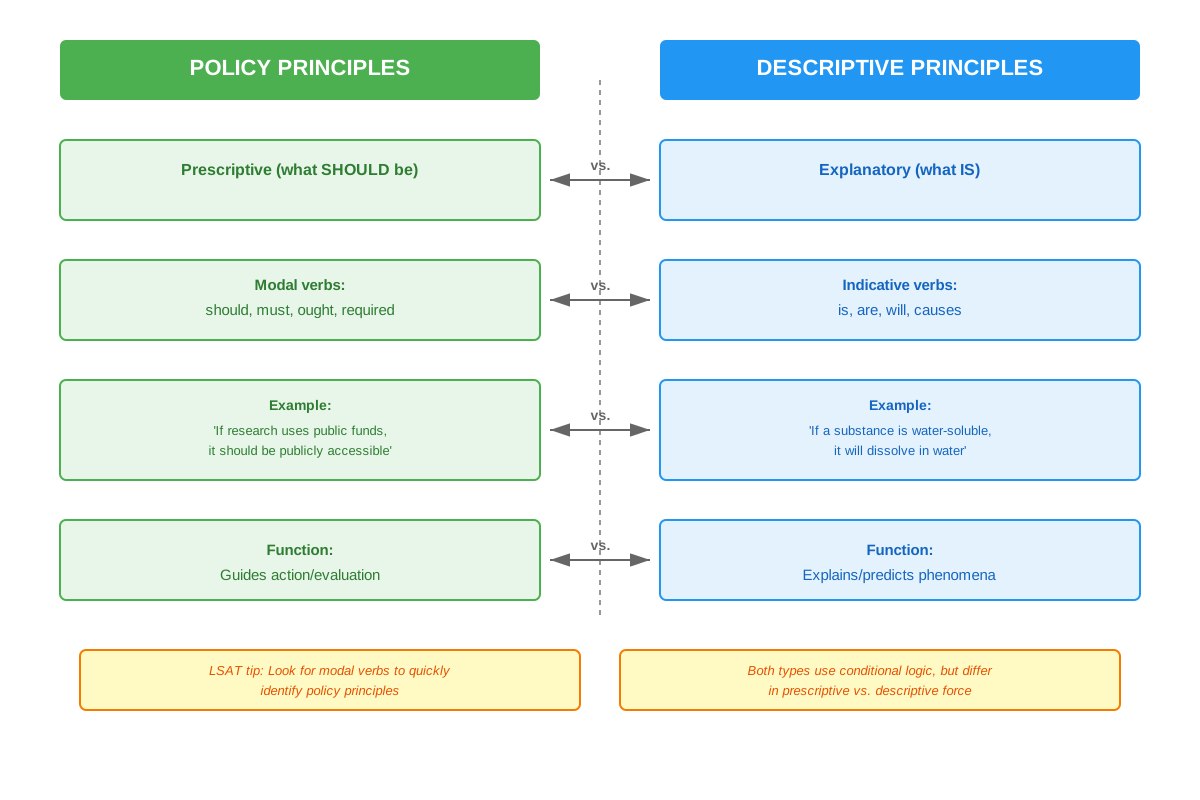
Policy principles represent a critical category within LSAT Logical Reasoning that tests a student's ability to identify, apply, and evaluate prescriptive rules governing what ought to be done in specific circumstances. Unlike descriptive principles that explain how things are, policy principles establish normative guidelines for action—they tell us what should or must happen under certain conditions. These principles typically take the form of conditional statements linking circumstances to recommended or required courses of action, such as "If a company's practices harm the environment, then the company should be required to pay for remediation."
Understanding policy principles is essential for LSAT success because they appear frequently across multiple question types within the Logical Reasoning section. Students encounter them in Principle Questions (both "identify the principle" and "apply the principle" variants), Strengthen/Weaken questions involving normative claims, and Parallel Reasoning questions that require matching prescriptive structures. The LSAT tests not only whether students can recognize policy principles but also whether they can accurately apply them to novel situations, distinguish between similar principles with subtle differences, and evaluate whether specific actions conform to or violate stated policies.
Within the broader landscape of Logical Reasoning, policy principles occupy a unique position at the intersection of conditional reasoning, argument structure, and normative evaluation. They require students to master conditional logic (understanding sufficient and necessary conditions) while also navigating the prescriptive dimension that distinguishes "what should be" from "what is." This dual requirement makes policy principles more complex than purely descriptive conditional statements, as students must track both the factual conditions that trigger a principle and the normative consequences that follow. Mastery of this topic builds directly on foundational skills in conditional reasoning while preparing students for advanced work in argument evaluation and parallel reasoning.
Learning Objectives
- [ ] Identify how Policy principles appears in LSAT questions
- [ ] Explain the reasoning pattern behind Policy principles
- [ ] Apply Policy principles to solve LSAT-style problems accurately
- [ ] Distinguish between policy principles and descriptive principles in argument contexts
- [ ] Evaluate whether specific scenarios satisfy or violate stated policy principles
- [ ] Recognize common structural patterns in policy principle formulations
- [ ] Predict the correct application of a policy principle to novel circumstances
Prerequisites
- Conditional Logic Fundamentals: Understanding sufficient and necessary conditions is essential because policy principles are structured as conditional statements (if X, then Y should occur).
- Argument Structure Recognition: Identifying premises, conclusions, and reasoning patterns enables students to locate where policy principles function within arguments.
- Basic Principle Question Familiarity: General awareness of how principle questions work provides context for the specific challenges posed by policy-focused variants.
- Normative vs. Descriptive Distinction: Recognizing the difference between "is" statements (descriptive) and "ought" statements (normative) helps students identify policy principles among other claim types.
Why This Topic Matters
Policy principles appear with remarkable frequency on the LSAT, making them one of the highest-yield topics within Logical Reasoning. Approximately 15-20% of Logical Reasoning questions involve principles in some capacity, and policy principles constitute a substantial portion of these. Students encounter them most commonly in Principle questions (which explicitly ask about principles), but they also appear in Strengthen/Weaken questions where the correct answer introduces a policy principle that supports or undermines an argument, and in Parallel Reasoning questions that require matching the normative structure of policy-based arguments.
Beyond exam performance, understanding policy principles develops critical thinking skills applicable to real-world contexts. Legal reasoning—the foundation of law school and legal practice—constantly involves applying general rules (policy principles) to specific cases. Contract law, constitutional interpretation, regulatory compliance, and ethical decision-making all require the ability to identify relevant principles, determine whether circumstances trigger those principles, and evaluate what actions the principles prescribe. The LSAT's focus on policy principles directly prepares students for the case-method instruction and legal analysis they will encounter throughout law school.
On the exam itself, policy principle questions appear in several distinct formats. "Identify the principle" questions present an argument or scenario and ask which principle best justifies the reasoning or action described. "Apply the principle" questions provide a policy principle and ask which scenario best illustrates or conforms to that principle. "Conform to principle" questions describe a principle and ask which action would be consistent with it. Additionally, policy principles frequently appear as answer choices in Strengthen questions (where introducing a relevant principle can support an argument's normative conclusion) and as elements within complex Parallel Reasoning questions. Recognizing these patterns enables strategic approach and efficient time management.
Core Concepts
Structure of Policy Principles
Policy principles are prescriptive conditional statements that establish what should, must, or ought to happen when certain conditions are met. They follow the general form: "If [condition/circumstance], then [prescribed action/outcome]." The condition component describes factual circumstances that trigger the principle, while the prescribed action component specifies the normative consequence—what should occur given those circumstances.
The conditional structure means policy principles have sufficient conditions (the triggering circumstances) and necessary conditions (the prescribed outcomes that must follow). For example: "If a medication has not been adequately tested for safety, then it should not be approved for public use." Here, inadequate safety testing is sufficient to trigger the principle, and non-approval is the necessary prescribed outcome. Understanding this logical structure is crucial because LSAT questions often test whether students can correctly identify when a principle applies (when its sufficient condition is met) and what it requires (its necessary condition).
Normative Language Indicators
Policy principles are distinguished by their normative language—words and phrases that signal prescriptive rather than descriptive content. Common indicators include:
- Obligation modals: should, must, ought to, is required to, is obligated to
- Permission modals: may, is permitted to, is allowed to, has the right to
- Prohibition language: should not, must not, ought not to, is forbidden from
- Value judgments: is justified in, would be wrong to, is appropriate to, is unethical to
Recognizing these linguistic markers helps students quickly identify policy principles in question stems and answer choices. The LSAT frequently tests whether students can distinguish between arguments that merely describe what happens and arguments that prescribe what should happen, making sensitivity to normative language essential.
Types of Policy Principles
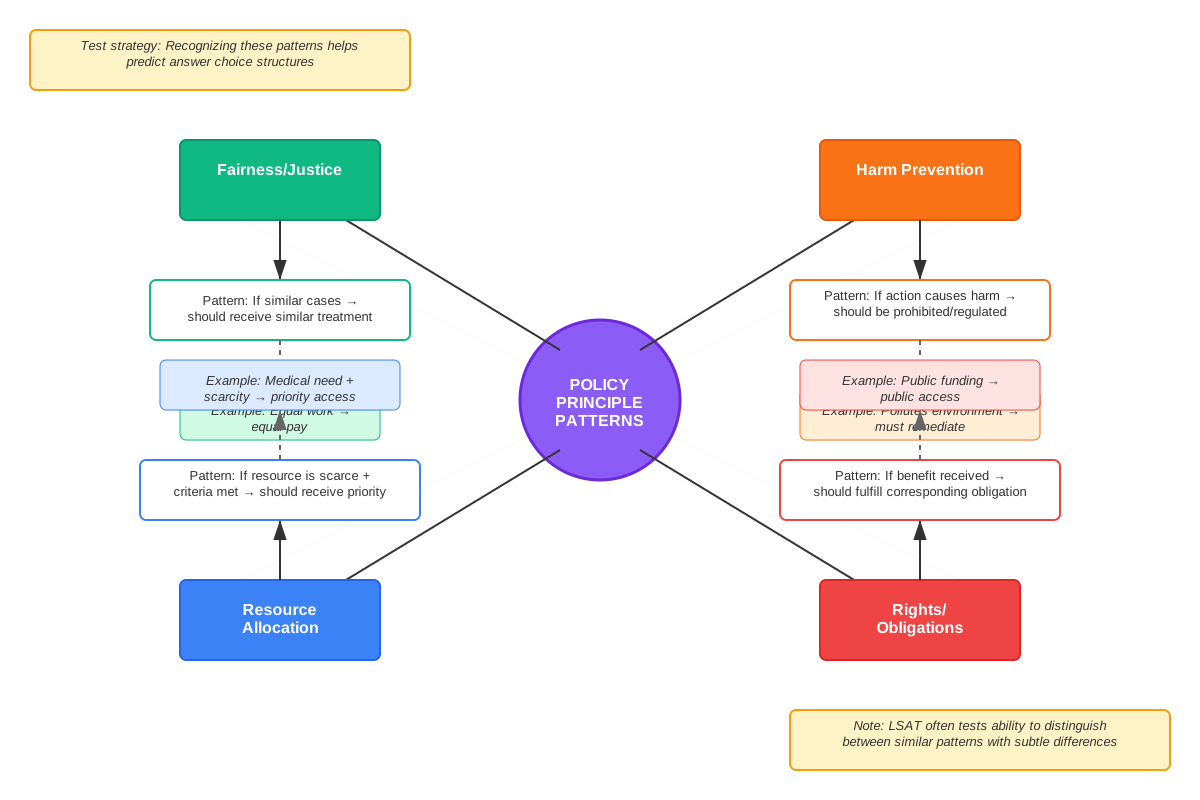
Policy principles on the LSAT fall into several common categories:
| Type | Structure | Example |
|---|---|---|
| Obligation Principles | If X, then Y must/should do Z | If a company profits from public resources, it should contribute to their maintenance |
| Permission Principles | If X, then Y may/is permitted to do Z | If a contract is breached, the injured party may seek compensation |
| Prohibition Principles | If X, then Y must not/should not do Z | If research involves human subjects, researchers must not proceed without consent |
| Conditional Permission | Only if X, then Y may do Z | Only if all alternatives have failed should military intervention be considered |
| Priority Principles | When X and Y conflict, X should take precedence | When privacy and security conflict, security concerns should take precedence |
Understanding these categories helps students anticipate the logical structure of principles and recognize when answer choices match or mismatch the required type.
Application vs. Justification
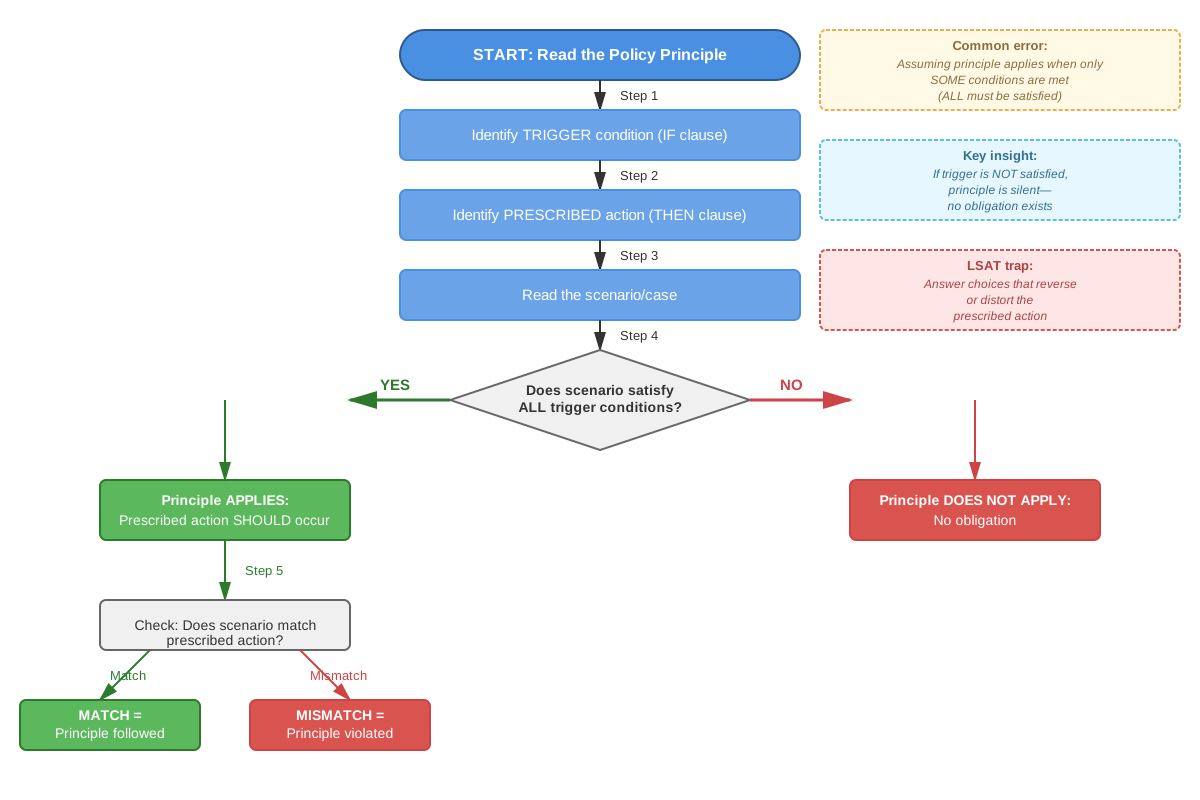
LSAT policy principles questions test two distinct cognitive operations: application and justification. Application questions provide a principle and ask students to identify which scenario the principle governs or what action it prescribes. These questions test whether students can recognize when a principle's sufficient condition is satisfied and correctly determine the necessary consequence. The reasoning moves from general principle to specific case.
Justification questions reverse this direction: they present a specific action, decision, or argument and ask which principle best supports or justifies it. These questions test whether students can identify the underlying normative rule that would make a particular action appropriate or an argument valid. The reasoning moves from specific case to general principle. Both operations are essential for legal reasoning, and the LSAT tests them with roughly equal frequency.
Principle Matching and Mismatching
A critical skill in policy principle questions is recognizing when circumstances satisfy a principle's conditions versus when they fail to trigger it. The LSAT frequently includes wrong answers that involve:
- Scope mismatches: The principle addresses different subject matter than the scenario
- Condition failures: The scenario doesn't meet the principle's triggering conditions
- Reversed logic: The principle's sufficient and necessary conditions are inverted
- Degree mismatches: The principle requires a stronger or weaker action than what occurs
- Incomplete matches: Only part of the principle's conditions are satisfied
Students must carefully compare each element of a principle's structure to the scenario in question, verifying that all conditions align and the prescribed action matches what's being evaluated.
Competing Principles and Exceptions
More complex LSAT questions involve scenarios where multiple principles might apply or where principles contain exceptions. Competing principles create situations where different normative rules point toward different actions. For example, a principle favoring transparency might conflict with a principle protecting privacy. The LSAT tests whether students can recognize which principle takes precedence or whether a scenario genuinely creates a conflict.
Exception clauses modify policy principles by specifying circumstances under which the usual prescription doesn't apply: "If X, then Y should do Z, unless W." These create more complex conditional structures where students must track both the main triggering condition and the exception condition. Questions involving exceptions test whether students can recognize when an exception applies and correctly determine that the principle's usual prescription is suspended.
Concept Relationships
Policy principles build directly on conditional logic fundamentals, as every policy principle is structured as a conditional statement. The sufficient condition (triggering circumstance) → necessary condition (prescribed action) relationship underlies all policy principle reasoning. Mastering basic conditional logic—including contrapositive formation, recognizing when conditions are satisfied, and avoiding common errors like affirming the consequent—is prerequisite to working effectively with policy principles.
Within the topic itself, the concepts form a progression: Structure of Policy Principles (understanding the basic conditional form) → Normative Language Indicators (recognizing policy principles in text) → Types of Policy Principles (categorizing different prescriptive structures) → Application vs. Justification (performing the two main operations tested) → Principle Matching (executing accurate comparisons) → Competing Principles (handling complex scenarios).
Policy principles also connect forward to other Logical Reasoning topics. They appear as components in Strengthen/Weaken questions (where introducing a relevant principle can support or undermine normative conclusions), Parallel Reasoning questions (where matching prescriptive structures is required), and Flaw questions (where misapplying principles or reasoning from inappropriate principles constitutes an error). Understanding policy principles thus enables more sophisticated analysis across multiple question types.
The relationship between application and justification represents a bidirectional connection: application moves from principle to case (deductive reasoning), while justification moves from case to principle (inductive/abductive reasoning). Both operations require the same underlying skill—recognizing structural correspondence between general rules and specific instances—but they test it in opposite directions. Mastering both directions ensures comprehensive competence with policy principles.
Quick check — test yourself on Policy principles so far.
Try Flashcards →High-Yield Facts
⭐ Policy principles are conditional statements with normative (prescriptive) consequences, not descriptive predictions.
⭐ The sufficient condition of a policy principle describes the triggering circumstances; the necessary condition describes what should happen.
⭐ Normative language indicators (should, must, ought, may, is required to) signal policy principles and distinguish them from descriptive claims.
⭐ Application questions move from principle to case; justification questions move from case to principle.
⭐ A scenario satisfies a policy principle only if ALL conditions in the sufficient condition are met.
- Policy principles can prescribe obligations (must do), permissions (may do), or prohibitions (must not do).
- Wrong answers in principle questions often involve scope mismatches, where the principle addresses different subject matter than the scenario.
- Exception clauses create conditional structures where the usual prescription is suspended under specified circumstances.
- Competing principles occur when multiple normative rules apply to the same situation but prescribe different actions.
- The contrapositive of a policy principle is also a valid policy principle: "If not [prescribed action], then not [triggering condition]."
- Degree mismatches occur when a principle prescribes a stronger or weaker action than what's being evaluated.
- Priority principles explicitly state which value or consideration should take precedence when conflicts arise.
- Recognizing when a principle's sufficient condition is NOT satisfied is as important as recognizing when it IS satisfied.
- Policy principles in LSAT questions are treated as universally applicable rules without unstated exceptions.
- The most common error in policy principle questions is selecting an answer that matches only part of the principle's structure.
Common Misconceptions
Misconception: Policy principles only apply to the exact situations explicitly mentioned in their conditions.
Correction: Policy principles apply to all situations that satisfy their conditions, even if the specific context differs from examples given. The principle "If an action harms others without their consent, it should not be permitted" applies to environmental pollution, medical procedures, and noise violations—any situation meeting the stated conditions.
Misconception: If a scenario satisfies part of a policy principle's conditions, the principle partially applies.
Correction: Policy principles operate on all-or-nothing logic. Unless ALL conditions in the sufficient condition are met, the principle doesn't apply at all. A principle requiring "adequate testing AND independent review" isn't triggered by adequate testing alone.
Misconception: Normative language like "should" is just a suggestion and doesn't create a logical requirement.
Correction: In LSAT logic, "should" and similar normative terms establish logical requirements within the principle's framework. "X should do Y" means that given the principle, Y is the prescribed action—it's not optional or merely advisable.
Misconception: The contrapositive of a policy principle reverses the prescription (if you should do X, then you shouldn't do not-X).
Correction: The contrapositive of a policy principle follows standard conditional logic: "If X, then should Y" becomes "If not should Y, then not X" (or equivalently, "If may not Y, then not X"). The prescription itself doesn't reverse; the entire conditional structure reverses.
Misconception: When two principles conflict, both are invalid or the question is flawed.
Correction: Competing principles are a legitimate test scenario. The LSAT may ask which principle takes precedence, whether a genuine conflict exists, or how to resolve the tension. Real-world legal reasoning constantly involves balancing competing principles.
Misconception: Policy principles must be explicitly labeled as "principles" in the question or passage.
Correction: Policy principles often appear as general normative claims within arguments without being labeled. Students must recognize them by their conditional structure and normative language, not by explicit labeling.
Misconception: If a scenario doesn't explicitly state that a principle's conditions are met, the principle doesn't apply.
Correction: Students must make reasonable inferences from the information provided. If a scenario describes a company dumping waste into a river, and a principle addresses "actions that harm the environment," students should recognize the connection even without explicit labeling.
Worked Examples
Example 1: Application Question
Question: "Government officials should not accept gifts from individuals or organizations that have business pending before their agencies. Which of the following actions most clearly violates this principle?"
Analysis Process:
- Identify the principle structure:
- Sufficient condition: Government official + gift from individual/organization + that individual/organization has business pending before official's agency
- Necessary condition (prescription): Should NOT accept
- Examine each answer choice for whether it satisfies ALL elements of the sufficient condition:
- (A) "A city council member accepts a campaign contribution from a local business owner who has no dealings with the city."
- ✗ Missing element: no business pending before the agency
- (B) "A regulatory agency director accepts a book as a gift from a colleague at another agency."
- ✗ Missing element: gift not from someone with business pending
- (C) "A judge accepts free tickets to a sporting event from a lawyer who is representing a client in a case before that judge."
- ✓ All elements present: judge (government official) + gift (tickets) + from lawyer with business (case) pending before the judge's court
- (D) "A mayor accepts a gift from a family member who owns a business in the city."
- ✗ Ambiguous: depends on whether the business has matters pending before city government
- (E) "A government employee accepts a promotional item of minimal value at a conference."
- ✗ Missing element: no indication of business pending
- Select the answer: (C) most clearly satisfies all conditions of the principle's sufficient condition, making the acceptance a violation of the "should not accept" prescription.
Key Takeaway: This demonstrates the application operation—moving from a general principle to identify which specific scenario it governs. Success requires checking that EVERY element of the sufficient condition is present.
Example 2: Justification Question
Question: "The city council voted to reject the proposed development project despite its potential economic benefits. Which of the following principles, if valid, most helps to justify the council's decision?"
Analysis Process:
- Identify what needs justification: The council rejected a project with economic benefits. We need a principle that would make this rejection appropriate.
- Determine what principle structure is needed:
- Sufficient condition: Must include circumstances that apply to this situation
- Necessary condition: Must prescribe rejection or prioritize something over economic benefits
- Evaluate answer choices:
- (A) "Economic benefits should be the primary consideration in development decisions."
- ✗ This would justify APPROVING, not rejecting
- (B) "Development projects should be rejected if they would significantly harm the environment, even if they provide economic benefits."
- ✓ This prescribes rejection under conditions that could apply here (environmental harm), and explicitly addresses the economic benefits issue
- (C) "City councils should consider all stakeholder input before making decisions."
- ✗ This is about process, not about when rejection is justified
- (D) "Projects with economic benefits should be approved unless they violate existing regulations."
- ✗ This would justify approval, not rejection
- (E) "Development decisions should balance multiple factors."
- ✗ Too vague; doesn't specify when rejection is appropriate
- Select the answer: (B) provides a principle that would justify rejecting a project despite economic benefits, making the council's decision consistent with a valid policy principle.
Key Takeaway: This demonstrates the justification operation—moving from a specific action to identify which general principle would make that action appropriate. The correct principle must prescribe the action taken and apply to the circumstances described.
Exam Strategy
When approaching lsat policy principles questions, begin by identifying whether the question asks for application (principle → case) or justification (case → principle). This determines your reasoning direction and helps you eliminate answers efficiently.
Trigger words and phrases that signal policy principle questions include:
- "Which principle, if valid, most helps to justify..."
- "The reasoning above most closely conforms to which principle..."
- "Which one of the following judgments conforms to the principle..."
- "The principle above, if valid, most helps to support..."
- "Which principle underlies the argument..."
Exam Tip: When you see normative language (should, must, ought) in either the question stem or answer choices, immediately activate your policy principle framework. These questions reward systematic structural analysis over intuitive reasoning.
For application questions, use this process:
- Break down the principle into its sufficient condition (triggering circumstances) and necessary condition (prescribed action)
- Create a mental checklist of ALL elements in the sufficient condition
- Evaluate each answer choice against this checklist
- Eliminate any choice missing even one element
- Among remaining choices, select the one where the prescribed action most clearly follows
For justification questions, use this process:
- Identify the specific action or decision that needs justification
- Determine what circumstances are present in the scenario
- Look for a principle whose sufficient condition matches those circumstances
- Verify that the principle's necessary condition prescribes the action taken
- Eliminate principles that would prescribe different actions or don't apply to these circumstances
Process-of-elimination tips:
- Eliminate answers with scope mismatches first—these are usually easiest to spot
- Watch for reversed logic (sufficient and necessary conditions flipped)
- Be suspicious of answers that match only part of the required structure
- In application questions, eliminate any scenario missing elements from the principle's conditions
- In justification questions, eliminate any principle that would prescribe a different action
Time allocation: Policy principle questions typically require 60-90 seconds. Spend 15-20 seconds analyzing the principle's structure, then 10-15 seconds per answer choice. If you're spending more than 90 seconds, you may be overthinking—trust your structural analysis and move on.
Memory Techniques
SCAN for policy principles:
- Should/must language (normative indicators)
- Conditional structure (if-then form)
- Action prescribed (what ought to happen)
- Necessary vs. sufficient (which is which)
APP-JUST for question types:
- APPlication: Principle → Case (given rule, find example)
- JUSTification: Case → Principle (given example, find rule)
ALL-IN for application questions:
- ALL conditions must be satisfied
- INcomplete matches are wrong
Visualization strategy: Picture policy principles as gates. The sufficient condition is the key that opens the gate; the necessary condition is what's on the other side. A scenario must have the complete key (all elements of the sufficient condition) to open the gate and reach the prescribed action. Missing even one tooth on the key means the gate stays closed—the principle doesn't apply.
Normative language mnemonic - "MOPS":
- Must/May
- Ought
- Permitted/Prohibited
- Should
When you see MOPS language, you're dealing with policy principles, not descriptive claims.
Summary
Policy principles are prescriptive conditional statements that establish what should, must, or ought to happen under specified circumstances. They form a critical component of LSAT Logical Reasoning, appearing in approximately 15-20% of questions across multiple question types. Understanding policy principles requires mastering their conditional structure (sufficient condition triggering circumstances → necessary condition prescribed action), recognizing normative language indicators that distinguish prescriptive from descriptive claims, and executing two key operations: application (moving from principle to case) and justification (moving from case to principle). Success on policy principle questions depends on systematic structural analysis—verifying that ALL elements of a principle's conditions are satisfied before concluding it applies, distinguishing between different types of prescriptions (obligations, permissions, prohibitions), and avoiding common errors like scope mismatches, incomplete condition satisfaction, and reversed logic. The ability to work effectively with policy principles not only improves LSAT performance but also develops the foundational legal reasoning skills essential for law school success.
Key Takeaways
- Policy principles are conditional statements with normative (prescriptive) consequences that establish what should happen under specified conditions
- Every policy principle has a sufficient condition (triggering circumstances) and a necessary condition (prescribed action)
- Normative language indicators (should, must, ought, may) distinguish policy principles from descriptive claims
- Application questions move from principle to case; justification questions move from case to principle
- A scenario satisfies a policy principle only when ALL elements of the sufficient condition are met—partial matches don't trigger the principle
- Common wrong answers involve scope mismatches, incomplete condition satisfaction, reversed logic, and degree mismatches
- Systematic structural analysis outperforms intuitive reasoning on policy principle questions
Related Topics
Conditional Logic Advanced Applications: Building on policy principles, this topic explores complex conditional chains, multiple sufficient conditions, and sophisticated contrapositive reasoning that appears in the most difficult LSAT questions.
Descriptive Principles: While policy principles prescribe what should happen, descriptive principles explain patterns in what does happen. Understanding the distinction and how both types function in arguments is essential for comprehensive principle question mastery.
Strengthen/Weaken with Principles: This advanced topic examines how introducing policy principles can support or undermine arguments with normative conclusions, requiring integration of principle reasoning with argument evaluation skills.
Parallel Reasoning with Normative Arguments: Mastering policy principles enables students to tackle parallel reasoning questions involving prescriptive arguments, where matching both logical structure and normative force is required.
Practice CTA
Now that you understand the structure and application of policy principles, it's time to put this knowledge into practice. Work through the practice questions to test your ability to identify, apply, and evaluate policy principles under timed conditions. Use the flashcards to reinforce your recognition of normative language indicators and common principle structures. Remember: policy principles reward systematic analysis over intuition—trust the structural framework you've learned, and you'll see consistent improvement in your accuracy and speed. Each practice question is an opportunity to strengthen the neural pathways that make policy principle reasoning automatic and effortless on test day.
Sign up free to keep reading
Create a free AnvayaPrep account to finish this LSAT guide on Policy principles — plus flashcards and practice questions.