Overview
Rule application is a fundamental skill tested extensively in the LSAT's Logical Reasoning section, particularly within principle questions. This question type requires test-takers to identify how a general rule, principle, or standard applies to a specific situation or set of facts. Unlike questions that ask you to identify principles from examples, rule application questions provide you with the principle first and then ask you to determine which scenario best exemplifies or is governed by that principle. Mastering this skill is essential because it tests your ability to move from abstract reasoning to concrete application—a core competency for legal thinking.
The LSAT tests rule application because lawyers must constantly apply general legal principles, statutes, and precedents to specific client situations. When you encounter these questions, you're essentially performing the same mental operation that attorneys perform daily: taking a general rule and determining whether specific facts fall within its scope. This requires careful attention to the precise language of the rule, understanding its necessary and sufficient conditions, and matching those conditions to the details presented in answer choices.
Rule application questions connect to broader logical reasoning concepts including conditional logic, argument structure, and inference-making. They also relate closely to other principle question types, forming a family of questions that test your ability to work with abstract standards. Understanding rule application strengthens your overall logical reasoning abilities and prepares you for the analytical demands of law school and legal practice.
Learning Objectives
- [ ] Identify how Rule application appears in LSAT questions
- [ ] Explain the reasoning pattern behind Rule application
- [ ] Apply Rule application to solve LSAT-style problems accurately
- [ ] Distinguish between rule application questions and other principle question types
- [ ] Analyze the logical structure of rules to identify their necessary and sufficient conditions
- [ ] Evaluate answer choices systematically by matching rule components to specific facts
- [ ] Recognize common trap answers that partially but incompletely satisfy rule requirements
Prerequisites
- Basic conditional logic: Understanding "if-then" statements is essential because rules are often expressed as conditional relationships that must be matched to specific scenarios.
- Argument structure fundamentals: Recognizing premises and conclusions helps distinguish the rule (general principle) from the application (specific instance).
- Reading comprehension skills: Careful parsing of language is necessary to identify the precise requirements and scope of rules.
- Principle question basics: Familiarity with how principles function in logical reasoning provides context for understanding application-specific challenges.
Why This Topic Matters
Rule application represents one of the most practical and legally relevant skills tested on the LSAT. In legal practice, attorneys spend significant time applying statutes, regulations, case law precedents, and ethical rules to client situations. The ability to accurately determine whether a general principle governs a specific set of facts is fundamental to legal analysis, making this question type highly predictive of law school success.
On the LSAT, rule application questions appear with high frequency, typically comprising 10-15% of all Logical Reasoning questions across both sections. These questions appear in several formats: some ask which scenario the principle applies to, others ask which scenario the principle does NOT apply to, and still others ask which scenario most closely conforms to the principle. The consistency with which these questions appear makes them high-yield study material—mastering this question type can directly improve your score by 2-4 points.
Rule application questions commonly appear with trigger phrases such as "Which one of the following conforms to the principle above?", "The principle above, if valid, most helps to justify which one of the following judgments?", or "Which one of the following actions would violate the principle stated above?" Recognizing these patterns allows for quick identification and appropriate strategic approach. These questions also frequently involve ethical scenarios, policy applications, and decision-making frameworks, requiring you to think precisely about how general standards translate into specific actions or judgments.
Core Concepts
The Structure of Rule Application Questions
LSAT rule application questions follow a predictable structure that, once recognized, enables systematic analysis. The question stem presents a general rule, principle, or standard in the stimulus. This rule typically contains specific conditions, requirements, or criteria that must be met. The answer choices then present five different scenarios, and your task is to identify which scenario best satisfies (or violates, depending on the question) the stated rule.
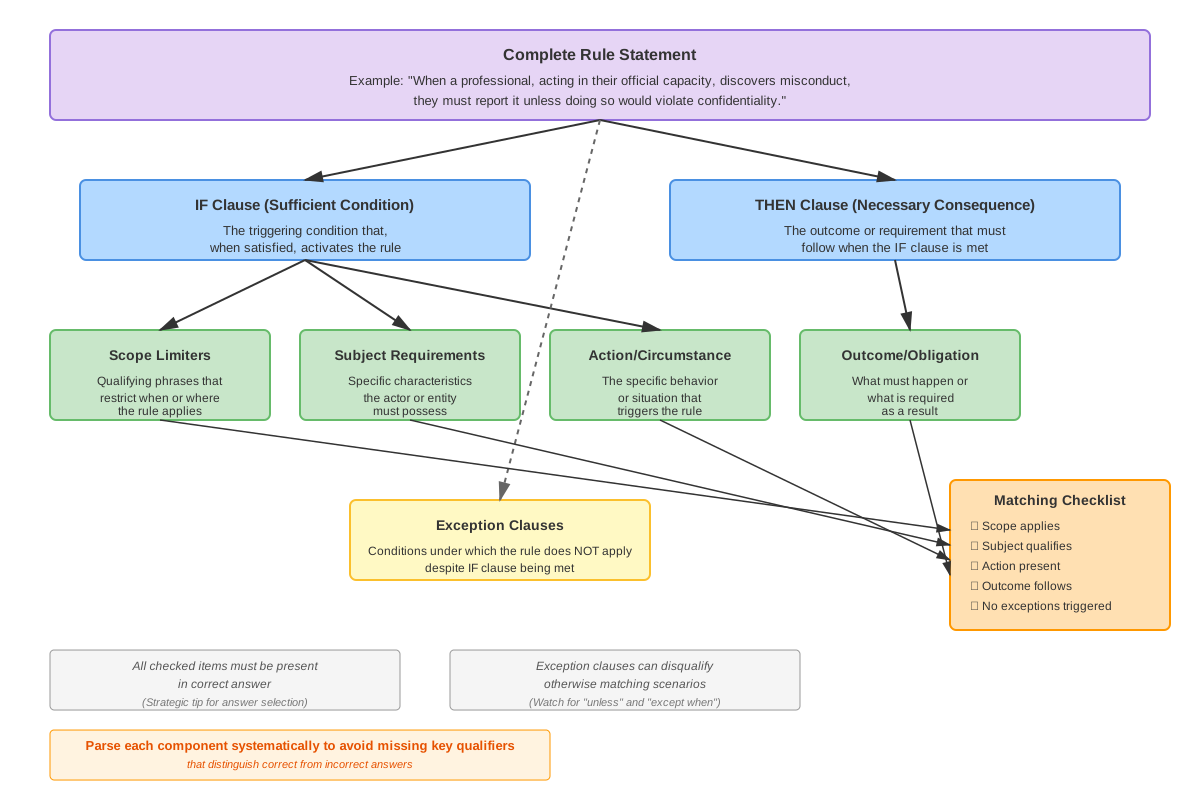
The rule itself usually contains several components that must be carefully identified:
- Scope: What domain or category of situations does the rule govern?
- Conditions: What specific requirements must be met for the rule to apply?
- Outcome: What follows when the conditions are satisfied?
- Exceptions: Are there any stated limitations or exclusions?
Understanding these components allows you to create a mental checklist against which to evaluate each answer choice systematically.
The Logic of Matching Rules to Cases
The core reasoning pattern in rule application involves matching—comparing the abstract elements of a rule to the concrete details of a specific situation. This process requires identifying the essential features that the rule specifies and then determining whether those features are present in the scenario under consideration.
Consider this simplified example:
Rule: "A student deserves academic recognition if that student has maintained excellent grades while also contributing significantly to campus life."
To apply this rule, you must identify:
- The subject (student)
- Condition 1 (excellent grades)
- Condition 2 (significant campus contribution)
- The logical connector (both conditions required—"while also" indicates conjunction)
- The outcome (deserves academic recognition)
When evaluating scenarios, you would need to verify that BOTH conditions are satisfied. A student with excellent grades but no campus involvement would NOT satisfy the rule, nor would a student with significant campus contributions but poor grades.
Necessary vs. Sufficient Conditions in Rules
Many rule application questions hinge on understanding the difference between necessary and sufficient conditions. A sufficient condition is one that, if present, guarantees the outcome. A necessary condition is one that must be present for the outcome to occur, but its presence alone doesn't guarantee the outcome.
| Condition Type | Logical Form | Example | Application Requirement |
|---|---|---|---|
| Sufficient | If A, then B | If you score 180, you'll be admitted | Presence of A guarantees B |
| Necessary | B only if A | You'll be admitted only if you apply | B cannot occur without A |
| Both | If and only if A, then B | You pass if and only if you score 70%+ | A guarantees B, and B requires A |
When applying rules, you must determine whether the rule establishes sufficient conditions (if these factors are present, the outcome follows), necessary conditions (the outcome requires these factors), or both. Misidentifying this relationship leads to incorrect applications.
The Role of Precise Language
Logical reasoning on the LSAT demands attention to precise language. Words like "all," "some," "most," "only," "unless," and "except" dramatically alter the meaning and application of rules. Rule application questions exploit this precision by including answer choices that would satisfy a slightly different version of the rule but not the actual rule as stated.
For example, a rule stating "All employees who work overtime must receive additional compensation" differs significantly from "Employees who work overtime must receive additional compensation." The first explicitly covers all such employees; the second, while likely intended the same way, could be interpreted more narrowly. The LSAT tests your ability to work with the rule as actually stated, not as you might reasonably interpret it.
Common Rule Structures
Rules on the LSAT typically follow several common patterns:
Conditional Rules: "If X, then Y" structures that specify what follows when certain conditions are met.
Comparative Rules: Standards that involve comparisons between options, such as "Choose the option that provides the greatest benefit relative to cost."
Ethical/Normative Rules: Principles about what should or should not be done under certain circumstances, often involving moral or professional obligations.
Definitional Rules: Standards that specify what counts as a particular category or type, such as "An action qualifies as negligent if it falls below the standard of care a reasonable person would exercise."
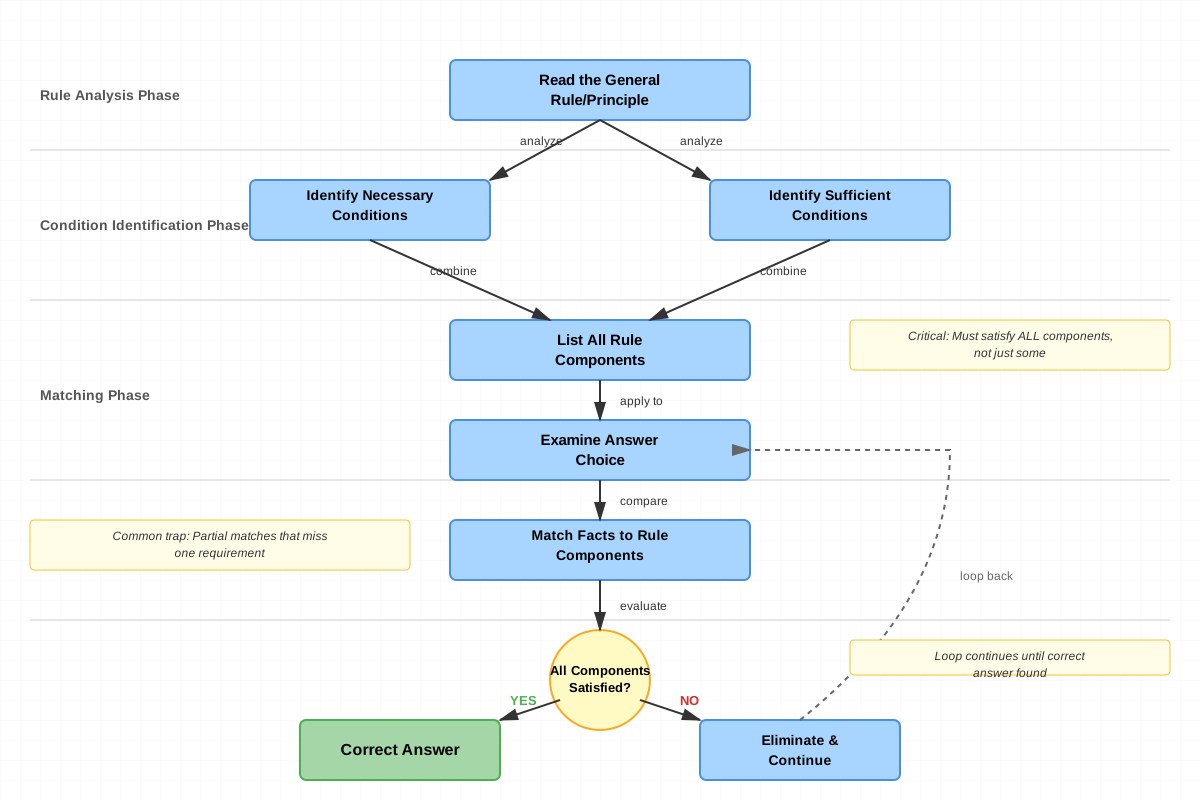
The Application Process
Applying a rule systematically involves these steps:
- Parse the rule: Break down the rule into its component parts, identifying all conditions, qualifiers, and outcomes
- Identify the logical structure: Determine whether conditions are necessary, sufficient, or both; note any conjunctions (and) or disjunctions (or)
- Create a checklist: List all requirements that must be satisfied
- Evaluate each answer choice: Systematically check whether each scenario satisfies all requirements
- Eliminate mismatches: Remove any answer choice that fails to satisfy even one requirement
- Select the best match: Choose the answer that most completely and accurately satisfies the rule
This systematic approach prevents the common error of selecting an answer that "feels right" but doesn't actually satisfy all components of the rule.
Concept Relationships
Rule application connects to several other logical reasoning concepts in important ways. At its foundation, rule application relies on conditional logic—understanding how "if-then" relationships work is essential for parsing rules correctly. When a rule states "If condition X is met, then outcome Y follows," you're working with a conditional statement that must be properly understood before application can occur.
The relationship flows as follows: Conditional Logic → enables → Rule Parsing → leads to → Systematic Application → produces → Accurate Answer Selection
Rule application also connects to argument evaluation because many rule application questions require you to determine whether a particular judgment or decision is justified by the stated principle. This creates a bridge between principle questions and justify/strengthen question types.
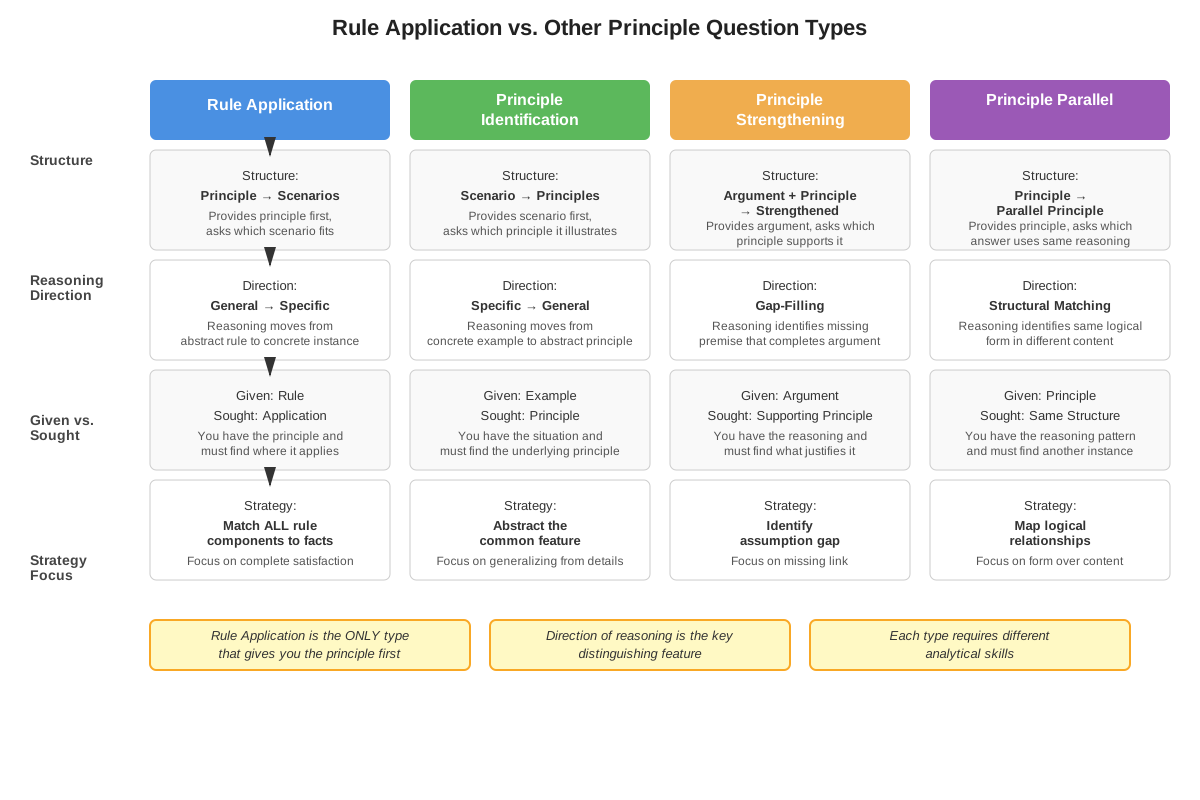
Within the family of principle questions, rule application is the inverse of principle identification. Where principle identification asks you to derive a general rule from specific examples, rule application provides the general rule and asks you to identify the appropriate specific application. Mastering both skills creates a complete understanding of how abstract principles and concrete cases relate.
The concept also relates to inference questions because applying a rule often requires drawing conclusions about what must, might, or cannot be true given the rule and specific facts. However, rule application is more structured—you're not making open-ended inferences but rather checking whether specific conditions are satisfied.
High-Yield Facts
⭐ Rule application questions provide the principle in the stimulus and ask you to identify which scenario it applies to or is exemplified by.
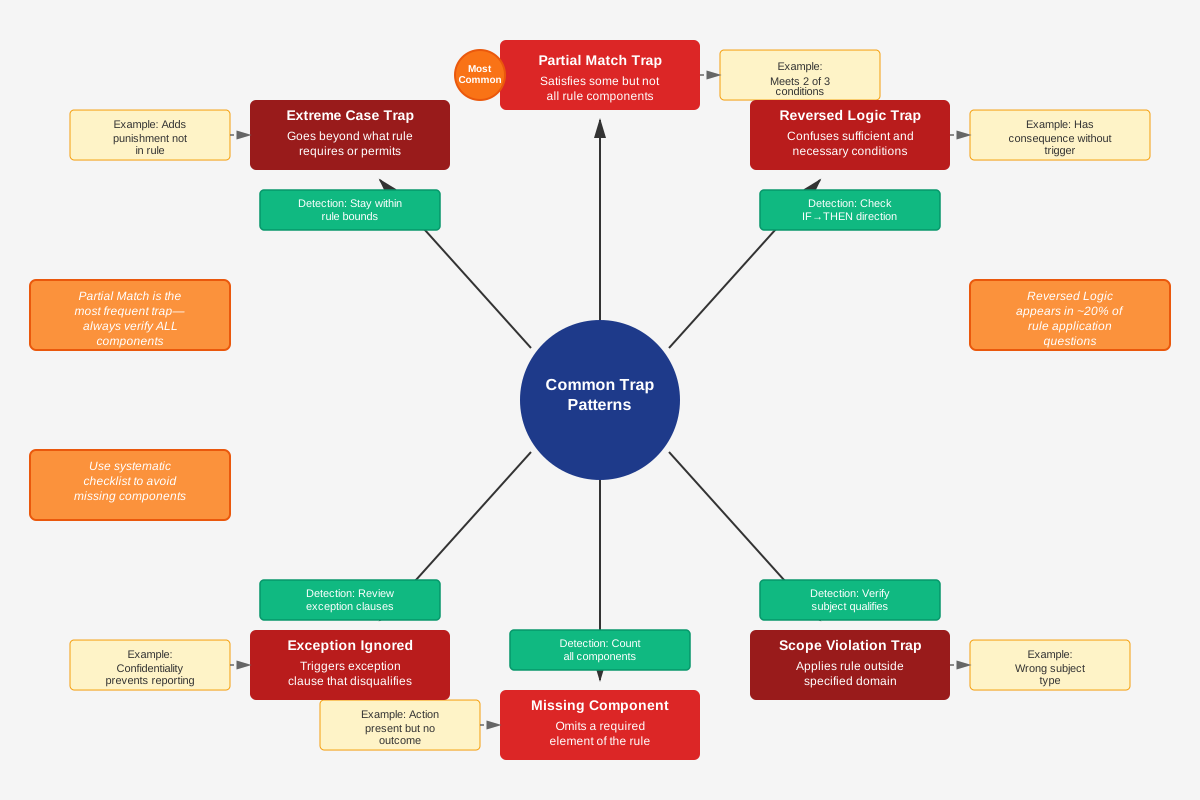
⭐ Every component of the rule must be satisfied for a scenario to correctly apply the rule—partial matches are incorrect.
⭐ Pay special attention to logical connectors like "and" (both conditions required) versus "or" (either condition sufficient).
⭐ The correct answer will match the rule's logical structure, not just its general theme or spirit.
⭐ Trap answers often satisfy most but not all requirements of the rule, making them tempting but incorrect.
- Rule application questions typically use phrases like "conforms to," "illustrates," "violates," or "is justified by" the principle.
- Necessary conditions must be present in the correct answer; their absence automatically eliminates that choice.
- Sufficient conditions, when present, guarantee the outcome specified in the rule.
- Scope limitations in the rule must be respected—if the rule applies only to "employees," scenarios about contractors don't apply.
- Quantifiers like "all," "some," "most," and "only" must be matched precisely between rule and application.
- Exception clauses in rules ("unless," "except when") create scenarios where the rule does NOT apply despite initial appearances.
- The correct answer may use different words than the rule but must capture the same logical relationships and requirements.
Quick check — test yourself on Rule application so far.
Try Flashcards →Common Misconceptions
Misconception: If an answer choice relates to the same general topic as the rule, it must be the correct application.
Correction: Topical similarity is insufficient; the answer must satisfy the specific logical requirements and conditions stated in the rule. An answer about workplace ethics might relate to a rule about workplace ethics but fail to meet the rule's specific conditions.
Misconception: The correct answer will use the same vocabulary and phrasing as the rule.
Correction: The LSAT often deliberately uses different language in the correct answer to test whether you understand the logical structure rather than just matching words. Focus on whether the logical relationships match, not whether the words match.
Misconception: If most of the rule's requirements are satisfied, the answer is close enough.
Correction: Rule application requires complete satisfaction of all stated conditions. An answer that satisfies three out of four requirements is incorrect, just as an answer that satisfies zero requirements would be. Legal reasoning demands precision—a contract missing one essential element is not "almost valid."
Misconception: You should interpret rules generously or apply common sense to fill in gaps.
Correction: Apply the rule exactly as stated, without adding unstated requirements or removing stated ones. The LSAT tests your ability to work with rules as written, not as you think they should be written. If the rule seems incomplete or odd, apply it anyway as stated.
Misconception: Rule application questions are just about matching keywords between the stimulus and answer choices.
Correction: While keywords matter, the fundamental task is matching logical structures and relationships. An answer might contain all the same keywords but arrange them in a way that violates the rule's logical structure, making it incorrect despite surface similarity.
Worked Examples
Example 1: Conditional Rule Application
Stimulus: "A company should offer a promotion to an employee only if that employee has both demonstrated exceptional performance in their current role and shown the ability to take on additional responsibilities."
Question: Which one of the following judgments most closely conforms to the principle stated above?
Answer Choices:
(A) Acme Corp should offer a promotion to Jenkins, who has demonstrated exceptional performance but has not yet been tested with additional responsibilities.
(B) Acme Corp should offer a promotion to Martinez, who has shown the ability to handle additional responsibilities and has performed exceptionally in her current role.
(C) Acme Corp should not offer a promotion to Thompson, who has performed adequately but not exceptionally, despite handling additional responsibilities well.
(D) Acme Corp should offer a promotion to Lee, who has performed exceptionally and expressed interest in taking on more responsibilities.
(E) Acme Corp should not offer a promotion to Davis, who has demonstrated exceptional performance and successfully managed additional responsibilities.
Solution Process:
Step 1: Parse the rule. The rule states that a promotion should be offered "only if" two conditions are met. "Only if" indicates necessary conditions—both must be present for a promotion to be appropriate.
Condition 1: Demonstrated exceptional performance in current role
Condition 2: Shown ability to take on additional responsibilities
Logical connector: "both...and" (conjunction—both required)
Step 2: Evaluate each answer systematically.
(A) Jenkins: Has condition 1 (exceptional performance) but NOT condition 2 (has not been tested with additional responsibilities). Since both conditions are required, this violates the principle. The answer says the company SHOULD offer a promotion, but the principle says they should only do so when both conditions are met. Incorrect.
(B) Martinez: Has condition 2 (ability to handle additional responsibilities) AND condition 1 (performed exceptionally). Both necessary conditions are satisfied. The answer says the company SHOULD offer a promotion, which conforms to the principle. Potentially correct.
(C) Thompson: Does NOT have condition 1 (performed adequately, not exceptionally), though has condition 2. The answer says the company should NOT offer a promotion. Since both conditions aren't met, not offering a promotion conforms to the principle. Potentially correct.
(D) Lee: Has condition 1 (exceptional performance) but only "expressed interest" in additional responsibilities, which is not the same as "shown the ability" to take them on. Condition 2 is not satisfied. The answer says SHOULD offer promotion, but the principle requires both conditions. Incorrect.
(E) Davis: Has BOTH conditions (exceptional performance AND successfully managed additional responsibilities). The answer says should NOT offer promotion, but when both conditions are met, the principle suggests a promotion is appropriate. Incorrect.
Step 3: Compare remaining candidates (B) and (C).
Both conform to the principle, but we need the judgment that "most closely conforms." Choice (B) presents a case where both conditions are met and recommends a promotion—this is a positive application of the principle. Choice (C) presents a case where conditions aren't met and recommends no promotion—this is consistent with the principle but represents what NOT to do rather than what to do.
Answer: (B) most closely conforms because it represents the positive application of the principle when all conditions are satisfied.
Example 2: Rule with Exception Clause
Stimulus: "A journalist should protect the confidentiality of sources unless revealing the source's identity is necessary to prevent serious harm to others."
Question: The principle above, if valid, most helps to justify which one of the following judgments?
Answer Choices:
(A) A journalist should reveal a source's identity when the source provided information about corporate fraud that could harm investors.
(B) A journalist should not reveal a source's identity who provided information about government corruption, even though the information is highly newsworthy.
(C) A journalist should reveal a source's identity when that source disclosed a credible plan to commit violence against specific individuals.
(D) A journalist should not reveal a source's identity who provided embarrassing but not harmful information about a public figure.
(E) A journalist should reveal a source's identity when doing so would significantly boost the journalist's career.
Solution Process:
Step 1: Parse the rule with its exception.
General rule: Protect source confidentiality
Exception: Unless revealing identity is necessary to prevent serious harm to others
Structure: Default to confidentiality; override only when exception applies
Step 2: Identify what triggers the exception.
The exception requires TWO elements:
- Revealing identity is necessary (not just helpful or interesting)
- To prevent serious harm to others (not just any negative consequence)
Step 3: Evaluate each answer.
(A) Corporate fraud harming investors: This involves harm, but is revealing the source's identity "necessary" to prevent it? The information about fraud could be reported without revealing the source. The harm is also financial rather than physical. Questionable fit.
(B) Government corruption information: The answer recommends NOT revealing identity. Since the information is described as newsworthy but not as involving serious harm to others, maintaining confidentiality conforms to the general rule. Potentially correct.
(C) Credible plan to commit violence: This clearly involves serious harm to others (violence against specific individuals). Revealing the source might be necessary to prevent this harm (authorities might need to know the source to assess credibility and take action). Potentially correct.
(D) Embarrassing but not harmful information: No serious harm to others is involved. The answer recommends NOT revealing identity, which conforms to the general rule. Potentially correct.
(E) Boosting journalist's career: This provides no benefit to others and involves no prevention of harm. The answer recommends revealing identity for personal gain, which violates the principle. Incorrect.
Step 4: Determine which judgment is most justified by the principle.
Choices (B) and (D) both recommend maintaining confidentiality when the exception doesn't apply—these conform to the principle but don't require the principle to justify them (they're the default).
Choice (C) recommends revealing identity specifically because the exception applies: serious harm to others (violence) that revealing the source's identity is necessary to prevent. This judgment is most strongly justified by the principle because it invokes the exception clause.
Answer: (C) because the principle specifically justifies overriding confidentiality in this circumstance, making the judgment directly dependent on the stated principle.
Exam Strategy
When approaching lsat rule application questions, begin by reading the question stem first to confirm you're dealing with an application question rather than another principle question type. Look for phrases like "conforms to," "illustrates," "exemplifies," "violates," or "is justified by" the principle.
Next, carefully parse the rule in the stimulus before looking at answer choices. Identify and mentally note (or physically note on scratch paper if permitted):
- All conditions or requirements
- Logical connectors (and/or)
- Quantifiers (all/some/most/only)
- Exception clauses (unless/except)
- The scope of the rule
Create a mental or written checklist of what must be present in the correct answer. This prevents you from being swayed by answer choices that sound good but don't actually satisfy the rule's requirements.
Exam Tip: Treat rule application like a matching exercise. You're not evaluating whether the rule is good or whether the answer choice describes a reasonable situation—you're only checking whether the specific requirements match.
When evaluating answer choices, work systematically through your checklist for each option. Eliminate any answer that fails to satisfy even one requirement. Be especially alert for answers that satisfy most but not all conditions—these are common trap answers designed to catch test-takers who read too quickly or who focus on general themes rather than specific requirements.
Trigger words to watch for in questions:
- "Conforms to" = find the scenario that satisfies the rule
- "Violates" = find the scenario that breaks the rule
- "Justified by" = find the judgment that the rule supports
- "Illustrates" = find the example that demonstrates the rule
- "Most closely" = all answers might partially fit; find the best match
Time allocation: Rule application questions typically require 60-90 seconds. Spend 20-30 seconds parsing the rule carefully, then 30-50 seconds evaluating answer choices systematically. Don't rush the initial parsing—errors here cascade into wrong answer selection.
Process of elimination tips:
- Eliminate answers that fail to satisfy necessary conditions immediately
- Eliminate answers that fall outside the rule's stated scope
- Eliminate answers where the logical structure doesn't match (e.g., rule requires "both A and B" but answer has only A)
- Between remaining answers, choose the one that most completely and precisely satisfies all rule components
If you're stuck between two answers, return to the exact language of the rule. Often one answer will match the logical structure precisely while the other will be close but not exact. The LSAT rewards precision.
Memory Techniques
MATCH - A mnemonic for the rule application process:
- Map out the rule's components
- Analyze the logical structure
- Test each answer systematically
- Check all conditions are satisfied
- Hone in on the precise match
The "Checklist Visualization": Imagine the rule as a physical checklist with boxes to check. As you read each answer choice, visualize checking off boxes. Only an answer that lets you check every box is correct. This prevents the common error of selecting an answer that satisfies most requirements.
The "Both/Either" Reminder: When you see "and" in a rule, hold up both hands—both conditions required. When you see "or," hold up one hand—either condition sufficient. This physical reminder helps distinguish conjunctions from disjunctions.
Scope Circle: Visualize drawing a circle around the scope of the rule (e.g., "employees," "published research," "elected officials"). Any answer choice outside that circle is automatically wrong. This helps quickly eliminate out-of-scope answers.
The "Only If" Flip: Remember that "A only if B" means "If A, then B" (not "If B, then A"). When you see "only if," mentally flip it to the standard conditional form to avoid confusion.
Summary
Rule application questions test your ability to take a general principle, standard, or rule and determine which specific scenario it applies to or is exemplified by. This skill is fundamental to legal reasoning and appears frequently on the LSAT, making it high-yield material for test preparation. Success requires careful parsing of the rule to identify all conditions, requirements, and logical structures, followed by systematic evaluation of answer choices against those requirements. The correct answer must satisfy every component of the rule—partial matches are incorrect. Common pitfalls include focusing on topical similarity rather than logical structure, failing to recognize necessary versus sufficient conditions, and selecting answers that satisfy most but not all requirements. Approaching these questions systematically by creating a mental checklist of rule components and methodically checking each answer choice against that checklist leads to consistent accuracy. The precision demanded by rule application questions mirrors the precision required in legal practice, where applying statutes and precedents to client situations requires exact matching of facts to legal requirements.
Key Takeaways
- Rule application questions provide a general principle and ask you to identify which specific scenario it applies to or is exemplified by
- Every component of the rule must be satisfied in the correct answer—partial matches are trap answers
- Parse the rule carefully before evaluating answer choices, identifying all conditions, logical connectors, and scope limitations
- Pay special attention to necessary versus sufficient conditions and to logical connectors like "and" (both required) versus "or" (either sufficient)
- Work systematically through answer choices using a checklist approach rather than relying on which answer "feels right"
- Focus on matching logical structures and relationships, not just matching keywords or general themes
- Common trap answers satisfy most but not all requirements or fall outside the rule's stated scope
Related Topics
Principle Identification: The inverse skill of rule application—deriving general principles from specific examples. Mastering rule application provides the foundation for understanding how principles and cases relate bidirectionally.
Conditional Logic: The logical foundation underlying most rules, involving if-then relationships, necessary and sufficient conditions, and contrapositive reasoning. Deeper study of conditional logic strengthens rule application abilities.
Parallel Reasoning: Questions that require matching logical structures between arguments. The structural matching skills developed in rule application transfer directly to parallel reasoning questions.
Justify Questions: Questions asking what principle would justify a conclusion. These combine rule application with principle identification, requiring you to both understand how rules apply and recognize what rule would support a given judgment.
Necessary Assumption Questions: Questions requiring identification of unstated assumptions. Understanding necessary versus sufficient conditions in rule application helps identify necessary assumptions in arguments.
Practice CTA
Now that you've mastered the core concepts of rule application, it's time to put your knowledge into practice. Work through the practice questions systematically, applying the checklist approach and elimination strategies you've learned. Pay special attention to parsing rules carefully before evaluating answer choices—this initial investment prevents errors downstream. Remember that rule application is a high-frequency question type on the LSAT, so every practice question you complete builds skills that will directly improve your score. Approach each question methodically, and you'll develop the precision and systematic thinking that characterizes top LSAT performers. You've got this!
Sign up free to keep reading
Create a free AnvayaPrep account to finish this LSAT guide on Rule application — plus flashcards and practice questions.