Overview
Comparing conclusions is a critical skill within the comparative reading section of the LSAT Reading Comprehension component. This question type requires test-takers to analyze two related passages (typically labeled Passage A and Passage B) and determine how the authors' final positions, recommendations, or judgments relate to one another. Unlike questions that focus on specific details or intermediate arguments, comparing conclusions demands that students synthesize each author's overall stance and evaluate the relationship between these positions.
The ability to compare conclusions effectively is essential for LSAT success because it tests multiple cognitive skills simultaneously: comprehension of complex arguments, identification of authorial intent, recognition of subtle distinctions in reasoning, and the capacity to hold two perspectives in mind while evaluating their relationship. These questions frequently appear in the comparative reading passages that constitute approximately 25% of the Reading Comprehension section, making them a high-yield area for focused study.
Mastering this topic builds directly upon fundamental reading comprehension skills while serving as a gateway to more sophisticated analytical abilities. The skill of comparing conclusions connects to broader LSAT competencies including identifying main points, understanding argument structure, and recognizing logical relationships—all of which are tested throughout the exam. Students who excel at comparing conclusions demonstrate the kind of nuanced analytical thinking that law schools seek in prospective students, as legal practice regularly requires comparing different judicial opinions, statutory interpretations, and argumentative positions.
Learning Objectives
- [ ] Identify how Comparing conclusions appears in LSAT questions
- [ ] Explain the reasoning pattern behind Comparing conclusions
- [ ] Apply Comparing conclusions to solve LSAT-style problems accurately
- [ ] Distinguish between superficial similarities and fundamental differences in authorial conclusions
- [ ] Evaluate the degree of agreement or disagreement between two authors' final positions
- [ ] Recognize when authors reach similar conclusions through different reasoning paths
- [ ] Identify cases where authors appear to disagree but actually address different aspects of an issue
Prerequisites
- Basic passage comprehension: Understanding main ideas, supporting details, and authorial purpose is necessary because comparing conclusions requires first identifying what each author concludes individually.
- Argument structure recognition: Familiarity with premises, evidence, and conclusions enables students to distinguish between intermediate claims and final positions.
- Comparative reading fundamentals: Understanding how paired passages relate (agreement, disagreement, complementary perspectives) provides the framework for conclusion comparison.
- Inference skills: The ability to draw reasonable conclusions from stated information helps when authors' final positions are implied rather than explicitly stated.
Why This Topic Matters
In legal practice, attorneys and judges constantly compare how different parties, precedents, or authorities reach their conclusions on similar issues. The skill of comparing conclusions mirrors the real-world legal task of synthesizing multiple opinions, identifying areas of consensus and conflict, and understanding how different reasoning processes lead to various outcomes. Law school itself demands this ability across case briefs, seminar discussions, and exam essays.
On the LSAT, questions about comparing conclusions appear with high frequency in the comparative reading passages. Approximately 1-2 questions per comparative passage set directly test this skill, and several additional questions indirectly require it. These questions typically ask test-takers to identify which statement best characterizes the relationship between the authors' conclusions, what both authors would agree upon, or how their final recommendations differ. The question stems often include phrases like "Both authors would be most likely to agree that," "The conclusions reached in the two passages are related in that," or "Unlike the author of Passage A, the author of Passage B concludes that."
Common manifestations include passages where both authors address the same problem but propose different solutions, passages where authors agree on a conclusion but for different reasons, and passages where authors appear to disagree but actually focus on different aspects of a broader issue. The LSAT deliberately constructs these passages to test whether students can move beyond surface-level reading to understand the precise nature of each author's final position and the relationship between them.
Core Concepts
Understanding What Constitutes a Conclusion
A conclusion in LSAT comparing conclusions questions represents the author's ultimate position, judgment, or recommendation regarding the topic under discussion. This differs from intermediate claims, supporting evidence, or preliminary observations that appear earlier in the passage. The conclusion typically answers the implicit question: "What does this author ultimately think or recommend about this issue?"
Conclusions may be explicitly stated in phrases like "Therefore," "Thus," "In conclusion," or "Ultimately," but they are often implied through the overall thrust of the argument. In comparative reading passages, authors may present their conclusions in the final paragraph, but sophisticated passages sometimes embed the conclusion throughout or present it early and then defend it. Students must distinguish between what an author observes (descriptive claims) and what an author advocates or judges (evaluative conclusions).
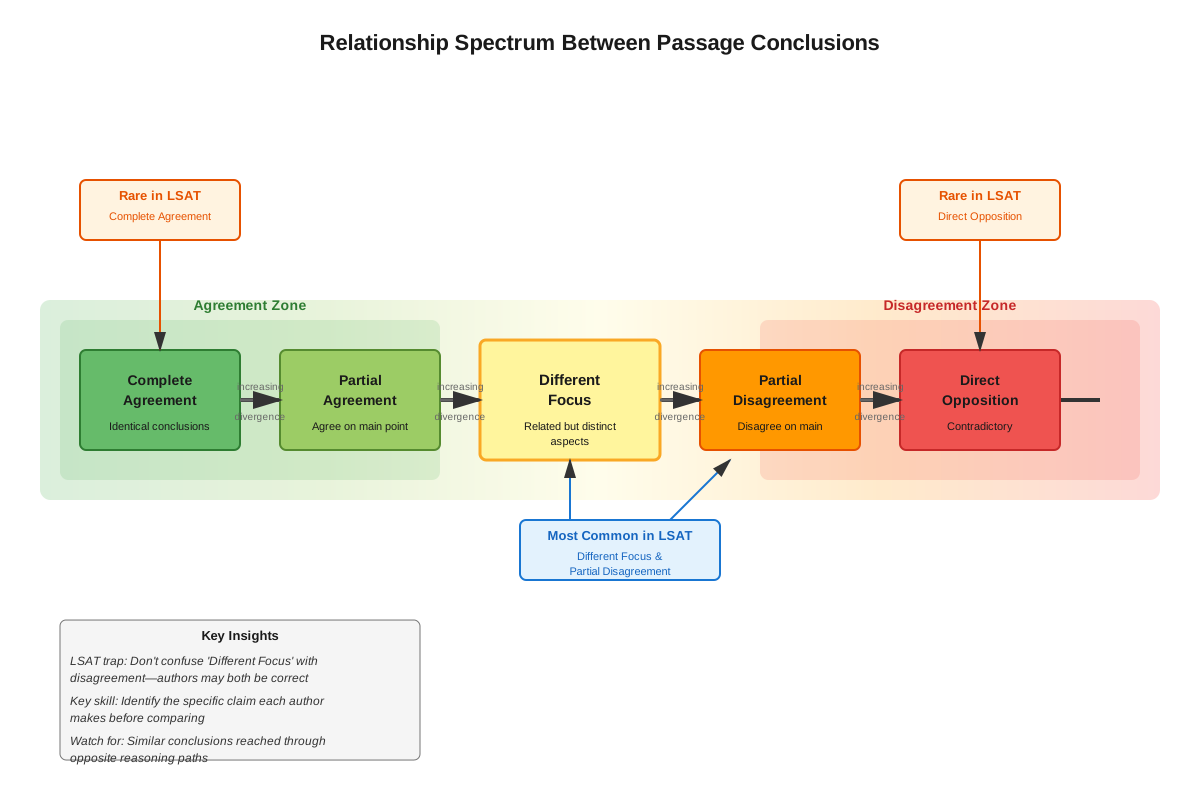
Types of Conclusion Relationships
When comparing conclusions between two passages, several relationship patterns emerge consistently on the LSAT:
Complete Agreement: Both authors reach essentially the same conclusion, though they may arrive there through different reasoning paths or emphasize different supporting evidence. For example, both authors might conclude that a particular policy should be implemented, even if one emphasizes economic benefits while the other focuses on social justice considerations.
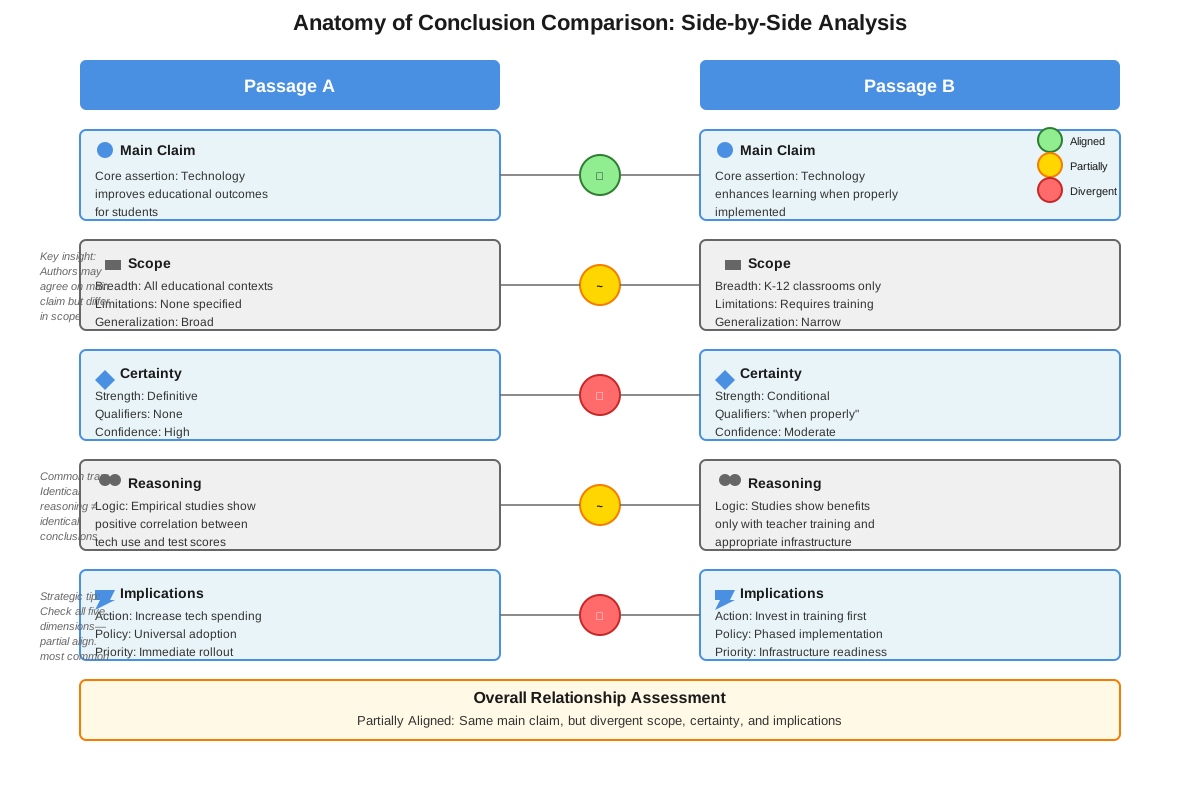
Partial Agreement: The authors agree on some aspects of their conclusions but diverge on others. This often occurs when authors address a multi-faceted issue and align on certain dimensions while disagreeing on others. One author might conclude that technology improves education overall but requires careful implementation, while another concludes that technology improves certain aspects of education but harms others.
Fundamental Disagreement: The authors reach opposite or incompatible conclusions. One might advocate for a policy while the other opposes it, or one might judge a phenomenon positively while the other views it negatively. The LSAT tests whether students can identify the precise point of divergence.
Complementary Conclusions: The authors address different aspects of the same issue and reach conclusions that don't directly conflict but rather complement each other. One passage might conclude about causes while another concludes about effects, or one might focus on theoretical implications while another addresses practical applications.
Scope Differences: The authors may reach conclusions that differ primarily in scope or degree rather than fundamental direction. One might conclude that a solution is "essential" while another concludes it is "helpful but insufficient."
The Reasoning-Conclusion Distinction
A critical concept in lsat comparing conclusions questions involves distinguishing between how authors reason and what they conclude. Two authors might:
- Reach the same conclusion through different reasoning (e.g., both support environmental regulation, but one emphasizes economic sustainability while the other emphasizes moral obligation)
- Use similar reasoning but reach different conclusions (e.g., both analyze cost-benefit data but interpret it differently)
- Disagree in both reasoning and conclusion (e.g., one uses economic analysis to oppose a policy while another uses rights-based reasoning to support it)
The LSAT frequently tests whether students confuse similarity in reasoning with similarity in conclusions, or vice versa. A question might ask what both authors would agree on, and the correct answer identifies a shared conclusion even though the passages use different argumentative approaches.
Explicit vs. Implicit Conclusions
Conclusions in LSAT passages range from explicitly stated to heavily implied:
Explicit conclusions are directly stated, often with conclusion indicators. Example: "Therefore, the government should implement universal healthcare."
Implicit conclusions must be inferred from the overall argument, tone, and emphasis. An author might present extensive evidence about healthcare system failures, discuss benefits of universal systems in other countries, and address counterarguments, without ever stating "I support universal healthcare"—yet this conclusion is clearly implied.
When comparing conclusions, students must sometimes compare one explicit conclusion with one implicit conclusion, requiring careful inference about what the second author ultimately believes based on the totality of their argument.
Degree and Qualification in Conclusions
The LSAT tests precise reading by varying the degree of certainty or qualification in conclusions. Consider these variations:
- "Policy X will solve the problem" (strong, unqualified)
- "Policy X will likely help address the problem" (moderate, qualified)
- "Policy X is one necessary component of solving the problem" (limited scope)
- "Policy X may contribute to solving the problem if implemented carefully" (heavily qualified)
When comparing conclusions, students must attend to these qualifications. Two authors might both support a policy, but if one concludes it is "essential" while another concludes it is "potentially useful," their conclusions differ significantly. Wrong answer choices often misrepresent the degree of certainty or qualification in one or both authors' conclusions.
The Role of Context in Conclusion Comparison
Understanding each author's conclusion requires considering the context in which it appears. The same statement might function as a conclusion in one passage but as a premise in another. Additionally, authors may present multiple conclusions at different levels:
- Primary conclusion: The main point or ultimate recommendation
- Secondary conclusions: Subsidiary points that support or relate to the primary conclusion
- Conditional conclusions: Conclusions that apply only under certain circumstances
When comparing conclusions, questions typically focus on primary conclusions, but some questions test whether students can identify that authors agree on a secondary point while disagreeing on the primary conclusion, or vice versa.
Concept Relationships
The concepts within comparing conclusions form an interconnected analytical framework. Understanding what constitutes a conclusion (the foundation) enables identification of different conclusion types (complete agreement, disagreement, etc.). This identification process requires applying the reasoning-conclusion distinction to avoid confusing how authors argue with what they ultimately conclude. Throughout this process, attention to explicit versus implicit conclusions ensures accurate identification of each author's position, while sensitivity to degree and qualification prevents mischaracterization of conclusions as more or less certain than they actually are. Finally, contextual awareness ensures that students identify the appropriate level of conclusion (primary vs. secondary) that the question targets.
This topic connects to prerequisite knowledge in several ways: Basic passage comprehension → enables → conclusion identification; Argument structure recognition → enables → distinguishing conclusions from premises; Comparative reading fundamentals → provides framework for → understanding conclusion relationships. The skill of comparing conclusions also enables progression to more advanced topics like evaluating the strength of comparative arguments and synthesizing multiple perspectives on complex issues.
Relationship Map:
Passage Comprehension → Conclusion Identification → Conclusion Classification (agreement/disagreement type) → Reasoning-Conclusion Distinction → Precise Comparison (attending to degree/qualification) → Accurate Answer Selection
High-Yield Facts
⭐ Conclusions in comparative reading passages may be explicitly stated or must be inferred from the overall argument and authorial tone.
⭐ Two authors can reach the same conclusion through entirely different reasoning processes—the LSAT frequently tests this distinction.
⭐ Degree and qualification matter: "will solve" differs significantly from "might help address" even if both authors support the same general approach.
⭐ The most common wrong answers in comparing conclusions questions misrepresent the scope, degree, or qualification of one or both authors' positions.
⭐ Authors may agree on secondary points while disagreeing on primary conclusions, or vice versa—questions specify which level of conclusion to compare.
- Conclusion indicators like "therefore," "thus," and "in sum" help locate explicit conclusions but are not always present.
- Partial agreement is more common in LSAT passages than complete agreement or total disagreement, reflecting real-world complexity.
- When authors address different aspects of an issue, their conclusions may be complementary rather than conflicting.
- The final paragraph often contains or strongly implies the author's conclusion, but sophisticated passages may place conclusions elsewhere.
- Comparing conclusions requires holding both authors' positions in mind simultaneously while evaluating their relationship—a skill that improves with practice.
- Questions asking what "both authors would agree with" test whether students can identify common ground even when passages emphasize different points.
- Authors may appear to disagree when they actually address different questions or define key terms differently.
Quick check — test yourself on Comparing conclusions so far.
Try Flashcards →Common Misconceptions
Misconception: If two authors discuss the same topic and use similar evidence, they must reach the same conclusion.
Correction: Authors frequently interpret the same evidence differently or weigh various considerations differently, leading to divergent conclusions despite discussing similar material. The LSAT specifically tests whether students recognize that similar evidence doesn't guarantee similar conclusions.
Misconception: If two authors reach the same conclusion, they must have used the same reasoning.
Correction: Authors often reach identical or similar conclusions through entirely different reasoning paths. One might use economic analysis while another uses ethical reasoning, yet both conclude that a policy should be implemented. Questions frequently test whether students confuse agreement in conclusion with agreement in reasoning.
Misconception: The conclusion is always in the last paragraph.
Correction: While conclusions often appear at the end, authors may state their position early and then defend it, or weave their conclusion throughout the passage. Students must identify the conclusion based on its function (the ultimate position) rather than its location.
Misconception: If authors disagree on one point, they disagree on everything.
Correction: Authors frequently agree on some aspects of an issue while disagreeing on others. The LSAT tests nuanced reading by asking about specific points of agreement or disagreement rather than overall alignment. Two authors might agree on problem diagnosis while disagreeing on solutions.
Misconception: Strong language in a passage indicates the author's conclusion.
Correction: Authors may use emphatic language when presenting opposing views they plan to refute, or when describing problems they then propose to solve. Strong language indicates emphasis but doesn't necessarily mark the author's own conclusion. Students must distinguish between positions the author presents and positions the author endorses.
Misconception: Implicit conclusions are less important than explicit ones.
Correction: The LSAT treats implicit and explicit conclusions equally. In fact, questions about implicit conclusions may be more challenging and thus more discriminating among test-takers. Students must develop skill at inferring conclusions from the totality of an argument, not just identifying explicitly stated positions.
Worked Examples
Example 1: Different Reasoning, Same Conclusion
Passage A (abbreviated): The author discusses rising healthcare costs and presents statistical evidence that administrative overhead in the current insurance-based system accounts for 30% of healthcare spending. The passage notes that single-payer systems in other countries have administrative costs of only 5-10%. The author concludes by stating that implementing a single-payer system would significantly reduce healthcare costs.
Passage B (abbreviated): The author examines healthcare from a rights-based perspective, arguing that healthcare is a fundamental human right that should not depend on employment status or ability to pay. The passage discusses how the current system leaves millions uninsured and creates disparities in health outcomes. The author concludes that a single-payer system is necessary to ensure universal healthcare access.
Question: The authors of both passages would be most likely to agree with which of the following?
Analysis Process:
- Identify Passage A's conclusion: The author concludes that a single-payer system should be implemented, based primarily on economic efficiency arguments about reducing administrative costs.
- Identify Passage B's conclusion: The author concludes that a single-payer system is necessary, based primarily on rights-based and equity arguments about universal access.
- Compare the conclusions: Both authors support implementing a single-payer healthcare system (same conclusion), but they arrive at this conclusion through different reasoning—one economic, one ethical.
- Evaluate answer choices (hypothetical):
- (A) "Healthcare administrative costs are the primary moral concern in healthcare policy" - Incorrect: Only Passage A focuses on costs; Passage B focuses on rights.
- (B) "A single-payer healthcare system would be preferable to the current system" - Correct: Both authors conclude this, despite different reasoning.
- (C) "Economic efficiency should be the primary consideration in healthcare reform" - Incorrect: Only Passage A emphasizes economic efficiency.
- (D) "The current healthcare system violates fundamental human rights" - Incorrect: Only Passage B makes rights-based arguments.
Key Lesson: This example demonstrates the crucial distinction between reasoning and conclusion. Students must recognize that agreement on conclusion doesn't require agreement on reasoning, and vice versa. The correct answer identifies the shared conclusion without requiring shared reasoning.
Example 2: Partial Agreement with Scope Differences
Passage A (abbreviated): The author examines the impact of social media on political discourse, presenting research showing that social media algorithms create "echo chambers" where users primarily encounter views they already agree with. The passage discusses how this polarizes political opinions and reduces productive dialogue. The author concludes that social media companies should be required to modify their algorithms to expose users to diverse viewpoints, suggesting this is essential for preserving democratic discourse.
Passage B (abbreviated): The author also discusses social media's impact on politics but focuses on misinformation and fake news. The passage presents evidence that false information spreads faster than accurate information on social media platforms. The author concludes that while algorithm modification might help somewhat, the more fundamental solution requires improved media literacy education so users can critically evaluate information regardless of how algorithms present it.
Question: Which of the following best characterizes the relationship between the conclusions reached in the two passages?
Analysis Process:
- Identify Passage A's conclusion: Social media companies should be required to modify algorithms (strong, specific recommendation presented as essential solution).
- Identify Passage B's conclusion: Algorithm modification might help, but media literacy education is the more fundamental solution (acknowledges Passage A's approach but prioritizes a different solution).
- Compare the conclusions:
- Both authors see problems with social media's impact on political discourse
- Both acknowledge that algorithm modification could play a role
- They differ on whether algorithm modification is the primary/essential solution (A) or a secondary measure compared to education (B)
- They differ in scope: A focuses on echo chambers; B focuses on misinformation
- Evaluate answer choices (hypothetical):
- (A) "The authors reach contradictory conclusions about whether social media harms political discourse" - Incorrect: Both agree it causes harm.
- (B) "The authors agree on the problem but disagree on the relative importance of different solutions" - Correct: This captures the partial agreement and the difference in emphasis/priority.
- (C) "The authors reach the same conclusion through different reasoning" - Incorrect: Their conclusions differ in what they prioritize as the solution.
- (D) "The authors address entirely different aspects of social media with no overlap" - Incorrect: Both address social media's impact on political discourse.
Key Lesson: This example illustrates partial agreement and scope differences. Students must recognize that authors can agree on problem diagnosis and even on the potential value of a solution while disagreeing on whether that solution is primary, secondary, sufficient, or insufficient. Attention to qualifying language ("essential" vs. "might help somewhat") is crucial for accurate comparison.
Exam Strategy
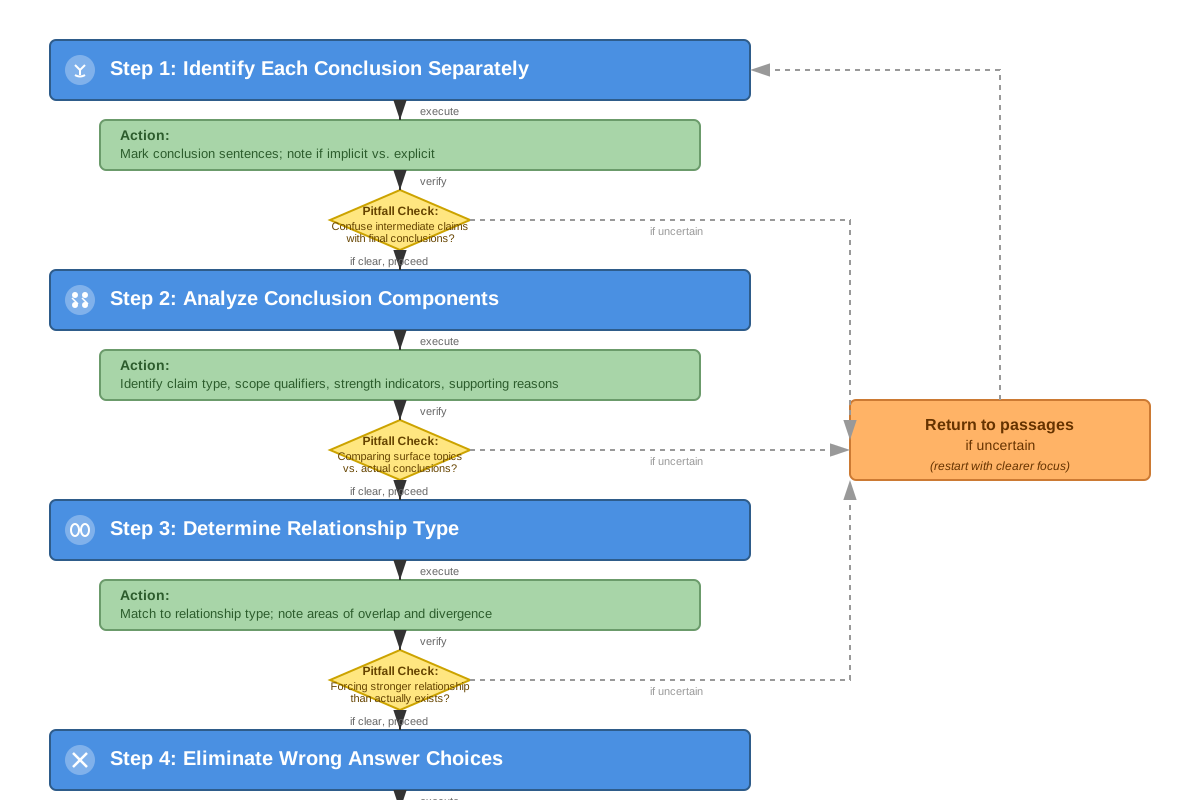
When approaching comparing conclusions questions on the reading comprehension section, follow this systematic process:
Step 1: Identify Each Conclusion Separately
Before comparing, clearly identify what each author concludes. Ask: "What is this author's ultimate position or recommendation?" Look for conclusion indicators but don't rely on them exclusively. Consider the overall thrust of the argument and the author's tone.
Step 2: Note Qualifications and Degree
Pay careful attention to how strongly or conditionally each author states their conclusion. Mark words like "essential," "necessary," "might," "could," "likely," "insufficient," "one factor among many," etc. These qualifications often distinguish correct from incorrect answers.
Step 3: Distinguish Reasoning from Conclusion
Actively separate how each author argues from what they conclude. Create a mental or physical note: "Author A concludes X using reasoning Y; Author B concludes Z using reasoning W." This prevents confusion between agreement in reasoning and agreement in conclusion.
Step 4: Identify the Relationship Type
Classify the relationship: complete agreement, partial agreement, disagreement, complementary, or scope difference. This classification helps predict what correct answers will look like.
Trigger Words and Phrases to Watch For:
In question stems:
- "Both authors would agree" → Look for common ground in conclusions
- "Unlike the author of Passage A" → Focus on differences in conclusions
- "The relationship between the conclusions" → Classify the relationship type
- "The author of Passage B, unlike the author of Passage A, concludes" → Identify the specific difference
In answer choices:
- "Contradictory" vs. "complementary" → Distinguish between conflict and different focus
- "Essential" vs. "helpful" → Attend to degree
- "Primary" vs. "secondary" → Note relative importance
- "Sufficient" vs. "necessary" → Understand logical relationships
Process of Elimination Tips:
Eliminate answers that:
- Misrepresent the degree or qualification of either conclusion (most common wrong answer type)
- Confuse reasoning with conclusion (e.g., claiming authors disagree when they reach the same conclusion through different reasoning)
- Overstate agreement (claiming complete agreement when agreement is only partial)
- Overstate disagreement (claiming contradiction when authors address different aspects)
- Focus on intermediate claims rather than ultimate conclusions
- Attribute to one author a position actually held by the other
Time Allocation:
Spend approximately 30-45 seconds per question on comparing conclusions questions. These questions require careful analysis but shouldn't require re-reading entire passages if you've identified conclusions during your initial read. If you find yourself re-reading extensively, you may not have adequately identified conclusions during your first pass through the passages.
Exam Tip: During your initial read of comparative passages, mark or mentally note each author's conclusion. This upfront investment saves time on conclusion-comparison questions and improves accuracy.
Memory Techniques
RACE Acronym for Comparing Conclusions:
- Read for each conclusion separately
- Attend to qualifications and degree
- Classify the relationship type
- Eliminate answers that misrepresent either position
Visualization Strategy:
Picture two people having a conversation. Person A makes their final point; Person B makes theirs. Now visualize the relationship: Are they nodding in agreement? Shaking hands (complete agreement)? Nodding but with one finger raised (partial agreement)? Shaking their heads (disagreement)? Talking about different topics (complementary)? This concrete visualization helps maintain clarity about the relationship.
The "Degree Spectrum" Mental Image:
For tracking qualifications, visualize a spectrum from "definitely will" to "might possibly":
Certain → Likely → Possible → One factor → Insufficient
   |         |         |           |            |
 "will"   "should"  "could"    "helps"    "won't solve"
Place each author's conclusion on this spectrum to compare their degree of certainty or commitment.
The Three-Column Method:
When practicing, create three mental columns:
- Passage A's conclusion
- Passage B's conclusion
- Relationship between them
This structure prevents confusion and ensures systematic comparison.
Summary
Comparing conclusions in LSAT comparative reading passages requires identifying each author's ultimate position or recommendation, distinguishing conclusions from reasoning, and accurately characterizing the relationship between the two positions. Success depends on attending to qualifications and degree (whether authors conclude something is essential, helpful, or insufficient), recognizing that authors may reach the same conclusion through different reasoning or different conclusions despite similar reasoning, and avoiding common traps like confusing partial agreement with complete agreement or misrepresenting the scope of either author's position. The skill integrates multiple reading comprehension abilities: identifying main points, understanding argument structure, making precise inferences, and holding multiple perspectives in mind simultaneously. Questions testing this skill appear frequently in comparative reading passages and often distinguish between high-scoring and average test-takers because they require nuanced, careful reading rather than general comprehension. Mastery requires systematic analysis—identifying each conclusion separately, classifying the relationship type, and eliminating answers that misrepresent degree, scope, or the reasoning-conclusion distinction.
Key Takeaways
- Comparing conclusions requires first identifying each author's ultimate position separately, then characterizing the relationship between these positions with attention to degree and qualification.
- The most common error is confusing agreement in reasoning with agreement in conclusion, or vice versa—authors can reach the same conclusion through different reasoning or different conclusions despite similar reasoning.
- Degree and qualification words ("essential," "might," "insufficient," "one factor") are crucial for accurate comparison and frequently distinguish correct from incorrect answers.
- Partial agreement is more common than complete agreement or total disagreement in LSAT passages, reflecting the exam's emphasis on nuanced reading.
- Wrong answers typically misrepresent the scope, degree, or qualification of one or both authors' conclusions, or confuse intermediate claims with ultimate positions.
- Systematic analysis using a consistent process (identify each conclusion → note qualifications → classify relationship → eliminate misrepresentations) improves both accuracy and efficiency.
- Conclusions may be explicit or implicit; both types appear equally on the exam and require equal attention during passage analysis.
Related Topics
Identifying Main Points in Single Passages: Mastering conclusion comparison builds upon and reinforces the fundamental skill of identifying an author's main point in individual passages. This foundational skill enables the more complex task of comparing two authors' positions.
Analyzing Author's Tone and Attitude: Understanding how to compare conclusions connects to recognizing authorial tone, as tone often signals the author's ultimate position even when not explicitly stated. Authors who conclude favorably about a topic typically maintain a positive or supportive tone throughout.
Evaluating Argument Strength: After mastering conclusion comparison, students can progress to evaluating which author makes a stronger argument for their conclusion, a more advanced skill that requires both identifying conclusions and assessing the quality of reasoning supporting them.
Synthesis Questions in Comparative Reading: Comparing conclusions enables tackling synthesis questions that ask how information from both passages relates, what new insights emerge from considering both perspectives, or how one passage's approach might address issues raised in the other.
Practice CTA
Now that you understand the framework for comparing conclusions in LSAT comparative reading passages, it's time to apply these concepts to actual practice questions. Work through the practice problems systematically, using the RACE acronym and the strategies outlined above. Pay special attention to how answer choices misrepresent degree and qualification—recognizing these patterns in practice will make them immediately visible on test day. Review the flashcards to reinforce the distinction between reasoning and conclusion, and the various types of conclusion relationships. Remember that this skill improves significantly with deliberate practice, so approach each practice question as an opportunity to refine your systematic analysis process. You're building the precise, nuanced reading ability that distinguishes top LSAT performers!
Sign up free to keep reading
Create a free AnvayaPrep account to finish this LSAT guide on Comparing conclusions — plus flashcards and practice questions.