Overview
Comparing evidence is a critical skill within the Reading Comprehension section of the LSAT, particularly in Comparative Reading passages. This question type requires test-takers to analyze how two different passages use evidence to support their respective arguments, identify similarities and differences in evidentiary approaches, and evaluate the relative strength or relevance of evidence across texts. Unlike single-passage questions that focus on understanding one author's argument, comparing evidence demands that students hold multiple perspectives in mind simultaneously while assessing how each author builds their case.
The LSAT frequently tests this skill because it mirrors the analytical work lawyers perform daily: evaluating competing arguments, weighing different types of evidence, and determining which evidence best supports a particular conclusion. Questions about comparing evidence may ask students to identify which passage relies more heavily on empirical data versus theoretical reasoning, which author provides more concrete examples, or how the evidentiary standards differ between two texts. Mastering this topic is essential because comparative reading passages appear in every LSAT Reading Comprehension section, and evidence-comparison questions represent some of the highest-value question types within these paired passages.
Within the broader Reading Comprehension framework, comparing evidence builds upon fundamental skills like identifying main ideas, understanding argument structure, and recognizing different types of support. However, it adds an additional layer of complexity by requiring students to perform these analytical tasks across two texts simultaneously while maintaining awareness of how each author's evidentiary choices reflect their broader argumentative strategy. This skill connects directly to other comparative reading competencies, including comparing viewpoints, identifying points of agreement and disagreement, and synthesizing information across passages.
Learning Objectives
- [ ] Identify how Comparing evidence appears in LSAT questions
- [ ] Explain the reasoning pattern behind Comparing evidence
- [ ] Apply Comparing evidence to solve LSAT-style problems accurately
- [ ] Distinguish between different types of evidence (empirical, anecdotal, theoretical, statistical) used across paired passages
- [ ] Evaluate the relative strength and relevance of evidence presented in each passage
- [ ] Recognize how evidentiary choices reflect each author's argumentative purpose and methodology
Prerequisites
- Understanding of basic argument structure: Recognizing premises, conclusions, and supporting evidence is essential because comparing evidence requires first identifying what counts as evidence in each passage before comparison can occur.
- Familiarity with single-passage Reading Comprehension: Students must be comfortable analyzing individual passages before attempting to compare two passages simultaneously.
- Knowledge of different evidence types: Understanding the distinction between empirical data, expert testimony, historical examples, and logical reasoning helps students categorize and compare evidentiary approaches.
- Basic comparative reading skills: Students should understand the dual-passage format and how to track information across two related texts.
Why This Topic Matters
In legal practice, attorneys constantly evaluate competing evidence from opposing counsel, expert witnesses, and various documentary sources. The ability to compare evidence critically—assessing which sources are more credible, which data sets are more comprehensive, and which examples are more relevant—forms the foundation of legal argumentation. The LSAT tests this skill because it predicts success in law school case analysis, where students must synthesize multiple judicial opinions, compare how different courts have interpreted evidence, and evaluate which evidentiary standards apply in different contexts.
Statistically, comparative reading passages appear in every modern LSAT Reading Comprehension section, typically as one of the four passage sets. Within these comparative passages, evidence-comparison questions represent approximately 20-30% of the associated questions, making them among the most frequently tested question types. These questions often appear in formats such as: "Which passage relies more heavily on empirical evidence?", "Both passages mention [X], but they use this information to support different conclusions. How do their uses differ?", or "The evidence in Passage A differs from that in Passage B in that..."
Common manifestations include passages where one author uses statistical data while another relies on case studies, where one text presents theoretical arguments while another offers practical examples, or where both authors discuss the same phenomenon but cite different types of supporting evidence. The LSAT particularly favors scenarios where the evidentiary differences reflect deeper methodological or philosophical disagreements between the authors.
Core Concepts
Types of Evidence in LSAT Passages
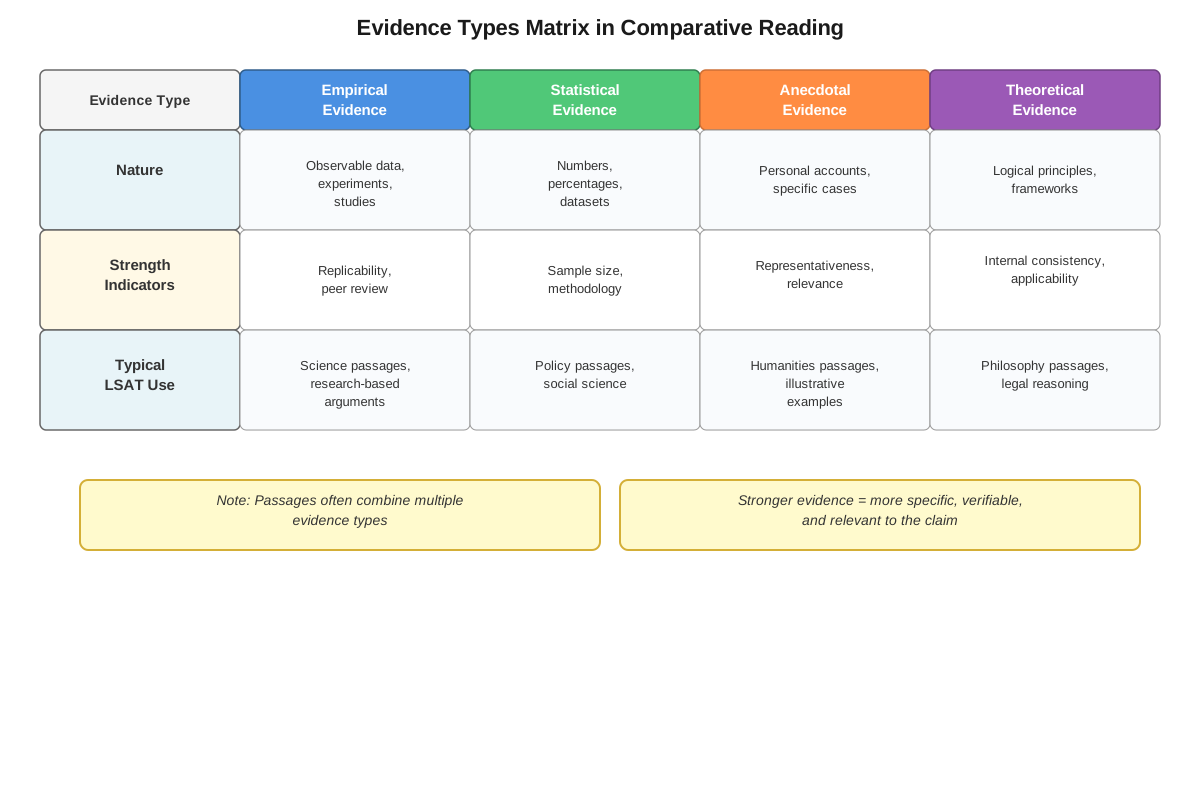
Understanding the various evidence types that appear in LSAT passages is fundamental to comparing them effectively. Evidence can be categorized into several distinct types, each with different persuasive weight and applicability:
Empirical evidence consists of data derived from observation, experimentation, or measurement. This includes scientific studies, statistical analyses, and quantitative research findings. When comparing passages, one text might rely heavily on empirical evidence (citing specific studies or numerical data) while another takes a more theoretical approach.
Anecdotal evidence involves specific examples, case studies, or illustrative scenarios. While less generalizable than empirical data, anecdotes can effectively demonstrate real-world applications or highlight particular aspects of an issue. Comparative passages often contrast authors who favor systematic data with those who prefer concrete examples.
Expert testimony and authoritative citations involve references to recognized authorities, established theories, or scholarly consensus. One passage might build its argument primarily through citing expert opinions, while another develops its own original reasoning.
Logical reasoning and theoretical arguments present evidence in the form of deductive or inductive reasoning chains, thought experiments, or conceptual analysis. Some authors construct arguments through pure logic rather than external evidence.
The Comparative Evidence Framework
When approaching lsat comparing evidence questions, students should employ a systematic framework:
| Analytical Dimension | Questions to Ask |
|---|---|
| Evidence Type | What kind of evidence does each passage primarily use? |
| Evidence Quantity | Which passage provides more supporting evidence? |
| Evidence Specificity | Which passage offers more concrete, detailed evidence? |
| Evidence Source | Where does each author's evidence originate? |
| Evidence Function | What role does the evidence play in each argument? |
| Evidence Strength | Which passage's evidence is more compelling or relevant? |
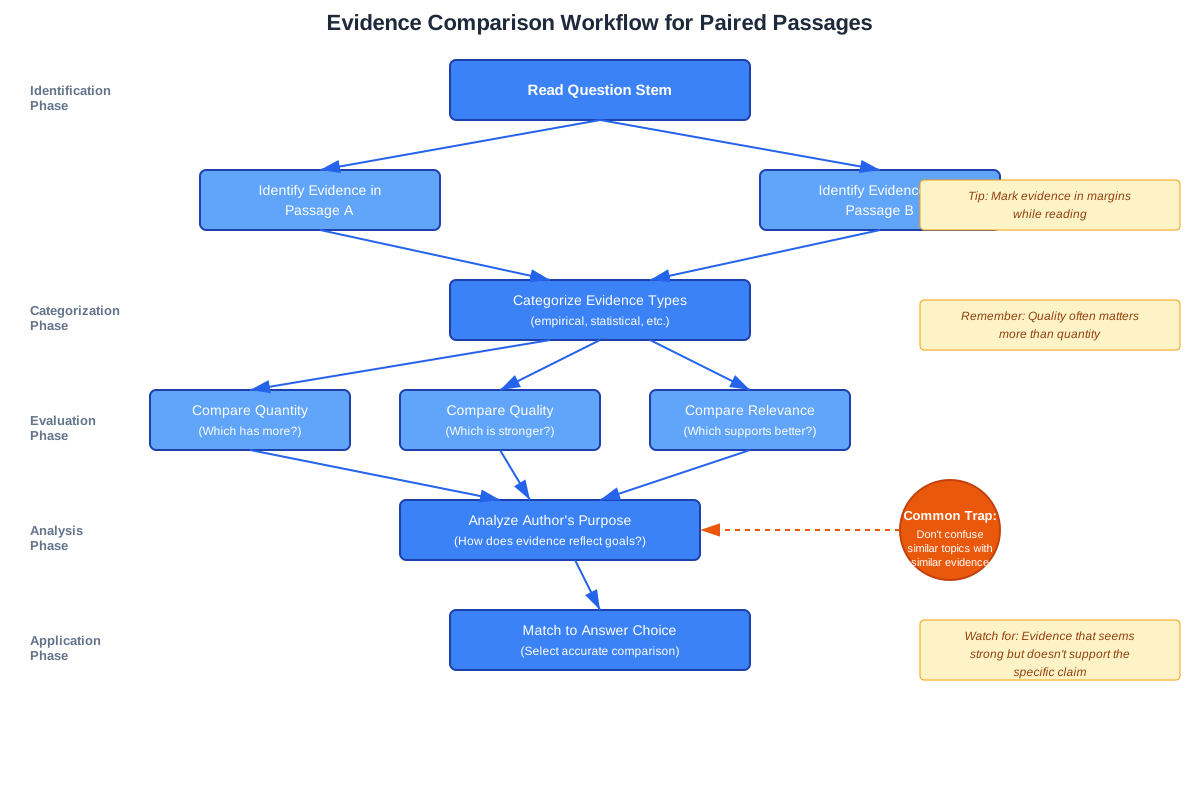
The reasoning pattern behind comparing evidence follows a consistent structure. First, identify the main claim or thesis of each passage. Second, locate the evidence each author uses to support their position. Third, categorize the evidence type in each passage. Fourth, analyze how the evidence functions within each argument. Finally, compare the evidentiary approaches to identify similarities, differences, and relative strengths.
Evidence Function and Purpose
Beyond merely identifying evidence types, successful comparison requires understanding evidence function—how each author deploys evidence to achieve their argumentative goals. Evidence can serve multiple purposes:
Establishing credibility: Some authors use evidence primarily to demonstrate expertise or authority on a subject. When comparing passages, one might establish credibility through extensive citations while another relies on the inherent logic of the argument.
Illustrating abstract concepts: Evidence can make theoretical ideas concrete and accessible. Comparative passages might show one author using multiple examples to illustrate a concept while another presents the concept through formal definition.
Proving causation or correlation: Scientific or social science passages often use evidence to demonstrate relationships between variables. One passage might present correlational data while another argues for causal mechanisms.
Refuting opposing views: Evidence can serve a defensive function, countering alternative explanations or criticisms. In comparative passages, authors might use evidence differently—one proactively building a case, another reactively addressing counterarguments.
Comparative Evidence Markers
The LSAT provides textual clues that signal when evidence comparison will be tested. Trigger phrases in passage content include: "studies show," "for example," "research indicates," "according to," "evidence suggests," "data reveal," and "as demonstrated by." When these phrases appear with different frequencies or contexts across paired passages, evidence comparison questions are likely.
Question stems that test evidence comparison include:
- "Unlike Passage A, Passage B supports its argument by..."
- "Both passages mention [X], but they differ in that..."
- "Which passage relies more heavily on..."
- "The evidence in Passage A is primarily [type], whereas Passage B..."
- "The authors would be most likely to disagree about which of the following claims regarding evidence?"
Evaluating Evidence Quality
Advanced comparative reading requires not just identifying evidence but evaluating its quality and appropriateness. When comparing evidence across passages, consider:
Relevance: Does the evidence directly support the author's claim, or is the connection tenuous? One passage might provide highly relevant evidence while another offers tangentially related support.
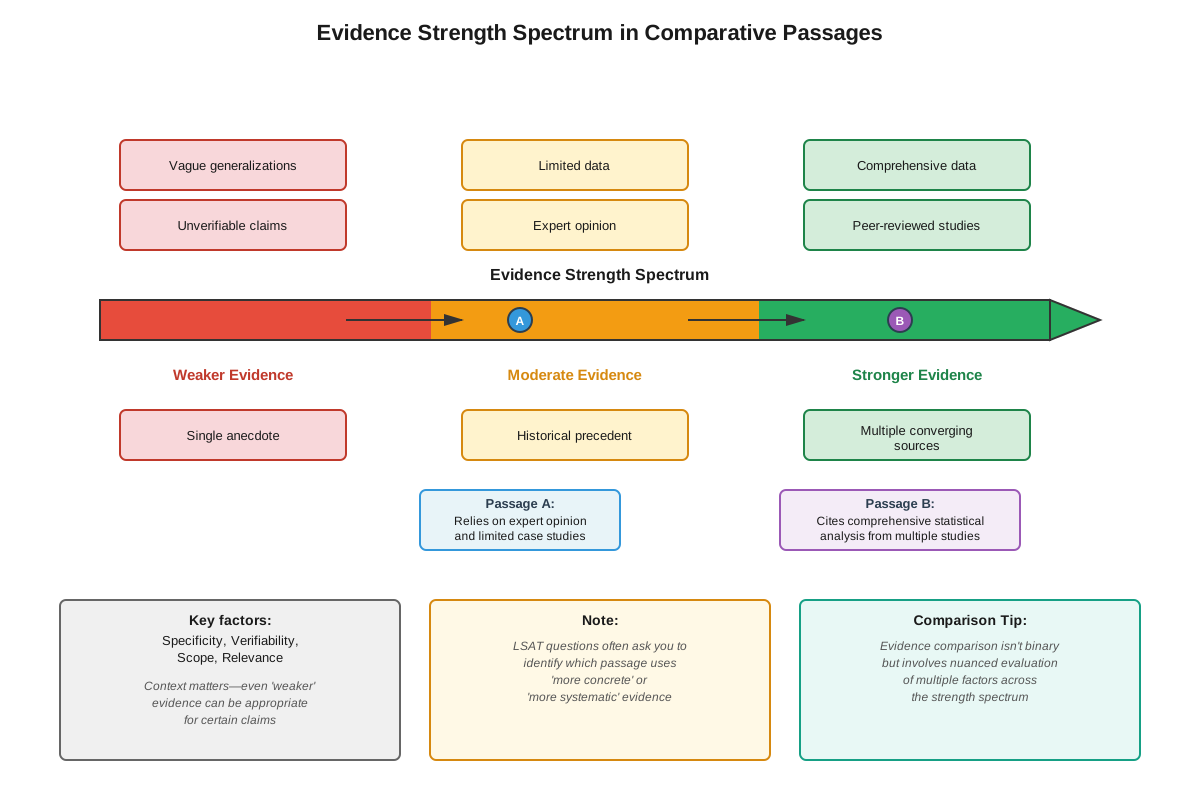
Sufficiency: Is there enough evidence to support the conclusion? Comparative passages often contrast well-supported arguments with those making broader claims based on limited evidence.
Representativeness: Does the evidence fairly represent the phenomenon under discussion, or is it cherry-picked? One author might use a single dramatic example while another presents a more balanced range of evidence.
Recency and reliability: Is the evidence current and from credible sources? Though the LSAT rarely requires outside knowledge, passages sometimes contrast outdated evidence with more recent findings.
Concept Relationships
The skill of comparing evidence builds directly upon several foundational reading comprehension abilities. Identifying main ideas serves as the prerequisite because students must understand what each passage argues before they can evaluate how evidence supports those arguments. This leads to recognizing argument structure, which reveals where evidence appears within each passage's logical framework.
From argument structure, the analysis branches into two parallel tracks: categorizing evidence types and understanding evidence function. These two analytical dimensions converge when students perform the actual comparison of evidentiary approaches, which requires simultaneously considering both what type of evidence appears and how it operates within each argument.
The comparison process then enables higher-order skills: evaluating relative evidence strength and synthesizing cross-passage information. These advanced competencies allow students to answer complex questions about which passage makes a stronger case, how the authors' methodological differences reflect deeper philosophical disagreements, or how evidence from both passages might be combined to support a new conclusion.
Textual relationship map:
Main Idea Identification → Argument Structure Recognition → Evidence Location → Evidence Type Categorization + Evidence Function Analysis → Cross-Passage Evidence Comparison → Evidence Quality Evaluation → Synthesis and Application
This skill set also connects laterally to other comparative reading competencies. Comparing viewpoints often depends on comparing evidence, since different perspectives typically rest on different evidentiary foundations. Identifying points of agreement requires recognizing when authors cite similar evidence despite reaching different conclusions, while identifying points of disagreement often involves recognizing that authors dispute the relevance or interpretation of particular evidence.
High-Yield Facts
⭐ Comparative reading passages appear in every LSAT Reading Comprehension section, and evidence comparison questions constitute 20-30% of questions for these passage pairs.
⭐ Evidence type differences often reflect deeper methodological disagreements between authors—one favoring empirical approaches, another preferring theoretical analysis.
⭐ The LSAT frequently contrasts passages where one author provides specific examples while another makes broader generalizations without concrete support.
⭐ When both passages mention the same fact or study, they almost always use it for different purposes—this is a high-yield question opportunity.
⭐ Questions asking which passage "relies more heavily on" a particular evidence type are among the most common comparative evidence questions.
- Evidence comparison questions often require students to recognize not just what evidence appears but how it functions within each argument's structure.
- Passages that appear to agree on conclusions may still differ significantly in their evidentiary approaches—the LSAT tests awareness of these methodological differences.
- Quantitative evidence (statistics, numerical data) versus qualitative evidence (examples, descriptions) represents one of the most frequently tested contrasts.
- The absence of certain evidence types can be as significant as their presence—one passage might notably lack empirical support that the other provides.
- Evidence comparison questions frequently appear in the middle-to-end of the question set for comparative passages, after basic comprehension questions but before complex synthesis questions.
Quick check — test yourself on Comparing evidence so far.
Try Flashcards →Common Misconceptions
Misconception: If both passages mention the same evidence, they must be using it to support the same point.
Correction: The LSAT frequently presents passages that cite identical facts, studies, or examples but deploy them for entirely different argumentative purposes. Always analyze how each author uses evidence, not just whether they mention it.
Misconception: More evidence always means a stronger argument.
Correction: Evidence quality and relevance matter more than quantity. A passage with one highly relevant, well-explained example may make a stronger case than a passage that lists multiple tangentially related facts. The LSAT tests the ability to evaluate evidence appropriateness, not just count evidence instances.
Misconception: Empirical evidence is always superior to anecdotal or theoretical evidence.
Correction: Different types of evidence serve different purposes. For some arguments, a well-chosen example or logical reasoning may be more appropriate than statistical data. The LSAT tests recognition of which evidence type best suits each author's specific purpose, not adherence to a universal evidence hierarchy.
Misconception: Comparing evidence only involves identifying differences between passages.
Correction: Effective evidence comparison also requires recognizing similarities in evidentiary approach, understanding why authors made similar or different choices, and evaluating how these choices affect argument strength. Questions may ask about commonalities as often as differences.
Misconception: Evidence comparison questions can be answered by reading only the portions of passages that contain evidence.
Correction: Understanding how evidence functions requires grasping each passage's overall argument structure and purpose. Evidence that seems weak in isolation might be perfectly appropriate given an author's specific goals, while seemingly strong evidence might be irrelevant to the actual claim being made.
Misconception: If a passage lacks a certain type of evidence, this represents a weakness.
Correction: Authors make deliberate choices about evidence based on their argumentative strategy, audience, and purpose. A theoretical passage doesn't need empirical data if its goal is conceptual analysis. The LSAT tests whether students can recognize appropriate evidence for each context, not whether passages meet a universal standard.
Worked Examples
Example 1: Scientific vs. Anecdotal Evidence
Passage A (abbreviated): "Recent studies demonstrate the effectiveness of early childhood music education. A longitudinal study following 500 children over ten years found that those receiving music instruction showed 15% higher spatial reasoning scores. Brain imaging research reveals increased neural connectivity in musically trained children. Statistical analysis controlling for socioeconomic factors confirms these benefits persist across demographic groups."
Passage B (abbreviated): "The value of music education becomes clear through individual stories. Consider Maria, a struggling math student who discovered pattern recognition through piano lessons. Or James, whose confidence blossomed after learning guitar. These transformations illustrate music education's profound impact on young learners' development."
Question: "The evidence in Passage A differs from that in Passage B in that Passage A relies primarily on..."
Analysis Process:
Step 1: Identify the main claim in each passage. Both argue for music education's value, so the difference lies in evidentiary approach, not conclusion.
Step 2: Categorize evidence types. Passage A uses: longitudinal study (empirical), brain imaging (empirical), statistical analysis (empirical). Passage B uses: individual case studies (anecdotal), specific examples (anecdotal).
Step 3: Analyze evidence function. Passage A's evidence establishes generalizable patterns through systematic research. Passage B's evidence illustrates concrete manifestations through individual experiences.
Step 4: Evaluate the contrast. The fundamental difference is empirical/systematic versus anecdotal/illustrative evidence.
Answer: Passage A relies primarily on systematic empirical research, while Passage B relies on individual anecdotal examples.
Connection to Learning Objectives: This example demonstrates how to identify evidence comparison in LSAT questions (Objective 1), explains the reasoning pattern of categorizing and contrasting evidence types (Objective 2), and applies the framework to reach an accurate answer (Objective 3).
Example 2: Same Evidence, Different Functions
Passage A (abbreviated): "The 1995 Chicago heat wave, which killed over 700 people, demonstrates the inadequacy of current urban emergency response systems. Despite advance weather warnings, the city's infrastructure failed to protect vulnerable populations. This tragedy proves that cities must develop comprehensive heat emergency protocols."
Passage B (abbreviated): "Urban heat vulnerability varies significantly based on social factors. The 1995 Chicago heat wave illustrates this variation: mortality rates differed dramatically between neighborhoods with similar temperatures. Areas with strong social networks experienced fewer deaths, suggesting that community cohesion, not just infrastructure, determines heat resilience."
Question: "Both passages mention the 1995 Chicago heat wave, but they use this information differently in that..."
Analysis Process:
Step 1: Note that both passages cite identical evidence (the Chicago heat wave), so the question tests understanding of evidence function, not evidence type.
Step 2: Determine what each passage argues. Passage A argues for better emergency systems. Passage B argues for the importance of social factors.
Step 3: Analyze how the heat wave evidence supports each argument. Passage A uses it as proof of infrastructure failure. Passage B uses it as an illustration of social variation in vulnerability.
Step 4: Articulate the functional difference. Passage A treats the heat wave as evidence of what went wrong with systems. Passage B treats it as evidence of what varies between communities.
Answer: Passage A uses the heat wave to demonstrate infrastructure inadequacy, while Passage B uses it to illustrate the role of social factors in determining vulnerability.
Connection to Learning Objectives: This example shows how comparing evidence appears when passages cite identical facts (Objective 1), explains the reasoning pattern of distinguishing evidence function from evidence content (Objective 2), and demonstrates accurate problem-solving when evidence appears similar but serves different purposes (Objective 3).
Exam Strategy
When approaching comparing evidence questions on the LSAT, employ this systematic strategy:
Pre-reading strategy: Before reading comparative passages, note that evidence comparison will likely be tested. As you read, actively mark different evidence types (empirical, anecdotal, theoretical) in each passage using consistent notation. This preparation makes evidence comparison questions significantly faster to answer.
Active reading technique: Create a mental or physical chart with two columns—one for each passage. As you encounter evidence, note: (1) What type? (2) What does it support? (3) How strong/specific? This comparative framework during initial reading prevents the need to re-read extensively when questions appear.
Exam Tip: When a question asks which passage "relies more heavily on" a particular evidence type, the correct answer typically involves a passage that uses that evidence type multiple times or as its primary support, not just mentions it once.
Trigger words in questions: Watch for these high-yield phrases that signal evidence comparison:
- "relies primarily on"
- "supports its argument by"
- "provides evidence in the form of"
- "differs from Passage B in that"
- "uses [X] to illustrate"
- "cites" or "references"
Process of elimination approach: For evidence comparison questions, eliminate answers that:
- Describe evidence that doesn't appear in the specified passage
- Confuse which passage contains which evidence
- Accurately describe evidence but mischaracterize its function
- Describe similarities when the question asks about differences (or vice versa)
Time allocation: Evidence comparison questions typically require 45-60 seconds each—slightly longer than basic comprehension questions but shorter than complex inference questions. If you've marked evidence types during initial reading, you can answer these questions quickly. If you must search both passages for evidence, budget an additional 20-30 seconds.
Common trap patterns: The LSAT frequently includes wrong answers that correctly identify evidence in one passage but incorrectly claim the other passage lacks it (when it actually appears in different form). Always verify both halves of comparative answer choices.
Strategic approach for "both passages" questions: When a question states "both passages mention [X]," the correct answer almost always involves recognizing that they use this shared evidence for different purposes. Focus on function, not just presence.
Memory Techniques
CAFE Mnemonic for evidence types:
- Concrete examples (anecdotal)
- Authorities and experts (testimonial)
- Facts and figures (empirical)
- Explanations and logic (theoretical)
When comparing passages, ask: "What's in each passage's CAFE?"
The COMPARE Framework for systematic analysis:
- Categorize evidence type in each passage
- Observe how evidence functions
- Match evidence to claims
- Pinpoint differences and similarities
- Analyze relative strength
- Review answer choices against your analysis
- Eliminate mismatches
Visualization Strategy: Picture two lawyers presenting cases. One holds a stack of research studies (empirical evidence), the other tells compelling stories (anecdotal evidence). When comparing evidence, visualize what each "lawyer" is holding and how they're using it to persuade.
The "Same Fact, Different Job" Rule: When both passages mention identical information, remember: "Same fact, different job." This phrase reminds you that identical evidence almost always serves different functions across passages—a high-yield testing pattern.
Evidence Strength Spectrum: Visualize a spectrum from "abstract/theoretical" on the left to "concrete/empirical" on the right. Mentally place each passage on this spectrum during reading. This spatial memory aid helps you quickly answer questions about which passage is more empirical, theoretical, specific, or general.
Summary
Comparing evidence represents a crucial skill within LSAT Reading Comprehension, particularly for comparative reading passages that appear in every test. This competency requires students to identify different evidence types (empirical, anecdotal, theoretical, authoritative), understand how each author deploys evidence to support their arguments, and evaluate the relative strength and appropriateness of evidentiary approaches across paired passages. The reasoning pattern involves systematically categorizing evidence, analyzing its function within each argument, and articulating meaningful comparisons that recognize both similarities and differences. Success requires moving beyond simply identifying what evidence appears to understanding why authors chose particular evidentiary strategies and how these choices reflect broader methodological or philosophical commitments. The LSAT frequently tests this skill through questions asking which passage relies more heavily on specific evidence types, how passages use shared evidence differently, or what distinguishes each author's evidentiary approach. Mastering evidence comparison enables students to answer 20-30% of questions associated with comparative passages and develops analytical skills essential for legal reasoning.
Key Takeaways
- Evidence comparison questions appear in every LSAT Reading Comprehension section and constitute a significant portion of comparative passage questions
- Successful comparison requires identifying both evidence type (empirical, anecdotal, theoretical, authoritative) and evidence function (how it supports the argument)
- When both passages mention identical facts or studies, they almost always use this evidence for different purposes—focus on function, not just presence
- Different evidence types serve different argumentative purposes; no single type is universally superior
- Systematic frameworks like categorizing evidence during initial reading dramatically improve speed and accuracy on evidence comparison questions
- The reasoning pattern follows: identify claims → locate evidence → categorize type → analyze function → compare approaches → evaluate relative strength
- Evidence comparison connects to broader comparative reading skills and reflects the analytical work lawyers perform when evaluating competing arguments
Related Topics
Comparing Viewpoints and Perspectives: While comparing evidence focuses on how authors support their arguments, comparing viewpoints examines what authors believe and how their fundamental perspectives differ. Mastering evidence comparison provides the foundation for understanding why authors hold different views—their evidentiary bases often explain their philosophical differences.
Identifying Points of Agreement and Disagreement: This skill builds directly on evidence comparison. Authors may agree on certain facts (shared evidence) while disagreeing on interpretation, or they may disagree on what evidence is relevant. Understanding evidence comparison enables more sophisticated analysis of where agreement and disagreement actually lie.
Evaluating Argument Strength: Once students can compare evidence across passages, they can progress to evaluating which passage makes a stronger overall case. This advanced skill requires synthesizing evidence comparison with analysis of logical reasoning, consideration of counterarguments, and assessment of claim scope.
Synthesis Questions in Comparative Reading: The most challenging comparative reading questions ask students to synthesize information from both passages or imagine how one author would respond to the other's evidence. Evidence comparison skills are prerequisite for these complex synthesis tasks.
Practice CTA
Now that you've mastered the framework for comparing evidence in LSAT Reading Comprehension, it's time to apply these skills to authentic practice questions. The concepts you've learned—identifying evidence types, analyzing evidence function, and systematically comparing evidentiary approaches—will become automatic only through deliberate practice. Challenge yourself with the practice questions and flashcards designed specifically for this topic, paying special attention to questions where both passages mention similar evidence but use it differently. Remember: every evidence comparison question you practice strengthens not just this specific skill but your overall analytical abilities for law school and legal practice. You've built the foundation—now construct mastery through application.
Sign up free to keep reading
Create a free AnvayaPrep account to finish this LSAT guide on Comparing evidence — plus flashcards and practice questions.