Overview
Disagreement between passages is a critical skill tested in the Comparative Reading section of the LSAT Reading Comprehension. This question type requires test-takers to identify, analyze, and articulate the specific points on which two paired passages diverge in their perspectives, arguments, or conclusions. Unlike questions that ask about similarities or general relationships between passages, disagreement questions demand precise identification of where authors would explicitly contradict each other or hold incompatible positions.
Mastering this topic is essential for LSAT success because comparative reading questions constitute approximately one of the four reading comprehension passages on every test administration. Within that comparative set, disagreement questions appear with high frequency and often prove challenging because they require simultaneous comprehension of both passages while maintaining clear distinctions between their respective positions. Students must avoid the common pitfall of identifying mere differences in focus or emphasis when the question specifically asks for genuine disagreement—points where the authors would actually dispute each other's claims.
The ability to identify disagreement between passages builds directly upon fundamental reading comprehension skills while adding layers of comparative analysis. This topic connects to broader LSAT competencies including argument analysis, logical reasoning, and precise textual interpretation. Success with disagreement questions demonstrates the sophisticated analytical thinking that law schools seek in candidates, as legal practice frequently requires comparing competing arguments, identifying genuine points of contention, and distinguishing substantive disputes from superficial differences.
Learning Objectives
- [ ] Identify how Disagreement between passages appears in LSAT questions
- [ ] Explain the reasoning pattern behind Disagreement between passages
- [ ] Apply Disagreement between passages to solve LSAT-style problems accurately
- [ ] Distinguish between genuine disagreement and mere difference in focus or scope
- [ ] Recognize the specific textual evidence that supports claims of disagreement
- [ ] Evaluate answer choices to eliminate options that describe differences without actual contradiction
- [ ] Synthesize information from both passages to predict likely points of disagreement
Prerequisites
- Basic passage comprehension skills: Ability to identify main ideas, author's purpose, and supporting details within individual passages—essential because disagreement analysis requires first understanding each passage independently
- Argument structure recognition: Understanding how authors construct claims, provide evidence, and draw conclusions—necessary to identify where argumentative positions actually conflict
- Comparative reading fundamentals: Familiarity with the paired-passage format and basic relationship questions—provides the foundation for more complex disagreement analysis
- Logical reasoning basics: Understanding of logical relationships including contradiction, opposition, and incompatibility—critical for distinguishing genuine disagreement from other relationships
Why This Topic Matters
Disagreement between passages represents one of the most sophisticated analytical tasks in LSAT comparative reading. In legal practice, attorneys must constantly evaluate competing arguments, identify genuine points of contention in case law, and distinguish substantive disagreements from rhetorical differences. The LSAT tests this skill because it directly correlates with success in law school seminars, legal writing, and courtroom advocacy.
Statistically, comparative reading appears as one of four reading comprehension passages on every LSAT administration, and disagreement questions constitute approximately 20-30% of the questions within that comparative set. This translates to roughly 1-2 disagreement questions per test, making this a high-yield topic that can directly impact scores. These questions typically appear in medium to difficult difficulty ranges, with correct answer rates often falling between 40-60% among test-takers, indicating significant room for competitive advantage through targeted preparation.
On the exam, disagreement questions manifest in several recognizable formats: direct disagreement questions ("The authors would be most likely to disagree about which one of the following?"), questions about what one author would say about the other's position ("The author of Passage B would be most likely to respond to the argument in Passage A by..."), and questions identifying statements one author would accept but the other would reject. The passages themselves typically present contrasting perspectives on a shared topic—such as competing theories about a scientific phenomenon, different policy recommendations for a social issue, or divergent interpretations of historical events or legal principles.
Core Concepts
Defining Genuine Disagreement
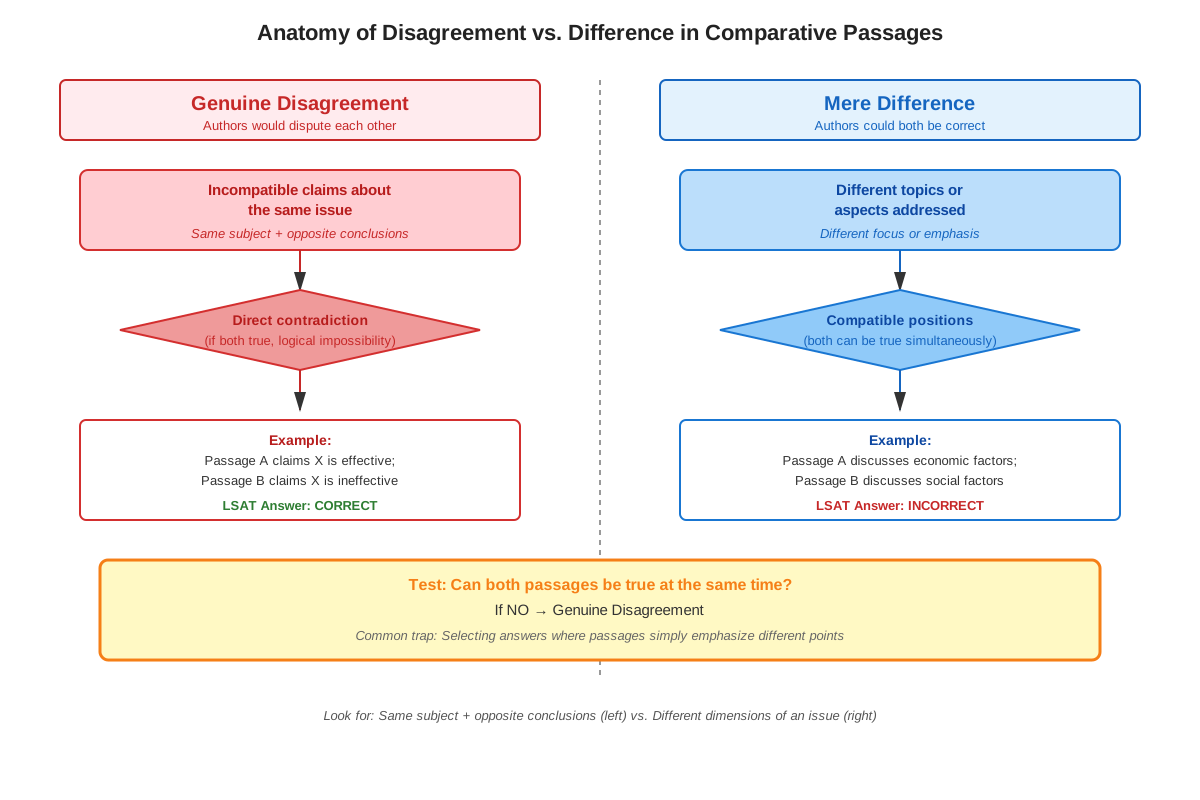
A disagreement between passages exists when the authors hold positions that cannot both be true simultaneously—they make incompatible claims about facts, causation, interpretation, or evaluation. This differs fundamentally from passages that simply discuss different aspects of a topic or emphasize different concerns. Genuine disagreement requires that if Author A's position is correct, Author B's position must be incorrect, or vice versa.
For example, if Passage A argues "increased screen time causes attention deficits in children" while Passage B argues "increased screen time does not cause attention deficits in children," this represents genuine disagreement. However, if Passage A discusses the educational benefits of technology while Passage B discusses the social drawbacks of technology, the passages differ in focus but don't necessarily disagree—both positions could be simultaneously true.
Types of Disagreement
Factual disagreement occurs when authors dispute what is actually true about the world. One author might claim a historical event occurred in a particular way while the other contests that account. These disagreements often involve empirical claims that could theoretically be resolved through evidence.
Interpretive disagreement emerges when authors agree on basic facts but disagree about their meaning or significance. Two passages might acknowledge the same statistical data but draw opposite conclusions about what that data demonstrates. This type frequently appears in LSAT passages because it requires more nuanced analysis than simple factual disputes.
Evaluative disagreement involves differing judgments about value, importance, or desirability. Authors might agree on facts and even interpretation but disagree about whether something is beneficial or harmful, important or trivial, justified or unjustified. These disagreements often involve normative claims about what should be done or what matters most.
Causal disagreement centers on disputes about cause-and-effect relationships. Authors might agree that two phenomena are correlated but disagree about whether one causes the other, whether the relationship is bidirectional, or whether a third factor explains both.
Identifying Disagreement Markers
Certain textual signals indicate potential disagreement. Explicit contradiction markers include phrases like "contrary to," "however," "in fact," "actually," and "despite claims that." When Passage B uses such language, it often signals disagreement with positions like those in Passage A.
Opposing stance indicators include contrasting positions on the same specific issue. If Passage A advocates for Policy X while Passage B advocates against Policy X, disagreement is clear. The key is ensuring both passages actually address the same specific policy rather than related but distinct issues.
Incompatible explanations appear when passages offer mutually exclusive accounts of the same phenomenon. If Passage A attributes an outcome to Factor X while Passage B attributes the same outcome to Factor Y while explicitly or implicitly excluding Factor X, disagreement exists.
Distinguishing Disagreement from Other Relationships
| Relationship Type | Characteristics | Example |
|---|---|---|
| Genuine Disagreement | Incompatible positions; both cannot be true | A: "X causes Y" vs. B: "X does not cause Y" |
| Different Focus | Different aspects of same topic; both can be true | A: discusses benefits of X; B: discusses costs of X |
| Different Scope | One broader/narrower than other; both can be true | A: "X is true generally" vs. B: "X is false in specific case Y" |
| Complementary | Different but compatible perspectives | A: explains mechanism; B: explains implications |
| Different Topics | Superficially similar but actually distinct subjects | A: discusses historical X; B: discusses contemporary X |
The Scope Precision Requirement
LSAT disagreement questions demand precise attention to scope. Authors disagree only when they make incompatible claims about the same specific issue. If Passage A claims "renewable energy is cost-effective for large-scale industrial applications" while Passage B claims "renewable energy is not cost-effective for residential use," no disagreement exists because the scopes differ (industrial vs. residential applications).
Similarly, temporal scope matters. If Passage A discusses 19th-century attitudes while Passage B discusses contemporary attitudes, they don't disagree even if they describe opposite positions—they're discussing different time periods. The LSAT frequently includes wrong answer choices that describe positions from different scopes to test whether students recognize this distinction.
Evidence Requirements
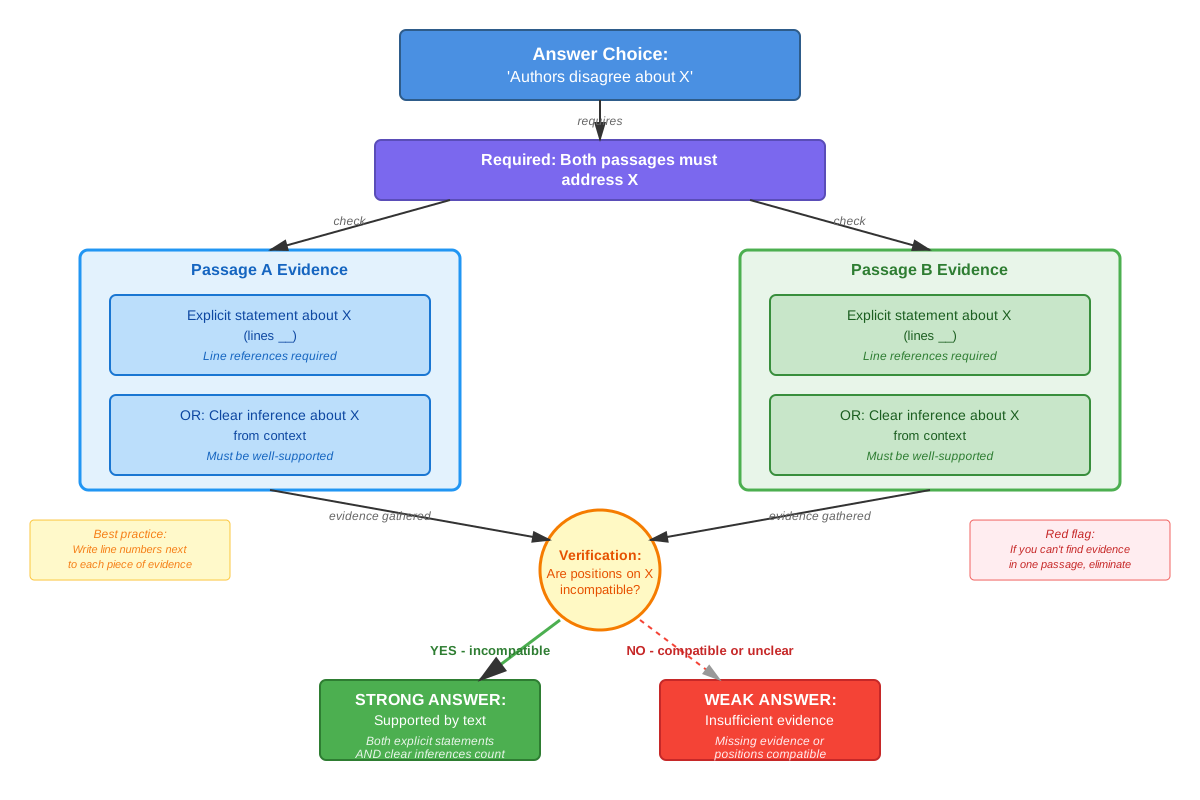
To support a claim of disagreement, test-takers must identify specific textual evidence from both passages. Vague impressions that authors "seem to disagree" are insufficient. Strong answers to disagreement questions can be defended by pointing to specific lines where Author A makes Claim X and specific lines where Author B makes a claim incompatible with X.
This evidence requirement explains why disagreement questions often include wrong answers describing positions that only one passage actually addresses. If Passage A never takes a position on Issue X, then the authors cannot disagree about Issue X, even if Passage B discusses it extensively.
Concept Relationships
The core concepts within disagreement analysis form an interconnected hierarchy. Defining genuine disagreement serves as the foundation—students must first understand what constitutes actual disagreement before they can identify it. This definition directly enables recognition of types of disagreement (factual, interpretive, evaluative, causal), which represent specific manifestations of the general principle.
Identifying disagreement markers provides the practical textual tools for locating disagreements within passages, connecting the abstract definition to concrete reading strategies. This skill works in tandem with distinguishing disagreement from other relationships, as recognizing what disagreement is requires simultaneously recognizing what it is not. These two concepts form complementary sides of the same analytical coin.
Scope precision requirements and evidence requirements function as quality-control mechanisms that refine and validate disagreement identification. They prevent false positives by ensuring that identified disagreements meet rigorous standards of specificity and textual support.
The relationship map flows as follows: Understanding genuine disagreement → Recognizing types of disagreement → Using textual markers to locate potential disagreements → Distinguishing genuine disagreement from other relationships → Applying scope precision to verify same-issue focus → Gathering textual evidence to confirm disagreement → Selecting correct answer.
This topic builds upon prerequisite knowledge of basic passage comprehension (understanding individual passage positions) and argument structure (recognizing claims and their relationships). It connects forward to more advanced comparative reading skills like synthesis questions and questions about how one author would respond to the other's reasoning.
High-Yield Facts
⭐ Disagreement requires incompatible positions on the same specific issue—different focuses or scopes do not constitute disagreement
⭐ Both passages must actually address the issue in question; if only one passage discusses it, no disagreement exists
⭐ Correct answers to disagreement questions can be supported by specific textual evidence from both passages
⭐ Authors can agree on facts but disagree on interpretation, causation, or evaluation
⭐ Explicit contradiction markers ("however," "contrary to," "in fact") often signal disagreement but are not required for disagreement to exist
- Disagreement questions frequently appear as "The authors would most likely disagree about which one of the following?"
- Wrong answers often describe positions that only one passage addresses or that represent different scopes rather than genuine disagreement
- Temporal, geographical, or contextual scope differences can prevent genuine disagreement even when positions seem opposite
- Disagreement about the significance or importance of an agreed-upon fact still constitutes genuine disagreement
- Authors who propose different solutions to the same problem disagree if their solutions are mutually exclusive but not if both could be implemented simultaneously
- Implicit disagreement (where positions are incompatible even without explicit contradiction) is as valid as explicit disagreement
- The strength of disagreement (mild vs. strong) is less important than whether disagreement exists at all
Quick check — test yourself on Disagreement between passages so far.
Try Flashcards →Common Misconceptions
Misconception: If two passages discuss the same general topic but emphasize different aspects, the authors disagree. → Correction: Disagreement requires incompatible positions on the same specific issue. Passages can discuss different aspects of a topic while holding entirely compatible views. For example, one passage praising the aesthetic qualities of architecture while another discusses its functional requirements does not create disagreement—both perspectives can be simultaneously valid.
Misconception: If one passage is positive about something and the other is negative, they automatically disagree. → Correction: Tone or overall attitude doesn't guarantee disagreement unless the passages make incompatible claims about the same specific aspect. A passage praising Feature X of a policy while another criticizes Feature Y of the same policy doesn't create disagreement about either feature—both assessments could be accurate.
Misconception: Authors disagree if they would recommend different courses of action. → Correction: Different recommendations constitute disagreement only if the recommendations are mutually exclusive or if one author would explicitly oppose the other's recommendation. Two authors might recommend different approaches to the same problem without disagreeing if both approaches could be valid or complementary.
Misconception: If Passage B doesn't mention a claim from Passage A, they don't disagree about it. → Correction: Disagreement can be implicit. If Passage A makes Claim X and Passage B makes a general claim that would necessarily exclude or contradict Claim X, disagreement exists even without explicit reference. However, mere silence doesn't constitute disagreement—Passage B must take a position incompatible with Passage A's claim.
Misconception: Disagreement questions always have obvious answers with clear textual support. → Correction: LSAT disagreement questions often test subtle distinctions and require careful analysis of scope and compatibility. The correct answer might involve synthesizing information from multiple parts of each passage to determine whether positions are truly incompatible.
Misconception: If passages discuss different time periods or contexts, any opposite-seeming claims represent disagreement. → Correction: Scope differences prevent disagreement. A claim about 18th-century practices and an opposite claim about 21st-century practices don't disagree—both can be true because they address different temporal scopes. The LSAT frequently exploits this misconception in wrong answer choices.
Worked Examples
Example 1: Scientific Theory Disagreement
Passage A argues that the extinction of megafauna in North America 12,000 years ago was primarily caused by climate change at the end of the last ice age. The passage presents evidence that temperature shifts altered vegetation patterns, reducing food sources for large herbivores. It acknowledges that human arrival in North America coincided with extinctions but argues this timing is coincidental rather than causal.
Passage B contends that human hunting was the primary cause of megafauna extinction in North America. The passage presents evidence that extinction rates correlate closely with human population expansion patterns and that similar climate changes in earlier periods did not produce comparable extinctions. It acknowledges climate change occurred but argues it was insufficient to cause extinctions without human hunting pressure.
Question: The authors would be most likely to disagree about which one of the following?
Analysis Process:
- Identify each passage's main position: Passage A attributes extinctions primarily to climate change; Passage B attributes them primarily to human hunting.
- Determine if positions are incompatible: Yes—both passages discuss the same phenomenon (North American megafauna extinction 12,000 years ago) and offer mutually exclusive primary causes. If climate change was the primary cause, human hunting was not, and vice versa.
- Check scope alignment: Both passages address the same extinctions in the same location during the same time period—scope is perfectly aligned.
- Locate specific textual evidence: Passage A explicitly states climate change was the "primary" cause and human arrival was "coincidental." Passage B explicitly states human hunting was the "primary" cause and climate change was "insufficient" alone.
- Formulate the disagreement: The authors disagree about whether climate change or human hunting was the primary cause of North American megafauna extinction 12,000 years ago.
Correct Answer Type: "Whether climate change was sufficient to cause the extinction of North American megafauna 12,000 years ago"
Why this works: Passage A would answer "yes" (climate change was sufficient), while Passage B would answer "no" (climate change was insufficient without human hunting). This represents genuine disagreement on a specific, shared issue.
Wrong Answer to Avoid: "Whether climate change occurred at the end of the last ice age"—Both passages acknowledge climate change occurred, so no disagreement exists on this point. This represents agreed-upon background fact, not a point of contention.
Example 2: Legal Interpretation Disagreement
Passage A discusses the legal doctrine of "fair use" in copyright law, arguing that courts should interpret fair use broadly to promote innovation and free expression. The passage contends that overly restrictive interpretations stifle creativity and that the social benefits of broad fair use outweigh potential economic harm to copyright holders. It provides examples of transformative works that should qualify as fair use.
Passage B examines fair use doctrine from the perspective of content creators' economic rights. The passage argues that broad fair use interpretations undermine the economic incentives that copyright protection is designed to provide. It contends that without strong economic protection, professional content creation becomes unsustainable. The passage acknowledges that some uses should qualify as fair use but argues courts have expanded the doctrine too far.
Question: The author of Passage B would be most likely to agree with which one of the following statements about the position taken in Passage A?
Analysis Process:
- Identify Passage A's position: Courts should interpret fair use broadly; social benefits outweigh economic harm to copyright holders.
- Identify Passage B's position: Fair use has been expanded too far; economic protection for creators is essential and currently insufficient.
- Determine the disagreement: The passages disagree about whether fair use should be interpreted broadly or more restrictively, and they disagree about the relative weight of social benefits versus economic protection for creators.
- Consider how Passage B would respond to Passage A: Passage B would likely argue that Passage A undervalues the economic harm to creators and overestimates the social benefits of broad fair use, or that Passage A's position would lead to unsustainable conditions for professional content creation.
- Check for scope alignment: Both passages discuss the same legal doctrine (fair use) and address how broadly it should be interpreted—scope is aligned.
Correct Answer Type: "It fails to give adequate consideration to the economic interests of content creators"
Why this works: This directly reflects Passage B's core concern (economic protection for creators) and identifies what Passage B would see as a flaw in Passage A's reasoning (prioritizing social benefits over economic protection). Passage B explicitly argues that economic incentives are essential, which contradicts Passage A's position that social benefits outweigh economic concerns.
Wrong Answer to Avoid: "It incorrectly assumes that fair use doctrine exists"—Both passages accept that fair use doctrine exists; they disagree about how it should be interpreted, not whether it exists. This would misidentify the level at which disagreement occurs.
Exam Strategy
When approaching disagreement between passages questions on the LSAT, employ a systematic process that minimizes errors and maximizes efficiency within the time constraints of reading comprehension sections.
Pre-question preparation: While reading the paired passages initially, actively note points where the passages take opposite or incompatible positions. Mark these locations physically (if testing on paper) or mentally catalog them. Pay special attention to moments when Passage B explicitly contradicts claims or uses language like "however," "contrary to," or "in fact"—these often signal disagreement points.
Question stem recognition: Disagreement questions typically use phrases like "disagree about," "would be most likely to dispute," "would reject," or "would respond by challenging." Recognize these stems immediately and activate your disagreement analysis framework.
Answer choice evaluation process:
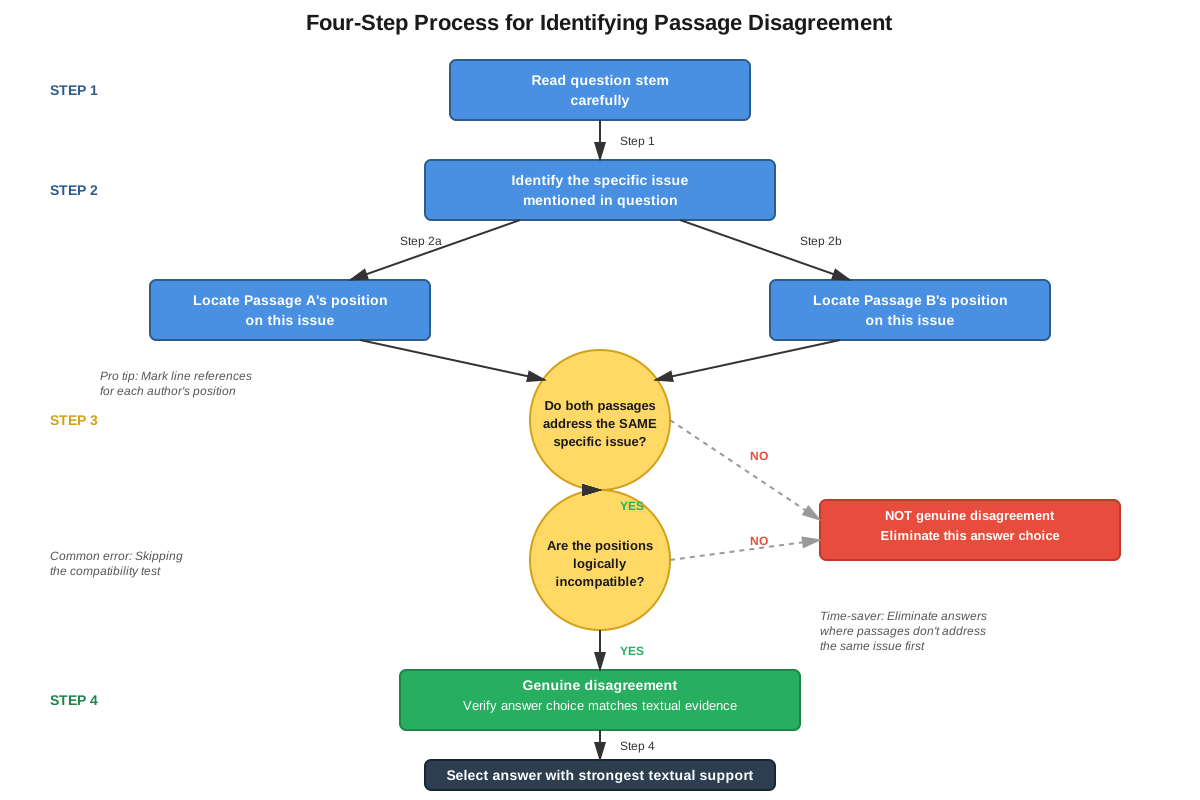
- First pass—Scope check: Eliminate any answer choice that describes an issue only one passage addresses. If Passage A never discusses Topic X, the authors cannot disagree about Topic X.
- Second pass—Compatibility check: For remaining choices, ask "Could both passages' positions on this issue be true simultaneously?" If yes, eliminate—that's difference in focus, not disagreement.
- Third pass—Evidence check: For remaining choices, locate specific textual support in both passages. The correct answer must be defensible by pointing to specific lines in each passage.
- Final verification: Confirm that the answer describes positions on the same specific issue with aligned scope. Verify that the positions are genuinely incompatible.
Trigger words in answer choices: Watch for scope qualifiers like "all," "some," "never," "always," "primarily," and "sufficient." These words often determine whether positions are actually incompatible. "X is sometimes effective" and "X is not always effective" are compatible, not disagreeing positions.
Time allocation: Disagreement questions typically require 60-90 seconds—slightly more than main idea questions but less than complex inference questions. If you find yourself spending more than 90 seconds, you may be overthinking. Return to the basic question: "Do these passages make incompatible claims about the same specific thing?"
Process of elimination power: Wrong answers to disagreement questions usually fall into predictable categories: (1) issues only one passage addresses, (2) compatible positions mischaracterized as disagreement, (3) scope mismatches, (4) background facts both passages accept, or (5) extreme positions neither passage actually takes. Recognizing these patterns accelerates elimination.
Exam Tip: If you're torn between two answer choices, check whether one describes a more specific issue than the other. The LSAT typically rewards precision—the correct answer usually identifies disagreement at a specific, concrete level rather than a vague, general level.
Memory Techniques
SCOPE Acronym for disagreement verification:
- Same issue (not just same general topic)
- Contradictory positions (incompatible, not just different)
- Opposite claims (what one affirms, the other denies)
- Passage evidence (specific textual support from both)
- Exclusivity (both positions cannot be true together)
The "Debate Test" Visualization: Imagine the two authors in a debate. If they would actually argue with each other about the issue in the answer choice—with one saying "yes" and the other saying "no" to the same specific question—that's genuine disagreement. If they would talk past each other, discussing different aspects without actually contradicting each other, that's not disagreement.
The "Both True?" Quick Check: For any potential disagreement, ask "Could both passages' positions on this be true at the same time?" If the answer is yes, it's not disagreement. This simple test eliminates many wrong answers quickly.
Disagreement Type Mnemonic—FICE:
- Factual (disputing what is true)
- Interpretive (disputing what facts mean)
- Causal (disputing cause-effect relationships)
- Evaluative (disputing value judgments)
Remembering these categories helps you recognize disagreement even when it's not explicitly signaled by contradiction markers.
The Scope Boundary Visualization: Picture each passage's claims as having boundaries defined by time, place, context, and specificity. Disagreement only occurs when these boundaries overlap and the claims within that overlap are incompatible. If the boundaries don't overlap (different time periods, different contexts, different levels of specificity), no disagreement exists regardless of how opposite the claims seem.
Summary
Disagreement between passages represents a sophisticated analytical skill central to LSAT comparative reading success. Genuine disagreement requires that passages make incompatible claims about the same specific issue—positions that cannot both be true simultaneously. This differs fundamentally from passages that merely emphasize different aspects of a topic or discuss related but distinct issues. The LSAT tests whether students can distinguish genuine disagreement from other relationships including different focus, different scope, and complementary perspectives. Success requires precise attention to scope alignment, ensuring both passages actually address the identical issue at the same level of specificity. Students must support disagreement claims with specific textual evidence from both passages, avoiding vague impressions or assumptions about what authors might believe. Disagreement manifests in multiple forms—factual, interpretive, causal, and evaluative—each requiring recognition of incompatibility within its domain. Mastering this topic demands systematic analysis: identifying each passage's position, verifying scope alignment, confirming incompatibility, and locating supporting evidence. This skill directly translates to legal practice, where attorneys must identify genuine points of contention in competing arguments while avoiding false disputes based on scope differences or misunderstanding.
Key Takeaways
- Disagreement requires incompatible positions on the same specific issue with aligned scope—different focuses or emphases do not constitute disagreement
- Both passages must actually address the issue; if only one passage discusses it, no disagreement exists regardless of what the other passage might imply
- Correct answers to disagreement questions must be supported by specific textual evidence from both passages showing incompatible positions
- Authors can agree on facts while disagreeing on interpretation, causation, significance, or evaluation—disagreement operates at multiple levels
- Scope precision is critical: temporal, geographical, contextual, or specificity differences can prevent genuine disagreement even when positions seem opposite
- The "Could both be true?" test quickly eliminates answer choices describing compatible positions mischaracterized as disagreement
- Systematic analysis (identify positions → verify scope → confirm incompatibility → locate evidence) prevents common errors and improves accuracy under time pressure
Related Topics
Agreement and Similarity Between Passages: Understanding what passages share in common provides the complementary skill to disagreement identification. Mastering disagreement enables better recognition of genuine agreement versus superficial similarity, as both require precise scope analysis and attention to what passages actually claim versus what they merely discuss.
Author Response and Critique Questions: These questions ask how one author would respond to the other's argument or reasoning. Disagreement identification forms the foundation for these questions, as understanding where authors disagree enables prediction of how they would critique each other's positions.
Synthesis and Relationship Questions: More complex comparative reading questions require synthesizing information from both passages or describing their overall relationship. Mastering disagreement identification is essential for these questions because recognizing where passages diverge versus where they align enables accurate characterization of their relationship.
Argument Structure in Reading Comprehension: Understanding how authors construct arguments, provide evidence, and draw conclusions enhances disagreement identification by clarifying exactly what claims each passage makes and at what level of generality or specificity.
Practice CTA
Now that you've mastered the conceptual framework for identifying disagreement between passages, it's time to apply these skills to authentic LSAT questions. The practice questions and flashcards will reinforce your ability to distinguish genuine disagreement from other relationships, verify scope alignment, and select correct answers with confidence. Remember that disagreement identification is a skill that improves dramatically with deliberate practice—each question you analyze strengthens your pattern recognition and analytical precision. Approach the practice materials systematically, using the SCOPE framework and the strategies outlined in this guide. Your investment in mastering this high-yield topic will pay dividends not only on test day but throughout your legal education and career.
Sign up free to keep reading
Create a free AnvayaPrep account to finish this LSAT guide on Disagreement between passages — plus flashcards and practice questions.