Overview
Passage pair mapping is a critical skill within the LSAT's Reading Comprehension section, specifically appearing in the comparative reading format. Since 2007, the LSAT has consistently included one comparative reading set in each Reading Comprehension section, presenting test-takers with two shorter passages (Passage A and Passage B) that address related topics from different perspectives, methodologies, or argumentative stances. Rather than treating these passages as isolated texts, successful test-takers must develop the ability to map the relationship between the passages—identifying points of agreement, disagreement, complementary information, and contrasting approaches.
The essence of lsat passage pair mapping lies in creating a mental or notational framework that captures how the two passages interact. This involves more than simply understanding each passage independently; it requires synthesizing information across both texts to answer questions about their relationship. Test-takers must track which author would agree or disagree with specific claims, how one passage's evidence relates to the other's argument, and where the passages diverge in scope, tone, or conclusion. This comparative analysis mirrors the type of critical thinking required in legal education, where attorneys must frequently evaluate competing arguments, reconcile different interpretations of law, and identify subtle distinctions between similar positions.
Within the broader landscape of reading comprehension skills, passage pair mapping represents an advanced application of fundamental analytical abilities. It builds upon core competencies like identifying main ideas, recognizing argumentative structure, and understanding authorial purpose, but adds an additional layer of complexity by requiring simultaneous consideration of multiple perspectives. Mastering this topic directly impacts performance on approximately 15-20% of all Reading Comprehension questions on the LSAT, making it a high-yield area for focused study and practice.
Learning Objectives
- [ ] Identify how Passage pair mapping appears in LSAT questions
- [ ] Explain the reasoning pattern behind Passage pair mapping
- [ ] Apply Passage pair mapping to solve LSAT-style problems accurately
- [ ] Construct a systematic comparison framework while reading paired passages
- [ ] Distinguish between five types of passage relationships (agreement, disagreement, complementary, contrasting scope, and different methodology)
- [ ] Predict which comparative question types will appear based on passage relationship patterns
- [ ] Evaluate answer choices by testing them against both passages simultaneously
Prerequisites
- Basic passage comprehension skills: Understanding main ideas, supporting details, and paragraph structure is essential because passage pair mapping builds upon the ability to extract meaning from individual texts before comparing them.
- Argument structure recognition: Identifying premises, conclusions, and evidence types enables test-takers to map how arguments in one passage relate to those in another.
- Tone and purpose identification: Recognizing authorial attitude and intent provides the foundation for understanding why two authors might approach the same topic differently.
- Standard Reading Comprehension question types: Familiarity with main idea, inference, and function questions helps because comparative questions often combine these question types with relational analysis.
Why This Topic Matters
In legal practice, attorneys constantly engage in comparative analysis—evaluating competing precedents, reconciling different statutory interpretations, and synthesizing multiple expert opinions. The LSAT's comparative reading format directly assesses this essential legal skill, making passage pair mapping not merely an exam technique but a preview of law school and professional demands. Law students regularly encounter casebooks presenting majority and dissenting opinions, requiring the same analytical framework tested in paired passages.
From an exam perspective, comparative reading appears with absolute consistency on the LSAT. Every Reading Comprehension section contains exactly one comparative reading set, comprising two shorter passages (typically 200-300 words combined) followed by 5-7 questions. Approximately 60-70% of questions in each comparative set explicitly test the relationship between passages, asking test-takers to identify points of agreement or disagreement, compare argumentative strategies, or determine how one author would respond to the other's claims. The remaining questions typically ask about individual passages but still benefit from comparative understanding.
Common manifestations in LSAT passages include: scientific debates where two researchers propose different explanations for the same phenomenon; legal or philosophical arguments where authors defend opposing positions on a normative question; historical analyses where scholars emphasize different aspects of the same event; and methodological discussions where authors advocate for different approaches to studying a subject. The passages may present direct rebuttals, complementary perspectives that address different aspects of a topic, or parallel arguments that reach similar conclusions through different reasoning paths.
Core Concepts
The Comparative Reading Framework
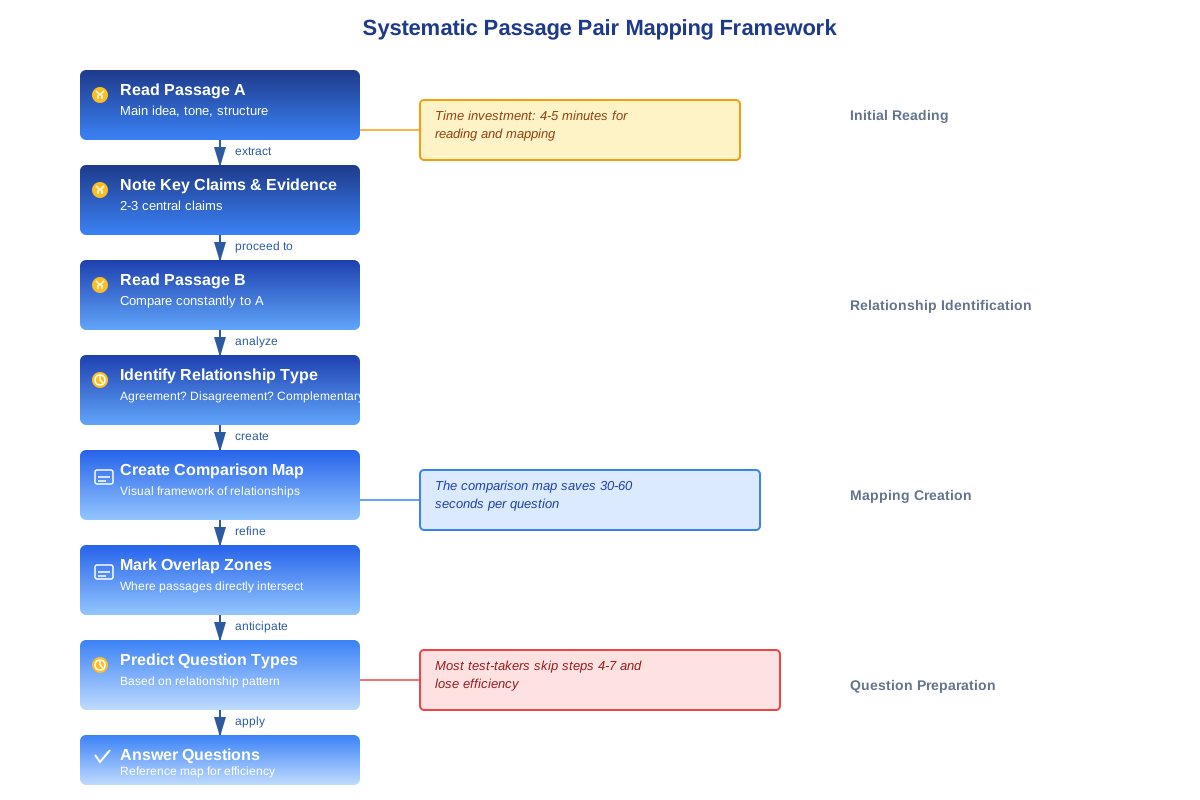
The foundation of effective passage pair mapping rests on a systematic approach to reading and annotating paired passages. Unlike single-passage reading, where the goal is comprehensive understanding of one text, comparative reading requires building a relational framework from the first sentence. Successful test-takers develop a three-phase process: first, quickly identifying the topic and scope of Passage A; second, reading Passage B with explicit attention to how it relates to Passage A; and third, consolidating the relationship before approaching questions.
During the initial reading of Passage A, test-takers should note the main point, key evidence, and authorial tone using the same strategies employed for standard passages. However, the critical difference emerges when beginning Passage B. Rather than treating it as a fresh start, skilled readers actively ask: "How does this relate to what I just read? Does this author agree or disagree? Is this addressing the same question or a different aspect?" This active comparison during reading—not after—dramatically improves accuracy and efficiency.
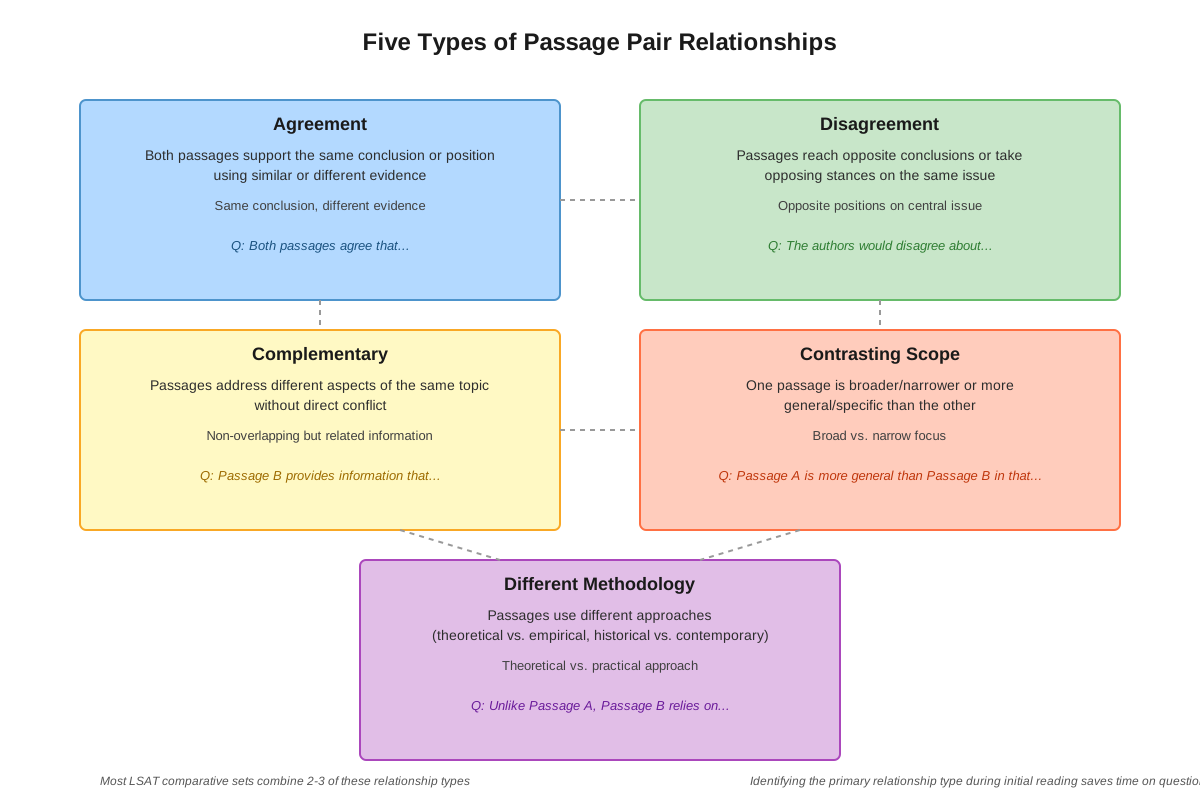
Five Core Relationship Types
Passage pair mapping requires recognizing that paired passages fall into predictable relationship patterns. Understanding these patterns enables test-takers to anticipate question types and organize their comparative analysis effectively.
| Relationship Type | Characteristics | Common Question Focus |
|---|---|---|
| Direct Disagreement | Authors take opposing positions on the same question | Points of disagreement, how one author would critique the other |
| Complementary Perspectives | Authors address different aspects of the same topic without conflict | How passages together provide fuller understanding, what each contributes |
| Methodological Contrast | Authors agree on goals but advocate different approaches | Comparison of methods, advantages/disadvantages of each approach |
| Scope Variation | One passage addresses a subset or broader version of the other's topic | Relationship between specific and general, what one passage addresses that the other doesn't |
| Qualified Agreement | Authors agree on main point but differ on details, emphasis, or implications | Nuanced points of agreement/disagreement, degree of support |
Identifying the relationship type early in the reading process provides a mental framework for organizing information. For instance, recognizing a direct disagreement pattern alerts the test-taker to track specific claims where authors diverge, while identifying complementary perspectives suggests focusing on what unique contribution each passage makes.
Mapping Points of Agreement and Disagreement
The most frequently tested aspect of lsat passage pair mapping involves identifying specific points where authors agree or disagree. This requires precision—test-takers must distinguish between explicit statements, implied positions, and topics the passages don't address. A common error involves assuming disagreement where passages simply emphasize different points without actually contradicting each other.
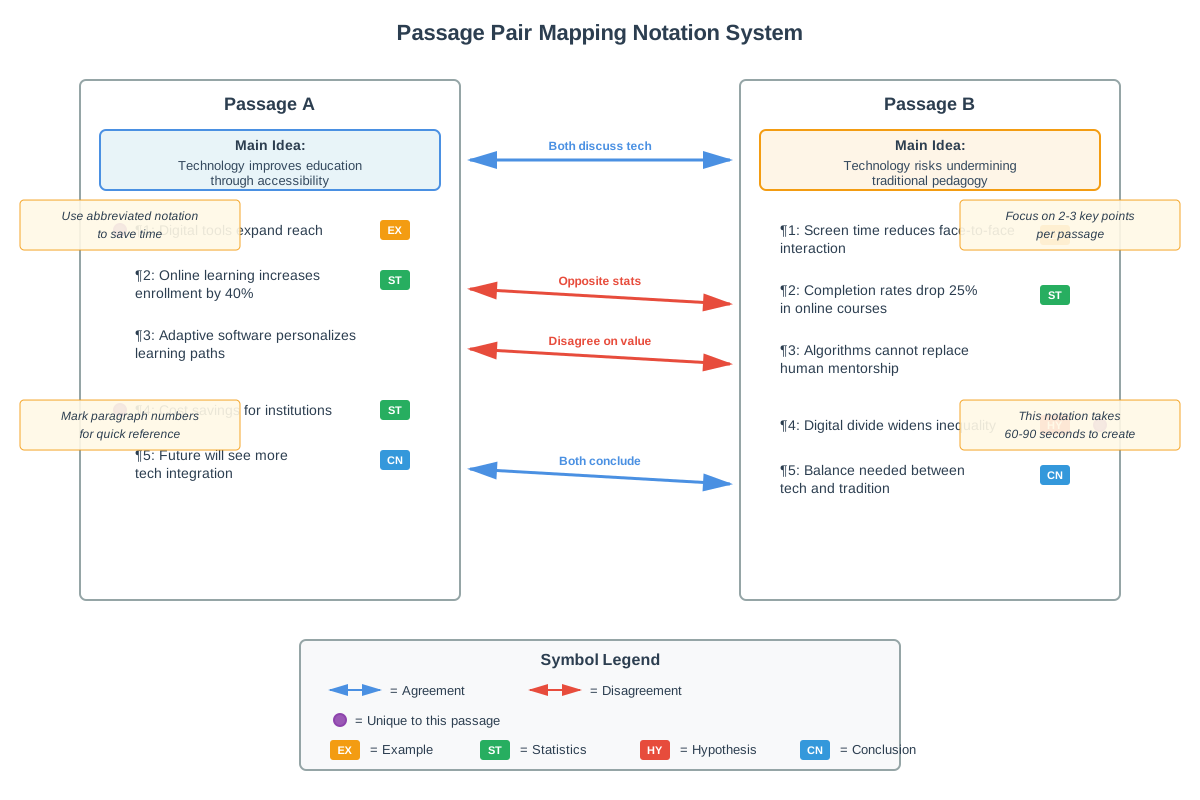
Effective mapping involves creating mental or notational categories:
- Explicit agreements: Claims both authors directly state or clearly support
- Explicit disagreements: Claims where authors take opposing positions
- Implied positions: Views that follow logically from each author's argument even if not directly stated
- Unaddressed topics: Issues one or both passages don't discuss (crucial for eliminating wrong answers)
For example, if Passage A argues that economic factors primarily drove a historical event while Passage B emphasizes political motivations, the passages disagree on primary causation. However, they might implicitly agree that the event had multiple causes, even though neither explicitly states this. Distinguishing these levels of agreement and disagreement separates high-scoring test-takers from those who struggle with comparative questions.
Tracking Authorial Response Patterns
A sophisticated element of passage pair mapping involves predicting how one author would respond to the other's claims—a frequent question type in comparative reading. This requires understanding not just what each author says, but the underlying reasoning and values that inform their positions. Test-takers must extrapolate from explicit statements to probable responses.
The key to this skill lies in identifying each author's core commitments—the fundamental assumptions, values, or methodological principles that drive their argument. When asked how Author A would respond to a claim in Passage B, the correct answer typically aligns with Author A's core commitments. For instance, if Author A consistently emphasizes empirical evidence while Author B relies on theoretical reasoning, Author A would likely critique any unsupported theoretical claim in Passage B, even if the specific claim wasn't addressed in Passage A.
Comparative Scope and Detail Analysis
Paired passages frequently differ in scope—one might address a general principle while the other examines a specific application, or one might provide historical context while the other focuses on contemporary implications. Recognizing these scope variations helps test-takers answer questions about what each passage addresses, what information appears in only one passage, and how the passages relate hierarchically.
Detail tracking becomes more complex in comparative reading because test-takers must remember not only what information appears but where it appears. A common wrong answer type presents information from Passage A as if it came from Passage B, or vice versa. Effective passage pair mapping includes noting which passage provides specific evidence, examples, or arguments—often through simple marginal notations like "A: example" or "B: evidence."
Synthesis and Integration Questions
Beyond identifying agreements and disagreements, some comparative questions require synthesizing information across both passages to reach a conclusion neither passage explicitly states. These questions test whether test-takers can integrate complementary information or recognize how evidence from one passage might support or undermine claims in the other.
For example, if Passage A describes a problem and Passage B proposes a solution without mentioning the problem, a synthesis question might ask whether Passage B's solution would address Passage A's problem. Answering requires understanding both passages deeply enough to evaluate their implicit relationship. This question type rewards test-takers who build genuine comparative understanding rather than simply cataloging surface-level similarities and differences.
Concept Relationships
The concepts within passage pair mapping form an interconnected system where each element supports and enhances the others. The Comparative Reading Framework serves as the foundational methodology that enables all other concepts. This framework → leads to → systematic identification of Relationship Types, which provides the organizational structure for analysis. Understanding relationship types → enables → more effective Mapping of Agreement and Disagreement, because recognizing the overall pattern helps predict where specific points of convergence or divergence will appear.
The ability to map agreements and disagreements → directly supports → Tracking Authorial Response Patterns, since predicting how one author would respond requires knowing where their positions align or conflict. Both of these skills → feed into → Comparative Scope and Detail Analysis, which adds precision by tracking not just what each author says but the level of generality and specific evidence they provide. Finally, all previous concepts → culminate in → successfully answering Synthesis and Integration Questions, which represent the highest level of comparative analysis.
These concepts connect to prerequisite topics through clear dependencies. Basic passage comprehension provides the raw material that passage pair mapping organizes comparatively. Argument structure recognition enables identification of how one author's premises might challenge another's conclusions. Tone and purpose identification helps predict authorial responses and recognize when passages approach topics from fundamentally different perspectives.
Looking forward, mastering passage pair mapping prepares students for advanced Reading Comprehension skills like evaluating complex argumentative structures and recognizing subtle rhetorical strategies, since comparative reading requires heightened attention to how authors construct and position their arguments.
High-Yield Facts
⭐ Every LSAT Reading Comprehension section contains exactly one comparative reading set with two shorter passages followed by 5-7 questions.
⭐ Approximately 60-70% of comparative reading questions explicitly test the relationship between passages rather than asking about passages individually.
⭐ The five core relationship types are: direct disagreement, complementary perspectives, methodological contrast, scope variation, and qualified agreement.
⭐ Questions asking how one author would respond to the other's claims require identifying each author's core commitments and reasoning patterns, not just their explicit statements.
⭐ Wrong answers in comparative questions frequently present information from one passage as if it came from the other, making source tracking essential.
- Passages may agree on a general principle while disagreeing on specific applications or implications.
- Silence on a topic is not disagreement—if one passage doesn't address an issue, the authors don't necessarily disagree about it.
- Comparative questions often include "both passages" answer choices that require verifying the claim against each passage independently.
- The relationship between passages typically becomes clearer in the second and third paragraphs rather than the opening sentences.
- Effective passage pair mapping during reading saves more time than it costs, reducing the need to re-read when answering questions.
- Tone differences between passages often signal deeper disagreements about methodology or values, even when surface-level claims seem compatible.
- Questions about what "both authors would agree" typically have answers that are more general or qualified than claims either author explicitly makes.
Quick check — test yourself on Passage pair mapping so far.
Try Flashcards →Common Misconceptions
Misconception: If two passages discuss the same topic, they must disagree about it. → Correction: Passages can address the same topic from complementary perspectives without contradicting each other. They might examine different aspects, time periods, or implications of the same subject. Disagreement requires opposing positions on the same specific question, not merely different emphases.
Misconception: The correct answer to "both authors would agree" questions must be explicitly stated in both passages. → Correction: Agreement questions often require identifying positions that both authors would logically support based on their arguments, even if neither explicitly states the exact claim. The correct answer must be consistent with and inferable from both passages, but need not be directly quoted from either.
Misconception: Longer passages contain more important information than shorter ones in comparative sets. → Correction: Passage length in comparative reading reflects the complexity of the argument or amount of detail provided, not importance. Both passages receive equal weight in questions, and shorter passages often contain highly concentrated, essential information.
Misconception: Reading Passage B first is more efficient because it's usually more recent or advanced. → Correction: The LSAT deliberately orders passages to create a logical reading sequence. Passage A typically provides context, background, or a position that Passage B responds to, builds upon, or contrasts with. Reading out of order disrupts this intentional structure and makes relationship identification more difficult.
Misconception: If one author would disagree with a claim in the other passage, they must disagree about everything. → Correction: Authors can disagree on specific points while agreeing on others. Effective passage pair mapping requires tracking multiple dimensions of agreement and disagreement simultaneously. A nuanced understanding recognizes that authors might agree on problems while disagreeing on solutions, or agree on goals while disagreeing on methods.
Misconception: Comparative reading questions are inherently harder than single-passage questions. → Correction: While comparative questions add relational complexity, they often provide more context and constraints that can make answers easier to identify. Having two passages means more information to work with, and relationship questions often have clear textual support. The key is systematic mapping rather than trying to hold everything in memory.
Worked Examples
Example 1: Direct Disagreement Pattern
Passage A (abbreviated): Archaeological evidence suggests that ancient Civilization X developed writing independently around 1500 BCE. The unique character system bears no resemblance to neighboring cultures' scripts, and the earliest examples appear suddenly in the archaeological record without precursors. This supports the theory that writing systems can emerge independently when societies reach sufficient complexity.
Passage B (abbreviated): Recent discoveries challenge the independence theory for Civilization X's writing. Newly excavated trade goods from 1600 BCE show symbols that appear to be transitional forms between Civilization Y's script and Civilization X's writing system. The "sudden appearance" cited by independence theorists likely reflects gaps in the archaeological record rather than actual historical development. Cultural diffusion better explains writing system development than independent invention.
Question: The authors would be most likely to disagree about whether:
(A) Civilization X developed a writing system around 1500 BCE
(B) Archaeological evidence can definitively prove theories about ancient writing
(C) Civilization X's writing system developed without influence from other cultures
(D) Writing systems require societies to reach a certain level of complexity
(E) Trade occurred between Civilization X and neighboring cultures
Worked Solution:
Step 1: Identify the relationship type. These passages present direct disagreement about the origin of Civilization X's writing—Author A argues for independent development, while Author B argues for cultural diffusion.
Step 2: Map specific points of agreement and disagreement.
- Both agree: Civilization X had a writing system around 1500 BCE (mentioned by both)
- Disagree: Whether the system developed independently (A's main claim) vs. through cultural influence (B's main claim)
- Disagree: Whether the "sudden appearance" indicates independent invention (A's interpretation) vs. gaps in evidence (B's interpretation)
Step 3: Evaluate each answer choice against both passages.
(A) Both passages accept this dating—no disagreement. Eliminate.
(B) Neither passage directly addresses what archaeological evidence can "definitively prove" in general. This is too broad. Eliminate.
(C) This directly captures the core disagreement. Author A explicitly argues the writing developed "independently" with "no resemblance to neighboring cultures' scripts." Author B explicitly challenges "the independence theory" and argues "cultural diffusion better explains" the development. This is the answer.
(D) Author A mentions this, but Author B doesn't address societal complexity requirements. Silence isn't disagreement. Eliminate.
(E) Author B mentions trade goods, but Author A doesn't deny trade occurred—only that writing was independently developed. They could both agree trade occurred without writing influence. Eliminate.
Answer: (C)
Connection to Learning Objectives: This example demonstrates how to identify passage pair mapping in questions (the "disagree about whether" format), explains the reasoning pattern (mapping specific agreements vs. disagreements), and applies the framework to solve accurately.
Example 2: Complementary Perspectives with Synthesis
Passage A (abbreviated): Urban gardens provide measurable environmental benefits to cities. Studies show they reduce ambient temperature by 2-5 degrees Fahrenheit in surrounding blocks, decrease stormwater runoff by absorbing precipitation, and improve air quality by filtering pollutants. A single community garden can process several tons of CO2 annually while producing oxygen.
Passage B (abbreviated): The social benefits of urban gardens often exceed their environmental impact. Community gardens create spaces for intergenerational interaction, reduce social isolation among elderly residents, and provide educational opportunities for children. Neighborhoods with active community gardens report 25% higher social cohesion scores and increased civic participation. The gardens serve as catalysts for community organization around other local issues.
Question: Based on the two passages, urban gardens can best be described as:
(A) Primarily valuable for their environmental rather than social contributions
(B) More effective at building community than providing measurable ecological benefits
(C) Multifaceted resources that address both environmental and social urban challenges
(D) Controversial interventions whose costs may outweigh their benefits
(E) Temporary solutions that fail to address underlying urban problems
Worked Solution:
Step 1: Identify the relationship type. These passages present complementary perspectives—each addresses different benefits of urban gardens without contradicting the other. Passage A focuses on environmental benefits; Passage B focuses on social benefits.
Step 2: Recognize this as a synthesis question. The question asks about urban gardens generally "based on the two passages," requiring integration of both perspectives rather than identifying agreement or disagreement.
Step 3: Evaluate answers by checking consistency with both passages.
(A) This contradicts Passage B, which argues social benefits "often exceed" environmental impact. Eliminate.
(B) This contradicts Passage A, which provides specific environmental measurements. The word "more" creates a comparison neither passage makes—they emphasize different aspects without ranking them. Eliminate.
(C) This synthesizes both passages accurately. "Multifaceted" acknowledges that gardens provide multiple types of benefits. "Both environmental and social" captures the focus of each passage. "Urban challenges" encompasses both passages' contexts. This integrates the complementary information without distorting either passage.
(D) Neither passage discusses controversy or costs outweighing benefits. Both are entirely positive about urban gardens. Eliminate.
(E) Neither passage characterizes gardens as "temporary" or suggests they "fail to address underlying problems." Both present gardens as providing genuine benefits. Eliminate.
Answer: (C)
Connection to Learning Objectives: This example shows how passage pair mapping appears in synthesis questions, explains the reasoning pattern of integrating complementary information, and demonstrates accurate application by testing each answer against both passages simultaneously.
Exam Strategy
When approaching comparative reading questions, implement a systematic process that leverages passage pair mapping from the initial reading through answer selection. Begin by reading Passage A with standard comprehension strategies—identify the main point, note key evidence, and recognize the author's tone. However, before moving to Passage B, take 5-10 seconds to mentally summarize Passage A's core claim in a single sentence. This brief pause creates a clear reference point for comparative analysis.
While reading Passage B, actively engage in real-time comparison. After each paragraph, ask: "Does this agree or disagree with Passage A? Does this address the same question or a different aspect?" Make brief marginal notes indicating relationship markers: "agrees w/ A," "different focus," "contradicts A's claim about X." This active mapping during reading—not after—dramatically improves accuracy on relationship questions while actually saving time by reducing the need for re-reading.
Trigger words and phrases that signal comparative questions include:
- "both passages" or "both authors"
- "the author of Passage B would most likely respond to Passage A by"
- "unlike Passage A, Passage B"
- "the two passages differ in that"
- "which one of the following is discussed in Passage B but not in Passage A"
- "the authors would be most likely to agree/disagree about"
When these triggers appear, immediately activate your passage pair map. For "both passages" questions, verify that the answer is supported by each passage independently—a claim supported by only one passage is wrong regardless of how strongly that passage supports it. For "author response" questions, focus on the responding author's core commitments and reasoning patterns rather than searching for explicit statements about the specific claim.
Process-of-elimination strategies specific to comparative reading:
- Source verification: Eliminate answers that attribute information to the wrong passage. If an answer claims "Passage A states X" but X appears only in Passage B, eliminate immediately.
- Silence test: For agreement/disagreement questions, eliminate answers about topics one or both passages don't address. Silence isn't agreement or disagreement.
- Degree matching: Comparative answers often include qualifiers like "primarily," "most important," or "exclusively." Verify that both passages support not just the basic claim but also the degree or emphasis the answer suggests.
- Relationship consistency: Eliminate answers that mischaracterize the passage relationship. If passages are complementary, answers suggesting direct contradiction are wrong.
Time allocation: Spend approximately 3.5-4 minutes reading both passages with active mapping, then 5-6 seconds per question. The comparative set should take 8-9 minutes total. The shorter combined length of paired passages (compared to single long passages) is offset by the additional complexity of relationship questions, resulting in similar time requirements. Invest the time in careful initial reading with active comparison—rushing through the passages to "save time" for questions invariably backfires because relationship questions require re-reading without a clear comparative framework.
Memory Techniques
GRADE - A mnemonic for the five core relationship types:
- General vs. specific (scope variation)
- Rebuttal (direct disagreement)
- Approach differences (methodological contrast)
- Different aspects (complementary perspectives)
- Except for details (qualified agreement)
The Two-Column Visualization: When reading paired passages, visualize a two-column table in your mind with "Passage A" and "Passage B" as headers. As you read, mentally place information in the appropriate column. When you encounter a relationship point (agreement, disagreement, or complementary information), visualize a connecting line or arrow between the columns. This spatial organization helps retrieve information during questions and prevents source confusion.
The "Would They Shake Hands?" Test: For quickly assessing the overall relationship, imagine the two authors meeting. Would they shake hands and agree? (complementary or qualified agreement) Would they shake hands but then debate? (methodological contrast or qualified agreement) Would they refuse to shake hands? (direct disagreement) This anthropomorphization creates an emotional memory anchor that helps recall the relationship type.
ABC - Always Be Comparing: This simple acronym reminds test-takers that comparative reading requires active comparison throughout the reading process, not just when answering questions. Repeat "ABC" mentally when transitioning from Passage A to Passage B to trigger comparative reading mode.
The Scope Spectrum: Visualize a horizontal line representing scope, with "specific/narrow" on the left and "general/broad" on the right. As you read each passage, mentally place it on this spectrum. This visualization immediately clarifies scope relationships and helps answer questions about what each passage addresses.
Summary
Passage pair mapping represents a sophisticated analytical skill that combines standard reading comprehension with relational analysis across two texts. Success requires recognizing that comparative reading isn't simply reading two passages sequentially, but rather building a systematic framework that captures how the passages interact. The five core relationship types—direct disagreement, complementary perspectives, methodological contrast, scope variation, and qualified agreement—provide organizational structures for this analysis. Effective passage pair mapping involves active comparison during reading, precise tracking of agreements and disagreements, understanding each author's core commitments to predict responses, and careful attention to which passage provides specific information. The skill directly impacts performance on 15-20% of Reading Comprehension questions and appears with absolute consistency on every LSAT. Mastery requires moving beyond surface-level similarity identification to deep understanding of how arguments, evidence, and perspectives relate across texts—a fundamental legal reasoning skill that the LSAT accurately assesses through comparative reading.
Key Takeaways
- Every LSAT Reading Comprehension section contains exactly one comparative reading set, making passage pair mapping a guaranteed high-yield topic for test preparation.
- Active comparison during reading—not after—is essential; build your relational framework while reading Passage B by constantly asking how it relates to Passage A.
- The five relationship types (direct disagreement, complementary perspectives, methodological contrast, scope variation, qualified agreement) provide predictable patterns that help organize comparative analysis and anticipate question types.
- Most comparative questions test relationships between passages rather than individual passage content; approximately 60-70% explicitly ask about agreements, disagreements, or how authors would respond to each other.
- Silence on a topic is not disagreement—distinguish between explicit contradictions, different emphases on the same topic, and addressing entirely different aspects of a subject.
- Track not just what information appears but where it appears; source confusion (attributing Passage A information to Passage B or vice versa) is a common wrong answer trap.
- Predicting authorial responses requires understanding core commitments and reasoning patterns, not just explicit statements; extrapolate from what authors say to what they would likely think about related claims.
Related Topics
Advanced Argument Structure Analysis: Building on passage pair mapping, this topic explores complex argumentative relationships including nested arguments, conditional reasoning chains, and multi-layered rebuttals. Mastering passage pair mapping provides the foundation for tracking how complex arguments interact across texts.
Perspective and Tone Comparison: This advanced topic examines subtle differences in authorial attitude, rhetorical strategies, and implicit values that inform explicit arguments. The comparative framework developed through passage pair mapping enables more sophisticated analysis of how perspective shapes argumentation.
Synthesis and Integration in Legal Reasoning: Moving beyond the LSAT, this topic applies comparative analysis skills to legal contexts like reconciling precedents, synthesizing statutory provisions, and evaluating competing expert testimonies—direct applications of passage pair mapping in legal practice.
Multi-Source Evidence Evaluation: This topic extends comparative reading skills to situations involving three or more sources, requiring hierarchical organization of relationships and complex synthesis—skills that build directly on two-passage mapping competency.
Practice CTA
Now that you've built a comprehensive understanding of passage pair mapping, it's time to apply these concepts to actual LSAT-style passages and questions. The practice questions and flashcards accompanying this guide will challenge you to identify relationship types, map agreements and disagreements, and predict authorial responses under timed conditions. Remember that passage pair mapping is a skill that improves dramatically with deliberate practice—each comparative set you analyze strengthens your ability to recognize patterns and build efficient comparative frameworks. Approach the practice materials systematically, reviewing not just which answers are correct but why your mapping process led you to those answers. Your investment in mastering this high-yield topic will pay dividends on test day and throughout your legal education.
Sign up free to keep reading
Create a free AnvayaPrep account to finish this LSAT guide on Passage pair mapping — plus flashcards and practice questions.