Overview
Passage mapping is a strategic annotation and mental organization technique that transforms how test-takers interact with LSAT Reading Comprehension passages. Rather than passively reading through dense legal, scientific, and humanities texts, passage mapping involves actively tracking the structure, purpose, and key elements of each paragraph while reading. This skill enables students to quickly locate information, understand authorial intent, and navigate complex argumentative structures—all critical abilities for answering questions accurately and efficiently under timed conditions.
The LSAT Reading Comprehension section presents four passages (including one comparative reading set) with 5-8 questions each, totaling 27 questions that must be completed in 35 minutes. Without an effective passage mapping strategy, students often find themselves rereading entire passages to answer individual questions, wasting precious time and losing focus. LSAT passage mapping creates a mental and physical roadmap that allows test-takers to reference specific content locations, understand how ideas relate to one another, and predict question types before even looking at the questions themselves.
Within the broader context of passage fundamentals, passage mapping serves as the bridge between initial reading and question answering. It builds upon basic reading comprehension skills by adding a layer of strategic analysis that aligns perfectly with how the LSAT tests understanding. While other reading comprehension strategies focus on speed or vocabulary, passage mapping emphasizes structural awareness and purpose-driven reading—the exact skills that distinguish top scorers from average performers on this challenging section.
Learning Objectives
- [ ] Identify how passage mapping appears in LSAT questions
- [ ] Explain the reasoning pattern behind passage mapping
- [ ] Apply passage mapping to solve LSAT-style problems accurately
- [ ] Create effective passage maps using minimal notation within time constraints
- [ ] Distinguish between high-value and low-value information while reading
- [ ] Predict question types based on passage structure and emphasis
- [ ] Utilize passage maps to eliminate wrong answer choices systematically
Prerequisites
- Basic reading comprehension skills: The ability to understand complex academic prose is foundational, as passage mapping enhances rather than replaces fundamental comprehension.
- Familiarity with LSAT question types: Understanding what the exam asks (main point, author's attitude, inference, etc.) helps determine what to track while mapping.
- Time management awareness: Knowing the 35-minute constraint for the section informs how detailed passage maps should be.
- Paragraph structure recognition: Identifying topic sentences, supporting details, and transitions enables effective structural mapping.
Why This Topic Matters
Passage mapping directly addresses the most common failure point in LSAT Reading Comprehension: the inability to efficiently locate and synthesize information when answering questions. Research on LSAT performance indicates that students who employ systematic passage mapping strategies score an average of 3-5 points higher on the Reading Comprehension section compared to those who read passively. This translates to answering 3-5 additional questions correctly out of 27 total questions—a substantial improvement that can elevate an overall LSAT score by multiple points.
On the LSAT, passage mapping proves essential for several high-frequency question types. Structure questions (asking about the organization or purpose of paragraphs) become straightforward when a clear map exists. Detail questions (requiring specific information retrieval) are answered quickly by referencing the map rather than rereading. Inference questions benefit from understanding how ideas connect across paragraphs. Author's attitude questions are easier when the map tracks tone shifts and evaluative language. Approximately 60-70% of all Reading Comprehension questions can be answered more efficiently with an effective passage map.
The technique appears most critically in passages with complex structures: those presenting multiple viewpoints, chronological developments, problem-solution frameworks, or comparative analyses. Law passages discussing case precedents, science passages explaining competing theories, and humanities passages tracing intellectual movements all demand passage mapping for optimal performance. Without this skill, students struggle particularly with the comparative reading passage, where tracking two authors' positions simultaneously is essential.
Core Concepts
The Purpose of Passage Mapping
Passage mapping serves three primary functions that align with LSAT question demands. First, it creates a structural outline that captures how the passage is organized—whether it follows a problem-solution pattern, presents multiple perspectives, traces a chronological development, or builds a cumulative argument. Second, it tracks content location, enabling rapid retrieval of specific details, examples, or arguments without rereading entire paragraphs. Third, it identifies authorial purpose and tone, distinguishing between objective description, critical evaluation, enthusiastic endorsement, or qualified support—distinctions that frequently determine correct answers.
The LSAT tests reading comprehension differently than academic exams. Rather than asking students to memorize details, it assesses the ability to understand structure, recognize relationships between ideas, and grasp authorial intent. Passage mapping aligns perfectly with these testing priorities by forcing active engagement with exactly these elements during the initial read.
Essential Elements to Map
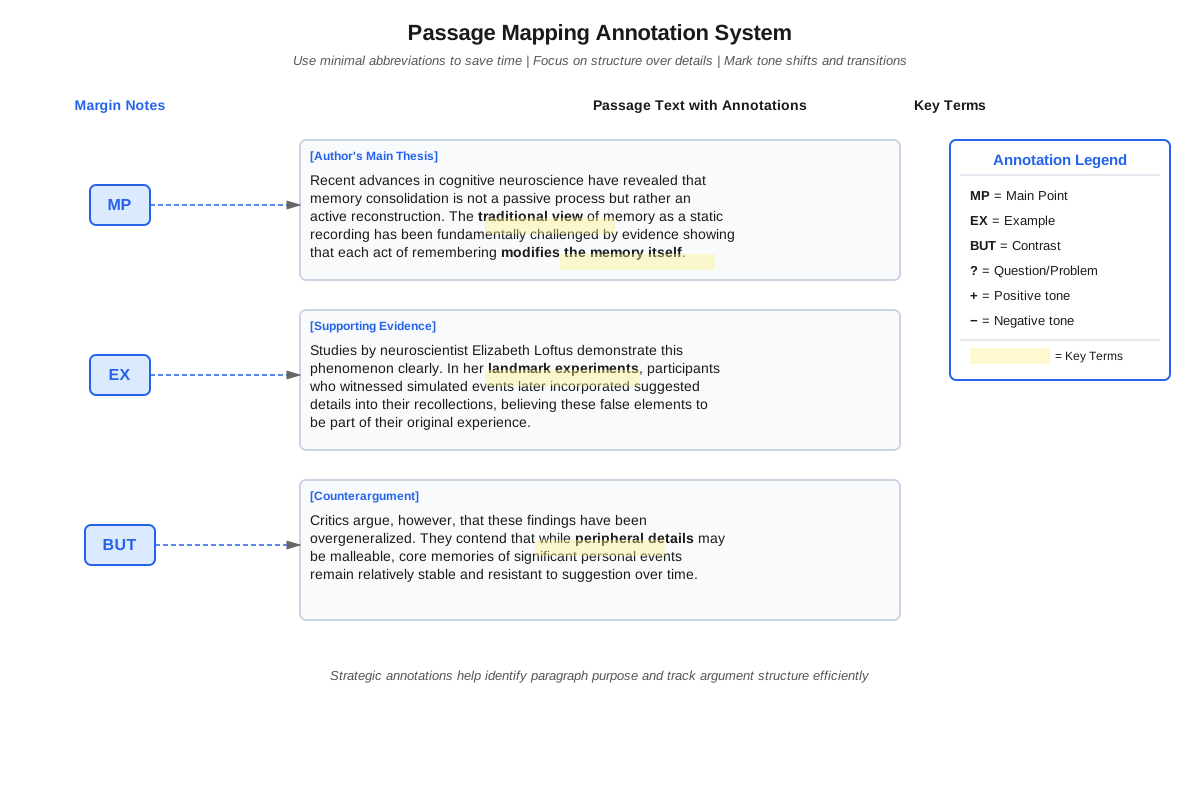
Effective passage maps capture five critical elements without becoming overly detailed. Paragraph purpose should be noted in 2-4 words per paragraph, describing what each paragraph accomplishes (e.g., "intro problem," "first solution," "critique solution," "author's view"). Main entities include key people, theories, concepts, or positions that the passage discusses—these should be tracked with simple labels or abbreviations. Tone indicators mark where the author expresses opinion, whether positive, negative, or neutral, as these moments often generate questions. Structural transitions note where the passage shifts direction, introduces contrasts, or moves between topics. Question-prone content includes definitions, lists, comparisons, and strong claims that frequently become question material.
| Element | What to Track | Example Notation |
|---|---|---|
| Paragraph Purpose | Function of each ¶ | P1: intro theory; P2: support; P3: critique |
| Main Entities | Key concepts/people | Theory X vs. Theory Y; Author A's view |
| Tone Indicators | Author's attitude | +/- symbols; "critical," "supports" |
| Structural Transitions | Shifts in direction | "However," "In contrast," "Moreover" |
| Question-Prone Content | Definitions, lists, comparisons | Underline or bracket key terms |
Physical vs. Mental Mapping
Test-takers can employ physical mapping (writing brief notes in margins) or mental mapping (creating a cognitive structure without extensive notation). Physical mapping provides a concrete reference but consumes time and can become distracting if too detailed. Mental mapping is faster but requires stronger working memory and risks losing track of complex structures. Most successful test-takers use a hybrid approach: minimal physical notation (paragraph labels, key terms, tone markers) combined with strong mental organization.
The optimal approach involves writing 1-3 words per paragraph in the margin to capture purpose, circling or underlining 3-5 key terms throughout the passage, and using simple symbols (+, -, ?, !) to mark tone. This minimal notation takes 15-30 seconds total and provides sufficient anchoring for the mental map without excessive time investment.
The Mapping Process: A Step-by-Step Approach
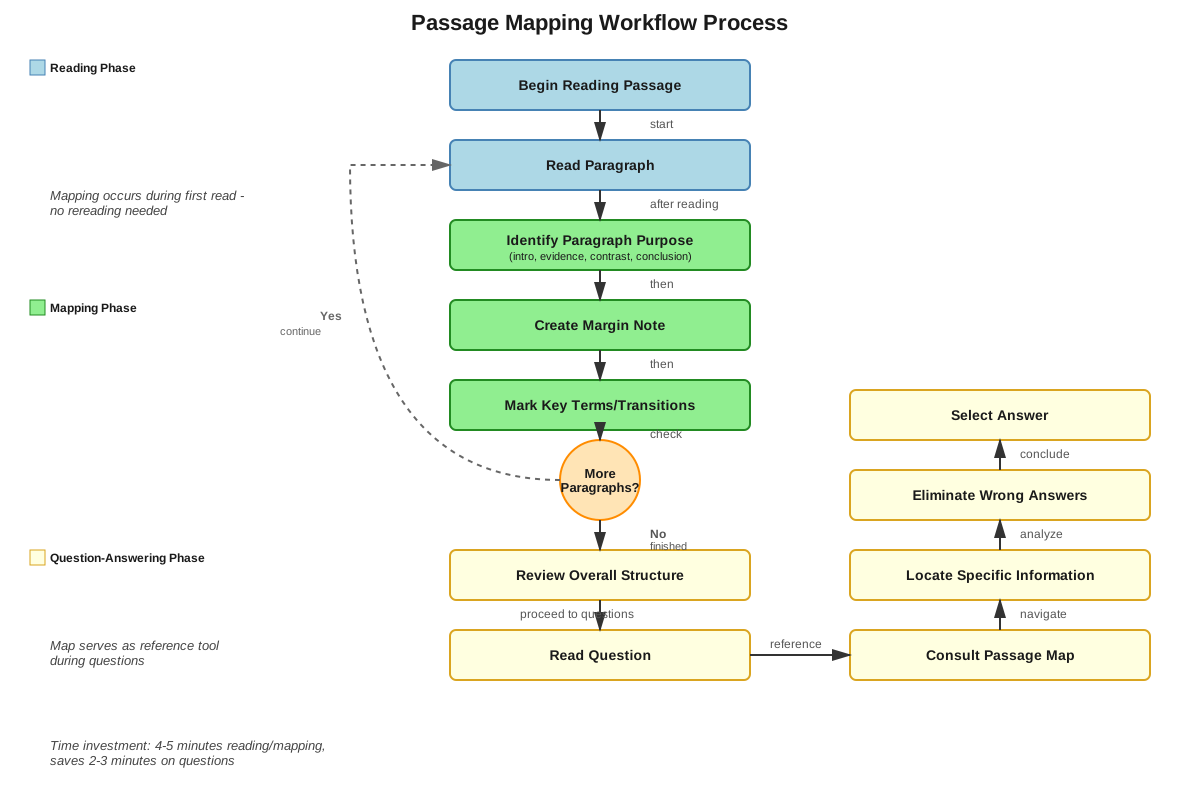
- Read the first paragraph actively, identifying whether it introduces a problem, presents a thesis, describes a phenomenon, or sets up a debate. Note this purpose in 2-3 words.
- Identify the passage's overall structure by the end of the second paragraph. Recognize whether the passage follows a problem-solution, chronological, compare-contrast, or thesis-support pattern.
- Track each subsequent paragraph's relationship to what came before. Does it support, contradict, qualify, or extend the previous idea? Note this relationship.
- Mark tone shifts explicitly. When the author moves from objective description to evaluation, or from presenting others' views to expressing their own position, this shift is highly testable.
- Create mental anchors for where specific types of information appear. Know which paragraph contains the main critique, where the alternative view is presented, or where the key example appears.
- Synthesize the big picture after finishing the passage. In 5-10 seconds, mentally articulate the main point, the structure, and the author's attitude before moving to questions.
Common Passage Structures and Mapping Strategies
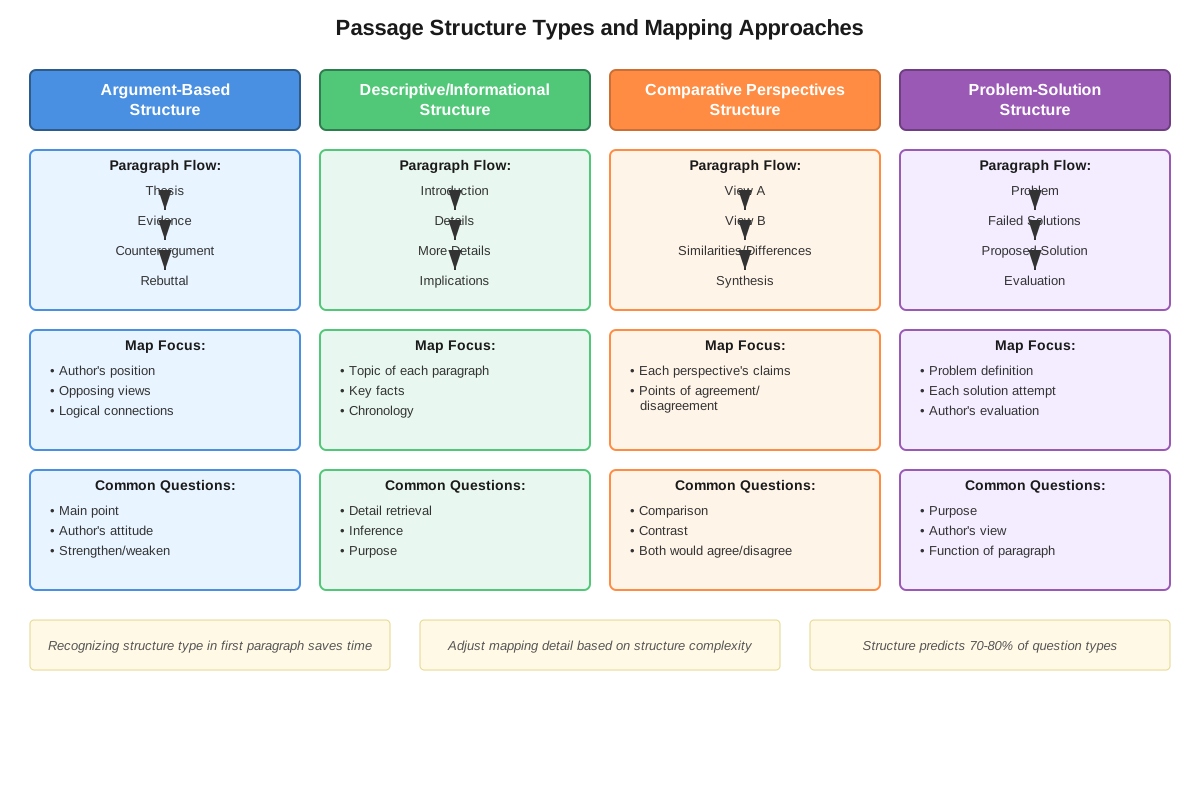
Different passage structures require adapted mapping approaches. Problem-solution passages should map the problem's nature (P1), proposed solutions (P2-3), and evaluation of solutions (P4). Comparative passages must track each author's position, areas of agreement and disagreement, and the relationship between the two texts. Theory-explanation passages should map the theory's main claims, supporting evidence, potential objections, and author's assessment. Historical-chronological passages benefit from timeline mapping, tracking how ideas or events developed sequentially.
Recognizing the structure early allows prediction of what will follow. If paragraph 1 introduces a traditional view, paragraph 2 will likely present a challenge or alternative. If paragraph 2 describes a problem, paragraph 3 will probably offer a solution. This predictive reading, enabled by structural awareness, increases comprehension and speed.
Integrating Mapping with Question Strategy
The true value of passage mapping emerges when answering questions. For main point questions, the map's overall structure and paragraph purposes provide the answer. For detail questions, the map indicates which paragraph to reference. For inference questions, the map shows how ideas connect across paragraphs. For function questions (asking why the author included something), the paragraph purpose notation directly answers the question. For attitude questions, tone markers guide answer selection.
When a question asks about a specific detail, the map prevents inefficient rereading. Instead of scanning the entire passage, the test-taker references the map, identifies the relevant paragraph, and locates the specific information within that paragraph. This targeted approach saves 20-40 seconds per question, accumulating to several minutes across the section.
Concept Relationships
Passage mapping builds directly upon fundamental reading comprehension skills by adding strategic structure. The relationship flows: basic comprehension → active reading → passage mapping → efficient question answering. Without basic comprehension, mapping is impossible; without active reading, mapping lacks substance; without mapping, question answering becomes inefficient.
Within passage mapping itself, the concepts interconnect hierarchically. Structural recognition (identifying the passage's organizational pattern) enables purpose identification (understanding what each paragraph accomplishes), which facilitates content location (knowing where specific information appears), which supports efficient question answering (quickly finding and applying relevant information). Each element depends on the previous one.
Passage mapping also connects forward to advanced Reading Comprehension strategies. It enables question prediction (anticipating what will be asked based on passage emphasis), supports wrong answer elimination (recognizing answers that misrepresent structure or tone), and facilitates comparative reading analysis (tracking two authors' positions simultaneously). Mastering passage mapping is prerequisite to these higher-level skills.
The relationship between passage mapping and time management is reciprocal. Effective mapping requires investing 3-4 minutes in the initial read (slightly longer than passive reading), but this investment returns 20-40 seconds per question, resulting in net time savings of 2-3 minutes per passage. This relationship—short-term investment for long-term efficiency—is fundamental to LSAT success.
Quick check — test yourself on Passage mapping so far.
Try Flashcards →High-Yield Facts
⭐ Passage mapping should capture paragraph purpose in 2-4 words per paragraph, not detailed content summaries.
⭐ Approximately 60-70% of Reading Comprehension questions can be answered more efficiently with an effective passage map.
⭐ The optimal mapping approach combines minimal physical notation (1-3 words per paragraph) with strong mental organization.
⭐ Recognizing passage structure by the end of paragraph 2 enables predictive reading and better comprehension.
⭐ Tone shifts—where the author moves from description to evaluation—are among the most frequently tested elements.
- Physical mapping should take no more than 15-30 seconds total across the entire passage to avoid time waste.
- Main entities (key theories, people, or concepts) should be tracked with simple abbreviations or labels.
- Question-prone content includes definitions, lists, comparisons, and strong authorial claims.
- Comparative reading passages require tracking each author's position, agreements, and disagreements simultaneously.
- The passage map should be referenced for every question except main point questions, which test overall understanding.
- Structural transitions (however, moreover, in contrast) signal important shifts that frequently generate questions.
- Effective passage mapping reduces rereading by 70-80%, the primary source of time waste in Reading Comprehension.
- Passages with complex structures (multiple viewpoints, chronological developments) benefit most from systematic mapping.
Common Misconceptions
Misconception: Passage mapping means writing detailed notes about everything in the passage. → Correction: Effective passage mapping involves minimal, strategic notation focused on structure and purpose, not comprehensive content summaries. Over-detailed mapping wastes time and creates clutter that obscures rather than clarifies.
Misconception: The passage map should be created after reading the entire passage. → Correction: Passage mapping occurs during the initial read, with notes and mental organization developing paragraph by paragraph. Waiting until after reading requires rereading to create the map, defeating the efficiency purpose.
Misconception: Passage mapping is only useful for difficult or complex passages. → Correction: Systematic mapping benefits all passages, including seemingly straightforward ones, because LSAT questions often test subtle structural relationships and purposes that are easy to miss without active tracking.
Misconception: Mental mapping is always superior to physical notation because it's faster. → Correction: While mental mapping saves notation time, most test-takers benefit from minimal physical anchors (paragraph labels, key terms) that support rather than replace mental organization. Pure mental mapping works only for those with exceptional working memory.
Misconception: The passage map should focus primarily on details and examples. → Correction: Effective maps prioritize structure, purpose, and relationships over specific details. Details can be located quickly when needed if the structural map is clear, but a detail-focused map without structural understanding provides little value.
Misconception: Passage mapping and question answering are separate, sequential activities. → Correction: Passage mapping and question answering are integrated processes. The map is created with question demands in mind, and questions are answered by actively referencing and applying the map.
Worked Examples
Example 1: Science Passage with Theory Comparison
Passage Structure (abbreviated):
P1: Traditional theory of planetary formation suggests planets form from gradual accretion of dust particles in protoplanetary disks.
P2: Recent observations of exoplanets challenge this view, showing gas giants forming much faster than traditional theory predicts.
P3: New "gravitational instability" theory proposes that dense regions in disks collapse rapidly to form planets.
P4: However, critics note that gravitational instability requires specific conditions rarely observed in protoplanetary disks.
P5: Author suggests both mechanisms may operate under different conditions, with traditional accretion explaining rocky planets and gravitational instability explaining rapid gas giant formation.
Effective Passage Map:
- P1: trad theory (gradual)
- P2: challenge (fast giants)
- P3: new theory (collapse)
- P4: critique new theory
- P5: author: both work (different conditions)
Sample Question: "The author's attitude toward the gravitational instability theory can best be described as..."
Using the Map: The map shows P3 introduces the new theory, P4 presents critiques, and P5 gives the author's view. The author doesn't fully endorse or reject the theory but suggests it applies in specific circumstances. This structural understanding, captured in the map, points to an answer like "qualified acceptance" or "cautiously optimistic" rather than "enthusiastic endorsement" or "skeptical rejection."
Reasoning Process: Without the map, a test-taker might remember that critiques were mentioned and incorrectly select a negative answer. The map clarifies that the author presents critiques (P4) but then offers a reconciling view (P5), indicating measured support rather than rejection. The map's structural clarity prevents misreading the author's nuanced position.
Example 2: Humanities Passage with Chronological Development
Passage Structure (abbreviated):
P1: Early 20th-century art critics viewed abstract art as lacking skill and meaning.
P2: Mid-century formalist critics like Clement Greenberg defended abstraction as the pinnacle of artistic evolution, emphasizing pure visual elements.
P3: By the 1970s, postmodern critics rejected formalism, arguing it ignored social and political contexts.
P4: Contemporary critics now recognize value in multiple interpretive approaches, seeing formalism as one useful but not exclusive framework.
Effective Passage Map:
- P1: early critics - negative on abstract
- P2: Greenberg - defends (formalism)
- P3: 1970s - reject formalism (context matters)
- P4: now - multiple approaches OK
Sample Question: "According to the passage, Greenberg's approach differed from that of postmodern critics in that Greenberg..."
Using the Map: The map immediately shows Greenberg in P2 (formalism, pure visual) and postmodern critics in P3 (context matters). The contrast is clear: Greenberg emphasized visual elements while postmodernists emphasized context. This structural understanding enables quick answer selection without rereading both paragraphs in detail.
Reasoning Process: The chronological map reveals the progression of critical thought and the specific contrast between P2 and P3. A test-taker referencing this map can eliminate answers that mischaracterize either position or confuse the timeline. The map's temporal organization makes relationship questions straightforward.
Exam Strategy
Approaching Passage Mapping Questions
When a question asks about passage structure, organization, or the purpose of a paragraph, the passage map provides a direct answer. These questions essentially test whether the test-taker created an effective map. Approach them by referencing the paragraph purpose notations and overall structural understanding captured in the map, not by rereading the passage.
Trigger Words for Mapping-Relevant Content
Watch for structural transitions that signal important shifts: "however," "nevertheless," "in contrast," "moreover," "furthermore," "alternatively," "traditionally," "recently," and "critics argue." These phrases indicate changes in direction, additions to arguments, or shifts between viewpoints—all highly testable elements that should be marked in the map.
Tone indicators also serve as triggers: "unfortunately," "surprisingly," "importantly," "merely," "significantly," and "clearly" reveal authorial attitude. When these words appear, mark them as they often generate attitude or tone questions.
Process of Elimination Using Passage Maps
Wrong answers in Reading Comprehension frequently misrepresent structure, confuse paragraph purposes, or distort the author's attitude. Use the passage map to eliminate answers that:
- Attribute ideas to the wrong paragraph or entity
- Mischaracterize the relationship between paragraphs (e.g., claiming P3 supports P2 when the map shows P3 critiques P2)
- Misstate the author's tone (e.g., claiming strong endorsement when the map shows qualified support)
- Confuse the order of presentation (e.g., claiming the critique came before the theory when the map shows the opposite)
Time Allocation Strategy
Invest 3-4 minutes in the initial read with mapping (30-45 seconds longer than passive reading). This investment returns 20-40 seconds per question, resulting in net time savings. Specifically:
- Spend 30-60 seconds after finishing the passage to mentally review the map and synthesize the big picture
- Reference the map for every detail, function, and structure question before looking back at the passage
- Use the map to predict correct answer characteristics before reading answer choices
- Allow the map to guide targeted rereading when necessary, focusing only on the relevant paragraph
Memory Techniques
The MAPS Acronym for Essential Elements
Main point and structure
Author's attitude and tone
Purpose of each paragraph
Shifts and transitions
This acronym reminds test-takers of the four critical elements every passage map must capture.
The 2-4-6 Rule
2 words minimum per paragraph purpose
4 words maximum per paragraph purpose
6 key terms maximum to circle/underline in the entire passage
This numerical framework prevents both insufficient mapping (too vague) and excessive mapping (too detailed).
Visualization: The Passage as a Building
Visualize the passage as a building where each paragraph is a floor. The map is the building's blueprint, showing what happens on each floor and how the floors connect. When a question asks about specific content, the map tells which floor to visit. This spatial metaphor helps maintain structural awareness.
Symbol System for Tone
Develop a consistent symbol system:
- + for positive/supportive tone
- - for negative/critical tone
- ? for questioning/uncertain tone
- ! for strong emphasis or surprising information
- = for neutral/objective description
Consistent symbols enable rapid notation and instant recognition when referencing the map.
Summary
Passage mapping is the strategic process of actively tracking structure, purpose, and key elements while reading LSAT Reading Comprehension passages. This technique transforms passive reading into active analysis, creating a mental and physical roadmap that enables efficient question answering. Effective passage mapping captures five essential elements—paragraph purpose, main entities, tone indicators, structural transitions, and question-prone content—using minimal notation (2-4 words per paragraph) combined with strong mental organization. The optimal approach invests 3-4 minutes in the initial read with mapping, returning this investment through 20-40 seconds saved per question by eliminating inefficient rereading. Passage mapping proves particularly valuable for structure questions, detail questions requiring information retrieval, and inference questions testing relationships between ideas. Mastery requires recognizing common passage structures (problem-solution, comparative, chronological, theory-explanation), adapting mapping strategies accordingly, and integrating the map seamlessly with question-answering processes. The skill distinguishes top scorers from average performers by enabling the structural awareness and efficient information access that LSAT Reading Comprehension demands.
Key Takeaways
- Passage mapping creates a structural roadmap using minimal notation (2-4 words per paragraph) that enables efficient question answering and eliminates wasteful rereading
- The five essential mapping elements are paragraph purpose, main entities, tone indicators, structural transitions, and question-prone content
- Effective mapping occurs during the initial read, not afterward, with structure recognized by the end of paragraph 2
- The technique saves net time by investing 30-45 extra seconds during reading to save 20-40 seconds per question
- Tone shifts and structural transitions (however, in contrast, moreover) are among the most frequently tested elements and must be tracked carefully
- Different passage structures (problem-solution, comparative, chronological) require adapted mapping strategies
- The passage map should be actively referenced for every question, guiding targeted rereading and enabling systematic wrong answer elimination
Related Topics
Active Reading Strategies: Building on passage mapping, active reading encompasses broader engagement techniques including prediction, questioning, and synthesis that enhance comprehension and retention across all LSAT sections.
Question Type Analysis: Understanding the specific demands of each Reading Comprehension question type (main point, detail, inference, function, attitude) enables more targeted passage mapping that captures exactly what questions will test.
Comparative Reading Techniques: The comparative passage set requires specialized mapping strategies that track two authors' positions, agreements, disagreements, and relationships simultaneously—an advanced application of basic mapping principles.
Time Management in Reading Comprehension: Mastering passage mapping enables broader time management strategies, including optimal passage selection order, strategic skipping, and efficient question triage.
Practice CTA
Now that you understand the principles and techniques of passage mapping, the next critical step is application. Attempt the practice questions associated with this topic, focusing on creating effective passage maps before answering questions. As you practice, refine your notation system, experiment with the balance between physical and mental mapping, and track how mapping improves both accuracy and speed. Remember that passage mapping is a skill that improves dramatically with deliberate practice—your first attempts may feel slow or awkward, but consistent application will make the technique automatic and highly efficient. Each practice passage is an opportunity to strengthen the structural awareness and strategic reading that distinguish top LSAT performers. Commit to mapping every practice passage for the next two weeks, and you'll see measurable improvement in both confidence and performance.
Sign up free to keep reading
Create a free AnvayaPrep account to finish this LSAT guide on Passage mapping — plus flashcards and practice questions.