Overview
Passage structure refers to the organizational framework and logical architecture that authors use to construct LSAT Reading Comprehension passages. Understanding how passages are built—how ideas are introduced, developed, contrasted, and concluded—is fundamental to success on the LSAT. Rather than reading passages as undifferentiated blocks of text, skilled test-takers recognize that every LSAT passage structure follows predictable patterns: arguments are presented and critiqued, theories are compared, historical developments are traced, or problems and solutions are explored. Recognizing these structural patterns allows students to anticipate where key information will appear, understand the author's purpose, and efficiently locate details when answering questions.
Mastery of passage structure transforms reading comprehension from a passive activity into an active, strategic process. The LSAT consistently tests whether students can identify the function of specific paragraphs, understand how different viewpoints relate to one another, and recognize the overall organizational logic of a passage. Questions explicitly asking about structure appear regularly, but structural understanding also underlies nearly every other question type—from main point questions to inference questions to function questions. Without a firm grasp of how passages are organized, students waste precious time rereading, struggle to locate relevant information, and miss the logical relationships that questions target.
Within the broader domain of passage fundamentals, passage structure serves as the architectural blueprint that connects all other reading skills. While other fundamentals address what the passage says (content) and why the author says it (purpose and tone), passage structure addresses how the passage is organized to convey its message. This organizational awareness enables students to create effective mental roadmaps, predict question types, and approach each passage with a systematic strategy rather than hoping to absorb everything through careful reading alone.
Learning Objectives
- [ ] Identify how Passage structure appears in LSAT questions
- [ ] Explain the reasoning pattern behind Passage structure
- [ ] Apply Passage structure to solve LSAT-style problems accurately
- [ ] Recognize and categorize the six most common LSAT passage structures within 30 seconds of reading
- [ ] Map the function of each paragraph within a passage to understand its role in the overall argument
- [ ] Predict likely question types based on structural features identified during the initial read
Prerequisites
- Basic reading comprehension skills: The ability to understand college-level prose is essential because LSAT passages assume sophisticated vocabulary and complex sentence structures.
- Understanding of argument components: Familiarity with premises, conclusions, evidence, and counterarguments helps identify how these elements are arranged within passage structure.
- Paragraph-level comprehension: The capacity to identify the main idea of individual paragraphs enables recognition of how paragraphs function within the larger structure.
- Awareness of transition words and phrases: Recognizing signals like "however," "moreover," and "in contrast" helps track structural shifts and relationships between ideas.
Why This Topic Matters
Understanding passage structure is not merely an academic exercise—it represents one of the highest-yield skills for LSAT Reading Comprehension success. Research on LSAT performance consistently shows that students who actively identify structural patterns score significantly higher than those who read for content alone. This skill translates directly to legal practice, where attorneys must quickly grasp the organization of complex legal documents, judicial opinions, and scholarly articles to extract relevant information efficiently.
On the LSAT, passage structure appears in approximately 20-25% of Reading Comprehension questions directly, through question stems that explicitly ask about organization, function, or the role of specific paragraphs. However, structural understanding indirectly supports nearly every other question type. Main point questions require recognizing which ideas are central versus peripheral based on their structural prominence. Detail questions become easier when students know where to look based on the passage's organizational logic. Inference questions often hinge on understanding relationships between different parts of the passage that only become clear through structural analysis.
Common manifestations of passage structure in LSAT passages include: comparative passages that present two theories or viewpoints side-by-side; passages that trace historical development chronologically; passages that present a problem followed by proposed solutions; passages that introduce a conventional view before presenting a critique or alternative perspective; and passages that describe a phenomenon before explaining its causes or implications. Recognizing these patterns during the initial read provides a strategic advantage that compounds throughout the question set.
Core Concepts
The Six Primary LSAT Passage Structures
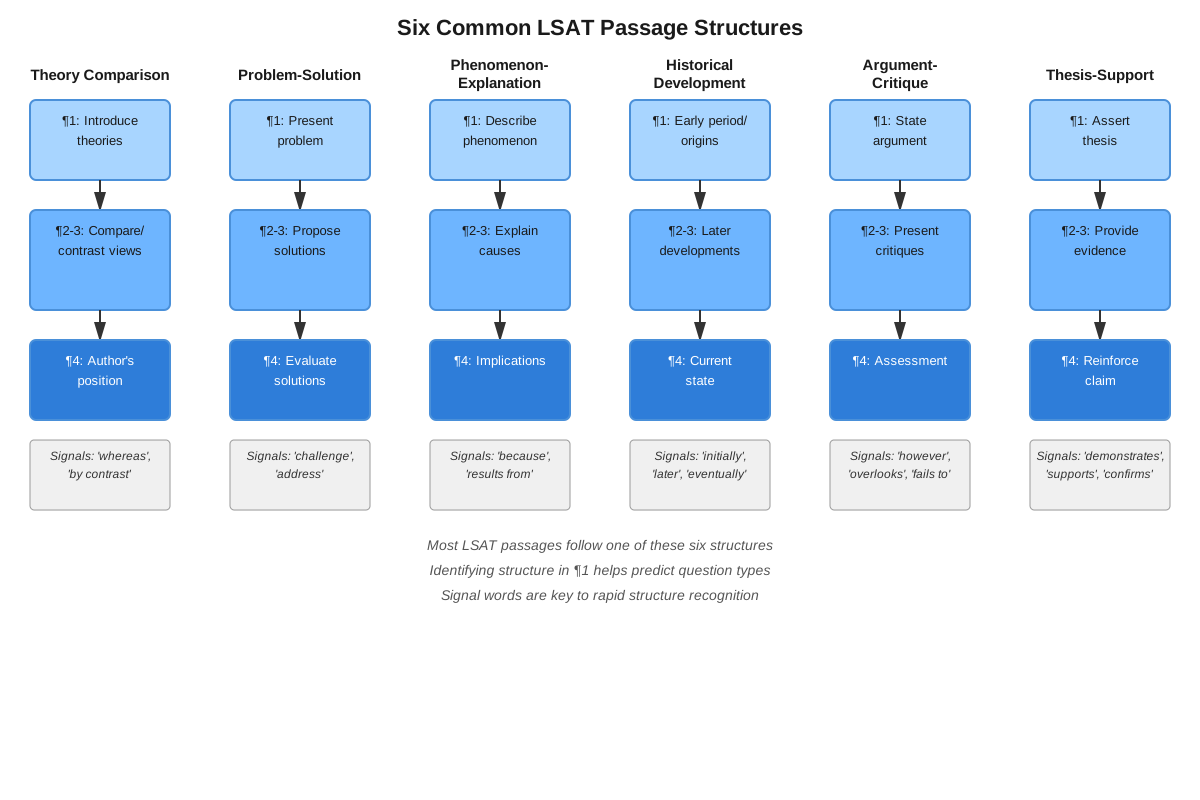
The LSAT employs a limited repertoire of organizational patterns that appear repeatedly across different subject matters. Recognizing these passage structure templates enables rapid comprehension and strategic reading.
1. Theory/Critique Structure: This pattern introduces a theory, viewpoint, or conventional wisdom in the opening paragraphs, then presents criticism, limitations, or alternative perspectives in subsequent paragraphs. The passage may conclude by evaluating the critique or proposing a synthesis. This structure appears in approximately 30% of LSAT passages and often generates questions about the author's attitude toward the initial theory and the relationship between the theory and its critique.
2. Comparison/Contrast Structure: This organizational pattern presents two or more theories, approaches, phenomena, or viewpoints and systematically compares their features, strengths, and weaknesses. The passage may alternate between the subjects (ABABAB pattern) or present each subject in blocks (AAABBB pattern). Questions frequently test understanding of how the subjects differ and what they share in common.
3. Problem/Solution Structure: The passage identifies a problem, puzzle, or question in the opening paragraphs, then explores one or more proposed solutions or answers. The author may evaluate these solutions, indicating which is most promising or explaining why all fall short. This structure naturally generates questions about the adequacy of proposed solutions and the criteria used to evaluate them.
4. Phenomenon/Explanation Structure: This pattern describes an observed phenomenon, behavior, or trend, then provides one or more explanations for why it occurs. Scientific passages frequently employ this structure, presenting empirical observations before discussing theoretical mechanisms. Questions often test whether students understand the relationship between evidence and explanation.
5. Historical Development Structure: This chronological organization traces how ideas, practices, or understandings have evolved over time. The passage typically moves from earlier to later developments, sometimes concluding with current understanding or future directions. Temporal markers ("initially," "subsequently," "by the 1950s") signal this structure.
6. Thesis/Support Structure: The most straightforward pattern presents the author's main argument or thesis early, then devotes subsequent paragraphs to providing evidence, examples, and reasoning that support this central claim. While less common in LSAT passages than structures involving multiple viewpoints, this pattern appears in passages where the author advocates strongly for a particular position.
Paragraph Function Within Passage Structure
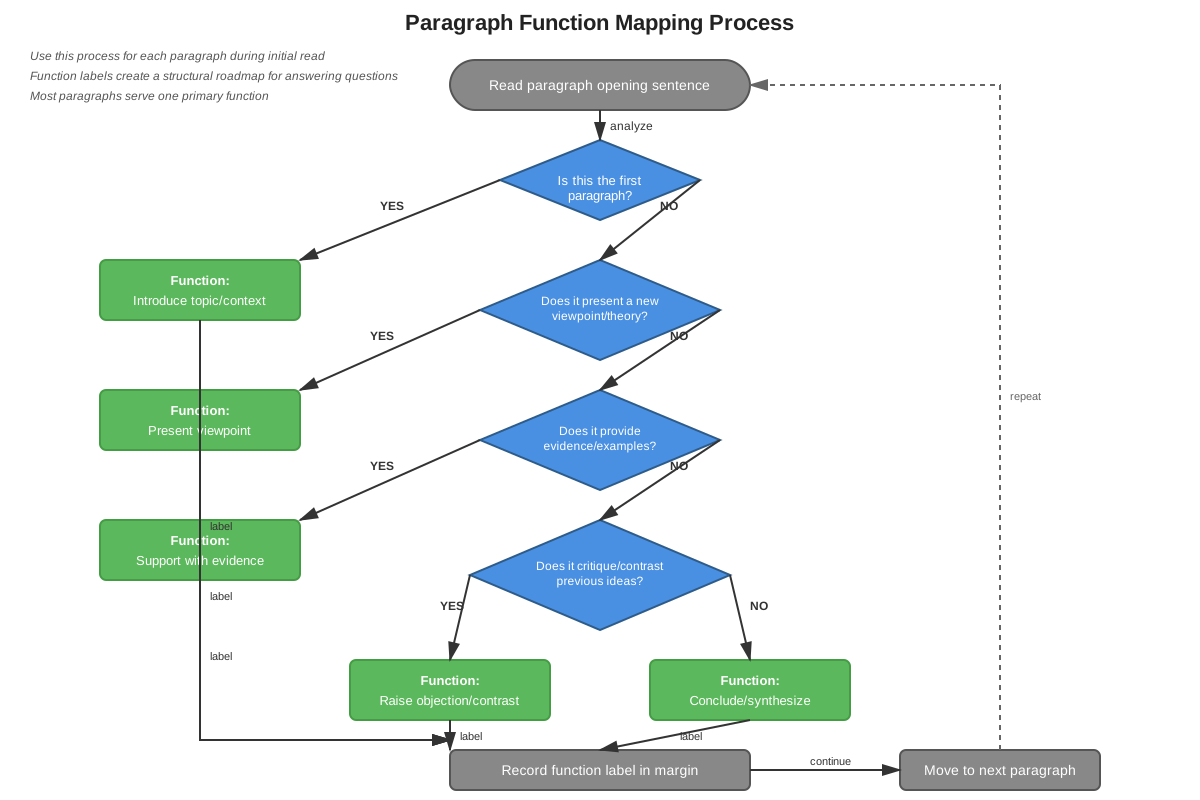
Each paragraph serves a specific structural function within the overall passage architecture. Identifying these functions creates a mental roadmap that facilitates efficient navigation during questions.
Opening paragraphs typically introduce the passage's subject matter, present background information, or establish a conventional view that will be examined. They set the stage but rarely contain the passage's most important claims. Skilled readers note the topic and move forward, knowing they can return if needed.
Development paragraphs elaborate on theories, present evidence, introduce alternative viewpoints, or provide examples. These middle paragraphs contain much of the passage's detailed content and often generate specific detail questions. Recognizing whether a paragraph supports, contrasts, or qualifies previous material helps track the argument's progression.
Transitional paragraphs shift the passage's focus, introduce complications, or pivot from one viewpoint to another. These paragraphs often begin with contrast words ("however," "nevertheless," "yet") or phrases indicating a shift in perspective ("critics argue," "an alternative view," "recent research suggests"). These transitions mark crucial structural boundaries.
Concluding paragraphs may summarize the passage's main points, present the author's evaluation or synthesis, indicate implications or future directions, or resolve tensions introduced earlier. Final paragraphs often contain or reinforce the passage's main point and reveal the author's ultimate perspective.
Structural Signals and Transition Markers
Authors use explicit linguistic signals to mark structural relationships and guide readers through the passage's organization. Recognizing these markers enables real-time structural mapping.
| Signal Type | Examples | Structural Function |
|---|---|---|
| Continuation | moreover, furthermore, additionally, also | Indicates the author is extending or reinforcing the current line of reasoning |
| Contrast | however, nevertheless, yet, but, although, despite | Signals a shift to an opposing view, limitation, or complication |
| Causation | because, since, therefore, thus, consequently | Shows logical relationships between claims and evidence |
| Exemplification | for example, for instance, such as, to illustrate | Indicates supporting details or concrete applications |
| Emphasis | indeed, in fact, crucially, most importantly | Highlights particularly significant claims or evidence |
| Temporal | initially, subsequently, eventually, finally | Marks chronological progression in historical development structures |
The Relationship Between Structure and Question Types
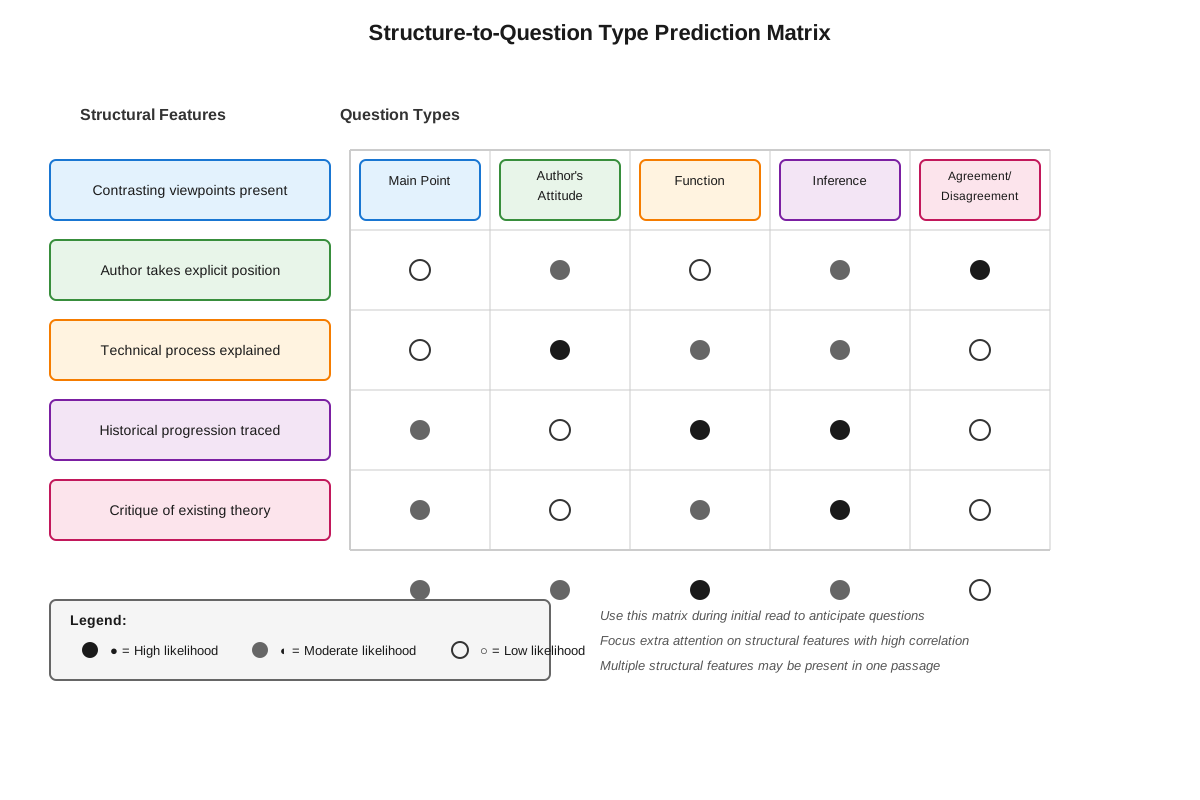
Different passage structures generate predictable question types, allowing strategic anticipation during the initial read.
Theory/Critique structures frequently generate questions about: the author's attitude toward the initial theory; the function of the critique; how the critique relates to specific aspects of the theory; and whether new information would strengthen or weaken either position.
Comparison/Contrast structures commonly produce questions about: similarities and differences between the compared subjects; the author's relative evaluation of each; how specific features of one subject relate to features of the other; and which characteristics are unique versus shared.
Problem/Solution structures typically generate questions about: the nature and scope of the problem; the adequacy of proposed solutions; criteria for evaluating solutions; and the author's assessment of which solution is most promising.
Understanding these patterns allows students to anticipate questions and note relevant information during the initial read, rather than scrambling to relocate details later.
Active Structural Mapping During Reading
Effective LSAT readers create mental or physical structural maps as they read, noting the function of each paragraph in a few words. This active process transforms passive reading into strategic comprehension.
A structural map for a Theory/Critique passage might look like:
- ¶1: Introduce traditional view of X
- ¶2: Explain how traditional view developed
- ¶3: Present critic Y's challenge to traditional view
- ¶4: Author evaluates critique—partially valid but overlooks Z
This abbreviated roadmap requires only seconds to create but provides enormous value when answering questions, enabling rapid location of relevant information and clear understanding of how different parts of the passage relate.
Concept Relationships
The concepts within passage structure form an interconnected system where each element reinforces and depends on others. The six primary passage structures serve as the foundational templates that organize all other structural elements. Within any given structure, paragraph functions operate as building blocks—each paragraph plays a specific role (introducing, developing, contrasting, concluding) that contributes to the overall organizational pattern.
Structural signals and transition markers act as the connective tissue that makes the passage structure explicit and navigable. These linguistic cues reveal how paragraphs relate to one another and mark boundaries between different structural sections. Recognizing these signals enables real-time identification of which primary structure is being employed and what function each paragraph serves.
The relationship between structure and question types represents the practical application of structural understanding. This concept connects structural analysis to actual test performance—knowing that Theory/Critique structures generate certain question types allows strategic reading that anticipates what will be tested. Finally, active structural mapping synthesizes all other concepts into a concrete reading strategy, transforming theoretical knowledge about structure into practical technique.
This topic connects to prerequisite knowledge of argument components by showing how premises, conclusions, and counterarguments are arranged spatially within passages. It also relates to future topics in Reading Comprehension, including question type strategies (where structural understanding guides approach to specific questions) and comparative passages (which employ comparison/contrast structure by definition).
Conceptual Flow: Primary Structures → Paragraph Functions → Structural Signals → Question Type Prediction → Active Mapping → Improved Performance
High-Yield Facts
⭐ Approximately 20-25% of Reading Comprehension questions directly test passage structure through questions about organization, function, or paragraph roles.
⭐ The Theory/Critique structure is the most common organizational pattern on the LSAT, appearing in roughly 30% of passages.
⭐ Transition words like "however," "nevertheless," and "yet" mark crucial structural boundaries where the passage shifts perspective or introduces complications.
⭐ The final paragraph often contains or reinforces the passage's main point and reveals the author's ultimate perspective on the topic.
⭐ Comparative passages always employ comparison/contrast structure, making structural analysis particularly straightforward for these paired passages.
- Opening paragraphs typically introduce background or conventional views but rarely contain the passage's most important claims.
- Development paragraphs in the middle of passages contain most specific details and generate the majority of detail-oriented questions.
- Problem/Solution structures generate questions about the adequacy of proposed solutions and criteria for evaluation.
- Historical Development structures use temporal markers ("initially," "by the 1950s," "eventually") to signal chronological progression.
- Creating a brief structural map (noting each paragraph's function in 2-4 words) dramatically improves question-answering efficiency.
- Passages that introduce a phenomenon before explaining it typically generate questions about the relationship between evidence and explanation.
- Authors use emphasis markers ("indeed," "crucially," "most importantly") to highlight claims likely to be tested in questions.
Quick check — test yourself on Passage structure so far.
Try Flashcards →Common Misconceptions
Misconception: All paragraphs in a passage are equally important and deserve equal attention during reading.
Correction: Paragraphs serve different structural functions, and strategic readers allocate attention based on function. Opening paragraphs providing background require less intensive focus than paragraphs presenting the author's main argument or introducing crucial contrasts.
Misconception: Passage structure is only relevant for questions explicitly asking about organization or function.
Correction: Structural understanding supports virtually every question type. Detail questions become easier when you know where information is located based on structure. Inference questions often depend on understanding relationships between different parts of the passage. Main point questions require recognizing which ideas are structurally central versus peripheral.
Misconception: Creating a structural map wastes valuable time that should be spent reading carefully.
Correction: Brief structural mapping (2-4 words per paragraph) takes only 10-15 seconds but saves significantly more time during questions by enabling rapid location of relevant information and preventing rereading. The time investment yields substantial returns.
Misconception: Different subject matters (science, law, humanities) require different structural analysis approaches.
Correction: The same six primary structures appear across all subject matters. A Theory/Critique structure works identically whether discussing legal theory, scientific hypotheses, or artistic movements. Subject matter changes, but organizational patterns remain consistent.
Misconception: The most important information always appears in the first or last paragraph.
Correction: While opening and closing paragraphs often contain important material, crucial information frequently appears in middle paragraphs, particularly in passages with Theory/Critique or Problem/Solution structures where the critique or solution may be introduced mid-passage.
Misconception: Structural signals like "however" always indicate the author disagrees with what came before.
Correction: Contrast markers indicate a shift in perspective but don't necessarily reveal the author's own view. The author may be neutrally presenting multiple viewpoints, and "however" simply marks the transition from one perspective to another.
Worked Examples
Example 1: Identifying Structure in a Theory/Critique Passage
Passage Summary:
¶1: Traditional economic theory assumes rational actors maximize utility through cost-benefit analysis.
¶2: This assumption has dominated economic modeling for decades and generates specific predictions about market behavior.
¶3: Behavioral economists challenge this assumption, presenting experimental evidence that people systematically violate rational choice principles.
¶4: However, defenders of traditional theory argue that these violations occur only in artificial laboratory settings and disappear in real markets with meaningful stakes.
Question: The passage is primarily concerned with:
(A) Advocating for behavioral economics over traditional economic theory
(B) Explaining why traditional economic theory has dominated the field
(C) Presenting a challenge to traditional economic theory and a response to that challenge
(D) Describing experimental methods used in behavioral economics
(E) Reconciling traditional and behavioral approaches to economics
Structural Analysis:
This passage follows a clear Theory/Critique structure. Paragraph 1 introduces the traditional theory. Paragraph 2 develops this theory by explaining its historical dominance and implications. Paragraph 3 presents the critique from behavioral economists. Paragraph 4 introduces a counter-response defending the traditional view.
The structural pattern is: Theory → Development → Critique → Defense of Theory
Solution Process:
Given this structure, the passage is not advocating for either position (eliminating A) but rather presenting multiple viewpoints. The passage's primary concern is not explaining why traditional theory dominated (that's a detail in ¶2, eliminating B) or describing experimental methods (mentioned but not central, eliminating D). The passage doesn't reconcile the approaches (eliminating E) but rather presents them in tension.
Answer: (C) correctly captures the Theory/Critique structure—the passage presents a challenge (behavioral economics) to traditional theory and includes a response to that challenge (the defense in ¶4).
Learning Objective Connection: This example demonstrates how identifying passage structure (Theory/Critique) enables accurate prediction of the passage's primary concern and efficient elimination of wrong answers that don't match the structural pattern.
Example 2: Using Structure to Answer a Function Question
Passage Summary:
¶1: Archaeologists have long puzzled over the sudden collapse of the Mayan civilization around 900 CE.
¶2: Early theories attributed the collapse to foreign invasion, but archaeological evidence of warfare is limited.
¶3: More recent research suggests environmental factors, particularly severe drought, as the primary cause.
¶4: Tree ring data and sediment analysis provide strong evidence for prolonged drought during the collapse period.
¶5: However, some scholars note that Mayan cities collapsed at different times, suggesting drought alone cannot explain the pattern.
Question: The primary function of the fourth paragraph is to:
(A) Introduce a new theory about Mayan collapse
(B) Provide evidence supporting the environmental explanation
(C) Critique the drought theory presented earlier
(D) Describe archaeological methods used to study the Maya
(E) Explain why the invasion theory was abandoned
Structural Analysis:
This passage follows a Problem/Solution structure with complications. Paragraph 1 presents the problem (explaining Mayan collapse). Paragraph 2 introduces and dismisses one solution (invasion). Paragraph 3 presents a more promising solution (drought). Paragraph 4's function must be understood in relation to this structure.
Looking at ¶4's content (tree ring data and sediment analysis supporting drought), it clearly provides evidence for the solution presented in ¶3. Paragraph 5 then introduces complications to this solution.
Solution Process:
(A) is incorrect because ¶4 doesn't introduce a new theory—the drought theory was introduced in ¶3. (C) is incorrect because ¶4 supports rather than critiques the drought theory (the critique comes in ¶5). (D) is incorrect because while methods are mentioned, that's not the paragraph's primary function. (E) is incorrect because that occurred in ¶2, not ¶4.
Answer: (B) correctly identifies that ¶4's structural function is providing evidence for the environmental explanation introduced in the previous paragraph.
Learning Objective Connection: This example shows how understanding the overall passage structure (Problem/Solution) and tracking paragraph functions enables accurate identification of a specific paragraph's role, even when the question doesn't explicitly mention structure.
Exam Strategy
Initial Read Strategy
During the first read-through, invest 10-15 seconds creating a structural map by jotting down each paragraph's function in 2-4 words. This minimal time investment pays enormous dividends when answering questions. Focus on identifying which of the six primary structures the passage employs—this recognition should occur within the first two paragraphs.
Exam Tip: Don't try to memorize details during the initial read. Instead, focus on understanding the organizational logic and noting where different types of information appear. You can always return to locate specific details when questions require them.
Trigger Words for Structure Questions
Questions explicitly testing passage structure use predictable language. Watch for these trigger phrases:
- "The organization of the passage is best described as..."
- "The primary function of the third paragraph is to..."
- "The author's discussion proceeds by..."
- "Which one of the following most accurately describes the structure..."
- "The passage is primarily concerned with..."
When you see these triggers, immediately refer to your structural map and match the question to the organizational pattern you identified.
Process of Elimination for Structure Questions
Wrong answers to structure questions typically fall into predictable categories:
Too Narrow: The answer describes only one paragraph or section rather than the overall structure. Example: An answer focusing only on the critique when the passage employs Theory/Critique structure.
Too Broad: The answer is so general it could apply to almost any passage. Example: "The passage discusses various viewpoints on a topic."
Factually Accurate but Functionally Wrong: The answer describes content that appears in the passage but misidentifies its structural role. Example: Saying a paragraph "introduces a theory" when it actually critiques a theory introduced earlier.
Wrong Sequence: The answer describes structural elements in an order that doesn't match the actual passage. Example: Claiming the passage presents a solution before identifying the problem.
Time Allocation
Spend approximately 3-4 minutes on the initial read, including time to create your structural map. This may feel slower than reading without mapping, but you'll recover this time (and more) when answering questions. Structure questions themselves should take 30-45 seconds once you've identified the passage structure—they become among the fastest questions to answer with proper preparation.
Strategic Advantages of Structural Understanding
Recognizing passage structure provides several strategic advantages beyond answering structure questions directly:
- Predictive Reading: Knowing the structure allows you to anticipate what's coming. In a Theory/Critique structure, after reading the theory, you know a critique is coming and can read it with that expectation.
- Efficient Detail Location: When questions ask about specific details, your structural map tells you which paragraph to check, eliminating random searching.
- Main Point Identification: The passage structure reveals which ideas are central (structurally prominent) versus peripheral (supporting details).
- Question Type Anticipation: Different structures generate predictable question types, allowing you to note relevant information during the initial read.
Memory Techniques
The "TCPHDT" Mnemonic for Primary Structures
Remember the six primary passage structures using TCPHDT:
- Theory/Critique
- Comparison/Contrast
- Problem/Solution
- Historical Development
- Description/Explanation (Phenomenon/Explanation)
- Thesis/Support
Visualize these as six different architectural blueprints—each provides a different framework for organizing ideas, just as different building designs organize physical space differently.
The "ODTC" Paragraph Function Framework
Remember that most paragraphs serve one of four functions using ODTC:
- Opening/Introduction
- Development/Support
- Transition/Contrast
- Conclusion/Synthesis
Transition Word Categories: "CCE"
Group transition words into three categories using CCE:
- Continuation (moreover, furthermore, additionally)
- Contrast (however, nevertheless, yet)
- Emphasis (indeed, crucially, in fact)
Visualization Strategy
Visualize passage structure as a physical journey through a building. The opening paragraph is the entrance where you learn what building you're in. Development paragraphs are rooms where you examine different features. Transition paragraphs are hallways connecting different sections. The conclusion is the exit where you reflect on what you've seen. This spatial metaphor makes abstract organizational patterns more concrete and memorable.
Summary
Passage structure represents the organizational framework that authors use to arrange ideas, arguments, and evidence within LSAT Reading Comprehension passages. Mastery of structural analysis transforms reading from passive absorption to active strategic engagement. The LSAT employs six primary structures—Theory/Critique, Comparison/Contrast, Problem/Solution, Phenomenon/Explanation, Historical Development, and Thesis/Support—that appear repeatedly across different subject matters. Within these structures, individual paragraphs serve specific functions (opening, developing, transitioning, concluding) that contribute to the overall organizational logic. Recognizing structural signals and transition markers enables real-time identification of these patterns and functions. This structural understanding directly supports approximately 20-25% of questions that explicitly test organization and function, while indirectly supporting virtually every other question type by enabling efficient navigation, detail location, and comprehension of relationships between different parts of the passage. The most effective strategy involves creating a brief structural map during the initial read, noting each paragraph's function in 2-4 words, which requires minimal time investment but yields substantial returns in question-answering efficiency and accuracy.
Key Takeaways
- The six primary LSAT passage structures (Theory/Critique, Comparison/Contrast, Problem/Solution, Phenomenon/Explanation, Historical Development, Thesis/Support) appear repeatedly and should be identifiable within the first two paragraphs
- Creating a structural map by noting each paragraph's function in 2-4 words takes only 10-15 seconds but dramatically improves question-answering efficiency
- Transition words like "however," "nevertheless," and "yet" mark crucial structural boundaries where passages shift perspective or introduce complications
- Understanding passage structure supports not only explicit structure questions (20-25% of questions) but also virtually every other question type by enabling efficient navigation and comprehension
- Different passage structures generate predictable question types, allowing strategic anticipation during the initial read
- Each paragraph serves a specific structural function (opening, developing, transitioning, concluding) that should be identified and noted during reading
- The Theory/Critique structure is the most common organizational pattern on the LSAT, appearing in approximately 30% of passages
Related Topics
Question Type Strategies: Understanding passage structure provides the foundation for approaching specific question types strategically. Main point questions, function questions, and organization questions all directly test structural understanding, while detail and inference questions benefit from the efficient navigation that structural mapping enables.
Comparative Passages: These paired passages always employ comparison/contrast structure, making structural analysis particularly straightforward. Mastering general passage structure prepares students to handle the specific challenges of identifying similarities and differences between paired passages.
Active Reading Techniques: Passage structure analysis represents one component of active reading, which also includes identifying the author's purpose, tone, and main point. These skills work synergistically—structural understanding reveals where to look for the author's main argument and how different viewpoints relate.
Argument Analysis: Many LSAT passages present arguments that can be analyzed using skills from Logical Reasoning. Understanding how arguments are structured within passages (premises, conclusions, counterarguments) connects Reading Comprehension to broader LSAT reasoning skills.
Practice CTA
Now that you understand the fundamental principles of passage structure, it's time to apply this knowledge through deliberate practice. Attempt the practice questions associated with this topic, focusing on identifying the primary structure of each passage within the first two paragraphs and creating structural maps before answering questions. Use the flashcards to reinforce recognition of structural signals and transition markers until identifying these patterns becomes automatic. Remember that structural analysis is a skill that improves dramatically with practice—each passage you analyze strengthens your pattern recognition and makes the next passage easier. Your investment in mastering passage structure will pay dividends not only on explicit structure questions but across every question type in Reading Comprehension. Approach practice with the confidence that you now possess a systematic framework for understanding how LSAT passages are organized and how to leverage that understanding for strategic advantage.
Sign up free to keep reading
Create a free AnvayaPrep account to finish this LSAT guide on Passage structure — plus flashcards and practice questions.