Overview
Reading for structure is one of the most critical skills tested in the LSAT Reading Comprehension section. Unlike casual reading where the goal is simply to absorb information, reading for structure requires identifying the organizational framework of a passage—how the author arranges ideas, develops arguments, and connects different parts of the text. This skill enables test-takers to understand not just what the passage says, but how it says it and why the author chose that particular arrangement.
On the LSAT, approximately 25-30% of Reading Comprehension questions directly test structural understanding. These questions ask about the passage's organization, the function of specific paragraphs, the relationship between different sections, or the author's method of argumentation. Even questions that appear to test content comprehension often require structural awareness to answer efficiently. Students who master LSAT reading for structure can navigate passages more quickly, predict question types, and eliminate wrong answers with greater confidence.
Within the broader framework of passage fundamentals, reading for structure serves as the foundation for all other Reading Comprehension skills. It connects directly to identifying main points, understanding author's purpose, recognizing argumentative techniques, and evaluating logical relationships. While other skills focus on what the passage communicates, structural reading focuses on the architecture of communication itself—the blueprint that holds all other elements together. This architectural understanding transforms passive reading into active analysis, which is precisely what the LSAT demands.
Learning Objectives
- [ ] Identify how Reading for structure appears in LSAT questions
- [ ] Explain the reasoning pattern behind Reading for structure
- [ ] Apply Reading for structure to solve LSAT-style problems accurately
- [ ] Distinguish between different structural patterns commonly used in LSAT passages (comparison/contrast, problem/solution, chronological development, thesis/support)
- [ ] Recognize structural keywords and transition phrases that signal organizational shifts
- [ ] Map the functional role of each paragraph within a passage's overall structure
- [ ] Predict likely question types based on a passage's structural organization
Prerequisites
- Basic reading comprehension skills: The ability to understand complex academic prose is necessary before analyzing its structure; students must comprehend content before they can analyze how that content is organized.
- Familiarity with argumentative writing: Understanding how claims, evidence, and conclusions work together provides the foundation for recognizing these elements within LSAT passages.
- Paragraph-level analysis: The capacity to identify topic sentences and supporting details within individual paragraphs enables recognition of how paragraphs function within larger passage structures.
Why This Topic Matters
Reading for structure is not merely an academic exercise—it reflects the analytical skills lawyers use daily when reviewing case law, statutes, and legal briefs. Attorneys must quickly identify how arguments are constructed, where key claims appear, and how different sections of legal documents relate to one another. The LSAT tests this skill because it predicts success in law school and legal practice.
On the LSAT, structural questions appear in several forms: "Which one of the following most accurately describes the organization of the passage?", "The author's discussion of X in the second paragraph serves primarily to...", "The passage proceeds by...", and "The relationship between the first and second paragraphs is best described as...". These question types consistently appear across all four Reading Comprehension passages in every LSAT administration. Statistical analysis of recent LSATs shows that 6-8 questions per test directly assess structural understanding, while another 8-10 questions require structural awareness to answer efficiently.
Beyond explicit structure questions, understanding passage organization enables test-takers to locate information quickly when answering detail questions, predict where counterarguments will appear, and identify the author's rhetorical strategies. Students who read for structure typically complete the Reading Comprehension section 3-5 minutes faster than those who read only for content, providing crucial extra time for difficult questions.
Core Concepts
The Structural Framework
Reading for structure means analyzing how a passage is organized rather than merely absorbing its content. Every LSAT passage has an underlying architecture—a deliberate arrangement of ideas that serves the author's purpose. This framework typically includes an introduction of the topic, development of main ideas, presentation of evidence or examples, acknowledgment of alternative views, and a conclusion or synthesis. Recognizing this framework allows test-takers to create a mental "map" of the passage that facilitates quick navigation during question-answering.
The structural framework operates on multiple levels simultaneously. At the macro level, the passage as a whole follows a particular organizational pattern. At the intermediate level, each paragraph serves a specific function within that overall pattern. At the micro level, sentences within paragraphs connect through logical relationships. Effective structural reading requires awareness of all three levels and how they interact.
Common Structural Patterns
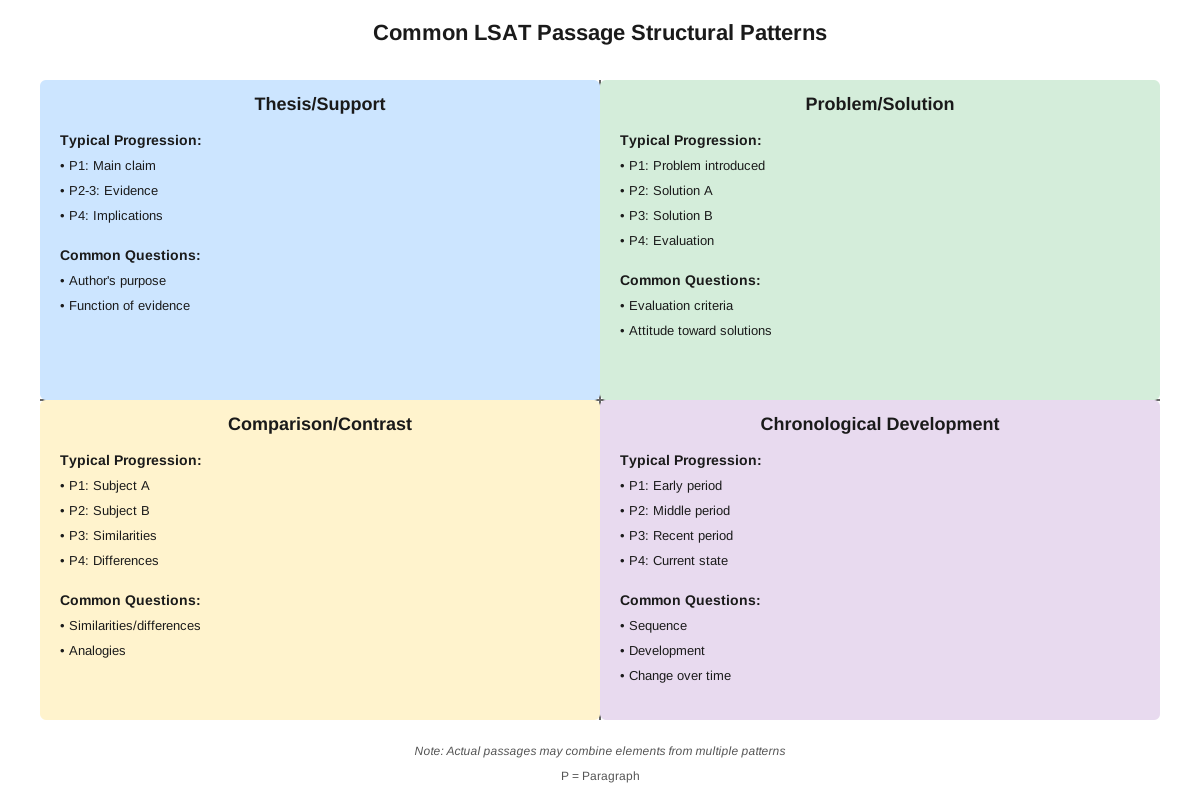
LSAT passages typically follow one of several recognizable organizational patterns:
| Pattern | Description | Typical Structure | Common in |
|---|---|---|---|
| Thesis-Support | Author presents a claim and provides evidence | Paragraph 1: Thesis; Paragraphs 2-3: Supporting evidence; Paragraph 4: Implications | Science, Law |
| Problem-Solution | Issue identified, then resolution proposed | Paragraph 1: Problem description; Paragraph 2: Failed solutions; Paragraph 3-4: Proposed solution | Social Sciences |
| Comparison-Contrast | Two or more subjects analyzed for similarities/differences | Paragraph 1: Introduction; Paragraph 2: Subject A; Paragraph 3: Subject B; Paragraph 4: Synthesis | Humanities, Comparative passages |
| Chronological Development | Ideas or events presented in time sequence | Paragraphs follow historical progression or evolution of thought | History, Science |
| Multiple Perspectives | Different viewpoints on a topic presented | Paragraph 1: Introduction; Paragraphs 2-3: Different perspectives; Paragraph 4: Author's position | Law, Philosophy |
Understanding which pattern a passage follows helps predict where specific information will appear and what questions might be asked.
Structural Keywords and Transitions
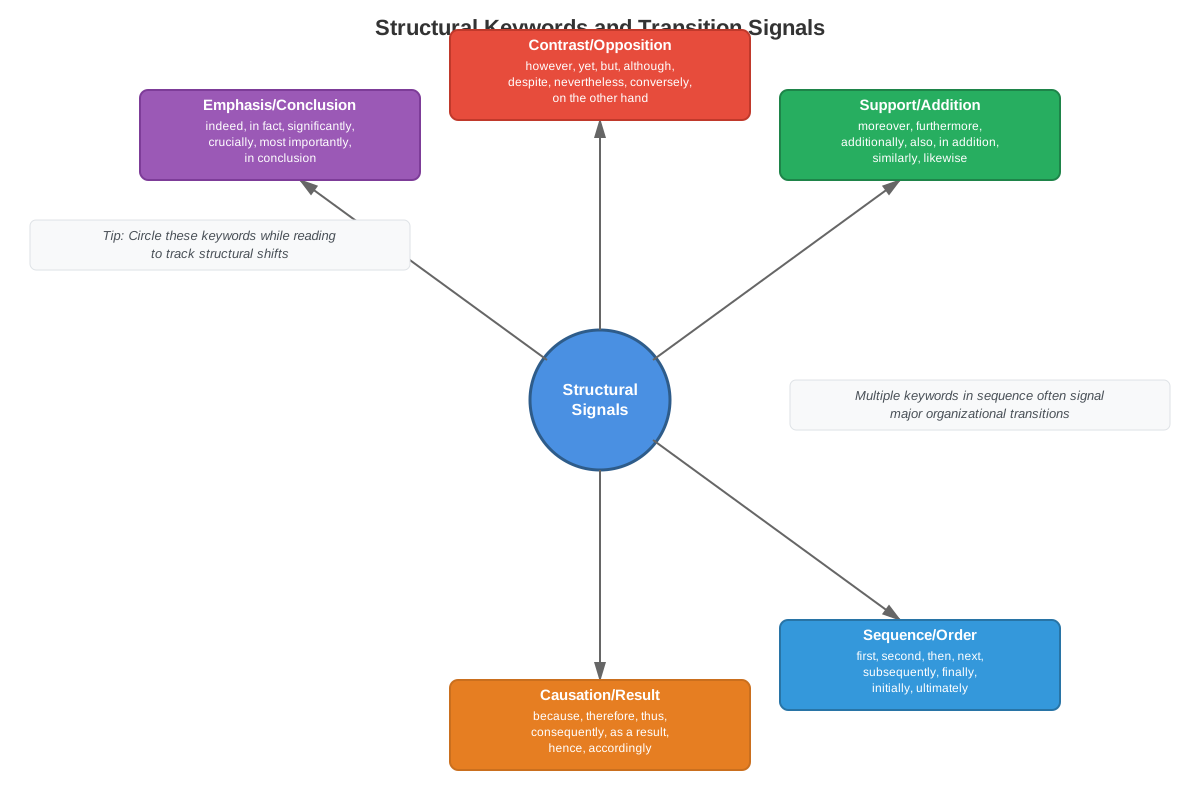
Certain words and phrases signal structural relationships and organizational shifts. These structural keywords function as signposts that guide readers through the passage's architecture:
Continuation signals (same direction): furthermore, additionally, moreover, similarly, likewise, also
Contrast signals (direction change): however, nevertheless, yet, although, despite, in contrast, on the other hand
Cause-effect signals: therefore, thus, consequently, as a result, because, since
Example signals: for instance, for example, to illustrate, such as
Emphasis signals: indeed, in fact, notably, especially, most importantly
Conclusion signals: in conclusion, ultimately, finally, in sum
Recognizing these keywords in real-time allows readers to anticipate structural shifts before they occur, maintaining orientation within the passage's organization.
Paragraph Function Analysis
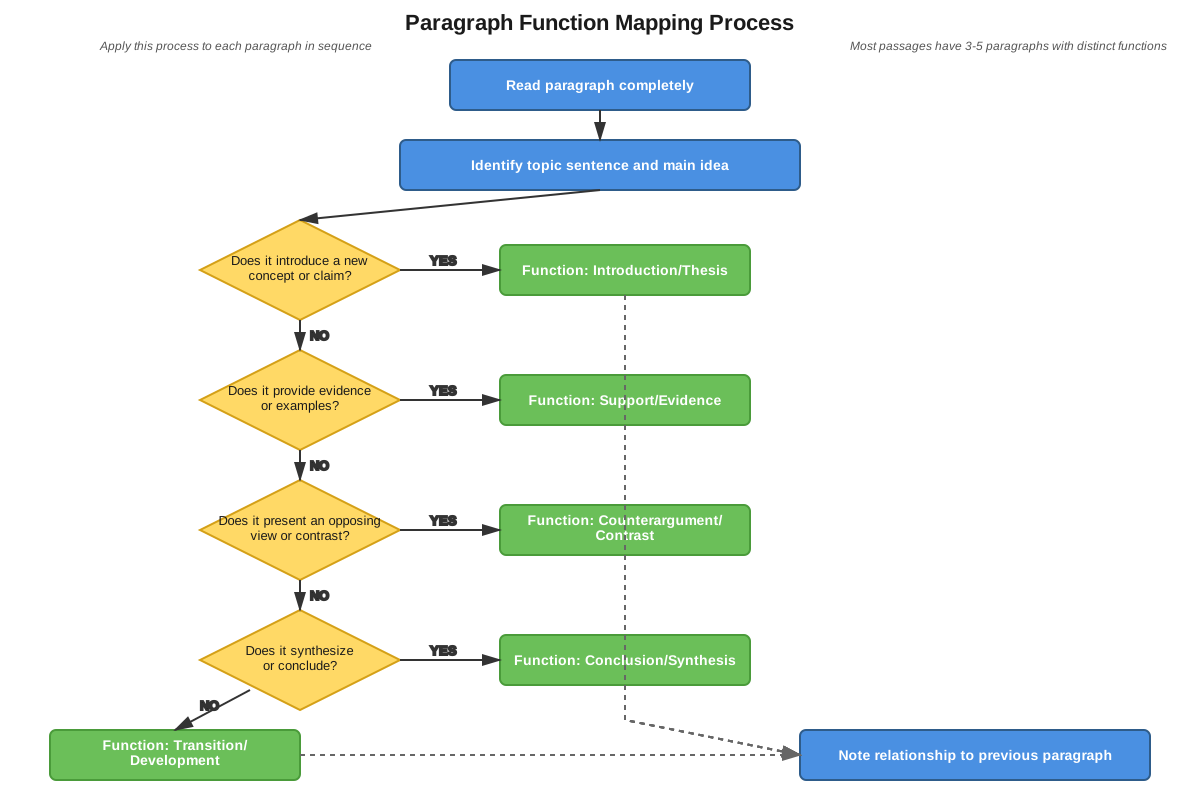
Each paragraph in an LSAT passage serves a specific structural function. Common functions include:
- Introduction/Context-Setting: Establishes the topic, provides background, or frames the discussion
- Thesis Statement: Presents the author's main claim or the passage's central argument
- Evidence/Support: Provides data, examples, or reasoning that supports claims
- Counterargument: Presents opposing views or alternative explanations
- Rebuttal: Responds to counterarguments or explains why alternatives are inadequate
- Elaboration/Explanation: Develops ideas introduced earlier with greater detail
- Synthesis/Conclusion: Integrates previous points or states implications
Identifying each paragraph's function creates a functional map of the passage. For example, a passage might follow this pattern: Paragraph 1 (Context + Thesis) → Paragraph 2 (Supporting Evidence) → Paragraph 3 (Counterargument) → Paragraph 4 (Rebuttal + Implications). This map enables rapid location of information when answering questions.
The Relationship Between Structure and Content
Structure and content are inseparable but distinct. Content refers to what the passage discusses—the specific facts, arguments, and ideas. Structure refers to how that content is organized and why it appears in a particular sequence. A passage about judicial review might present content about Marbury v. Madison, but its structure might be chronological (tracing the doctrine's development) or argumentative (defending a particular interpretation).
The LSAT frequently tests whether students can distinguish between these dimensions. A question might ask about a paragraph's function (structure) rather than its content. For example: "The author mentions the 1954 decision primarily in order to..." requires understanding the structural role of that reference, not just knowing what the decision said.
Structural Prediction and Active Reading
Skilled structural readers engage in continuous prediction. After reading the first paragraph, they predict what might come next based on the structural pattern emerging. If the first paragraph presents a traditional view, they anticipate that subsequent paragraphs might challenge it. If it describes a problem, they expect a solution. This predictive reading creates engagement and improves retention.
Active structural reading involves asking questions while reading: "What is this paragraph doing?" "How does this connect to what came before?" "Why did the author include this information here?" These questions transform passive absorption into active analysis, which is essential for LSAT success.
Concept Relationships
The concepts within reading for structure form an interconnected system. Structural patterns provide the overall framework, while structural keywords signal transitions between sections of that framework. Paragraph function analysis operates within the chosen structural pattern, with each paragraph playing a role in the larger architecture. Structural prediction emerges from recognizing patterns and keywords, enabling anticipation of what comes next.
This topic connects directly to other passage fundamentals. Understanding structure facilitates identifying the main point (usually appearing at a structurally significant location), recognizing the author's purpose (revealed through structural choices), and evaluating arguments (which follow predictable structural patterns). Structure also connects to question strategy—different structural patterns generate predictable question types.
The relationship map flows as follows:
Recognize Structural Pattern → Identify Structural Keywords → Determine Paragraph Functions → Create Mental Map → Predict Information Location → Answer Questions Efficiently
This sequence transforms structural awareness into practical test-taking advantage.
High-Yield Facts
⭐ Approximately 25-30% of LSAT Reading Comprehension questions directly test structural understanding
⭐ The first paragraph typically establishes the structural pattern that the entire passage will follow
⭐ Contrast keywords (however, yet, nevertheless) signal the most important structural shifts and frequently precede testable content
⭐ Questions asking about paragraph function or passage organization require structural analysis, not content recall
⭐ The author's main point typically appears at a structurally significant location: end of first paragraph, beginning of last paragraph, or immediately after a major contrast keyword
- Structural patterns are predictable: most passages follow thesis-support, problem-solution, comparison-contrast, chronological, or multiple-perspectives organization
- Each paragraph serves exactly one primary structural function, though it may serve secondary functions as well
- Transition words between paragraphs reveal relationships: "Furthermore" indicates continuation, "However" indicates contrast, "For example" indicates illustration
- The longest paragraph often contains the most detailed evidence or the most complex argument, making it a frequent source of questions
- Comparative passages (two shorter passages on related topics) always follow a comparison-contrast structure at the macro level
- Questions using phrases like "serves primarily to," "functions to," or "in order to" are testing structural understanding
- The conclusion paragraph often synthesizes earlier points or states implications, making it crucial for main point questions
Quick check — test yourself on Reading for structure so far.
Try Flashcards →Common Misconceptions
Misconception: Reading for structure means ignoring content and only focusing on organization.
Correction: Effective structural reading integrates content and organization simultaneously. Understanding what the passage says is necessary for understanding how it's organized. The goal is to read for both dimensions at once, not to sacrifice one for the other.
Misconception: All LSAT passages follow the same structural pattern.
Correction: While certain patterns are common, passages vary significantly in organization. Part of structural reading skill is quickly identifying which pattern a particular passage follows rather than forcing every passage into the same template.
Misconception: Structural keywords always appear at paragraph boundaries.
Correction: While transitions between paragraphs are important, crucial structural keywords often appear mid-paragraph, signaling shifts in direction or emphasis within a single paragraph's discussion. Readers must remain alert throughout each paragraph.
Misconception: The first sentence of each paragraph always reveals that paragraph's function.
Correction: While topic sentences often appear first, some paragraphs begin with transitional material or context before stating their main functional purpose. The entire paragraph must be considered to determine its structural role accurately.
Misconception: Reading for structure takes too much time and slows down passage completion.
Correction: Initially, conscious structural analysis may feel slower, but with practice, it becomes automatic and actually speeds up both reading and question-answering. Students who master structural reading typically complete the section faster overall because they can locate information and eliminate wrong answers more efficiently.
Misconception: Structure questions are easier than content questions because they don't require understanding details.
Correction: Structure questions often require deeper understanding than simple detail questions. They demand comprehension of relationships, purposes, and organizational logic—higher-level cognitive skills that many students find more challenging than simple recall.
Worked Examples
Example 1: Identifying Structural Pattern and Paragraph Functions
Passage Excerpt (abbreviated for illustration):
Paragraph 1: Traditional economic theory assumes that consumers make rational decisions based on complete information. This assumption has guided policy-making for decades.
Paragraph 2: However, recent research in behavioral economics challenges this assumption. Studies by Kahneman and Tversky demonstrate that cognitive biases systematically distort decision-making.
Paragraph 3: For example, the "anchoring effect" causes consumers to rely too heavily on the first piece of information encountered, even when that information is irrelevant. In one experiment, participants shown a higher initial price consistently estimated values higher than those shown a lower initial price.
Paragraph 4: These findings suggest that policy-makers should reconsider regulations based on the rational actor model. Consumer protection laws might need strengthening to account for predictable irrationality.
Question: The organization of the passage is best described as:
(A) A theory is presented, then refined through additional evidence
(B) A traditional view is described, then challenged with contrary evidence and implications discussed
(C) Two competing theories are compared and a synthesis is proposed
(D) A problem is identified and multiple solutions are evaluated
(E) A chronological account of a field's development is provided
Structural Analysis:
Step 1: Identify each paragraph's function
- Paragraph 1: Introduces traditional view (context-setting)
- Paragraph 2: Challenges that view with contrast keyword "However" (counterargument to traditional view)
- Paragraph 3: Provides specific evidence supporting the challenge (supporting evidence)
- Paragraph 4: States implications of the challenge (conclusion/implications)
Step 2: Recognize the overall pattern
This follows a traditional view challenged pattern: Old view → Challenge → Evidence for challenge → Implications
Step 3: Evaluate answer choices structurally
- (A) Incorrect: The theory isn't refined; it's challenged and potentially replaced
- (B) Correct: Matches the identified pattern exactly
- (C) Incorrect: Only one alternative view is presented, not two competing theories with synthesis
- (D) Incorrect: No problem-solution structure; this is challenge-to-traditional-view structure
- (E) Incorrect: Not chronological; the organization is argumentative, not temporal
Answer: (B)
Connection to Learning Objectives: This example demonstrates how identifying structural patterns and paragraph functions enables accurate answering of organization questions without getting lost in content details.
Example 2: Using Structure to Predict Information Location
Passage Excerpt (abbreviated):
Paragraph 1: The doctrine of judicial review, established in Marbury v. Madison, grants courts the power to invalidate laws conflicting with the Constitution. This power has shaped American governance for over two centuries.
Paragraph 2: Proponents argue that judicial review protects minority rights against majoritarian tyranny. Without courts checking legislative power, they contend, fundamental rights would be vulnerable to popular prejudice.
Paragraph 3: Critics, however, maintain that judicial review is fundamentally undemocratic. Unelected judges, they argue, should not override the decisions of elected representatives, as this substitutes judicial preferences for popular will.
Paragraph 4: Yet this criticism overlooks the Constitution's counter-majoritarian design. The framers intentionally created institutions insulated from immediate popular pressure to protect enduring principles against temporary passions.
Question: The passage suggests that the framers of the Constitution would most likely have agreed with which of the following?
Structural Analysis:
Step 1: Identify where the author's position appears
- Paragraphs 2-3 present opposing views (proponents vs. critics)
- Paragraph 4 begins with "Yet," a contrast keyword, suggesting the author is responding to the critics
- The author's position appears in Paragraph 4
Step 2: Recognize the structural pattern
This follows: Introduction → View A → View B → Author's position (which sides with View A against View B)
Step 3: Predict information location
Since the question asks about the framers' views, and Paragraph 4 discusses the framers' intentions while defending judicial review, the answer must come from Paragraph 4's content about counter-majoritarian design.
Step 4: Apply structural understanding
The author uses the framers' intentions to rebut critics, suggesting the framers would have supported judicial review as consistent with their counter-majoritarian design.
Connection to Learning Objectives: This example shows how structural awareness enables prediction of where specific information will appear, allowing efficient navigation during question-answering and demonstrating the reasoning pattern behind structural reading.
Exam Strategy
Approaching Structure Questions
When encountering questions about passage organization or paragraph function, follow this systematic approach:
- Identify the question type: Look for trigger phrases like "organization of the passage," "serves primarily to," "functions to," or "proceeds by"
- Consult your mental map: Before looking at answer choices, recall the structural pattern you identified while reading
- Match pattern to choices: Eliminate answers that describe different structural patterns than the one you identified
- Verify with keywords: Check that the correct answer accounts for major structural keywords (especially contrast words) that appeared in the passage
Trigger Words and Phrases
Questions testing structural understanding typically include these phrases:
- "The organization of the passage is best described as..."
- "The author's discussion of X serves primarily to..."
- "The passage proceeds by..."
- "The relationship between paragraphs X and Y is..."
- "The function of the third paragraph is to..."
- "The author mentions X in order to..."
Exam Tip: When you see "primarily" or "mainly" in a structure question, the correct answer identifies the paragraph's or passage's primary structural function, not every detail it contains. Wrong answers often describe secondary or incidental aspects.
Process of Elimination Strategy
For structure questions, eliminate answers that:
- Describe content not present in the passage (e.g., "compares three theories" when only two are discussed)
- Misidentify the sequence (e.g., "presents a solution then describes the problem")
- Confuse structural function with content (e.g., "describes judicial review" instead of "challenges a traditional view")
- Overstate or understate the author's position (e.g., "definitively proves" vs. "suggests")
Time Allocation
Invest 30-45 seconds during initial reading to identify the structural pattern and note each paragraph's function. This upfront investment saves 60-90 seconds during question-answering by enabling rapid location of information and quick elimination of structurally incompatible answers. For structure questions specifically, spend 15-20 seconds confirming your structural understanding before evaluating choices, rather than reading each choice and checking it against the passage.
Active Reading Techniques
While reading, create brief marginal notes (mental or written) identifying each paragraph's function: "Intro," "Trad view," "Challenge," "Evidence," "Implications." These notes create a visual/mental map that facilitates navigation. Also, mark major structural keywords (however, therefore, for example) as you encounter them—these mark the passage's structural skeleton.
Memory Techniques
The MAPS Acronym for Structural Reading
Main pattern: Identify the overall organizational structure (thesis-support, problem-solution, etc.)
Architecture: Note each paragraph's function within that structure
Pivots: Mark contrast keywords and major transitions
Synthesis: Understand how parts connect to form the whole
Visualization Strategy: The Building Metaphor
Think of passage structure as a building:
- Foundation = Introduction/context (Paragraph 1)
- Supporting pillars = Evidence paragraphs (Paragraphs 2-3)
- Roof = Conclusion/implications (Paragraph 4)
- Doorways = Transition words connecting sections
This metaphor helps remember that structure provides the framework supporting content, just as a building's structure supports its interior.
The "However Hunt" Technique
The most important structural keyword is "however" (and its synonyms: yet, nevertheless, but, although). Train yourself to immediately heighten attention when encountering these words. Create a mental rule: "However" = "Pay attention—something important is shifting." Most LSAT passages contain 2-4 major contrast keywords, and these typically mark the most testable structural shifts.
Paragraph Function Checklist
Memorize common paragraph functions using the acronym ICEERS:
- Introduction
- Counterargument
- Evidence
- Elaboration
- Rebuttal
- Synthesis
When reading each paragraph, mentally check which function it serves from this list.
Summary
Reading for structure is the foundational skill for LSAT Reading Comprehension success, requiring test-takers to analyze how passages are organized rather than merely absorbing content. This skill involves recognizing common structural patterns (thesis-support, problem-solution, comparison-contrast, chronological, multiple perspectives), identifying structural keywords that signal organizational shifts, determining each paragraph's functional role, and creating mental maps that facilitate efficient navigation. Approximately 25-30% of Reading Comprehension questions directly test structural understanding through questions about passage organization, paragraph function, and relationships between sections. Beyond these explicit structure questions, structural awareness enables faster information location, more accurate prediction of question types, and more efficient elimination of wrong answers across all question types. Mastery requires simultaneous attention to both content and organization, recognition of structural patterns within the first paragraph, and active engagement through continuous prediction of what will come next based on emerging patterns.
Key Takeaways
- Reading for structure means analyzing passage organization—how ideas are arranged and why—not just absorbing content
- The five most common structural patterns are thesis-support, problem-solution, comparison-contrast, chronological development, and multiple perspectives
- Structural keywords (especially contrast words like "however") signal the most important organizational shifts and frequently precede testable content
- Each paragraph serves one primary structural function: introduction, thesis, evidence, counterargument, rebuttal, elaboration, or synthesis
- Structure questions use trigger phrases like "serves primarily to," "functions to," "organization of the passage," and "proceeds by"
- Creating a mental map of paragraph functions during initial reading saves significant time during question-answering
- The author's main point typically appears at structurally significant locations: after major contrast keywords, at the end of the first paragraph, or in the conclusion
Related Topics
Main Point Identification: Understanding passage structure directly facilitates identifying main points, as these typically appear at structurally significant locations (after major transitions, in concluding paragraphs, or following contrast keywords). Mastering structural reading makes main point questions significantly easier.
Author's Purpose and Tone: An author's structural choices reveal their purpose—whether to persuade, explain, compare, or critique. The organizational pattern selected reflects the author's goals and attitude toward the subject matter.
Argument Analysis: Arguments follow predictable structural patterns (claim-evidence-conclusion), and recognizing these patterns enables more effective evaluation of logical reasoning within passages.
Comparative Passages: The two-passage format always involves comparison-contrast structure at the macro level, making structural reading skills essential for efficiently handling this passage type.
Question Prediction: Advanced structural reading enables prediction of likely question types based on passage organization, allowing strategic allocation of attention during initial reading.
Practice CTA
Now that you understand the principles of reading for structure, it's time to apply these concepts to actual LSAT passages. The practice questions and flashcards will reinforce your ability to identify structural patterns, recognize paragraph functions, and answer structure questions efficiently. Remember: structural reading feels unnatural at first but becomes automatic with practice. Each passage you analyze strengthens your structural awareness, building the foundation for Reading Comprehension mastery. Start practicing now—your improved efficiency and accuracy will demonstrate the power of reading for structure!
Sign up free to keep reading
Create a free AnvayaPrep account to finish this LSAT guide on Reading for structure — plus flashcards and practice questions.