Overview
Author-heavy passages represent a distinct category of LSAT reading comprehension passages in which the author's perspective, opinions, arguments, and rhetorical choices take center stage. Unlike passages that primarily present objective information or describe others' theories, author-heavy passages foreground what the author thinks, believes, argues, or advocates. These passages require test-takers to track not just what is being discussed, but how the author positions themselves relative to the subject matter—whether they're critiquing existing views, proposing new frameworks, or evaluating competing theories.
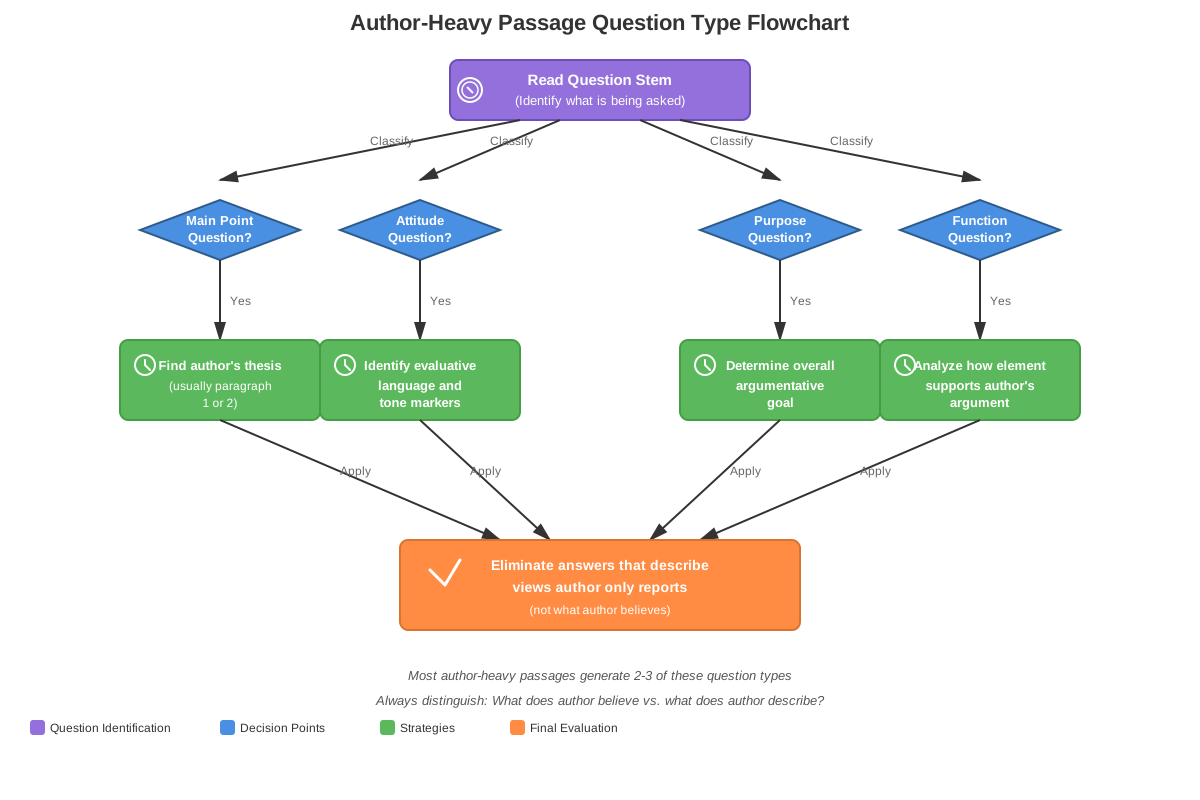
Understanding author-heavy passages is essential for LSAT success because they appear frequently across all four reading comprehension passages in each test section, and they generate a disproportionate number of questions about authorial attitude, purpose, tone, and argumentative structure. The LSAT tests your ability to distinguish between information the author merely reports versus claims the author endorses, to recognize subtle shifts in the author's stance, and to identify the rhetorical strategies the author employs to advance their argument. Mastery of these passages directly impacts performance on question types including Main Point, Primary Purpose, Author's Attitude, Function, and Strengthen/Weaken questions.
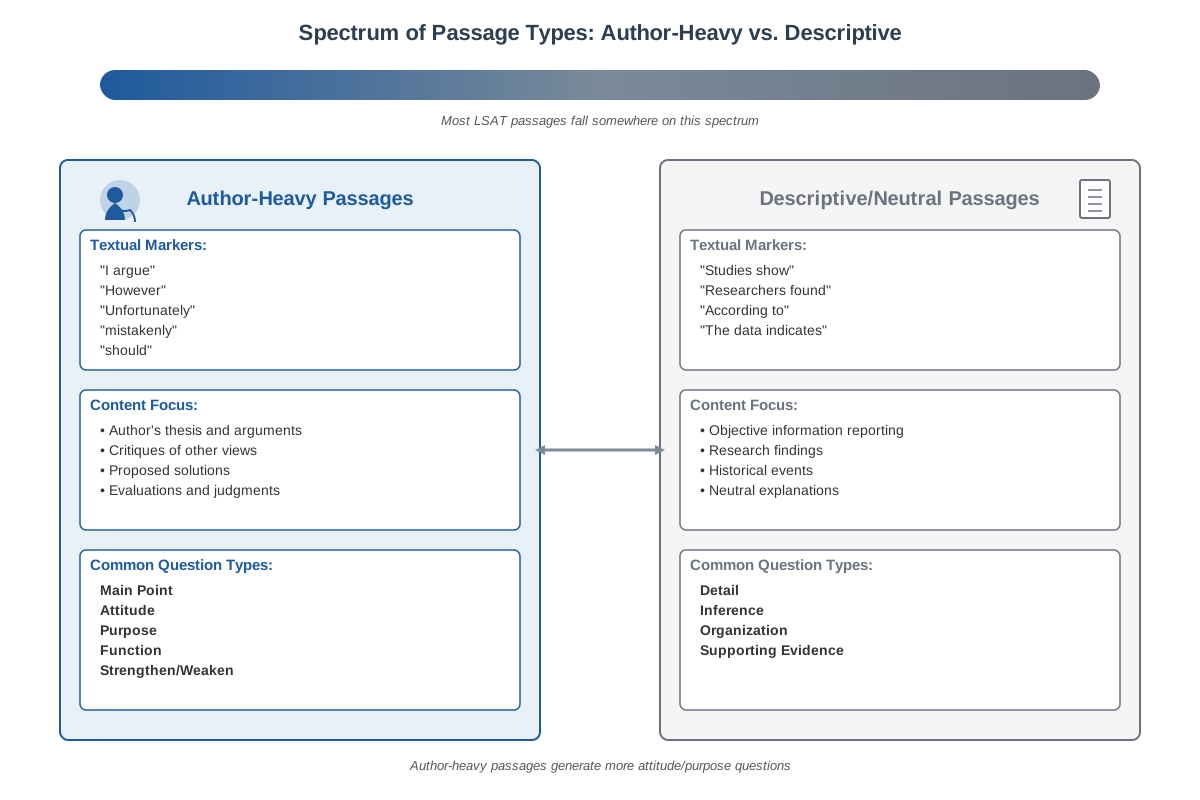
Within the broader framework of passage subjects and strategies, author-heavy passages represent one end of a spectrum. While some passages function primarily as neutral expositions of scientific findings or historical events, author-heavy passages demand that readers engage with an argumentative voice. This topic connects intimately with skills in identifying argument structure, recognizing rhetorical devices, tracking viewpoint shifts, and distinguishing between descriptive and evaluative language—all fundamental competencies for LSAT reading comprehension success.
Learning Objectives
- [ ] Identify how author-heavy passages appear in LSAT questions
- [ ] Explain the reasoning pattern behind author-heavy passages
- [ ] Apply author-heavy passages to solve LSAT-style problems accurately
- [ ] Distinguish between author's views and views the author merely describes or reports
- [ ] Recognize textual markers that signal authorial opinion, evaluation, or argument
- [ ] Predict question types most likely to accompany author-heavy passages
- [ ] Analyze how authors use rhetorical strategies to advance their arguments in these passages
Prerequisites
- Basic argument structure recognition: Understanding premises, conclusions, and supporting evidence is essential because author-heavy passages are fundamentally argumentative texts where the author advances claims.
- Familiarity with LSAT question types: Knowing the difference between Main Point, Primary Purpose, Inference, and Attitude questions helps recognize how author-heavy passages generate specific question patterns.
- Reading comprehension fundamentals: The ability to identify topic sentences, track paragraph transitions, and recognize contrast indicators provides the foundation for tracking authorial voice.
- Understanding of viewpoint indicators: Recognizing language that signals opinion versus fact allows students to distinguish what the author believes from what they merely report.
Why This Topic Matters
Author-heavy passages matter because they test a critical real-world skill: the ability to understand and evaluate arguments presented by others. Legal professionals must constantly analyze how authors of legal briefs, judicial opinions, and scholarly articles position themselves relative to legal questions. The capacity to identify an author's thesis, recognize their argumentative strategy, and distinguish their views from those they discuss is fundamental to legal reasoning.
On the LSAT, author-heavy passages appear in approximately 50-70% of reading comprehension passages, making them one of the most frequent passage types. These passages generate the highest concentration of questions about authorial purpose, attitude, and argumentative structure—question types that collectively represent 30-40% of all reading comprehension questions. Author-heavy passages commonly appear in humanities passages (literary criticism, philosophy, art theory) and social science passages (critiques of economic theories, evaluations of historical interpretations), though they can emerge in any subject area when an author takes a strong evaluative stance.
The LSAT specifically tests author-heavy passages through questions asking: "The author's primary purpose is to...," "The author's attitude toward X can best be described as...," "The author mentions Y primarily in order to...," and "Which one of the following most accurately describes the organization of the passage?" These question types require precise understanding of not just what the passage says, but why the author structured it that way and what argumentative goals the author pursues.
Core Concepts
Defining Author-Heavy Passages
Author-heavy passages are reading comprehension passages in which the author's voice, perspective, argument, or evaluation dominates the text. Rather than serving as a neutral conduit for information, the author actively engages with the subject matter by critiquing theories, proposing alternatives, evaluating evidence, or advocating for particular interpretations. The defining characteristic is that understanding the passage requires tracking what the author thinks, not merely what the passage discusses.
These passages contrast with information-heavy passages, where the author primarily reports facts, describes processes, or explains theories without taking strong evaluative stances. In author-heavy passages, the author's thesis—their central claim or argument—provides the organizational backbone, and supporting paragraphs advance this thesis through evidence, examples, and reasoning.
Textual Markers of Author-Heavy Passages
Several linguistic features signal that a passage is author-heavy:
Evaluative language: Words expressing judgment, assessment, or opinion indicate authorial voice. Examples include "unfortunately," "surprisingly," "correctly," "mistakenly," "overlooks," "fails to recognize," "successfully demonstrates," and "convincingly argues."
First-person constructions: Though less common in LSAT passages, occasional use of "I argue," "I contend," or "we should recognize" explicitly marks authorial opinion.
Contrast indicators with evaluative weight: Phrases like "however," "but," "yet," and "nevertheless" often introduce the author's own view in contrast to views they've described. When these transitions are followed by evaluative language, they signal the author's argumentative turn.
Rhetorical questions: Questions posed by the author often introduce positions the author will challenge or support, serving as argumentative devices rather than genuine inquiries.
Modal verbs expressing necessity or obligation: "Must," "should," "ought to," and "need to" frequently express authorial prescription or evaluation.
The Author's Thesis and Argumentative Structure
In author-heavy passages, identifying the author's thesis—their main argumentative claim—is paramount. The thesis typically appears in one of three locations:
- Early in the passage (often paragraph 1): The author states their position upfront, then spends subsequent paragraphs supporting it
- After presenting opposing views (often late paragraph 1 or early paragraph 2): The author describes existing theories or conventional wisdom, then introduces their contrasting view
- At the passage's conclusion: The author builds through analysis and evidence toward a final evaluative claim
The argumentative structure in author-heavy passages typically follows predictable patterns:
| Structure Type | Description | Example Signal |
|---|---|---|
| Critique-and-Alternative | Author criticizes existing view, proposes better approach | "While scholars have traditionally believed X, this view overlooks..." |
| Evaluation-of-Evidence | Author assesses whether evidence supports a claim | "The data, however, suggests a different interpretation..." |
| Comparative-Assessment | Author weighs competing theories or approaches | "Although both theories have merit, Theory A better accounts for..." |
| Defense-Against-Criticism | Author supports a view against objections | "Despite critics' concerns, the approach remains valid because..." |
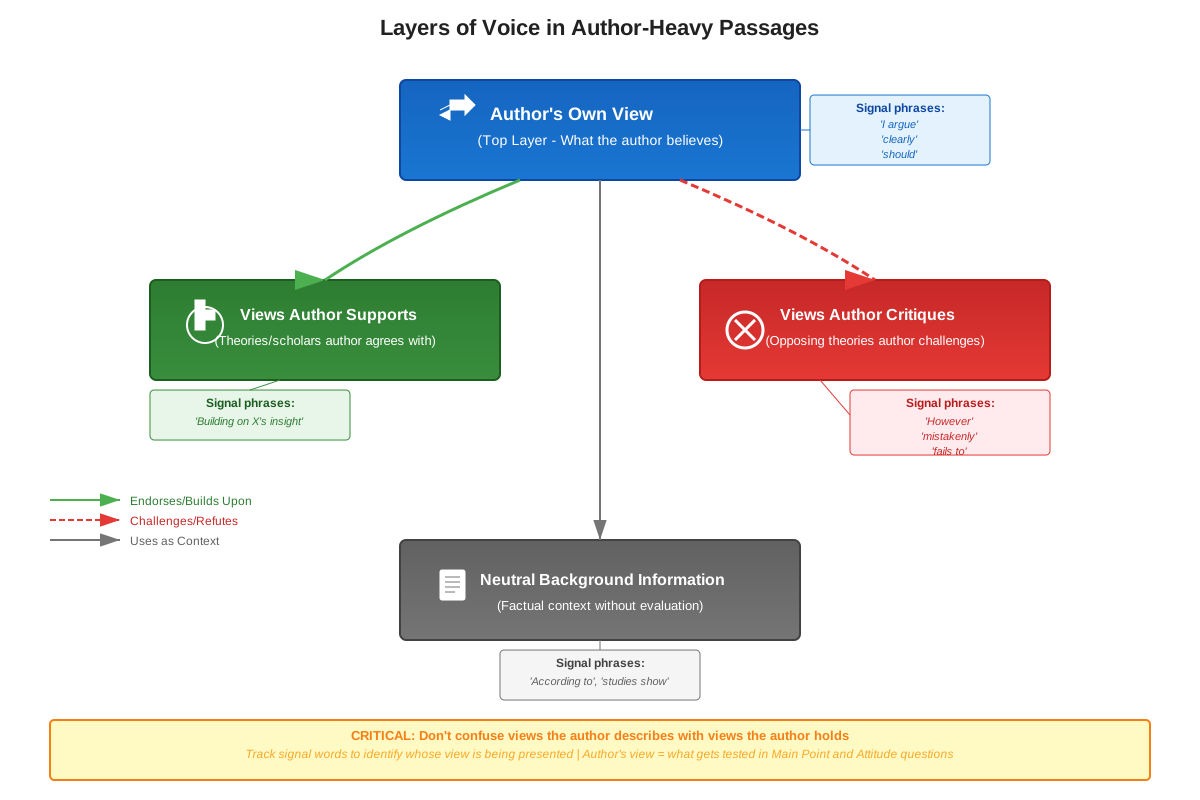
Distinguishing Author's Views from Reported Views
A critical skill for author-heavy passages is distinguishing between:
Views the author endorses: Claims the author believes, supports, or argues for
Views the author describes: Positions held by others that the author reports without necessarily endorsing
Views the author critiques: Positions the author explicitly or implicitly rejects
The LSAT frequently tests this distinction by asking which statement the author would agree with or by presenting answer choices that confuse reported views with the author's own position.
Attribution markers help make this distinction:
- "According to scholars..." (reported view)
- "Critics argue..." (reported view, often one the author will challenge)
- "As I will demonstrate..." (author's view)
- "In fact..." (often introduces author's view, especially after reporting others' views)
- "Actually..." (similar to "in fact," signals author's corrective)
Authorial Tone and Attitude
Tone refers to the author's emotional stance or attitude toward the subject matter. In author-heavy passages, tone questions are common and require careful attention to evaluative language. Common tones include:
- Critical/skeptical: Author questions or challenges a view
- Supportive/approving: Author endorses or defends a position
- Qualified/cautious: Author sees merit but notes limitations
- Enthusiastic/optimistic: Author strongly supports with positive language
- Concerned/worried: Author sees problems or dangers
Tone is rarely extreme on the LSAT. Answer choices like "contemptuous," "dismissive," or "unqualified enthusiasm" are usually incorrect. The LSAT favors measured, academic tones like "cautiously optimistic," "mildly critical," or "qualified approval."
Rhetorical Purpose and Function
In author-heavy passages, every element serves the author's argumentative purpose. Understanding rhetorical function—why the author includes specific information—is essential. Common functions include:
- Providing background: Establishing context for the author's argument
- Presenting a view to critique: Introducing a position the author will challenge
- Offering supporting evidence: Providing data or examples that support the author's thesis
- Anticipating objections: Addressing potential counterarguments to strengthen the author's position
- Illustrating through example: Making abstract claims concrete
- Establishing credibility: Demonstrating the author's expertise or fairness
Function questions ask "The author mentions X primarily in order to..." or "The author's discussion of Y serves to..." Answering these requires understanding how each part advances the author's overall argumentative goal.
Concept Relationships
The concepts within author-heavy passages form an interconnected system. Textual markers signal the presence of authorial voice, which expresses the author's thesis. This thesis organizes the passage's argumentative structure, which deploys various rhetorical functions to advance the argument. Throughout, the author's tone and attitude color the presentation, and readers must constantly distinguish the author's views from reported views to accurately track the argument.
This topic connects to prerequisite knowledge of argument structure because author-heavy passages are essentially extended arguments where premises support the author's thesis-as-conclusion. The skill of identifying viewpoint indicators from basic reading comprehension becomes more sophisticated here, as students must track not just who holds which view, but how the author positions themselves relative to multiple viewpoints.
Author-heavy passages also connect forward to advanced topics in comparative reading passages, where students must track two authors' potentially differing perspectives, and to question-type strategies, where understanding authorial purpose directly informs approaches to Primary Purpose, Main Point, and Function questions.
Relationship map: Textual markers → Signal authorial voice → Express thesis → Organize argumentative structure → Deploy rhetorical functions → Convey tone/attitude → Generate specific question types (Purpose, Attitude, Function)
High-Yield Facts
⭐ Author-heavy passages generate 30-40% of all reading comprehension questions, making them the highest-yield passage type for focused study.
⭐ The author's thesis typically appears in the first or second paragraph, often immediately after presenting a view the author will challenge.
⭐ Evaluative language (unfortunately, surprisingly, mistakenly, correctly) is the most reliable marker of authorial opinion rather than neutral reporting.
⭐ Contrast indicators (however, but, yet, nevertheless) frequently introduce the author's own view after describing others' positions.
⭐ The LSAT rarely uses extreme tones; answer choices suggesting "contempt," "dismissiveness," or "unqualified enthusiasm" are usually incorrect.
- Author-heavy passages most commonly appear in humanities and social science passages, though they can occur in any subject area.
- Questions asking "The author's primary purpose is to..." require identifying the author's main argumentative goal, not just the passage topic.
- Attribution markers like "according to scholars" or "critics argue" signal reported views that may differ from the author's position.
- Function questions about why the author mentions specific information require understanding how that information advances the author's thesis.
- The author's attitude toward different elements in the passage may vary—they might support one theory while critiquing another.
- Rhetorical questions in author-heavy passages typically introduce positions the author will either support or challenge.
- The conclusion of author-heavy passages often contains the author's strongest evaluative claim or most direct statement of their thesis.
- When the author presents multiple views, the view receiving the most detailed support or positive evaluation is typically the author's own.
Quick check — test yourself on Author-heavy passages so far.
Try Flashcards →Common Misconceptions
Misconception: If the passage discusses a theory extensively, the author must support that theory.
Correction: Authors often discuss theories at length precisely to critique them. Extensive discussion indicates importance to the passage structure, not necessarily authorial endorsement. Look for evaluative language to determine the author's actual stance.
Misconception: The author's view is always stated explicitly with phrases like "I argue" or "I believe."
Correction: LSAT passages rarely use first-person constructions. The author's view is more commonly signaled through evaluative language, contrast indicators, and the weight of evidence presented. The view receiving the most support and positive evaluation is typically the author's.
Misconception: Everything in the passage represents the author's opinion.
Correction: Author-heavy passages frequently present multiple viewpoints, including positions the author describes but doesn't endorse. Distinguishing reported views from the author's views is a core skill tested by the LSAT.
Misconception: Strong language always indicates strong authorial commitment.
Correction: Authors may use strong language when describing others' views ("Critics vehemently oppose...") without sharing that intensity. Always check whether strong language appears in attributed or authorial voice.
Misconception: The main point and primary purpose are the same thing.
Correction: The main point is the author's central claim (what they argue), while the primary purpose is their argumentative goal (why they wrote the passage—to critique, to propose, to evaluate, etc.). A passage's primary purpose might be "to critique a traditional interpretation," while its main point is the specific criticism offered.
Misconception: If the author presents both sides of an issue, they must be neutral.
Correction: Presenting multiple perspectives is often a rhetorical strategy to demonstrate fairness before advocating for one position. Look for which view receives more support, more positive evaluation, or appears after contrast indicators.
Misconception: The author's tone is consistent throughout the passage.
Correction: Authors may be critical toward one theory while supportive of another, or cautiously optimistic about a proposal while concerned about its implementation. Track tone toward specific elements, not just overall passage tone.
Worked Examples
Example 1: Identifying Author's Thesis and Distinguishing Views
Passage excerpt:
"Traditional art historians have long maintained that Renaissance portraiture served primarily to display wealth and social status. According to this view, the elaborate clothing, jewelry, and settings depicted in portraits functioned as visual inventories of the sitter's possessions and position. However, this interpretation overlooks the psychological complexity evident in many Renaissance portraits. The subtle expressions, averted gazes, and carefully composed poses suggest that artists and patrons were equally concerned with conveying interior states and individual personality. Rather than mere status symbols, these portraits represent early explorations of human subjectivity."
Question: The author's primary purpose in the passage is to:
(A) Describe the traditional interpretation of Renaissance portraiture
(B) Challenge an established view about the function of Renaissance portraits
(C) Explain why Renaissance portraits displayed wealth
(D) Compare Renaissance portraiture with earlier artistic traditions
(E) Analyze the techniques Renaissance artists used in portraits
Analysis:
Step 1: Identify textual markers of authorial voice.
- "According to this view" (line 2) signals a reported view, not the author's
- "However" (line 4) is a contrast indicator suggesting the author's view follows
- "overlooks" (line 4) is evaluative language indicating criticism
- "suggest" (line 6) introduces evidence for the author's alternative interpretation
- "Rather than" (line 7) explicitly contrasts the traditional view with the author's
Step 2: Distinguish reported views from author's view.
- Reported view: Traditional historians believe portraits displayed wealth and status
- Author's view: This interpretation overlooks psychological complexity; portraits explored human subjectivity
Step 3: Identify the author's thesis.
The author's thesis appears after "However": Renaissance portraits conveyed interior states and personality, not just status.
Step 4: Determine the author's primary purpose.
The author describes a traditional view in order to challenge it with an alternative interpretation. This is a critique-and-alternative structure.
Answer: (B) Challenge an established view about the function of Renaissance portraits
Why other answers are wrong:
- (A) describes what the author does in the first part, but not their primary purpose
- (C) represents the traditional view the author challenges, not the author's purpose
- (D) introduces a comparison not present in the passage
- (E) focuses on technique rather than the interpretive debate that is the passage's focus
Example 2: Determining Author's Attitude
Passage excerpt:
"Recent proposals to address climate change through large-scale geoengineering projects have attracted considerable attention from policymakers. Proponents argue that technologies such as stratospheric aerosol injection could rapidly reduce global temperatures, buying time for emissions reductions. While the technical feasibility of such interventions is not in question, their wisdom certainly is. The potential for unintended consequences—disrupted weather patterns, damage to the ozone layer, and unpredictable regional effects—remains poorly understood. Moreover, the availability of a technological 'fix' might reduce political will to address the root cause: greenhouse gas emissions. A more prudent approach would prioritize emissions reductions while supporting research into geoengineering only as a last resort."
Question: The author's attitude toward large-scale geoengineering projects can best be described as:
(A) Unqualified opposition
(B) Enthusiastic support
(C) Cautious skepticism
(D) Neutral objectivity
(E) Mild curiosity
Analysis:
Step 1: Identify tone markers.
- "While the technical feasibility...is not in question, their wisdom certainly is" (lines 3-4): Concedes technical possibility but questions judgment—qualified criticism
- "potential for unintended consequences" (line 5): Expresses concern
- "remains poorly understood" (line 6): Indicates uncertainty and caution
- "Moreover" (line 6): Adds additional criticism
- "might reduce political will" (line 7): Expresses worry about negative effects
- "more prudent approach" (line 8): Evaluative language favoring alternative
- "only as a last resort" (line 9): Conditional, limited acceptance
Step 2: Assess the overall tone.
The author acknowledges technical feasibility (not completely dismissive) but raises multiple concerns and advocates for a different approach. This is neither neutral nor enthusiastic, but critical with qualifications.
Step 3: Match to answer choices.
- (A) "Unqualified opposition" is too extreme; the author accepts geoengineering "as a last resort"
- (B) "Enthusiastic support" contradicts the passage's critical tone
- (C) "Cautious skepticism" captures both the concerns raised and the qualified acceptance
- (D) "Neutral objectivity" ignores the evaluative language and advocacy for an alternative
- (E) "Mild curiosity" understates the author's substantive concerns
Answer: (C) Cautious skepticism
The author is skeptical (questions wisdom, raises concerns, advocates alternative) but cautious rather than dismissive (acknowledges feasibility, allows for last-resort use).
Exam Strategy
Approaching Author-Heavy Passages
Step 1: Identify the passage type early. As you read the first paragraph, watch for evaluative language, contrast indicators, and attribution markers. If you spot these, you're likely dealing with an author-heavy passage.
Step 2: Actively track the author's thesis. Ask yourself: "What is the author arguing?" Write a brief note in the margin when you identify the thesis. This becomes your anchor for answering questions.
Step 3: Mark viewpoint shifts. Use brackets or underlining to distinguish reported views from the author's views. When you see "Critics argue..." or "According to traditional interpretations...", mark it as a reported view. When you see "However" or "In fact" followed by evaluative language, mark it as the author's view.
Step 4: Note the author's tone toward different elements. The author might be critical of Theory A but supportive of Theory B. Track these distinctions rather than assuming uniform tone.
Trigger Words and Phrases
Watch for these indicators of authorial opinion:
- Evaluative adjectives: "unfortunate," "surprising," "mistaken," "correct," "flawed," "successful"
- Modal verbs: "should," "must," "ought to," "need to"
- Contrast indicators: "however," "but," "yet," "nevertheless," "in fact," "actually"
- Intensifiers: "clearly," "obviously," "certainly," "undoubtedly" (when not attributed to others)
Watch for these indicators of reported views:
- Attribution phrases: "according to," "scholars argue," "critics claim," "the traditional view holds"
- Distancing language: "supposedly," "allegedly," "purportedly"
Process-of-Elimination Tips
For Primary Purpose questions:
- Eliminate answers that describe only part of the passage (usually the first paragraph)
- Eliminate answers that focus on reported views rather than the author's argument
- Eliminate answers that are too narrow (specific examples) or too broad (topics not discussed)
For Attitude questions:
- Eliminate extreme tones first (contempt, dismissiveness, unqualified enthusiasm)
- Eliminate neutral tones if you've identified evaluative language
- Choose answers that match both the direction (positive/negative) and intensity (strong/mild) of the author's language
For Function questions:
- Eliminate answers that describe what the information is rather than why the author included it
- Eliminate answers that contradict the author's thesis
- Choose answers that show how the information advances the author's argumentative goal
Time Allocation
Spend slightly more time on the initial read of author-heavy passages (4-4.5 minutes instead of 3.5-4 minutes) because tracking viewpoints and identifying the thesis during the first read saves time on questions. The investment pays off because author-heavy passages generate more questions about structure, purpose, and attitude—questions that are easier to answer if you've tracked these elements during reading.
Memory Techniques
CAVE Mnemonic for Identifying Author's Voice
Contrast indicators (however, but, yet)
Attribution absence (no "according to" or "scholars argue")
Value judgments (evaluative language)
Explicit prescription (should, must, ought to)
When you see CAVE markers, you're likely reading the author's own view.
The "Reporter vs. Advocate" Visualization
Visualize two roles the author can play:
- Reporter: Neutral journalist describing what others think (uses attribution, neutral language)
- Advocate: Lawyer arguing for a position (uses evaluative language, builds toward a thesis)
In author-heavy passages, the author shifts from Reporter (describing existing views) to Advocate (presenting their own argument). Visualize this shift happening at contrast indicators.
PURPOSE Acronym for Primary Purpose Questions
Position: What is the author's thesis?
Underlying goal: Why did they write this (critique, propose, evaluate)?
Reported views: Are they describing others' positions?
Passage structure: How is the argument organized?
Overall scope: Does the answer cover the whole passage?
Specific enough: Is it neither too broad nor too narrow?
Eliminate: Remove answers that fail any criterion
Summary
Author-heavy passages represent a critical category of LSAT reading comprehension passages in which the author's voice, argument, and perspective dominate the text. Success with these passages requires identifying textual markers of authorial opinion (evaluative language, contrast indicators, modal verbs), distinguishing the author's views from positions they merely report, and tracking the author's thesis and argumentative structure. The author's thesis typically appears early in the passage, often after presenting views the author will challenge, and organizes the passage through predictable argumentative structures like critique-and-alternative or evaluation-of-evidence patterns. Understanding rhetorical function—why the author includes specific information—is essential for answering the high concentration of Purpose, Attitude, and Function questions these passages generate. The LSAT favors measured, academic tones over extreme positions, and students must track how the author's attitude may vary toward different elements within the passage. Mastering author-heavy passages directly impacts performance on 30-40% of reading comprehension questions, making this topic one of the highest-yield areas for focused study.
Key Takeaways
- Author-heavy passages foreground the author's argument, perspective, and evaluation rather than merely presenting information, and they generate the majority of Purpose, Attitude, and Function questions on the LSAT.
- Evaluative language and contrast indicators are the most reliable textual markers for identifying when the author expresses their own view rather than reporting others' positions.
- The author's thesis typically appears in the first or second paragraph, often immediately after presenting a view the author will challenge, and serves as the organizational backbone for the entire passage.
- Distinguishing reported views from the author's views is a core skill tested repeatedly; attribution markers like "according to scholars" signal positions the author describes but may not endorse.
- Rhetorical function matters more than content in author-heavy passages—understanding why the author includes information (to critique, support, illustrate, or anticipate objections) is essential for answering Function questions.
- Tone is rarely extreme on the LSAT; measured, qualified attitudes like "cautious skepticism" or "qualified approval" are far more common than "contempt" or "unqualified enthusiasm."
- Active tracking during the initial read—marking viewpoint shifts, identifying the thesis, and noting tone—saves significant time on questions and improves accuracy across all question types.
Related Topics
Comparative Reading Passages: Building on author-heavy passage skills, comparative reading requires tracking two authors' potentially differing perspectives, identifying points of agreement and disagreement, and understanding how each author would respond to the other's argument. Mastering single author-heavy passages provides the foundation for this more complex task.
Argument Structure in Logical Reasoning: The skills developed for analyzing author-heavy passages—identifying conclusions, recognizing supporting premises, and understanding argumentative strategies—transfer directly to Logical Reasoning questions, particularly Strengthen, Weaken, and Flaw questions.
Question Type Strategies: Understanding author-heavy passages enables more sophisticated approaches to specific question types, including Primary Purpose questions (which require identifying the author's argumentative goal), Main Point questions (which ask for the author's central claim), and Attitude questions (which test understanding of the author's tone and evaluation).
Viewpoint Questions in Reading Comprehension: Some passages present multiple viewpoints without a dominant authorial voice. Understanding how to track and distinguish viewpoints in author-heavy passages prepares students for these more complex multi-perspective passages.
Practice CTA
Now that you've mastered the core concepts of author-heavy passages, it's time to put your knowledge into practice. Attempt the practice questions and flashcards designed specifically for this topic. Focus on actively applying the CAVE mnemonic to identify authorial voice, using the PURPOSE acronym for Primary Purpose questions, and distinguishing reported views from the author's position. Remember: recognizing author-heavy passages and tracking the author's thesis during your initial read will transform your performance on 30-40% of reading comprehension questions. Your investment in mastering this high-yield topic will pay dividends across the entire Reading Comprehension section. You've got this!
Sign up free to keep reading
Create a free AnvayaPrep account to finish this LSAT guide on Author-heavy passages — plus flashcards and practice questions.