Overview
Law passages represent one of the four primary subject categories that appear consistently in the LSAT Reading Comprehension section. These passages typically explore legal theory, constitutional interpretation, judicial philosophy, landmark court decisions, or the evolution of legal doctrines. Unlike the other passage types (humanities, natural sciences, and social sciences), law passages hold unique significance for prospective law students because they provide an early glimpse into the type of analytical reading required throughout legal education and professional practice.
The LSAT includes lsat law passages to assess whether test-takers can navigate complex legal reasoning, understand nuanced arguments about jurisprudence, and critically evaluate competing interpretations of legal principles. These passages frequently present debates between different schools of legal thought, trace the historical development of legal concepts, or examine the tension between competing values in constitutional law. Mastering these passages is essential not only for scoring well on the LSAT but also for developing the foundational reading comprehension skills that law school demands from day one.
Within the broader framework of passage subjects and strategies, law passages require a specific analytical approach that differs from scientific or humanities passages. While science passages demand attention to experimental methodology and humanities passages focus on aesthetic or philosophical arguments, law passages require readers to track the evolution of legal reasoning, identify the relationship between general principles and specific applications, and understand how courts balance competing interests. Success with law passages builds directly on core reading comprehension skills while adding layers of legal-specific analysis that will serve students throughout their legal careers.
Learning Objectives
- [ ] Identify how Law passages appears in LSAT questions
- [ ] Explain the reasoning pattern behind Law passages
- [ ] Apply Law passages to solve LSAT-style problems accurately
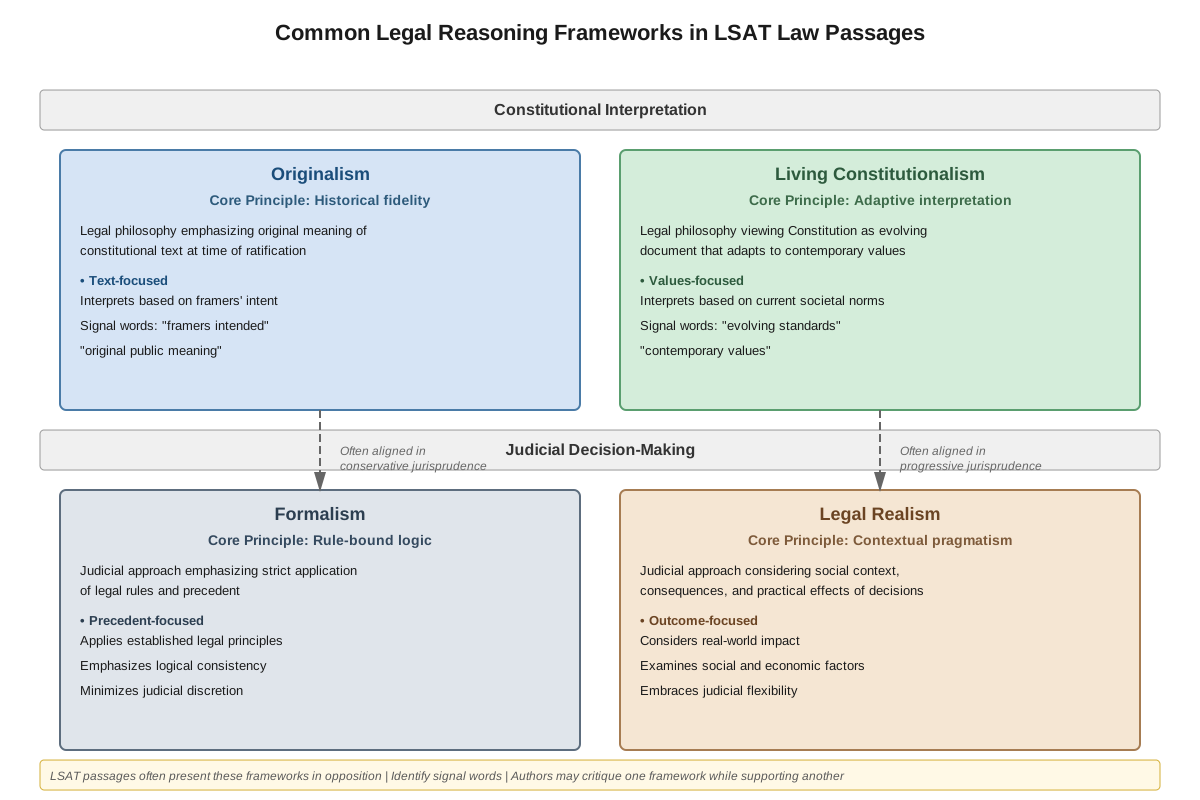
- [ ] Distinguish between different types of legal reasoning presented in law passages (originalism vs. living constitutionalism, formalism vs. legal realism, etc.)
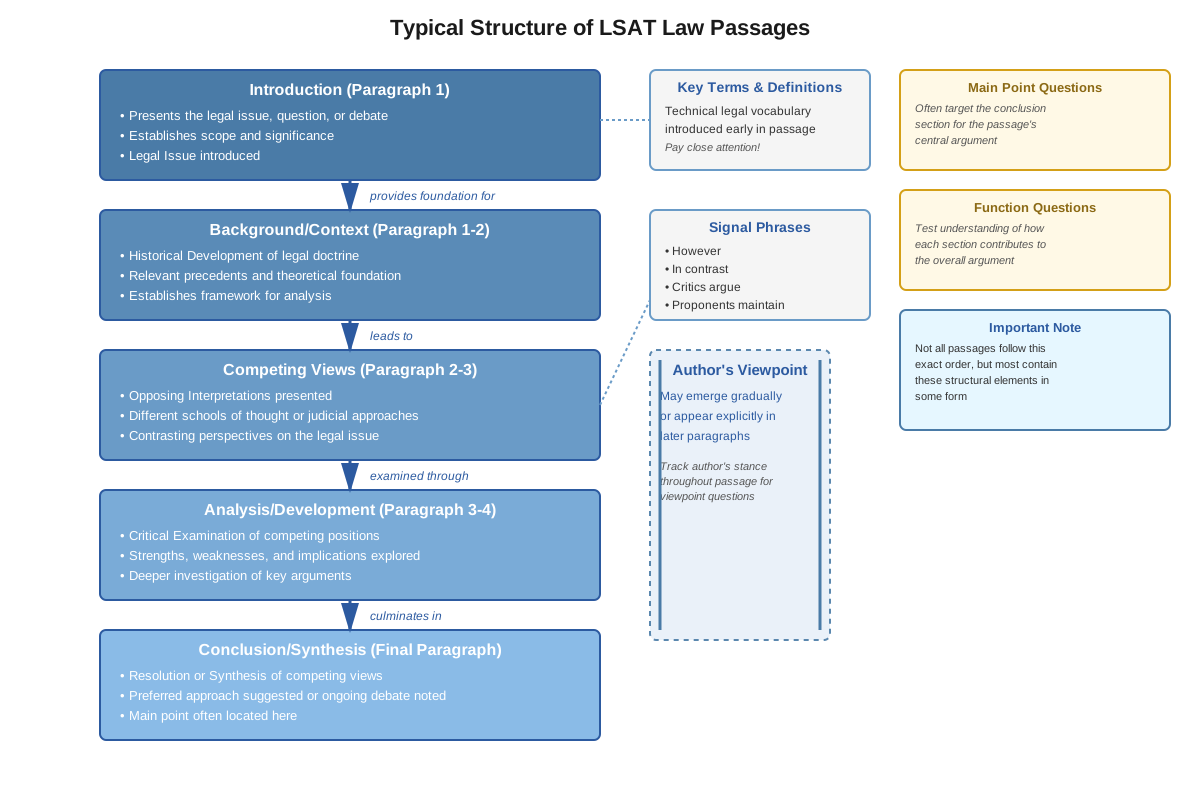
- [ ] Recognize the structural patterns common to law passages, including the presentation of legal problems, competing interpretations, and resolution or synthesis
- [ ] Evaluate the strength of legal arguments and identify the underlying assumptions that support different legal positions
Prerequisites
- Basic reading comprehension skills: The ability to identify main ideas, supporting details, and author's purpose forms the foundation for analyzing more complex legal arguments
- Understanding of argument structure: Recognizing premises, conclusions, and logical connections is essential because law passages are fundamentally argumentative in nature
- Familiarity with LSAT question types: Knowledge of main point, inference, function, and attitude questions allows students to apply passage-specific strategies effectively
- Ability to track multiple viewpoints: Law passages frequently present competing perspectives, requiring the skill to maintain mental separation between different positions
Why This Topic Matters
Law passages appear with remarkable consistency on the LSAT, with at least one law-focused passage guaranteed in virtually every Reading Comprehension section. Statistical analysis of recent LSATs reveals that law passages constitute approximately 25% of all reading comprehension passages, making them equally weighted with the other three subject categories. However, their importance extends beyond mere frequency—these passages directly preview the type of material law students will encounter in constitutional law, jurisprudence, and legal theory courses during their first year.
In practical terms, law passages test skills that lawyers use daily: extracting rules from complex texts, understanding how general principles apply to specific situations, recognizing when authorities conflict, and evaluating the strength of competing arguments. The LSAT uses law passages to assess whether candidates can handle the intellectual demands of legal education, where students must rapidly process dense legal opinions, synthesize conflicting precedents, and construct coherent arguments from ambiguous materials.
Common manifestations of law passages include discussions of Supreme Court decisions and their implications, explorations of jurisprudential philosophies (such as originalism, textualism, or pragmatism), examinations of how specific legal doctrines evolved over time, analyses of tensions between individual rights and governmental interests, and debates about proper methods of constitutional or statutory interpretation. Questions accompanying these passages typically ask about the author's main argument, the function of specific paragraphs or examples, inferences that can be drawn from the legal principles discussed, and the author's attitude toward different legal theories.
Core Concepts
Structure of Law Passages
Law passages on the LSAT follow predictable organizational patterns that, once recognized, significantly enhance comprehension and speed. The most common structure begins with an introduction to a legal problem or question, proceeds to present one or more perspectives on that problem (often contrasting traditional and modern approaches), and concludes with either a resolution, synthesis, or acknowledgment of ongoing debate. Understanding this architecture allows readers to anticipate where key information will appear and how different parts of the passage relate to each other.
Typically, the first paragraph establishes the legal issue at stake and provides necessary historical or contextual background. The middle paragraphs develop competing viewpoints, often using specific cases or hypothetical scenarios to illustrate abstract principles. The final paragraph frequently reveals the author's position (if any) or explains why the debate remains unresolved. This structure mirrors the organization of legal briefs and judicial opinions, reinforcing its relevance to actual legal practice.
Types of Legal Reasoning
Legal formalism represents one major approach frequently discussed in LSAT law passages. Formalists believe that legal decisions should flow logically from established rules and principles, with judges acting as neutral arbiters who apply law mechanically to facts. Passages presenting formalist perspectives emphasize consistency, predictability, and the constraint of judicial discretion. Questions about formalist passages often test whether students understand the priority formalists place on textual language and precedent over policy considerations.
Legal realism stands in contrast to formalism, arguing that law cannot be separated from social context, policy implications, and the practical consequences of judicial decisions. Realist passages emphasize how judges' backgrounds, values, and policy preferences inevitably influence legal interpretation. The LSAT frequently presents passages that contrast these two schools of thought, requiring students to track which arguments support which perspective and to recognize the underlying assumptions of each approach.
Originalism versus living constitutionalism represents another fundamental divide in legal philosophy that appears regularly in LSAT passages. Originalists argue that constitutional provisions should be interpreted according to their original public meaning at the time of ratification, while living constitutionalists contend that constitutional interpretation must evolve to address contemporary circumstances and values. Passages exploring this debate typically present arguments about specific constitutional provisions (such as the Eighth Amendment's prohibition on "cruel and unusual punishment") and ask students to identify which interpretive method different arguments exemplify.
Common Legal Concepts in Passages
Precedent and stare decisis form the backbone of common law reasoning and appear frequently in LSAT law passages. Stare decisis—the principle that courts should follow earlier decisions—promotes stability and predictability in law. However, passages often explore tensions that arise when precedents conflict, when social conditions change, or when earlier decisions appear wrongly decided. Questions may ask students to identify circumstances under which an author believes precedent should be followed or overturned.
Balancing tests represent a common judicial methodology discussed in law passages. When constitutional rights conflict with governmental interests, courts often employ balancing frameworks that weigh competing values. For example, First Amendment cases frequently balance free speech interests against government interests in public safety or order. LSAT passages describing balancing tests require careful attention to which factors courts consider and how different weights assigned to those factors lead to different outcomes.
Statutory interpretation passages explore how courts determine the meaning of legislative enactments. These passages typically contrast different interpretive methods: textualism (focusing on the plain meaning of statutory language), purposivism (considering the legislature's broader goals), and intentionalism (seeking to discern specific legislative intent). Understanding these distinctions helps students recognize which interpretive philosophy an author endorses and predict how that philosophy would resolve specific interpretive questions.
Analytical Frameworks in Law Passages
Law passages frequently present hierarchical relationships between legal concepts, such as the relationship between constitutional provisions and statutes, or between general principles and specific applications. Recognizing these hierarchies helps students understand why certain arguments carry more weight than others and how legal reasoning proceeds from abstract rules to concrete cases.
The problem-rule-application-conclusion framework, though more commonly associated with legal writing, also structures many LSAT law passages. The passage identifies a legal problem, articulates the relevant rule or principle, demonstrates how that rule applies to specific situations, and reaches a conclusion. Recognizing this pattern helps students locate key information quickly and understand how different parts of the passage function together.
Author's Perspective and Tone
Unlike some other passage types, law passages often feature authors who take clear positions on contested legal questions. Identifying the author's viewpoint early—whether they favor one interpretive method over another, support or criticize a particular decision, or advocate for legal reform—provides a framework for understanding the entire passage. Signal phrases like "unfortunately," "wisely," "fails to consider," or "correctly recognizes" reveal the author's attitude toward different legal positions.
However, some law passages maintain a more neutral, expository tone, presenting competing perspectives without endorsing either. In these passages, the author's role resembles that of a legal scholar surveying a field rather than an advocate arguing for a position. Questions accompanying neutral passages often test whether students can distinguish the author's views from the views being described.
Concept Relationships
The concepts within law passages interconnect in systematic ways that reflect the structure of legal reasoning itself. Legal formalism and legal realism represent competing foundational philosophies that influence positions on more specific issues. For example, a formalist approach to constitutional interpretation naturally aligns with originalism, since both prioritize fixed textual meaning over evolving social values. Conversely, legal realism's emphasis on practical consequences and social context supports living constitutionalism's adaptive approach.
The relationship flows as follows: Foundational legal philosophy (formalism vs. realism) → influences → interpretive methodology (originalism vs. living constitutionalism, textualism vs. purposivism) → determines → approach to specific legal questions (how to interpret particular constitutional provisions or statutes) → produces → judicial outcomes (specific decisions in cases).
Understanding precedent and stare decisis connects directly to questions about judicial philosophy because different legal theories assign different weights to past decisions. Formalists typically grant precedent strong binding force, while realists may more readily overturn precedents that produce undesirable social consequences. This connection helps students predict how authors with different philosophical commitments will approach questions about following or overturning earlier cases.
Balancing tests represent a practical application of legal realism's emphasis on consequences and context, since balancing inherently requires judges to weigh competing policy interests rather than mechanically applying rules. Recognizing this connection helps students understand why passages criticizing balancing tests often come from formalist perspectives, while passages defending balancing typically adopt realist assumptions.
The relationship to prerequisite topics is equally important. Basic argument structure skills enable students to identify premises and conclusions in legal reasoning, while the ability to track multiple viewpoints allows students to maintain mental separation between the author's position and the positions being described. These foundational skills become specialized tools when applied to law passages' unique content.
High-Yield Facts
⭐ Law passages appear in approximately 25% of all LSAT Reading Comprehension passages, guaranteeing at least one law passage per test
⭐ The most common law passage structure presents a legal problem, explores competing perspectives, and concludes with resolution or acknowledgment of ongoing debate
⭐ Legal formalism emphasizes mechanical rule application and judicial constraint, while legal realism emphasizes social context and practical consequences
⭐ Originalism interprets constitutional provisions according to original public meaning, while living constitutionalism allows interpretation to evolve with changing social values
⭐ Questions about law passages frequently test the ability to distinguish the author's view from views being described
- Stare decisis (the principle of following precedent) promotes legal stability but may conflict with correcting erroneous decisions
- Textualism focuses on statutory language's plain meaning, while purposivism considers the legislature's broader goals
- Balancing tests weigh competing interests and typically reflect legal realist rather than formalist approaches
- Law passages often use specific cases or hypothetical scenarios to illustrate abstract legal principles
- Signal words like "unfortunately," "wisely," or "fails to consider" reveal the author's attitude toward legal positions
- The relationship between constitutional provisions and statutes creates hierarchies that determine which legal authority prevails
- Many law passages explore tensions between individual rights and governmental interests
- Understanding the historical evolution of legal doctrines helps predict how authors will argue for or against change
- Law passages may present neutral surveys of legal debates or advocate for specific positions
- The function of examples in law passages typically illustrates how abstract principles apply to concrete situations
Quick check — test yourself on Law passages so far.
Try Flashcards →Common Misconceptions
Misconception: All law passages require prior legal knowledge to understand → Correction: LSAT law passages are self-contained and provide all necessary information within the passage itself. While legal background may increase reading speed, it is neither necessary nor sufficient for answering questions correctly. In fact, outside legal knowledge can sometimes interfere with comprehension if students rely on it rather than the passage text.
Misconception: The author's view always appears in the final paragraph → Correction: While final paragraphs often reveal the author's position, authors may signal their perspective throughout the passage using evaluative language, and some passages maintain neutrality throughout. Students must attend to tone and signal words in all paragraphs rather than assuming the conclusion contains the author's view.
Misconception: Legal formalism and originalism are identical concepts → Correction: Though related, these concepts operate at different levels. Legal formalism is a broad philosophy about how judges should decide cases (mechanically applying rules), while originalism is a specific method of constitutional interpretation (using original public meaning). A judge could theoretically be formalist about statutory interpretation but not originalist about constitutional interpretation.
Misconception: Law passages are always more difficult than other passage types → Correction: Difficulty varies within each passage category. Some law passages present straightforward explanations of legal concepts, while some science or humanities passages involve highly complex reasoning. The key is recognizing the specific challenges each passage presents rather than assuming law passages are inherently harder.
Misconception: Understanding every legal term is essential for answering questions → Correction: LSAT passages define or contextualize technical terms sufficiently for answering questions. Students should focus on understanding the relationships between concepts and the structure of arguments rather than memorizing legal terminology. Questions test reading comprehension, not legal knowledge.
Misconception: Precedent must always be followed according to stare decisis → Correction: While stare decisis creates a presumption in favor of following precedent, courts can and do overturn earlier decisions under certain circumstances. Law passages often explore precisely when precedent should be followed versus overturned, making this a common topic for questions.
Worked Examples
Example 1: Identifying Competing Legal Philosophies
Passage Excerpt: "Justice Marshall's opinion in the case reflects the view that constitutional interpretation must adapt to contemporary understandings of human dignity. He argues that the Eighth Amendment's prohibition on cruel and unusual punishment cannot be limited to those specific punishments the Framers considered cruel in 1791. Rather, the Amendment must be interpreted according to 'evolving standards of decency that mark the progress of a maturing society.' Critics of this approach contend that it grants judges excessive discretion to impose their own values under the guise of constitutional interpretation. They argue that the Amendment's meaning was fixed at ratification and that changes in social attitudes should be addressed through the amendment process rather than judicial reinterpretation."
Question: The passage suggests that critics of Justice Marshall's approach would be most likely to endorse which interpretive method?
Step 1 - Identify Justice Marshall's position: The passage explicitly states Marshall believes constitutional interpretation must "adapt to contemporary understandings" and references "evolving standards of decency." This language clearly indicates a living constitutionalist approach that allows constitutional meaning to change over time.
Step 2 - Identify the critics' position: The critics argue that "the Amendment's meaning was fixed at ratification" and that social changes should be addressed through formal amendment rather than judicial reinterpretation. This language signals an originalist approach that interprets constitutional provisions according to their original meaning.
Step 3 - Connect to broader legal philosophy: The critics' concern about "excessive discretion" and judges imposing "their own values" reflects formalist concerns about constraining judicial power through fixed rules. This connects originalism to the broader formalist philosophy.
Step 4 - Predict the answer: The critics would most likely endorse originalism or original public meaning interpretation. They would reject living constitutionalism, purposivism focused on evolving purposes, or any interpretive method that allows constitutional meaning to change without formal amendment.
Connection to learning objectives: This example demonstrates how to identify different legal reasoning patterns (originalism vs. living constitutionalism) and apply that understanding to predict how different legal actors would approach interpretive questions.
Example 2: Analyzing Passage Structure and Function
Passage Excerpt: "For decades, courts applied a categorical rule prohibiting any government regulation of commercial speech. In the 1970s, however, the Supreme Court recognized that commercial speech merits some First Amendment protection, though less than political speech receives. The Court developed a four-part test for evaluating restrictions on commercial advertising: the speech must concern lawful activity and not be misleading; the government must assert a substantial interest; the regulation must directly advance that interest; and the regulation must be no more extensive than necessary. This framework has generated considerable controversy. Supporters argue that it appropriately balances free speech interests against legitimate regulatory concerns, such as consumer protection. Critics contend that the test grants government too much power to suppress truthful information about lawful products, particularly when applied to controversial goods like tobacco or alcohol."
Question: The primary function of the second paragraph (beginning with "The Court developed...") is to:
Step 1 - Identify the overall passage structure: The first paragraph establishes historical context (categorical prohibition evolving to limited protection). The second paragraph presents the current legal framework (the four-part test). The third paragraph presents competing evaluations of that framework (supporters vs. critics).
Step 2 - Determine the specific function: The second paragraph doesn't argue for or against the test; it simply explains the test's components. This is descriptive/expository rather than argumentative.
Step 3 - Consider relationships to surrounding paragraphs: The second paragraph provides the necessary foundation for understanding the debate presented in the third paragraph. Without knowing what the four-part test requires, readers couldn't evaluate the competing arguments about it.
Step 4 - Predict the answer: The paragraph's primary function is to describe or explain the current legal standard that will be evaluated in subsequent paragraphs. It serves as a bridge between historical context and contemporary debate.
Connection to learning objectives: This example demonstrates how to identify structural patterns in law passages and understand how different sections function together to build the overall argument. Recognizing that law passages typically move from problem to framework to evaluation helps students anticipate where key information will appear.
Exam Strategy
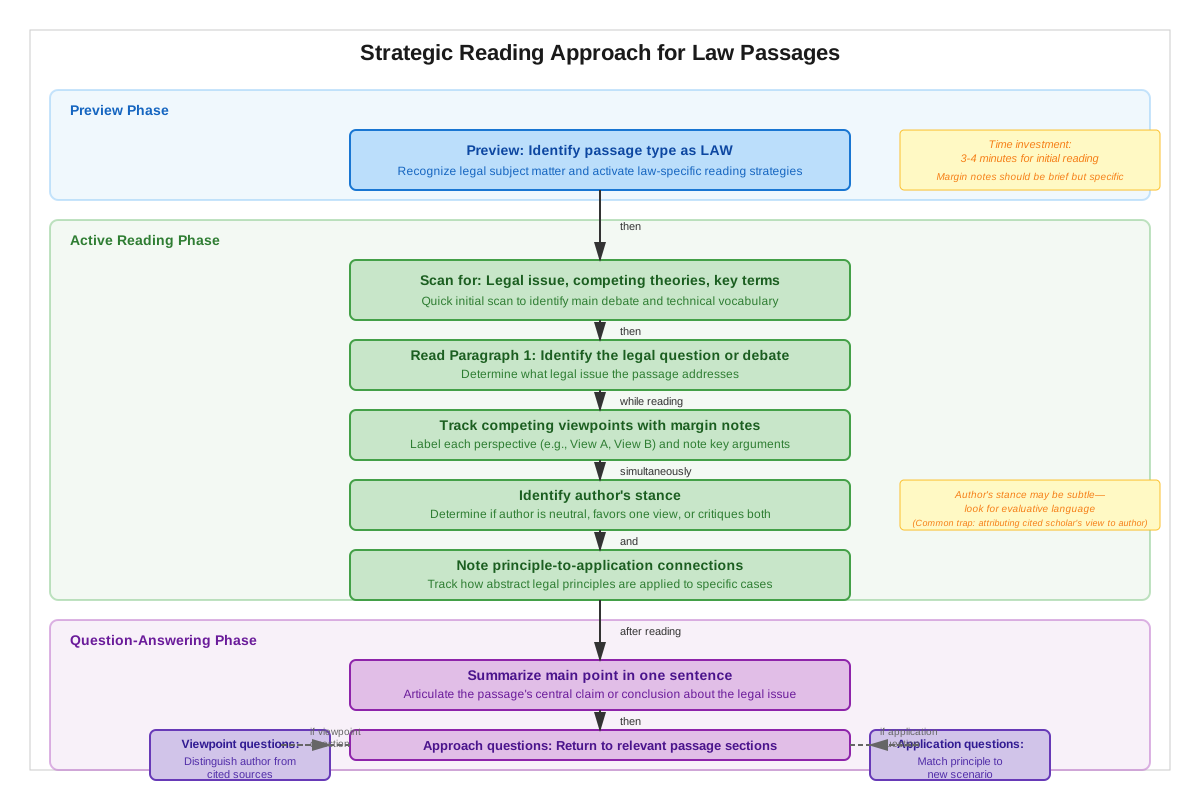
When approaching law passages on the LSAT, begin by identifying the passage's organizational structure in the first 30 seconds. Scan for signal phrases that indicate competing viewpoints ("however," "in contrast," "critics argue") and note where the passage transitions from description to evaluation. This initial mapping provides a framework for understanding how details fit together.
Trigger words and phrases that signal important content include: "traditionally," "however," "in contrast," "critics contend," "supporters argue," "the court held," "the principle of," "this approach," "alternatively," and "the rule." These phrases typically introduce new perspectives, signal transitions between viewpoints, or mark the articulation of legal principles. When these phrases appear, slow down slightly and ensure complete comprehension before proceeding.
For process of elimination, law passage questions often include wrong answers that confuse the author's view with views being described, attribute positions to the wrong party, or make claims too extreme for the passage's measured tone. Eliminate answers that use absolute language ("always," "never," "only") unless the passage explicitly supports such categorical claims. Also eliminate answers that require outside legal knowledge not provided in the passage.
Time allocation for law passages should mirror other passage types: approximately 3-4 minutes for initial reading and 5-6 minutes for questions, totaling 8-10 minutes per passage. However, if a law passage presents particularly dense legal reasoning or multiple competing frameworks, allocate an extra 30-60 seconds to the initial read rather than rushing through and missing key relationships. Time invested in comprehension pays dividends in question accuracy and speed.
When questions ask about the author's attitude or perspective, return to evaluative language throughout the passage rather than relying solely on memory. Words like "unfortunately," "wisely," "merely," "significantly," or "fails to consider" reveal the author's position more reliably than structural location. For function questions, consider how the referenced text relates to surrounding paragraphs and the passage's overall argument.
Exam Tip: If a law passage presents three or more distinct perspectives (e.g., traditional approach, modern approach, and author's synthesis), create a simple mental or physical notation system to track which arguments support which position. This prevents confusion when questions ask about specific viewpoints.
Memory Techniques
FORMALIST acronym for remembering key features of legal formalism:
- Fixed rules applied mechanically
- Objective interpretation prioritized
- Rule-based decision making
- Minimizes judicial discretion
- Applies precedent strictly
- Language of text controls
- Ignores policy consequences
- Stability and predictability valued
- Textualism often associated
REALIST acronym for legal realism's characteristics:
- Recognizes social context matters
- Emphasizes practical consequences
- Acknowledges judicial discretion
- Law reflects policy choices
- Interpretation considers purposes
- Social values influence decisions
- Transforms with society
Visualization strategy: Picture originalism as a photograph frozen in time (capturing the original moment of ratification) and living constitutionalism as a video that continues playing (evolving with society). This visual metaphor helps distinguish these competing interpretive methods.
The "Three Ps" of law passage structure: Most law passages follow a pattern of Problem (introducing the legal issue), Perspectives (presenting competing viewpoints), and Position (revealing the author's view or acknowledging ongoing debate). Remembering this sequence helps predict where information will appear.
For remembering the relationship between concepts, use the phrase "Philosophy Influences Interpretation, Interpretation Determines Decisions" to recall that foundational legal philosophy (formalism vs. realism) influences interpretive methodology (originalism vs. living constitutionalism), which determines approaches to specific legal questions.
Summary
Law passages constitute a critical component of LSAT Reading Comprehension, appearing in approximately one-quarter of all passages and directly previewing the analytical reading required in law school. These passages typically explore legal theory, constitutional interpretation, judicial philosophy, or the evolution of legal doctrines, following predictable structural patterns that move from problem to competing perspectives to resolution or synthesis. Success with law passages requires understanding fundamental divides in legal philosophy—particularly formalism versus realism and originalism versus living constitutionalism—and recognizing how these foundational philosophies influence approaches to specific interpretive questions. Students must develop the ability to track multiple viewpoints simultaneously, distinguish the author's position from positions being described, and identify the function of specific paragraphs within the passage's overall argument. The skills tested by law passages—extracting rules from complex texts, evaluating competing arguments, and understanding how general principles apply to specific situations—directly translate to the intellectual demands of legal education and practice, making mastery of this topic essential for both LSAT success and future legal study.
Key Takeaways
- Law passages appear consistently on the LSAT, comprising approximately 25% of Reading Comprehension passages and testing skills essential for legal education
- The most common structure presents a legal problem, explores competing perspectives (often contrasting traditional and modern approaches), and concludes with resolution or acknowledgment of ongoing debate
- Legal formalism emphasizes mechanical rule application and judicial constraint, while legal realism emphasizes social context and practical consequences—understanding this fundamental divide helps predict positions on specific legal questions
- Originalism interprets constitutional provisions according to original public meaning, while living constitutionalism allows interpretation to evolve with changing social values
- Success requires distinguishing the author's view from views being described, tracking multiple perspectives simultaneously, and understanding how different parts of the passage function together
- Signal words like "however," "critics argue," "unfortunately," and "wisely" reveal transitions between viewpoints and the author's attitude toward different positions
- Law passages are self-contained and require no outside legal knowledge; questions test reading comprehension and analytical reasoning rather than legal expertise
Related Topics
Comparative Reading Passages: Many LSAT Reading Comprehension sections include paired passages that present competing perspectives on the same topic, often featuring legal debates. Mastering law passages provides essential preparation for comparative reading, as the skills for tracking multiple viewpoints and identifying points of agreement and disagreement transfer directly.
Logical Reasoning - Principle Questions: These questions ask students to identify general principles that support specific conclusions or to apply stated principles to new situations. The reasoning patterns in law passages—moving between abstract rules and concrete applications—directly parallel the skills tested in principle questions.
Argument Structure in Legal Contexts: Understanding how legal arguments are constructed, including the relationship between rules, precedents, and applications, builds on law passage comprehension skills while adding layers of formal logical analysis.
Constitutional Law Fundamentals: While not required for LSAT success, students who master law passages will find themselves well-prepared for first-year constitutional law courses, where similar debates about interpretive methodology and judicial philosophy form the core curriculum.
Practice CTA
Now that you've mastered the core concepts, structural patterns, and analytical strategies for law passages, it's time to apply this knowledge to authentic LSAT questions. The practice questions and flashcards for this topic will reinforce your ability to identify legal reasoning patterns, track competing perspectives, and answer questions accurately under timed conditions. Remember that law passages reward careful attention to structure and viewpoint—skills that improve dramatically with deliberate practice. Each practice passage you complete strengthens the neural pathways for legal analysis that will serve you throughout the LSAT, law school, and your legal career. Approach practice with confidence, knowing that you now possess a comprehensive framework for tackling any law passage the LSAT presents.
Sign up free to keep reading
Create a free AnvayaPrep account to finish this LSAT guide on Law passages — plus flashcards and practice questions.