Overview
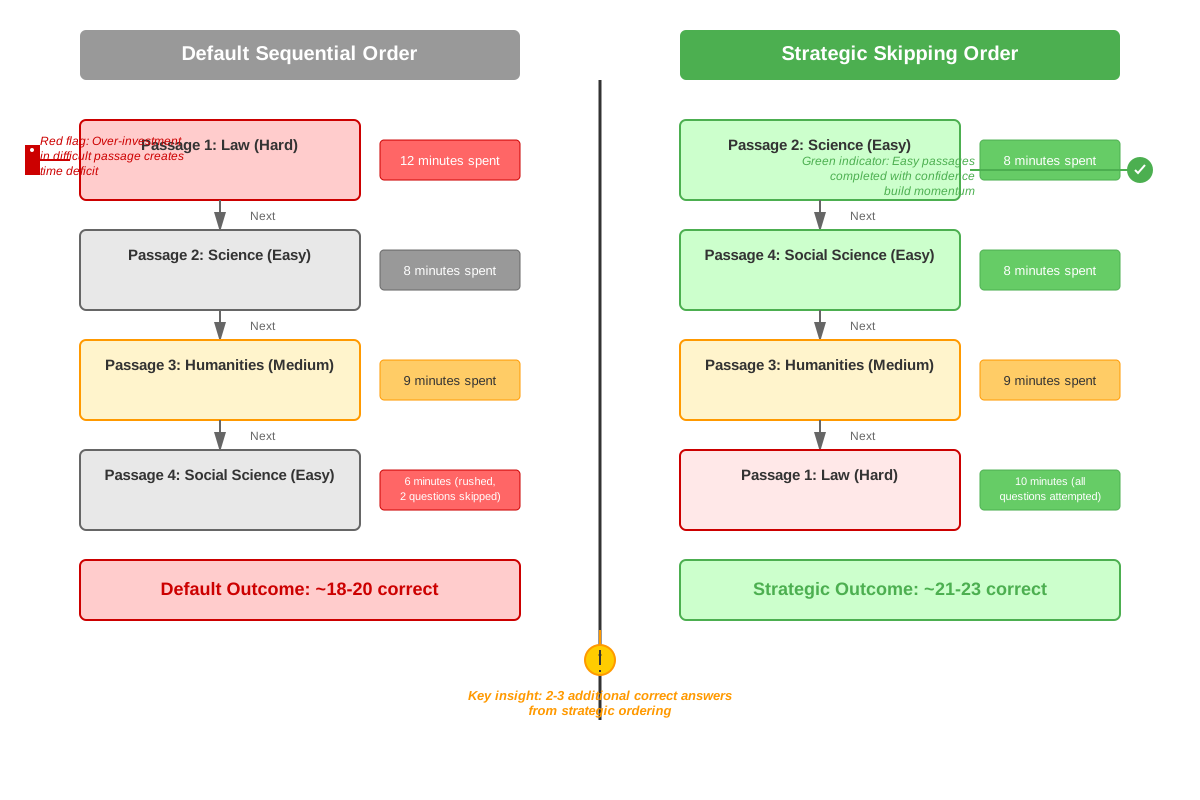
The passage skipping strategy is one of the most powerful yet underutilized tactical approaches in LSAT Reading Comprehension. This strategy involves making a deliberate, informed decision about the order in which to tackle the four passages presented in the Reading Comprehension section. Rather than automatically working through passages 1-2-3-4 in the order they appear, test-takers can strategically choose to skip a particularly challenging or unfamiliar passage and return to it after completing more accessible passages. This approach maximizes point acquisition within the 35-minute time constraint by ensuring that easier questions are answered first, building confidence and momentum while securing points that might otherwise be lost if time runs out on a difficult passage.
Understanding and implementing the LSAT passage skipping strategy is essential because not all passages are created equal in terms of difficulty, subject matter accessibility, or question complexity. The LSAT deliberately includes passages from diverse domains—law, humanities, natural sciences, and social sciences—and test-takers naturally have varying levels of comfort with these subjects. A student with a strong science background might breeze through a passage on quantum mechanics but struggle with dense legal theory, while another student might experience the opposite. By recognizing personal strengths and weaknesses and making strategic decisions about passage order, test-takers can optimize their performance and avoid the common pitfall of spending excessive time on a single difficult passage at the expense of easier questions elsewhere.
This topic sits at the intersection of time management, self-awareness, and tactical decision-making within the broader framework of passage subjects and strategies. While other Reading Comprehension skills focus on comprehension techniques, question types, and analytical reasoning, the passage skipping strategy addresses the meta-level question of how to approach the section as a whole. It complements other strategic approaches by ensuring that strong comprehension skills are applied where they can yield the highest return on investment, making it a critical component of any comprehensive LSAT preparation program.
Learning Objectives
- [ ] Identify how passage skipping strategy appears in LSAT questions
- [ ] Explain the reasoning pattern behind passage skipping strategy
- [ ] Apply passage skipping strategy to solve LSAT-style problems accurately
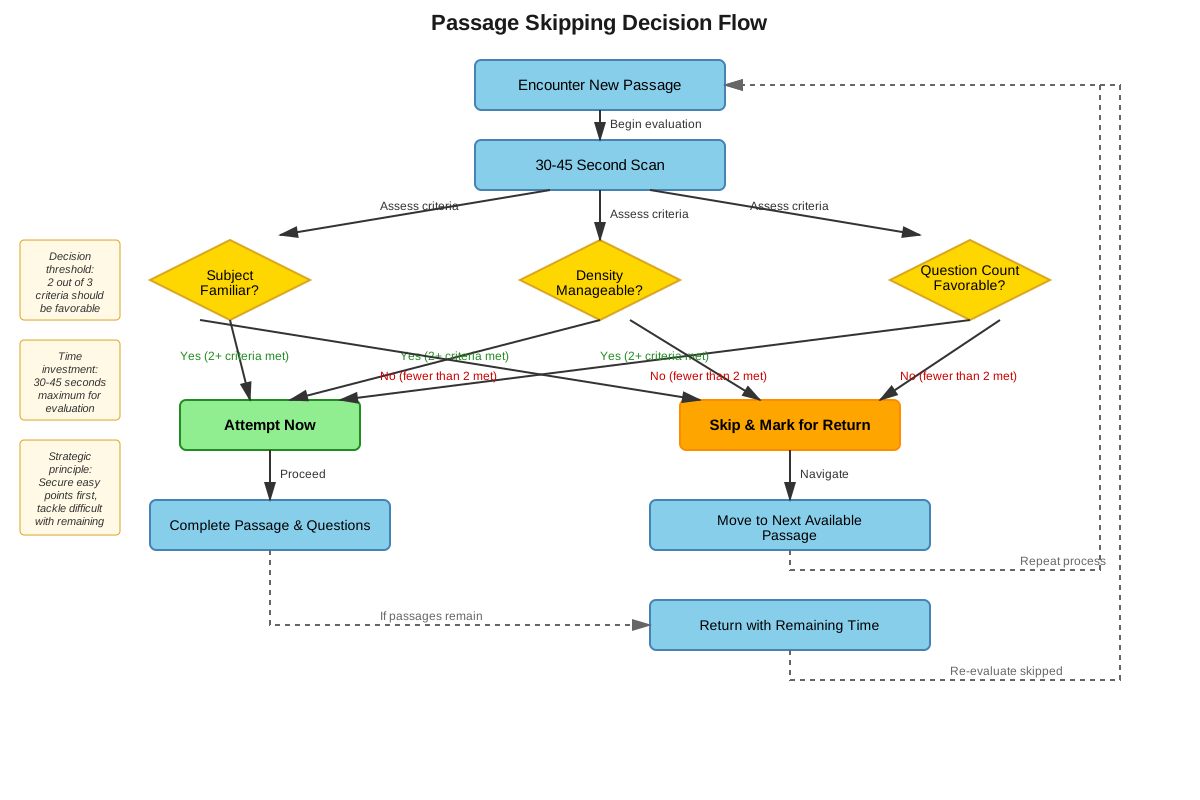
- [ ] Evaluate passage characteristics within 30-45 seconds to make informed skipping decisions
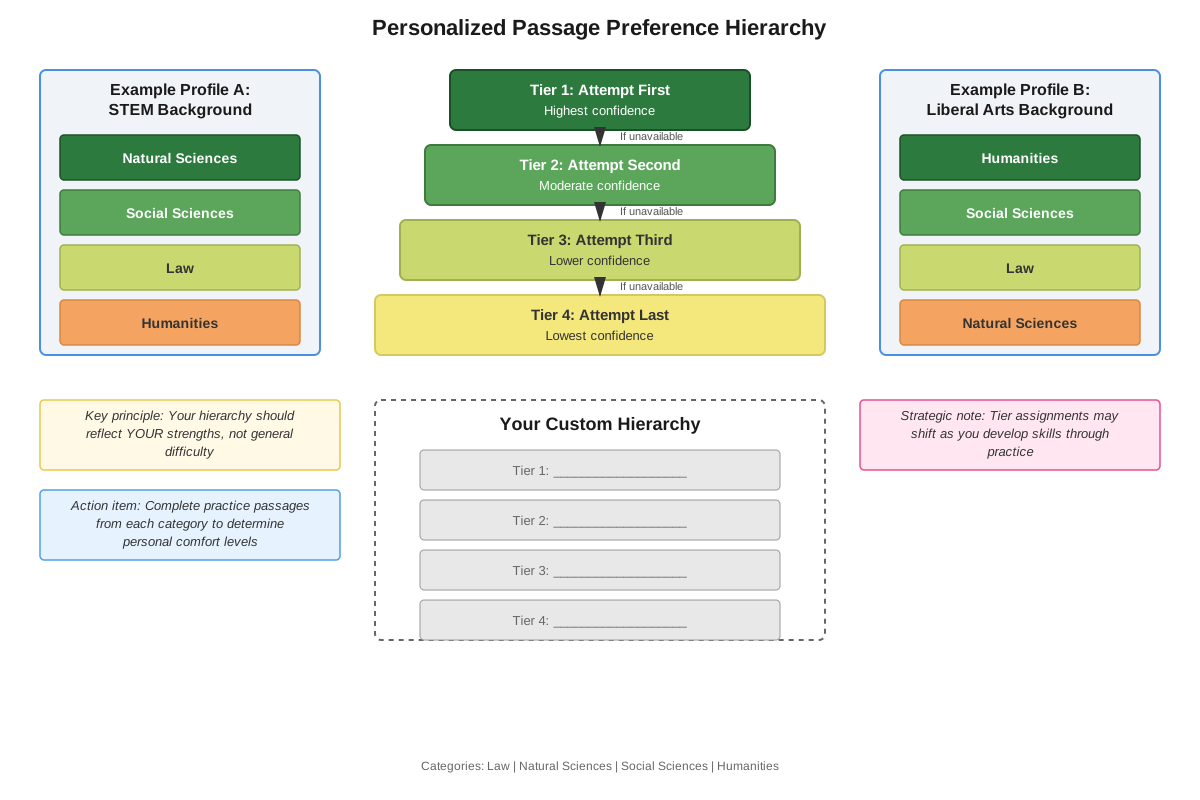
- [ ] Develop a personalized passage preference hierarchy based on subject matter strengths
- [ ] Execute efficient passage navigation while maintaining focus and avoiding time loss during transitions
- [ ] Recognize when to abandon a passage mid-attempt and move to a more accessible option
Prerequisites
- Basic LSAT Reading Comprehension format knowledge: Understanding that the section contains four passages with 5-8 questions each is essential for making strategic decisions about passage order and time allocation.
- Familiarity with passage subject categories: Recognizing the typical domains (law, humanities, natural sciences, social sciences) enables quick assessment of personal comfort level with each passage.
- Time management fundamentals: Basic awareness of the 35-minute time constraint and approximate per-passage timing goals provides the foundation for strategic skipping decisions.
- Question type recognition: Understanding that all passages contain similar question types helps confirm that skipping is based on passage difficulty rather than question difficulty.
Why This Topic Matters
The passage skipping strategy directly addresses one of the most significant challenges test-takers face: the psychological and practical impact of encountering a difficult passage early in the Reading Comprehension section. When students tackle passages in the presented order and encounter a particularly challenging one first or second, they often experience anxiety, spend excessive time trying to master it, and enter subsequent passages with depleted time and confidence. This cascade effect can devastate section performance even when the student possesses strong comprehension skills.
From an exam statistics perspective, the Reading Comprehension section accounts for approximately 27% of the total LSAT score (one of four scored sections), making it a critical performance area. Within this section, research on test-taker performance reveals that students who employ strategic passage selection typically score 2-4 points higher than those who work in presented order, particularly when their skipped passage would have consumed disproportionate time. The LSAT does not penalize for skipping passages—all questions carry equal weight regardless of passage difficulty—making this strategy risk-free when executed properly.
This topic commonly appears in exam preparation through several manifestations: students must recognize when a passage's dense technical vocabulary, complex sentence structure, or unfamiliar subject matter signals a good skipping candidate; they must develop the discipline to make quick assessment decisions rather than committing to a passage prematurely; and they must maintain accurate bubble-sheet management when answering questions out of order. The strategy is particularly relevant for comparative reading passages (Passage A/Passage B format), which some students find more challenging due to the additional cognitive load of tracking two related texts simultaneously.
Core Concepts
The Fundamental Principle of Strategic Passage Selection
The passage skipping strategy rests on a simple but powerful principle: maximizing correct answers within a fixed time constraint requires prioritizing questions where comprehension comes most naturally. Unlike the Logical Reasoning or Logic Games sections where question difficulty varies within a section, Reading Comprehension presents entire passages as units. Each passage generates 5-8 questions, and passage difficulty significantly impacts the accuracy and speed of answering all associated questions. By selecting passages strategically, test-takers can ensure they spend their most alert, focused minutes on passages where they can work most efficiently.
The strategy operates on three levels: macro-level (deciding overall passage order), meso-level (determining when to abandon a passage mid-attempt), and micro-level (managing the mechanics of skipping, including answer sheet navigation). At the macro level, test-takers scan all four passages during an initial 2-3 minute assessment phase, identifying subject matter, apparent complexity, and personal comfort level. At the meso level, they establish decision rules for when to cut losses on a passage that proves more difficult than anticipated. At the micro level, they maintain careful tracking of question numbers to avoid transcription errors when bubbling answers out of sequence.
The 30-Second Passage Assessment Protocol
Effective passage skipping requires rapid but accurate passage evaluation. The 30-second assessment protocol involves scanning each passage's first paragraph, noting subject matter indicators, evaluating sentence complexity, and gauging personal familiarity with the topic. This assessment should occur before reading any passage in depth, creating a strategic roadmap for the entire section.
Key assessment criteria include:
- Subject matter identification: Determine whether the passage falls into law, humanities, natural sciences, or social sciences
- Vocabulary density: Note the presence of technical terminology, jargon, or specialized language
- Sentence structure complexity: Observe average sentence length and syntactic complexity
- Personal familiarity: Assess background knowledge and comfort with the topic
- Passage structure: Identify whether it's a standard single passage or comparative reading format
Passage Difficulty Indicators
Certain characteristics reliably predict passage difficulty and should trigger consideration of skipping:
| Difficulty Indicator | Why It Matters | Example Subjects |
|---|---|---|
| Dense technical vocabulary | Requires constant mental translation | Quantum physics, legal procedure, molecular biology |
| Abstract philosophical concepts | Demands high cognitive load for comprehension | Epistemology, aesthetic theory, metaphysics |
| Multiple competing viewpoints | Increases tracking burden | Scholarly debates, comparative analyses |
| Unfamiliar cultural/historical context | Requires building background knowledge while reading | Non-Western philosophy, historical periods outside common knowledge |
| Comparative reading format | Doubles the information to track | Any Passage A/Passage B combination |
Personal Passage Preference Hierarchy
Each test-taker should develop a personalized preference hierarchy based on academic background, reading interests, and practice test performance. This hierarchy ranks passage types from most to least comfortable, providing a decision framework during the assessment phase.
A typical hierarchy might look like:
- First choice: Passages in areas of academic strength (e.g., humanities for English majors, natural sciences for STEM backgrounds)
- Second choice: Passages with clear structure and familiar vocabulary, regardless of subject
- Third choice: Passages with moderate difficulty but manageable length and question count
- Last choice: Passages combining multiple difficulty factors (technical vocabulary + abstract concepts + comparative format)
The Skipping Decision Matrix
The decision to skip should be systematic rather than impulsive. The following matrix helps structure this decision:
Skip immediately if:
- Subject matter is completely unfamiliar AND vocabulary is highly technical
- First paragraph requires multiple re-reads for basic comprehension
- Passage length exceeds 500 words AND complexity is high
- Comparative reading format AND both passages are in uncomfortable subject areas
Consider skipping if:
- Two or more moderate difficulty indicators are present
- Time pressure is already building from previous passages
- Confidence level is low after reading the first two paragraphs
Do not skip if:
- Only one minor difficulty indicator is present
- Subject matter is within comfort zone despite some challenging vocabulary
- This is the fourth passage (no alternatives remain)
- Sufficient time remains to work methodically
Execution Mechanics and Answer Sheet Management
The practical execution of passage skipping requires careful attention to administrative details. When skipping passage 2 to attempt passage 3, test-takers must:
- Mark the test booklet clearly: Circle or star the skipped passage number for easy location later
- Leave answer sheet space blank: Skip the corresponding question numbers (e.g., questions 8-14 if passage 2 has 7 questions)
- Track question numbering carefully: Ensure passage 3's questions are bubbled in the correct locations
- Budget return time: Reserve 8-10 minutes for the skipped passage if possible
- Maintain focus during transitions: Avoid dwelling on the skipping decision once made
The Return Strategy
Returning to a skipped passage requires a modified approach. With limited time remaining, the goal shifts from comprehensive understanding to strategic point acquisition:
- Skim for main idea and structure: Spend 2-3 minutes getting the gist rather than deep comprehension
- Prioritize question types: Tackle main idea and explicit detail questions first, saving inference questions for last
- Accept strategic guessing: If time is critically short, make educated guesses on remaining questions rather than leaving them blank
- Maintain composure: Avoid panic about the skipped passage affecting performance on completed passages
Concept Relationships
The passage skipping strategy connects intimately with several other Reading Comprehension concepts. Time management serves as the foundation—without understanding per-passage time targets (approximately 8-9 minutes per passage), test-takers cannot make informed skipping decisions. The strategy builds upon passage subject recognition, as identifying whether a passage discusses legal theory, scientific research, or literary criticism enables quick assessment of personal comfort level.
The relationship flows as follows: Subject matter recognition → Difficulty assessment → Strategic skipping decision → Optimized passage order → Improved time allocation → Higher accuracy on completed passages → Better overall section score.
This strategy also connects to question type mastery because understanding that all passages contain similar distributions of question types (main idea, detail, inference, etc.) confirms that skipping is truly about passage accessibility rather than question difficulty. Additionally, the strategy interfaces with comparative reading techniques, as the Passage A/Passage B format often presents unique challenges that may warrant skipping.
The passage skipping strategy enables progression to more advanced concepts like adaptive pacing (adjusting speed based on real-time performance) and strategic guessing protocols (making educated guesses when time expires). It also supports the development of test-day resilience, as students who can flexibly adjust their approach demonstrate greater psychological preparedness for unexpected challenges.
High-Yield Facts
⭐ The LSAT Reading Comprehension section does not require passages to be completed in the presented order—all questions carry equal weight regardless of passage sequence.
⭐ Test-takers who employ passage skipping strategy typically gain 2-4 additional correct answers compared to those who work in presented order, particularly when encountering a difficult passage early.
⭐ The optimal assessment phase lasts 2-3 minutes total (30-45 seconds per passage), providing sufficient information for strategic decisions without consuming excessive time.
⭐ Comparative reading passages (Passage A/Passage B format) are statistically the most commonly skipped passage type, as they require tracking two related texts simultaneously.
⭐ The most reliable difficulty indicators are dense technical vocabulary combined with unfamiliar subject matter—either factor alone is manageable, but both together signal a strong skipping candidate.
- Personal passage preference hierarchies should be established during practice tests, not on test day, through systematic tracking of passage types and performance patterns.
- When returning to a skipped passage with limited time, prioritizing main idea and explicit detail questions over inference questions typically yields more points per minute invested.
- Answer sheet management errors (bubbling questions in wrong locations) are the primary risk of passage skipping, making careful tracking and verification essential.
- The decision to skip should be made within the first 1-2 paragraphs of reading—committing beyond this point typically means the passage should be completed rather than abandoned.
- Skipping more than one passage is generally inadvisable unless time management has already failed, as it creates excessive pressure and increases answer sheet error risk.
Quick check — test yourself on Passage skipping strategy so far.
Try Flashcards →Common Misconceptions
Misconception: Skipping a passage means giving up on those questions entirely and accepting a lower score.
Correction: Strategic skipping means temporarily deferring a passage to maximize performance on more accessible passages first, with the intention of returning to the skipped passage with remaining time. The goal is to secure more total correct answers, not to avoid difficult content.
Misconception: The passages are ordered from easiest to hardest, so passage 1 should always be attempted first.
Correction: The LSAT does not order passages by difficulty. Passage difficulty is subjective and varies based on individual background knowledge and reading preferences. The first passage may be the most difficult for a particular test-taker.
Misconception: Skipping requires reading all four passages completely before deciding which to attempt.
Correction: Effective skipping uses a rapid 30-45 second assessment per passage (reading first paragraph and scanning structure), not complete reading of all passages. Complete reading would consume 15-20 minutes before answering any questions.
Misconception: Once you begin reading a passage, you must complete it because you've already invested time.
Correction: The "sunk cost fallacy" does not apply to strategic test-taking. If a passage proves more difficult than anticipated after 2-3 paragraphs, cutting losses and moving to a more accessible passage can save time and preserve mental energy.
Misconception: Passage skipping is only for students who struggle with time management or reading comprehension.
Correction: Even high-performing test-takers benefit from passage skipping because it optimizes the order of work based on personal strengths. The strategy is about maximization, not remediation.
Misconception: Skipping creates anxiety and disrupts focus more than working through a difficult passage.
Correction: For most test-takers, the anxiety of spending 15 minutes on a single difficult passage and rushing through remaining passages far exceeds the brief transition involved in skipping. Practice builds comfort with the skipping process.
Misconception: You should skip any passage that seems even slightly challenging.
Correction: The skipping strategy is for passages that present significant difficulty indicators (multiple factors like technical vocabulary + unfamiliar subject + complex structure), not for passages with minor challenges. Over-skipping can create time pressure and answer sheet confusion.
Worked Examples
Example 1: Initial Assessment and Skipping Decision
Scenario: A test-taker begins the Reading Comprehension section and conducts a rapid assessment of all four passages:
- Passage 1: Legal theory discussing the evolution of tort law and negligence standards (approximately 450 words, moderate vocabulary density)
- Passage 2: Natural science passage on quantum entanglement and non-locality in particle physics (approximately 500 words, very high technical vocabulary density)
- Passage 3: Humanities passage analyzing narrative techniques in 19th-century novels (approximately 400 words, familiar subject matter)
- Passage 4: Comparative reading on two perspectives on urban planning and zoning regulations (Passage A: 250 words, Passage B: 250 words)
Analysis Process:
The test-taker has a humanities background with limited science coursework. During the 30-second assessment of each passage:
- Passage 1: Legal content is moderately accessible; tort law concepts are somewhat familiar from general knowledge. Assessment: Second choice
- Passage 2: First paragraph contains terms like "quantum superposition," "wave function collapse," and "Bell's theorem"—highly technical with no background knowledge. Assessment: Skip candidate
- Passage 3: Narrative techniques align with academic background; vocabulary is comfortable. Assessment: First choice
- Passage 4: Comparative format adds complexity, but urban planning is relatively accessible subject matter. Assessment: Third choice
Strategic Decision:
The test-taker decides to attempt passages in this order: 3 → 1 → 4 → 2. This sequence begins with the most comfortable passage (building confidence and momentum), proceeds to moderately accessible passages, and reserves the highly technical science passage for last when strategies for time-limited reading can be employed if necessary.
Execution:
- Minutes 0-2: Rapid assessment of all four passages
- Minutes 2-10: Complete Passage 3 (humanities) with high accuracy
- Minutes 10-18: Complete Passage 1 (legal theory) with good accuracy
- Minutes 18-27: Complete Passage 4 (comparative urban planning) with moderate accuracy
- Minutes 27-35: Approach Passage 2 (quantum physics) with skim-and-target strategy, focusing on main idea and explicit detail questions
Outcome: By saving the most difficult passage for last, the test-taker secured all available points on three passages and made educated attempts on the fourth, rather than potentially spending 15 minutes on the physics passage early and rushing through more accessible content.
Example 2: Mid-Passage Abandonment Decision
Scenario: A test-taker begins with Passage 1, which appeared moderately accessible during initial assessment—a social science passage on economic theories of behavioral decision-making. However, after reading three paragraphs (approximately 4 minutes invested), the passage proves more challenging than anticipated. The content involves complex mathematical models of utility functions and references multiple competing economic theories without clear explanation.
Decision Point Analysis:
The test-taker must decide: continue with this passage or cut losses and move to another passage?
Factors favoring continuation:
- Already invested 4 minutes
- Completed more than half the passage
- Questions might be answerable even with imperfect comprehension
Factors favoring abandonment:
- Comprehension level is low (approximately 60% understanding)
- Three passages remain, likely including more accessible options
- Current pace suggests this passage will require 12-14 minutes total
- Mental fatigue is building from struggling with dense content
Strategic Decision:
The test-taker decides to abandon the passage because the 4 minutes already invested is a sunk cost, and continuing would likely consume 8-10 additional minutes for potentially low accuracy. The decision rule: "If comprehension is below 70% after three paragraphs, move to another passage."
Execution:
- Mark Passage 1 clearly in the test booklet with a star
- Conduct 30-second assessments of Passages 2, 3, and 4
- Select the most accessible alternative (Passage 3, a humanities passage on architectural history)
- Complete Passage 3 in 8 minutes with high confidence
- Continue with Passages 2 and 4
- Return to Passage 1 with 9 minutes remaining, using a modified approach: skim remaining paragraphs for structure, attempt main idea and detail questions, make educated guesses on inference questions if time is short
Outcome: The mid-passage abandonment prevented a time spiral on a single difficult passage. The test-taker secured strong performance on three passages and made reasonable attempts on the fourth, rather than potentially scoring poorly on Passage 1 and rushing through remaining passages.
Exam Strategy
Pre-Section Preparation
Before beginning the Reading Comprehension section, establish clear decision rules for passage skipping. These rules should be developed during practice tests and refined based on personal performance patterns:
- Immediate skip triggers: Identify 2-3 specific indicators that warrant immediate skipping (e.g., "quantum physics + no science background" or "dense legal theory + comparative format")
- Time checkpoints: Set mental alarms at minutes 9, 18, and 27 to assess pacing
- Personal preference order: Know your subject matter hierarchy (e.g., humanities > social sciences > law > natural sciences)
Trigger Words and Phrases for Difficulty Assessment
During the 30-second assessment phase, watch for these indicators:
High difficulty triggers:
- Technical terminology: "quantum," "epistemological," "jurisprudence," "phenomenological," "thermodynamic"
- Hedging language suggesting complex argumentation: "however, some scholars contend," "the debate centers on," "competing interpretations"
- Dense proper nouns: Multiple unfamiliar names, theories, or movements in the first paragraph
- Abstract concepts: "the nature of consciousness," "the problem of universals," "the foundations of moral reasoning"
Moderate difficulty signals:
- Familiar subject matter with some specialized vocabulary
- Clear thesis statement in first paragraph
- Chronological or cause-effect structure indicators
- Concrete examples supporting abstract points
Accessibility indicators:
- Narrative or descriptive passages
- Familiar historical periods or cultural contexts
- Clear organizational structure (e.g., "three main arguments," "two competing views")
- Moderate sentence length and straightforward syntax
Process-of-Elimination Tips
When deciding whether to skip a passage, use this elimination framework:
- Eliminate passages in your strongest subject area from skipping consideration—these should be attempted regardless of other difficulty factors
- Eliminate passages with clear, simple structure even if subject matter is unfamiliar—structure aids comprehension
- Eliminate the shortest passage from skipping consideration if all other factors are equal—length impacts time investment
- Among remaining candidates, skip the passage with the most difficulty indicators (technical vocabulary + unfamiliar subject + complex structure)
Time Allocation Guidance
Optimal time allocation when employing passage skipping strategy:
- Minutes 0-2: Rapid assessment of all four passages (30-45 seconds each)
- Minutes 2-10: First passage (most comfortable)
- Minutes 10-18: Second passage (second choice)
- Minutes 18-27: Third passage (third choice)
- Minutes 27-35: Fourth passage (skipped passage, using modified approach)
Exam Tip: If you reach minute 27 with only two passages completed, immediately shift to triage mode: skim the remaining two passages for main ideas and attempt only the most straightforward questions, making educated guesses on others.
Answer Sheet Management Protocol
To avoid costly bubbling errors when skipping passages:
- Before skipping: Count and note the number of questions in the passage being skipped
- Mark your test booklet: Circle or star the skipped passage number prominently
- Verify question numbers: Before bubbling the first answer of the new passage, confirm the question number matches the passage you're attempting
- Use finger tracking: Keep one finger on the test booklet question number and one on the answer sheet to maintain alignment
- Verify before moving on: After completing each passage, quickly confirm that the number of bubbled answers matches the number of questions
Memory Techniques
The "SKIP" Acronym for Assessment
Subject matter familiarity
Key vocabulary density
Initial paragraph comprehension
Passage structure clarity
Use this acronym during the 30-second assessment to ensure all critical factors are evaluated before making a skipping decision.
The "3-2-1" Rule for Passage Order
3 passages should be completed with high confidence (your top three choices)
2 minutes for initial assessment of all passages
1 passage may require modified approach (the skipped passage)
This rule helps maintain perspective that one difficult passage should not dominate the section.
Visualization: The Buffet Strategy
Visualize the Reading Comprehension section as a buffet where you can select items in any order. Just as you would choose your favorite foods first to ensure you get them before feeling full, choose your most comfortable passages first to ensure you secure those points before time runs out. The least appealing dish (most difficult passage) can be sampled last when you have a better sense of your remaining capacity (time).
The "Red Flag, Green Light" System
During assessment, mentally assign each passage a color:
- Green: Comfortable subject matter, clear structure, accessible vocabulary—attempt first
- Yellow: Moderate difficulty, some challenging elements but manageable—attempt second or third
- Red: Multiple difficulty indicators, unfamiliar subject, dense vocabulary—skip and attempt last
This color-coding creates a quick mental map of passage order.
Summary
The passage skipping strategy represents a fundamental shift from passive acceptance of presented passage order to active optimization of the Reading Comprehension section. By investing 2-3 minutes in strategic assessment at the section's outset, test-takers can identify their most and least accessible passages, creating a personalized sequence that maximizes point acquisition within the 35-minute constraint. The strategy rests on recognizing that passage difficulty is subjective and varies based on individual background knowledge, that all questions carry equal weight regardless of passage difficulty, and that securing points on accessible passages before tackling challenging ones produces better outcomes than working in presented order. Effective implementation requires developing a personal passage preference hierarchy, learning to identify difficulty indicators rapidly, maintaining careful answer sheet management, and establishing clear decision rules for when to skip or abandon passages. The strategy is not about avoiding difficult content but about ensuring that strong comprehension skills are applied where they can yield the highest return, with challenging passages approached last when time-limited strategies can be employed if necessary.
Key Takeaways
- The LSAT does not require passages to be completed in presented order; strategic sequencing based on personal strengths can improve scores by 2-4 points
- Invest 2-3 minutes in initial assessment (30-45 seconds per passage) to identify difficulty indicators and create an optimized passage order
- The most reliable difficulty indicators are dense technical vocabulary combined with unfamiliar subject matter—either alone is manageable, but both together signal a strong skipping candidate
- Develop a personal passage preference hierarchy during practice tests based on subject matter comfort, not on test day under pressure
- Answer sheet management is the primary risk of passage skipping; careful tracking and verification of question numbers prevents costly bubbling errors
- Mid-passage abandonment is justified when comprehension falls below 70% after 2-3 paragraphs—sunk cost should not drive continued investment in a passage that will consume excessive time
- When returning to a skipped passage with limited time, prioritize main idea and explicit detail questions over complex inference questions to maximize points per minute
Related Topics
Time Management and Pacing Strategies: Building on passage skipping, comprehensive time management includes per-question pacing, checkpoint systems, and adaptive strategies when falling behind schedule. Mastering passage skipping enables more sophisticated pacing approaches.
Passage Subject Recognition and Analysis: Understanding the characteristics of law, humanities, natural science, and social science passages deepens the ability to make informed skipping decisions and builds the subject matter expertise that underlies personal preference hierarchies.
Comparative Reading Techniques: Since comparative passages (Passage A/Passage B format) are frequently skipped, developing specialized techniques for these passages can transform them from skip candidates to manageable challenges.
Question Type Mastery: Understanding the distribution and characteristics of main idea, detail, inference, and other question types enables strategic question selection when returning to skipped passages with limited time.
Strategic Guessing Protocols: When time expires before completing all passages, systematic guessing strategies maximize expected value on remaining questions, complementing the passage skipping approach.
Practice CTA
Now that you understand the passage skipping strategy, it's time to put this knowledge into action. Attempt the practice questions and flashcards for this topic, focusing on rapid passage assessment and strategic decision-making. During practice, time your assessment phase and track which passages you skip and why—this data will refine your personal preference hierarchy. Remember, the passage skipping strategy is a skill that improves with deliberate practice. Each practice test is an opportunity to test your decision rules, evaluate outcomes, and adjust your approach. The confidence and efficiency you build through practice will translate directly to test-day performance, transforming the Reading Comprehension section from a source of anxiety to an opportunity for strategic point maximization. You've got this!
Sign up free to keep reading
Create a free AnvayaPrep account to finish this LSAT guide on Passage skipping strategy — plus flashcards and practice questions.