Overview
Passage timing strategy is one of the most critical yet frequently overlooked components of success on the LSAT Reading Comprehension section. While many test-takers focus exclusively on comprehension techniques and question-solving methods, the ability to manage time effectively across four passages can mean the difference between a good score and an exceptional one. The LSAT Reading Comprehension section presents 27 questions across four passages in exactly 35 minutes, creating an environment where strategic time allocation becomes as important as reading ability itself.
The lsat passage timing strategy encompasses more than simply dividing 35 minutes by four passages. It involves understanding your personal reading speed, recognizing which passages deserve more investment, knowing when to move forward despite uncertainty, and maintaining the discipline to execute a pre-planned approach under pressure. This strategic framework integrates seamlessly with other passage subjects and strategies, as different passage types (law, science, humanities, social science) may require different time investments based on both their inherent difficulty and your individual strengths.
Mastering passage timing strategy creates a foundation for all other reading comprehension skills to flourish. Without proper time management, even students with excellent analytical abilities find themselves rushing through final questions, making careless errors, or leaving questions blank. Conversely, students who implement effective timing strategies create space for careful reading, thoughtful analysis, and strategic question selection—all of which directly translate to higher scores. This topic connects directly to passage selection strategies, question triage techniques, and overall test-day execution, making it an essential pillar of comprehensive LSAT preparation.
Learning Objectives
- [ ] Identify how Passage timing strategy appears in LSAT questions
- [ ] Explain the reasoning pattern behind Passage timing strategy
- [ ] Apply Passage timing strategy to solve LSAT-style problems accurately
- [ ] Calculate optimal time allocation for reading versus answering questions within each passage
- [ ] Recognize personal timing patterns and adjust strategy based on passage difficulty
- [ ] Implement a flexible timing framework that accommodates both easier and more challenging passages
- [ ] Execute strategic decisions about when to skip questions and return later versus investing additional time immediately
Prerequisites
- Basic LSAT structure knowledge: Understanding that Reading Comprehension consists of four passages with 5-8 questions each in 35 minutes provides the framework for timing calculations
- Familiarity with passage types: Recognizing the four main passage categories (law, science, humanities, social science) enables strategic time allocation based on content
- Question type recognition: Knowing the difference between main point, detail, inference, and other question types helps prioritize which questions deserve more time investment
- Baseline reading comprehension skills: Fundamental ability to understand complex texts ensures that timing strategy enhances rather than compensates for comprehension deficits
Why This Topic Matters
Passage timing strategy represents one of the highest-yield areas for score improvement on the LSAT because it directly impacts every single question in the Reading Comprehension section. Unlike content-specific strategies that apply only to certain question types, timing strategy creates the conditions under which all other skills can be effectively deployed. Students who master timing strategy typically see 2-4 point improvements in their Reading Comprehension raw scores, which can translate to several points on the overall LSAT scale.
On the LSAT, timing pressure appears in every administration and affects every test-taker. Statistical analysis of LSAT performance reveals that approximately 60-70% of test-takers report feeling rushed during Reading Comprehension, and roughly 40% fail to complete all questions in the allotted time. These statistics underscore a critical reality: raw intellectual ability alone does not guarantee success when time constraints create artificial barriers to performance. The students who score in the 170+ range consistently demonstrate not just superior comprehension skills but also disciplined time management.
Passage timing strategy manifests in several concrete ways during actual LSAT administrations. Test-takers must decide how long to spend on initial passage reading (typically 3-4 minutes), how to allocate remaining time across questions of varying difficulty, whether to skip challenging questions and return later, and how to adjust their approach when encountering an unexpectedly difficult passage. Additionally, the comparative reading passage (which pairs two shorter passages) requires modified timing considerations. Each of these decisions directly impacts score outcomes, making timing strategy an essential competency for competitive LSAT performance.
Core Concepts
The 8-9 Minute Per Passage Framework
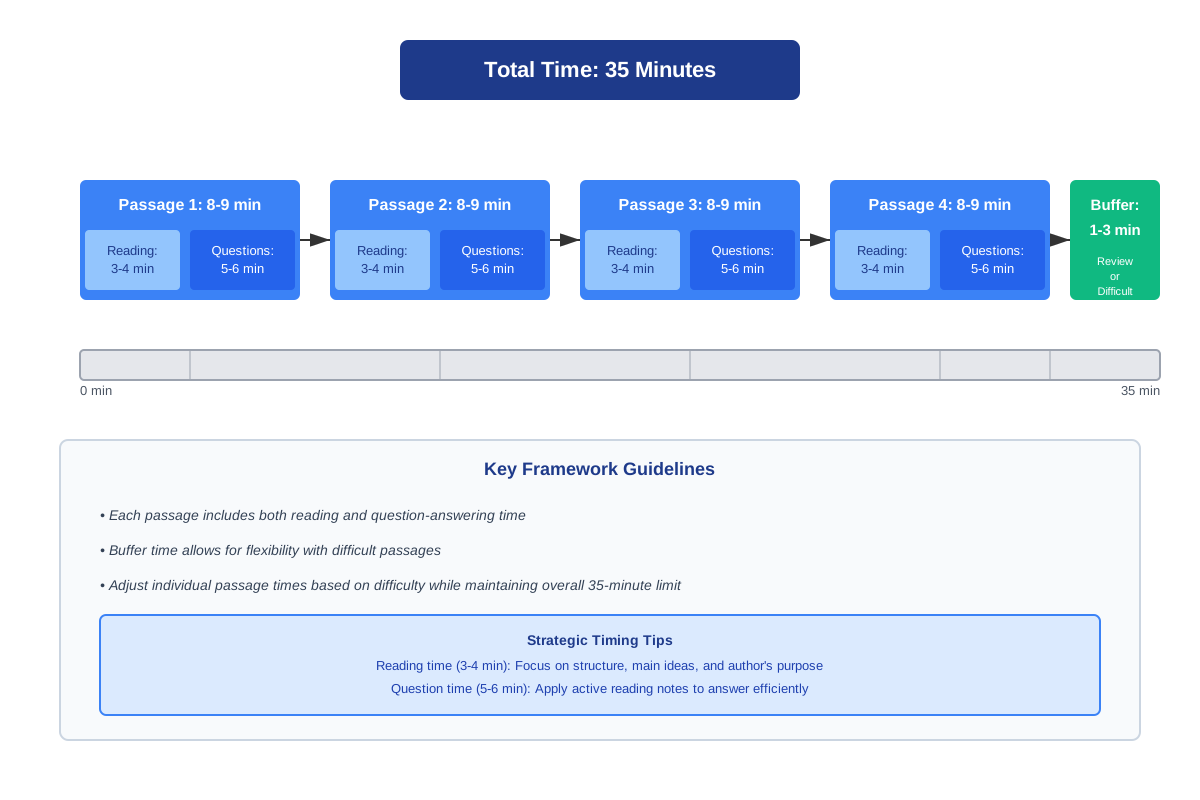
The foundational principle of passage timing strategy involves allocating approximately 8-9 minutes per passage, which divides the 35-minute section into four roughly equal segments. This framework provides 3-4 minutes for initial reading and annotation, leaving 5-6 minutes for answering questions. However, this represents an average rather than a rigid rule—some passages may require 7 minutes while others demand 10 minutes, depending on difficulty and question count.
The 8-9 minute guideline serves multiple strategic purposes. First, it prevents catastrophic time mismanagement where a test-taker spends 15 minutes on the first passage and must rush through the remaining three. Second, it creates natural checkpoints (at approximately 9, 18, and 27 minutes) where test-takers can assess whether they're on pace. Third, it builds in a small time buffer (1-2 minutes) that can be deployed strategically on the most challenging passage or used to review flagged questions.
Reading Time Versus Question Time Allocation
Effective lsat passage timing strategy requires understanding the optimal balance between time invested in initial reading versus time spent answering questions. Research on high-scoring test-takers reveals a consistent pattern: they typically spend 35-45% of their per-passage time on initial reading (approximately 3-4 minutes) and 55-65% on questions (approximately 5-6 minutes). This ratio reflects a crucial insight: thorough initial reading creates efficiency in question-answering by reducing the need to constantly return to the passage.
| Time Allocation Component | Recommended Time | Percentage of Total | Strategic Purpose |
|---|---|---|---|
| Initial passage reading | 3-4 minutes | 35-45% | Build mental map, identify structure, note key details |
| Question answering | 5-6 minutes | 55-65% | Apply comprehension, eliminate answers, verify choices |
| Review/buffer time | 0-1 minute | 0-10% | Double-check flagged questions, manage uncertainty |
The specific ratio should be calibrated to individual reading speed and comprehension style. Test-takers who naturally read quickly may spend only 3 minutes on initial reading, while those who read more deliberately might invest 4-5 minutes. The key is ensuring that initial reading time translates to faster, more accurate question-answering—if you're spending 5 minutes reading but still constantly returning to the passage for every question, the time investment isn't yielding appropriate returns.
Strategic Passage Selection and Ordering
While the LSAT presents passages in a fixed order, effective timing strategy includes strategic decisions about passage ordering. Test-takers can choose to tackle passages in the presented sequence or to skip a particularly challenging passage and return to it later. This flexibility allows for capitalizing on strengths and managing psychological momentum throughout the section.
The strategic approach involves quickly previewing all four passages (spending 15-20 seconds scanning each) to identify which appears most accessible based on subject matter, question count, and personal comfort with the topic. Many high-scoring test-takers adopt a "confidence-first" approach, beginning with their strongest passage type to build momentum and secure easy points before tackling more challenging material. However, this strategy requires discipline—the preview process should consume no more than 90 seconds total, and the decision to reorder must be made quickly to avoid wasting valuable time.
The Checkpoint System
Implementing a checkpoint system transforms abstract time awareness into concrete, actionable feedback during the test. Effective checkpoints occur at three intervals:
- After Passage 1 (9-minute mark): Assess whether you're at or near the end of the first passage. If you're significantly behind (still on question 3 of 7, for example), implement acceleration strategies immediately.
- After Passage 2 (18-minute mark): Evaluate overall pacing. At this midpoint, you should have completed two passages. If you're ahead of schedule, you've created valuable buffer time; if behind, you need to increase efficiency on remaining passages.
- After Passage 3 (27-minute mark): With 8 minutes remaining, you should be starting the fourth passage. This checkpoint is critical—if you have less than 7 minutes remaining, you may need to employ emergency strategies like strategic guessing on the most difficult questions.
These checkpoints function as early-warning systems, allowing for mid-section adjustments before time pressure becomes overwhelming. The key is training yourself to automatically note these time markers without disrupting concentration or flow.
Question Triage Within Passages
Question triage represents a micro-level timing strategy applied within each passage. Not all questions require equal time investment—some can be answered in 30 seconds while others may demand 90 seconds or more. Effective triage involves quickly categorizing questions into three tiers:
- Tier 1 (Quick questions): Detail questions with clear line references, straightforward main point questions, and questions where the correct answer is immediately apparent (target: 30-45 seconds each)
- Tier 2 (Standard questions): Most inference questions, author's attitude questions, and questions requiring moderate analysis (target: 60-75 seconds each)
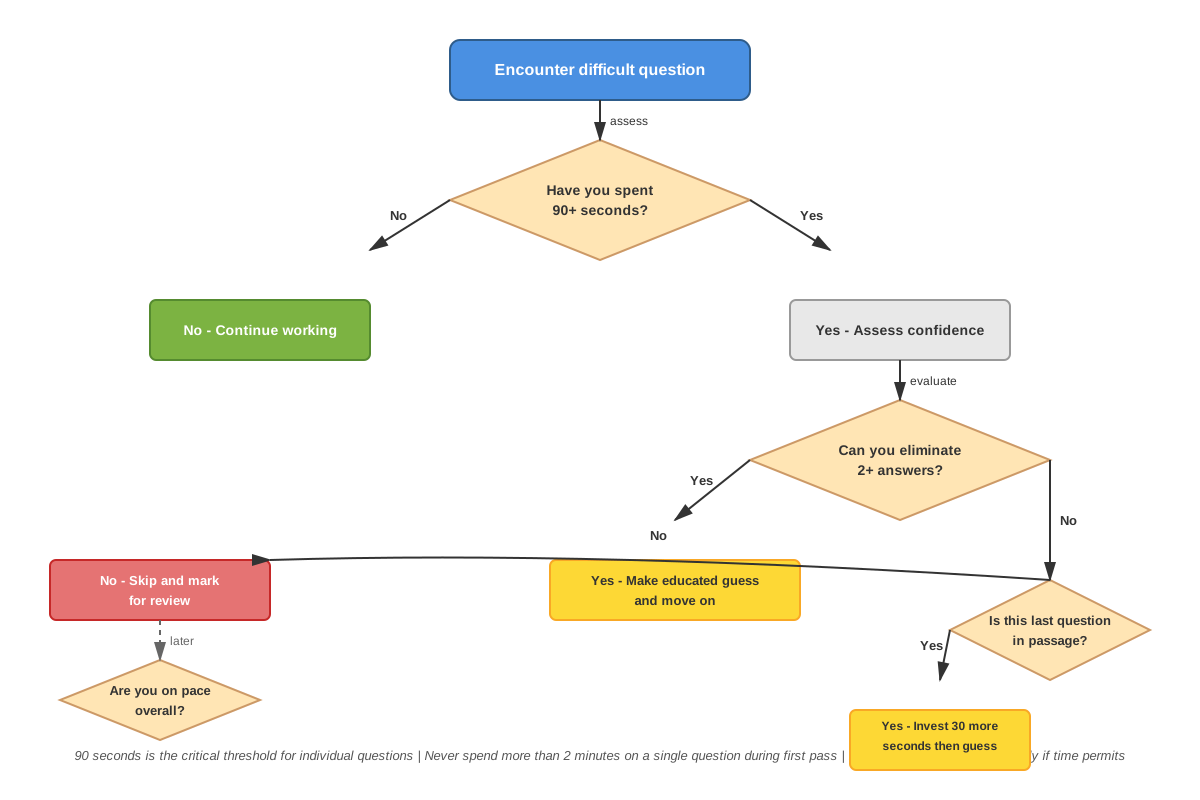
- Tier 3 (Time-intensive questions): Complex inference questions, challenging EXCEPT questions, and questions where answer choices are closely competitive (target: 90-120 seconds each)
The strategic approach involves answering Tier 1 questions immediately and efficiently, investing appropriate time in Tier 2 questions, and making conscious decisions about Tier 3 questions—either investing the necessary time if you're on pace, or flagging them for return if time is tight. This triage system prevents the common mistake of spending 2 minutes on a question that should take 45 seconds, thereby creating artificial time pressure on subsequent questions.
Adaptive Timing Strategies
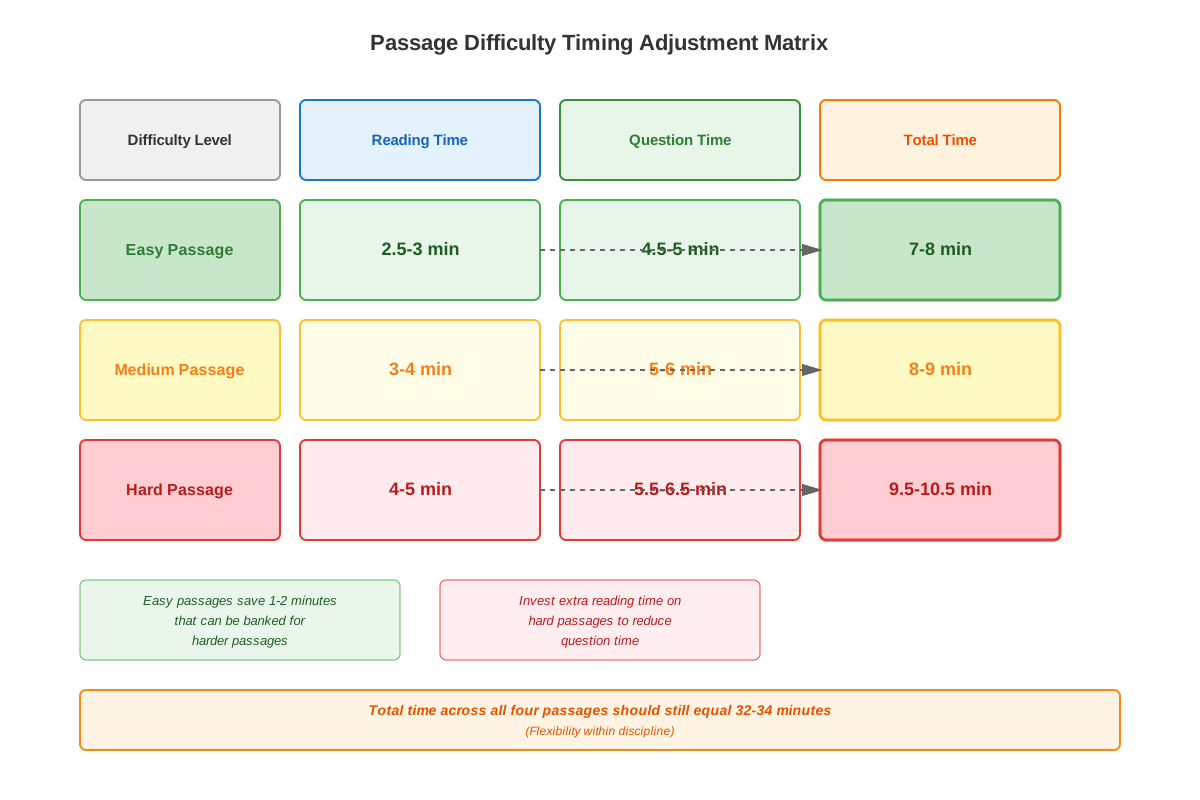
Adaptive timing acknowledges that not all passages are created equal—some will be significantly more challenging than others, and rigid adherence to the 8-9 minute guideline can be counterproductive. The adaptive approach involves recognizing when a passage requires additional time investment and consciously deciding to allocate that time, understanding that you'll need to compensate by working more efficiently on other passages.
For example, if you encounter a particularly dense science passage with complex argumentation and 8 questions, investing 10-11 minutes may be appropriate—but only if you've built buffer time from earlier passages or commit to completing a later passage in 7 minutes. This flexibility requires confidence in your abilities and trust in your preparation, as it involves making real-time strategic decisions under pressure.
The Comparative Reading Adjustment
The comparative reading passage (typically the third passage) requires modified timing considerations because it presents two shorter passages rather than one longer passage. Many test-takers find comparative reading either significantly easier or more challenging than standard passages, making it a critical area for personalized timing strategy.
The recommended approach involves spending approximately 2 minutes on Passage A, 2 minutes on Passage B, and 5-6 minutes on questions—maintaining the overall 9-minute target while adjusting the internal allocation. Some questions will focus exclusively on Passage A or B (typically answerable more quickly), while relationship questions require synthesizing both passages (typically requiring more time). Understanding this pattern allows for efficient question triage within the comparative reading set.
Concept Relationships
The core concepts within passage timing strategy form an interconnected system where each element supports and reinforces the others. The 8-9 minute per passage framework serves as the foundation, establishing the overall time budget that all other strategies must work within. This framework directly enables the checkpoint system, which provides the feedback mechanism for determining whether the overall strategy is being executed successfully.
Within each passage, the reading time versus question time allocation principle determines how the 8-9 minute budget is distributed, while question triage provides the tactical approach for maximizing efficiency during the question-answering phase. These micro-level strategies must align with the macro-level framework to create coherent time management.
Strategic passage selection and adaptive timing represent flexibility mechanisms that allow test-takers to deviate from the standard framework when circumstances warrant. These concepts acknowledge that rigid adherence to timing rules can be counterproductive when facing unusual difficulty patterns. However, both require the foundation of the checkpoint system to function effectively—you can only make informed decisions about adaptation when you have accurate feedback about your current pacing.
The relationship map flows as follows:
8-9 Minute Framework → establishes → Checkpoint System → provides feedback for → Adaptive Timing Decisions → which modify → Reading/Question Time Allocation → which is executed through → Question Triage → all while considering → Strategic Passage Selection → with special adjustments for → Comparative Reading
This interconnected system means that weakness in any single area compromises the entire timing strategy. For example, poor question triage leads to inefficient use of question-answering time, which throws off the reading/question allocation, which causes checkpoint failures, which prevents effective adaptive timing decisions.
Quick check — test yourself on Passage timing strategy so far.
Try Flashcards →High-Yield Facts
⭐ The optimal time allocation for LSAT Reading Comprehension is approximately 8-9 minutes per passage, with 3-4 minutes for reading and 5-6 minutes for questions.
⭐ Implementing checkpoints at 9, 18, and 27 minutes allows for mid-section timing adjustments before time pressure becomes critical.
⭐ Test-takers who spend 35-45% of per-passage time on initial reading typically answer questions more efficiently than those who rush through the passage.
⭐ Question triage—categorizing questions by expected time investment—prevents spending excessive time on difficult questions while easier questions remain unanswered.
⭐ Strategic passage selection (choosing to reorder passages based on difficulty) can improve performance, but the preview process should consume no more than 90 seconds total.
- The comparative reading passage typically requires the same overall time (8-9 minutes) but with modified internal allocation (2 minutes per passage, 5-6 minutes for questions).
- Building a 1-2 minute time buffer through efficient work on easier passages provides flexibility for challenging passages without creating time pressure.
- Most test-takers can answer detail questions with clear line references in 30-45 seconds, while complex inference questions may require 90-120 seconds.
- Spending more than 2 minutes on any single question is rarely strategic—flagging and returning is typically more efficient.
- The fourth passage often receives the least time due to accumulated delays, making it strategically valuable to preview and potentially reorder if it appears particularly challenging.
- Adaptive timing strategies (consciously spending 10 minutes on a difficult passage) require compensating by completing another passage in 7 minutes to maintain overall pacing.
- Test-takers who consistently finish with 3+ minutes remaining are likely reading too quickly and sacrificing comprehension, while those who consistently fail to finish need to implement more aggressive timing strategies.
Common Misconceptions
Misconception: All passages should receive exactly equal time investment regardless of difficulty or question count.
Correction: Effective timing strategy is adaptive, not rigid. A passage with 8 questions naturally requires more time than one with 5 questions, and an exceptionally difficult passage may warrant 10 minutes while an easier passage can be completed in 7 minutes. The 8-9 minute guideline represents an average, not an absolute rule.
Misconception: Spending more time on initial reading always leads to better performance.
Correction: There is an optimal range for reading time (3-4 minutes for most test-takers), beyond which additional reading time yields diminishing returns. Spending 6-7 minutes on initial reading leaves insufficient time for careful question analysis and often indicates inefficient reading strategies rather than thoroughness.
Misconception: Strategic passage selection (reordering passages) wastes too much time to be worthwhile.
Correction: A quick 15-20 second preview of each passage (90 seconds total) can identify the most accessible passage, and beginning with a confidence-building passage often improves overall performance by reducing anxiety and building momentum. The time investment is minimal compared to the potential benefit.
Misconception: If you're behind pace at the first checkpoint, you should rush through remaining passages to catch up.
Correction: Rushing typically leads to comprehension errors and careless mistakes that cost more points than the time saved. Instead, implement targeted efficiency strategies: slightly reduce reading time (by 30-60 seconds), employ more aggressive question triage, and be willing to make educated guesses on the most difficult questions rather than investing excessive time.
Misconception: You should always complete questions in the order presented within each passage.
Correction: Question triage involves identifying quick questions (like detail questions with line references) and answering them first, then tackling more complex questions. This approach secures easy points quickly and can build confidence and momentum within each passage.
Misconception: Timing strategy is only important for test-takers who struggle with time management.
Correction: Even test-takers who naturally finish within the time limit benefit from timing strategy because it allows them to allocate their time more effectively—spending more time on high-value questions and less on questions where additional time yields minimal benefit. Strategic time allocation improves accuracy, not just completion rate.
Worked Examples
Example 1: Mid-Section Timing Adjustment
Scenario: You're taking the LSAT Reading Comprehension section. After completing the first passage (a challenging science passage about quantum mechanics), you check your watch and see that 11 minutes have elapsed. You're now beginning the second passage, which appears to be a humanities passage about Renaissance art. You have 24 minutes remaining for three passages.
Analysis and Strategy:
- Assess the situation: You're 2 minutes behind pace (should be at 9 minutes, actually at 11 minutes). This is concerning but not catastrophic—you haven't created an insurmountable deficit.
- Identify the cause: The first passage was genuinely difficult and had 8 questions. Spending 11 minutes was a reasonable response to difficulty, not a sign of poor time management.
- Calculate required adjustment: With 24 minutes for three passages, you need to average 8 minutes per passage to finish on time. This means you need to make up the 2-minute deficit across the remaining passages.
- Implement targeted efficiency strategies:
- Reduce reading time on the second passage from 4 minutes to 3 minutes by reading slightly faster and making fewer annotations
- Employ aggressive question triage—answer quick questions immediately and flag any question that doesn't yield to 60 seconds of analysis
- Aim to complete the second passage in 7.5 minutes (30 seconds ahead of pace)
- If successful, you'll have 16.5 minutes for the final two passages (8.25 minutes each), putting you back on pace
- Execute with discipline: Begin the humanities passage with a clear time goal (finish by the 18.5-minute mark), maintain awareness of pacing throughout, and resist the temptation to over-invest in difficult questions.
Key Takeaway: This example demonstrates adaptive timing in action—recognizing a timing deficit early, calculating the required adjustment, and implementing specific strategies to return to pace without panicking or rushing.
Example 2: Question Triage Within a Passage
Scenario: You've just finished reading a law passage about intellectual property rights (4 minutes elapsed). You have 5 minutes remaining for your 9-minute passage budget. The passage has 7 questions. You quickly scan the questions and categorize them:
- Question 1: "The primary purpose of the passage is to..." (Main point—Tier 2)
- Question 2: "According to the passage, the 1998 legislation (lines 23-27)..." (Detail with line reference—Tier 1)
- Question 3: "The author's attitude toward current copyright law can best be described as..." (Author's attitude—Tier 2)
- Question 4: "Which of the following, if true, would most strengthen the author's argument?" (Strengthen—Tier 3)
- Question 5: "The passage suggests which of the following about digital media?" (Inference—Tier 2)
- Question 6: "The author mentions the Supreme Court decision primarily in order to..." (Function—Tier 2)
- Question 7: "Each of the following is mentioned in the passage EXCEPT..." (EXCEPT question—Tier 3)
Strategic Approach:
- Answer Tier 1 questions first: Begin with Question 2 (detail with line reference). Return to lines 23-27, read carefully, and select the answer that directly matches the text. Time invested: 40 seconds.
- Tackle Tier 2 questions systematically: Answer Questions 1, 3, 5, and 6 in order. These require moderate analysis but should be answerable with your comprehension from the initial reading. Average time per question: 60-70 seconds. Total time: approximately 4.5 minutes.
- Assess remaining time: After completing Tier 1 and Tier 2 questions (approximately 5.5 minutes total), you have 3.5 minutes remaining for two Tier 3 questions—well above the 90-second minimum per question.
- Address Tier 3 questions: Spend approximately 90 seconds on Question 4 (strengthen question), carefully analyzing how each answer choice would affect the argument. Spend approximately 90 seconds on Question 7 (EXCEPT question), systematically checking each answer choice against the passage.
- Final check: If time permits (30-60 seconds remaining), quickly review any flagged questions or verify your answer to the most challenging question.
Key Takeaway: This example illustrates how question triage creates efficiency by ensuring quick questions are answered quickly (preventing time waste) while still allocating sufficient time for complex questions. The strategic approach prevents the common mistake of spending 2 minutes on Question 2 (which should take 40 seconds) and then rushing through Question 7 (which legitimately requires 90 seconds).
Exam Strategy
When approaching LSAT Reading Comprehension with timing strategy in mind, begin by setting your watch or the test center clock as your reference point at the start of the section. Immediately note the time and calculate your checkpoint times (9, 18, and 27 minutes). This external time awareness should operate in the background of your consciousness without dominating your attention.
Trigger phrases for timing adjustments include recognizing when you think "I'm not understanding this passage" (signal to either invest more time or move to a different passage), "This question is taking too long" (signal to flag and return), or "I'm not sure between two answers" (signal to make your best choice and move forward rather than deliberating endlessly). These internal signals should prompt immediate strategic responses rather than continued struggle.
Process-of-elimination tips specific to timing include setting a mental timer for each question—if you've spent 60 seconds and haven't eliminated any answers, you're likely missing something and should either return to the passage for clarification or flag the question and move forward. Additionally, if you've narrowed to two answers and spent 30 seconds deliberating between them, make your best choice and move forward—the additional time rarely changes your answer and creates time pressure on subsequent questions.
Time allocation advice for different question types:
- Detail questions with line references: 30-45 seconds
- Main point questions: 45-60 seconds
- Inference questions: 60-90 seconds
- EXCEPT/LEAST questions: 90-120 seconds
- Strengthen/Weaken questions: 75-90 seconds
- Author's attitude questions: 45-60 seconds
Develop a personal timing rhythm during practice that you can replicate on test day. This rhythm should feel slightly faster than comfortable but not rushed—you should feel time pressure but not panic. During practice, deliberately work at this pace until it becomes automatic, allowing you to maintain efficiency on test day without constant clock-checking.
Memory Techniques
The "3-5-9" mnemonic captures the essential timing framework: 3 minutes for reading, 5 minutes for questions, 9 minutes total per passage. This simple number sequence provides an easy-to-remember guideline that can be recalled instantly during the test.
The "Checkpoint Clock" visualization involves imagining a clock face divided into four equal segments, with each segment representing one passage. Visualize the clock hand moving through each segment, with checkpoints at the 9, 18, and 27-minute marks. This visual representation makes abstract time management concrete and memorable.
The "TRIAGE" acronym for question management:
- Tier questions by difficulty
- Recognize quick questions immediately
- Invest appropriate time in each tier
- Answer easy questions first
- Guess strategically when necessary
- Evaluate pacing at checkpoints
The "Read-React-Return" framework for passage approach: Read the passage thoroughly (3-4 minutes), React to questions efficiently (5-6 minutes), Return to flagged questions if time permits (0-1 minute). This three-phase approach provides a memorable structure for each passage.
Visualization strategy: Picture yourself as a runner in a four-lap race, with each lap representing one passage. You need to maintain a consistent pace across all four laps—starting too fast leads to exhaustion (time pressure) on later laps, while starting too slow means you won't finish. This athletic metaphor makes timing strategy intuitive and memorable.
Summary
Passage timing strategy represents a comprehensive framework for managing the 35-minute LSAT Reading Comprehension section, encompassing both macro-level time allocation (8-9 minutes per passage) and micro-level efficiency techniques (question triage, strategic reading time investment). The foundation of effective timing strategy is the checkpoint system, which provides feedback at 9, 18, and 27 minutes, enabling mid-section adjustments before time pressure becomes overwhelming. Within each passage, optimal performance requires balancing reading time (3-4 minutes, or 35-45% of total time) against question-answering time (5-6 minutes, or 55-65% of total time), with question triage ensuring that easy questions are answered quickly while difficult questions receive appropriate time investment. Adaptive timing strategies allow for flexibility when encountering unusually difficult passages, but require compensating efficiency on other passages to maintain overall pacing. Mastery of passage timing strategy transforms time from an obstacle into a strategic resource, enabling test-takers to demonstrate their full analytical capabilities under the constraints of a timed examination.
Key Takeaways
- The 8-9 minute per passage framework (3-4 minutes reading, 5-6 minutes questions) provides the foundation for effective time management across the entire Reading Comprehension section
- Implementing checkpoints at 9, 18, and 27 minutes enables early detection of timing problems and allows for strategic adjustments before time pressure becomes critical
- Question triage—categorizing questions by expected time investment and answering quick questions first—prevents time waste and ensures efficient point accumulation
- Adaptive timing strategies allow for spending 10 minutes on difficult passages, but require compensating by completing other passages in 7 minutes to maintain overall pacing
- Strategic passage selection (reordering based on difficulty) can improve performance, but the preview process must be limited to 90 seconds to avoid wasting valuable time
- The optimal reading time investment (3-4 minutes) creates efficiency in question-answering by building a strong mental map of the passage, reducing the need for constant re-reading
- Spending more than 2 minutes on any single question is rarely strategic—flagging and returning (or making an educated guess) is typically more efficient than extended deliberation
Related Topics
Question Type Strategies: Mastering timing strategy creates the foundation for implementing question-specific approaches, as proper time allocation ensures you have sufficient time to apply detailed strategies for inference questions, main point questions, and other question types.
Passage Annotation Techniques: Effective annotation during the 3-4 minute reading phase supports timing strategy by creating reference points that accelerate question-answering, reducing the need to re-read large sections of the passage.
Comparative Reading Strategies: The comparative reading passage requires modified timing considerations (2 minutes per passage, 5-6 minutes for questions), making it a natural extension of general timing strategy principles.
Test Day Execution and Stress Management: Timing strategy intersects with psychological preparation, as the ability to maintain disciplined pacing under pressure requires both technical knowledge and emotional regulation skills.
Practice CTA
Now that you've mastered the principles of passage timing strategy, it's time to put these concepts into practice. Attempt the practice questions and flashcards associated with this topic, focusing on implementing the checkpoint system and question triage techniques in realistic conditions. Remember that timing strategy is a skill that improves with deliberate practice—each practice passage is an opportunity to refine your pacing, test your checkpoint system, and build the automatic timing awareness that distinguishes top performers. Your investment in mastering timing strategy will pay dividends across every passage you encounter on test day, transforming time from an obstacle into a strategic advantage.
Sign up free to keep reading
Create a free AnvayaPrep account to finish this LSAT guide on Passage timing strategy — plus flashcards and practice questions.