Overview
Political theory passages represent one of the most intellectually demanding and frequently tested passage types in the LSAT Reading Comprehension section. These passages explore fundamental questions about governance, justice, rights, power, authority, and the relationship between individuals and the state. Unlike casual political commentary or current events analysis, lsat political theory passages engage with systematic philosophical arguments about how societies should be organized, what legitimizes governmental authority, and how competing values like liberty, equality, and security should be balanced.
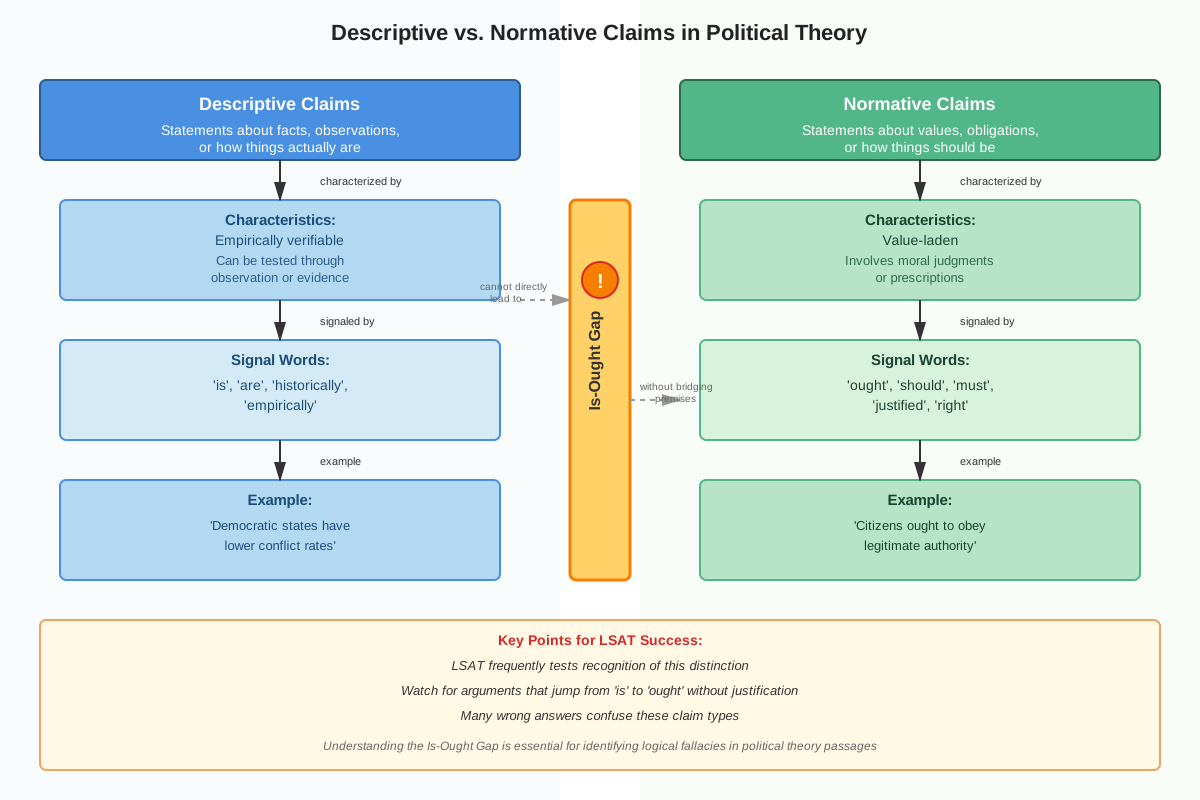
The LSAT regularly features political theory content because legal reasoning and political philosophy share deep conceptual connections. Both disciplines require careful analysis of abstract principles, evaluation of competing normative claims, and application of theoretical frameworks to concrete situations. Students who master political theory passages develop crucial skills in identifying argumentative structure, recognizing implicit assumptions, and distinguishing between descriptive claims (what is) and prescriptive claims (what ought to be). These passages typically present a theorist's position, critique an established view, or compare competing philosophical frameworks—all while maintaining the dense, academically rigorous tone characteristic of LSAT passages.
Within the broader context of reading comprehension and passage subjects and strategies, political theory passages require specific analytical approaches. They demand attention to logical structure over narrative flow, careful tracking of abstract concepts and their relationships, and sensitivity to subtle distinctions between similar-sounding ideas. Mastering these passages builds transferable skills applicable to other LSAT passage types, particularly those in law, philosophy, and social sciences, while directly preparing students for the theoretical reasoning they will encounter in law school and legal practice.
Learning Objectives
- [ ] Identify how political theory passages appear in LSAT questions
- [ ] Explain the reasoning pattern behind political theory passages
- [ ] Apply political theory passages to solve LSAT-style problems accurately
- [ ] Distinguish between normative and descriptive claims within political theory arguments
- [ ] Recognize common philosophical frameworks and their characteristic features in passages
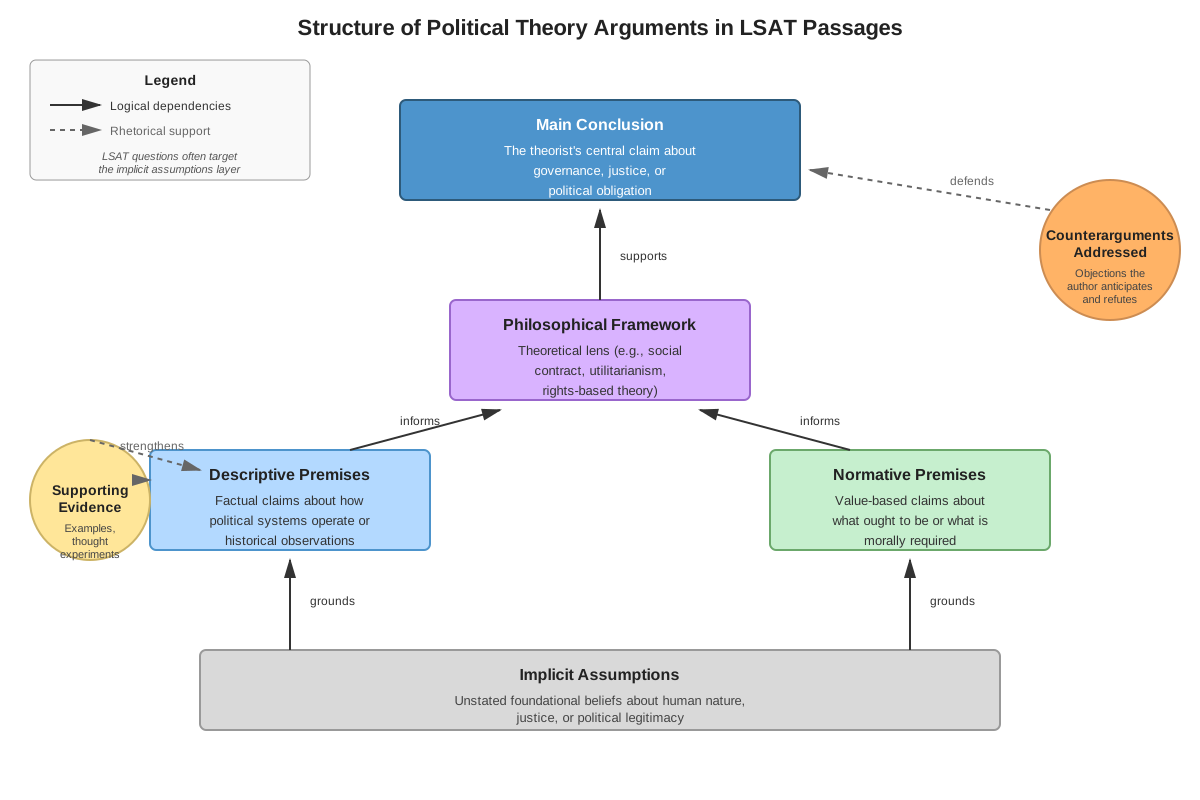
- [ ] Evaluate the logical structure of political theory arguments, including premises, conclusions, and supporting evidence
- [ ] Anticipate question types most commonly associated with political theory passages
Prerequisites
- Basic argument structure recognition: Understanding premises, conclusions, and supporting evidence is essential because political theory passages present complex philosophical arguments that must be deconstructed systematically.
- Familiarity with abstract reasoning: Political theory deals with concepts like justice, liberty, and legitimacy that require comfort working with ideas rather than concrete examples.
- General LSAT Reading Comprehension strategies: Foundational skills in active reading, passage mapping, and question-type recognition provide the framework for approaching specialized passage types.
- Understanding of author's purpose and tone: Political theory passages often involve subtle advocacy or critique that requires recognizing the author's stance toward competing viewpoints.
Why This Topic Matters
Political theory passages appear with remarkable consistency on the LSAT, typically comprising 15-25% of all Reading Comprehension passages. The LSAT favors these passages because they test the same analytical skills required for legal reasoning: parsing complex arguments, identifying unstated assumptions, recognizing logical relationships, and evaluating the strength of competing positions. Law schools value these skills because constitutional law, jurisprudence, and legal philosophy all draw heavily on political theory traditions.
In real-world legal practice, attorneys regularly engage with questions that political theory addresses: What rights do individuals possess? When can the state legitimately restrict freedom? How should competing interests be balanced? Constitutional litigation, human rights advocacy, legislative drafting, and judicial interpretation all require the analytical frameworks that political theory provides. Understanding social contract theory helps lawyers analyze constitutional questions; familiarity with theories of justice informs arguments about fairness in legal proceedings; and knowledge of rights-based reasoning strengthens advocacy for individual liberties.
On the LSAT specifically, political theory passages generate questions testing main idea identification, author's purpose, specific detail retrieval, inference drawing, logical structure analysis, and application of principles to new scenarios. These passages frequently appear as the most challenging passage in a Reading Comprehension section, often placed strategically to test students' ability to maintain focus and analytical precision under pressure. Common manifestations include passages discussing social contract theorists (Locke, Rousseau, Hobbes), theories of justice (distributive justice, procedural justice), rights frameworks (natural rights, positive rights), democratic theory, and critiques of political systems.
Core Concepts
Normative vs. Descriptive Claims
The fundamental distinction in political theory passages separates normative claims (statements about what ought to be, what is right or just) from descriptive claims (statements about what actually is or was). Political theory passages predominantly make normative arguments—they advocate for particular conceptions of justice, legitimate authority, or proper governance. However, these normative arguments often rest on descriptive premises about human nature, historical patterns, or social dynamics.
For example, a passage might descriptively claim that "humans naturally seek self-preservation" (a factual assertion about human psychology) and then normatively conclude that "governments are therefore justified in prioritizing security over other values" (a value judgment about what governments should do). LSAT questions frequently test whether students can distinguish these claim types and recognize when an author moves from descriptive premises to normative conclusions.
Common Philosophical Frameworks
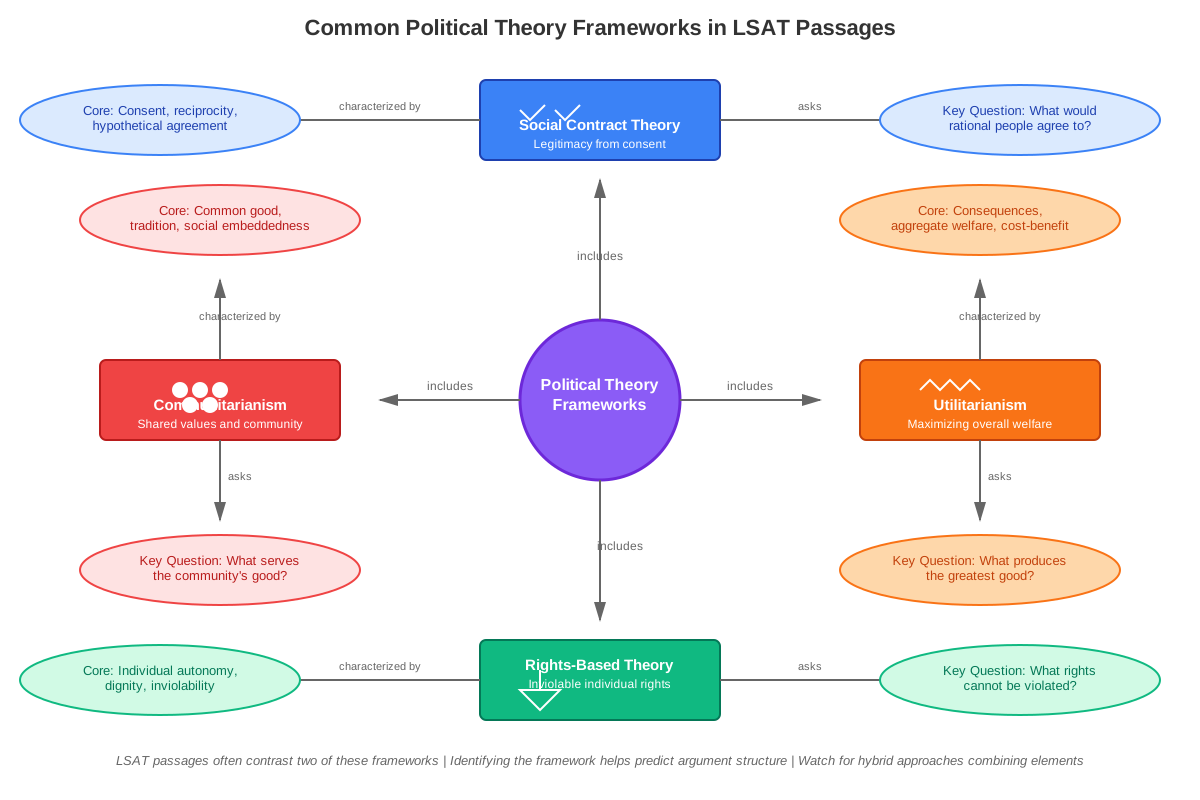
Social contract theory represents one of the most frequently tested frameworks in LSAT political theory passages. This tradition argues that political authority derives from an agreement (actual or hypothetical) among individuals who consent to governmental power in exchange for protection, order, or other benefits. Passages may present classical social contract theorists or modern variations, often exploring what individuals would rationally agree to, what rights they retain, and what obligations they accept.
Rights-based theories focus on individual entitlements that governments must respect or protect. These passages distinguish between negative rights (freedoms from interference, like freedom of speech) and positive rights (entitlements to goods or services, like education or healthcare). LSAT passages often explore tensions between different rights, the source of rights (natural law, social construction, or legal recognition), and the limits of rights when they conflict with other values.
Utilitarian and consequentialist frameworks evaluate political arrangements based on their outcomes, typically aiming to maximize overall welfare, happiness, or preference satisfaction. Passages presenting these views often contrast them with rights-based or duty-based approaches, highlighting situations where maximizing aggregate welfare might require sacrificing individual rights or treating people as means rather than ends.
Theories of justice examine how benefits and burdens should be distributed in society. Distributive justice concerns the fair allocation of resources, opportunities, and social goods. Procedural justice focuses on fair processes and decision-making mechanisms. LSAT passages might present egalitarian theories (emphasizing equality), libertarian theories (emphasizing liberty and property rights), or capability approaches (emphasizing what people can actually do and become).
Argumentative Structure in Political Theory
Political theory passages typically follow recognizable structural patterns. The thesis-driven structure presents a central claim early, then develops supporting arguments, addresses potential objections, and reinforces the main position. The comparative structure contrasts two or more theoretical approaches, often highlighting their different assumptions, methods, or implications. The critique structure presents an established view, identifies its weaknesses or limitations, and sometimes proposes an alternative.
Understanding these structures helps predict where key information appears and how questions will test comprehension. Main idea questions target the thesis or central comparison; specific detail questions focus on supporting arguments or examples; inference questions explore implications or unstated assumptions; and application questions test whether students can extend the theoretical framework to new scenarios.
Key Concepts and Terminology
| Concept | Definition | LSAT Relevance |
|---|---|---|
| Legitimacy | The justification for political authority; why citizens should obey | Central to passages about governmental power and consent |
| Sovereignty | Supreme authority within a territory; who has final decision-making power | Appears in passages about state power and international relations |
| Liberty | Freedom from interference or constraint | Frequently contrasted with equality, security, or community values |
| Equality | Similar treatment or status; can mean equal rights, opportunities, or outcomes | Often examined in justice-focused passages |
| Autonomy | Self-governance; capacity to make one's own choices | Key to passages about individual rights and paternalism |
| Coercion | Use of force or threats to compel behavior | Relevant to discussions of state power and legitimate authority |
Implicit Assumptions and Logical Gaps
Political theory passages often rely on unstated assumptions that LSAT questions expose. A passage arguing for expanded governmental authority might assume that governments will use power responsibly, that citizens cannot adequately protect themselves, or that collective action problems require centralized solutions. Recognizing these implicit premises helps answer inference questions and evaluate argument strength.
Similarly, passages may contain logical gaps—places where the reasoning doesn't fully support the conclusion. An argument might move from "people value security" to "governments should prioritize security over liberty" without establishing why valuing something justifies governmental action or why security should outweigh other values. LSAT questions frequently test whether students can identify these gaps and recognize what additional premises would strengthen or weaken the argument.
Concept Relationships
The concepts within political theory passages form an interconnected web of relationships. Normative claims about legitimate governance typically rest on descriptive assumptions about human nature, social dynamics, or historical patterns. For example, social contract theory's normative conclusions about legitimate authority depend on descriptive claims about what rational individuals would consent to in hypothetical scenarios.
Different philosophical frameworks often compete by emphasizing different values or principles. Rights-based theories prioritize individual entitlements → which may conflict with → utilitarian frameworks prioritizing aggregate welfare → creating tensions that → require balancing mechanisms or priority rules. Understanding these relationships helps predict how passages will develop and what questions will ask.
The argumentative structures employed in passages reflect the underlying philosophical commitments. Thesis-driven structures suit passages advocating a particular theory → comparative structures work well for passages exploring competing frameworks → critique structures appear when authors challenge established views. Recognizing the structure → enables prediction of content location → which improves efficiency and accuracy.
Key terminology provides the building blocks for more complex arguments. Concepts like legitimacy, sovereignty, and autonomy → combine to form arguments about → when governmental authority is justified → and what limits constrain state power. These relationships → generate the specific claims and reasoning patterns → that LSAT questions test.
This topic connects to prerequisite knowledge of argument structure by applying those general skills to the specific domain of political philosophy. It relates to other Reading Comprehension passage types by exemplifying how specialized content requires adapted strategies while maintaining core analytical approaches. Mastering political theory passages → strengthens skills in → abstract reasoning and normative argument analysis → which transfer to → legal philosophy passages, ethical reasoning questions, and complex argumentative texts across LSAT sections.
High-Yield Facts
⭐ Political theory passages appear in approximately 15-25% of LSAT Reading Comprehension sections, making them one of the most common specialized passage types.
⭐ The distinction between normative claims (what ought to be) and descriptive claims (what is) represents the most frequently tested conceptual distinction in political theory passages.
⭐ Social contract theory passages typically explore three key questions: what individuals consent to, what rights they retain, and what obligations they accept.
⭐ Rights-based passages often test understanding of the difference between negative rights (freedoms from interference) and positive rights (entitlements to goods or services).
⭐ Utilitarian frameworks evaluate political arrangements based on outcomes and aggregate welfare, often creating tension with individual rights.
- Political theory passages frequently present competing frameworks to test students' ability to distinguish different philosophical approaches and their implications.
- Questions about author's purpose in political theory passages often hinge on recognizing whether the author advocates, critiques, or neutrally presents a theoretical position.
- Inference questions commonly test recognition of unstated assumptions underlying normative arguments.
- Application questions require extending theoretical principles to new scenarios not explicitly discussed in the passage.
- The most challenging political theory passages combine multiple frameworks or present subtle critiques that require careful attention to logical structure and implicit reasoning.
- Passages discussing legitimacy typically address why citizens should obey governmental authority and what justifies state power.
- Justice-focused passages often distinguish between distributive justice (fair allocation of resources) and procedural justice (fair decision-making processes).
- Political theory passages regularly employ abstract examples or hypothetical scenarios to illustrate theoretical principles.
- Understanding the historical context of political theorists (Enlightenment, post-war period, contemporary debates) can aid comprehension but is never required for answering questions.
- The densest, most abstract language in political theory passages typically appears when defining key concepts or stating fundamental principles—these sections deserve extra attention during active reading.
Quick check — test yourself on Political theory passages so far.
Try Flashcards →Common Misconceptions
Misconception: Political theory passages require prior knowledge of specific philosophers or theories to answer questions correctly.
Correction: The LSAT never requires outside knowledge. All information needed to answer questions appears in the passage itself. Familiarity with philosophical traditions may speed comprehension but cannot substitute for careful reading of the specific passage content.
Misconception: Normative claims can be proven true or false like factual claims.
Correction: Normative claims express value judgments about what should be, not factual assertions about what is. They can be supported with arguments and evidence, but they rest ultimately on value commitments rather than empirical verification. LSAT questions test understanding of the arguments supporting normative claims, not whether the claims are "correct."
Misconception: Political theory passages always present a single, unified argument that the author endorses.
Correction: Many political theory passages present multiple perspectives, compare competing frameworks, or neutrally explain a theory without endorsing it. Recognizing the author's actual stance—advocacy, critique, or neutral presentation—is often what questions test.
Misconception: Abstract passages should be read more slowly than concrete, narrative passages.
Correction: While political theory passages are conceptually dense, effective LSAT strategy involves reading them at a consistent pace while actively mapping structure and relationships. Slowing down excessively often reduces comprehension by making it harder to track the overall argument flow.
Misconception: Understanding every word and concept on first reading is necessary for answering questions.
Correction: Strategic reading involves identifying main ideas, tracking argument structure, and noting key relationships while accepting that some details will be clarified when returning to the passage for specific questions. Attempting perfect comprehension on first reading wastes time and increases anxiety.
Misconception: Political theory passages are primarily about historical figures and their biographical details.
Correction: While passages may mention theorists by name, the focus is always on ideas, arguments, and logical relationships—not biographical information. Questions test understanding of philosophical positions and reasoning patterns, not historical facts about individuals.
Misconception: The most complex sentence in a passage must contain the main idea.
Correction: Main ideas are often stated relatively clearly, while complex sentences typically develop supporting arguments, address objections, or explain subtle distinctions. Complexity doesn't correlate with importance.
Worked Examples
Example 1: Social Contract Theory Passage
Passage Excerpt: "Rousseau's conception of the social contract differs fundamentally from Locke's in its treatment of individual liberty. While Locke argued that individuals retain natural rights even after entering civil society, surrendering only the right to enforce these rights themselves, Rousseau contended that the social contract requires individuals to alienate all their rights to the community. This total alienation, Rousseau maintained, paradoxically preserves freedom because individuals become subject only to laws they collectively author through the general will. Critics argue that Rousseau's framework provides insufficient protection against majoritarian tyranny, as minority rights receive no special protection beyond their participation in collective decision-making."
Question: The passage suggests that Rousseau's theory differs from Locke's primarily in:
Analysis Process:
- Identify the comparison structure: The passage explicitly contrasts Rousseau and Locke on treatment of individual liberty
- Locate Locke's position: Individuals retain natural rights, surrendering only enforcement rights
- Locate Rousseau's position: Individuals alienate all rights to the community
- Identify the key difference: Extent of rights surrendered (partial vs. total)
- Note Rousseau's justification: Total alienation preserves freedom through collective authorship of laws
- Consider the critique: This addresses a potential weakness but doesn't change the fundamental difference
Answer: The primary difference concerns the extent to which individuals surrender their natural rights when entering civil society—Locke advocates partial surrender (retaining rights but not enforcement), while Rousseau advocates total alienation to the community.
Connection to Learning Objectives: This example demonstrates how to identify political theory content in passages (Objective 1), recognize the reasoning pattern of comparative analysis between frameworks (Objective 2), and apply careful reading to distinguish similar but distinct positions (Objective 3).
Example 2: Rights and Justice Passage
Passage Excerpt: "Contemporary debates about healthcare policy reveal a fundamental tension between two conceptions of rights. Those advocating a right to healthcare typically conceive of it as a positive right—an entitlement requiring governmental provision of services or resources. This view implies that justice demands not merely non-interference but active measures to ensure all citizens can access medical care. Opponents often argue from a negative rights framework, contending that while individuals possess rights against interference with their healthcare choices, they have no entitlement to have others provide healthcare for them. This disagreement reflects deeper philosophical divisions about whether justice requires only equal liberty or also demands some measure of equal access to essential goods."
Question: Based on the passage, proponents of positive rights would most likely agree with which of the following?
Analysis Process:
- Identify the key distinction: Positive rights (entitlements to provision) vs. negative rights (freedoms from interference)
- Locate positive rights position: Requires governmental provision; justice demands active measures for access
- Identify the underlying principle: Justice requires more than non-interference—it demands ensuring access
- Consider implications: This view would support governmental action to provide or ensure access to essential goods
- Distinguish from negative rights view: Opponents reject entitlement to provision, accepting only non-interference rights
Answer: Proponents of positive rights would likely agree that governmental action to ensure equal access to essential goods is a requirement of justice, not merely a policy option. They would reject the claim that justice is satisfied by simply not interfering with individual choices.
Connection to Learning Objectives: This example shows how to identify the normative reasoning pattern distinguishing different rights frameworks (Objective 2), recognize how abstract principles generate concrete policy implications (Objective 4), and apply theoretical distinctions to evaluate positions (Objective 3).
Exam Strategy
Initial Reading Approach
When encountering a political theory passage, immediately identify whether it presents a single theory, compares multiple frameworks, or critiques an established position. This structural recognition guides expectations about where key information will appear. During the first read-through, focus on:
- Main thesis or central comparison: Usually stated in the first or second paragraph
- Key concepts and their definitions: Often introduced early, then developed throughout
- Logical structure: How arguments build, what supports what
- Author's stance: Advocacy, critique, or neutral presentation
Exam Tip: Political theory passages often front-load abstract definitions before presenting arguments. Don't get bogged down in initial definitional paragraphs—note the concepts introduced, then see how they're used in the argument.
Trigger Words and Phrases
Certain language signals important logical moves in political theory passages:
- Normative indicators: "should," "ought," "must," "justified," "legitimate," "right," "wrong," "fair," "just"
- Contrast markers: "however," "in contrast," "whereas," "unlike," "differs from"
- Assumption indicators: "assumes," "presupposes," "takes for granted," "rests on"
- Logical connection words: "therefore," "thus," "because," "since," "follows from"
- Qualification language: "some," "may," "can," "potentially," "in certain cases"
These triggers help identify argument structure, locate key claims, and recognize logical relationships that questions will test.
Question Type Strategies
Main Idea Questions: Look for the passage's central claim or comparison, typically stated explicitly in the first two paragraphs. Correct answers capture the scope and purpose without being too narrow (focusing on a supporting detail) or too broad (going beyond what the passage addresses).
Specific Detail Questions: Return to the passage using paragraph references or content memory from active reading. Political theory passages often use parallel structure, so if a question asks about one theorist's view, the relevant information likely appears in the same structural position as information about contrasting theorists.
Inference Questions: Focus on what must be true based on explicit statements, not what might be true or what seems plausible. Political theory inference questions often test recognition of unstated assumptions, logical implications of stated principles, or what would strengthen/weaken an argument.
Application Questions: Identify the relevant principle or framework in the passage, then carefully apply it to the new scenario. Avoid bringing in outside knowledge or assumptions—use only what the passage establishes about how the theory works.
Author's Purpose/Attitude Questions: Distinguish between views the author presents and views the author endorses. Language like "argues," "contends," or "maintains" often introduces others' views, while "however," "in fact," or "actually" may signal the author's own position.
Process of Elimination Tips
- Eliminate answers that confuse normative and descriptive claims
- Eliminate answers that attribute one theorist's view to another in comparative passages
- Eliminate answers that go beyond the passage scope, introducing concepts or claims not discussed
- Eliminate answers using extreme language ("always," "never," "only") unless the passage itself uses such language
- Eliminate answers that reverse the passage's logical relationships (treating a premise as a conclusion or vice versa)
Time Allocation
Political theory passages typically require slightly more time than narrative passages due to conceptual density. Allocate approximately:
- 3.5-4 minutes: Initial reading and passage mapping
- 5-6 minutes: Answering questions (approximately 1 minute per question, with more time for complex inference or application questions)
- Total: 8.5-10 minutes per political theory passage
If a passage feels exceptionally difficult, consider whether it's worth investing extra time or whether moving to an easier passage and returning later would be more strategic.
Memory Techniques
The RIGHTS Acronym for Rights-Based Passages
Recognize the type (negative vs. positive)
Identify the source (natural, legal, social)
Grasp what it entitles or protects
Highlight conflicts with other values
Track limitations or boundaries
See implications for governance
The CONTRACT Framework for Social Contract Theory
Consent: What do individuals agree to?
Obligations: What duties do they accept?
Natural state: What's the pre-political condition?
Trade-offs: What do they surrender for what benefits?
Rights retained: What do they keep?
Authority: What power does government gain?
Conditions: When is the contract valid or void?
Theory's goal: What problem does it solve?
Visualization Strategy
Picture political theory arguments as architectural structures:
- Foundation: Descriptive assumptions about human nature or social conditions
- Supporting pillars: Key principles or values (liberty, equality, justice)
- Framework: Logical connections between principles and conclusions
- Roof: Normative conclusions about legitimate governance
When reading, visualize which part of the structure each paragraph builds. This spatial metaphor helps track argument development and remember relationships between concepts.
The "Three Questions" Mnemonic
Every political theory passage answers three questions:
- What's the problem? (Why do we need government/justice/rights?)
- What's the solution? (What framework or principle addresses it?)
- What's the catch? (What tensions, objections, or limitations arise?)
Actively seeking answers to these questions during reading creates a mental framework for organizing information and predicting question content.
Summary
Political theory passages represent a high-frequency, high-difficulty passage type on the LSAT Reading Comprehension section, testing students' ability to analyze abstract philosophical arguments about governance, justice, rights, and political legitimacy. Success requires distinguishing normative claims (what ought to be) from descriptive claims (what is), recognizing common philosophical frameworks (social contract theory, rights-based approaches, utilitarian reasoning, theories of justice), and tracking complex argumentative structures. These passages typically present a single theory, compare competing frameworks, or critique established positions, using dense academic language and abstract concepts. The most critical skills involve identifying implicit assumptions, recognizing logical relationships between principles and conclusions, and applying theoretical frameworks to new scenarios. Questions test main idea comprehension, specific detail retrieval, inference drawing, and principle application, with particular emphasis on distinguishing similar but distinct positions and recognizing what arguments presuppose or imply. Strategic approaches include structural mapping during initial reading, attention to trigger words signaling logical moves, and careful process of elimination based on scope, logical relationships, and normative/descriptive distinctions. Mastering political theory passages builds transferable analytical skills essential for legal reasoning and strengthens performance across all Reading Comprehension passage types.
Key Takeaways
- Political theory passages appear in 15-25% of Reading Comprehension sections and test abstract reasoning about governance, justice, and rights through dense philosophical arguments
- The normative/descriptive distinction is the most frequently tested concept—always identify whether claims state what is or what ought to be
- Common frameworks include social contract theory, rights-based approaches (negative vs. positive rights), utilitarian reasoning, and theories of justice (distributive and procedural)
- Passage structures follow predictable patterns: thesis-driven (single theory), comparative (multiple frameworks), or critique (challenging established views)
- Success requires identifying implicit assumptions, tracking logical relationships, and recognizing what arguments presuppose without stating explicitly
- No outside knowledge is required—all information needed appears in the passage, though familiarity with philosophical traditions may speed comprehension
- Strategic reading focuses on main thesis, key concepts, logical structure, and author's stance rather than attempting perfect comprehension of every detail
Related Topics
Legal Philosophy and Jurisprudence Passages: Building on political theory foundations, these passages explore the nature of law, legal interpretation, and the relationship between law and morality. Mastering political theory provides essential background for understanding debates about legal positivism, natural law theory, and judicial reasoning.
Social Science Methodology Passages: Political theory's emphasis on normative reasoning contrasts with social science's empirical approaches, but both require careful analysis of assumptions, evidence, and logical structure. Understanding this relationship strengthens ability to distinguish different types of claims and reasoning patterns.
Comparative Passage Sets: Political theory content frequently appears in comparative passages that present two related texts with different perspectives. Skills developed through single political theory passages transfer directly to analyzing relationships between paired texts.
Argument Structure in Logical Reasoning: The logical analysis skills honed through political theory passages—identifying premises, conclusions, assumptions, and logical gaps—apply directly to Logical Reasoning questions, particularly those involving principles, necessary assumptions, and argument evaluation.
Practice CTA
Now that you've mastered the core concepts, reasoning patterns, and strategic approaches for political theory passages, it's time to apply this knowledge to actual LSAT-style practice questions. The flashcards will reinforce key concepts and terminology, while practice passages will test your ability to analyze complex philosophical arguments under timed conditions. Remember: political theory passages reward careful structural analysis and attention to logical relationships. Trust your preparation, focus on what the passage actually states rather than outside assumptions, and systematically apply the frameworks you've learned. Each practice passage strengthens your analytical skills and builds confidence for test day. You've got this!
Sign up free to keep reading
Create a free AnvayaPrep account to finish this LSAT guide on Political theory passages — plus flashcards and practice questions.