Overview
The LSAT Reading Comprehension section presents a unique challenge: test-takers must analyze dense, sophisticated passages on topics ranging from legal theory to molecular biology, often with little to no prior knowledge of the subject matter. The unfamiliar subject strategy is a critical approach that enables students to navigate passages on topics they've never encountered before—whether that's 19th-century art criticism, quantum mechanics, or indigenous land rights. This strategy recognizes a fundamental truth about the LSAT: the exam tests reading skills and logical reasoning, not specialized content knowledge. Success depends not on what you know about the subject, but on how effectively you can extract, organize, and apply information from the passage itself.
Understanding and mastering the lsat unfamiliar subject strategy is essential because the test deliberately includes passages designed to level the playing field. The LSAC (Law School Admission Council) intentionally selects topics that most test-takers won't have studied in depth, ensuring that pre-existing knowledge provides minimal advantage. This means that a biology major has no inherent edge on a passage about cellular respiration, and a philosophy student gains no special benefit from a passage on epistemology. The exam rewards those who can quickly adapt to new information, identify structural patterns, and answer questions based solely on what the passage states or implies.
Within the broader framework of reading comprehension and passage subjects and strategies, the unfamiliar subject strategy serves as a foundational skill that supports all other reading techniques. It connects directly to active reading, structural analysis, and question-type strategies. When students internalize that unfamiliarity is not a barrier but rather the intended testing condition, they can approach every passage with confidence, knowing they possess the tools to succeed regardless of the topic's obscurity or technical complexity.
Learning Objectives
- [ ] Identify how Unfamiliar subject strategy appears in LSAT questions
- [ ] Explain the reasoning pattern behind Unfamiliar subject strategy
- [ ] Apply Unfamiliar subject strategy to solve LSAT-style problems accurately
- [ ] Recognize psychological barriers that arise when encountering unfamiliar content and implement techniques to overcome them
- [ ] Distinguish between passage-based reasoning and outside knowledge, consistently prioritizing textual evidence
- [ ] Develop a systematic approach for extracting key information from technical or specialized passages without getting lost in details
- [ ] Evaluate answer choices by identifying which rely on passage content versus which require specialized knowledge
Prerequisites
- Basic reading comprehension skills: The ability to understand complex sentences and paragraph structure is necessary before applying specialized strategies for unfamiliar content.
- Familiarity with LSAT passage structure: Understanding that passages typically present a main point, supporting evidence, and author's perspective helps students know what to look for regardless of subject matter.
- Experience with different question types: Knowing the difference between main point, detail, inference, and function questions allows students to apply the unfamiliar subject strategy appropriately to each question type.
- Active reading fundamentals: The practice of engaging with text through annotation and mental summarization provides the foundation for processing unfamiliar material efficiently.
Why This Topic Matters
The unfamiliar subject strategy represents one of the highest-yield skills for LSAT success because it directly addresses a primary source of test anxiety and performance decline. Research on LSAT performance shows that students frequently report feeling intimidated by passages on topics outside their academic background, leading to rushed reading, poor comprehension, and avoidable errors. By mastering this strategy, students transform what initially appears as a weakness into a neutral factor—or even a strength, as they learn to approach all passages with the same systematic methodology.
On the LSAT, approximately 100% of test-takers will encounter at least one passage on a topic they find unfamiliar or challenging. The Reading Comprehension section typically includes four passages covering diverse domains: humanities, social sciences, natural sciences, and law. The LSAC deliberately selects passages that require no specialized background knowledge, but the topics themselves may involve technical terminology, abstract concepts, or culturally specific content that feels foreign to many students. Common unfamiliar subjects include: evolutionary biology mechanisms, art historical movements and criticism, economic theories and models, linguistic analysis, indigenous cultural practices, legal philosophy, and scientific research methodologies.
The practical application extends beyond test day. Law school and legal practice require attorneys to quickly master unfamiliar areas of law, understand expert testimony in specialized fields, and analyze complex documents on topics ranging from patent law to environmental regulations. The unfamiliar subject strategy develops transferable skills in information processing, logical analysis, and confident engagement with new material—all essential competencies for legal professionals.
Core Concepts
The Fundamental Principle: Passage Sufficiency
The cornerstone of the unfamiliar subject strategy is understanding that every LSAT Reading Comprehension passage contains all the information necessary to answer every question correctly. The test is designed with passage sufficiency as a guiding principle—no question requires outside knowledge, specialized vocabulary beyond what's defined in context, or familiarity with the subject matter. This means that a student who has never heard of "Fauvist painting" can answer questions about a passage on Fauvism just as accurately as an art history major, provided they extract and apply information from the passage effectively.
This principle has profound implications for test strategy. It means that when facing an unfamiliar topic, the correct response is not to panic or to try to recall half-remembered information from a college course, but rather to trust that the passage will provide everything needed. Students must train themselves to distinguish between what they think they know about a topic and what the passage actually states. In fact, pre-existing knowledge can sometimes be a liability if it contradicts or distracts from the passage's specific claims.
The Psychology of Unfamiliarity
Understanding the psychological dimension of encountering unfamiliar subjects is crucial for developing an effective strategy. When readers encounter unfamiliar content, several predictable cognitive responses occur:
- Cognitive load increase: The brain works harder to process new terminology and concepts, leading to fatigue and slower reading speed
- Confidence decline: Uncertainty about the subject matter triggers self-doubt and test anxiety
- Comprehension illusion: Readers may think they understand less than they actually do, or conversely, may believe they understand when they've actually missed key points
- Outside knowledge interference: The mind searches for related information from memory, which may not align with the passage's specific presentation
Recognizing these responses allows students to implement countermeasures. The strategy involves metacognitive awareness—monitoring one's own thinking and adjusting approach when unfamiliarity triggers counterproductive responses.
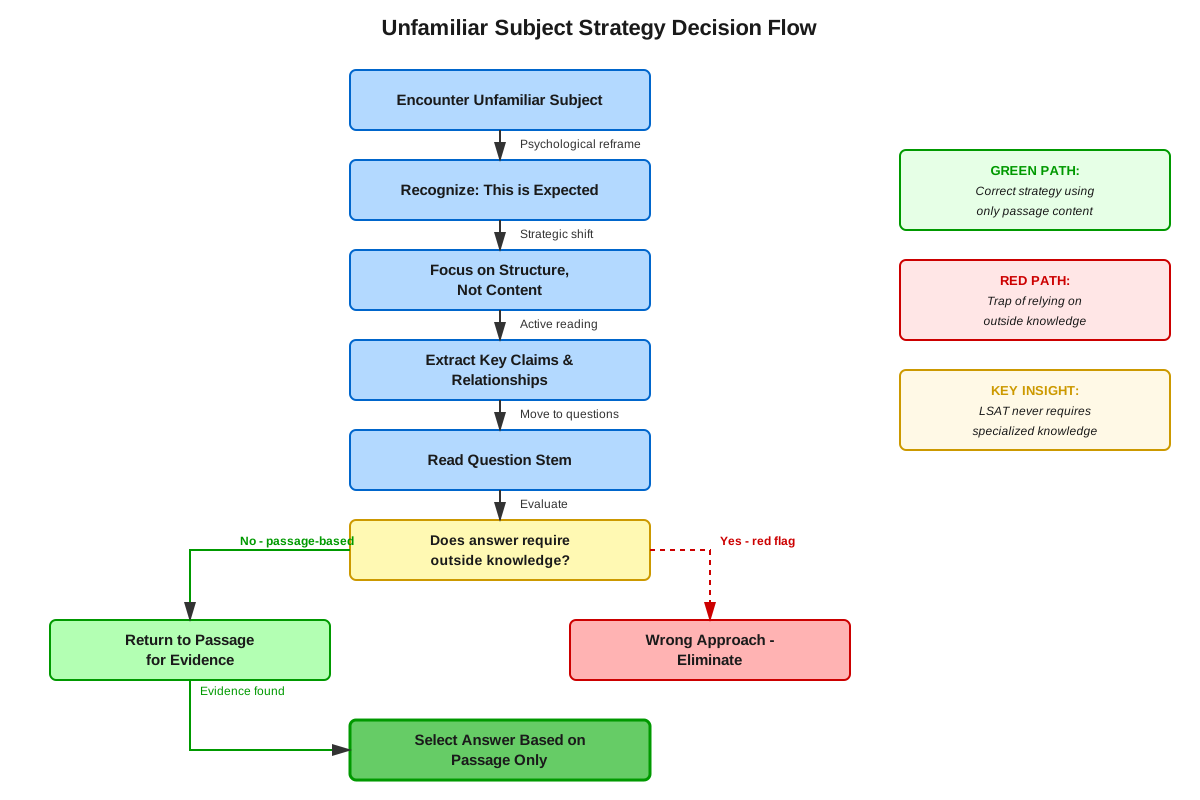
The Three-Phase Approach to Unfamiliar Passages
Phase 1: Orientation and Acceptance (First 30 seconds)
When beginning an unfamiliar passage, students should:
- Acknowledge the unfamiliarity without judgment ("This is about quantum entanglement, which I don't know much about—that's fine and expected")
- Read the first sentence or two to identify the general topic and scope
- Commit to trusting the passage as the sole source of information
- Adjust expectations for reading speed (unfamiliar passages may require slightly more time initially)
Phase 2: Structural Reading (Main reading phase)
Rather than trying to master the content, focus on identifying the passage's structure and purpose:
- Identify the main point or thesis (usually in the first or last paragraph)
- Note the function of each paragraph (introduces problem, presents theory, offers evidence, raises objection, etc.)
- Track the author's attitude and perspective
- Mark key transitions and logical relationships
- Create a mental or written roadmap of where information is located
Phase 3: Strategic Reference (During questions)
When answering questions:
- Return to the passage frequently to verify answers
- Use the structural roadmap to locate relevant information quickly
- Read answer choices skeptically, eliminating those that introduce outside concepts
- Trust specific textual evidence over general impressions
Technical Terminology Management
Unfamiliar passages often include specialized vocabulary that can intimidate readers. The strategy for handling technical terms involves:
Context-based definition: Most technical terms are defined explicitly or implicitly through context. For example, if a passage states, "The process of photosynthesis, by which plants convert light energy into chemical energy, occurs primarily in chloroplasts," the reader doesn't need to know what photosynthesis is beforehand—the passage provides the essential definition.
Functional understanding over precise definition: Often, knowing the exact meaning of a term matters less than understanding its function in the passage's argument. If a passage discusses "Hegelian dialectic" and explains that it involves thesis, antithesis, and synthesis, the reader needs to understand how this concept relates to the passage's main point, not necessarily master Hegelian philosophy.
Term tracking: When a technical term appears multiple times, note its first appearance and how it's used throughout. The passage will typically establish the term's meaning early and then build upon it.
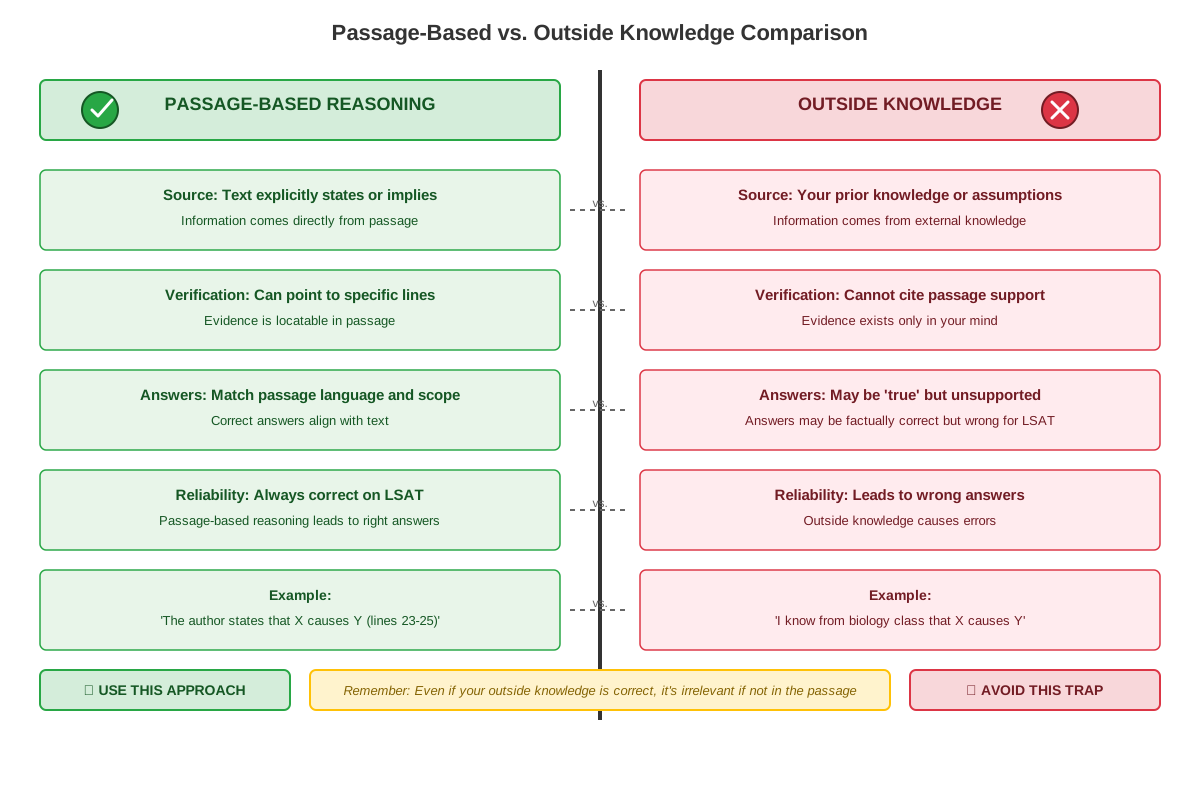
The Comparison Table: Effective vs. Ineffective Approaches
| Effective Unfamiliar Subject Strategy | Ineffective Approach |
|---|---|
| Read at a steady, deliberate pace | Rush through to "get it over with" |
| Focus on structure and main ideas | Try to memorize every detail |
| Trust the passage as the sole authority | Rely on vague memories of the topic |
| Accept that some details may remain unclear | Panic when encountering confusing terminology |
| Return to passage frequently during questions | Answer from memory to save time |
| Identify what the author thinks about the topic | Focus only on factual content |
| Use process of elimination based on passage evidence | Choose answers that "sound right" based on outside knowledge |
Active Reading Techniques for Unfamiliar Content
The unfamiliar subject strategy integrates specific active reading techniques:
Annotation for structure: Mark passages with simple symbols:
- MP (main point)
- + (supporting evidence)
- - (contrasting view or objection)
- ? (confusing section to return to if needed)
- ! (author's strong opinion)
Paragraph summaries: After each paragraph, create a brief mental or written summary (5-7 words) capturing its function. For example: "Introduces traditional view of X" or "Presents evidence against theory."
Question anticipation: While reading, predict what questions might be asked. This keeps reading purposeful and helps identify important information.
The Evidence-Based Mindset
Perhaps the most critical element of the unfamiliar subject strategy is developing an evidence-based mindset. This means:
- Every answer must be supported by specific passage content
- "I think I remember reading something about this" is never sufficient justification
- When two answer choices seem possible, return to the passage to find the distinguishing evidence
- Eliminate answers that introduce concepts, terms, or relationships not present in the passage
- Recognize that "true in the real world" does not equal "supported by the passage"
This mindset is particularly important for unfamiliar subjects because the temptation to rely on outside knowledge—or the fear that one lacks necessary knowledge—is strongest in these cases.
Concept Relationships
The unfamiliar subject strategy connects to and depends upon several other Reading Comprehension concepts in a hierarchical and interactive relationship:
Foundation level: Active reading skills provide the base upon which the unfamiliar subject strategy builds. Without the ability to identify main ideas, track arguments, and note structural elements, students cannot effectively apply specialized strategies for unfamiliar content.
Parallel relationship: The unfamiliar subject strategy works alongside other passage-specific strategies (such as comparative reading strategies or science passage strategies). While those strategies address particular passage formats or subjects, the unfamiliar subject strategy addresses the reader's relationship to the content itself.
Application level: Once the unfamiliar subject strategy establishes the proper mindset and approach, it enables more specific question-answering techniques. For example, inference questions on unfamiliar topics require the evidence-based mindset developed through this strategy.
Conceptual flow:
Active Reading Skills → Structural Analysis → Unfamiliar Subject Strategy → Question-Type Specific Strategies → Accurate Answer Selection
The strategy also connects to test-taking psychology and time management. By reducing anxiety around unfamiliar content, students can maintain consistent pacing across all passages rather than spending excessive time on intimidating topics or rushing through them in avoidance.
High-Yield Facts
⭐ The LSAT never requires outside knowledge to answer Reading Comprehension questions correctly—every answer is supported by passage content.
⭐ Unfamiliar subjects appear in approximately 100% of LSAT administrations, making this strategy universally applicable.
⭐ Pre-existing knowledge about a passage topic can be a liability if it contradicts or distracts from what the passage specifically states.
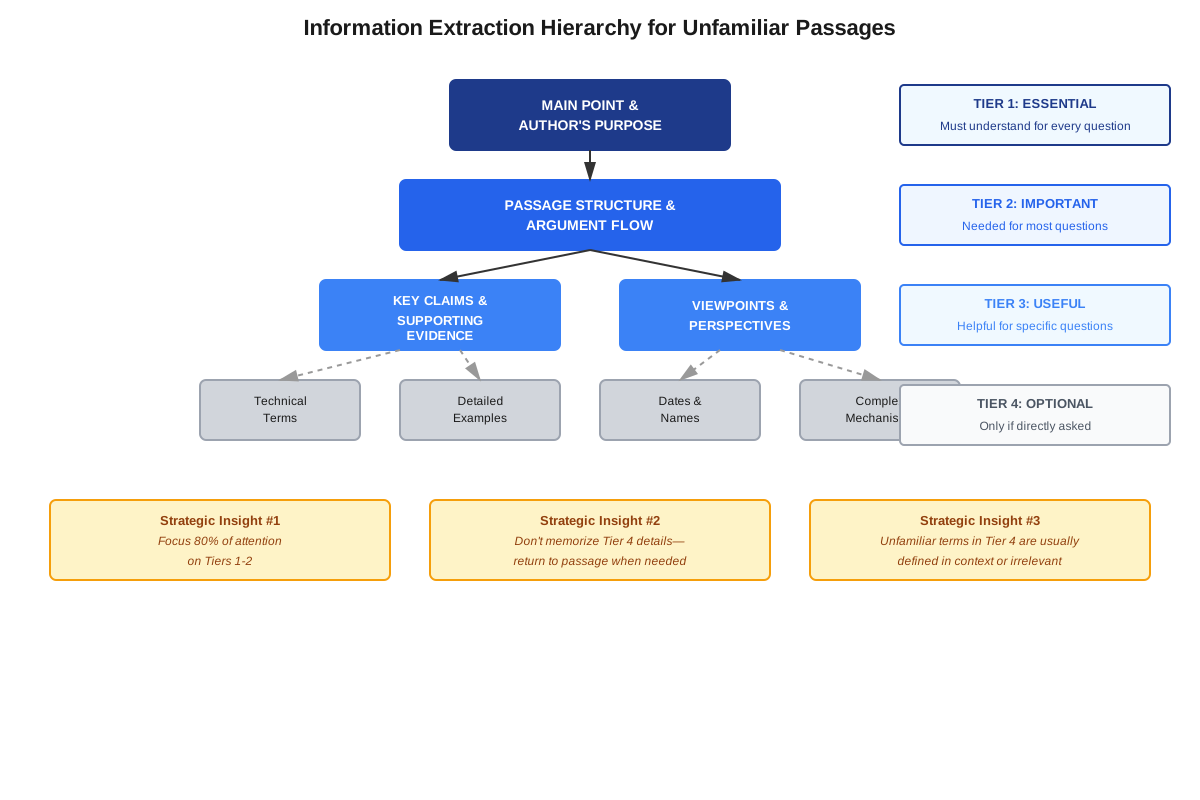
⭐ The primary goal when reading unfamiliar passages is understanding structure and main ideas, not mastering content details.
⭐ Technical terms in LSAT passages are always defined explicitly or through context—memorizing specialized vocabulary is unnecessary.
- Students who approach all passages with the same systematic strategy perform more consistently than those who vary approach based on familiarity.
- The most common error on unfamiliar passages is choosing answers that "sound right" based on general knowledge rather than passage-specific evidence.
- Returning to the passage during questions is not a sign of poor comprehension—it's a strategic necessity, especially for unfamiliar topics.
- Author's perspective and tone are often more important than factual content for answering questions on unfamiliar subjects.
- Passages on unfamiliar subjects typically include more explicit structural signals (transitions, topic sentences) to guide readers through complex content.
- The difficulty of LSAT passages comes from logical complexity and dense writing, not from requiring specialized knowledge.
- Effective annotation focuses on passage structure and argument flow, not on defining every unfamiliar term.
Quick check — test yourself on Unfamiliar subject strategy so far.
Try Flashcards →Common Misconceptions
Misconception: If I don't understand every word and concept in a passage, I can't answer the questions correctly.
Correction: Complete comprehension of every detail is neither necessary nor expected. The LSAT tests your ability to extract relevant information and understand relationships between ideas. Many successful test-takers report feeling uncertain about passage content while still answering questions correctly by returning to the text and using evidence-based reasoning.
Misconception: I should skip passages on unfamiliar topics and save them for last.
Correction: While strategic passage ordering can be beneficial, avoiding unfamiliar topics entirely is counterproductive. Since most tests include multiple unfamiliar passages, this approach can lead to time pressure and increased anxiety. Instead, develop confidence in your unfamiliar subject strategy so that topic familiarity becomes irrelevant to your approach.
Misconception: Reading faster through unfamiliar passages will give me more time for questions.
Correction: Rushing through unfamiliar content typically leads to poor comprehension, requiring multiple re-readings during questions that ultimately waste more time. A deliberate, structural reading approach—even if slightly slower initially—creates a better foundation for efficient question-answering.
Misconception: If I recognize a topic from my academic background, I should use that knowledge to answer questions more quickly.
Correction: Outside knowledge frequently leads to errors when it doesn't align perfectly with the passage's specific presentation. The safest approach is to treat every passage as unfamiliar, relying exclusively on textual evidence regardless of your background knowledge.
Misconception: Unfamiliar passages are inherently harder and will have more difficult questions.
Correction: Passage difficulty is not determined by topic familiarity but by logical complexity, writing density, and question design. Many students find that once they apply the proper strategy, unfamiliar passages are no more challenging than familiar ones—and sometimes easier because they're less likely to make assumptions.
Misconception: I need to understand the underlying science/philosophy/theory to answer questions about it.
Correction: The LSAT tests reading comprehension and logical reasoning, not subject matter expertise. You need to understand what the passage says about the topic and how the argument is structured, not the topic itself in any deep or comprehensive way.
Worked Examples
Example 1: Science Passage on Unfamiliar Topic
Passage excerpt (simplified for illustration):
"Recent research in epigenetics has challenged the traditional view of genetic determinism. While DNA sequence remains unchanged, epigenetic modifications—chemical changes that affect gene expression without altering the underlying genetic code—can be influenced by environmental factors and potentially transmitted across generations. This phenomenon, known as transgenerational epigenetic inheritance, suggests that experiences such as stress or nutrition might affect not only an individual but also their descendants. However, critics argue that evidence for transgenerational effects in humans remains limited, with most compelling data coming from studies of simpler organisms."
Question: The passage suggests that proponents of transgenerational epigenetic inheritance would most likely agree with which of the following?
(A) DNA sequence changes are the primary mechanism of evolutionary adaptation
(B) Environmental experiences can have hereditary effects beyond traditional genetic inheritance
(C) Epigenetic modifications are more important than genetic mutations in human evolution
(D) Studies of simple organisms provide insufficient evidence for theories about human heredity
(E) Genetic determinism has been definitively disproven by recent research
Worked Solution:
Step 1: Identify what we're looking for
The question asks what proponents (supporters) of transgenerational epigenetic inheritance would agree with. This is an inference question requiring us to understand the position described in the passage.
Step 2: Locate relevant information
The passage describes transgenerational epigenetic inheritance as the idea that "experiences such as stress or nutrition might affect not only an individual but also their descendants." This is the key claim of proponents.
Step 3: Evaluate each answer using passage evidence
(A) Eliminate: This contradicts the passage. The passage presents transgenerational epigenetic inheritance as an alternative or addition to traditional genetic mechanisms, not as supporting DNA sequence changes as primary.
(B) Strong candidate: This directly paraphrases the passage's description—environmental experiences (stress, nutrition) having hereditary effects (affecting descendants) beyond traditional genetic inheritance (epigenetic rather than DNA sequence changes).
(C) Eliminate: The passage never compares the relative importance of epigenetic modifications versus genetic mutations. This introduces a comparison not made in the text.
(D) Eliminate: This represents the critics' view, not the proponents' view. The passage states critics argue evidence is limited, implying proponents find the evidence from simpler organisms compelling.
(E) Eliminate: Too extreme. The passage says the research "challenged" traditional views, not that it "definitively disproven" them.
Step 4: Confirm the answer
(B) is correct because it accurately captures what proponents believe based solely on passage content, without requiring any outside knowledge of epigenetics.
Strategy application: Notice that this question is answerable without knowing what epigenetics actually is, what DNA is, or any scientific background. The passage provides all necessary information: a concept (transgenerational epigenetic inheritance), what it means (experiences affecting descendants), and who supports it (proponents). The unfamiliar subject strategy succeeds by focusing on these textual relationships rather than the underlying science.
Example 2: Humanities Passage on Unfamiliar Art Movement
Passage excerpt:
"The Vorticist movement, though short-lived, represented a distinctly British response to European modernism. Founded in 1914 by Wyndham Lewis, Vorticism rejected what Lewis perceived as the sentimentality of Italian Futurism while embracing its emphasis on dynamism and modernity. The movement's name derived from Lewis's conception of the artist as positioned at the vortex—the still point at the center of energy and activity—rather than being swept along by cultural currents. This positioning allowed for both engagement with and critical distance from modern industrial society."
Question: Based on the passage, Lewis's conception of the artist's position as being at the "vortex" primarily served to:
(A) Align Vorticism with the central principles of Italian Futurism
(B) Emphasize the artist's passive observation of modern society
(C) Suggest a balance between involvement in and detachment from contemporary culture
(D) Indicate that artists should remain isolated from industrial influences
(E) Demonstrate the superiority of British art movements over European ones
Worked Solution:
Step 1: Understand the question's focus
We need to identify the primary purpose or function of Lewis's "vortex" concept based on passage information.
Step 2: Locate and analyze relevant text
The passage explains the vortex as "the still point at the center of energy and activity" and states this positioning "allowed for both engagement with and critical distance from modern industrial society."
Step 3: Evaluate answers against passage evidence
(A) Eliminate: The passage states Vorticism "rejected" aspects of Futurism, so the vortex concept wouldn't primarily serve to align with it.
(B) Eliminate: "Passive observation" contradicts "engagement with" modern society. The passage emphasizes both engagement and distance, not passivity.
(C) Strong candidate: This directly matches the passage's statement about "both engagement with and critical distance from" modern society. "Balance between involvement and detachment" accurately paraphrases this idea.
(D) Eliminate: "Isolated from" contradicts the passage's emphasis on engagement. The vortex concept involves being at the center of activity, not removed from it.
(E) Eliminate: The passage never makes claims about superiority of British over European movements. This introduces an evaluative judgment not present in the text.
Step 4: Confirm through passage structure
The passage presents the vortex concept immediately after discussing Vorticism's relationship to Futurism (rejecting some aspects, embracing others), suggesting the concept explains this nuanced position. Answer (C) captures this nuance.
Strategy application: This question requires no knowledge of Vorticism, Wyndham Lewis, or early 20th-century art movements. A student encountering these terms for the first time can answer correctly by carefully reading what the passage says about the vortex concept and matching that to answer choices. The unfamiliar subject strategy succeeds by treating the passage as a self-contained source of information about an otherwise unknown topic.
Exam Strategy
Approaching Unfamiliar Passages
Initial assessment (5-10 seconds): When you first see a passage topic, quickly categorize your familiarity level:
- Completely unfamiliar: Activate full unfamiliar subject strategy
- Somewhat familiar: Consciously set aside outside knowledge and treat as unfamiliar
- Very familiar: Be extra cautious—your greatest risk is importing outside information
Reading approach: For unfamiliar passages, implement these specific techniques:
- Read the first and last sentences of the passage first to establish the main point
- Slow down slightly (10-15% slower than familiar passages) to ensure structural comprehension
- Annotate more heavily, marking paragraph functions clearly
- Don't get stuck on difficult sentences—mark them and continue, returning only if questions require that specific information
Trigger Words and Phrases
Watch for these signals that indicate the passage is providing necessary context for unfamiliar concepts:
- "This process, known as..." (definition following)
- "In other words..." (clarification of complex concept)
- "For example..." (concrete illustration of abstract idea)
- "Traditionally..." or "Historically..." (establishing context for new information)
- "However, recent research..." (signaling shift in understanding)
- "Critics argue..." (presenting alternative view)
These phrases indicate the passage is teaching you what you need to know—pay close attention to the information that follows.
Process of Elimination for Unfamiliar Topics
When evaluating answer choices on unfamiliar passages:
- First pass—eliminate obvious outliers: Remove answers that introduce terms or concepts not mentioned in the passage
- Second pass—check for passage support: For remaining answers, identify where in the passage each could be supported
- Third pass—verify with text: Return to the passage and confirm which answer has the strongest textual evidence
Red flags in answer choices:
- Extreme language (always, never, only, completely) unless the passage uses equally extreme language
- Technical terms not defined or used in the passage
- Causal relationships not established in the passage
- Comparisons between concepts not compared in the passage
Time Allocation
Don't over-invest in initial reading: Students often spend excessive time trying to "fully understand" unfamiliar passages before moving to questions. This is inefficient. Aim for:
- Initial reading: 3-4 minutes (same as familiar passages)
- Questions: 4-5 minutes
- Total: 8-9 minutes per passage
If you find yourself re-reading the same paragraph three times, move on. The questions will direct you back to what's important.
Strategic re-reading: Budget time for returning to the passage during questions. This is not a failure of comprehension—it's an efficient strategy. Each question reference should take 15-30 seconds.
Memory Techniques
The TRUST Acronym
For approaching unfamiliar passages, remember TRUST:
- Text is sufficient—everything you need is in the passage
- Read for structure, not mastery of content
- Understand the author's perspective and purpose
- Set aside outside knowledge
- Track where information is located for efficient reference
The Three-Question Check
Before selecting an answer on an unfamiliar passage, mentally ask:
- "Where in the passage does this answer come from?" (If you can't point to specific lines, it's likely wrong)
- "Does this answer introduce anything not in the passage?" (If yes, eliminate)
- "Am I choosing this because it sounds right or because the passage supports it?" (Only the latter is valid)
Visualization Strategy
Picture yourself as a translator or interpreter. Your job isn't to become an expert in the subject—it's to accurately convey what the passage says about the subject. This mental frame reduces pressure to "understand everything" and refocuses attention on textual accuracy.
The Bracket Technique
When encountering a particularly dense or technical sentence, mentally bracket it: "This sentence contains complex information about [topic]. If a question asks about this, I'll return to parse it carefully. For now, I understand it relates to [general function in passage]." This prevents getting stuck while maintaining awareness of where detailed information resides.
Summary
The unfamiliar subject strategy is a comprehensive approach to LSAT Reading Comprehension passages on topics outside a test-taker's background knowledge. The strategy rests on the fundamental principle that LSAT passages are self-sufficient—they contain all information necessary to answer questions correctly, regardless of the reader's prior familiarity with the subject. Success requires shifting from a content-mastery mindset to a structural-analysis mindset, focusing on the passage's organization, main ideas, and argumentative purpose rather than attempting to master specialized content. The strategy involves three phases: accepting unfamiliarity without anxiety, reading for structure and author's perspective, and strategically referencing the passage during questions. Critical components include managing technical terminology through context, maintaining an evidence-based approach to answer selection, and resisting the temptation to rely on outside knowledge. By treating every passage as the sole authority on its topic and developing systematic techniques for extracting and applying information, students can perform consistently across all passage types, transforming unfamiliarity from a liability into a neutral factor that has no bearing on accuracy or confidence.
Key Takeaways
- The LSAT is designed so that unfamiliar topics provide no disadvantage—passage sufficiency ensures all necessary information is contained in the text itself
- Focus on understanding passage structure, main ideas, and author's perspective rather than mastering content details or technical terminology
- Pre-existing knowledge can be a liability; always prioritize what the passage specifically states over what you think you know about a topic
- Develop an evidence-based mindset where every answer choice must be supported by specific, identifiable passage content
- Implement the three-phase approach: accept unfamiliarity, read structurally, and reference strategically during questions
- Technical terms are always defined through context—don't panic when encountering specialized vocabulary
- Return to the passage frequently during questions; this is efficient strategy, not a sign of poor comprehension
Related Topics
Active Reading Techniques: Mastering the unfamiliar subject strategy enables more sophisticated active reading, as students learn to identify and annotate structural elements that remain consistent across all passage types, regardless of subject matter.
Question Type Strategies: Once comfortable with unfamiliar content, students can focus on question-specific approaches (inference, main point, function, etc.) without the distraction of topic anxiety.
Comparative Reading Passages: The unfamiliar subject strategy provides essential foundation for comparative passages, which often present two perspectives on a single unfamiliar topic, requiring careful tracking of which passage makes which claims.
Time Management and Pacing: Confidence with unfamiliar subjects enables consistent pacing across all passages rather than the time-wasting patterns of either rushing through intimidating passages or over-investing time trying to master them.
Test Anxiety Management: The psychological components of the unfamiliar subject strategy—accepting uncertainty, trusting the process, and maintaining confidence—transfer to broader test anxiety reduction techniques.
Practice CTA
Now that you've mastered the conceptual framework for approaching unfamiliar subjects on the LSAT, it's time to put this strategy into practice. The practice questions and flashcards for this topic will present you with passages on diverse, potentially unfamiliar subjects, allowing you to apply the TRUST framework, test your evidence-based mindset, and build confidence in your ability to succeed regardless of topic. Remember: every expert LSAT test-taker was once intimidated by unfamiliar passages. The difference between struggling and succeeding isn't background knowledge—it's strategic approach. You now have that strategy. Practice it deliberately, and watch your consistency and confidence grow across all Reading Comprehension passages.
Sign up free to keep reading
Create a free AnvayaPrep account to finish this LSAT guide on Unfamiliar subject strategy — plus flashcards and practice questions.