Overview
Analogical reasoning in passages is a critical component of LSAT reading comprehension that tests the ability to recognize, analyze, and evaluate comparisons between different situations, concepts, or cases. This reasoning pattern appears when authors draw parallels between two or more domains to clarify complex ideas, support arguments, or illustrate abstract principles through more familiar examples. On the LSAT, passages frequently employ analogies to strengthen claims, and questions demand that test-takers identify the structural relationships between compared elements, assess the validity of these comparisons, and apply analogical patterns to new scenarios.
Understanding lsat analogical reasoning in passages is essential because it bridges multiple cognitive skills tested throughout the Reading Comprehension section. When authors use analogies, they reveal their argumentative strategies and underlying assumptions about how different domains relate. Test-takers must discern not just what is being compared, but why the comparison matters, what features are considered relevant, and where the analogy might break down. This skill directly connects to viewpoints and argumentation because analogies serve as persuasive tools that authors deploy to make their positions more compelling or accessible.
Mastery of analogical reasoning enhances performance across all Reading Comprehension question types, from main point questions to inference questions to application questions. The ability to recognize analogical structures allows test-takers to anticipate how passages will develop, identify the author's rhetorical moves, and quickly eliminate answer choices that misrepresent the relationships being drawn. This topic integrates closely with other argumentation concepts such as parallel reasoning, structural analysis, and the evaluation of evidence, making it a foundational skill for achieving high scores on the LSAT.
Learning Objectives
- [ ] Identify how analogical reasoning in passages appears in LSAT questions
- [ ] Explain the reasoning pattern behind analogical reasoning in passages
- [ ] Apply analogical reasoning in passages to solve LSAT-style problems accurately
- [ ] Distinguish between strong and weak analogies based on relevant similarities
- [ ] Recognize when answer choices distort or misrepresent analogical relationships
- [ ] Evaluate the scope and limitations of analogies presented in complex passages
- [ ] Predict how authors will extend or modify analogies throughout a passage
Prerequisites
- Basic argument structure recognition: Understanding premises, conclusions, and supporting evidence is necessary because analogies function as a specific type of argumentative support
- Passage mapping skills: The ability to track the flow of ideas through a passage helps identify where analogies appear and how they contribute to the overall argument
- Comparative reading fundamentals: Recognizing similarities and differences between concepts provides the foundation for analyzing analogical relationships
- Author's purpose and tone analysis: Understanding why authors make particular rhetorical choices clarifies the strategic function of analogies in passages
Why This Topic Matters
Analogical reasoning appears in approximately 40-50% of LSAT Reading Comprehension passages, making it one of the most frequently tested reasoning patterns. Legal reasoning itself relies heavily on analogical thinking—attorneys and judges constantly compare current cases to precedents, drawing parallels to establish how laws should apply. The LSAT tests this skill because it directly predicts success in law school, where students must analogize between cases, distinguish precedents, and apply legal principles across different factual scenarios.
In real-world legal practice, analogical reasoning enables lawyers to argue that a favorable ruling in one case should extend to their client's situation, or conversely, that an unfavorable precedent is distinguishable based on relevant differences. Judges use analogies to explain their reasoning and make abstract legal principles concrete. Beyond law, analogical thinking underlies scientific reasoning (comparing experimental models to real-world phenomena), policy analysis (drawing lessons from historical examples), and philosophical argumentation (using thought experiments to test principles).
On the LSAT, analogical reasoning appears in several question formats: questions asking what situation is most analogous to one described in the passage; questions testing whether you understand the basis of comparison; questions requiring you to identify where an analogy breaks down; and questions asking how the author uses an analogy to support a claim. Passages in law, humanities, social sciences, and natural sciences all employ analogies, though they manifest differently across domains—legal passages compare cases, science passages compare models or organisms, and humanities passages compare artistic movements or philosophical positions.
Core Concepts
Definition and Structure of Analogical Reasoning
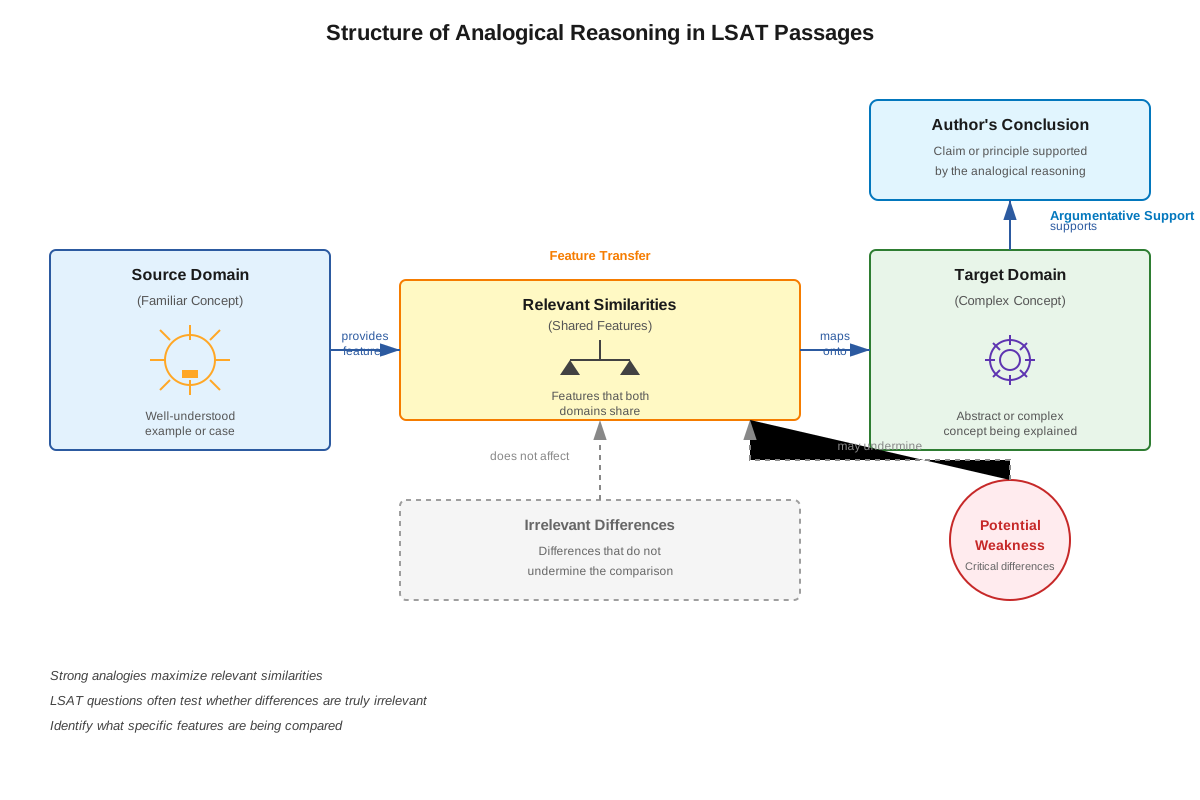
Analogical reasoning involves drawing a comparison between two or more things that share certain relevant features, then inferring that they likely share additional features or that conclusions about one apply to the other. The basic structure includes a source domain (the familiar or established case) and a target domain (the less familiar case or the situation being explained). The reasoning proceeds by identifying shared attributes between the domains, then concluding that what is true in the source domain is likely true in the target domain.
For example, a passage might compare the human immune system (source) to a military defense system (target), noting shared features like detection mechanisms, response forces, and memory of past threats. The author then uses this analogy to explain how immune memory works by reference to how military forces learn from previous conflicts. The strength of this analogy depends on whether the shared features are relevant to the conclusion being drawn.
Types of Analogies in LSAT Passages
LSAT passages employ several distinct types of analogical reasoning:
Explanatory analogies clarify complex or abstract concepts by comparing them to more familiar situations. A passage about quantum mechanics might compare particle behavior to everyday objects to make counterintuitive principles more accessible. These analogies serve pedagogical purposes and help readers grasp difficult material.
Argumentative analogies provide evidence for claims by showing that similar reasoning applies in parallel cases. If a passage argues for regulating artificial intelligence, it might compare AI development to nuclear technology, arguing that just as nuclear weapons required international oversight, so too does AI. These analogies function as premises supporting conclusions.
Illustrative analogies provide concrete examples that instantiate general principles without necessarily proving them. A passage discussing economic theories might use historical examples as analogies to contemporary situations, illustrating how principles manifest in practice.
Structural analogies focus on relationships and patterns rather than surface similarities. A passage might compare the structure of legal reasoning to mathematical proof, emphasizing the logical relationships rather than content similarities.
Evaluating Analogical Strength
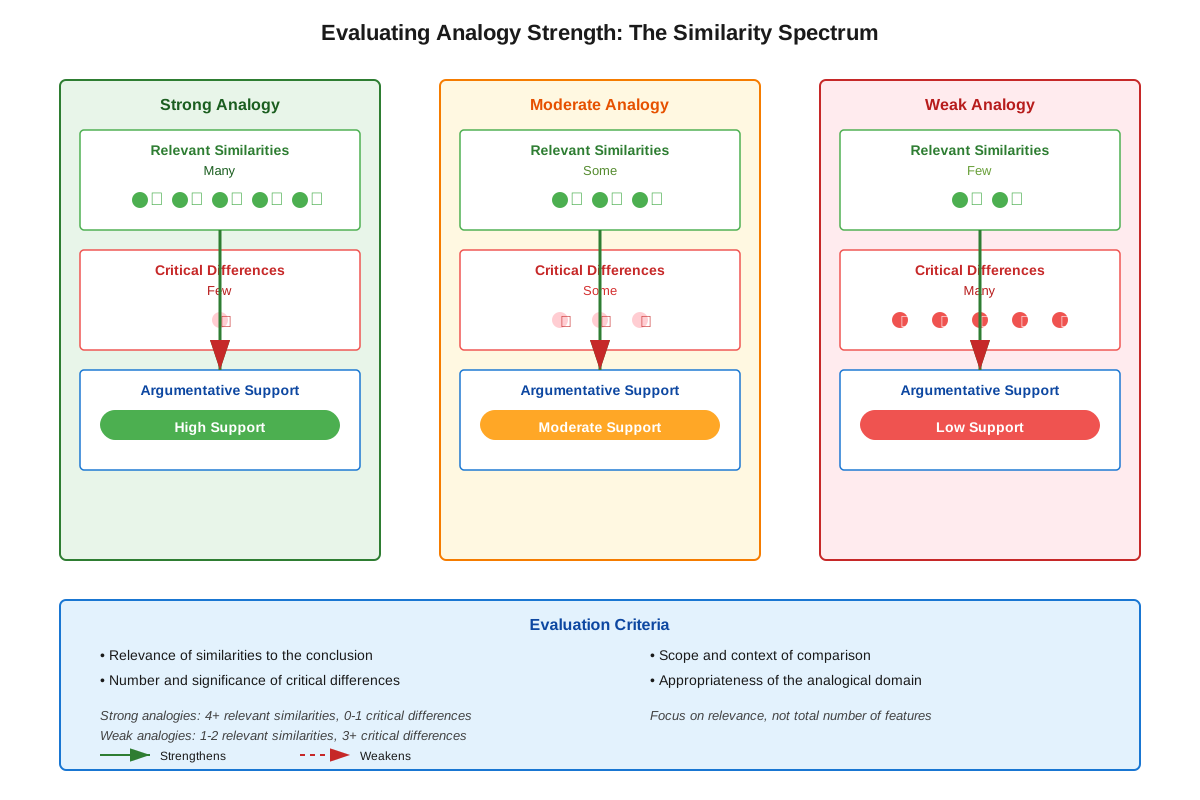
The strength of an analogy depends on several factors that LSAT questions frequently test:
| Strength Factor | Strong Analogy | Weak Analogy |
|---|---|---|
| Relevant similarities | Shared features directly relate to the conclusion | Shared features are superficial or irrelevant |
| Number of similarities | Multiple relevant parallels | Few points of comparison |
| Significant differences | Differences don't undermine the comparison | Critical differences exist between domains |
| Specificity | Precise, well-defined comparison | Vague or overly broad comparison |
| Scope of conclusion | Modest claims within analogy's limits | Overreaching claims beyond what analogy supports |
Test-takers must assess whether the features being compared are genuinely relevant to the author's point. An analogy between the brain and a computer might be strong for discussing information processing but weak for discussing consciousness, because the relevant similarities differ depending on what aspect is being analyzed.
Recognizing Analogical Reasoning in Passages
Several textual markers signal that analogical reasoning is being employed:
Explicit comparison language: "similarly," "likewise," "just as," "in the same way," "analogously," "comparable to," "parallels," "resembles," "corresponds to"
Hypothetical scenarios: Authors often introduce analogies through hypothetical examples beginning with "imagine," "suppose," "consider," or "for instance"
Cross-domain references: When a passage about one subject suddenly references a completely different domain, an analogy is likely being constructed
Structural parallelism: Authors may present two situations in parallel grammatical structures to emphasize their analogical relationship
Common Analogical Patterns in LSAT Passages
Certain analogical patterns recur across LSAT passages:
- Historical precedent analogies: Comparing current situations to historical events to predict outcomes or justify policies
- Scientific model analogies: Comparing natural phenomena to experimental models or simplified systems
- Legal case analogies: Comparing different legal cases to argue for consistent application of principles
- Biological analogies: Comparing different organisms or biological systems to understand shared mechanisms
- Economic analogies: Comparing different markets, economic systems, or financial situations
- Artistic/cultural analogies: Comparing different artistic movements, cultural practices, or literary works
The Role of Disanalogies
Understanding where analogies break down is as important as recognizing similarities. Disanalogies are relevant differences that limit the scope of analogical reasoning. LSAT passages often acknowledge limitations of their own analogies, and questions test whether readers recognize these boundaries.
For example, a passage comparing ecosystems to economic markets might note that while both involve competition for resources, ecosystems lack the intentional planning and regulatory structures present in markets. This disanalogy limits what conclusions can be drawn from the comparison. Strong test-takers anticipate these limitations and avoid answer choices that push analogies beyond their legitimate scope.
Analogical Reasoning and Author's Purpose
Authors deploy analogies for specific rhetorical purposes that LSAT questions probe:
- Clarification: Making complex ideas accessible through familiar comparisons
- Persuasion: Leveraging emotional or intuitive responses to familiar situations
- Prediction: Suggesting that outcomes in one domain will mirror outcomes in another
- Criticism: Highlighting problematic features by comparing to obviously flawed situations
- Theory-building: Developing explanatory frameworks by drawing systematic parallels
Recognizing the author's purpose in using an analogy helps predict what questions will ask and what answer choices will be correct.
Concept Relationships
Analogical reasoning connects to multiple Reading Comprehension skills in an integrated network. The ability to identify argument structure provides the foundation for recognizing when analogies serve as premises supporting conclusions. This connects directly to evaluating evidence quality, as analogies function as a specific type of evidence whose strength must be assessed.
The relationship flows as follows: Passage mapping → Identifying analogical reasoning → Analyzing relevant similarities → Evaluating analogical strength → Applying to answer choices. Each step builds on the previous one, creating a systematic approach to questions involving analogies.
Analogical reasoning also connects laterally to parallel reasoning questions in Logical Reasoning, where test-takers must identify arguments with similar structures. The same skills that enable recognition of analogical patterns in passages transfer to identifying parallel argument structures. Additionally, analogical reasoning relates to inference questions because valid inferences often extend analogical patterns that passages establish.
Within viewpoints and argumentation, analogical reasoning represents one of several persuasive strategies authors employ. It connects to counterargument analysis because authors often address potential disanalogies as counterarguments to their comparisons. It also relates to assumption identification because analogies rest on assumptions about which similarities are relevant and which differences can be ignored.
High-Yield Facts
⭐ Analogical reasoning appears in 40-50% of LSAT Reading Comprehension passages, making it one of the most frequently tested patterns
⭐ The strength of an analogy depends primarily on whether shared features are relevant to the conclusion being drawn, not merely on the number of similarities
⭐ LSAT questions frequently test whether test-takers can identify where analogies break down or what their limitations are
⭐ Explicit comparison language ("similarly," "just as," "likewise") signals analogical reasoning and should trigger heightened attention
⭐ Strong answer choices preserve the structural relationships in the original analogy while weak choices distort these relationships
- Analogies can serve multiple functions simultaneously—both explaining and arguing for a position
- Authors often acknowledge limitations of their own analogies, and recognizing these acknowledgments helps predict correct answers
- Cross-domain analogies (comparing very different fields) require careful attention to which specific features are being compared
- The source domain in an analogy is typically more familiar or established than the target domain being explained
- Disanalogies (relevant differences) are as important as similarities for evaluating analogical reasoning
- Legal passages frequently use case-to-case analogies as their primary argumentative structure
- Scientific passages often employ model-to-phenomenon analogies to explain complex natural processes
- Questions asking "which of the following is most analogous to" test whether you understand the structural relationships, not surface similarities
Quick check — test yourself on Analogical reasoning in passages so far.
Try Flashcards →Common Misconceptions
Misconception: More similarities between two things always make a stronger analogy → Correction: Only relevant similarities strengthen an analogy; numerous irrelevant similarities add nothing to analogical strength. Two situations might share dozens of superficial features while differing on the one feature that matters for the conclusion.
Misconception: Analogies are just metaphors or literary devices without logical force → Correction: While analogies can serve stylistic purposes, they function as genuine forms of reasoning that provide evidence for claims. LSAT passages use analogies as argumentative tools that can be evaluated for logical strength.
Misconception: If an analogy has any differences between the compared situations, it fails → Correction: All analogies involve some differences; the question is whether the differences are relevant to the conclusion. Strong analogies acknowledge differences while showing they don't undermine the comparison's validity.
Misconception: The most analogous situation is the one with the most similar content or subject matter → Correction: Structural similarity matters more than content similarity. A situation from a completely different domain might be more analogous if it shares the same pattern of relationships, even if the specific content differs.
Misconception: Authors always explicitly state when they're using analogical reasoning → Correction: While comparison language often signals analogies, authors sometimes present analogical reasoning implicitly through parallel examples or by discussing one situation in terms borrowed from another domain without explicit comparison markers.
Misconception: Analogies in LSAT passages are always meant to be persuasive arguments → Correction: Passages sometimes present analogies to critique them, showing their limitations or explaining why a comparison fails. Test-takers must distinguish between analogies the author endorses and those presented for critical analysis.
Misconception: If you can think of any difference between compared situations, you should choose answer choices that say the analogy fails → Correction: The LSAT tests whether differences are relevant to the specific conclusion being drawn. Many differences are irrelevant and don't undermine the analogy's validity for its intended purpose.
Worked Examples
Example 1: Evaluating Analogical Strength
Passage excerpt: "The relationship between a corporation and its shareholders resembles that between a government and its citizens. Just as governments derive their legitimacy from the consent of the governed and must act in citizens' interests, corporations exist through shareholder investment and must prioritize shareholder value. This parallel suggests that corporate managers, like government officials, should be held accountable through regular elections and transparent reporting of their decisions."
Question: The author's analogy between corporations and governments is most vulnerable to criticism on which grounds?
Analysis:
Step 1: Identify the source and target domains
- Source: Government-citizen relationship
- Target: Corporation-shareholder relationship
Step 2: Identify the claimed similarities
- Both derive legitimacy from a constituency (citizens/shareholders)
- Both should act in constituency's interests
- Both should have accountability mechanisms
Step 3: Identify the conclusion being drawn
- Corporate managers should have election and transparency requirements similar to government officials
Step 4: Consider potential disanalogies
- Citizens cannot easily exit their relationship with government, while shareholders can sell shares
- Governments have coercive power (taxation, law enforcement) that corporations lack
- Citizens have diverse interests beyond economic return, while shareholders primarily seek financial gain
- Government officials represent all citizens, while corporate managers represent only shareholders
Step 5: Evaluate which disanalogy most undermines the specific conclusion
The most relevant disanalogy is that shareholders have fundamentally different options and interests than citizens. Shareholders voluntarily invest and can exit by selling shares, while citizens cannot easily leave their country. This difference undermines the conclusion that corporations need government-like accountability structures because market mechanisms (selling shares, shareholder lawsuits) provide accountability that doesn't require formal elections.
Correct reasoning: The analogy is vulnerable because the voluntary, exit-available nature of shareholder relationships differs critically from the mandatory, difficult-to-exit nature of citizenship, which affects what accountability mechanisms are necessary.
Example 2: Applying Analogical Patterns
Passage excerpt: "Eighteenth-century critics dismissed early novels as frivolous entertainment, claiming they lacked the moral seriousness of poetry and drama. These critics failed to recognize that novels were developing new techniques for psychological realism and social commentary. Today's dismissal of video games as mere entertainment repeats this pattern. Like novels before them, video games are developing sophisticated narrative techniques and exploring complex ethical questions, yet critics focus only on their entertainment function."
Question: Based on the analogy in the passage, which of the following situations would be most parallel to the author's argument?
Analysis:
Step 1: Identify the analogical pattern structure
- New artistic medium emerges (novels/video games)
- Critics dismiss it as mere entertainment
- Critics fail to recognize developing sophistication
- Medium actually develops new techniques for serious purposes
- Current dismissal repeats historical pattern
Step 2: Identify the key relationships
- Temporal: Earlier medium faced criticism that later proved shortsighted
- Evaluative: Initial dismissal based on entertainment function
- Developmental: Medium was evolving capabilities critics didn't recognize
- Parallel: Current situation mirrors historical pattern
Step 3: Evaluate answer choices for structural similarity
A strong answer would present:
- A new medium or form being dismissed
- Critics focusing on one aspect (entertainment, accessibility, popularity)
- The medium actually developing sophisticated capabilities
- A parallel to an earlier historical dismissal
Example strong answer: "Early photography was dismissed as mechanical reproduction lacking artistic merit, just as digital art today is dismissed as computer-generated rather than genuinely creative, though both develop new aesthetic possibilities."
This preserves the structure: new medium → dismissed for surface characteristics → actually developing sophistication → parallels earlier dismissal.
Example weak answer: "Just as novels were once expensive and available only to wealthy readers, video games today require expensive equipment that limits access."
This fails because it focuses on accessibility rather than critical dismissal and doesn't preserve the pattern of unrecognized sophistication.
Correct reasoning: The strongest parallel maintains the temporal pattern (earlier dismissal proved wrong), the evaluative pattern (critics missing developing sophistication), and the structural relationship between the two cases being compared.
Exam Strategy
Approaching Analogical Reasoning Questions
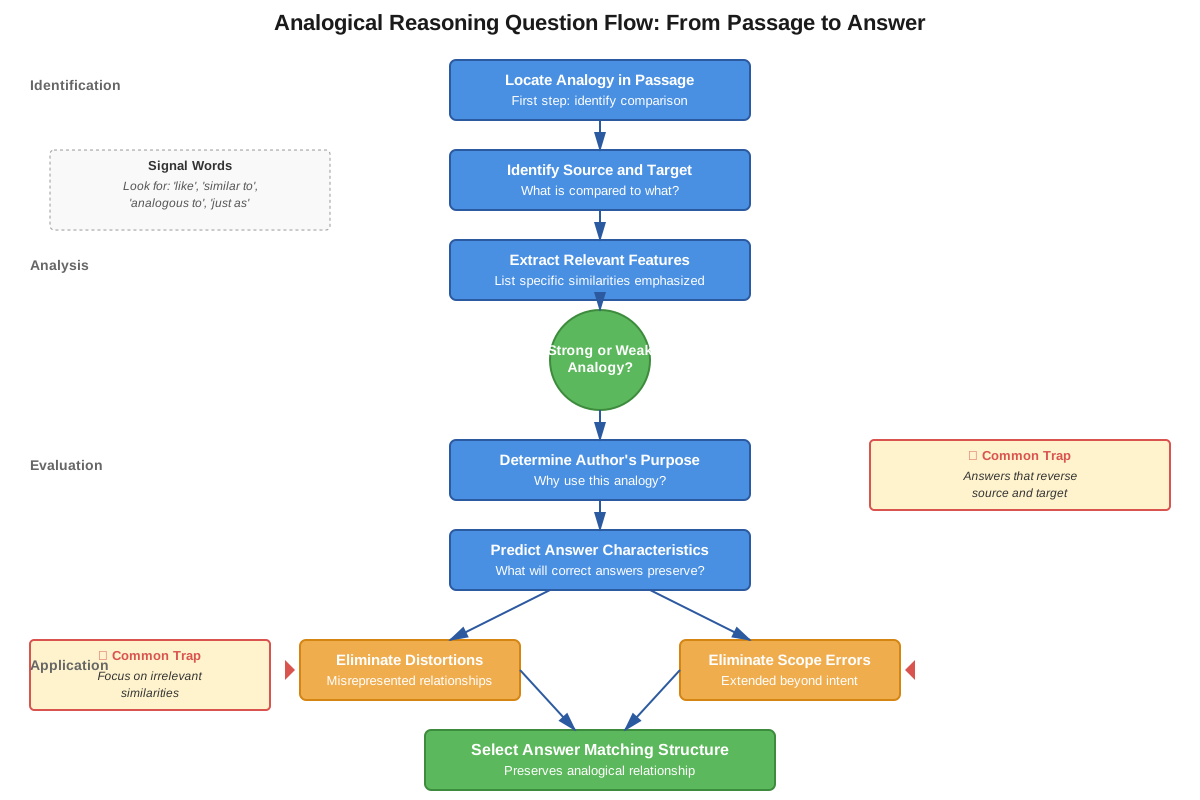
When encountering passages with analogical reasoning, implement this systematic approach:
- Mark comparison language: Circle or underline "similarly," "just as," "likewise," "analogous," and other comparison markers as you read
- Identify both domains: Clearly note what is being compared to what
- List the claimed similarities: Jot down the specific features the author says are shared
- Note the conclusion: Identify what the author infers from the analogy
- Anticipate limitations: Before looking at questions, consider where the analogy might break down
Trigger Words and Phrases
High-yield phrases that signal analogical reasoning:
- "Similarly," "likewise," "in the same way," "just as"
- "Parallels," "corresponds to," "mirrors," "resembles"
- "By analogy," "analogously," "comparable to"
- "Consider the case of," "imagine," "suppose"
- "This resembles," "this is like," "much as"
When these appear, immediately shift to analogical reasoning mode: identify domains, map similarities, and anticipate questions about the comparison's validity or application.
Process of Elimination Tips
For "most analogous" questions:
- Eliminate choices that share surface similarities but different structural relationships
- Eliminate choices that reverse the direction of the relationship
- Eliminate choices that change which features are being compared
- Keep choices that preserve the pattern of relationships even if content differs
For "analogy's weakness" questions:
- Eliminate differences that are irrelevant to the conclusion
- Eliminate criticisms that apply to all analogies generally
- Keep differences that specifically undermine what the author infers
- Keep criticisms that identify assumptions the analogy requires
For "author uses the analogy to" questions:
- Eliminate purposes that don't match the passage's argumentative structure
- Keep purposes that align with the conclusion following the analogy
- Consider whether the analogy explains, argues, illustrates, or criticizes
Time Allocation
Analogical reasoning questions typically require 60-90 seconds each. Allocate time as follows:
- 15-20 seconds: Re-read the relevant passage section
- 20-30 seconds: Analyze the analogical structure
- 30-40 seconds: Evaluate answer choices
If a question asks about a complex analogy spanning multiple paragraphs, allow up to 2 minutes. Don't rush these questions—they reward careful structural analysis.
Memory Techniques
The STAR Method for Analyzing Analogies
Source domain: What is the familiar case?
Target domain: What is being explained or argued?
Attributes: What features are claimed to be shared?
Relevance: Are these features relevant to the conclusion?
This acronym provides a systematic checklist for analyzing any analogy in a passage.
Visualization Strategy
Picture analogies as bridges connecting two islands (domains). The bridge's strength depends on:
- How many support cables (similarities) it has
- Whether the cables connect to solid ground (relevant features)
- Whether the bridge can bear the weight (conclusion) being placed on it
- Whether gaps in the bridge (disanalogies) make it unsafe
This visual metaphor helps evaluate analogical strength quickly during the exam.
The Three Questions Mnemonic
For any analogy, ask: "What? Why? Where?"
- What is being compared?
- Why is the author making this comparison (purpose)?
- Where does the comparison break down (limitations)?
These three questions cover the most common question types about analogical reasoning.
Summary
Analogical reasoning in passages represents a critical LSAT skill that tests the ability to recognize, analyze, and evaluate comparisons between different domains. This reasoning pattern appears in approximately half of all Reading Comprehension passages and serves multiple functions: explaining complex concepts, supporting arguments, illustrating principles, and building theories. Strong performance requires identifying both the source and target domains of analogies, mapping the specific features being compared, evaluating whether these features are relevant to the author's conclusion, and recognizing where analogies break down. The LSAT tests not just recognition of analogies but deep understanding of their logical structure, including the ability to distinguish relevant from irrelevant similarities, identify assumptions underlying comparisons, and apply analogical patterns to new situations. Success demands moving beyond surface-level content similarities to focus on structural relationships—the pattern of connections between elements matters more than whether the compared situations involve similar subject matter. By systematically analyzing analogies using frameworks like the STAR method and anticipating common question types, test-takers can efficiently navigate these questions and avoid common traps like overextending analogies or being distracted by irrelevant differences.
Key Takeaways
- Analogical reasoning appears in 40-50% of LSAT Reading Comprehension passages and tests the ability to analyze comparisons between different domains
- The strength of an analogy depends on whether shared features are relevant to the conclusion, not merely on the number of similarities
- Structural relationships matter more than content similarities—analogies from completely different domains can be stronger than those with similar subject matter
- All analogies have limitations; recognizing where comparisons break down is as important as identifying similarities
- Common question types include identifying analogous situations, evaluating analogical strength, recognizing the purpose of analogies, and determining their limitations
- Explicit comparison language ("similarly," "just as," "likewise") signals analogical reasoning and should trigger systematic analysis
- The STAR method (Source, Target, Attributes, Relevance) provides a reliable framework for analyzing any analogy efficiently
Related Topics
Parallel Reasoning in Logical Reasoning: While analogical reasoning in passages compares situations or concepts, parallel reasoning questions require identifying arguments with matching logical structures. Mastering analogical reasoning in Reading Comprehension builds the pattern-recognition skills essential for parallel reasoning questions.
Assumption Identification: Analogies rest on assumptions about which similarities are relevant and which differences can be ignored. Understanding analogical reasoning enhances the ability to identify unstated assumptions in arguments.
Strengthen/Weaken Questions: Many strengthen and weaken questions involve analogies or require evaluating whether new information makes a comparison more or less valid. The skills developed through studying analogical reasoning transfer directly to these question types.
Comparative Reading Passages: The LSAT's paired passages require comparing and contrasting different authors' viewpoints, which involves recognizing similarities and differences—the same core skill underlying analogical reasoning analysis.
Practice CTA
Now that you understand the structure and strategy behind analogical reasoning in passages, it's time to apply these concepts to actual LSAT questions. Work through the practice questions to test your ability to identify analogies, evaluate their strength, and apply analogical patterns to new situations. Use the flashcards to reinforce key concepts and trigger words. Remember: analogical reasoning is a skill that improves dramatically with deliberate practice. Each question you analyze strengthens your pattern-recognition abilities and builds the confidence you need to excel on test day. Approach each practice problem systematically using the STAR method, and you'll find these questions becoming increasingly manageable and even predictable.
Sign up free to keep reading
Create a free AnvayaPrep account to finish this LSAT guide on Analogical reasoning in passages — plus flashcards and practice questions.