Overview
Identifying qualifications is a critical skill in LSAT reading comprehension that involves recognizing when an author limits, modifies, or adds nuance to a claim rather than making an absolute statement. In academic and legal writing—the primary sources for LSAT passages—authors rarely make sweeping, unqualified assertions. Instead, they carefully hedge their claims with words like "often," "typically," "may," "some," or "in certain contexts." Understanding these qualifications is essential because the LSAT frequently tests whether students can distinguish between what an author actually said (with all its careful limitations) versus what a careless reader might think was said.
This topic sits at the heart of viewpoints and argumentation because qualifications reveal an author's level of certainty, the scope of their claims, and their awareness of counterarguments or exceptions. When authors qualify their statements, they're demonstrating intellectual rigor and acknowledging the complexity of their subject matter. The LSAT rewards students who can track these subtle distinctions, as many wrong answer choices will either overstate the author's position by removing qualifications or understate it by adding qualifications that weren't present in the original text.
Mastering qualification identification connects directly to other Reading Comprehension skills, including understanding author attitude, evaluating argument strength, and making valid inferences. Students who excel at spotting qualifications can more accurately assess what the passage supports versus what it merely suggests, what the author believes strongly versus tentatively, and what claims have been proven versus merely proposed. This precision in reading is exactly what separates high scorers from average performers on the LSAT.
Learning Objectives
- [ ] Identify how identifying qualifications appears in LSAT questions
- [ ] Explain the reasoning pattern behind identifying qualifications
- [ ] Apply identifying qualifications to solve LSAT-style problems accurately
- [ ] Distinguish between qualified and unqualified statements in complex passages
- [ ] Recognize common qualifying language and its impact on claim strength
- [ ] Evaluate answer choices for inappropriate addition or removal of qualifications
- [ ] Analyze how qualifications affect the scope and certainty of arguments
Prerequisites
- Basic reading comprehension skills: Understanding literal meaning is necessary before analyzing subtle modifications to claims
- Familiarity with argument structure: Recognizing premises and conclusions helps identify where qualifications typically appear
- Understanding of author's purpose: Knowing why authors write helps explain why they choose to qualify certain statements
- Vocabulary knowledge: Recognizing the meaning of common qualifying terms is essential for spotting them in context
Why This Topic Matters
In legal reasoning and academic discourse—the foundations of LSAT passages—precision in language is paramount. Attorneys must understand exactly what a law permits or prohibits, what a precedent establishes or merely suggests, and what evidence proves or simply indicates. Similarly, scholars must carefully delineate between established facts, working hypotheses, and speculative theories. The LSAT tests this precision because it's fundamental to legal thinking.
Qualification-related questions appear in approximately 15-20% of Reading Comprehension questions across all LSAT administrations. They manifest in several question types: "The author would most likely agree with which of the following?" questions test whether students notice qualifications that limit agreement; "According to the passage" questions often include wrong answers that remove crucial qualifications; and "The author's attitude can best be described as" questions require recognizing whether qualifications indicate tentativeness or measured confidence.
This topic appears most frequently in passages discussing scientific theories (where qualifications indicate the provisional nature of findings), legal analysis (where qualifications define the scope of rules), and comparative arguments (where qualifications acknowledge exceptions to general patterns). Students who miss qualifications typically select answer choices that are too extreme, too certain, or too broad—exactly the trap the test-makers design.
Core Concepts
What Are Qualifications?
Qualifications are words, phrases, or clauses that limit the scope, certainty, or applicability of a claim. Rather than making absolute statements, qualified claims acknowledge boundaries, exceptions, or degrees of confidence. For example, "Exercise improves health" is unqualified, while "Regular exercise typically improves cardiovascular health in most adults" contains multiple qualifications: "regular" (frequency limitation), "typically" (certainty limitation), "cardiovascular" (scope limitation), and "most adults" (population limitation).
In LSAT reading comprehension, qualifications serve several functions. They allow authors to make claims while acknowledging complexity, demonstrate intellectual honesty by recognizing exceptions, hedge against overgeneralization, and signal the strength of available evidence. The LSAT tests whether students can track these qualifications accurately because legal reasoning demands this precision.
Types of Qualifications
Frequency qualifications indicate how often something occurs: "often," "usually," "sometimes," "rarely," "occasionally," "frequently," "seldom." These words tell readers that a pattern exists but isn't universal. For instance, "Courts often defer to agency expertise" means deference is common but not guaranteed in every case.
Certainty qualifications express the author's confidence level: "probably," "possibly," "likely," "may," "might," "could," "appears to," "seems to," "suggests." These indicate that the author is proposing rather than asserting. "The evidence suggests a correlation" is much weaker than "The evidence proves a correlation."
Scope qualifications limit which cases or contexts a claim covers: "some," "many," "most," "certain," "particular," "specific," "in this context," "under these conditions." These prevent overgeneralization. "Some critics argue" is very different from "Critics argue"—the former acknowledges a subset of opinion while the latter implies consensus.
Degree qualifications indicate extent or intensity: "somewhat," "relatively," "partially," "largely," "primarily," "mainly," "to some extent." These acknowledge that something is true but not completely or uniformly. "The theory is largely accepted" means significant but not universal acceptance.
Qualification Markers in Context
| Qualification Type | Example Markers | Impact on Claim Strength |
|---|---|---|
| Frequency | often, usually, sometimes, rarely | Weakens from universal to pattern-based |
| Certainty | may, might, possibly, likely | Weakens from fact to probability |
| Scope | some, many, certain contexts | Weakens from all to subset |
| Degree | somewhat, largely, relatively | Weakens from absolute to partial |
| Conditional | if, when, provided that, unless | Weakens by adding requirements |
Conditional qualifications deserve special attention because they're particularly common in legal and scientific passages. Phrases like "if properly implemented," "when conditions permit," "provided that safeguards exist," or "unless contradicted by new evidence" fundamentally change what a claim asserts. "The policy will succeed if properly implemented" is not a prediction of success—it's a conditional statement that success depends on proper implementation.
How Qualifications Affect Arguments
Qualifications directly impact argument strength and scope. An unqualified claim is vulnerable to a single counterexample, while a qualified claim can withstand exceptions. If an author writes "Economic sanctions change government behavior," one instance of sanctions failing would undermine the claim. But "Economic sanctions can sometimes influence government behavior" remains defensible even when sanctions fail, because the qualification "can sometimes" acknowledges that success isn't guaranteed.
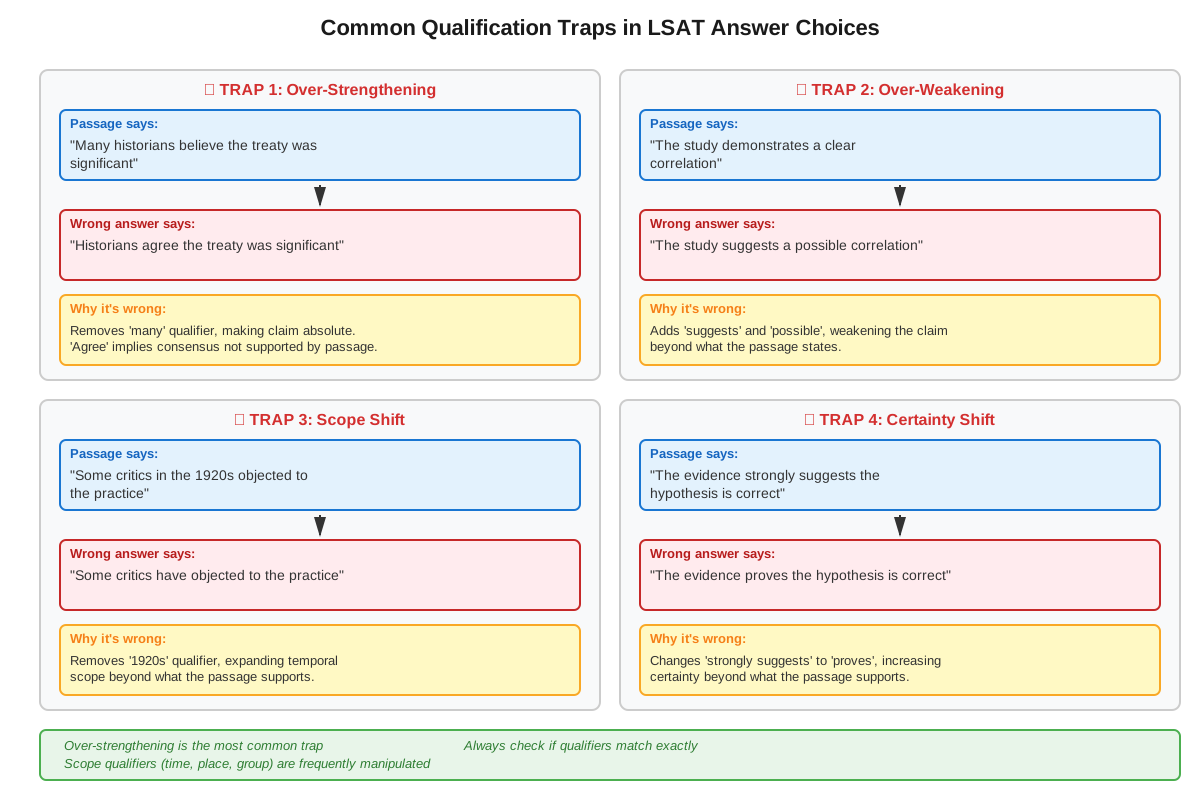
The LSAT exploits this by creating wrong answer choices that remove qualifications, making claims stronger than the passage supports. If a passage says "The new approach may offer advantages in certain clinical settings," a wrong answer might say "The new approach offers advantages in clinical settings"—removing both "may" (certainty) and "certain" (scope). Students who don't track qualifications carefully will miss this distortion.
Conversely, wrong answers sometimes add qualifications the author didn't include, making claims weaker than the passage supports. If an author definitively states "The court's reasoning was flawed," a wrong answer might say "The court's reasoning was arguably flawed" or "The court's reasoning may have been flawed." These additions suggest uncertainty the author didn't express.
Recognizing Implicit Qualifications
Not all qualifications use explicit qualifying words. Context can create implicit limitations. If a passage discusses "the effects of the policy in urban areas," the geographic limitation is implicit—the author isn't claiming the effects apply everywhere. Similarly, if a passage analyzes "nineteenth-century American novels," temporal and geographic scope are built into the subject matter itself.
The LSAT tests whether students recognize these implicit boundaries. A wrong answer might extend claims beyond their implicit scope: taking a statement about nineteenth-century American novels and applying it to all novels, or taking a claim about urban policy effects and suggesting it applies universally.
Qualifications and Author Attitude
Qualifications reveal author attitude and confidence. Heavy qualification often indicates tentativeness, acknowledgment of complexity, or scholarly caution. Minimal qualification suggests confidence, strong evidence, or deliberate advocacy. The LSAT tests this connection through attitude questions: "The author's attitude toward the theory can best be described as..." requires noticing whether the author uses language like "convincingly demonstrates" (strong support) or "may suggest" (tentative support).
However, qualification doesn't always mean weakness. In academic writing, careful qualification often indicates rigor rather than uncertainty. An author who writes "The evidence strongly suggests, though doesn't definitively prove" is being methodologically sound, not uncertain. The LSAT tests whether students can distinguish between appropriate scholarly caution and genuine doubt.
Concept Relationships
Identifying qualifications connects directly to understanding viewpoints and argumentation because qualifications define the boundaries of what an author claims. When analyzing an argument's structure, qualifications determine the actual scope of premises and conclusions. A premise that "some studies show X" provides weaker support than "all studies show X," and this difference affects argument evaluation.
Qualification identification enables accurate inference-making. Valid inferences must respect the qualifications in the original text. If a passage says "The approach often succeeds," you can infer "The approach sometimes succeeds" (weaker claim) but not "The approach always succeeds" (stronger claim). This connects to the logical principle that qualified statements support weaker but not stronger versions of themselves.
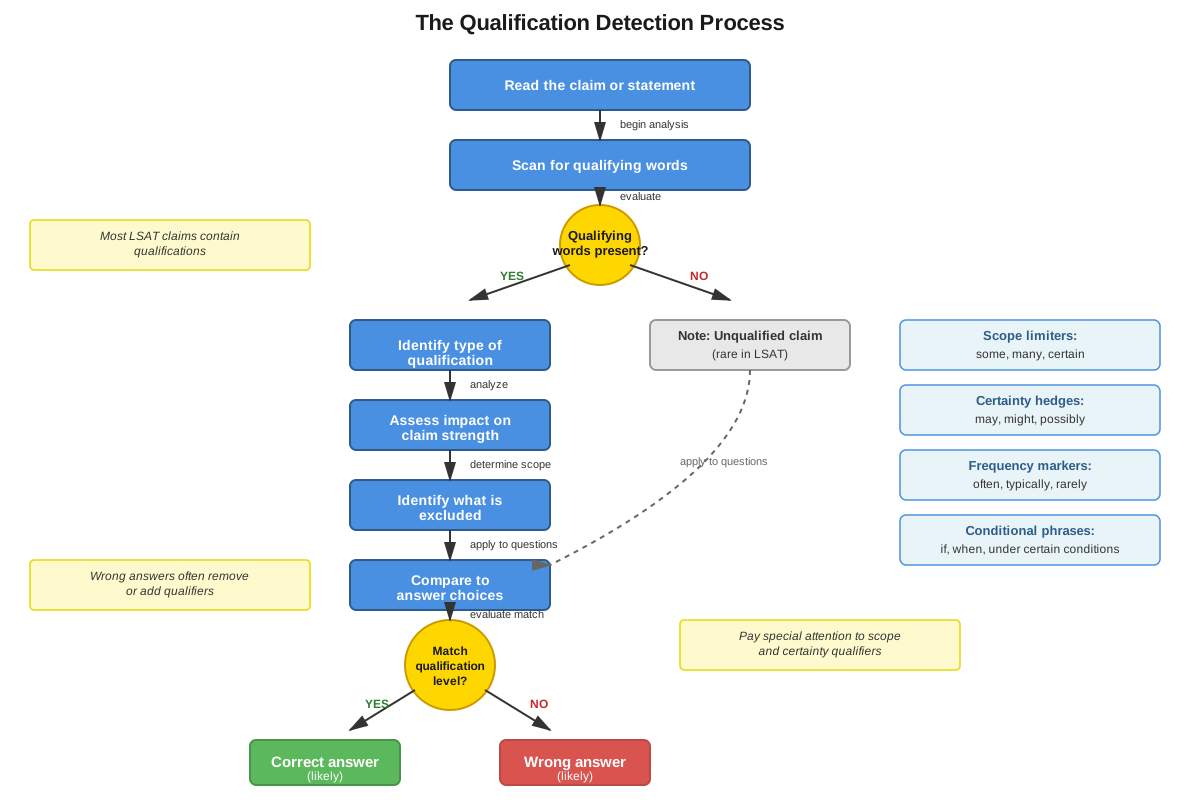
The relationship flows as follows: Careful reading → Identifying qualifying language → Understanding claim scope and certainty → Evaluating argument strength → Making valid inferences → Eliminating answer choices that misrepresent qualifications. Each step depends on the previous one, making qualification identification foundational to multiple question types.
Qualifications also connect to author's purpose and tone. Authors who extensively qualify claims may be presenting exploratory analysis, acknowledging scholarly debate, or demonstrating intellectual humility. Authors who minimize qualifications may be advocating a position, presenting established facts, or deliberately making strong claims. Understanding this relationship helps answer both attitude questions and primary purpose questions.
High-Yield Facts
⭐ Qualifying words like "often," "may," "some," and "typically" limit the scope or certainty of claims and must be tracked precisely
⭐ Wrong answers frequently remove qualifications from passage claims, making them too strong or absolute
⭐ Wrong answers also add qualifications that weren't present, making claims weaker than the author intended
⭐ Conditional qualifications ("if," "when," "provided that") fundamentally change what a claim asserts by adding requirements
⭐ Implicit qualifications based on context (time period, geographic scope, specific population) are as important as explicit qualifying words
- Frequency qualifications indicate patterns rather than universal rules and appear in approximately 60% of LSAT passages
- Multiple qualifications in a single sentence compound their limiting effect on claim strength
- The absence of qualification in a passage claim is itself significant—it indicates the author is making a strong, unhedged assertion
- Qualifications often cluster around controversial claims or areas where evidence is incomplete
- Scientific and legal passages contain more qualifications on average than humanities passages, reflecting disciplinary norms
Quick check — test yourself on Identifying qualifications so far.
Try Flashcards →Common Misconceptions
Misconception: All qualifications indicate author uncertainty or weak evidence → Correction: Qualifications often reflect appropriate scholarly caution, methodological rigor, or acknowledgment of complexity rather than doubt. An author who writes "The evidence strongly suggests" may be highly confident while remaining intellectually honest about the difference between strong evidence and absolute proof.
Misconception: "Some" and "many" are interchangeable qualifications → Correction: These words indicate different quantities. "Some" means "at least one, possibly more" while "many" means "a large number." If a passage says "some critics object," you cannot infer that many critics object. The LSAT exploits this distinction in wrong answer choices.
Misconception: Qualified statements are always weaker than unqualified ones → Correction: In context, a carefully qualified statement can be stronger than an unqualified one because it's more defensible and precise. "Regular cardiovascular exercise typically improves heart health in adults without contraindications" is more credible than "Exercise improves health" because the qualifications show the author understands the complexity.
Misconception: If a passage doesn't explicitly qualify a claim, you should assume implicit qualifications → Correction: You must take claims as written. If an author makes an unqualified assertion, don't add qualifications the author didn't include. The LSAT tests this by offering answer choices that inappropriately hedge definitive passage claims.
Misconception: Qualifications only appear in specific qualifying words → Correction: Qualifications can be expressed through sentence structure, context, or implicit limitations. A claim made within a specific paragraph about a specific time period carries those limitations even without explicit qualifying words.
Misconception: More qualifications always mean a weaker argument → Correction: Appropriate qualifications can strengthen an argument by making it more accurate and defensible. An argument with precise qualifications is often stronger than one making sweeping, easily-refuted claims.
Worked Examples
Example 1: Scientific Passage
Passage excerpt: "Recent studies suggest that intermittent fasting may offer metabolic benefits for some individuals, particularly those with insulin resistance. While the mechanism remains incompletely understood, researchers have observed improvements in several biomarkers among participants who maintained the regimen for at least twelve weeks."
Question: According to the passage, which of the following is true about intermittent fasting?
Answer choices:
(A) It offers metabolic benefits for individuals with insulin resistance
(B) It may offer metabolic benefits for some individuals with insulin resistance
(C) Studies prove it offers metabolic benefits
(D) It improves biomarkers in all participants who maintain the regimen
(E) Researchers fully understand its mechanism
Analysis: Let's identify every qualification in the passage:
- "suggest" (certainty qualification—indicates evidence points toward but doesn't prove)
- "may offer" (certainty qualification—indicates possibility, not certainty)
- "some individuals" (scope qualification—not all individuals)
- "particularly" (emphasis but also limitation—especially but not exclusively)
- "remains incompletely understood" (certainty qualification about knowledge state)
- "observed" (neutral but indicates empirical finding, not theoretical proof)
- "several biomarkers" (scope qualification—not all biomarkers)
- "among participants who maintained" (conditional qualification—only for those who completed the regimen)
- "at least twelve weeks" (temporal qualification—requires minimum duration)
Now evaluate each answer:
(A) removes "may" and "some"—too strong. The passage doesn't assert definite benefits for all individuals with insulin resistance.
(B) preserves "may" and "some" and includes "with insulin resistance" (the "particularly" group). This matches the passage qualifications exactly. CORRECT
(C) changes "suggest" to "prove"—too strong. Studies suggest, they don't prove.
(D) removes "some" and changes it to "all"—too strong. The passage says improvements were observed among participants, not that all participants improved.
(E) contradicts "remains incompletely understood"—opposite of what the passage states.
Key lesson: The correct answer preserves all relevant qualifications from the passage. Wrong answers systematically remove qualifications (A, C, D) or contradict them (E).
Example 2: Legal Passage
Passage excerpt: "The court's decision appears to expand the scope of permissible government regulation, though the majority opinion carefully limits its holding to cases involving substantial public health concerns. Justice Martinez's concurrence suggests that even this limited expansion may prove problematic in future applications."
Question: The passage indicates which of the following about the court's decision?
Answer choices:
(A) It definitively expands the scope of permissible government regulation
(B) It expands regulation only in cases involving public health
(C) It appears to expand regulation but is limited to cases involving substantial public health concerns
(D) Justice Martinez believes the expansion will prove problematic
(E) The majority opinion broadly expands regulatory scope
Analysis: Identify qualifications:
- "appears to expand" (certainty qualification—seems to, but not definitively stated)
- "carefully limits" (scope qualification—deliberate restriction)
- "cases involving substantial public health concerns" (scope qualification—specific category)
- "suggests" (certainty qualification—indicates but doesn't assert)
- "even this limited expansion" (acknowledges the limitation exists)
- "may prove" (certainty qualification—possibility, not certainty)
Evaluate answers:
(A) removes "appears to"—too definitive. The passage hedges with "appears to expand."
(B) removes "substantial" and "appears to"—changes both scope and certainty. The passage specifies "substantial" public health concerns, not all public health matters.
(C) preserves "appears to" and includes "substantial public health concerns." This maintains all the passage's qualifications. CORRECT
(D) removes "may"—too strong. Martinez suggests it "may prove" problematic, not that it "will" prove problematic.
(E) contradicts "carefully limits"—opposite meaning. The passage emphasizes limitation, not broad expansion.
Key lesson: Track every qualifying word. The difference between "public health" and "substantial public health concerns" is exactly the kind of distinction the LSAT tests. The correct answer must preserve the author's level of certainty ("appears to") and scope limitations ("substantial public health concerns").
Exam Strategy
When approaching LSAT reading comprehension questions involving qualifications, develop a systematic process. During initial passage reading, mark or mentally note qualifying language. Circle or underline words like "may," "some," "often," "typically," "appears to," and "suggests." This active reading prevents overlooking qualifications when answering questions.
Exam Tip: Create a mental "qualification alert" for common hedge words. When you see "may," "some," "often," or "suggests," recognize immediately that the author is limiting their claim.
For "According to the passage" questions, wrong answers typically commit one of two errors: removing qualifications (making claims too strong) or adding qualifications (making claims too weak). Eliminate answers that change the certainty or scope of passage claims. If the passage says "often," wrong answers might say "always" (too strong) or "occasionally" (too weak).
Trigger phrases that signal qualification-testing questions include:
- "The author would most likely agree..."
- "According to the passage..."
- "The passage suggests..."
- "Which of the following is supported by the passage?"
These question stems require precise matching between passage qualifications and answer choice qualifications.
Use process of elimination by checking each answer choice against the passage for qualification mismatches. Ask: "Does this answer add certainty the passage didn't have?" "Does it remove a limitation the author included?" "Does it extend scope beyond what the passage claimed?" One mismatch eliminates the answer.
Time allocation: Don't rush through qualification-heavy sentences. A complex sentence with multiple qualifications might take 10-15 seconds to fully process, but that investment prevents errors on multiple questions. Conversely, once you've identified qualifications during passage reading, question answering becomes faster because you've already done the analytical work.
For comparative passages, track whether qualifications differ between authors. One author might make qualified claims ("may suggest") while another makes definitive assertions ("clearly demonstrates"). Questions often test whether students notice these differences in certainty levels.
Memory Techniques
Use the acronym SCOPED to remember major qualification categories:
- Scope (some, many, certain contexts)
- Certainty (may, might, possibly, likely)
- Occurrence (often, usually, sometimes)
- Partial (somewhat, largely, partially)
- Exceptions (unless, except, but)
- Degree (relatively, comparatively, moderately)
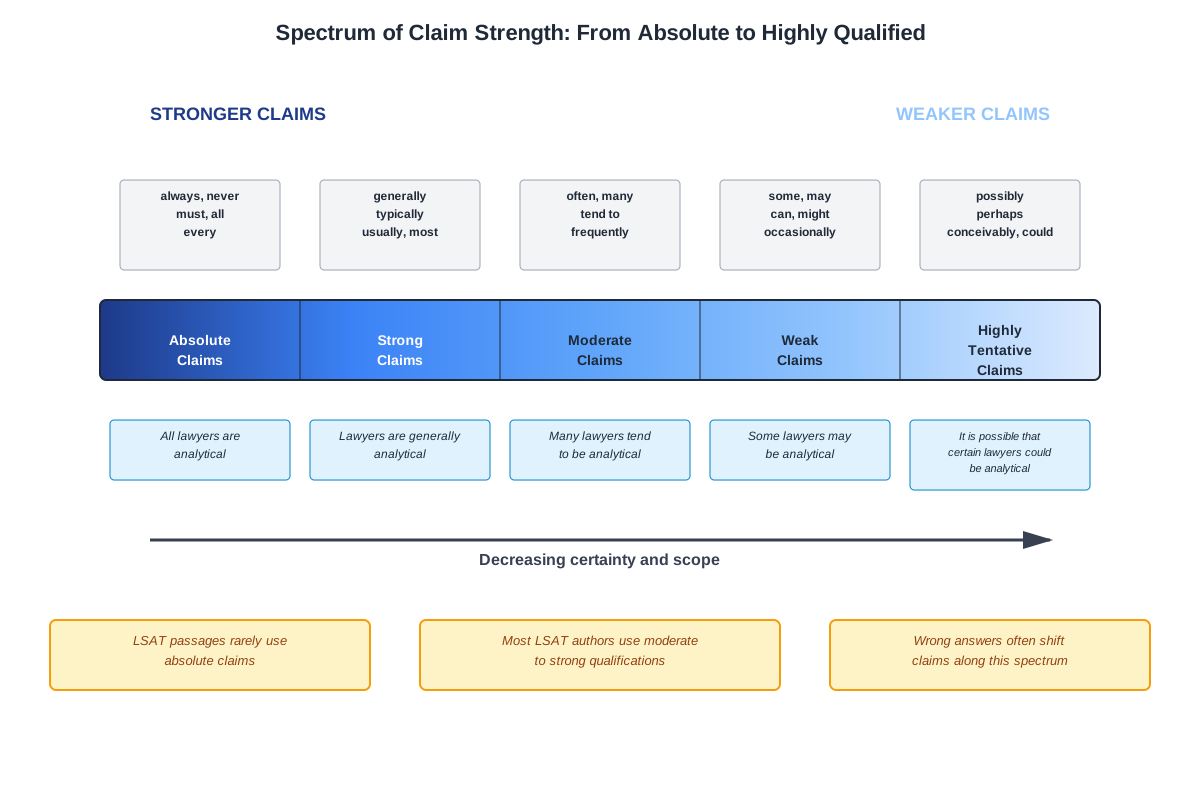
Visualize qualifications as dimmer switches rather than on/off switches. Unqualified claims are at full brightness (100% certainty, scope, or frequency). Each qualification dims the claim: "may" dims certainty, "some" dims scope, "often" dims frequency. This visualization helps recognize that qualifications reduce claim strength along a spectrum.
Create a qualification spectrum in your mind:
Certainty: proves → demonstrates → strongly suggests → suggests → may indicate → might suggest
Frequency: always → usually → often → sometimes → occasionally → rarely → never
Scope: all → most → many → some → few → none
For conditional qualifications, remember "IF = REQUIREMENT". Whenever you see "if," "when," "provided that," or "unless," the claim has a requirement that must be met. The claim isn't asserting something will happen—it's asserting what would happen if conditions are met.
Use the mnemonic "MATCH THE HEDGE" when evaluating answer choices. The correct answer must match the passage's level of hedging—neither stronger nor weaker.
Summary
Identifying qualifications is a foundational skill for LSAT reading comprehension that involves recognizing when authors limit the scope, certainty, or applicability of their claims through specific language choices. Qualifications appear as frequency markers (often, usually), certainty indicators (may, suggests), scope limiters (some, certain contexts), degree modifiers (largely, somewhat), and conditional phrases (if, when, provided that). The LSAT systematically tests whether students track these qualifications accurately by creating wrong answer choices that either remove qualifications (making claims too strong) or add qualifications (making claims too weak). Mastering this skill requires active reading to identify qualifying language, precise matching between passage claims and answer choices, and understanding that qualifications define the boundaries of what an author actually asserts versus what a careless reader might assume. Success depends on recognizing that legal and academic writing—the foundation of LSAT passages—relies on careful qualification to maintain intellectual rigor and defensible claims. Students who excel at identifying qualifications can distinguish between what passages prove versus suggest, what applies universally versus in specific contexts, and what authors assert confidently versus tentatively.
Key Takeaways
- Qualifications limit claim scope, certainty, or frequency through specific words and phrases that must be tracked precisely throughout passages
- Wrong answers systematically remove qualifications (making claims too strong) or add qualifications (making claims too weak), requiring careful comparison with original passage language
- Common qualifying words include "may," "some," "often," "typically," "suggests," "appears to," and conditional phrases like "if" and "when"
- Implicit qualifications based on context (time period, geographic scope, specific populations) are as important as explicit qualifying words
- Qualifications don't necessarily indicate weakness—they often reflect appropriate scholarly caution and intellectual rigor
- The correct answer to qualification-focused questions preserves the exact level of certainty and scope present in the passage
- Developing a systematic process for marking qualifications during initial reading prevents errors on multiple question types
Related Topics
Author's Tone and Attitude: Understanding qualifications directly supports analyzing author attitude, as the degree of qualification reveals confidence levels, scholarly caution, or advocacy positions. Mastering qualification identification enables more accurate tone analysis.
Making Valid Inferences: Proper inference requires respecting passage qualifications—valid inferences can be weaker but not stronger than qualified source claims. This topic builds directly on qualification identification skills.
Argument Structure and Evaluation: Qualifications affect argument strength by defining premise and conclusion scope. Understanding how qualifications limit claims enables more sophisticated argument analysis.
Comparative Reading: When analyzing dual passages, tracking qualification differences between authors reveals contrasting levels of certainty, different scopes of claims, and varying degrees of confidence in evidence.
Practice CTA
Now that you understand how to identify and track qualifications in LSAT reading comprehension passages, it's time to apply these skills to practice questions. Work through the accompanying practice set, paying special attention to how answer choices manipulate qualifications. Create flashcards for common qualifying terms and their effects on claim strength. Remember: precision in tracking qualifications is what separates good LSAT scores from great ones. Every qualification you correctly identify is a wrong answer you'll successfully eliminate. You've built the foundation—now practice until qualification identification becomes automatic!
Sign up free to keep reading
Create a free AnvayaPrep account to finish this LSAT guide on Identifying qualifications — plus flashcards and practice questions.