Overview
In LSAT Reading Comprehension passages, understanding the researcher's view is fundamental to answering questions correctly and efficiently. The researcher's view refers to the perspective, position, or argument presented by a researcher, scientist, scholar, or expert mentioned within a passage. This concept is particularly important because LSAT passages frequently present multiple viewpoints—including those of researchers, critics, traditional schools of thought, and the passage author—and test-takers must distinguish between these perspectives to answer questions accurately.
The ability to identify and analyze a researcher's view is essential for success on the LSAT because approximately 30-40% of Reading Comprehension questions require students to recognize whose opinion is being expressed, what evidence supports that opinion, and how it relates to other viewpoints in the passage. Questions may ask students to identify what a researcher would agree with, how a researcher would respond to a criticism, or what assumption underlies a researcher's argument. Mastering this skill directly impacts performance on viewpoints and argumentation questions, which constitute a significant portion of the Reading Comprehension section.
Within the broader context of reading comprehension, the researcher's view connects to several critical skills: identifying the main idea, understanding passage structure, recognizing argumentative patterns, and distinguishing between different voices in a text. The researcher's view often serves as either the primary thesis of a passage or as a contrasting perspective that the author evaluates. Understanding how to track and analyze these views enables test-takers to navigate complex passages efficiently and answer questions with confidence, making this a high-yield topic for LSAT preparation.
Learning Objectives
- [ ] Identify how Researcher's view appears in LSAT questions
- [ ] Explain the reasoning pattern behind Researcher's view
- [ ] Apply Researcher's view to solve LSAT-style problems accurately
- [ ] Distinguish between the researcher's view and the author's view in complex passages
- [ ] Recognize common question stems that test understanding of researcher's perspectives
- [ ] Evaluate the strength of evidence supporting a researcher's position
- [ ] Predict how a researcher would respond to counterarguments or new information
Prerequisites
- Basic passage structure recognition: Understanding how LSAT passages are organized (introduction, body paragraphs, conclusion) is necessary to locate where researchers' views are typically presented.
- Ability to identify opinion markers: Recognizing phrases like "argues that," "contends," "believes," and "suggests" helps distinguish factual statements from viewpoints.
- Understanding of argumentative structure: Familiarity with premises, conclusions, and evidence allows students to analyze how researchers support their positions.
- Skill in tracking multiple perspectives: LSAT passages often present several viewpoints, so students must be able to keep track of who believes what throughout a passage.
Why This Topic Matters
Understanding the researcher's view has profound practical applications beyond the LSAT. In academic settings, graduate students must regularly evaluate competing scholarly perspectives, assess the strength of research claims, and synthesize multiple viewpoints—skills directly tested through researcher's view questions. In legal practice, attorneys must understand expert testimony, evaluate the credibility of research presented as evidence, and distinguish between different expert opinions in complex cases.
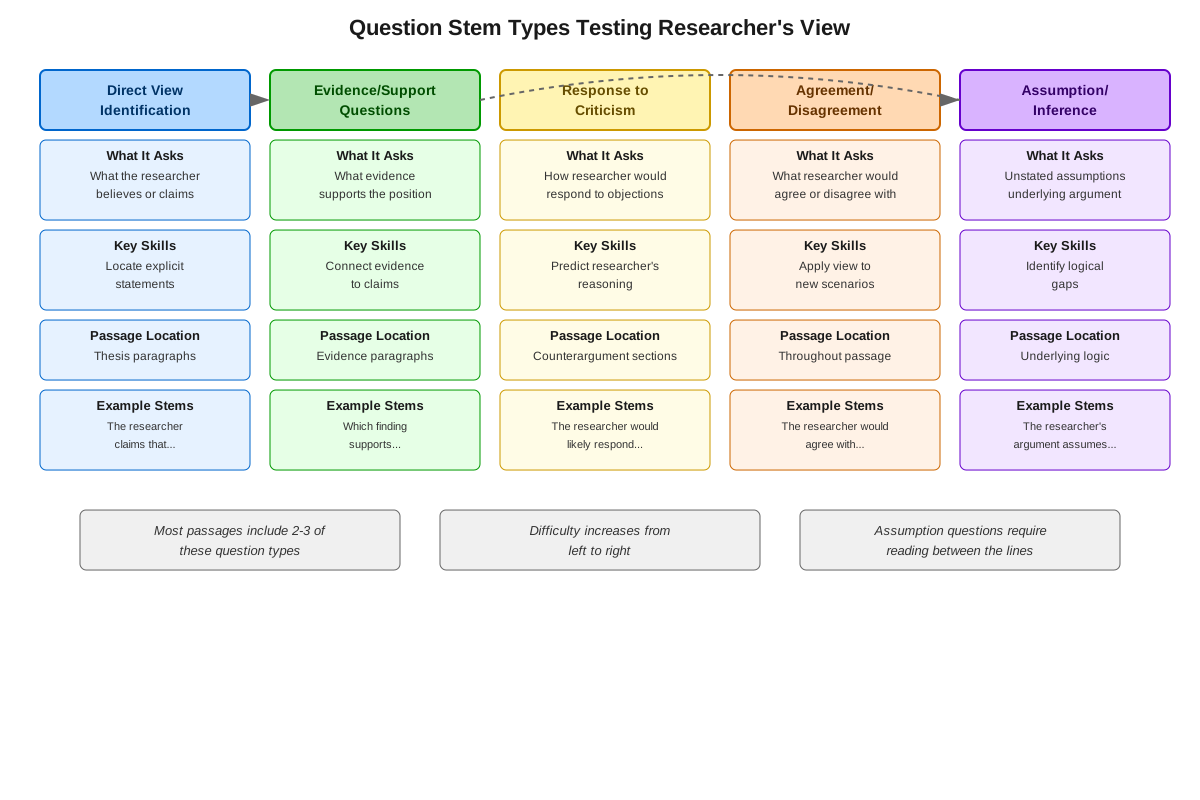
On the LSAT specifically, researcher's view questions appear with high frequency across all Reading Comprehension passage types. Approximately 2-3 questions per passage may directly or indirectly test understanding of a researcher's perspective. These questions appear in several formats: "According to the researcher mentioned in lines 15-20...," "The researcher would most likely agree with which of the following...," "Which of the following, if true, would most strengthen the researcher's argument...," and "The researcher's view differs from the traditional view primarily in that..."
Common manifestations in LSAT passages include: scientific passages presenting a researcher's new theory that challenges established understanding; humanities passages discussing a scholar's interpretation of historical events or literary works; social science passages describing a researcher's findings about human behavior or social phenomena; and law passages presenting legal scholars' arguments about constitutional interpretation or jurisprudence. The researcher's view typically appears in one of three structural positions: as the main thesis the passage explores, as a contrasting view to another perspective, or as supporting evidence for the author's argument.
Core Concepts
Defining the Researcher's View
The researcher's view encompasses the complete perspective, argument, or position held by a researcher, scientist, scholar, or expert mentioned in an LSAT passage. This view includes not only the researcher's main claim or thesis but also the reasoning, evidence, assumptions, and implications that support that position. Unlike factual statements or objective descriptions, a researcher's view represents an interpretive stance, theoretical position, or argumentative claim that could potentially be challenged or debated.
In LSAT passages, researchers' views are typically attributed explicitly through citation markers such as "Dr. Smith argues," "According to Johnson's research," or "The study conducted by Martinez suggests." However, some passages present researchers' views more subtly, requiring careful attention to context and attribution. The key distinguishing feature is that a researcher's view represents that specific individual's or group's perspective rather than universally accepted fact or the passage author's own opinion.
Components of a Researcher's View
Every researcher's view presented in LSAT passages contains several identifiable components that test-takers must recognize:
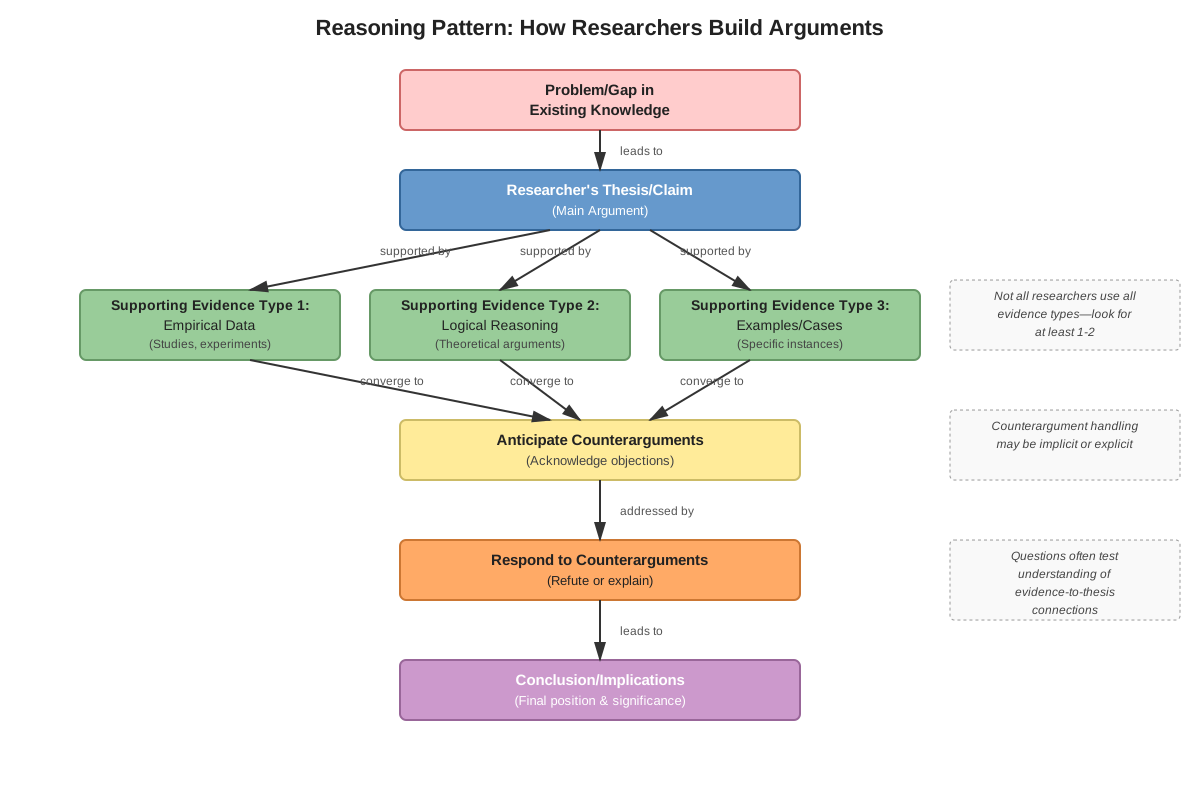
The Central Claim: This is the main thesis or position the researcher advocates. For example, "Researcher X argues that climate patterns in the medieval period were primarily influenced by solar activity rather than volcanic eruptions."
Supporting Evidence: Researchers' views are backed by data, observations, experiments, or logical reasoning. LSAT passages typically describe what evidence the researcher relies upon, such as "based on analysis of ice core samples" or "drawing from archaeological findings."
Underlying Assumptions: Every researcher's view rests on certain assumptions—unstated premises that must be true for the argument to hold. Identifying these assumptions is crucial for answering inference and strengthening/weakening questions.
Scope and Limitations: Careful readers note what the researcher's view does and does not claim. A researcher might argue that a factor is "significant" without claiming it is the "only" factor, or might limit claims to a specific time period or geographic region.
Implications and Applications: Many LSAT questions test understanding of what follows from a researcher's view—what predictions the researcher would make, what other phenomena the theory would explain, or what practical applications would follow.
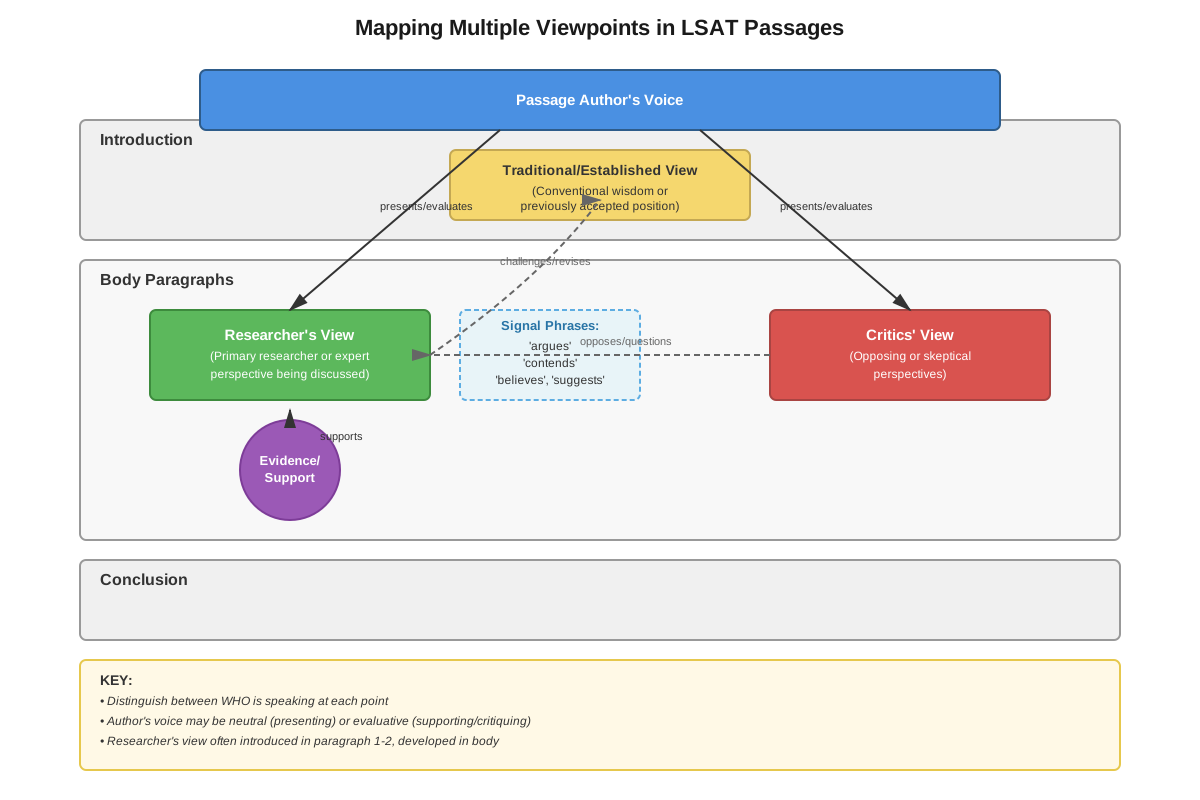
Distinguishing Multiple Viewpoints
LSAT passages frequently present multiple perspectives, making it essential to distinguish the researcher's view from other viewpoints:
| Viewpoint Type | Characteristics | Common Markers |
|---|---|---|
| Researcher's View | Specific attributed position; often novel or challenging | "X argues," "According to Y's study," "Z's research suggests" |
| Author's View | Passage writer's own perspective; may evaluate other views | "However," "In fact," "More importantly," tone and emphasis |
| Traditional/Conventional View | Established or widely-held position, often contrasted with researcher's view | "Traditionally," "It has long been believed," "The standard view" |
| Critics' View | Opposition to researcher's position | "Critics contend," "Opponents argue," "Some scholars dispute" |
The most common LSAT pattern presents a researcher's view that challenges or modifies a traditional understanding, with the passage author either supporting, critiquing, or neutrally presenting both perspectives. Test-takers must track these relationships carefully, as questions often ask about the relationship between viewpoints rather than about a single view in isolation.
Reasoning Patterns in Researcher's Views
Researchers' views in LSAT passages typically follow recognizable reasoning patterns:
Causal Arguments: The researcher claims that X causes Y, often challenging previous explanations. Example: "Researcher Martinez argues that the decline in bee populations is caused primarily by habitat fragmentation rather than pesticide use."
Comparative Arguments: The researcher asserts that one factor, interpretation, or approach is more significant, accurate, or effective than another. Example: "According to Thompson's analysis, economic factors played a more decisive role in the revolution than ideological considerations."
Reinterpretation Arguments: The researcher offers a new way of understanding existing evidence or phenomena. Example: "Johnson reinterprets the archaeological evidence, suggesting the structures served ceremonial rather than defensive purposes."
Challenge to Consensus: The researcher disputes widely-accepted views, presenting evidence or reasoning that contradicts conventional wisdom. Example: "Smith's research challenges the long-held belief that the species migrated from north to south, proposing instead a south-to-north migration pattern."
Synthesis Arguments: The researcher combines or reconciles previously separate or conflicting perspectives. Example: "Chen's work synthesizes the biological and cultural explanations, arguing that both factors interact to produce the observed behavior."
Textual Markers and Signal Phrases
Recognizing the language that introduces and develops a researcher's view is crucial for efficient passage reading. Key signal phrases include:
- Attribution markers: "argues," "contends," "maintains," "asserts," "claims," "proposes," "suggests," "hypothesizes," "theorizes"
- Evidence indicators: "based on," "drawing from," "relying on," "according to data showing," "as evidenced by"
- Contrast markers (indicating researcher's view differs from others): "however," "in contrast," "contrary to," "challenging," "disputing," "rejecting"
- Qualification markers: "may," "might," "could," "appears to," "seems to," "suggests" (indicating tentative claims)
- Certainty markers: "demonstrates," "proves," "establishes," "shows definitively" (indicating strong claims)
Understanding these markers helps test-takers quickly identify when a researcher's view is being introduced, developed, or contrasted with other perspectives.
Concept Relationships
The researcher's view concept connects to multiple elements within LSAT Reading Comprehension. At the foundational level, identifying a researcher's view depends on passage structure recognition—understanding where in a passage different viewpoints typically appear. This leads to viewpoint attribution, the skill of tracking who believes what throughout a passage.
The relationship flow operates as follows: Passage Structure Recognition → Viewpoint Attribution → Researcher's View Identification → Argument Analysis → Question Application. Each step builds on the previous one, with researcher's view identification serving as the crucial middle stage that enables both understanding the passage's argumentative structure and answering specific questions.
The researcher's view concept also connects horizontally to related skills: Author's Purpose (understanding why the author presents a particular researcher's view), Tone and Attitude (recognizing whether the author or others support or critique the researcher), and Inference Questions (determining what follows from the researcher's position). Additionally, researcher's view questions often test Strengthening and Weakening skills, as students must identify what evidence would support or undermine the researcher's argument.
Within the broader Viewpoints and Argumentation unit, the researcher's view represents one specific type of perspective that students must track. It relates to but differs from the author's view (the passage writer's own perspective), the traditional view (established consensus), and critics' views (opposition perspectives). Understanding these relationships enables students to navigate complex passages where multiple voices interact and debate.
High-Yield Facts
⭐ Researcher's views are always attributed to a specific person or group, never presented as universal fact or the author's own opinion.
⭐ Approximately 30-40% of Reading Comprehension questions require distinguishing between different viewpoints, including researchers' perspectives.
⭐ The most common passage structure presents a researcher's view that challenges or modifies traditional understanding.
⭐ Questions asking "The researcher would most likely agree with..." require understanding not just what was stated but what logically follows from the researcher's position.
⭐ Signal phrases like "argues," "contends," and "maintains" always introduce opinion or perspective, not established fact.
- Researcher's views typically appear in the first or second paragraph of LSAT passages, establishing the main perspective the passage will explore.
- When a passage presents multiple researchers' views, questions often test the ability to distinguish between them or identify points of agreement and disagreement.
- The strength of a researcher's claim (tentative vs. definitive) affects what can be inferred and what would strengthen or weaken the argument.
- Researchers' views in LSAT passages are almost always supported by some form of evidence, even if that evidence is later questioned.
- Understanding the scope of a researcher's claim (what it does and doesn't assert) is essential for avoiding wrong answer choices that overstate or misrepresent the view.
- Questions about researchers' views frequently include wrong answers that confuse the researcher's view with the author's view or traditional view.
- Identifying the assumptions underlying a researcher's view enables prediction of what would strengthen or weaken that view.
Quick check — test yourself on Researcher's view so far.
Try Flashcards →Common Misconceptions
Misconception: The researcher's view is always the correct or preferred perspective in the passage.
Correction: LSAT passages may present researchers' views that the author critiques, questions, or presents neutrally alongside other perspectives. The passage structure and tone indicators reveal the author's attitude toward the researcher's view.
Misconception: If information appears in a passage, it represents the researcher's view.
Correction: Passages contain multiple types of information: background facts, traditional views, critics' perspectives, and the author's own analysis. Only information explicitly attributed to the researcher represents that researcher's view.
Misconception: The researcher's view and the author's view are the same thing.
Correction: These are distinct perspectives. The author is the passage writer who may present, evaluate, or critique the researcher's view. The researcher is a person or group mentioned within the passage whose perspective is being discussed.
Misconception: Questions about researcher's views only ask about explicitly stated information.
Correction: Many questions require inference—determining what the researcher would likely believe, how they would respond to new information, or what assumptions underlie their position, based on the view presented in the passage.
Misconception: All researchers mentioned in a passage hold the same view.
Correction: Passages frequently present multiple researchers with different or competing perspectives. Careful tracking of attribution is essential to avoid confusing which researcher holds which view.
Misconception: The researcher's view is always presented in a single paragraph or section.
Correction: A researcher's complete view may be developed across multiple paragraphs, with the initial claim presented early and supporting evidence, implications, or responses to criticism appearing later in the passage.
Misconception: Strong language like "proves" or "demonstrates" always indicates a researcher's view.
Correction: These words may appear in descriptions of what a researcher claims to have proven, but they may also appear in the author's or critics' evaluation of whether the researcher actually succeeded in proving their point.
Worked Examples
Example 1: Identifying and Applying a Researcher's View
Passage Excerpt:
"For decades, historians attributed the rapid urbanization of medieval European cities primarily to agricultural innovations that freed rural workers to migrate to urban centers. However, recent research by historian Elena Vasquez challenges this agricultural-centric explanation. Drawing from extensive analysis of trade records and guild documents, Vasquez argues that the expansion of long-distance trade networks was the primary driver of urban growth. According to her analysis, cities grew most rapidly along major trade routes, regardless of local agricultural productivity. While Vasquez acknowledges that agricultural improvements played a supporting role, she contends that the demand for merchants, craftspeople, and laborers to support trade activities was the decisive factor in drawing population to cities."
Question: Based on the passage, Vasquez would most likely agree with which of the following statements?
A) Agricultural innovations had no impact on medieval urbanization.
B) Cities located far from trade routes experienced minimal population growth during the medieval period.
C) Guild documents provide more reliable historical evidence than agricultural records.
D) The traditional explanation of urbanization is entirely incorrect.
E) Trade networks developed as a result of urban population growth.
Worked Solution:
Step 1: Identify Vasquez's complete view. She argues that trade network expansion was the "primary driver" of urban growth, with cities growing "most rapidly along major trade routes." She acknowledges agricultural improvements played a "supporting role" but were not the decisive factor.
Step 2: Analyze each answer choice against Vasquez's view:
A) Too extreme. Vasquez "acknowledges that agricultural improvements played a supporting role," so she doesn't claim they had "no impact."
B) Strongly supported. If cities grew "most rapidly along major trade routes," then cities far from such routes would logically experience less growth. This is a valid inference from Vasquez's position.
C) Not addressed. While Vasquez uses guild documents as evidence, the passage doesn't indicate she makes comparative claims about the reliability of different source types.
D) Too extreme. Vasquez challenges the traditional view but doesn't claim it's "entirely incorrect"—she acknowledges agricultural factors played a supporting role.
E) Reverses causation. Vasquez argues trade networks caused urban growth, not that urban growth caused trade networks.
Answer: B
Connection to Learning Objectives: This example demonstrates how to identify a researcher's view (Vasquez's trade-based explanation), understand its reasoning pattern (causal argument challenging traditional explanation), and apply that understanding to predict what the researcher would agree with (inference question).
Example 2: Distinguishing Multiple Viewpoints
Passage Excerpt:
"The conventional interpretation of the Antikythera mechanism, an ancient Greek astronomical device, held that it was primarily used for predicting solar eclipses. Archaeologist James Wright, however, proposes a different function. Based on his analysis of the gear ratios and inscriptions, Wright argues that the device was designed to track the timing of the ancient Olympic Games, which followed a complex four-year cycle tied to lunar months. Critics of Wright's theory, including physicist Sarah Chen, point out that the mechanism's sophisticated eclipse prediction capabilities seem too advanced to be merely incidental to a games-tracking function. The passage author notes that while Wright's interpretation is innovative, the device's complexity suggests it likely served multiple purposes, with both eclipse prediction and games-tracking among its functions."
Question: The passage indicates that Wright's view differs from the conventional interpretation primarily in its claims about:
A) The sophistication of ancient Greek astronomical knowledge
B) The primary intended use of the Antikythera mechanism
C) The accuracy of the device's eclipse predictions
D) The complexity of the Olympic Games cycle
E) The reliability of archaeological evidence
Worked Solution:
Step 1: Identify the conventional view: The mechanism was "primarily used for predicting solar eclipses."
Step 2: Identify Wright's view: The device was "designed to track the timing of the ancient Olympic Games."
Step 3: Identify the key difference: Both views concern what the mechanism was primarily for—its main intended purpose or function.
Step 4: Note what Wright's view does NOT primarily differ on: Wright doesn't dispute that the mechanism could predict eclipses (he just thinks that wasn't its primary purpose), doesn't make claims about the sophistication of Greek knowledge in general, and doesn't focus on the Olympic cycle's complexity as his main point of departure from conventional interpretation.
Step 5: Evaluate answer choices:
A) Not the primary difference. Both views acknowledge sophisticated astronomical capabilities.
B) Correct. The fundamental disagreement is about the mechanism's "primary" purpose—eclipse prediction vs. games-tracking.
C) Wright doesn't dispute the accuracy of eclipse predictions, only whether that was the primary function.
D) The Olympic cycle's complexity is mentioned as part of Wright's evidence, but the primary difference concerns the mechanism's purpose, not the games' complexity.
E) Neither view is primarily about evidence reliability.
Answer: B
Connection to Learning Objectives: This example demonstrates distinguishing between multiple viewpoints (conventional view, Wright's view, Chen's criticism, and author's view), identifying the specific point of disagreement between perspectives, and recognizing that researcher's views are defined by their central claims rather than peripheral details.
Exam Strategy
When approaching LSAT questions involving researcher's views, implement this systematic strategy:
Pre-Reading Strategy: Before diving into the passage, quickly scan for researcher names, dates, and attribution markers ("argues," "contends," "according to"). This preview helps anticipate that the passage will present specific viewpoints requiring careful tracking.
Active Reading Technique: As you read, create a mental or marginal map of viewpoints. Note: (1) Who holds each view, (2) What their main claim is, (3) What evidence supports it, and (4) How it relates to other views (supports, challenges, modifies). Use abbreviations: "R" for researcher, "A" for author, "T" for traditional view, "C" for critics.
Trigger Words to Watch For:
- Attribution: "argues," "contends," "maintains," "proposes," "suggests," "according to," "in X's view"
- Contrast: "however," "in contrast," "challenging," "contrary to," "unlike" (signals researcher's view differs from another)
- Evidence: "based on," "drawing from," "analysis of," "research shows" (indicates support for researcher's view)
- Qualification: "primarily," "mainly," "most significant," "may," "appears to" (defines scope of researcher's claim)
Question Stem Recognition: Identify question types that test researcher's view:
- "According to [researcher]..." (direct comprehension)
- "The researcher would most likely agree with..." (inference)
- "Which of the following, if true, would strengthen/weaken the researcher's argument..." (reasoning)
- "The researcher's view differs from [other view] in that..." (comparison)
- "The researcher assumes that..." (assumption identification)
Process of Elimination Tips:
- Eliminate answer choices that confuse viewpoints: Wrong answers often attribute the author's view to the researcher or vice versa. Always verify whose perspective the question asks about.
- Eliminate extreme answers: If the researcher makes a qualified claim ("primarily," "significant factor"), eliminate answers that make absolute claims ("only," "entirely," "completely").
- Eliminate scope violations: If the researcher's claim is limited to a specific context, time period, or domain, eliminate answers that extend beyond that scope.
- Eliminate reversal answers: Watch for choices that reverse the researcher's causal claims or flip their position on an issue.
- For inference questions, eliminate answers that require additional assumptions: The correct answer should follow directly from the researcher's stated position without requiring outside information.
Time Allocation: Spend approximately 3-4 minutes on initial passage reading, ensuring you clearly understand each viewpoint presented. This upfront investment saves time on questions, as you won't need to re-read extensively to determine whose view is whose. For questions specifically about researcher's views, allocate 45-60 seconds: 15-20 seconds to locate the relevant passage content, 25-35 seconds to evaluate answer choices.
Verification Strategy: Before selecting an answer, perform this quick check: (1) Confirm the answer addresses the correct viewpoint (researcher's, not author's or others'), (2) Verify the answer aligns with the researcher's scope and strength of claim, (3) Ensure the answer doesn't contradict any explicitly stated element of the researcher's view.
Memory Techniques
RACE Acronym for Analyzing Researcher's Views:
- Recognize attribution (Who holds this view?)
- Assess the claim (What is their main argument?)
- Consider the evidence (What supports their position?)
- Evaluate relationships (How does this view relate to others?)
The "Three W's" Mnemonic:
- Who says it? (Identify the researcher)
- What do they claim? (Main thesis)
- Why do they believe it? (Evidence and reasoning)
Visualization Strategy: Picture the passage as a conversation or debate. Visualize different speakers (researcher, author, critics, traditional view) as distinct people in a room, each presenting their perspective. This mental image helps maintain clear separation between viewpoints and makes it easier to track who believes what.
The "Contrast Clue" Technique: When you see contrast words like "however," "in contrast," or "challenging," mentally highlight that a new viewpoint is being introduced. Create a visual or mental marker that signals "viewpoint shift ahead."
Scope Reminder - "SPAN":
- Strength of claim (tentative vs. definitive)
- Period/time frame (when does this apply?)
- Area/domain (what field or context?)
- Number of factors (primary cause vs. one of several factors)
This helps remember to check whether answer choices respect the scope of the researcher's actual claims.
Summary
The researcher's view is a fundamental concept in LSAT Reading Comprehension that requires test-takers to identify, analyze, and apply the specific perspectives of researchers, scholars, or experts mentioned within passages. Success with this topic depends on three core competencies: accurately identifying when and how a researcher's view is presented through attribution markers and signal phrases; understanding the complete structure of that view including its central claim, supporting evidence, underlying assumptions, and scope limitations; and distinguishing the researcher's perspective from other viewpoints in the passage, particularly the author's view, traditional perspectives, and critics' positions. The most common LSAT pattern presents a researcher's view that challenges or modifies conventional understanding, with questions testing whether students can recognize what the researcher would agree with, how their view differs from others, what would strengthen or weaken their argument, and what assumptions underlie their position. Mastering this topic requires active reading that tracks multiple perspectives simultaneously, careful attention to the scope and strength of researchers' claims, and systematic application of elimination strategies that avoid common traps like viewpoint confusion and scope violations.
Key Takeaways
- Researcher's views are always explicitly attributed to specific individuals or groups through signal phrases like "argues," "contends," or "according to," distinguishing them from facts or the author's own perspective.
- The most critical skill is distinguishing between multiple viewpoints in a passage—researcher's view, author's view, traditional view, and critics' views—as questions frequently test this differentiation.
- Understanding the complete structure of a researcher's view requires identifying not just the main claim but also the supporting evidence, underlying assumptions, scope limitations, and implications.
- Common question types include direct comprehension ("According to the researcher..."), inference ("The researcher would most likely agree..."), and reasoning ("Which would strengthen the researcher's argument...").
- Scope and strength matter immensely: A researcher claiming something is a "primary factor" is different from claiming it's the "only factor," and answer choices often exploit these distinctions.
- Active reading with viewpoint tracking during initial passage reading saves significant time on questions and prevents the need for extensive re-reading.
- The RACE framework (Recognize attribution, Assess the claim, Consider the evidence, Evaluate relationships) provides a systematic approach to analyzing any researcher's view encountered in LSAT passages.
Related Topics
Author's Purpose and Tone: Understanding why the passage author presents a particular researcher's view and what attitude the author takes toward that view (supportive, critical, neutral) builds directly on researcher's view identification skills. Mastering researcher's view enables more sophisticated analysis of authorial intent.
Strengthening and Weakening Arguments: Once a researcher's view is identified, many questions test the ability to recognize what evidence would support or undermine that position. This requires understanding the logical structure and assumptions underlying the researcher's argument.
Inference and Implication Questions: These questions often ask what a researcher would likely believe or how they would respond to new information, requiring extrapolation from the stated view to unstated but logically consistent positions.
Comparative Reading: Some LSAT Reading Comprehension sections include paired passages presenting different researchers' or authors' views on the same topic, making viewpoint distinction skills even more critical.
Main Point and Primary Purpose: Identifying whether a researcher's view constitutes the passage's main point or serves another function (contrast, support, example) requires integration of researcher's view identification with overall passage structure analysis.
Practice CTA
Now that you've mastered the core concepts of identifying and analyzing researcher's views in LSAT Reading Comprehension passages, it's time to put your knowledge into practice. Attempt the practice questions and flashcards associated with this topic to reinforce your understanding and build the speed and accuracy needed for test day. Remember: understanding the theory is just the first step—consistent practice with real LSAT-style questions transforms knowledge into the automatic recognition and analysis skills that lead to top scores. Each practice question you work through strengthens your ability to quickly identify viewpoints, track multiple perspectives, and confidently answer even the most challenging researcher's view questions. You've built a strong foundation—now apply it!
Sign up free to keep reading
Create a free AnvayaPrep account to finish this LSAT guide on Researcher's view — plus flashcards and practice questions.