Overview
Theory comparison is a critical reasoning pattern that appears frequently in LSAT reading comprehension passages, particularly within the viewpoints and argumentation framework. This pattern involves passages that present two or more competing theories, hypotheses, or explanations for a phenomenon, then analyze their relative strengths, weaknesses, or compatibility. Students must identify the key distinctions between theories, understand the evidence supporting or challenging each position, and recognize how authors position these theories relative to one another.
Mastering theory comparison is essential for LSAT success because approximately 15-20% of reading comprehension passages explicitly compare competing theoretical frameworks. These passages appear across all content domains—from scientific explanations of natural phenomena to legal theories about constitutional interpretation to competing historical accounts of events. The LSAT tests not merely whether students can identify that theories differ, but whether they can precisely articulate how they differ, why those differences matter, and what logical implications follow from adopting one theory over another.
Theory comparison connects to broader reading comprehension skills by requiring synthesis of multiple viewpoints, careful attention to argumentative structure, and precise understanding of logical relationships. Unlike passages presenting a single unified argument, theory comparison passages demand that students maintain mental separation between distinct positions while simultaneously tracking their points of intersection and divergence. This skill builds directly on fundamental argument analysis abilities while adding layers of complexity that mirror the sophisticated reasoning required throughout the LSAT.
Learning Objectives
- [ ] Identify how theory comparison appears in LSAT questions
- [ ] Explain the reasoning pattern behind theory comparison
- [ ] Apply theory comparison to solve LSAT-style problems accurately
- [ ] Distinguish between competing theories based on their core assumptions and predictions
- [ ] Evaluate the relative strengths and weaknesses of multiple theoretical positions
- [ ] Recognize common structural patterns in theory comparison passages
- [ ] Synthesize information across multiple theoretical frameworks to answer inference questions
Prerequisites
- Basic argument structure: Understanding premises, conclusions, and logical connections is essential because theory comparison passages present multiple complete arguments that must be analyzed separately and comparatively.
- Identifying main ideas and author's purpose: Students must track not only what each theory claims but also how the author positions these theories (neutral presentation, advocacy for one, critique of both, etc.).
- Understanding evidence and support: Theory comparison passages evaluate theories based on supporting evidence, so recognizing what counts as evidence and how it relates to claims is foundational.
- Vocabulary for academic discourse: Terms like "hypothesis," "postulate," "framework," and "paradigm" appear frequently in these passages and must be understood fluently.
Why This Topic Matters
Theory comparison represents one of the most intellectually demanding and practically relevant skills tested on the LSAT. In legal practice, attorneys constantly evaluate competing interpretations of statutes, precedents, and constitutional provisions. Judges must weigh different theoretical approaches to jurisprudence. This LSAT skill directly translates to the analytical reasoning required throughout legal education and professional practice.
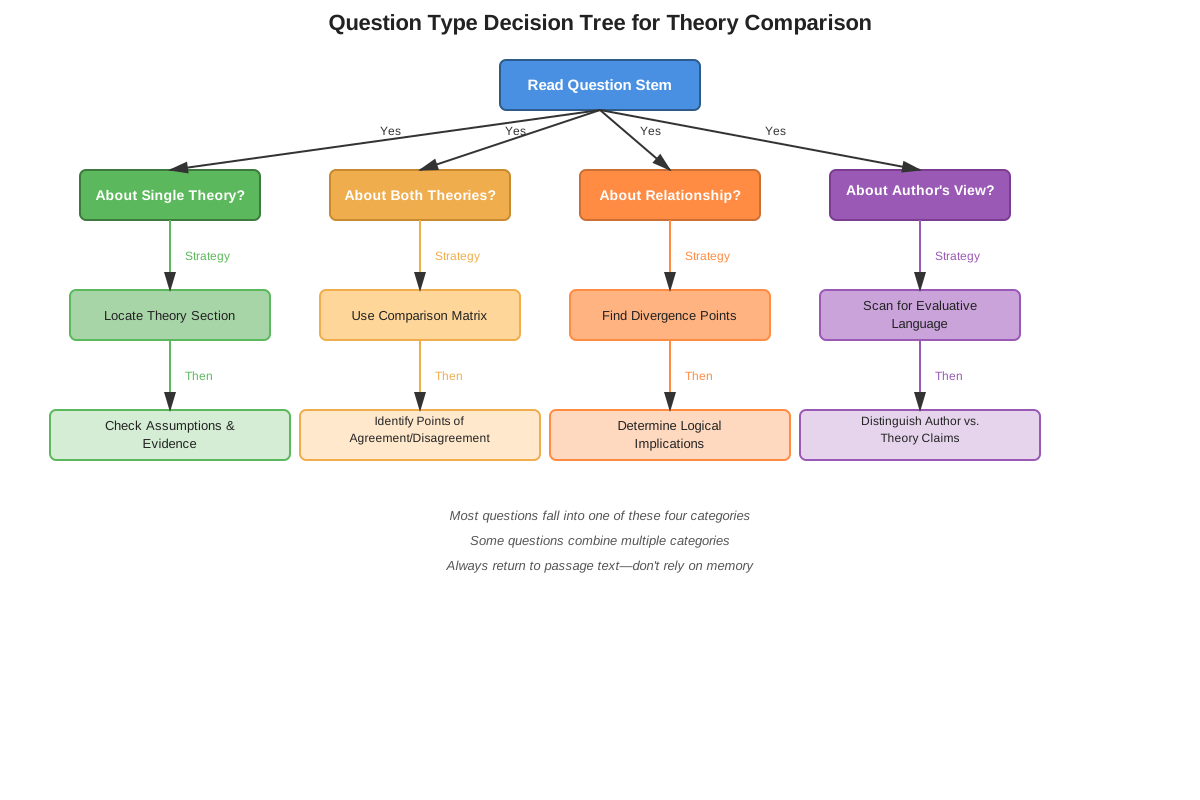
On the exam itself, theory comparison passages generate questions across all major question types: main point questions about the passage's overall purpose, detail questions about specific theoretical claims, inference questions requiring synthesis across theories, and application questions asking how theories would respond to new scenarios. Approximately 4-6 questions typically accompany each theory comparison passage, making these passages among the highest-yield content on the test.
LSAT theory comparison passages commonly appear in several recognizable formats: scientific passages presenting competing explanations for observed phenomena (e.g., different theories about dinosaur extinction), humanities passages comparing interpretive frameworks (e.g., different approaches to literary criticism), social science passages evaluating competing models (e.g., different economic theories), and law passages presenting different judicial philosophies or constitutional interpretations. Recognizing these patterns allows students to activate appropriate reading strategies immediately upon encountering such passages.
Core Concepts
Structure of Theory Comparison Passages
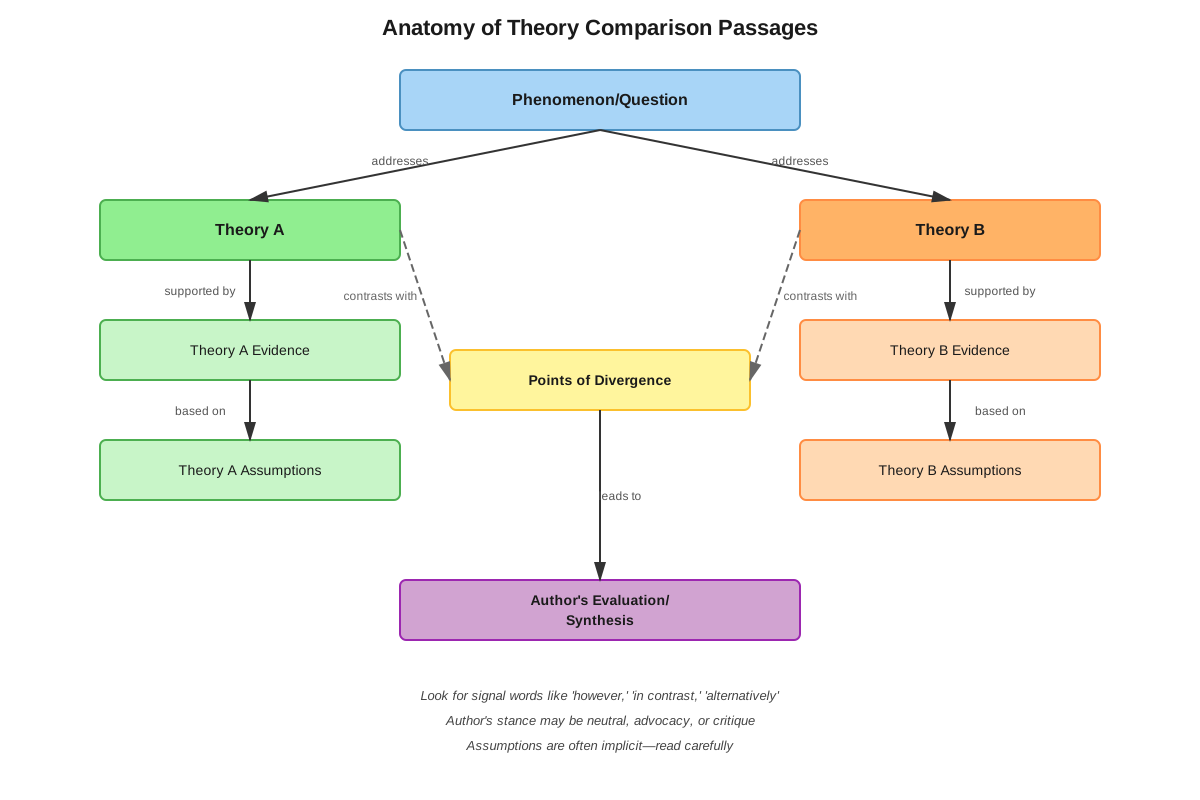
Theory comparison passages follow predictable organizational patterns that students must recognize quickly. The most common structure presents Theory A in the first paragraph or two, then introduces Theory B as an alternative or competing explanation. Subsequent paragraphs may present evidence supporting or challenging each theory, discuss their relative merits, or propose synthesis or reconciliation. Less commonly, passages present both theories briefly upfront, then devote the remainder to detailed comparison.
Key structural markers include transitional phrases like "In contrast," "An alternative explanation," "However, some scholars argue," and "A competing theory suggests." These signals indicate shifts between theoretical positions and help students maintain clear mental separation between views. The passage may conclude by advocating for one theory, suggesting both have merit, proposing a synthesis, or leaving the question unresolved while noting what further evidence would help adjudicate between them.
Types of Theoretical Relationships
Theories in LSAT passages relate to each other in several distinct ways, and recognizing these relationships is crucial for answering questions accurately:
| Relationship Type | Description | Example |
|---|---|---|
| Mutually Exclusive | Theories cannot both be true; accepting one requires rejecting the other | Theory A: Language is innate; Theory B: Language is entirely learned |
| Complementary | Theories address different aspects of a phenomenon and can coexist | Theory A explains mechanism; Theory B explains evolutionary origin |
| Nested | One theory is a special case or subset of the other | Theory B is Theory A applied to specific conditions |
| Competing Emphasis | Theories accept similar facts but emphasize different causal factors | Both acknowledge multiple factors but disagree on which is primary |
| Methodological Alternatives | Theories differ in approach or framework rather than specific claims | Quantitative vs. qualitative research paradigms |
Understanding which relationship type applies helps students predict what questions will ask and what distinctions matter most. Mutually exclusive theories generate questions about which evidence supports which theory. Complementary theories generate questions about scope and domain of application.
Core Components of Each Theory
When analyzing theory comparison passages, students must extract and track several key elements for each theory:
- Central claim or thesis: What is the theory's main explanatory proposition?
- Supporting evidence: What observations, data, or arguments support this theory?
- Underlying assumptions: What must be true for this theory to work?
- Predictions or implications: What would we expect to observe if this theory is correct?
- Acknowledged limitations: What does the theory not explain or where does it face challenges?
- Proponents: Who advocates for this theory (if specified)?
Systematically identifying these components for each theory creates a mental framework for answering questions. Many wrong answer choices on the LSAT misattribute evidence from Theory A to Theory B, or claim Theory A makes predictions that actually belong to Theory B. Maintaining clear separation prevents these errors.
Points of Comparison
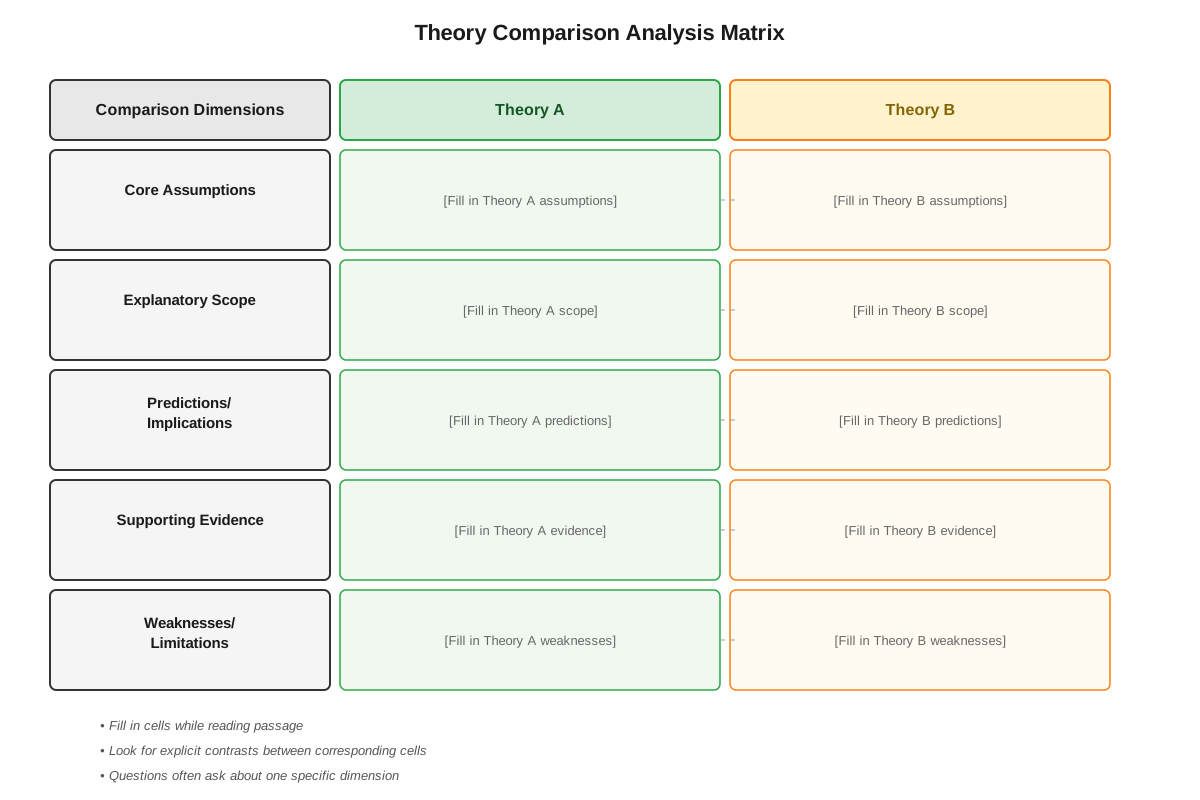
The passage itself typically highlights specific dimensions along which theories differ. These points of comparison become the focus of many questions. Common comparison dimensions include:
- Causal mechanisms: How does each theory explain why the phenomenon occurs?
- Scope: What range of phenomena does each theory claim to explain?
- Testability: Can the theory's predictions be empirically verified?
- Parsimony: Which theory requires fewer assumptions or is simpler?
- Explanatory power: Which theory accounts for more observed facts?
- Historical development: How did each theory emerge and evolve?
Effective readers actively identify these comparison points while reading, often mentally creating a comparison chart. This active processing dramatically improves retention and question-answering accuracy.
Author's Stance
A critical but often overlooked element is determining the author's stance toward the competing theories. The author might:
- Present both theories neutrally without advocating for either
- Favor one theory while acknowledging the other's contributions
- Critique both theories and suggest neither is adequate
- Propose a synthesis or middle position
- Present theories historically without evaluating their current validity
The author's stance determines correct answers to main point questions and influences inference questions. Phrases like "more persuasive," "fails to account for," "compelling evidence," and "remains controversial" signal the author's evaluative position.
Evidence Evaluation
Theory comparison passages frequently discuss how evidence relates to competing theories. Students must understand several evidence patterns:
- Differential support: Evidence that supports Theory A but not Theory B (or vice versa)
- Ambiguous evidence: Observations consistent with both theories
- Disconfirming evidence: Data that challenges or contradicts a theory's predictions
- Crucial experiments: Tests that could definitively distinguish between theories
- Reinterpretation: How proponents of one theory explain evidence initially thought to support the competing theory
Questions often ask which new piece of evidence would strengthen or weaken a particular theory, requiring students to understand each theory's logical structure and predictions.
Concept Relationships
The concepts within theory comparison form an interconnected analytical framework. The structure of theory comparison passages provides the organizational scaffold within which students identify types of theoretical relationships. Understanding the relationship type (mutually exclusive vs. complementary, for instance) determines which core components of each theory matter most for comparison. These components are then evaluated along specific points of comparison that the passage emphasizes.
The author's stance influences how all other elements should be interpreted—a passage favoring Theory A will present evidence differently than a neutral presentation. Finally, evidence evaluation applies the logical structure of each theory to determine what observations would support, challenge, or distinguish between positions.
This topic connects to prerequisite knowledge of basic argument structure by treating each theory as a complete argument requiring analysis. It extends that foundation by demanding simultaneous analysis of multiple arguments and their interrelationships. Theory comparison also connects forward to more advanced reading comprehension skills like evaluating complex argumentative strategies and synthesizing information across multiple sources—skills tested in comparative reading passages.
The reasoning pattern flows: Identify structure → Determine relationship type → Extract core components → Compare along key dimensions → Assess author's stance → Evaluate evidence → Answer questions with precision.
High-Yield Facts
⭐ Theory comparison passages typically present 2-3 competing theories, with two being most common; passages with three theories usually present one as a synthesis or middle position.
⭐ The most frequently tested question types for theory comparison passages are: main point (asking about the passage's overall purpose), inference (requiring synthesis across theories), and detail (asking what specific theory claims).
⭐ Wrong answers frequently misattribute evidence or claims from one theory to another; maintaining clear mental separation between theories prevents this error pattern.
⭐ Transitional phrases like "In contrast," "Alternatively," "However," and "By comparison" signal shifts between theories and are crucial for tracking passage structure.
⭐ Author's stance questions are answerable only by attending to evaluative language (e.g., "more compelling," "fails to explain," "persuasive evidence") rather than just the content of theories themselves.
- Approximately 15-20% of LSAT reading comprehension passages involve explicit theory comparison, making this a high-frequency pattern.
- Theory comparison passages appear across all content domains: natural sciences, social sciences, humanities, and law.
- The passage typically devotes roughly equal space to each theory unless the author explicitly favors one position.
- Questions asking "which of the following would strengthen Theory A" require understanding Theory A's logical structure and predictions, not just memorizing what the passage stated.
- Many theory comparison passages conclude by noting what additional evidence or research would help adjudicate between theories—this information often appears in questions.
- Theories may agree on observations but disagree on interpretation or causal explanation; recognizing this distinction is crucial.
- The phrase "proponents of Theory A would likely respond to this criticism by..." signals that students must infer beyond explicitly stated content based on the theory's logical commitments.
Quick check — test yourself on Theory comparison so far.
Try Flashcards →Common Misconceptions
Misconception: Theory comparison passages always favor one theory over the other. → Correction: Many passages present theories neutrally, describing competing positions without advocating for either. Students must read carefully for evaluative language rather than assuming the author takes a position.
Misconception: If two theories are discussed, they must be mutually exclusive. → Correction: Theories can be complementary, addressing different aspects of a phenomenon, or one can be a special case of the other. The relationship type must be determined from passage content, not assumed.
Misconception: The theory presented first is the one the author favors. → Correction: Passage organization does not indicate author preference. A passage might present the traditional view first, then advocate for a newer alternative, or vice versa. Only evaluative language reveals author stance.
Misconception: All evidence mentioned in the passage supports one of the theories discussed. → Correction: Passages often present evidence that challenges theories, remains ambiguous, or is reinterpreted differently by competing theories. Students must track how evidence relates to each theory specifically.
Misconception: Understanding the technical details of each theory is most important. → Correction: While understanding core claims matters, the LSAT primarily tests understanding of relationships between theories—how they differ, what evidence distinguishes them, and what their relative strengths and weaknesses are. Comparative analysis matters more than exhaustive detail.
Misconception: Questions about theory comparison passages only ask about the theories themselves. → Correction: Questions also ask about passage structure, author's purpose, the role of specific paragraphs, and how new information would affect the theoretical debate. Comprehensive passage understanding is required.
Misconception: If a theory has limitations or faces criticism in the passage, it must be the theory the author rejects. → Correction: Sophisticated passages often acknowledge that even preferred theories face challenges, or that competing theories each have both strengths and weaknesses. Acknowledging limitations doesn't necessarily indicate rejection.
Worked Examples
Example 1: Scientific Theory Comparison
Passage Summary: A passage discusses two theories explaining why certain bird species migrate thousands of miles annually. Theory A (genetic programming) argues that migration routes and timing are encoded genetically through evolutionary selection, with birds following innate instructions. Theory B (learned behavior) contends that migration patterns are culturally transmitted, with young birds learning routes by following experienced adults. The passage notes that Theory A better explains how birds navigate to specific locations they've never visited, while Theory B better explains observed variations in routes over time and rapid adaptation to environmental changes. The author concludes that both mechanisms likely operate, with genetic programming providing general directional tendencies and social learning refining specific routes.
Question: According to the passage, which of the following observations would most strengthen Theory B relative to Theory A?
Answer Choices:
(A) Birds raised in isolation still attempt to migrate in the appropriate direction and season
(B) Migration routes have shifted significantly over just three generations in response to climate change
(C) Genetic analysis reveals specific genes associated with migratory behavior
(D) Birds from different populations have distinct migration patterns
(E) Young birds that become separated from flocks often fail to reach traditional destinations
Analysis:
Step 1: Identify what Theory B claims. Theory B argues migration is learned behavior, culturally transmitted through social learning.
Step 2: Determine what would strengthen Theory B relative to Theory A. We need evidence that supports learned behavior and/or challenges genetic programming.
Step 3: Evaluate each choice:
(A) Strengthens Theory A: If isolated birds (with no opportunity to learn) still migrate appropriately, this supports genetic programming, not learned behavior. Eliminate.
(B) Strengthens Theory B: Rapid change over three generations suggests flexibility and learning rather than slow genetic evolution. The passage explicitly states Theory B better explains "rapid adaptation to environmental changes." This is promising.
(C) Strengthens Theory A: Genetic evidence directly supports genetic programming theory. Eliminate.
(D) Neutral or supports both: Different populations could have different genes (Theory A) or different cultural traditions (Theory B). This doesn't distinguish between theories.
(E) Strengthens Theory B: If separated young birds fail to reach destinations, this suggests they need to learn routes from experienced birds rather than following genetic instructions. This is also promising.
Step 4: Compare (B) and (E). Both support Theory B, but which does so relative to Theory A? Choice (B) emphasizes rapid change that genetic evolution cannot easily explain—this challenges Theory A while supporting Theory B. Choice (E) shows learning is important but doesn't necessarily challenge genetic programming (perhaps both are needed). The passage states Theory B better explains "rapid adaptation," making (B) the stronger answer.
Correct Answer: (B)
Connection to Learning Objectives: This example demonstrates identifying how theory comparison appears in questions (comparative strengthening), explaining the reasoning pattern (evidence that supports one theory while challenging another is most valuable), and applying this understanding to select the correct answer.
Example 2: Legal Theory Comparison
Passage Summary: A passage compares two approaches to constitutional interpretation: originalism and living constitutionalism. Originalism holds that constitutional provisions should be interpreted according to their meaning at the time of ratification, providing stability and constraining judicial discretion. Living constitutionalism argues the Constitution must be interpreted in light of contemporary values and circumstances, allowing it to remain relevant across changing social conditions. The passage notes originalists criticize living constitutionalism for permitting judges to impose personal preferences, while living constitutionalists argue originalism cannot address modern issues the framers never contemplated. The author presents both views without explicit endorsement but notes that pure versions of either approach face practical difficulties.
Question: The author's attitude toward the two theories of constitutional interpretation can most accurately be described as:
Answer Choices:
(A) Enthusiastic endorsement of originalism as more faithful to constitutional text
(B) Preference for living constitutionalism despite acknowledging its limitations
(C) Neutral presentation of both theories with recognition that each faces challenges
(D) Dismissive rejection of both theories as inadequate for modern jurisprudence
(E) Advocacy for a synthesis that combines elements of both approaches
Analysis:
Step 1: Review the passage for evaluative language indicating author's stance. The passage "presents both views without explicit endorsement" and "notes that pure versions of either approach face practical difficulties."
Step 2: Eliminate choices inconsistent with neutral presentation:
(A) Eliminate: "Enthusiastic endorsement" contradicts neutral presentation.
(B) Eliminate: "Preference for" indicates taking sides, which the passage avoids.
(D) Eliminate: "Dismissive rejection" is too strong; the passage acknowledges both theories have merit.
Step 3: Distinguish between remaining choices (C) and (E):
(C) describes neutral presentation with acknowledgment of challenges—this matches the passage description.
(E) suggests the author advocates for synthesis. While the author notes both face difficulties, there's no explicit advocacy for combining them. The passage describes challenges but doesn't propose solutions.
Step 4: Verify (C) captures the author's stance. "Neutral presentation" matches "presents both views without explicit endorsement." "Recognition that each faces challenges" matches "pure versions of either approach face practical difficulties."
Correct Answer: (C)
Connection to Learning Objectives: This example demonstrates identifying author's stance (a key element of theory comparison), explaining the reasoning pattern (distinguishing neutral presentation from advocacy), and applying careful textual analysis to eliminate wrong answers and select the choice that precisely matches the passage.
Exam Strategy
Approaching Theory Comparison Passages
When encountering a theory comparison passage, implement this systematic approach:
- Identify the passage type quickly (within the first paragraph). Trigger phrases include "competing theories," "alternative explanation," "in contrast," and "different approaches."
- Create a mental or physical comparison chart with columns for each theory. As you read, populate this chart with: main claim, supporting evidence, assumptions, and limitations for each theory.
- Mark transitions between theories. Circle or mentally note phrases like "however," "alternatively," and "by contrast" that signal shifts.
- Identify the author's stance by noting evaluative language. Underline phrases like "more persuasive," "fails to account for," or "compelling evidence."
- Note points of comparison explicitly discussed in the passage. These become the focus of questions.
Trigger Words and Phrases
Watch for these high-yield signals in both passages and questions:
In passages: "competing," "alternative," "in contrast," "however," "different approaches," "one theory suggests," "proponents argue," "critics contend," "by comparison"
In questions: "according to Theory A," "proponents of Theory B would most likely," "which would strengthen," "which would weaken," "both theories agree that," "the theories differ in that," "relative to Theory A"
Process of Elimination Tips
Theory comparison questions generate predictable wrong answer patterns:
- Misattribution errors: Claims or evidence from Theory A attributed to Theory B (or vice versa). Eliminate any choice that confuses which theory makes which claim.
- Overgeneralization: Choices claiming both theories agree on something when they actually differ, or claiming they differ on something they both accept.
- Extreme language: Choices using "always," "never," "only," or "completely" when the passage presents more nuanced positions.
- Opposite answers: For strengthening/weakening questions, choices that do the opposite of what's asked (strengthen when the question asks for weakening).
- Out of scope: Evidence or claims not discussed in the passage, even if they seem logically relevant to the theories.
Time Allocation
Theory comparison passages typically warrant slightly more time than single-viewpoint passages due to their complexity. Allocate approximately:
- 3.5-4 minutes for initial reading (slightly longer than typical passages)
- 5-6 minutes for answering questions (standard allocation)
- Total: 8.5-10 minutes per passage
The additional reading time investment pays dividends by reducing question-answering time. Students who rush through theory comparison passages often must re-read extensively when answering questions, ultimately spending more total time.
Exam Tip: If a question asks what both theories agree on, the correct answer will typically be a basic observation or fact, while the theories differ on interpretation or explanation of that fact. This pattern appears frequently.
Memory Techniques
COMPARE Acronym
Use COMPARE to remember the key elements to track for each theory:
- Claim: What is the theory's central thesis?
- Observations: What evidence supports it?
- Mechanism: How does it explain the phenomenon?
- Proponents: Who advocates for this view?
- Assumptions: What must be true for this theory to work?
- Relationship: How does it relate to competing theories?
- Evaluation: What are its strengths and limitations?
Visualization Strategy
Imagine theories as competing athletes in a race. Each has different strengths (speed, endurance, strategy). The passage is the sports commentary explaining each athlete's approach, past performance, and chances of winning. Evidence is like race checkpoints—some favor one athlete, some favor another. The author is the commentator who might favor one athlete, remain neutral, or note both have strengths. This visualization helps maintain separation between theories while tracking their comparative performance.
The "Two-Column" Mental Model
Visualize a two-column table in your mind as you read:
Theory A          |  Theory B
------------------|------------------
Main claim        |  Main claim
Evidence 1        |  Evidence 1
Evidence 2        |  Evidence 2
Strength          |  Strength
Weakness          |  Weakness
Actively populate this mental table while reading. This structured approach prevents confusion and facilitates quick reference when answering questions.
Author Stance Spectrum
Visualize a spectrum from "Strongly favors Theory A" through "Neutral" to "Strongly favors Theory B." As you read evaluative language, mentally place the author on this spectrum. This prevents the common error of assuming neutrality when the author actually takes a position, or vice versa.
Summary
Theory comparison is a high-frequency, high-value pattern in LSAT reading comprehension that requires students to simultaneously analyze multiple competing explanations, track their similarities and differences, and understand their relative strengths and weaknesses. Success requires systematic identification of each theory's core components (claims, evidence, assumptions, predictions), recognition of the relationship type between theories (mutually exclusive, complementary, nested, etc.), and careful attention to the author's stance toward competing positions. The most effective approach involves creating mental comparison frameworks while reading, marking structural transitions between theories, and noting evaluative language that signals the author's position. Questions test not merely recall of what each theory claims, but deeper understanding of how theories differ, what evidence would strengthen or weaken each position, and what logical implications follow from theoretical commitments. Mastering theory comparison requires practice identifying passage structure quickly, maintaining clear mental separation between competing views, and applying systematic elimination strategies that target common wrong answer patterns like misattribution and overgeneralization.
Key Takeaways
- Theory comparison passages present 2-3 competing explanations and test understanding of their relationships, not just their individual claims
- Systematic tracking of each theory's claims, evidence, assumptions, and limitations prevents confusion and enables accurate question answering
- Author's stance must be determined from evaluative language, not assumed from passage organization or the mere presence of multiple theories
- The most common wrong answers misattribute claims or evidence from one theory to another—maintaining clear separation is essential
- Questions frequently ask what would strengthen or weaken theories, requiring understanding of each theory's logical structure and predictions
- Transitional phrases like "in contrast," "alternatively," and "however" signal structural shifts and must be noted carefully
- Allocating slightly more reading time to theory comparison passages reduces total time by minimizing re-reading during question answering
Related Topics
Comparative Reading Passages: LSAT comparative reading presents two shorter passages on related topics, requiring synthesis and comparison skills that build directly on theory comparison abilities. Mastering theory comparison within single passages prepares students for the added complexity of comparing across separate texts.
Argument Evaluation and Critique: Many theory comparison passages include explicit critiques of each theory's weaknesses. Understanding how to evaluate argument strength, identify assumptions, and recognize logical flaws enhances theory comparison analysis.
Scientific Reasoning: A substantial portion of theory comparison passages involve scientific theories. Familiarity with scientific methodology, hypothesis testing, and evidence evaluation strengthens performance on these passages.
Author's Purpose and Tone: Determining author's stance in theory comparison passages requires sophisticated understanding of purpose and tone. Developing these skills enhances overall reading comprehension performance.
Complex Argumentation Structures: Theory comparison represents one type of complex argumentative structure. Mastering it enables progression to other sophisticated patterns like dialectical reasoning and multi-layered arguments.
Practice CTA
Now that you've mastered the conceptual framework for theory comparison, it's time to apply these skills to actual LSAT passages and questions. The practice questions and flashcards will reinforce your ability to quickly identify theory comparison patterns, systematically analyze competing positions, and accurately answer questions under timed conditions. Remember: theory comparison appears in 15-20% of reading comprehension passages, making this one of the highest-yield skills you can develop. Each practice passage you complete strengthens your pattern recognition and builds the automaticity needed for test-day success. Approach practice deliberately, applying the COMPARE framework and systematic elimination strategies you've learned. Your investment in mastering this topic will pay dividends across multiple passages on test day!
Sign up free to keep reading
Create a free AnvayaPrep account to finish this LSAT guide on Theory comparison — plus flashcards and practice questions.